
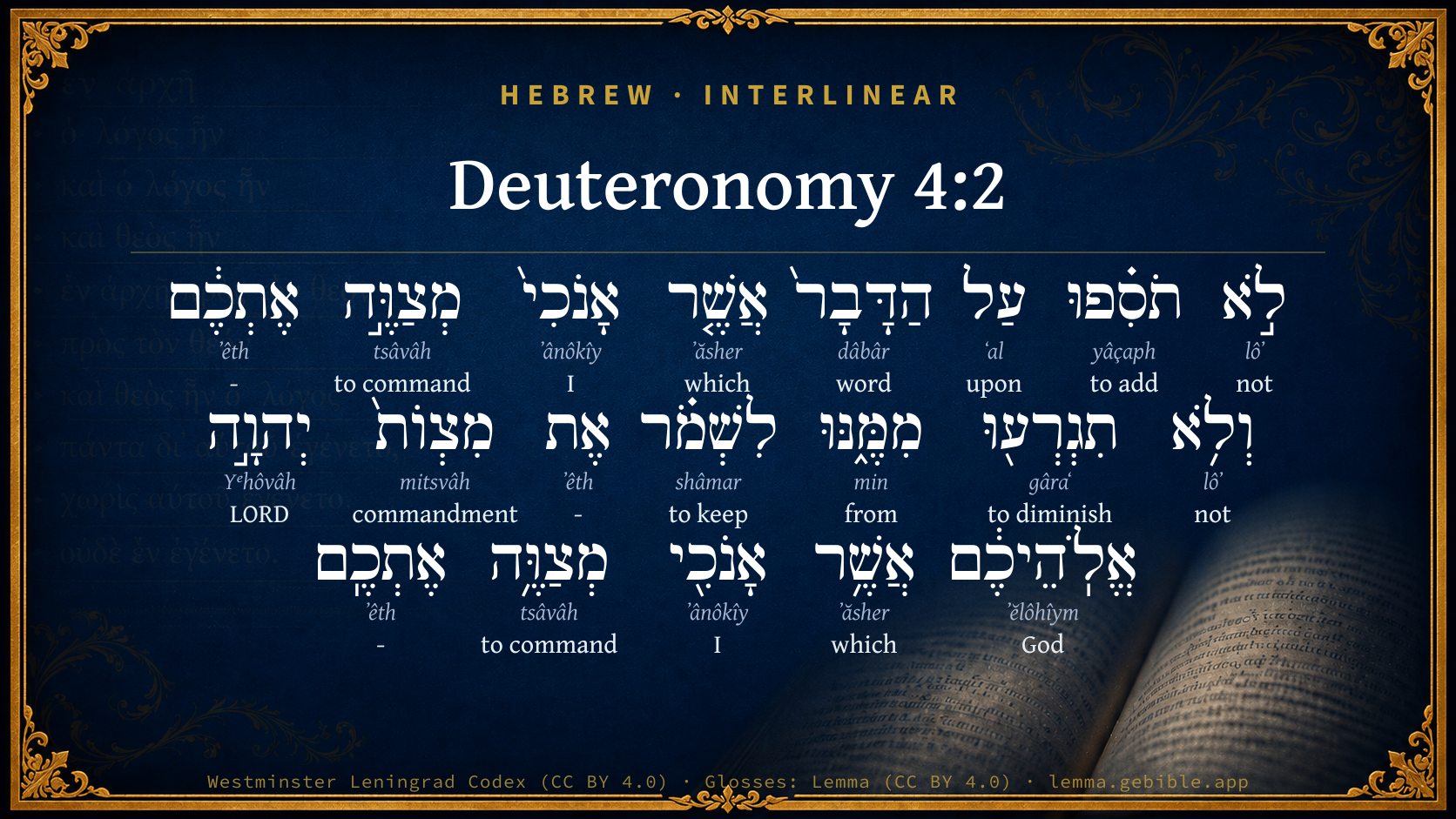
Deuteronomy 4:2

Hebrew (Westminster Leningrad Codex) Deuteronomy 4:2 appears in the Hebrew Old Testament. The text above is from the Westminster Leningrad Codex. Each word links to its Strong’s number, a concise gloss, and parsing drawn from the Open Scriptures Hebrew Bible morphology. Click any word for its full Brown-Driver-Briggs (BDB) entry.
Download image
Cite this verse

Deuteronomy 4:2 (World English Bible). Public Domain. Lemma interlinear Bible study tool, https://lemma.gebible.app/v/deuteronomy/4/2.

Show BibTeX & RIS
BibTeX
RIS
English Translation
You shall not add to the word which I command you, neither shall you diminish from it, that you may keep the commandments of Yahweh your God which I command you.
World English Bible · Public Domain
Download a study sheet

One document with this verse’s original text, its word-by-word gloss line, the meaning frame, cross-references with their text, attributed commentary, and full source and license credits — printable, and it pastes into notes with its structure intact.

This verse Autodidact and up

Study sheet (.html) Plain text (.txt)

A passage Seminary Student

Up to 50 verses in one chapter. A passage sheet keeps up to 6 commentary sources and 12 cross-references per verse, in the order this page ranks them, and says so on the sheet whenever that leaves anything out. Ask for a single verse and you get the Autodidact verse sheet above.

Everything on this page stays free to read, with no account — the sheet is a download of what is already on screen, not access to it.

Want to remove ads? Support Godless Engineer
Compare translations 3

The same verse in 3 English versions, stacked beneath the original-language interlinear above. Click any original word for its lexicon entry.

Each is an independent rendering of the whole verse — the interlinear is not word-aligned to these translations.

Highlighted words mark where these versions differ — a whole-verse word diff, not a word-by-word alignment.

  • World English Bible Public Domain
    You shall not add to the word which I command you, neither shall you diminish from it, that you may keep the commandments of Yahweh your God which I command you.
  • King James Version Public Domain
    Ye shall not add unto the word which I command you, neither shall ye diminish ought from it, that ye may keep the commandments of the LORD your God which I command you.
  • unfoldingWord Literal Text CC BY-SA 4.0
    Do not add onto the word that I command you, and do not take from them, keeping the commandments of Yahweh your God that I am commanding you.

unfoldingWord Literal Text — © unfoldingWord, licensed CC BY-SA 4.0. Word-aligned USFM3 via Door43 (git.door43.org/unfoldingWord/en_ult).

Versions to compare (up to 4)

3 of 4 selected

Show all 18 translations

Every available English version of this verse, each an independent rendering of the whole verse.

  • World English Bible Public Domain
    You shall not add to the word which I command you, neither shall you diminish from it, that you may keep the commandments of Yahweh your God which I command you.
  • Berean Standard Bible Public Domain
    You must not add to or subtract from what I command you, so that you may keep the commandments of the LORD your God that I am giving you.
  • Majority Standard Bible Public Domain
    You must not add to or subtract from what I command you, so that you may keep the commandments of the LORD your God that I am giving you.
  • King James Version Public Domain
    Ye shall not add unto the word which I command you, neither shall ye diminish ought from it, that ye may keep the commandments of the LORD your God which I command you.
  • American Standard Version (1901) Public Domain
    Ye shall not add unto the word which I command you, neither shall ye diminish from it, that ye may keep the commandments of Jehovah your God which I command you.
  • Revised Version (1885) Public Domain
    Ye shall not add unto the word which I command you, neither shall ye diminish from it, that ye may keep the commandments of the LORD your God which I command you.
  • Geneva Bible (1599) Public Domain
    Ye shall put nothing vnto the word which I command you, neither shall ye take ought there from, that ye may keepe the commandements of the Lord your God which I commande you.
  • Douay-Rheims (1899) Public Domain
    You shall not add to the word that I speak to you, neither shall you take away from it: keep the commandments of the Lord your God which I command you.
  • Young's Literal Translation Public Domain
    Ye do not add to the word which I am commanding you, nor diminish from it, to keep the commands of Jehovah your God which I am commanding you.
  • Literal Standard Version CC BY-SA 4.0
    You do not add to the word which I am commanding you, nor diminish from it, to keep the commands of your God YHWH which I am commanding you.
  • Unlocked Literal Bible CC BY-SA 4.0
    You will not add to the words that I command you, neither will you diminish them, so that you may keep the commandments of Yahweh your God that I am about to command you.
  • unfoldingWord Literal Text CC BY-SA 4.0
    Do not add onto the word that I command you, and do not take from them, keeping the commandments of Yahweh your God that I am commanding you.
  • Darby Bible Public Domain
    Ye shall not add to the word which I command you, neither shall ye take from it, that ye may keep the commandments of Jehovah your God which I command you.
  • World Messianic Bible Public Domain
    You shall not add to the word which I command you, neither shall you take away from it, that you may keep the commandments of the LORD your God which I command you.
  • Webster's Bible Public Domain
    Ye shall not add to the word which I command you, neither shall ye diminish aught from it, that ye may keep the commandments of the LORD your God which I command you.
  • Free Bible Version CC BY-SA 4.0
    You are not to add to or take away from what I'm telling you, so that you can keep the commandments of the Lord your God that I'm ordering you to follow.
  • Bible in Basic English Public Domain
    Make no addition to the orders which I give you, and take nothing from them, but keep the orders of the Lord your God which I give you.
  • JPS Tanakh (1917) Public Domain
    Ye shall not add unto the word which I command you, neither shall ye diminish from it, that ye may keep the commandments of the LORD your God which I command you.

Literal Standard Version (2020), Covenant Press — licensed CC BY-SA 4.0. Text via the HelloAO Bible API (eBible.org). Unlocked Literal Bible (unfoldingWord) — licensed CC BY-SA 4.0. Text via the HelloAO Bible API (eBible.org). unfoldingWord Literal Text — © unfoldingWord, licensed CC BY-SA 4.0. Word-aligned USFM3 via Door43 (git.door43.org/unfoldingWord/en_ult). Free Bible Version, Dr. Jonathan Gallagher — licensed CC BY-SA 4.0. Text via the HelloAO Bible API (eBible.org).

Word by word

More ways to search: Search by grammar → Find every occurrence → Compare this word →

Practice this passage: Drill this verse → Learn its vocabulary →

תִגְרְע֖וּ
gâraʻ
H1639
“to diminish”
Verb, Qal, Imperfect, 2nd Person, Masculine, Plural
Part of Speech
Verb
Stem
Qal
Form
Imperfect
Person
2nd Person
Gender
Masculine
Number
Plural
Full BDB Definition

Origin: a primitive root

TWOT: 384

to diminish, restrain, withdraw, abate, keep back, do away, take from, clip - (Qal) - to diminish - to restrain - to withdraw - (Niphal) - to be withdrawn - to be restrained - (Piel) to withdraw, draw up
  1. לֹ֣א lôʼ H3808 “not” Particle, Negative
  2. תֹסִ֗פוּ yâçaph H3254 “to add” Verb, Hiphil, Imperfect, 2nd Person, Masculine, Plural
  3. עַל ʻal H5921 “upon” Preposition
  4. הַדָּבָר֙ dâbâr H1697 “the · word” Particle, Definite Article + Noun, Common, Masculine, Singular, Absolute
  5. אֲשֶׁ֤ר ʼăsher H834 “which” Particle, Relative
  6. אָנֹכִי֙ ʼânôkîy H595 “I” Pronoun, Personal, 1st Person, Common, Singular
  7. מְצַוֶּ֣ה tsâvâh H6680 “commanding” Verb, Piel, Participle Active, Masculine, Singular, Absolute
  8. אֶתְכֶ֔ם ʼêth H853 “- · you” Particle, Direct Object + Suffix, Personal, 2nd Person, Masculine, Plural
  9. וְלֹ֥א lôʼ H3808 “and · not” Conjunction + Particle, Negative
  10. מִמֶּ֑נּוּ min H4480 “from · us” Preposition + Suffix, Personal, 1st Person, Common, Plural
  11. לִשְׁמֹ֗ר shâmar H8104 “to keep” Preposition + Verb, Qal, Infinitive Construct
  12. אֶת ʼêth H853 “-” Particle, Direct Object
  13. מִצְוֺת֙ mitsvâh H4687 “commandments of” Noun, Common, Feminine, Plural, Construct
  14. יְהוָ֣ה Yᵉhôvâh H3068 “LORD” Noun, Proper
  15. אֱלֹֽהֵיכֶ֔ם ʼĕlôhîym H430 “God(s) · your” Noun, Common, Masculine, Plural, Construct + Suffix, Personal, 2nd Person, Masculine, Plural
  16. אֲשֶׁ֥ר ʼăsher H834 “which” Particle, Relative
  17. אָנֹכִ֖י ʼânôkîy H595 “I” Pronoun, Personal, 1st Person, Common, Singular
  18. מְצַוֶּ֥ה tsâvâh H6680 “commanding” Verb, Piel, Participle Active, Masculine, Singular, Absolute
  19. אֶתְכֶֽם ʼêth H853 “- · you” Particle, Direct Object + Suffix, Personal, 2nd Person, Masculine, Plural

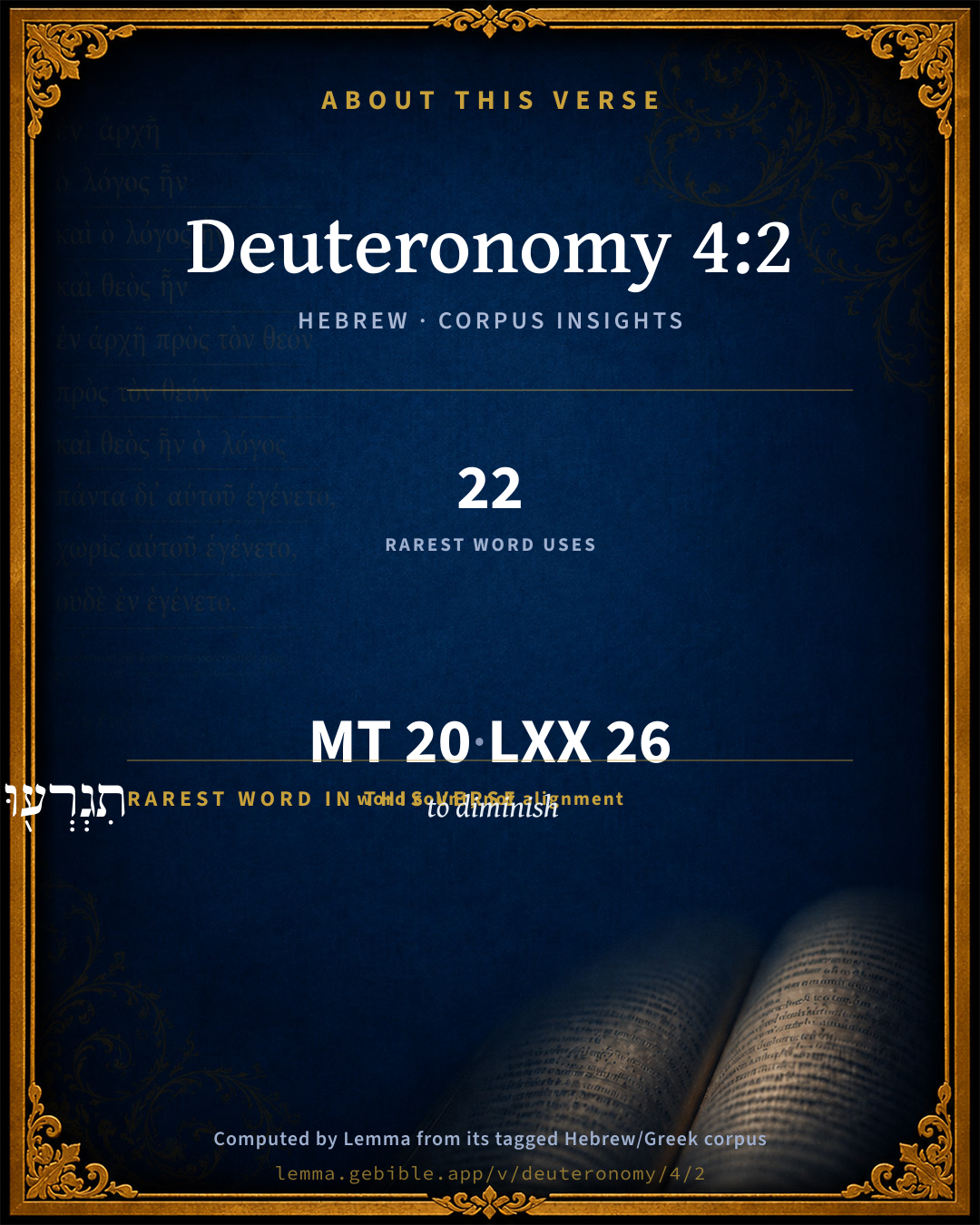
About this verse

These counts appear in no published source. They are computed here, from the morphology-tagged text and Lemma’s own curated glosses. What Lemma adds →

20
words
14
distinct lemmas
Pentateuch
section

Notable vocabulary

The rarest word here is תִגְרְע֖וּ to diminish H1639 — appearing just 22 times in the whole Hebrew Bible.

Shared distinctive vocabulary

תִגְרְע֖וּ to diminish H1639 occurs in 21 verses of the Hebrew Bible. Also found in:

Grammatical profile

  • 5 verbs
  • 4 nouns
  • 2 pronouns
  • 2 prepositions
  • 7 particles

Verb forms

  • תֹסִ֗פוּ Hiphil · Imperfect
  • מְצַוֶּ֣ה Piel · Participle Active
  • תִגְרְע֖וּ Qal · Imperfect
  • לִשְׁמֹ֗ר Qal · Infinitive Construct
  • מְצַוֶּ֥ה Piel · Participle Active

Repetition

Words recur within this verse — often emphatic in Hebrew:

  • מְצַוֶּ֣ה to command H6680 ×2
  • לֹ֣א not H3808 ×2
  • אֲשֶׁ֤ר which H834 ×2
  • אָנֹכִי֙ I H595 ×2

Hebrew & Septuagint length

In English translation the verse runs 31 words from the Hebrew and 33 from the Septuagint (LXX English) — closely comparable.

A rough comparison of the two English renderings, which tokenize alike — not a word-level alignment.

Word counts can differ between the Hebrew and the Greek without any difference in meaning — e.g. the Hebrew direct-object marker אֵת has no separate Greek word, and Greek often adds the article ὁ.

In the original languages it is 20 Hebrew tokens and 26 Greek tokens — but the two are counted differently (Hebrew bundles its prefixes and suffixes into one token; the Greek is in lemma form), so that isn’t a like-for-like length.

Cross-references

10

Topical passages linked to Deuteronomy 4:2 in the Treasury of Scripture Knowledge — connected by theme and wording, ordered by reader-vote popularity; previews shown in the World English Bible.

  • Deuteronomy 12:32 Whatever thing I command you, that shall you observe to do: you shall not add thereto, nor diminish from it.
  • Proverbs 30:6 Don't you add to his words, Lest he reprove you, and you be found a liar.
  • Revelation 22:18–19 I testify to everyone who hears the words of the prophecy of this book, if anyone adds to them, may God add to him the plagues which are written in this book.
  • Joshua 1:7 Only be strong and very courageous, to observe to do according to all the law, which Moses my servant commanded you: don't turn from it to the right hand or to the left, that you may have good success wherever you go.
  • Matthew 5:18 For most assuredly, I tell you, until heaven and earth pass away, not even one smallest letter or one tiny pen stroke shall in any way pass away from the law, until all things are accomplished.
  • Galatians 3:15 Brothers, I speak like men. Though it is only a man's covenant, yet when it has been confirmed, no one makes it void, or adds to it.
  • Ecclesiastes 12:13 This is the end of the matter. All has been heard. Fear God, and keep his commandments; for this is the whole duty of man.
  • Mark 7:1–13 Then the Pharisees, and some of the scribes gathered together to him, having come from Jerusalem.
  • Matthew 15:2–9 "Why do your disciples disobey the tradition of the elders? For they don't wash their hands when they eat bread."
  • Matthew 5:43 "You have heard that it was said, 'You shall love your neighbor, and hate your enemy.'

Cross-references courtesy of OpenBible.info (CC BY 4.0).

Hebrew and Greek witnesses Masoretic Hebrew ↔ Greek Septuagint

The same verse in the two great witnesses to the Old Testament, shown verse-for-verse.

These are two independent witnesses, not word-aligned to each other, and the Septuagint is shown in lemma (dictionary) form.

Hebrew Deuteronomy 4:2 Masoretic · Westminster Leningrad Codex

לֹ֣א תֹסִ֗פוּ עַל הַדָּבָר֙ אֲשֶׁ֤ר אָנֹכִי֙ מְצַוֶּ֣ה אֶתְכֶ֔ם וְלֹ֥א תִגְרְע֖וּ מִמֶּ֑נּוּ לִשְׁמֹ֗ר אֶת מִצְוֺת֙ יְהוָ֣ה אֱלֹֽהֵיכֶ֔ם אֲשֶׁ֥ר אָנֹכִ֖י מְצַוֶּ֥ה אֶתְכֶֽם

You shall not add to the word which I command you, neither shall you diminish from it, that you may keep the commandments of Yahweh your God which I command you.

World English Bible · Public Domain

Greek LXX Deuteronomy 4:2 Septuagint · lemma form

οὐ προςτίθημι πρός ὁ ῥῆμα ὅς ἐγώ ἐντέλλομαι σύ καί οὐ ἀποαἱρέω ἀπό αὐτός φυλάσσω ὁ ἐντολή κύριος ὁ θεός σύ ὅσος ἐγώ ἐντέλλομαι σύ σήμερον

You⌃ shall not add to the word which I command you, and you⌃ shall not take from it: keep the commandments of the Lord our God, all that I command you this day.

LXX2012 (modern English Septuagint) · Public Domain

Hebrew: Westminster Leningrad Codex (CC BY 4.0). Greek: Septuagint (public domain); English from LXX2012 (modern English Septuagint) (Public Domain). How the Septuagint differs from the Hebrew →

Targum (Aramaic paraphrase)

2

The Targum is the ancient Jewish Aramaic paraphrase of the Hebrew Scriptures — an interpretive translation, not the Hebrew text itself. Onkelos (literal) and Pseudo-Jonathan (expansive) render the Torah, and Jonathan the Prophets. Coverage is partial: where no permissively-licensed English translation exists for a verse, only the Aramaic is shown. This is verse-level text, not a word-by-word alignment to the Hebrew.

  1. Targum Onkelos Torah (Genesis–Deuteronomy)
    לָא תוֹסְפוּן עַל פִּתְגָמָא דִי אֲנָא מְפַקֵד יָתְכוֹן וְלָא תִמְנְעוּן מִנֵהּ לְמִטַר יָת פִּקוּדַיָא דַיְיָ אֱלָהֲכוֹן דִי אֲנָא מְפַקֵד יָתְכוֹן

    (no public-domain English translation for this verse)

    Targum Onkelos — Aramaic: “Onkelos Genesis” (public domain); “Onkelos Exodus” (public domain); “Onkelos Leviticus” (public domain); “Onkelos Numbers” (public domain); “Onkelos Deuteronomy” (public domain). English: “Sefaria Community Translation” (CC0 1.0 (public-domain dedication)); “J.W. Etheridge. The Targums of Onkelos and Jonathan Ben Uzziel on the Pentateuch. London: Longmans, Green, 1862” (public domain). Text via Sefaria.

  2. Targum Pseudo-Jonathan Torah (Genesis–Deuteronomy)
    לֵיתְכוֹן רַשָּׁאִין לְמוֹסָפָא עַל פִּתְגָמַיָא דַאֲנָא מְפַקֵּיד יַתְכוֹן וְלָא תְבַצְרוּן מִינֵיהּ מִן לָא לְמִנְטוֹר יַת פִּקּוּדַיָא דַיְיָ אֱלָהָכוֹן דַּאֲנָא מְפַקֵּיד יַתְכוֹן

    Ye shall not add to the words that I teach you nor diminish them, but keep the commandments of the Lord your God which I command you.

    Targum Pseudo-Jonathan — Aramaic: “Targum Jonathan on Genesis” (public domain); “Targum Jonathan on Exodus” (public domain); “Targum Jonathan on Leviticus” (public domain); “Targum Jonathan on Numbers” (public domain); “Targum Jonathan on Deuteronomy” (public domain). English: “The Targum of Jonathan ben Uzziel, trans. J. W. Etheridge, London, 1862” (public domain). Text via Sefaria.

Commentary

Notes on Deuteronomy 4:2 from classic Christian and Jewish commentators (each source and its license shown beneath its notes). The classic Christian expositions comment on the surrounding passage and are grouped to its opening verse, so a note may address several verses; the Jewish commentaries on the Tanakh (Rashi and others) are per-verse, so they appear only where the commentator wrote on this verse.

Lemma curates 59 commentaries, every one of them public domain or Creative Commons licensed, each selected and text-cleaned for this edition rather than reprinted as found. About our sources →

Trapp's Complete Commentary

John Trapp

Deu 4:2 Ye shall not add unto the word which I command you, neither shall ye diminish [ought] from it, that ye may keep the commandments of the LORD your God which I command you.

Ver. 2. Ye shall not add.] The Jews have added their deuteroseis; the Turks their alfurta; the Papists their unwritten verities, which they equalise, at least, to the Holy Scriptures; and so argue them of insufficiency and imperfection. {a}

{a} Oι σοφοι ημων δευτερωσι, Our wise men teach tradition See 1Co 1:20.

John Trapp, A Commentary or Exposition upon All the Books of the Old and New Testament (1647–1656) — public domain. Text from a community e-Sword module.

Joseph Benson's Commentary

Deu 4:2. Ye shall not add unto the word which I command you — By desiring other doctrines, or ways of worship, than what I have taught or prescribed. For this were to accuse me of want of wisdom, or care, or faithfulness, in not giving you sufficient instructions for God’s service. Neither shall ye diminish aught from it — By rejecting or neglecting any thing which I have commanded, though it seem ever so small; but take my word, as it is, for your sole rule and guide in things temporal and eternal.

Joseph Benson's Commentary on the Old and New Testaments (1811–1818) — public domain. Text from a community e-Sword module.

Geneva Bible (1599)

Geneva Bible translators

Think not to be more wise than I am.

God will not be served by halves, but will have full obedience.

Geneva Bible (1599) marginal notes — public domain. Text via Bolls.life.

Jamieson, Fausset & Brown

Robert Jamieson, A. R. Fausset & David Brown

Ye shall not add unto the word which I command you--by the introduction of any heathen superstition or forms of worship different from those which I have appointed (Deu 12:32; Num 15:39; Mat 15:9).

neither shall ye diminish aught from it--by the neglect or omission of any of the observances, however trivial or irksome, which I have prescribed. The character and provisions of the ancient dispensation were adapted with divine wisdom to the instruction of that infant state of the church. But it was only a temporary economy; and although God here authorizes Moses to command that all its institutions should be honored with unfailing observance, this did not prevent Him from commissioning other prophets to alter or abrogate them when the end of that dispensation was attained.

Jamieson, Fausset & Brown — Commentary Critical and Explanatory on the Whole Bible (1871) — public domain (CC PDM 1.0). Text via the HelloAO Bible API.

Adam Clarke's Commentary

Verse 2. Ye shall not add] Any book, chapter, verse or word, which I have not spoken; nor give any comment that has any tendency to corrupt, weaken, or destroy any part of this revelation.

Neither shall ye diminish] Ye shall not only not take away any larger portion of this word, but ye shall not take one jot or tittle from the LAW; it is that word of God that abideth for ever.

Adam Clarke's Commentary on the Bible (1810–1826) — public domain. Text from a community e-Sword/MySword module.

Ellicott's Commentary for English Readers

(2) Ye shall not add unto the word.—The word, not “the words.” The word is the substance of the Law. The words in which it is expressed may be more or less. The law of Moses contains in it the germ of all revelation to the very end.

A Bible Commentary for English Readers, edited by Charles John Ellicott (1878–1897) — public domain. Text from a community e-Sword module.

The Cambridge Bible for Schools and Colleges

gen. ed. J. J. S. Perowne

2. Ye shall not add unto the word … neither … diminish from it] So Deu_12:32 [Heb_13:1], cp. Jer_26:2, Rev_22:18 f. That the Law was tampered with in Josiah’s day is implied in Jer_8:8, the false pen of the scribes has wrought falsehood. Our verse and Deu_12:32 have been interpreted as if the deuteronomic law gave itself forth as the full, final letter of the Divine Revelation. This is not so: cp. its promise of a new prophet like to Moses, Deu_18:15 ff.

which I command you] Again the participle, am about to command. Sam. and Luc. add this day.

The Cambridge Bible for Schools and Colleges (gen. ed. J. J. S. Perowne; Cambridge University Press, 1878–1918) — public domain. Text from a community e-Sword module.

John Gill's Exposition

Ye shall not add to the word which I command you, nether shall you diminish ought from it,.... Neither make new laws of their own, and join them to the law of God, and set them upon a level with it, or prefer them before it; as the Scribes and Pharisees did in Christ's time, who by their traditions made the word of God of none effect, as do the Papists also by their unwritten traditions; nor abrogate nor detract from the law of God, nor make void any part of it: or else the sense is, neither do that which is forbidden, nor neglect that which is commanded; neither be guilty of sins of omission nor commission, nor in any way break the law of God, and teach men so to do by word or by example; not a jot or tittle is either to be put to it, or taken from it, Pro 30:5.

that ye may keep the commandments of the Lord your God, which I command you; in his name; or which he delivered unto them as his commandments, and which were to be kept just as they were delivered, without adding to them, or taking from them.

John Gill's Exposition of the Whole Bible (1746–1763) — public domain (CC PDM 1.0). Text via the HelloAO Bible API.

Haydock's Catholic Bible Commentary

Add any thing repugnant to the spirit of my law. No interpretation of this kind can be admitted. But this does not condemn well authorized traditions, and laws enacted by lawful superiors. The Jews always boast of their close adherence to the letter of the law, but they often forget the spirit of it, and by their traditions render it deformed, like a carcass. Demosthenes takes notice, that the Locrians had such a regard for their laws, that if any one chose to propose any fresh ones, he came with a rope about his neck, that if they did not meet with the approbation of the people, he might be strangled immediately. (Calmet) --- Moses cannot mean to forbid any more divine or civil commandments being written by Josue and the subsequent prophets. He only enjoins that nothing shall be altered by human authority. The other books of the Old Testament serve to explain the law; and so do the apostolical traditions (Worthington) afford great assistance to understand the true meaning of all the Scriptures, and hence we learn whatever we have to perform, without danger of being led astray. (Haydock) --- To these the Scriptures frequently refer. He that heareth you, heareth me, Luke x. Hold the traditions which you have learnt, 2 Thessalonians ii. The rest I will set in order, when I come, 1 Corinthians xi. 34. Hence St. Augustine (contra Cresc. i. 33) observes, "Though no evident example can be produced from Scripture, yet we hold the truth of the same Scripture, when we do what meets with the approbation of that Church whose authority the Scripture establishes." See ep. 80, St. Chrysostom in 1 Thess. iv.; St. Irenæus, Against Heresies iii. 4. (Worthington) --- The Jews themselves never had the folly to imagine with the modern innovators, that all laws both of a religous or civil nature were here proscribed. Under David, Mardocheus, and the Machabees, various laws and feasts were commanded, and observed in the true spirit of the law, 1 Kings xxx. 25., and Esther ix., and 1 Machabees iv. God does not leave to the discretion of the Jews, the appointing of different victims, &c., in his worship, (chap. xii. 30,) as they might very easily give way to the superstitious observances of their neighbours, and these things that had been sufficiently determined. But he enjoins all to obey the declarations of the priests and judges, chap. xvii. 10. (Bellarmine) (Tirinus) --- Thus when the Apocalypse records a prohibition similar to this, (Apocalypse xxii. 18, 19,) it is not intended to seal up the divine volume, so that nothing more shall be admitted into it, for St. John wrote his gospel afterwards. But it must be explained in the same sense as this passage, and condemns all those who, of their own authority, would set up fresh doctrine in opposition to the word of God. Let Protestants consider if they be not concerned in this caution, when they not only cut off whole books of Scripture, but deny the authority of the Church itself, without which the Scripture can be of little service. They are the book sealed with seven seals, impenetrable to man without the aid of the Divine author; (Apocalypse v. 5;) and this aid he will never grant to those who obstinately refuse to hear the Church, Matthew xviii. 17., and 2 Peter i. 20. (Haydock)

George Leo Haydock (1774–1849), Haydock's Catholic Family Bible and Commentary, 1859 edition — public domain. Excludes Psalms (Douay-Rheims chapter numbering differs from Protestant) and Deuterocanonical books (Catholic canon only).

Matthew Poole's English Annotations

Ye shall not add, by devising other doctrines or ways of worship than what I have taught or prescribed; see Num 15:39,40; Deu 12:8,32; 1Ki 12:33; Pro 30:6; Mat 15:9; for this were to accuse me of want of wisdom or care or faithfulness in not giving you sufficient instructions for my own service.

Neither shall ye diminish, by rejecting or neglecting any thing which I have commanded, though it seem never so small.

Matthew Poole's English Annotations on the Holy Bible (1683–1685) — public domain. Text from a community e-Sword/MySword module.

Whedon's Commentary on the Bible

Daniel D. Whedon

2. Ye shall not add unto the word — The Pharisees received condemnation from Christ for adding to the law. Mat_15:3.

Daniel D. Whedon (gen. ed.), Commentary on the Old and New Testaments (1874–1909) — public domain. Text from a community e-Sword module.

Rashi

Rabbi Shlomo Yitzchaki (Rashi)

לא תספו YE SHALL NOT ADD — For instance, to place five chapters in the Tephillin, to employ five species of fruit and plants in the fulfilment of the command of Lulab And to place five fringes on one’s garment. Thus, too, must we explain the following words ולא תגרעו, Ye shall not diminish [from it]" (Sifrei Devarim 82:4).

Rashi on the Tanakh — English translations: “The Judaica Press complete Tanach with Rashi, translated by A. J. Rosenberg” (CC BY 4.0); “Pentateuch with Rashi's commentary by M. Rosenbaum and A.M. Silbermann, 1929-1934” (public domain); “The Metsudah Tanach series, Lakewood, N.J” (CC BY 4.0); and “The Book of Joshua, Metsudah Publications, 1997” (CC BY 4.0). Text via Sefaria.

Ramban (Nachmanides)

Rabbi Moshe ben Nachman (Ramban / Nachmanides)

YE SHALL NOT ADD [UNTO THE WORD WHICH I COMMAND YOU] — “such as placing five sections [of the Torah] in the phylacteries, five species in a lulav, are: the palm-branch, the ethrog, the myrtle and the willows. — For phylacteries See Vol. II, p. 168, Note 406. five fringes [in a garment]. The same principle applies to the prohibition, neither shall ye diminish from it” [by placing three sections of the Torah in the phylacteries etc.]. This is Rashi’s language. And thus the Rabbis said in the Sifre: 82. “Whence do we know that you are not to add to [the four species in the commandment of] the lulav, are: the palm-branch, the ethrog, the myrtle and the willows. — For phylacteries See Vol. II, p. 168, Note 406. nor to the [four] fringes? Scripture therefore says, Ye shall not add. And whence do we know that you are not to diminish from them? Because Scripture states, neither shall ye diminish. Whence do we know that if [a priest] began to recite the Priestly Blessing he is not to say: ‘Since I began to bless [the people], I will [further] say, The Eternal, the G-d of your fathers, make you a thousand times so many more as ye are?’ Because Scripture states, [Ye shall not add] unto the ‘word’ — even ‘a word’ you are not to add to it.” However, not only concerning these [commandments] have the Rabbis said [that the prohibitions neither to add nor to diminish, apply], but also in the case of someone who sleeps in a Booth on the eighth Day [of the Festival of Tabernacles]. Thus the Torah specifically states that the commandment to dwell in Booths applies to seven days only, and not to the eighth Day, which is a separate festival (Shemini Atzereth). Sleeping is part of the commandment “to dwell” in a Booth. [However, because of the general rule that he who feels uncomfortable is exempt from sitting in a Booth, sleeping there, in the colder climates in which we live, is practiced only by those who are very strict in religious observance (Orach Chayim 639:2, R’ma).] with the intent [of performing a religious duty] that he is liable to whipping [for having added to the commandment], as is mentioned in Tractate Rosh Hashanah. So also if he were to observe the Festival of Tabernacles for only six days, he would be transgressing this negative commandment [neither shall ye diminish from it].In my opinion, even if someone devised an independent commandment [rather than altering an existing one] such as establishing a festival in a month which he had devised of his own accord, as Jeroboam did, he transgresses the negative commandment [Ye shall not add unto the word which I command you]. And so did the Rabbis say with reference to the reading of the Scroll of Esther [on Purim]: “One hundred and eighty prophets arose in Israel and they did not diminish from nor add even one letter to what was written in the Torah, except for reading the Scroll of Esther [which was instituted by the prophets]. What basis did they have for that? etc.” (reasoning from minor to major): If [when Israel was delivered] from slavery to freedom they sang [in praise of G-d], how much more ought they to do so when they were saved from death [that was decreed upon Israel through the plot of Haman] to life!” (Megillah 14 b). The reading of the Scroll of Esther constitutes the praise to G-d for our deliverance (ibid.). And in the Yerushalmi it is stated: “Eighty-five elders, among them many prophets, were troubled about the matter [of the new duty to read the Scroll of Esther]. They said, ‘It is written, These are the commandments which the Eternal commanded Moses. These are the commandments that [we] were ordered by the mouth of Moses, and Moses told us that no other prophet is destined to establish anything new for you — and Mordecai and Esther want to establish something new for us!’ They did not move from there while discussing the matter, until the Holy One, blessed be He, enlightened their eyes [and they found the new commandment intimated in the Torah, Prophets, and Writings].” Thus you see that [the institution of] this commandment [of reading the Scroll of Esther on Purim] would have been forbidden to them [were it not for the fact that ultimately they found it intimated in the Torah, etc.]; otherwise it would have been included in the principle, thou shalt not add thereto. (613) Commandments, or of abolishing altogether one of the Divine precepts. In speaking, therefore, of the prophetic precept of reading the Scroll of Esther on Purim, Ramban thus rightly cites the verse from further on (13:1), for were it not that the prophets and Sages of that time found it intimated in the Torah, the prohibition against instituting such a new commandment would have come under the admonition, thou shalt not add thereto. However, the prohibition against adding [to the Torah] by word of a prophet we derive only from the verse stating, These are the commandments, which establishes,. “From now on, no prophet is permitted to originate anything [in the Torah].” Whatever [laws] the Sages have established in the nature of “a fence [around the Torah],” such as the secondary degrees of forbidden marriages — that activity of [establishing fences] is itself a requirement of the Torah, provided only that one realizes that these [laws] are a result of a particular fence and that they are not [expressly] from the mouth of the Holy One, blessed be He, in the Torah. (and ye shall keep My charge — Leviticus 18:30), tradition interpreting this to mean: “Make a mishmereth (a protection, a fence as a safeguard) l’mishmarti (for My commandment)” (Yebamoth 21 b).

Ramban (Nachmanides) on the Tanakh — English translation: “Commentary on the Torah by Ramban (Nachmanides). Translated and annotated by Charles B. Chavel. New York, Shilo Pub. House, 1971-1976” (CC BY 4.0). Text via Sefaria.

Lesson kit

Teaching starters — assembled from the data on this page, not authored interpretation. Every prompt links to the verse data it draws on. Edit before teaching.

Deuteronomy, in the Pentateuch, opens this verse with 20 words (14 distinct Hebrew lemmas). Its most distinctive word is gâraʻ (“to diminish”). A historical commentator’s framing appears above. Read the whole chapter for the surrounding context.

Discussion questions

  1. How does “to diminish” (gâraʻ) shape what this verse is saying?
  2. How does Exodus 5:8, which shares the word «to diminish», read alongside this verse?
  3. What does the repetition of “to command” (2× in this one verse) do in this verse?
  4. These translations render this verse differently; the difference is in the English rendering, not the original. What questions does that raise?
  5. «תֹסִ֗פוּ» is a Hiphil Imperfect verb. How does that grammatical form shape the action described?
  6. Compare how Trapp's Complete Commentary and Joseph Benson's Commentary read this verse. Where do they agree or differ?

Things to notice

Reading settings

Reading text

Shown beneath each verse's original-language words.

Old Testament
Old Testament edition

Read the OT as the Masoretic Hebrew (MT) or the Greek Septuagint (LXX).

English shown for the Greek Septuagint (in the Hebrew ↔ Greek comparison).

Comparing translations? Open the Compare panel on any verse page to stack up to four side by side.