
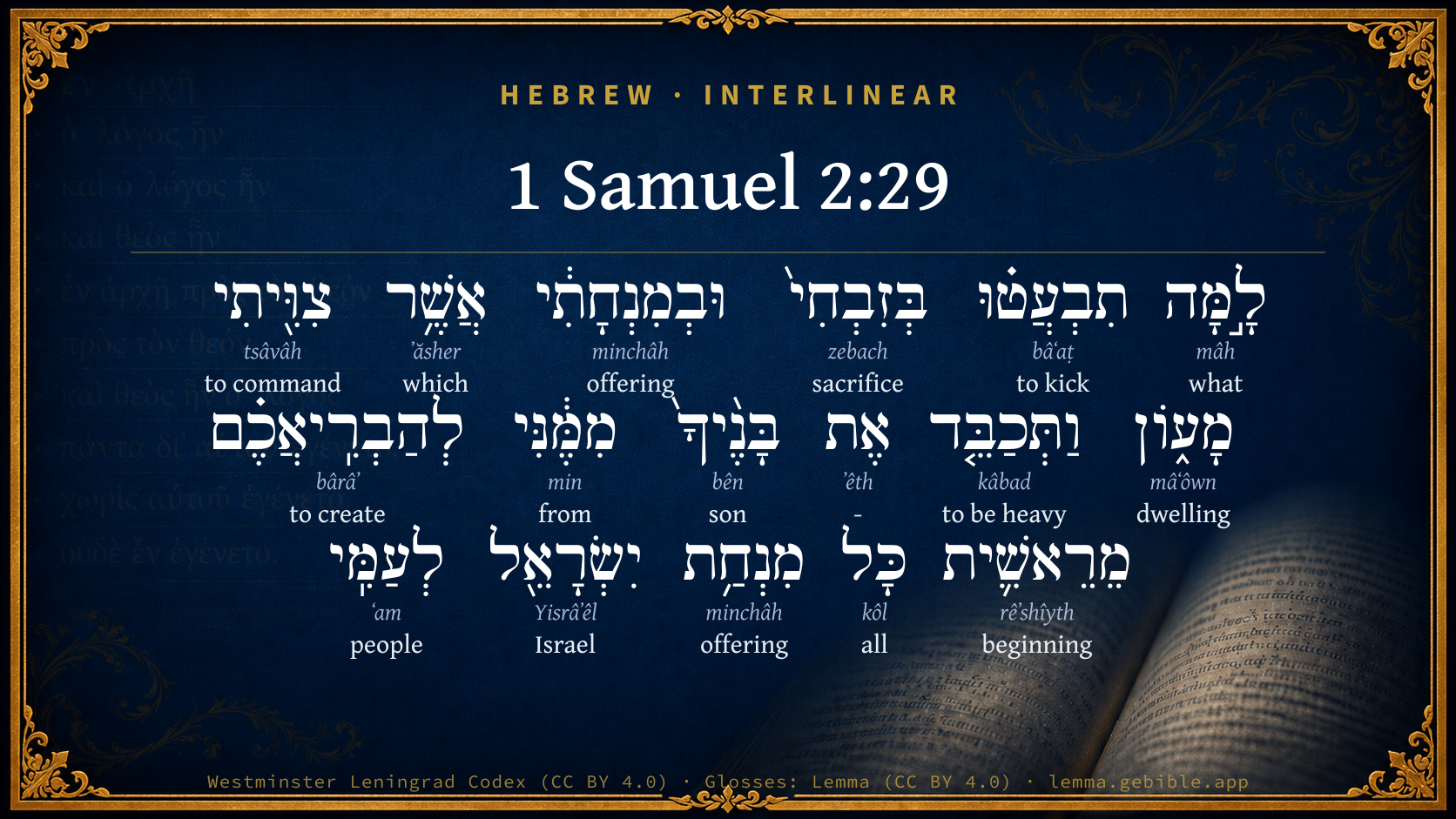
1 Samuel 2:29

Hebrew (Westminster Leningrad Codex) 1 Samuel 2:29 appears in the Hebrew Old Testament. The text above is from the Westminster Leningrad Codex. Each word links to its Strong’s number, a concise gloss, and parsing drawn from the Open Scriptures Hebrew Bible morphology. Click any word for its full Brown-Driver-Briggs (BDB) entry.
Download image
Cite this verse

1 Samuel 2:29 (World English Bible). Public Domain. Lemma interlinear Bible study tool, https://lemma.gebible.app/v/1-samuel/2/29.

Show BibTeX & RIS
BibTeX
RIS
English Translation
Why kick you at my sacrifice and at my offering, which I have commanded in [my] habitation, and honor your sons above me, to make yourselves fat with the best of all the offerings of Israel my people?
World English Bible · Public Domain
Download a study sheet

One document with this verse’s original text, its word-by-word gloss line, the meaning frame, cross-references with their text, attributed commentary, and full source and license credits — printable, and it pastes into notes with its structure intact.

This verse Autodidact and up

Study sheet (.html) Plain text (.txt)

A passage Seminary Student

Up to 50 verses in one chapter. A passage sheet keeps up to 6 commentary sources and 12 cross-references per verse, in the order this page ranks them, and says so on the sheet whenever that leaves anything out. Ask for a single verse and you get the Autodidact verse sheet above.

Everything on this page stays free to read, with no account — the sheet is a download of what is already on screen, not access to it.

Want to remove ads? Support Godless Engineer
Compare translations 3

The same verse in 3 English versions, stacked beneath the original-language interlinear above. Click any original word for its lexicon entry.

Each is an independent rendering of the whole verse — the interlinear is not word-aligned to these translations.

Highlighted words mark where these versions differ — a whole-verse word diff, not a word-by-word alignment.

  • World English Bible Public Domain
    Why kick you at my sacrifice and at my offering, which I have commanded in [my] habitation, and honor your sons above me, to make yourselves fat with the best of all the offerings of Israel my people?
  • King James Version Public Domain
    Wherefore kick ye at my sacrifice and at mine offering, which I have commanded in my habitation; and honorest thy sons above me, to make yourselves fat with the chiefest of all the offerings of Israel my people?
  • unfoldingWord Literal Text CC BY-SA 4.0
    Why do you kick at my sacrifice and at my offering that I commanded the Dwelling and honor your sons more than me by the fattening of yourselves from the first of every offering of Israel, of my people?

unfoldingWord Literal Text — © unfoldingWord, licensed CC BY-SA 4.0. Word-aligned USFM3 via Door43 (git.door43.org/unfoldingWord/en_ult).

Versions to compare (up to 4)

3 of 4 selected

Show all 18 translations

Every available English version of this verse, each an independent rendering of the whole verse.

  • World English Bible Public Domain
    Why kick you at my sacrifice and at my offering, which I have commanded in [my] habitation, and honor your sons above me, to make yourselves fat with the best of all the offerings of Israel my people?
  • Berean Standard Bible Public Domain
    Why then do you kick at My sacrifice and offering that I have prescribed for My dwelling place? You have honored your sons more than Me by fattening yourselves with the best of all the offerings of My people Israel.’
  • Majority Standard Bible Public Domain
    Why then do you kick at My sacrifice and offering that I have prescribed for My dwelling place? You have honored your sons more than Me by fattening yourselves with the best of all the offerings of My people Israel.’
  • King James Version Public Domain
    Wherefore kick ye at my sacrifice and at mine offering, which I have commanded in my habitation; and honorest thy sons above me, to make yourselves fat with the chiefest of all the offerings of Israel my people?
  • American Standard Version (1901) Public Domain
    Wherefore kick ye at my sacrifice and at mine offering, which I have commanded in `my' habitation, and honorest thy sons above me, to make yourselves fat with the chiefest of all the offerings of Israel my people?
  • Revised Version (1885) Public Domain
    Wherefore kick ye at my sacrifice and at mine offering, which I have commanded in my habitation; and honourest thy sons above me, to make yourselves fat with the chiefest of all the offerings of Israel my people?
  • Geneva Bible (1599) Public Domain
    Wherefore haue you kicked against my sacrifice and mine offering, which I commanded in my Tabernacle, and honourest thy children aboue mee, to make your selues fatte of the first fruites of all the offerings of Israel my people?
  • Douay-Rheims (1899) Public Domain
    Why have you kicked away my victims, and my gifts which I commanded to be offered in the temple: and thou hast rather honoured thy sons than me, to eat the firstfruits of every sacrifice of my people Israel?
  • Young's Literal Translation Public Domain
    Why do ye kick at My sacrifice, and at Mine offering which I commanded `in' My habitation, and dost honour thy sons above Me, to make yourselves fat from the first part of every offering of Israel, of My people?
  • Literal Standard Version CC BY-SA 4.0
    Why do you kick at My sacrifice and at My offering, which I commanded [in] My habitation, and honor your sons above Me, to make yourselves fat from the first part of every offering of Israel, of My people?
  • Unlocked Literal Bible CC BY-SA 4.0
    Why, then, do you scorn my sacrifices and offerings that I required in the place where I live? Why do you honor your sons above me by making yourselves fat with the best of every offering of my people Israel?'
  • unfoldingWord Literal Text CC BY-SA 4.0
    Why do you kick at my sacrifice and at my offering that I commanded the Dwelling and honor your sons more than me by the fattening of yourselves from the first of every offering of Israel, of my people?
  • Darby Bible Public Domain
    Wherefore do ye trample upon my sacrifice and upon mine oblation which I have commanded [in my] habitation? And thou honourest thy sons above me, to make yourselves fat with the primest of all the oblations of Israel my people.
  • World Messianic Bible Public Domain
    Why do you kick at my sacrifice and at my offering, which I have commanded in my habitation, and honor your sons above me, to make yourselves fat with the best of all the offerings of Israel my people?’
  • Webster's Bible Public Domain
    Wherefore kick ye at my sacrifice and at my offering, which I have commanded in my habitation; and honorest thy sons above me, to make yourselves fat with the chiefest of all the offerings of Israel my people?
  • Free Bible Version CC BY-SA 4.0
    So why have you treated with contempt my sacrifices and offerings that I have ordered for my place of worship? You honor your sons more than me by fattening yourselves with the best parts of all the offerings from my people Israel.
  • Bible in Basic English Public Domain
    Why then are you looking with envy on my offerings of meat and of meal which were ordered by my word, honouring your sons before me, and making yourselves fat with all the best of the offerings of Israel, my people?
  • JPS Tanakh (1917) Public Domain
    Wherefore kick ye at My sacrifice and at Mine offering, which I have commanded in My habitation; and honourest thy sons above Me, to make yourselves fat with the chiefest of all the offerings of Israel My people?

Literal Standard Version (2020), Covenant Press — licensed CC BY-SA 4.0. Text via the HelloAO Bible API (eBible.org). Unlocked Literal Bible (unfoldingWord) — licensed CC BY-SA 4.0. Text via the HelloAO Bible API (eBible.org). unfoldingWord Literal Text — © unfoldingWord, licensed CC BY-SA 4.0. Word-aligned USFM3 via Door43 (git.door43.org/unfoldingWord/en_ult). Free Bible Version, Dr. Jonathan Gallagher — licensed CC BY-SA 4.0. Text via the HelloAO Bible API (eBible.org).

Word by word

More ways to search: Search by grammar → Find every occurrence → Compare this word →

Practice this passage: Drill this verse → Learn its vocabulary →

תִבְעֲט֗וּ
bâʻaṭ
H1163
“to kick”
Verb, Qal, Imperfect, 2nd Person, Masculine, Plural
Part of Speech
Verb
Stem
Qal
Form
Imperfect
Person
2nd Person
Gender
Masculine
Number
Plural
Full BDB Definition

Origin: a primitive root

TWOT: 261

to kick, kick at - (Qal) - to kick - to kick at - to desire (figuratively)
  1. לָ֣מָּה mâh H4100 “to/for · what” Preposition + Particle, Interrogative
  2. בְּזִבְחִי֙ zebach H2077 “in/at · sacrifice · my” Preposition + Noun, Common, Masculine, Singular, Construct + Suffix, Personal, 1st Person, Common, Singular
  3. וּבְמִנְחָתִ֔י minchâh H4503 “and · in/at · offering · my” Conjunction + Preposition + Noun, Common, Feminine, Singular, Construct + Suffix, Personal, 1st Person, Common, Singular
  4. אֲשֶׁ֥ר ʼăsher H834 “which” Particle, Relative
  5. צִוִּ֖יתִי tsâvâh H6680 “to command” Verb, Piel, Perfect, 1st Person, Common, Singular
  6. מָע֑וֹן mâʻôwn H4583 “dwelling” Noun, Common, Both, Singular, Absolute
  7. וַתְּכַבֵּ֤ד kâbad H3513 “and · to be heavy” Conjunction + Verb, Piel, Sequential Imperfect, 2nd Person, Masculine, Singular
  8. אֶת ʼêth H853 “-” Particle, Direct Object
  9. בָּנֶ֨יךָ֙ bên H1121 “sons · your” Noun, Common, Masculine, Plural, Construct + Suffix, Personal, 2nd Person, Masculine, Singular
  10. מִמֶּ֔נִּי min H4480 “from · me” Preposition + Suffix, Personal, 1st Person, Common, Singular
  11. לְהַבְרִֽיאֲכֶ֗ם bârâʼ H1254 “to create · you” Preposition + Verb, Hiphil, Infinitive Construct + Suffix, Personal, 2nd Person, Masculine, Plural
  12. מֵרֵאשִׁ֛ית rêʼshîyth H7225 “from · beginning of” Preposition + Noun, Common, Feminine, Singular, Construct
  13. כָּל kôl H3605 “all of” Noun, Common, Masculine, Singular, Construct
  14. מִנְחַ֥ת minchâh H4503 “offering of” Noun, Common, Feminine, Singular, Construct
  15. יִשְׂרָאֵ֖ל Yisrâʼêl H3478 “Israel” Noun, Proper
  16. לְעַמִּֽי ʻam H5971 “to/for · people · my” Preposition + Noun, Common, Masculine, Singular, Construct + Suffix, Personal, 1st Person, Common, Singular

About this verse

These counts appear in no published source. They are computed here, from the morphology-tagged text and Lemma’s own curated glosses. What Lemma adds →

17
words
16
distinct lemmas
Historical
section

Notable vocabulary

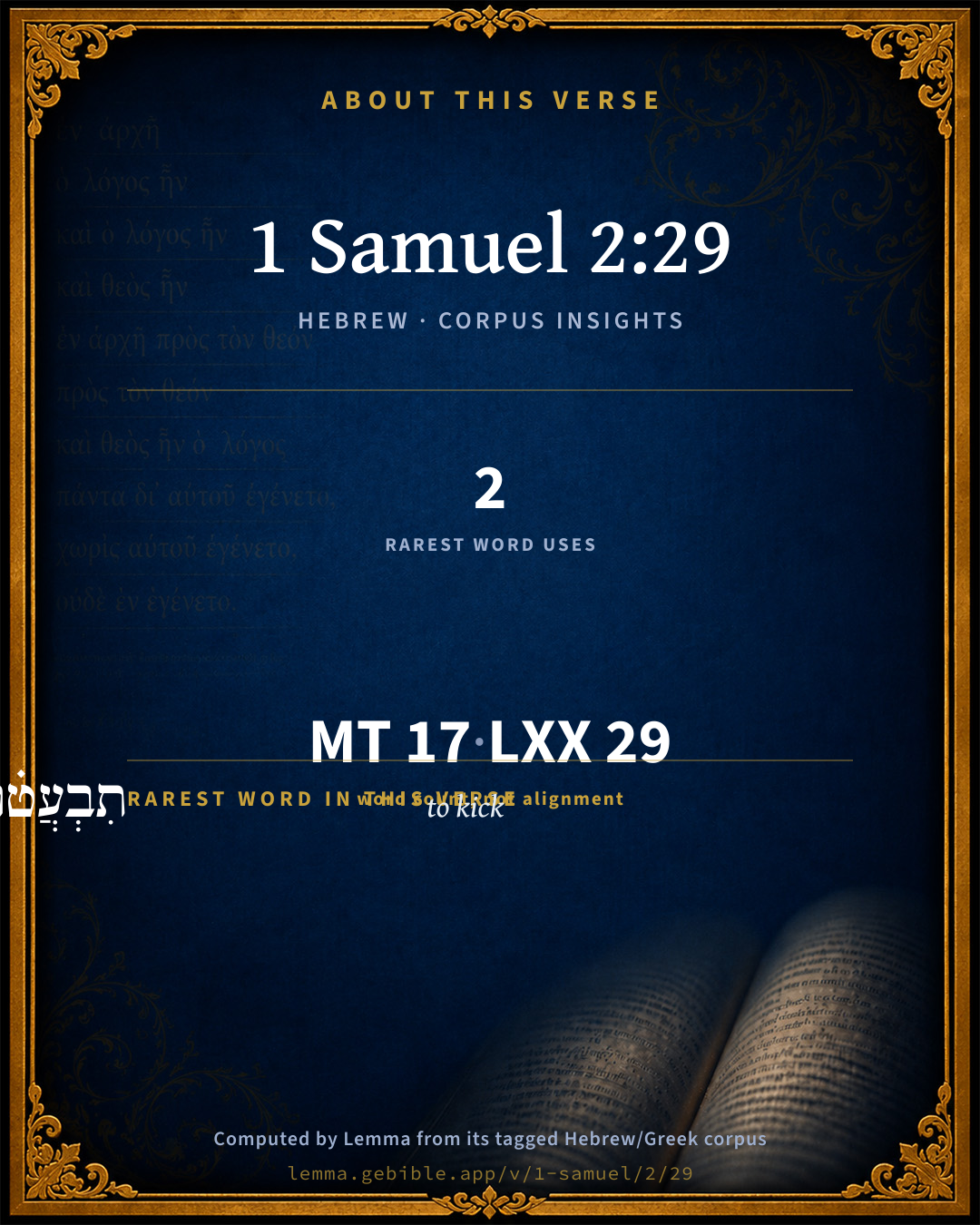
The rarest word here is תִבְעֲט֗וּ to kick H1163 — appearing just 2 times in the whole Hebrew Bible.

Shared distinctive vocabulary

תִבְעֲט֗וּ to kick H1163 occurs in 2 verses of the Hebrew Bible. Also found in:

Grammatical profile

  • 4 verbs
  • 9 nouns
  • 1 preposition
  • 3 particles

Verb forms

  • תִבְעֲט֗וּ Qal · Imperfect
  • צִוִּ֖יתִי Piel · Perfect
  • וַתְּכַבֵּ֤ד Piel · Sequential Imperfect
  • לְהַבְרִֽיאֲכֶ֗ם Hiphil · Infinitive Construct

Repetition

A word recurs within this verse — often emphatic in Hebrew:

  • וּבְמִנְחָתִ֔י offering H4503 ×2

Hebrew & Septuagint length

In English translation the verse runs 38 words from the Hebrew and 39 from the Septuagint (LXX English) — closely comparable.

A rough comparison of the two English renderings, which tokenize alike — not a word-level alignment.

Word counts can differ between the Hebrew and the Greek without any difference in meaning — e.g. the Hebrew direct-object marker אֵת has no separate Greek word, and Greek often adds the article ὁ.

In the original languages it is 17 Hebrew tokens and 29 Greek tokens — but the two are counted differently (Hebrew bundles its prefixes and suffixes into one token; the Greek is in lemma form), so that isn’t a like-for-like length.

Cross-references

18

Topical passages linked to 1 Samuel 2:29 in the Treasury of Scripture Knowledge — connected by theme and wording, ordered by reader-vote popularity; previews shown in the World English Bible.

  • Matthew 10:37 He who loves father or mother more than me is not worthy of me; and he who loves son or daughter more than me isn't worthy of me.
  • Deuteronomy 32:15 But Jeshurun grew fat, and kicked: You have grown fat, you are grown thick, you are become sleek; Then he forsook God who made him, Lightly esteemed the Rock of his salvation.
  • 1 Samuel 2:13–17 The custom of the priests with the people was that when any man offered sacrifice, the priest's servant came, while the flesh was boiling, with a flesh-hook of three teeth in his hand;
  • Luke 14:26 "If anyone comes to me, and doesn't hate his own father, mother, wife, children, brothers, and sisters, yes, and his own life also, he can't be my disciple.
  • Deuteronomy 12:5–6 But to the place which Yahweh your God shall choose out of all your tribes, to put his name there, even to his habitation shall you seek, and there you shall come;
  • Ezekiel 34:2 Son of man, prophesy against the shepherds of Israel, prophesy, and tell them, even to the shepherds, Thus says the Lord Yahweh: Woe to the shepherds of Israel who feed themselves! Shouldn't the shepherds feed the sheep?
  • Malachi 1:12–13 "But you profane it, in that you say, 'Yahweh's table is polluted, and its fruit, even its food, is contemptible.'
  • Leviticus 19:15 "'You shall do no injustice in judgment: you shall not be partial to the poor, nor show favoritism to the great; but in righteousness shall you judge your neighbor.
  • Deuteronomy 33:9 Who said of his father, and of his mother, I have not seen him; Neither did he acknowledge his brothers, Nor knew he his own children: For they have observed your word, Keep your covenant.
  • Joshua 18:1 The whole congregation of the children of Israel assembled themselves together at Shiloh, and set up the tent of meeting there: and the land was subdued before them.
  • Isaiah 56:11–12 Yes, the dogs are greedy, they can never have enough; and these are shepherds who can't understand: they have all turned to their own way, each one to his gain, from every quarter.
  • Hosea 4:8 They feed on the sin of my people, And set their heart on their iniquity.
  • Micah 3:5 Thus says Yahweh concerning the prophets who lead my people astray; for those who feed their teeth, they proclaim, "Peace!" and whoever doesn't provide for their mouths, they prepare war against him:
  • Matthew 22:16 They sent their disciples to him, along with the Herodians, saying, "Teacher, we know that you are honest, and teach the way of God in truth, no matter who you teach, for you aren't partial to anyone.
  • James 3:17 But the wisdom that is from above is first pure, then peaceful, gentle, reasonable, full of mercy and good fruits, without partiality, and without hypocrisy.
  • Ezekiel 13:19 You have profaned me among my people for handfuls of barley and for pieces of bread, to kill the souls who should not die, and to save the souls alive who should not live, by your lying to my people who listen to lies.
  • Romans 16:18 For those who are such don't serve our Lord, Jesus Christ, but their own belly; and by their smooth and flattering speech, they deceive the hearts of the innocent.
  • 2 Corinthians 5:16 Therefore we know no one after the flesh from now on. Even though we have known Christ after the flesh, yet now we know him so no more.

Cross-references courtesy of OpenBible.info (CC BY 4.0).

Hebrew and Greek witnesses Masoretic Hebrew ↔ Greek Septuagint

The same verse in the two great witnesses to the Old Testament, shown verse-for-verse.

These are two independent witnesses, not word-aligned to each other, and the Septuagint is shown in lemma (dictionary) form.

Hebrew 1 Samuel 2:29 Masoretic · Westminster Leningrad Codex

לָ֣מָּה תִבְעֲט֗וּ בְּזִבְחִי֙ וּבְמִנְחָתִ֔י אֲשֶׁ֥ר צִוִּ֖יתִי מָע֑וֹן וַתְּכַבֵּ֤ד אֶת בָּנֶ֨יךָ֙ מִמֶּ֔נִּי לְהַבְרִֽיאֲכֶ֗ם מֵרֵאשִׁ֛ית כָּל מִנְחַ֥ת יִשְׂרָאֵ֖ל לְעַמִּֽי

Why kick you at my sacrifice and at my offering, which I have commanded in [my] habitation, and honor your sons above me, to make yourselves fat with the best of all the offerings of Israel my people?

World English Bible · Public Domain

Greek LXX 1 Samuel 2:29 Septuagint · lemma form

καί ἵνα τίς ἐπιβλέπω ἐπί ὁ θυμίαμα ἐγώ καί εἰς ὁ θυσία ἐγώ ἀναιδής ὀφθαλμός καί δοξάζω ὁ υἱός σύ ὑπέρ ἐγώ ἐνεὐλογέω ἀπαρχή πᾶς θυσία ἰσραήλ ἔμπροσθεν ἐγώ

And therefore have you looked upon my incense-offering and my meat-offering with a shameless eye, and have honored your sons above me, so that they should bless themselves with the first fruits of every sacrifice of Israel before me?

LXX2012 (modern English Septuagint) · Public Domain

Hebrew: Westminster Leningrad Codex (CC BY 4.0). Greek: Septuagint (public domain); English from LXX2012 (modern English Septuagint) (Public Domain). How the Septuagint differs from the Hebrew →

Targum (Aramaic paraphrase)

1

The Targum is the ancient Jewish Aramaic paraphrase of the Hebrew Scriptures — an interpretive translation, not the Hebrew text itself. Onkelos (literal) and Pseudo-Jonathan (expansive) render the Torah, and Jonathan the Prophets. Coverage is partial: where no permissively-licensed English translation exists for a verse, only the Aramaic is shown. This is verse-level text, not a word-by-word alignment to the Hebrew.

  1. Targum Jonathan Prophets (Joshua–Malachi)
    לְמָא אַתּוּן אַנְסִין בְּנִכְסַת קוּדְשַׁיָא וּבְקוּרְבָּנִי דְפַקְדִית לִקָרָבָא קֳדָמַי בְּבֵית מַקְדְשִׁי וְיָקַרְתָּ יַת בְּנָךְ קֳדָמֵיתָא לְאוֹכָלוּתְהוֹן מֵרֵישׁ כָּל קוּרְבַּן מִנְחַת יִשְׂרָאֵל דְעַמִי:

    (no public-domain English translation for this verse)

    Targum Jonathan — Aramaic: “Mikraot Gedolot” (public domain). English: “Sefaria Community Translation” (CC0 1.0 (public-domain dedication)); “London "Chaldee Paraphrase," 1871” (public domain). Text via Sefaria.

Commentary

Notes on 1 Samuel 2:29 from classic Christian and Jewish commentators (each source and its license shown beneath its notes). The classic Christian expositions comment on the surrounding passage and are grouped to its opening verse, so a note may address several verses; the Jewish commentaries on the Tanakh (Rashi and others) are per-verse, so they appear only where the commentator wrote on this verse.

Lemma curates 59 commentaries, every one of them public domain or Creative Commons licensed, each selected and text-cleaned for this edition rather than reprinted as found. About our sources →

Trapp's Complete Commentary

John Trapp

1Sa 2:29 Wherefore kick ye at my sacrifice and at mine offering, which I have commanded [in my] habitation; and honourest thy sons above me, to make yourselves fat with the chiefest of all the offerings of Israel my people?

Ver. 29. Wherefore kick ye at my sacrifice?] i.e., Why slight ye, and, as headstrong horses, {a} trample under foot my holy ordinances?

“ Quae tibi pro vili, sub pedibusque iacent? ”

And honourest thy sons above me.] Choosing rather to gratify them than to glorify me, by abdicating them from the priesthood. But it may be Eli feared lest the high priesthood should by this means go from his family, as it had before from Eleazar’s for like misdemeanour, which also afterwards befell him, and he by seeking to prevent it, hastened it.

To make yourselves fat with the chiefest.] Whereby you intrench upon God’s part. And because Eli himself ate part thereof, he is also blamed: or rather because he suffered these disorders. Of Claudius, Emperor, it was said, Non faciendo malus, sed patiendo, fuit. And of Edward the Confessor, that, by Earl Godwin’s insolencies, though a good man, yet, not by doing, but enduring ill, he was held to be a bad prince. {b}

{a} Metaph. a refractario pecore. - Pisc.

{b} Dan. Hist.

John Trapp, A Commentary or Exposition upon All the Books of the Old and New Testament (1647–1656) — public domain. Text from a community e-Sword module.

Joseph Benson's Commentary

1Sa 2:29. Wherefore kick ye, &c. — Using my sacrifices irreverently and profanely; both by abusing them to your own luxury, and by causing the people to abhor them. He chargeth Eli with his sons’ faults. Honourest thy sons — Permitting them to dishonour and injure me, by taking my part to themselves; choosing rather to offend me by thy connivance at their sin, than to displease them by severe rebukes and just punishments. To make yourselves fat — To pamper yourselves. This you did, not out of necessity, but out of mere luxury. Chiefest — Not contented with those parts which I had allotted you, you invaded those which I reserved for myself.

Joseph Benson's Commentary on the Old and New Testaments (1811–1818) — public domain. Text from a community e-Sword module.

Tyndale Open Study Notes

Tyndale Open Resources

2:29 By failing to stop his sons’ wickedness, Eli showed contempt for God’s sacrifices and offerings. Eli benefited from his sons’ activities, and God held Eli responsible for letting them continue.

Tyndale Open Study Notes — © Tyndale Open Resources, licensed CC BY-SA 4.0. Text via the HelloAO Bible API.

Geneva Bible (1599)

Geneva Bible translators

Why have you contemned my sacrifices, and as it were trod them under foot?

Geneva Bible (1599) marginal notes — public domain. Text via Bolls.life.

Adam Clarke's Commentary

Verse 29. Wherefore kick ye at my sacrifice] They disdained to take the part allowed by law; and would take for themselves what part they pleased, and as much as they pleased, 1Sa 2:13-16: thus they kicked at the sacrifices.

Honourest thy sons above me] Permitting them to deal, as above, with the offerings and sacrifices, and take their part before the fat, &c., was burnt unto the Lord: thus they were first served. At this Eli connived, and thus honoured his sons above God.

Adam Clarke's Commentary on the Bible (1810–1826) — public domain. Text from a community e-Sword/MySword module.

Ellicott's Commentary for English Readers

(29) Wherefore kick ye at my sacrifice.—The imagery of the words are taken from Deu_32:15 : “Jeshurun waxed fat, and kicked . . . then he forsook God which made him, and lightly esteemed the Rock of his salvation.” The image is one drawn from the pastoral life of the people: the ox or ass over-fed, pampered, and indulged, becomes unmanageable, and refuses obedience to his kind master.

And honourest thy sons above me.—Although Eli knew well what was right, yet foolish fondness for his sons seems in part to have blinded his eyes to the enormity of their wickedness. It is also probable that he was influenced not by feelings of weak affection, but also by unwillingness to divert from his own family the rich source of wealth which proceeded from the offerings of the pilgrims from all parts of the land. These considerations induced him to maintain these bad and covetous men as his acknowledged representatives in the national sanctuary of Shiloh. Eli then allowed things, which gradually grew worse and worse, to drift, and merely interfered with a weak rebuke; but the day of reckoning was at hand.

A Bible Commentary for English Readers, edited by Charles John Ellicott (1878–1897) — public domain. Text from a community e-Sword module.

The Cambridge Bible for Schools and Colleges

gen. ed. J. J. S. Perowne

29. Wherefore kick ye] Better, Wherefore do ye trample upon, i.e. treat with contempt.

at my sacrifice and at mine offering] When the words are distinguished, that rendered sacrifice (literally slaying) includes as a general term all sacrifices of slain animals: that rendered offering (literally a gift) is applied to unbloody sacrifices, the so-called meat-offering: but the latter is often used in a wide sense to include all kinds of sacrifice, e.g. in 1Sa_2:17. The distinction between the words is fairly observed in the E. V.

in my habitation] The word is used again in 1Sa_2:32, and in Psa_26:8, of the tabernacle. The Heb. is obscure, and the Sept. rendering diverges considerably from the present text, thus, “And wherefore didst thou look upon my offering and my sacrifice with a shameless eye?”

with the chiefest of all the offerings] “With the first,” or, “best part of every offering,” which should have been God’s. See note on 1Sa_2:13.

The Cambridge Bible for Schools and Colleges (gen. ed. J. J. S. Perowne; Cambridge University Press, 1878–1918) — public domain. Text from a community e-Sword module.

John Gill's Exposition

Wherefore the Lord God of Israel saith,.... This being the case, so much contempt cast upon his sacrifices, and dishonour on himself:

I said indeed that thy house, and the house of thy father, should walk before me for ever; or minister in the priest's office before him: if the house of Aaron in general is meant, it did continue so to do, in one branch or another of it, as long as the Mosaic dispensation lasted, which is meant by the phrase "for ever"; but since it is afterwards denied that it should, rather the house of Ithamar, or of the immediate parent of Eli, is meant, and this said when the priesthood was translated from the family of Eleazar to the family of Ithamar; when, and on what account that was done, we nowhere read. It is a tradition (f), that it was in the time of the Levite's concubine; and because Phinehas, and the other priests, did not go from city to city, and reprove the Israelites for the many sins they were fallen into, that the priesthood was taken away out of the family of Eleazar, and translated to that of Ithamar:

but now the Lord saith, be it far from me; to continue the priesthood in the line of Ithamar; which argues no change in the purposes or promises of God, this being not a decree of his, but a declaration of his will; that if the house of Ithamar behaved well in the discharge of the office of the high priest, it should continue with them to the end of the Mosaic dispensation, but if not, it should be taken from them, and restored to the family of Eleazar; as it was in Solomon's time:

for them that honour me I will honour; as Phinehas the son of Eleazar did at Shittim, where he showed his zeal for the Lord of hosts, and had the promise of the everlasting priesthood; and which continued in his family until the Babylonish captivity, excepting the interval in which it was in the family of Ithamar, and for what reason is not known:

and they that despise me shall be lightly esteemed; as the posterity of Eli, whose sons despised the Lord, and his offerings, as appeared by their conduct; and these were killed in battle in one day, and in the times of Solomon, Abiathar, of the posterity of Eli, was thrust out of the priesthood, and Zadok, of the line of Eleazar, was put in his room, Kg1 2:27.

(f) Midrash Samuel, apud Jarch. & Kimch. in loc.

John Gill's Exposition of the Whole Bible (1746–1763) — public domain (CC PDM 1.0). Text via the HelloAO Bible API.

Albert Barnes' Notes on the Bible

Wherefore kick ye - See the marginal reference. The well-fed beast becomes unmanageable and refractory, and refuses the yoke, and bursts the bonds Jer 5:5. So the priests, instead of being grateful for the provision made for them, in their pampered pride became dissatisfied, wantonly broke the laws of God which regulated their share of the offerings, and gave themselves up to an unbridled indulgence of their passions and their covetousness.

Honourest thy sons above me - What restrained Eli from taking vigorous action to vindicate God’s honor, was his unwillingness to lose for his sons the lucrative office of the priesthood. He was willing to rebuke them, he was grieved at their misdeeds, but he was not willing to give up the wealth and plenty which flowed into his house from the offerings of Israel.

Albert Barnes' Notes on the Bible (1834–1885) — public domain. Text from a community e-Sword/MySword module.

Haydock's Catholic Bible Commentary

Away, by scandalizing the people, and causing them to neglect offering the appointed victims. (Haydock) --- To eat. Heli seems to have refrained from divesting his sons of their high office, that the riches of his family might not be impaired. (Calmet) --- Avarice is the root of many evils, and those who seek to become rich fall into many snares. Poverty soon overtook the descendants of Heli, while the immediate perpetrators of the wickedness were punished with death. (Haydock)

George Leo Haydock (1774–1849), Haydock's Catholic Family Bible and Commentary, 1859 edition — public domain. Excludes Psalms (Douay-Rheims chapter numbering differs from Protestant) and Deuterocanonical books (Catholic canon only).

Matthew Poole's English Annotations

Wherefore kick ye at my sacrifice; using them irreverently, contemptuously, and profanely; both by abusing them to your own luxury, and by causing the people to abhor and neglect them? He chargeth Eli with his sons’ faults.

Honourest thy sons above me; permitting them to dishonour and injure me, by taking my part to themselves; choosing rather to offend me by thy connivance at their sin, than to displease them by severe rebukes, and effectual restraints, and just punishments; and so prefer their will, and pleasure, and honour, before mine.

To make yourselves fat; to pamper yourselves. This you did not out of any necessity, but out of mere luxury.

The chiefest of all the offerings; not contented with those parts which I had allotted you, you invaded those choice parts which I reserved for myself.

Matthew Poole's English Annotations on the Holy Bible (1683–1685) — public domain. Text from a community e-Sword/MySword module.

Whedon's Commentary on the Bible

Daniel D. Whedon

29. Kick ye at my sacrifice — Literally, Why trample ye under foot, that is, despise, treat with contempt, my sacrifices? Eli treated with contempt the offerings by allowing his sons to desecrate the holy service when he had the authority and power to punish them as their sins deserved. In this way he virtually honoured his sons more than God. According to 1Sa_2:15-16, they appropriated the most choice of the offerings to themselves, thus making themselves fat at the expense and reproach of Israel and God.

Habitation — The tabernacle, the immediate dwelling place of Jehovah.

Daniel D. Whedon (gen. ed.), Commentary on the Old and New Testaments (1874–1909) — public domain. Text from a community e-Sword module.

John Wesley's Explanatory Notes

Kick ye - Using them irreverently, and profanely; both by abusing them to your own luxury, and by causing the people to abhor them. He chargeth Eli with his sons faults. honourest thy sons - Permitting them to dishonour and injure me, by taking my part to themselves; chusing rather to offend me by thy connivance at their sin, than to displease them by severe rebukes, and just punishments. Fat - To pamper yourselves. This you did not out of necessity, but out of mere luxury. Chiefest - Not contented with those parts which I had allotted you, you invaded those choice parts which I reserved for myself.

John Wesley, Explanatory Notes Upon the Whole Bible (1754–1765) — public domain. Text via the GEBible commentary corpus.

unfoldingWord translationNotes

Door43 World Missions Community

Connecting Statement:

The man of God continues to speak to Eli.

Why, then, do you scorn my sacrifices ... live?

This rhetorical question is a rebuke. It can be translated as a statement. AT: "You should not scorn my sacrifices ... where I live." (See: Rhetorical Question)

the place where I live

"the place where my people bring offerings to me"

making yourselves fat with the best of every offering

The best part of the offering was to be burned up as an offering to Yahweh, but the priests were eating it.

the house of your ancestor

The word "house" is a metonym for the people who lived in the house. See how you translated this in 1 Samuel 2:27. AT: "the family of your ancestor" (See: Metonymy)

should walk before me

This is an idiom that means "live in obedience to me." (See: Idiom)

Far be it from me to do this

"I will certainly not allow your family to serve me forever"

those who despise me will be lightly esteemed

The words "lightly esteemed" is an ironic euphemism for "greatly despised." This can be stated in active form. AT: "I will lightly esteem those who despise me" or "I will greatly despise those who despise me" (See: Irony and Euphemism and Active or Passive)

translationWords

honor

promise

walk

eternity

unfoldingWord translationNotes — © Distant Shores Media and the Door43 World Missions Community, licensed CC BY-SA 4.0. Source: git.door43.org/Door43/en_tn.

Rashi

Rabbi Shlomo Yitzchaki (Rashi)

Which I commanded you [to bring in My] Sanctuary. Which I commanded in My dwelling place.

To feed yourselves from the choice parts… This is an inverted sentence [meaning], "you honor your sons more than Me," ]לְעַמִּי[ before My people, i.e., in the eyes of My people, you honor your sons more than Me. And what is the honor? To feed yourselves from the choice parts of all the offerings of Yisroel. Your meal preceded My meal, as it is stated, "even before they would burn the fat…"

To feed yourselves. [לְהַבְרִיאֲכֶם] is an expression of having a meal, as in, "Please let my sister Tamar come and serve [וְתַבְרֵנִי] me bread."

My people. This reverts to, "you honor your sons more than Me." You showed My people that you are more honored than I. And how have you shown this? By feeding yourselves from the choice parts of My offerings.

Rashi on the Tanakh — English translations: “The Judaica Press complete Tanach with Rashi, translated by A. J. Rosenberg” (CC BY 4.0); “Pentateuch with Rashi's commentary by M. Rosenbaum and A.M. Silbermann, 1929-1934” (public domain); “The Metsudah Tanach series, Lakewood, N.J” (CC BY 4.0); and “The Book of Joshua, Metsudah Publications, 1997” (CC BY 4.0). Text via Sefaria.

Lesson kit

Teaching starters — assembled from the data on this page, not authored interpretation. Every prompt links to the verse data it draws on. Edit before teaching.

1 Samuel, in the Historical, opens this verse with 17 words (16 distinct Hebrew lemmas). Its most distinctive word is bâʻaṭ (“to kick”). A historical commentator’s framing appears above. Read the whole chapter for the surrounding context.

Discussion questions

  1. What does “to kick” (bâʻaṭ) contribute to the verse as a whole?
  2. How does Deuteronomy 32:15, which shares the word «to kick», read alongside this verse?
  3. What does the repetition of “offering” (2× in this one verse) do in this verse?
  4. These translations render this verse differently. What is at stake in choosing one wording over another?
  5. «תִבְעֲט֗וּ» is a Qal Imperfect verb. How does that grammatical form shape the action described?
  6. Compare how Trapp's Complete Commentary and Joseph Benson's Commentary read this verse. Where do they agree or differ?

Things to notice

Reading settings

Reading text

Shown beneath each verse's original-language words.

Old Testament
Old Testament edition

Read the OT as the Masoretic Hebrew (MT) or the Greek Septuagint (LXX).

English shown for the Greek Septuagint (in the Hebrew ↔ Greek comparison).

Comparing translations? Open the Compare panel on any verse page to stack up to four side by side.