Esther 2:10

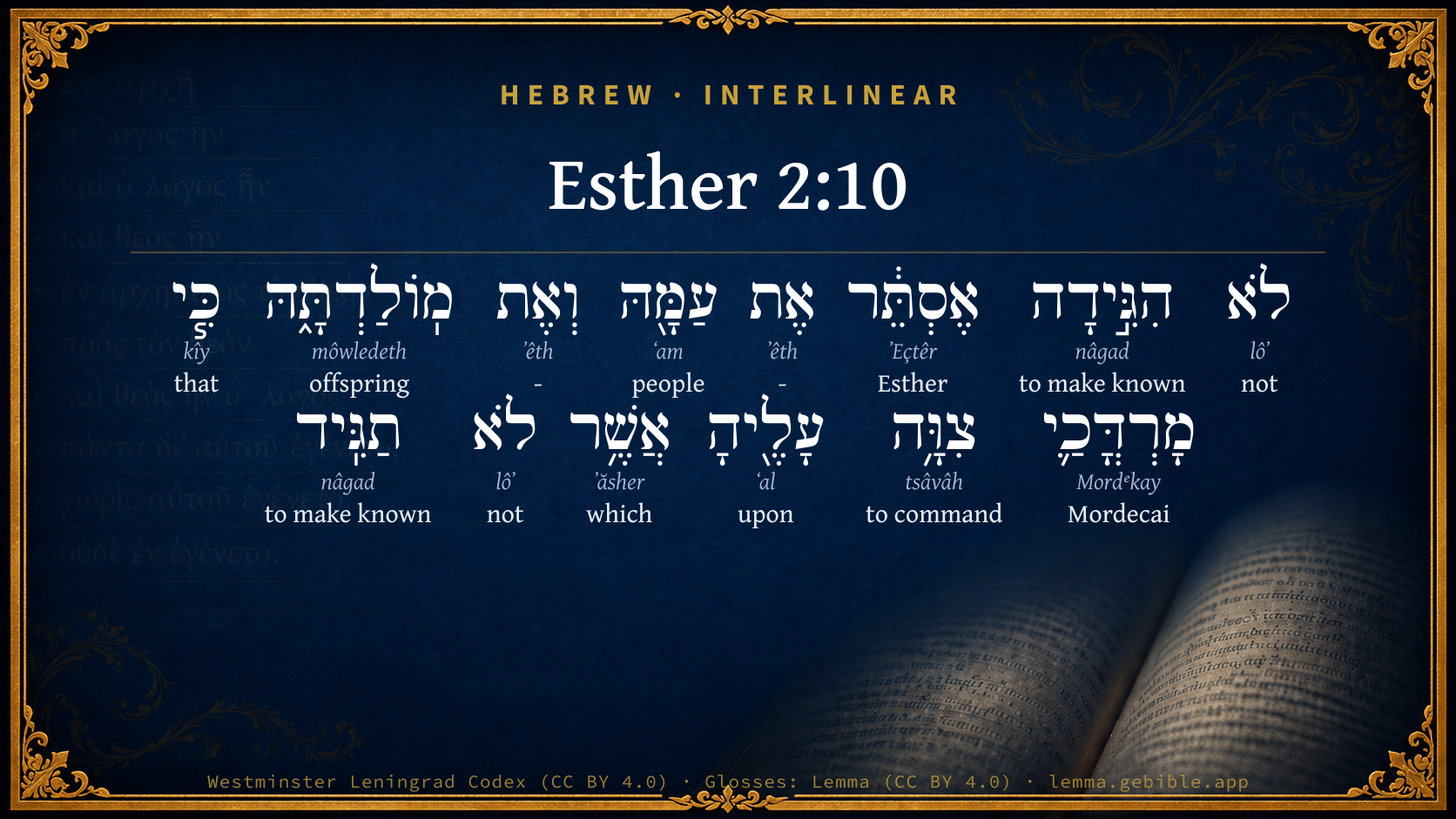
Hebrew (Westminster Leningrad Codex) Esther 2:10 appears in the Hebrew Old Testament. The text above is from the Westminster Leningrad Codex. Each word links to its Strong’s number, a concise gloss, and parsing drawn from the Open Scriptures Hebrew Bible morphology. Click any word for its full Brown-Driver-Briggs (BDB) entry.
Download image
Cite this verse

Esther 2:10 (World English Bible). Public Domain. Lemma interlinear Bible study tool, https://lemma.gebible.app/v/esther/2/10.

Show BibTeX & RIS
BibTeX
RIS
English Translation
Esther had not made known her people nor her relatives; for Mordecai had charged her that she should not make it known.
World English Bible · Public Domain
Download a study sheet

One document with this verse’s original text, its word-by-word gloss line, the meaning frame, cross-references with their text, attributed commentary, and full source and license credits — printable, and it pastes into notes with its structure intact.

This verse Autodidact and up

Study sheet (.html) Plain text (.txt)

A passage Seminary Student

Up to 50 verses in one chapter. A passage sheet keeps up to 6 commentary sources and 12 cross-references per verse, in the order this page ranks them, and says so on the sheet whenever that leaves anything out. Ask for a single verse and you get the Autodidact verse sheet above.

Everything on this page stays free to read, with no account — the sheet is a download of what is already on screen, not access to it.

Want to remove ads? Support Godless Engineer
Compare translations 3

The same verse in 3 English versions, stacked beneath the original-language interlinear above. Click any original word for its lexicon entry.

Each is an independent rendering of the whole verse — the interlinear is not word-aligned to these translations.

Highlighted words mark where these versions differ — a whole-verse word diff, not a word-by-word alignment.

  • World English Bible Public Domain
    Esther had not made known her people nor her relatives; for Mordecai had charged her that she should not make it known.
  • King James Version Public Domain
    Esther had not shewed her people nor her kindred: for Mordecai had charged her that she should not shew it.
  • unfoldingWord Literal Text CC BY-SA 4.0
    Esther had not declared her people or her ancestry, for Mordecai had laid a charge upon her that she should not tell it.

unfoldingWord Literal Text — © unfoldingWord, licensed CC BY-SA 4.0. Word-aligned USFM3 via Door43 (git.door43.org/unfoldingWord/en_ult).

Versions to compare (up to 4)

3 of 4 selected

Show all 18 translations

Every available English version of this verse, each an independent rendering of the whole verse.

  • World English Bible Public Domain
    Esther had not made known her people nor her relatives; for Mordecai had charged her that she should not make it known.
  • Berean Standard Bible Public Domain
    Esther did not reveal her people or her lineage, because Mordecai had instructed her not to do so.
  • Majority Standard Bible Public Domain
    Esther did not reveal her people or her lineage, because Mordecai had instructed her not to do so.
  • King James Version Public Domain
    Esther had not shewed her people nor her kindred: for Mordecai had charged her that she should not shew it.
  • American Standard Version (1901) Public Domain
    Esther had not made known her people nor her kindred; for Mordecai had charged her that she should not make it known.
  • Revised Version (1885) Public Domain
    Esther had not shewed her people nor her kindred: for Mordecai had charged her that she should not shew it.
  • Geneva Bible (1599) Public Domain
    But Ester shewed not her people and her kinred: for Mordecai had charged her, that shee should not tell it.
  • Douay-Rheims (1899) Public Domain
    And she would not tell him her people nor her country. For Mardochai had charged her to say nothing at all of that:
  • Young's Literal Translation Public Domain
    Esther hath not declared her people, and her kindred, for Mordecai hath laid a charge on her that she doth not declare `it';
  • Literal Standard Version CC BY-SA 4.0
    Esther has not declared her people, and her family, for Mordecai has laid a charge on her that she does not declare [it];
  • Unlocked Literal Bible CC BY-SA 4.0
    Esther had not told anyone who her people or relatives were, for Mordecai had instructed her not to tell.
  • unfoldingWord Literal Text CC BY-SA 4.0
    Esther had not declared her people or her ancestry, for Mordecai had laid a charge upon her that she should not tell it.
  • Darby Bible Public Domain
    Esther had not made known her people nor her birth; for Mordecai had charged her that she should not make it known.
  • World Messianic Bible Public Domain
    Esther had not made known her people nor her relatives, because Mordecai had instructed her that she should not make it known.
  • Webster's Bible Public Domain
    Esther had not showed her people nor her kindred: for Mordecai had charged her that she should not show it.
  • Free Bible Version CC BY-SA 4.0
    Esther had not let anyone know her nationality or who her family was, because Mordecai had ordered her not to.
  • Bible in Basic English Public Domain
    Esther had not said what family or people she came from, for Mordecai had given her orders not to do so.
  • JPS Tanakh (1917) Public Domain
    Esther had not made known her people nor her kindred; for Mordecai had charged her that she should not tell it.

Literal Standard Version (2020), Covenant Press — licensed CC BY-SA 4.0. Text via the HelloAO Bible API (eBible.org). Unlocked Literal Bible (unfoldingWord) — licensed CC BY-SA 4.0. Text via the HelloAO Bible API (eBible.org). unfoldingWord Literal Text — © unfoldingWord, licensed CC BY-SA 4.0. Word-aligned USFM3 via Door43 (git.door43.org/unfoldingWord/en_ult). Free Bible Version, Dr. Jonathan Gallagher — licensed CC BY-SA 4.0. Text via the HelloAO Bible API (eBible.org).

Word by word

More ways to search: Search by grammar → Find every occurrence → Compare this word →

Practice this passage: Drill this verse → Learn its vocabulary →

מֽוֹלַדְתָּ֑הּ
môwledeth
H4138
“offspring · her”
Noun, Common, Feminine, Singular, Construct + Suffix, Personal, 3rd Person, Feminine, Singular
Part of Speech
Noun
Type
Common
Gender
Feminine
Number
Singular
State
Construct
Full BDB Definition

Origin: from H3205

TWOT: 867f

kindred, birth, offspring, relatives - kindred - birth, circumstances of birth - one born, begotten, issue, offspring, female offspring
  1. לֹא lôʼ H3808 “not” Particle, Negative
  2. הִגִּ֣ידָה nâgad H5046 “to make known” Verb, Hiphil, Perfect, 3rd Person, Feminine, Singular
  3. אֶסְתֵּ֔ר ʼEçtêr H635 “Esther” Noun, Proper
  4. אֶת ʼêth H853 “-” Particle, Direct Object
  5. עַמָּ֖הּ ʻam H5971 “people · her” Noun, Common, Masculine, Singular, Construct + Suffix, Personal, 3rd Person, Feminine, Singular
  6. וְאֶת ʼêth H853 “and · -” Conjunction + Particle, Direct Object
  7. כִּ֧י kîy H3588 “that” Conjunction
  8. מָרְדֳּכַ֛י Mordᵉkay H4782 “Mordecai” Noun, Proper
  9. צִוָּ֥ה tsâvâh H6680 “to command” Verb, Piel, Perfect, 3rd Person, Masculine, Singular
  10. עָלֶ֖יהָ ʻal H5921 “upon · her” Preposition + Suffix, Personal, 3rd Person, Feminine, Singular
  11. אֲשֶׁ֥ר ʼăsher H834 “which” Particle, Relative
  12. לֹא lôʼ H3808 “not” Particle, Negative
  13. תַגִּֽיד nâgad H5046 “to make known” Verb, Hiphil, Imperfect, 3rd Person, Feminine, Singular

About this verse

These counts appear in no published source. They are computed here, from the morphology-tagged text and Lemma’s own curated glosses. What Lemma adds →

14
words
11
distinct lemmas
Historical
section

Notable vocabulary

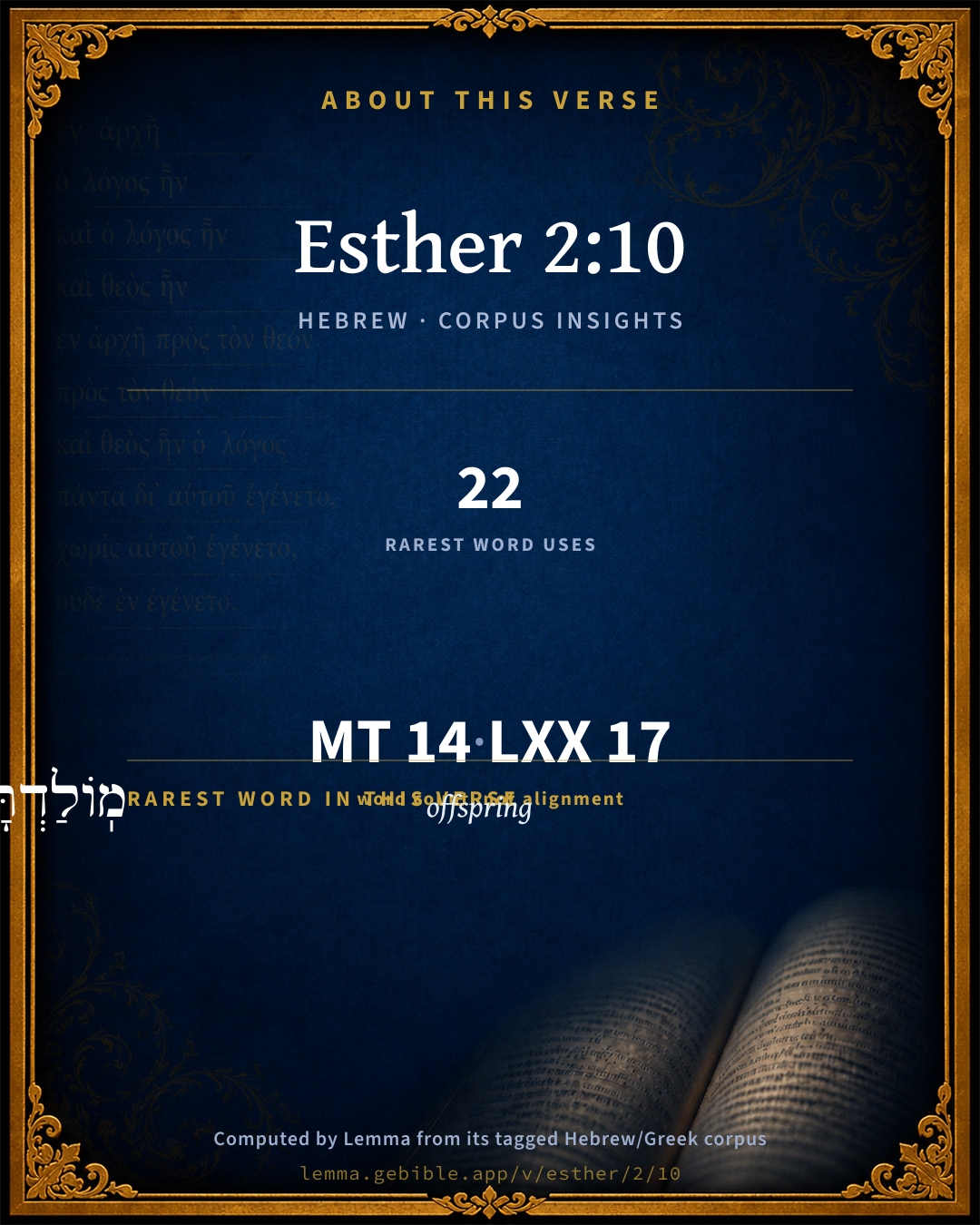
The rarest word here is מֽוֹלַדְתָּ֑הּ offspring H4138 — appearing just 22 times in the whole Hebrew Bible.

Shared distinctive vocabulary

מֽוֹלַדְתָּ֑הּ offspring H4138 occurs in 21 verses of the Hebrew Bible. Also found in:

Grammatical profile

  • 3 verbs
  • 4 nouns
  • 1 preposition
  • 1 conjunction
  • 5 particles

Verb forms

  • הִגִּ֣ידָה Hiphil · Perfect
  • צִוָּ֥ה Piel · Perfect
  • תַגִּֽיד Hiphil · Imperfect

Repetition

Words recur within this verse — often emphatic in Hebrew:

  • הִגִּ֣ידָה to make known H5046 ×2
  • לֹא not H3808 ×2

Hebrew & Septuagint length

In English translation the verse runs 22 words from the Hebrew and 18 from the Septuagint (LXX English) — closely comparable.

A rough comparison of the two English renderings, which tokenize alike — not a word-level alignment.

Word counts can differ between the Hebrew and the Greek without any difference in meaning — e.g. the Hebrew direct-object marker אֵת has no separate Greek word, and Greek often adds the article ὁ.

In the original languages it is 14 Hebrew tokens and 17 Greek tokens — but the two are counted differently (Hebrew bundles its prefixes and suffixes into one token; the Greek is in lemma form), so that isn’t a like-for-like length.

Cross-references

7

Topical passages linked to Esther 2:10 in the Treasury of Scripture Knowledge — connected by theme and wording, ordered by reader-vote popularity; previews shown in the World English Bible.

  • Esther 2:20 Esther had not yet made known her relatives nor her people; as Mordecai had charged her: for Esther did the commandment of Mordecai, like as when she was brought up with him.
  • Matthew 10:16 "Behold, I send you out as sheep in the midst of wolves. Therefore be wise as serpents, and harmless as doves.
  • Esther 3:8 Haman said to king Ahasuerus, There is a certain people scattered abroad and dispersed among the peoples in all the provinces of your kingdom; and their laws are diverse from [those of] every people; neither keep they the king's laws: therefore it is not for the king's profit to allow them.
  • Ephesians 6:1 Children, obey your parents in the Lord, for this is right.
  • Esther 4:13–14 Then Mordecai bade them return answer to Esther, Don't think to yourself that you shall escape in the king's house, more than all the Jews.
  • Esther 2:7 He brought up Hadassah, who is, Esther, his uncle's daughter: for she had neither father nor mother, and the maiden was fair and beautiful; and when her father and mother were dead, Mordecai took her for his own daughter.
  • Esther 7:4 for we are sold, I and my people, to be destroyed, to be slain, and to perish. But if we had been sold for bondservants and bondmaids, I had held my peace, although the adversary could not have compensated for the king's damage.

Cross-references courtesy of OpenBible.info (CC BY 4.0).

Hebrew and Greek witnesses Masoretic Hebrew ↔ Greek Septuagint

The same verse in the two great witnesses to the Old Testament, shown verse-for-verse.

These are two independent witnesses, not word-aligned to each other, and the Septuagint is shown in lemma (dictionary) form.

Hebrew Esther 2:10 Masoretic · Westminster Leningrad Codex

לֹא הִגִּ֣ידָה אֶסְתֵּ֔ר אֶת עַמָּ֖הּ וְאֶת מֽוֹלַדְתָּ֑הּ כִּ֧י מָרְדֳּכַ֛י צִוָּ֥ה עָלֶ֖יהָ אֲשֶׁ֥ר לֹא תַגִּֽיד

Esther had not made known her people nor her relatives; for Mordecai had charged her that she should not make it known.

World English Bible · Public Domain

Greek LXX Esther 2:10 Septuagint · lemma form

καί οὐ ὑποδεικνύω εσθηρ ὁ γένος αὐτός οὐδέ ὁ πατρίς ὁ γάρ μαρδοχαῖος ἐντέλλω αὐτός μή ἀποἀγγέλλω

But Esther did not reveal her family nor her kindred: for Mardochaeus had charged her not to tell.

LXX2012 (modern English Septuagint) · Public Domain

Hebrew: Westminster Leningrad Codex (CC BY 4.0). Greek: Septuagint (public domain); English from LXX2012 (modern English Septuagint) (Public Domain). How the Septuagint differs from the Hebrew →

Commentary

Notes on Esther 2:10 from classic Christian and Jewish commentators (each source and its license shown beneath its notes). The classic Christian expositions comment on the surrounding passage and are grouped to its opening verse, so a note may address several verses; the Jewish commentaries on the Tanakh (Rashi and others) are per-verse, so they appear only where the commentator wrote on this verse.

Lemma curates 59 commentaries, every one of them public domain or Creative Commons licensed, each selected and text-cleaned for this edition rather than reprinted as found. About our sources →

Trapp's Complete Commentary

John Trapp

Est 2:10 Esther had not shewed her people nor her kindred: for Mordecai had charged her that she should not shew [it].

Ver. 10. Esther had not shewed her people] Because the Jews were slighted as captives and forlorn (how dear to the gods that nation is, saith Cicero, it appeareth, quod est victa, quod elocata, quod servata, in that they are conquered, captivated, and not utterly destroyed by us), they were also generally hated, as different in religion, and would not so much as drink with heathens, lest they should drink things sacrificed to idols. They held it meritorious in later times to kill an idolater, as Tacitus testifieth; and at this day they say, Optimus inter gentes, &c., The very best among the Gentiles is worthy to have his head bruised as a serpent. A nasty people they are still, and blood thirsty, odious, and sordid. A historian telleth us of an emperor, travelling into Egypt, and there meeting with certain Jews, he was so annoyed with the stench of them, that he cried out, O Marcomanni, O Quadi, O Sarmatae, tandem alios vobis deteriores inveni (Ammian. lib. 2), This is the basest and most contemptible people that ever I lighted upon. The Romans would not own them, when they had conquered them, as they did other nations, though they complied never so much, and were their servants (Aug. in Psa 58:1-11). The Turks so hate them for crucifying Christ, that they use to say, in detestation of a thing, I would I might die a Jew, then; as when they would assure anything, in execrationibus dicunt Iudaeus sim, si fallo, they curse themselves, and say, Let me be held a Jew if I deceive thee (Sanctius in Zec 8:13). This lieth upon them as a punishment for their unexpiable guilt in putting to death the Lord of life. But in Esther’s time they were hated chiefly for their religion. In prudence, therefore, she concealeth her kindred, as being not called to give an account of her faith; and, living private, might well perform her devotions, and yet not thrust herself into observation.

For Mordecai had charged her that she should not shew it] Lest she should be cashiered the court for a Jewess, which was then held crime enough, as afterwards it was, in Nero’s days, to be a Christian; and this haud perinde in crimine, quam odio humani generis, as Tacitus hath it, not for any great fault so much, as by the hatred of mankind, incensed and set on work by the devil, doubtless, to root out the true religion, and to set up himself in the hearts of men as god of this present world. Hence those complaints of Tertullian and Justin Martyr, in their Apologies for Christians, that their name, and not their crimes, was hated and hissed out of all companies. Odio publico est confessio nominis, non examinatio criminis. Solius hominis crimea est, &c. (Tert. Apol. c. 1-3; Just. Apol. 2). Wisely, therefore, did Mordecai charge Esther to conceal herself for present; so long as it might be done without prejudice to the truth, and scandal to her profession. Worthily also did holy Esther, in obeying Mordecai, her faithful foster father, in ruling her tongue, that unruly member; and in that, although she had changed her keeper, yet she had not let go her integrity, but held with that good woman, in Jerome, who cried out, Non ideo fateri volo, ne peream: sed ideo mentiri nolo, ne peccem.

John Trapp, A Commentary or Exposition upon All the Books of the Old and New Testament (1647–1656) — public domain. Text from a community e-Sword module.

Joseph Benson's Commentary

Est 2:10. Mordecai had charged her that she should not show it — Lest the knowledge hereof should either make her contemptible, or bring some inconvenience to the whole nation: but there was also a hand of God in causing this to be concealed, for the better accomplishment of that which he designed, though Mordecai was ignorant of it. If Mordecai sought or desired that his niece should become either the king’s concubine or wife, he certainly acted contrary to the Jewish law, which forbid any marriage or communication of that sort with idolaters; but the circumstances of things, and perhaps the hopes he entertained of being able to do his nation great service thereby, may plead his excuse.

Joseph Benson's Commentary on the Old and New Testaments (1811–1818) — public domain. Text from a community e-Sword module.

Keil & Delitzsch

C. F. Keil & F. Delitzsch

Est 2:10 contains a supplementary remark. This kind and respectful treatment was shown to Esther, because, in obedience to Mordochai's command, she had not shown her people nor her kindred, i.e., her Jewish extraction; for a Jewish maiden would hardly have experienced such friendly usage. Est 2:11 also contains an additional notice, prefixed here to enable what follows to be rightly understood, and repeated in another connection Est 2:19, and on several other occasions: Mordochai walked every day before the court or enclosure of the women's house, to know the welfare (שׁלום) of Esther and what became of her (בּה יעשׂה, properly, what was done to her). Hence Mordochai was in constant communication with Esther. How this communication was effected is not more particularly stated; probably by means of the maids appointed to wait on her. Jewish expositors are of opinion, that Mordochai held high office, and that having consequently free access to the royal palace, he could easily find the means of communicating with his relative.

Keil & Delitzsch — Biblical Commentary on the Old Testament (1861–1891) — public domain (CC PDM 1.0). Text via the HelloAO Bible API. (Old Testament only.)

Tyndale Open Study Notes

Tyndale Open Resources

2:10 Mordecai had probably already experienced some prejudice against Jews. Esther’s Jewish background would later become the key to her exposing Haman’s terrible plot.

Tyndale Open Study Notes — © Tyndale Open Resources, licensed CC BY-SA 4.0. Text via the HelloAO Bible API.

Adam Clarke's Commentary

Verse 10. Esther had not showed her people] This might have prejudiced her with the king; for it was certainly no credit at the Persian court to be a Jew; and we shall find from the sequel that those who were in the Persian dominions were far from being reputable, or in a safe state. Besides, had her lineage been known, envy might have prevented her from ever having access to the king.

Adam Clarke's Commentary on the Bible (1810–1826) — public domain. Text from a community e-Sword/MySword module.

Ellicott's Commentary for English Readers

(10) Esther had not shewed . . .—From the hope on Mordecai’s part that she might pass for a native Persian, and that her Jewish birth should be no hindrance to her advancement. The king does not learn his wife’s nation till some time afterwards (Est_7:4).

A Bible Commentary for English Readers, edited by Charles John Ellicott (1878–1897) — public domain. Text from a community e-Sword module.

The Cambridge Bible for Schools and Colleges

gen. ed. J. J. S. Perowne

10. Esther had not shewed her people nor her kindred] We must suppose that it would easily be discovered that she, like many of her companions (see Est_2:3), was not Persian by nation. Thus what she desired to conceal was not simply that she was a foreigner, but that she was a Jewess. Nevertheless we have no knowledge from any other source that there was a special antipathy to her people on the part of the Persians. The concealment of her nationality must, one would think, have involved her in various acts both connected with food (cp. Dan_1:8 etc.) and otherwise, which were inconsistent with Judaism. According to the Targum Shçnî the king on one occasion said to her, “Pray, tell me, who are thy people, and what is thy family?” She replied, “I am ignorant both concerning my people and concerning my family, because, when I was quite a child, my father and mother died and left me.” (Cassel, Comm. p. 302.)

The Cambridge Bible for Schools and Colleges (gen. ed. J. J. S. Perowne; Cambridge University Press, 1878–1918) — public domain. Text from a community e-Sword module.

John Gill's Exposition

Esther had not showed her people nor her kindred,.... What nation or family she was of; it not being asked, she was under no obligation to declare it; and being born in Shushan, as very probable, she was taken to be a Persian:

for Mordecai had charged her that she should not show it; lest she should be despised and ill treated on that account; fearing, if the king knew it, he would not marry her, as Aben Ezra; or rather, as the same writer thinks, that she might keep the law of God privately, observe the sabbath, &c.

John Gill's Exposition of the Whole Bible (1746–1763) — public domain (CC PDM 1.0). Text via the HelloAO Bible API.

Albert Barnes' Notes on the Bible

The Persians had no special contempt for the Jews; but, of course, they despised more or less all the subject races. Esther, with her Aryan name, may have passed for a native Persian.

Albert Barnes' Notes on the Bible (1834–1885) — public domain. Text from a community e-Sword/MySword module.

Haydock's Catholic Bible Commentary

Would. Hebrew, "had not declared." He was not influenced to treat her thus on account of her royal extraction. (Haydock) --- In effect, the Jews were despised. (Calmet)

George Leo Haydock (1774–1849), Haydock's Catholic Family Bible and Commentary, 1859 edition — public domain. Excludes Psalms (Douay-Rheims chapter numbering differs from Protestant) and Deuterocanonical books (Catholic canon only).

Matthew Poole's English Annotations

Lest the knowledge hereof should either make her contemptible or odious, or bring some inconvenience to the whole nation, as things might happen. But there was also a hand of God in causing this to be concealed, for the better accomplishment of that which he designed, though Mordecai was ignorant of it.

Matthew Poole's English Annotations on the Holy Bible (1683–1685) — public domain. Text from a community e-Sword/MySword module.

Whedon's Commentary on the Bible

Daniel D. Whedon

10. Not showed her people — She was directed to this course by her cousin and foster-father as a matter of politic prudence, lest her attachment to her race and religion should prejudice her interests with the officers of the harem.

Daniel D. Whedon (gen. ed.), Commentary on the Old and New Testaments (1874–1909) — public domain. Text from a community e-Sword module.

The Pulpit Commentary

Esther had not showed her people. To have confessed that she was a Jewess would probably have roused a prejudice against her, or at any rate have prevented her from being received with special favour. Mordecai, knowing this, had instructed her to say nothing to Hegel on the subject, and no one else, it would seem, had enlightened him.

Reserve and reticence.

Both when residing in the king"s house, under the custody of Hegai, the keeper of the women, and afterwards, when promoted to be queen, Esther concealed her family and her nationality. This is expressly mentioned in verses 10 and 20, and stress is evidently laid upon her acting thus. A general practical lesson may be drawn from this part of Esther"s conduct.

I THERE ARE OCCASIONS FOR RESERVE AND RETICENCE WITH REGARD TO ONESELF. Such concealment is especially repugnant to our frank and open English habits. Yet there may be reasons and justification for it.

1. Filial obedience may require such reticence. Esther was charged to act as she did; and, even when raised to the throne, she "did the commandment of Mordecai, like as when she was brought up with him." Her guardian"s care of her entitled him to use some authority, which her just gratitude disposed her to acknowledge.

2. Prudence may make such reticence expedient. It was probably for Esther"s advantage that her nationality should remain a secret in her own bosom. Had it been known that she was a Jewess, an exile, she might have had to endure some suffering, and disfavour, and contempt. There was no sufficient reason for disclosing her kindred and people; no one had a right to interrogate her thereupon; and she was not guilty of falsehood, or of deceit, in acting as she did.

II THERE ARE OCCASIONS WHEN RESERVE AND RETICENCE MUST BE THROWN ASIDE. The wise man tells us, "There is a time to keep silence, and a time to speak." The time came when Esther spoke out, and declared herself one of the exiled and contemned race, against which the haughty minister of state was maliciously plotting: Until then there was no obligation for her to reveal herself; after that moment silence would have been guilty. Christ himself remained silent amidst the accusations and calumnies of the false witnesses; but when adjured by the high priest, he acknowledged himself to be the Messiah, and the Son of God. There is scope for great discretion and prudence in the conduct of those who mix much with the world, and especially of those who are connected with courts and governments. The Christian will often stand in need of that guidance, which can be obtained only by consulting the oracles of God, and by seeking the teaching of the Spirit of all wisdom and grace.

The Pulpit Commentary (1880–1919), ed. H.D.M. Spence-Jones & Joseph S. Exell — public domain. Text from a community e-Sword module.

John Wesley's Explanatory Notes

Shew it - Lest the knowledge hereof should either make her contemptible, or bring some inconvenience to the whole nation; but there was also an hand of God in causing this to be concealed, for the better accomplishment of that which he designed, though Mordecai was ignorant of it.

John Wesley, Explanatory Notes Upon the Whole Bible (1754–1765) — public domain. Text via the GEBible commentary corpus.

unfoldingWord translationNotes

Door43 World Missions Community

about Esther's welfare

"how Esther was doing" or "about Esther's well-being"

translationWords

Esther

people group

Mordecai

unfoldingWord translationNotes — © Distant Shores Media and the Door43 World Missions Community, licensed CC BY-SA 4.0. Source: git.door43.org/Door43/en_tn.

Rashi

Rabbi Shlomo Yitzchaki (Rashi)

not to reveal so that they should say that she was from an ignoble family and dismiss her, for if they knew that she was of the family of King Saul, they would detain her.

Rashi on the Tanakh — English translations: “The Judaica Press complete Tanach with Rashi, translated by A. J. Rosenberg” (CC BY 4.0); “Pentateuch with Rashi's commentary by M. Rosenbaum and A.M. Silbermann, 1929-1934” (public domain); “The Metsudah Tanach series, Lakewood, N.J” (CC BY 4.0); and “The Book of Joshua, Metsudah Publications, 1997” (CC BY 4.0). Text via Sefaria.

Lesson kit

Teaching starters — assembled from the data on this page, not authored interpretation. Every prompt links to the verse data it draws on. Edit before teaching.

Esther, in the Historical, opens this verse with 14 words (11 distinct Hebrew lemmas). Its most distinctive word is môwledeth (“offspring”). A historical commentator’s framing appears above. Read the whole chapter for the surrounding context.

Discussion questions

  1. The word môwledeth carries the sense “offspring.” How does it shape the verse?
  2. Genesis 11:28 shares the word «offspring» with this verse. How do the two illuminate each other?
  3. “to make known” occurs 2× in this one verse. What is the effect of the repetition?
  4. These translations render this verse differently. What is at stake in choosing one wording over another?
  5. The verb «הִגִּ֣ידָה» is Hiphil Perfect. How does its form color the action?
  6. Reading how Trapp's Complete Commentary and Joseph Benson's Commentary read this verse, where do the two commentators agree and where do they part?

Things to notice

Reading settings

Reading text

Shown beneath each verse's original-language words.

Old Testament
Old Testament edition

Read the OT as the Masoretic Hebrew (MT) or the Greek Septuagint (LXX).

English shown for the Greek Septuagint (in the Hebrew ↔ Greek comparison).

Comparing translations? Open the Compare panel on any verse page to stack up to four side by side.