
Deuteronomy 12:28

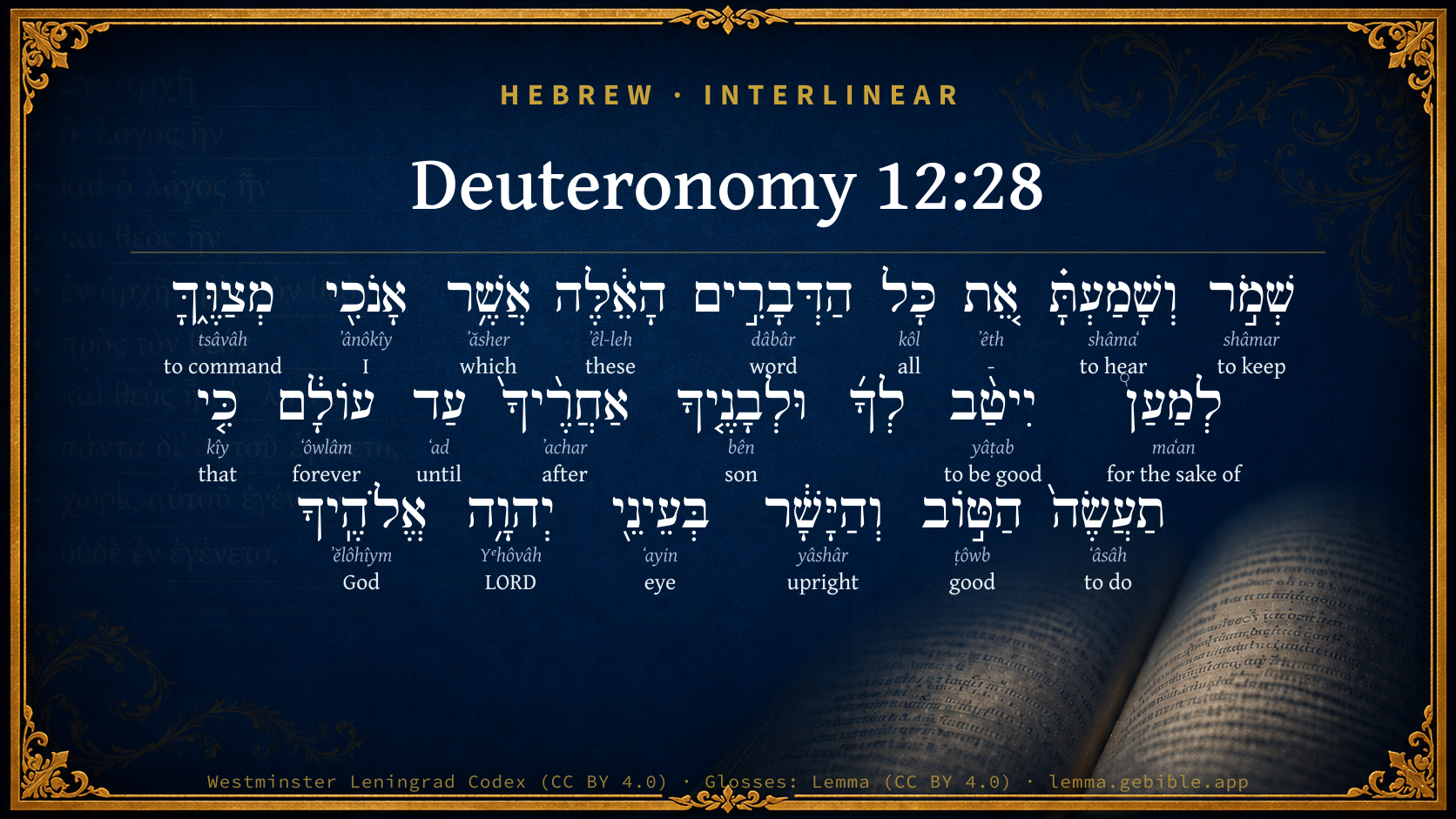
Hebrew (Westminster Leningrad Codex) Deuteronomy 12:28 appears in the Hebrew Old Testament. The text above is from the Westminster Leningrad Codex. Each word links to its Strong’s number, a concise gloss, and parsing drawn from the Open Scriptures Hebrew Bible morphology. Click any word for its full Brown-Driver-Briggs (BDB) entry.
Download image
Cite this verse

Deuteronomy 12:28 (World English Bible). Public Domain. Lemma interlinear Bible study tool, https://lemma.gebible.app/v/deuteronomy/12/28.

Show BibTeX & RIS
BibTeX
RIS
English Translation
Observe and hear all these words which I command you, that it may go well with you, and with your children after you forever, when you do that which is good and right in the eyes of Yahweh your God.
World English Bible · Public Domain
Download a study sheet

One document with this verse’s original text, its word-by-word gloss line, the meaning frame, cross-references with their text, attributed commentary, and full source and license credits — printable, and it pastes into notes with its structure intact.

This verse Autodidact and up

Study sheet (.html) Plain text (.txt)

A passage Seminary Student

Up to 50 verses in one chapter. A passage sheet keeps up to 6 commentary sources and 12 cross-references per verse, in the order this page ranks them, and says so on the sheet whenever that leaves anything out. Ask for a single verse and you get the Autodidact verse sheet above.

Everything on this page stays free to read, with no account — the sheet is a download of what is already on screen, not access to it.

Want to remove ads? Support Godless Engineer
Compare translations 3

The same verse in 3 English versions, stacked beneath the original-language interlinear above. Click any original word for its lexicon entry.

Each is an independent rendering of the whole verse — the interlinear is not word-aligned to these translations.

Highlighted words mark where these versions differ — a whole-verse word diff, not a word-by-word alignment.

  • World English Bible Public Domain
    Observe and hear all these words which I command you, that it may go well with you, and with your children after you forever, when you do that which is good and right in the eyes of Yahweh your God.
  • King James Version Public Domain
    Observe and hear all these words which I command thee, that it may go well with thee, and with thy children after thee for ever, when thou doest that which is good and right in the sight of the LORD thy God.
  • unfoldingWord Literal Text CC BY-SA 4.0
    Keep and listen to all these words that I command you so that it may go well for you and for your sons after you until forever, when you do the good and the right in the eyes of Yahweh your God.

unfoldingWord Literal Text — © unfoldingWord, licensed CC BY-SA 4.0. Word-aligned USFM3 via Door43 (git.door43.org/unfoldingWord/en_ult).

Versions to compare (up to 4)

3 of 4 selected

Show all 18 translations

Every available English version of this verse, each an independent rendering of the whole verse.

  • World English Bible Public Domain
    Observe and hear all these words which I command you, that it may go well with you, and with your children after you forever, when you do that which is good and right in the eyes of Yahweh your God.
  • Berean Standard Bible Public Domain
    Be careful to obey all these things I command you, so that it may always go well with you and your children after you, because you will be doing what is good and right in the eyes of the LORD your God.
  • Majority Standard Bible Public Domain
    Be careful to obey all these things I command you, so that it may always go well with you and your children after you, because you will be doing what is good and right in the eyes of the LORD your God.
  • King James Version Public Domain
    Observe and hear all these words which I command thee, that it may go well with thee, and with thy children after thee for ever, when thou doest that which is good and right in the sight of the LORD thy God.
  • American Standard Version (1901) Public Domain
    Observe and hear all these words which I command thee, that it may go well with thee, and with thy children after thee for ever, when thou doest that which is good and right in the eyes of Jehovah thy God.
  • Revised Version (1885) Public Domain
    Observe and hear all these words which I command thee, that it may go well with thee, and with thy children after thee for ever, when thou doest that which is good and right in the eyes of the LORD thy God.
  • Geneva Bible (1599) Public Domain
    Take heede, and heare all these woordes which I commaund thee, that it may goe well with thee, and with thy children after thee for euer, when thou doest that which is good and right in the sight of the Lord thy God.
  • Douay-Rheims (1899) Public Domain
    Observe and hear all the things that I command thee, that it may be well with thee and thy children after thee for ever, when thou shalt do what is good and pleasing in the sight of the Lord thy God.
  • Young's Literal Translation Public Domain
    Observe, and thou hast obeyed all these words which I am commanding thee, in order that it may be well with thee and with thy sons after thee -- to the age, when thou dost that which `is' good and right in the eyes of Jehovah thy God.
  • Literal Standard Version CC BY-SA 4.0
    Observe, and you have obeyed all these words which I am commanding you, in order that it may be well with you and with your sons after you for all time, when you do that which [is] good and right in the eyes of your God YHWH.
  • Unlocked Literal Bible CC BY-SA 4.0
    Observe and listen to all these words that I command you, that it may go well with you and with your children after you forever, when you do what is good and right in the eyes of Yahweh your God.
  • unfoldingWord Literal Text CC BY-SA 4.0
    Keep and listen to all these words that I command you so that it may go well for you and for your sons after you until forever, when you do the good and the right in the eyes of Yahweh your God.
  • Darby Bible Public Domain
    Take heed to hear all these words which I command thee, that it may be well with thee, and with thy children after thee for ever, when thou doest what is good and right in the eyes of Jehovah thy God.
  • World Messianic Bible Public Domain
    Observe and hear all these words which I command you, that it may go well with you and with your children after you forever, when you do that which is good and right in the LORD your God’s eyes.
  • Webster's Bible Public Domain
    Observe and hear all these words which I command thee, that it may be well with thee, and with thy children after thee for ever, when thou doest that which is good and right in the sight of the LORD thy God.
  • Free Bible Version CC BY-SA 4.0
    Make sure you obey everything I'm commanding you, so that it may always go well with you and your children, because you will be following what is good and right in the sight of the Lord your God.
  • Bible in Basic English Public Domain
    Take note of all these orders I am giving you and give attention to them, so that it may be well for you and for your children after you for ever, while you do what is good and right in the eyes of the Lord your God.
  • JPS Tanakh (1917) Public Domain
    Observe and hear all these words which I command thee, that it may go well with thee, and with thy children after thee for ever, when thou doest that which is good and right in the eyes of the LORD thy God.

Literal Standard Version (2020), Covenant Press — licensed CC BY-SA 4.0. Text via the HelloAO Bible API (eBible.org). Unlocked Literal Bible (unfoldingWord) — licensed CC BY-SA 4.0. Text via the HelloAO Bible API (eBible.org). unfoldingWord Literal Text — © unfoldingWord, licensed CC BY-SA 4.0. Word-aligned USFM3 via Door43 (git.door43.org/unfoldingWord/en_ult). Free Bible Version, Dr. Jonathan Gallagher — licensed CC BY-SA 4.0. Text via the HelloAO Bible API (eBible.org).

Word by word

More ways to search: Search by grammar → Find every occurrence → Compare this word →

Practice this passage: Drill this verse → Learn its vocabulary →

יִיטַ֨ב
yâṭab
H3190
“to be good”
Verb, Qal, Imperfect, 3rd Person, Masculine, Singular
Part of Speech
Verb
Stem
Qal
Form
Imperfect
Person
3rd Person
Gender
Masculine
Number
Singular
Full BDB Definition

Origin: a primitive root

TWOT: 863

to be good, be pleasing, be well, be glad - (Qal) - to be glad, be joyful - to be well placed - to be well for, be well with, go well with - to be pleasing, be pleasing to - (Hiphil) - to make glad, rejoice - to do good to, deal well with - to do well, do thoroughly - to make a thing good or right or beautiful - to do well, do right
  1. שְׁמֹ֣ר shâmar H8104 “keep” Verb, Qal, Imperative, 2nd Person, Masculine, Singular
  2. וְשָׁמַעְתָּ֗ shâmaʻ H8085 “and · to hear” Conjunction + Verb, Qal, Sequential Perfect, 2nd Person, Masculine, Singular
  3. אֵ֚ת ʼêth H853 “-” Particle, Direct Object
  4. כָּל kôl H3605 “all of” Noun, Common, Masculine, Singular, Construct
  5. הַדְּבָרִ֣ים dâbâr H1697 “the · words” Particle, Definite Article + Noun, Common, Masculine, Plural, Absolute
  6. הָאֵ֔לֶּה ʼêl-leh H428 “the · these” Particle, Definite Article + Pronoun, Demonstrative, Common, Plural
  7. אֲשֶׁ֥ר ʼăsher H834 “which” Particle, Relative
  8. אָנֹכִ֖י ʼânôkîy H595 “I” Pronoun, Personal, 1st Person, Common, Singular
  9. מְצַוֶּ֑ךָּ tsâvâh H6680 “commanding · you” Verb, Piel, Participle Active, Masculine, Singular, Construct + Suffix, Personal, 2nd Person, Masculine, Singular
  10. לְמַעַן֩ maʻan H4616 “for the sake of” Preposition
  11. וּלְבָנֶ֤יךָ bên H1121 “and · to/for · sons · your” Conjunction + Preposition + Noun, Common, Masculine, Plural, Construct + Suffix, Personal, 2nd Person, Masculine, Singular
  12. אַחֲרֶ֨יךָ֙ ʼachar H310 “after · you” Preposition + Suffix, Personal, 2nd Person, Masculine, Singular
  13. עַד ʻad H5704 “until” Preposition
  14. עוֹלָ֔ם ʻôwlâm H5769 “forever” Noun, Common, Masculine, Singular, Absolute
  15. כִּ֤י kîy H3588 “that” Conjunction
  16. תַעֲשֶׂה֙ ʻâsâh H6213 “to do” Verb, Qal, Imperfect, 2nd Person, Masculine, Singular
  17. הַטּ֣וֹב ṭôwb H2896 “the · good” Particle, Definite Article + Adjective, Adjective, Masculine, Singular, Absolute
  18. וְהַיָּשָׁ֔ר yâshâr H3477 “and · the · upright” Conjunction + Particle, Definite Article + Adjective, Adjective, Masculine, Singular, Absolute
  19. בְּעֵינֵ֖י ʻayin H5869 “in/at · eyes of” Preposition + Noun, Common, Both, Dual, Construct
  20. יְהוָ֥ה Yᵉhôvâh H3068 “LORD” Noun, Proper
  21. אֱלֹהֶֽיךָ ʼĕlôhîym H430 “God(s) · your” Noun, Common, Masculine, Plural, Construct + Suffix, Personal, 2nd Person, Masculine, Singular

About this verse

These counts appear in no published source. They are computed here, from the morphology-tagged text and Lemma’s own curated glosses. What Lemma adds →

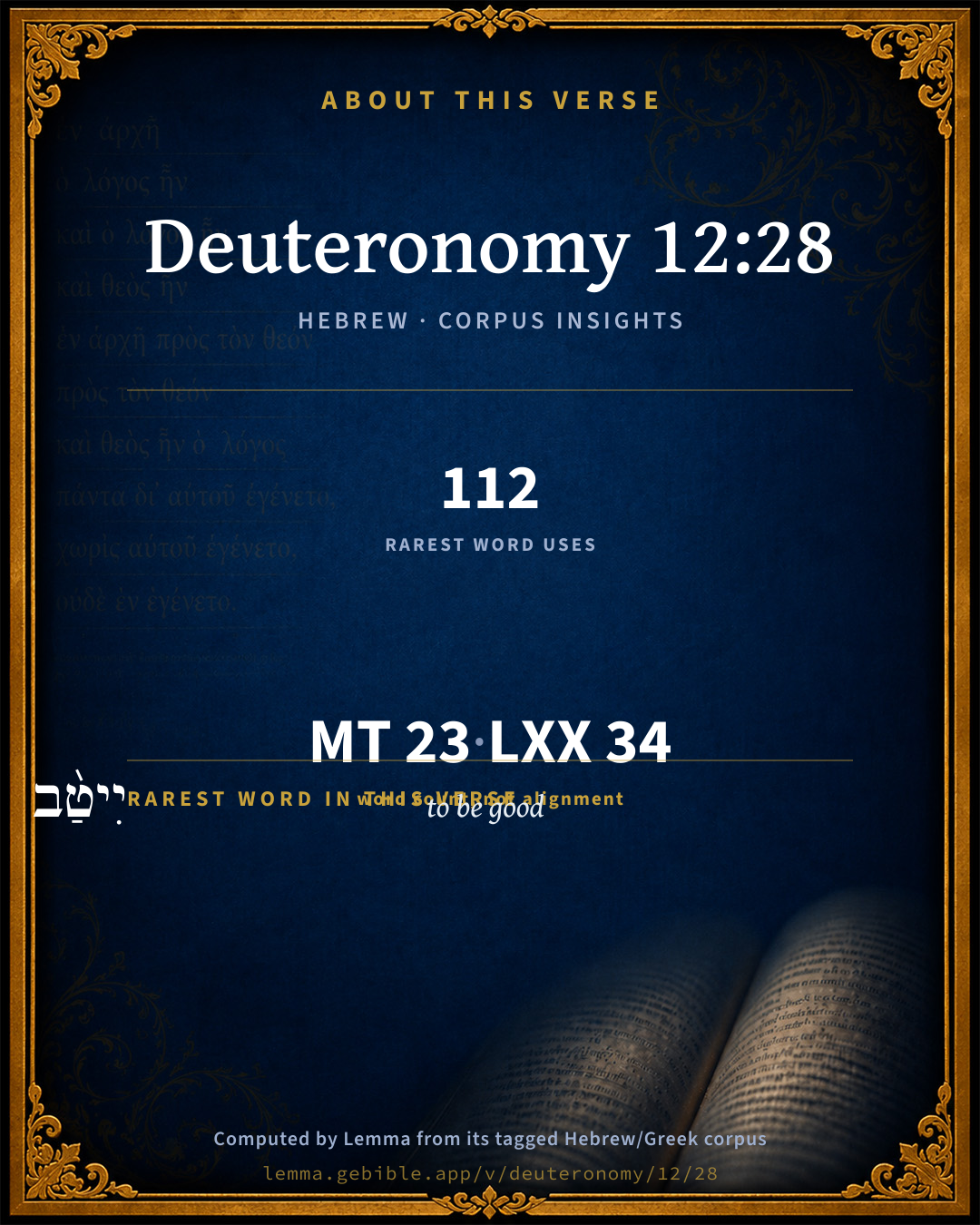
23
words
22
distinct lemmas
Pentateuch
section

Grammatical profile

  • 5 verbs
  • 7 nouns
  • 2 adjectives
  • 2 pronouns
  • 4 prepositions
  • 1 conjunction
  • 2 particles

Verb forms

  • שְׁמֹ֣ר Qal · Imperative
  • וְשָׁמַעְתָּ֗ Qal · Sequential Perfect
  • מְצַוֶּ֑ךָּ Piel · Participle Active
  • יִיטַ֨ב Qal · Imperfect
  • תַעֲשֶׂה֙ Qal · Imperfect

Hebrew & Septuagint length

In English translation the verse runs 40 words from the Hebrew and 42 from the Septuagint (LXX English) — closely comparable.

A rough comparison of the two English renderings, which tokenize alike — not a word-level alignment.

Word counts can differ between the Hebrew and the Greek without any difference in meaning — e.g. the Hebrew direct-object marker אֵת has no separate Greek word, and Greek often adds the article ὁ.

In the original languages it is 23 Hebrew tokens and 34 Greek tokens — but the two are counted differently (Hebrew bundles its prefixes and suffixes into one token; the Greek is in lemma form), so that isn’t a like-for-like length.

Cross-references

12

Topical passages linked to Deuteronomy 12:28 in the Treasury of Scripture Knowledge — connected by theme and wording, ordered by reader-vote popularity; previews shown in the World English Bible.

  • Deuteronomy 4:40 You shall keep his statutes, and his commandments, which I command you this day, that it may go well with you, and with your children after you, and that you may prolong your days in the land, which Yahweh your God gives you, forever.
  • John 15:10 If you keep my commandments, you will remain in my love; even as I have kept my Father's commandments, and remain in his love.
  • John 15:14 You are my friends, if you do whatever I command you.
  • Exodus 34:11 Observe that which I command you this day. Behold, I drive out before you the Amorite, the Canaanite, the Hittite, the Perizzite, the Hivite, and the Jebusite.
  • Leviticus 19:37 You shall observe all my statutes, and all my ordinances, and do them. I am Yahweh.'"
  • Deuteronomy 12:25 You shall not eat it; that it may go well with you, and with your children after you, when you shall do that which is right in the eyes of Yahweh.
  • Deuteronomy 24:8 Take heed in the plague of leprosy, that you observe diligently, and do according to all that the priests the Levites shall teach you: as I commanded them, so you shall observe to do.
  • 2 Chronicles 7:17 As for you, if you will walk before me as David your father walked, and do according to all that I have commanded you, and will keep my statutes and my ordinances;
  • Nehemiah 1:5 and said, I beg you, Yahweh, the God of heaven, the great and awesome God, who keeps covenant and loving kindness with those who love him and keep his commandments:
  • Psalms 105:45 That they might keep his statutes, And observe his laws. Praise Yah!
  • Ezekiel 37:24 My servant David shall be king over them; and they all shall have one shepherd: they shall also walk in my ordinances, and observe my statutes, and do them.
  • John 15:3 You are already pruned clean because of the word which I have spoken to you.

Cross-references courtesy of OpenBible.info (CC BY 4.0).

Hebrew and Greek witnesses Masoretic Hebrew ↔ Greek Septuagint

The same verse in the two great witnesses to the Old Testament, shown verse-for-verse.

These are two independent witnesses, not word-aligned to each other, and the Septuagint is shown in lemma (dictionary) form.

Hebrew Deuteronomy 12:28 Masoretic · Westminster Leningrad Codex

שְׁמֹ֣ר וְשָׁמַעְתָּ֗ אֵ֚ת כָּל הַדְּבָרִ֣ים הָאֵ֔לֶּה אֲשֶׁ֥ר אָנֹכִ֖י מְצַוֶּ֑ךָּ לְמַעַן֩ יִיטַ֨ב לְךָ֜ וּלְבָנֶ֤יךָ אַחֲרֶ֨יךָ֙ עַד עוֹלָ֔ם כִּ֤י תַעֲשֶׂה֙ הַטּ֣וֹב וְהַיָּשָׁ֔ר בְּעֵינֵ֖י יְהוָ֥ה אֱלֹהֶֽיךָ

Observe and hear all these words which I command you, that it may go well with you, and with your children after you forever, when you do that which is good and right in the eyes of Yahweh your God.

World English Bible · Public Domain

Greek LXX Deuteronomy 12:28 Septuagint · lemma form

φυλάσσω καί ἀκούω καί ποιέω πᾶς ὁ λόγος ὅς ἐγώ ἐντέλλομαι σύ ἵνα εὖ σύ γίγνομαι καί ὁ υἱός σύ διά αἰών ἐάν ποιέω ὁ καλός καί ὁ ἀρεστός ἐναντίον κύριος ὁ θεός σύ

Beware and listen, and you shall do all the commands which I charge you, that it may be well with you and with your sons for ever, if you shall do that which is pleasing and good before the Lord your God.

LXX2012 (modern English Septuagint) · Public Domain

Hebrew: Westminster Leningrad Codex (CC BY 4.0). Greek: Septuagint (public domain); English from LXX2012 (modern English Septuagint) (Public Domain). How the Septuagint differs from the Hebrew →

Targum (Aramaic paraphrase)

2

The Targum is the ancient Jewish Aramaic paraphrase of the Hebrew Scriptures — an interpretive translation, not the Hebrew text itself. Onkelos (literal) and Pseudo-Jonathan (expansive) render the Torah, and Jonathan the Prophets. Coverage is partial: where no permissively-licensed English translation exists for a verse, only the Aramaic is shown. This is verse-level text, not a word-by-word alignment to the Hebrew.

  1. Targum Onkelos Torah (Genesis–Deuteronomy)
    טַר וּתְקַבֵּל יָת כָּל פִּתְגָמַיָא הָאִלֵין דִי אֲנָא מְפַקְדָךְ בְּדִיל דְיֵיטַב לָךְ וְלִבְנָיךְ בַּתְרָךְ עַד עֳלָם אֲרֵי תַעְבֵּד דְתָקֵן וּדְכָשַׁר קֳדָם יְיָ אֱלָהָךְ

    (no public-domain English translation for this verse)

    Targum Onkelos — Aramaic: “Onkelos Genesis” (public domain); “Onkelos Exodus” (public domain); “Onkelos Leviticus” (public domain); “Onkelos Numbers” (public domain); “Onkelos Deuteronomy” (public domain). English: “Sefaria Community Translation” (CC0 1.0 (public-domain dedication)); “J.W. Etheridge. The Targums of Onkelos and Jonathan Ben Uzziel on the Pentateuch. London: Longmans, Green, 1862” (public domain). Text via Sefaria.

  2. Targum Pseudo-Jonathan Torah (Genesis–Deuteronomy)
    טוּרוּ וְקַבִּילוּ יַת פִּתְגָמַיָא דַאֲנָא מְפַקֵּיד לְכוֹן מִן בִּגְלַל דְּיֵיטִיב לְכוֹן וְלִבְנֵיכוֹן בַּתְרֵיכוֹן עַד עַלְמָא אֲרוּם תַּעַבְדוּן דְּתַקִּין וּדְכָשַׁר קֳדָם יְיָ אֱלָהָכוֹן

    Observe and obey all these words that I command you, that it may be well with you and with your children after you for ever, while you do that which is good and right before the Lord your God.

    Targum Pseudo-Jonathan — Aramaic: “Targum Jonathan on Genesis” (public domain); “Targum Jonathan on Exodus” (public domain); “Targum Jonathan on Leviticus” (public domain); “Targum Jonathan on Numbers” (public domain); “Targum Jonathan on Deuteronomy” (public domain). English: “The Targum of Jonathan ben Uzziel, trans. J. W. Etheridge, London, 1862” (public domain). Text via Sefaria.

Commentary

Notes on Deuteronomy 12:28 from classic Christian and Jewish commentators (each source and its license shown beneath its notes). The classic Christian expositions comment on the surrounding passage and are grouped to its opening verse, so a note may address several verses; the Jewish commentaries on the Tanakh (Rashi and others) are per-verse, so they appear only where the commentator wrote on this verse.

Lemma curates 59 commentaries, every one of them public domain or Creative Commons licensed, each selected and text-cleaned for this edition rather than reprinted as found. About our sources →

Trapp's Complete Commentary

John Trapp

Deu 12:28 Observe and hear all these words which I command thee, that it may go well with thee, and with thy children after thee for ever, when thou doest [that which is] good and right in the sight of the LORD thy God.

Ver. 28. And with thy children after thee.] Whose comfort they that seek not, are peremptores potius quam parentes, rather parricides than parents. {a}

{a} Bern., Epist., i. 1.

John Trapp, A Commentary or Exposition upon All the Books of the Old and New Testament (1647–1656) — public domain. Text from a community e-Sword module.

The Biblical Illustrator

Joseph S. Exell

Deu_12:28

That it may go well with thee.

Blessings for the obedient

Though salvation is not by the works of the law, yet the blessings which are promised to obedience are not denied to the faithful servants of God. The curses our Lord took away when He was made a curse for us, but no clause of blessing has been abrogated. We are to note the revealed will of the Lord, giving our attention not to portions of it, but to all these words. There must be no picking and choosing, but an impartial respect to all that God has commanded. This is the road of blessedness for the father and for his children. The Lords blessing is upon His chosen to the third and fourth generation. If they walk uprightly before Him, He will make all men know that they are a seed which the Lord hath blessed. No blessing can come to us or ours through dishonesty or double dealing. The ways of worldly conformity and unholiness cannot bring good to us or ours. It will go well with us when we go well before God. If integrity does not make us prosper, knavery will not. That which gives pleasure to God will bring pleasure to us. (C. H. Spurgeon.)

And with thy children after thee.

Care for posterity

God is concerned for posterity. We may mock the suggestion, and put foolish questions concerning the generations yet to come, but the Book of God is as careful about the child unborn as about the old pilgrim born into the higher spaces. God does not insulate Himself by the little present; He contemplates the end from the beginning. All souls are His. He also puts it into our care to regard the welfare of our successors. There is a sense in which we all have a posterity--some in a narrower, some in a larger sense; but we all have a succession: we are influencing tomorrow by our spirit and action today. How mad are they, and how guilty of the cruellest murder, who go on indulging every desire, sating every appetite, satisfying every wish, forgetting that they are involving the yet unborn to pain, weakness, incapacity, and dooming them to lifelong suffering and distress. Here is the greatness of the Bible, the noble condescension of God, the infinite solicitude of the eternal Father. His speech runs to this effect: take care: not only are you involved, but your child and childs child, for generation upon generation: your drunkenness will reappear in the disease of ages yet to come; your bad conduct will repeat itself in a long succession of evil-minded men; your behaviour appears at present to be agreeable, to have some aspects that might be called delightful, but things are not what they seem: actions do not end in themselves; every bad thought you think takes out some spark of vitality from your brain--robs you, depletes you; be careful; have some regard for those who have to succeed you; learn from those who went before you how evil a thing it is to have sown bad seed, and by what you have learned from them conduct yourself aright; if you are true, wise, pure, generous, well-conducted altogether, generations will arise to bless you; if you take care of the poor, if any of your succession be doomed to poverty, with what measure you mete it shall be measured to you and them again; blessed are the merciful, for they shall obtain mercy; with what judgment ye judge ye shall be judged. Life is one: touch it where we may, we send a thrill, a vibration, along all the vital lines. The law is two-fold: sow evil, and reap evil; sow good, and reap good. This is no partial law, dealing with penalty and shame only: it is an impartial righteousness, dealing with reward and glory, and promising delight vast and tender as the heaven of God. (J. Parker, D. D.)

The Biblical Illustrator, edited by Joseph S. Exell (c. 1880s–1900s) — public domain. Text from a community e-Sword module.

Geneva Bible (1599)

Geneva Bible translators

God by promise bindeth himself to do good to them that obey his word.

Geneva Bible (1599) marginal notes — public domain. Text via Bolls.life.

John Gill's Exposition

Observe and hear all these words which I command thee,.... Respecting the demolition of all monuments of idolatry, and bringing all holy things to the place the Lord should choose to dwell in; and eating common flesh in their own houses, only to be careful not to eat blood:

that it may go well with thee, and with thy children after thee for ever; for, as has been often observed, their continuance in the land of Canaan, and enjoyment of all good things in it, depended upon their obedience to the commands of God; see Isa 1:19.

when thou doest that which is good and right in the sight of the Lord thy God; which is to do all his commandments; for these are what are good and right in his sight, and it is for the good of men to do them.

John Gill's Exposition of the Whole Bible (1746–1763) — public domain (CC PDM 1.0). Text via the HelloAO Bible API.

Keil & Delitzsch

C. F. Keil & F. Delitzsch

The closing admonition is a further expansion of Deu 12:25 (see at Deu 11:21). - In Deu 12:29-31, the exhortation goes back to the beginning again, viz., to a warning against the Canaanitish idolatry (cf. Deu 12:2.). When the Lord had cut off the nations of Canaan from before the Israelites, they were to take heed that they did not get into the snare behind them, i.e., into the sin of idolatry, which had plunged the Canaanites into destruction (cf. Deu 7:16, Deu 7:25). The clause "after they be destroyed from before thee" is not mere tautology, but serves to depict the danger of the snare most vividly before their eyes. The second clause, "that thou inquire not after them" (their gods), etc., explains more fully to the Israelites the danger which threatened them. This danger was so far a pressing one, that the whole of the heathen world was animated with the conviction, that to neglect the gods of a land would be sure to bring misfortune (cf. Kg2 17:26).

Keil & Delitzsch — Biblical Commentary on the Old Testament (1861–1891) — public domain (CC PDM 1.0). Text via the HelloAO Bible API. (Old Testament only.)

unfoldingWord translationNotes

Door43 World Missions Community

General Information:

Moses continues speaking to the people of Israel.

Observe and listen to all these words that I command you

"Carefully listen to and obey everything that I am commanding you"

that it may go well with you and with your children after you

Here "children" means all of their descendants. AT: "that you and your descendants may prosper" (See: Synecdoche)

when you do what is good and right

The words "good" and "right" have similar meanings and emphasize the importance of right behavior. AT: "when you do what is right" (See: Doublet)

what is good and right in the eyes of Yahweh

The eyes represent seeing, and seeing represents thoughts or judgment. AT: "what is good and right in Yahweh's judgment" or "what Yahweh considers to be good and right" (See: Metaphor)

translationWords

word

command

children

eternity

good

unfoldingWord translationNotes — © Distant Shores Media and the Door43 World Missions Community, licensed CC BY-SA 4.0. Source: git.door43.org/Door43/en_tn.

Rashi

Rabbi Shlomo Yitzchaki (Rashi)

שמר KEEP [AND HEAR (understand) ALL THESE WORDS WHICH I COMMAND THEE] — This (the word שמר) implies the studying of the oral law — that you must keep it within you that it should not be forgotten, just as it is said, (Proverbs 22:18) “[And apply thy heart unto my knowledge] for it is a pleasant thing if thou keep (תשמרם) them within thee”, and only if thou learnest is it possible that thou wilt understand and fulfil the commands, but one who is not amongst those who study (lit., who is not included in learning) cannot be amongst those who act correctly (cf. Sifrei Devarim 79:3; see also Rashi on Deuteronomy 4:6). (The translation is: keep, i.e. study and retain your learning in mind: ושמעת, and then thou wilt understand how to observe the commands).

את כל הדברים [KEEP …] ALL WORDS [WHICH I COMMAND THEE] — This implies that a light precept should be as dear to you as a grave precept (Sifrei Devarim 79:4).

הטוב [THAT IT MAY GO WELL WITH THEE … WHEN THOU DOEST] WHAT IS GOOD — This refers to an action that is proper in the eyes of the Heavenly Father.

והישר AND WHAT IS RIGHT — this refers to an action that appears to be proper in the eyes of men (Sifrei Devarim 79:5).

Rashi on the Tanakh — English translations: “The Judaica Press complete Tanach with Rashi, translated by A. J. Rosenberg” (CC BY 4.0); “Pentateuch with Rashi's commentary by M. Rosenbaum and A.M. Silbermann, 1929-1934” (public domain); “The Metsudah Tanach series, Lakewood, N.J” (CC BY 4.0); and “The Book of Joshua, Metsudah Publications, 1997” (CC BY 4.0). Text via Sefaria.

Ramban (Nachmanides)

Rabbi Moshe ben Nachman (Ramban / Nachmanides)

OBSERVE AND HEAR ALL THOSE WORDS WHICH I COMMAND THEE. He [Moses] did not mention here the statutes and ordinances, nor His testimonies and His commandments, but said all those words in order to include in this observance the good and the right, as I have explained in the section of Va’ethchanan.

Ramban (Nachmanides) on the Tanakh — English translation: “Commentary on the Torah by Ramban (Nachmanides). Translated and annotated by Charles B. Chavel. New York, Shilo Pub. House, 1971-1976” (CC BY 4.0). Text via Sefaria.

Lesson kit

Teaching starters — assembled from the data on this page, not authored interpretation. Every prompt links to the verse data it draws on. Edit before teaching.

Deuteronomy, in the Pentateuch, opens this verse with 23 words (22 distinct Hebrew lemmas). Its most distinctive word is yâṭab (“to be good”). A historical commentator’s framing appears above. Read the whole chapter for the surrounding context.

Discussion questions

  1. What does “to be good” (yâṭab) contribute to the verse as a whole?
  2. Deuteronomy 4:40 shares this passage’s theme. How do the two illuminate each other?
  3. These translations render this verse differently. What is at stake in choosing one wording over another?
  4. The verb «שְׁמֹ֣ר» is Qal Imperative. How does its form color the action?
  5. Reading how Trapp's Complete Commentary and The Biblical Illustrator read this verse, where do the two commentators agree and where do they part?

Things to notice

Reading settings

Reading text

Shown beneath each verse's original-language words.

Old Testament
Old Testament edition

Read the OT as the Masoretic Hebrew (MT) or the Greek Septuagint (LXX).

English shown for the Greek Septuagint (in the Hebrew ↔ Greek comparison).

Comparing translations? Open the Compare panel on any verse page to stack up to four side by side.