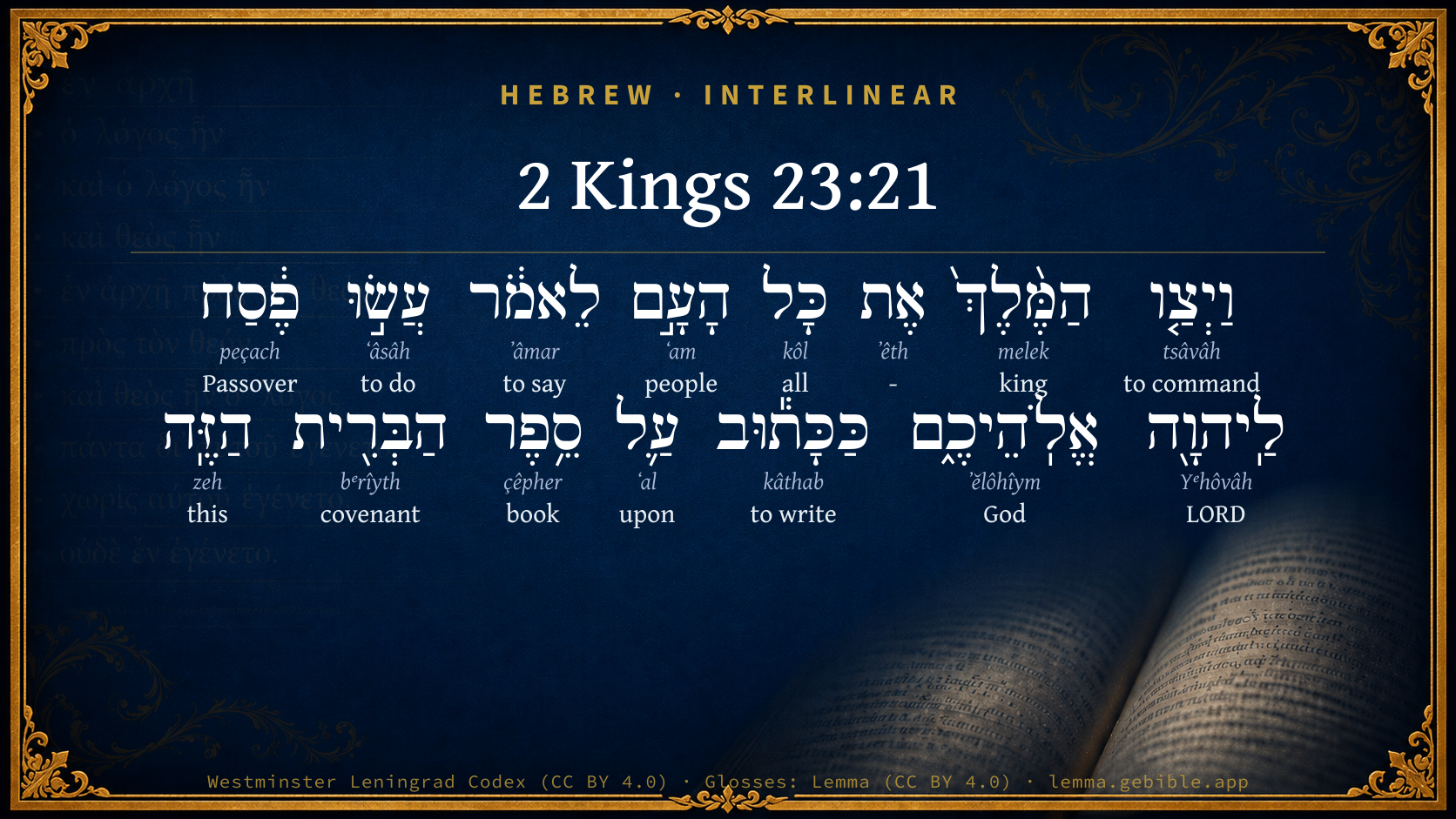
2 Kings 23:21

Hebrew (Westminster Leningrad Codex) 2 Kings 23:21 appears in the Hebrew Old Testament. The text above is from the Westminster Leningrad Codex. Each word links to its Strong’s number, a concise gloss, and parsing drawn from the Open Scriptures Hebrew Bible morphology. Click any word for its full Brown-Driver-Briggs (BDB) entry.
Download image
Cite this verse

2 Kings 23:21 (World English Bible). Public Domain. Lemma interlinear Bible study tool, https://lemma.gebible.app/v/2-kings/23/21.

Show BibTeX & RIS
BibTeX
RIS
English Translation
The king commanded all the people, saying, Keep the Passover to Yahweh your God, as it is written in this book of the covenant.
World English Bible · Public Domain
Download a study sheet

One document with this verse’s original text, its word-by-word gloss line, the meaning frame, cross-references with their text, attributed commentary, and full source and license credits — printable, and it pastes into notes with its structure intact.

This verse Autodidact and up

Study sheet (.html) Plain text (.txt)

A passage Seminary Student

Up to 50 verses in one chapter. A passage sheet keeps up to 6 commentary sources and 12 cross-references per verse, in the order this page ranks them, and says so on the sheet whenever that leaves anything out. Ask for a single verse and you get the Autodidact verse sheet above.

Everything on this page stays free to read, with no account — the sheet is a download of what is already on screen, not access to it.

Want to remove ads? Support Godless Engineer
Compare translations 3

The same verse in 3 English versions, stacked beneath the original-language interlinear above. Click any original word for its lexicon entry.

Each is an independent rendering of the whole verse — the interlinear is not word-aligned to these translations.

Highlighted words mark where these versions differ — a whole-verse word diff, not a word-by-word alignment.

  • World English Bible Public Domain
    The king commanded all the people, saying, Keep the Passover to Yahweh your God, as it is written in this book of the covenant.
  • King James Version Public Domain
    And the king commanded all the people, saying, Keep the passover unto the LORD your God, as it is written in the book of this covenant.
  • unfoldingWord Literal Text CC BY-SA 4.0
    And the king commanded all of the people, saying, “Do Passover for Yahweh your God, as written in this scroll of the covenant.”

unfoldingWord Literal Text — © unfoldingWord, licensed CC BY-SA 4.0. Word-aligned USFM3 via Door43 (git.door43.org/unfoldingWord/en_ult).

Versions to compare (up to 4)

3 of 4 selected

Show all 18 translations

Every available English version of this verse, each an independent rendering of the whole verse.

  • World English Bible Public Domain
    The king commanded all the people, saying, Keep the Passover to Yahweh your God, as it is written in this book of the covenant.
  • Berean Standard Bible Public Domain
    The king commanded all the people, “Keep the Passover of the LORD your God, as it is written in this Book of the Covenant.”
  • Majority Standard Bible Public Domain
    The king commanded all the people, “Keep the Passover of the LORD your God, as it is written in this Book of the Covenant.”
  • King James Version Public Domain
    And the king commanded all the people, saying, Keep the passover unto the LORD your God, as it is written in the book of this covenant.
  • American Standard Version (1901) Public Domain
    And the king commanded all the people, saying, Keep the passover unto Jehovah your God, as it is written in this book of the covenant.
  • Revised Version (1885) Public Domain
    And the king commanded all the people, saying, Keep the passover unto the LORD your God, as it is written in this book of the covenant.
  • Geneva Bible (1599) Public Domain
    Then the king commanded all the people, saying, Keepe the passeouer vnto the Lord your God, as it is written in the booke of this couenant.
  • Douay-Rheims (1899) Public Domain
    And he commanded all the people, saying: Keep the phase to the Lord your God, according as it is written in the book of this covenant.
  • Young's Literal Translation Public Domain
    And the king commandeth the whole of the people, saying, `Make ye a passover to Jehovah your God, as it is written on this book of the covenant.'
  • Literal Standard Version CC BY-SA 4.0
    And the king commands the whole of the people, saying, “Make a Passover to your God YHWH, as it is written on this scroll of the covenant.”
  • Unlocked Literal Bible CC BY-SA 4.0
    Then the king commanded all the people, saying, “Keep the Passover to Yahweh your God, as it is written in this Book of the Covenant.”
  • unfoldingWord Literal Text CC BY-SA 4.0
    And the king commanded all of the people, saying, “Do Passover for Yahweh your God, as written in this scroll of the covenant.”
  • Darby Bible Public Domain
    And the king commanded all the people saying, Hold the passover to Jehovah your God, as it is written in this book of the covenant.
  • World Messianic Bible Public Domain
    The king commanded all the people, saying, “Keep the Passover to the LORD your God, as it is written in this book of the covenant.”
  • Webster's Bible Public Domain
    And the king commanded all the people, saying, Keep the passover to the LORD your God, as it is written in the book of this covenant.
  • Free Bible Version CC BY-SA 4.0
    The king sent out an order to all the people, “Observe the Passover of the Lord your God, as it is written in this Book of the Agreement.”
  • Bible in Basic English Public Domain
    And the king gave orders to all the people, saying, Keep the Passover to the Lord your God, as it says in this book of the law.
  • JPS Tanakh (1917) Public Domain
    And the king commanded all the people, saying: 'Keep the passover unto the LORD your God, as it is written in this book of the covenant.'

Literal Standard Version (2020), Covenant Press — licensed CC BY-SA 4.0. Text via the HelloAO Bible API (eBible.org). Unlocked Literal Bible (unfoldingWord) — licensed CC BY-SA 4.0. Text via the HelloAO Bible API (eBible.org). unfoldingWord Literal Text — © unfoldingWord, licensed CC BY-SA 4.0. Word-aligned USFM3 via Door43 (git.door43.org/unfoldingWord/en_ult). Free Bible Version, Dr. Jonathan Gallagher — licensed CC BY-SA 4.0. Text via the HelloAO Bible API (eBible.org).

Word by word

More ways to search: Search by grammar → Find every occurrence → Compare this word →

Practice this passage: Drill this verse → Learn its vocabulary →

פֶ֔סַח
peçach
H6453
“Passover”
Noun, Common, Masculine, Singular, Absolute
Part of Speech
Noun
Type
Common
Gender
Masculine
Number
Singular
State
Absolute
Full BDB Definition

Origin: from H6452

TWOT: 1786a

passover - sacrifice of passover - animal victim of the passover - festival of the passover
  1. וַיְצַ֤ו tsâvâh H6680 “and · to command” Conjunction + Verb, Piel, Sequential Imperfect, 3rd Person, Masculine, Singular
  2. הַמֶּ֨לֶךְ֙ melek H4428 “the · king” Particle, Definite Article + Noun, Common, Masculine, Singular, Absolute
  3. אֶת ʼêth H853 “-” Particle, Direct Object
  4. כָּל kôl H3605 “all of” Noun, Common, Masculine, Singular, Construct
  5. הָעָ֣ם ʻam H5971 “the · people” Particle, Definite Article + Noun, Common, Masculine, Singular, Absolute
  6. לֵאמֹ֔ר ʼâmar H559 “to say” Preposition + Verb, Qal, Infinitive Construct
  7. עֲשׂ֣וּ ʻâsâh H6213 “do” Verb, Qal, Imperative, 2nd Person, Masculine, Plural
  8. לַֽיהוָ֖ה Yᵉhôvâh H3068 “to/for · LORD” Preposition + Noun, Proper
  9. אֱלֹֽהֵיכֶ֑ם ʼĕlôhîym H430 “God(s) · your” Noun, Common, Masculine, Plural, Construct + Suffix, Personal, 2nd Person, Masculine, Plural
  10. כַּכָּת֕וּב kâthab H3789 “like/as the · written” Preposition, Determined + Verb, Qal, Participle Passive, Masculine, Singular, Absolute
  11. עַ֛ל ʻal H5921 “upon” Preposition
  12. סֵ֥פֶר çêpher H5612 “book of” Noun, Common, Masculine, Singular, Construct
  13. הַבְּרִ֖ית bᵉrîyth H1285 “the · covenant” Particle, Definite Article + Noun, Common, Feminine, Singular, Absolute
  14. הַזֶּֽה zeh H2088 “the · this” Particle, Definite Article + Pronoun, Demonstrative, Masculine, Singular

About this verse

These counts appear in no published source. They are computed here, from the morphology-tagged text and Lemma’s own curated glosses. What Lemma adds →

15
words
15
distinct lemmas
Historical
section

Shared distinctive vocabulary

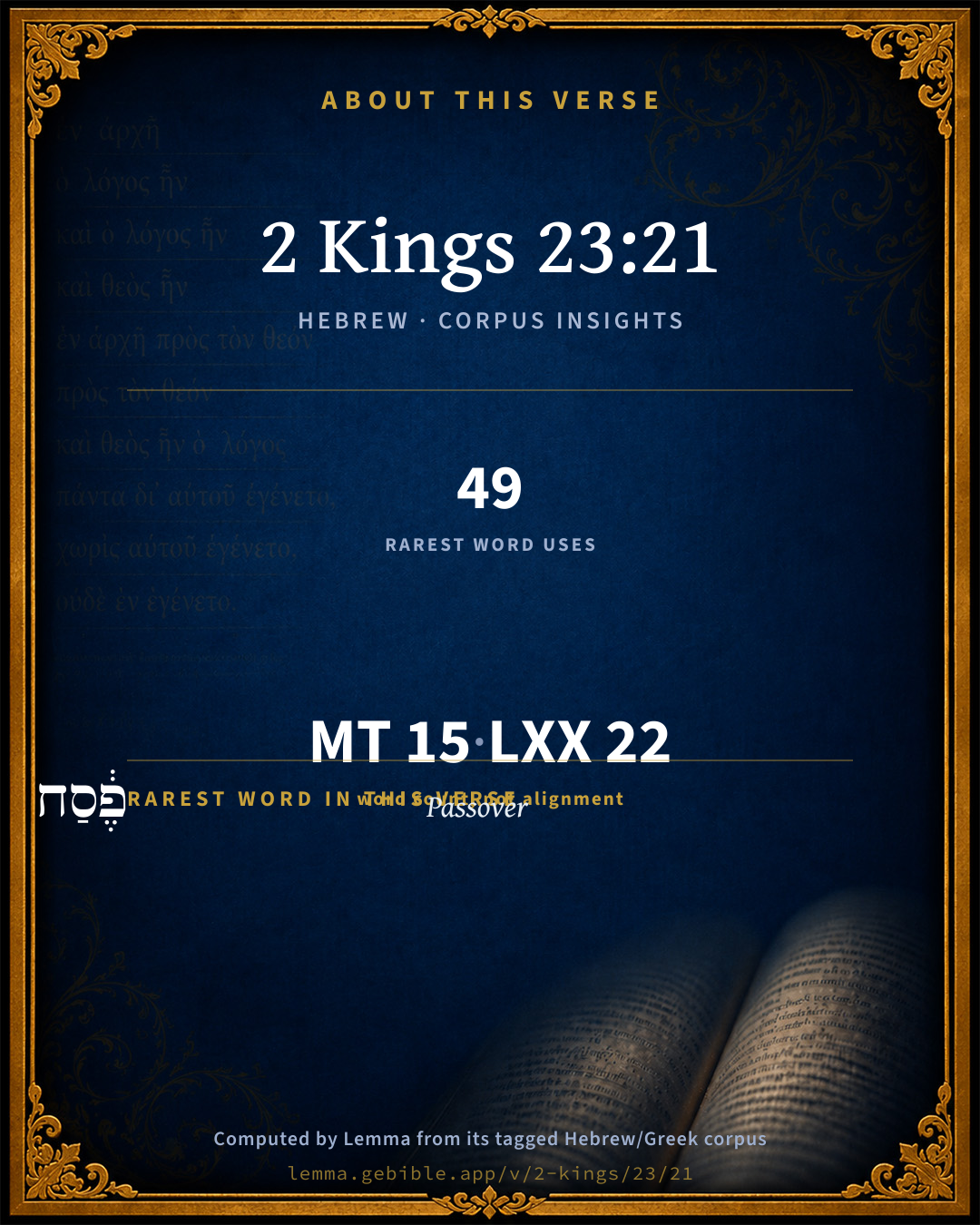
פֶ֔סַח Passover H6453 occurs in 46 verses of the Hebrew Bible. Also found in:

Grammatical profile

  • 4 verbs
  • 8 nouns
  • 1 pronoun
  • 1 preposition
  • 1 particle

Verb forms

  • וַיְצַ֤ו Piel · Sequential Imperfect
  • לֵאמֹ֔ר Qal · Infinitive Construct
  • עֲשׂ֣וּ Qal · Imperative
  • כַּכָּת֕וּב Qal · Participle Passive

Hebrew & Septuagint length

In English translation the verse runs 24 words from the Hebrew and 26 from the Septuagint (LXX English) — closely comparable.

A rough comparison of the two English renderings, which tokenize alike — not a word-level alignment.

Word counts can differ between the Hebrew and the Greek without any difference in meaning — e.g. the Hebrew direct-object marker אֵת has no separate Greek word, and Greek often adds the article ὁ.

In the original languages it is 15 Hebrew tokens and 22 Greek tokens — but the two are counted differently (Hebrew bundles its prefixes and suffixes into one token; the Greek is in lemma form), so that isn’t a like-for-like length.

Cross-references

6

Topical passages linked to 2 Kings 23:21 in the Treasury of Scripture Knowledge — connected by theme and wording, ordered by reader-vote popularity; previews shown in the World English Bible.

  • Deuteronomy 16:1–8 Observe the month of Abib, and keep the Passover to Yahweh your God; for in the month of Abib Yahweh your God brought you forth out of Egypt by night.
  • Numbers 9:2–5 "Moreover let the children of Israel keep the Passover in its appointed season.
  • Exodus 12:3–20 Speak to all the congregation of Israel, saying, 'On the tenth day of this month, they shall take to them every man a lamb, according to their fathers' houses, a lamb for a household;
  • Leviticus 23:5–8 In the first month, on the fourteenth day of the month in the evening, is Yahweh's Passover.
  • Numbers 28:16–25 In the first month, on the fourteenth day of the month, is Yahweh's Passover.
  • 2 Chronicles 35:1–19 Josiah kept a Passover to Yahweh in Jerusalem: and they killed the Passover on the fourteenth [day] of the first month.

Cross-references courtesy of OpenBible.info (CC BY 4.0).

Hebrew and Greek witnesses Masoretic Hebrew ↔ Greek Septuagint

The same verse in the two great witnesses to the Old Testament, shown verse-for-verse.

These are two independent witnesses, not word-aligned to each other, and the Septuagint is shown in lemma (dictionary) form.

Hebrew 2 Kings 23:21 Masoretic · Westminster Leningrad Codex

וַיְצַ֤ו הַמֶּ֨לֶךְ֙ אֶת כָּל הָעָ֣ם לֵאמֹ֔ר עֲשׂ֣וּ פֶ֔סַח לַֽיהוָ֖ה אֱלֹֽהֵיכֶ֑ם כַּכָּת֕וּב עַ֛ל סֵ֥פֶר הַבְּרִ֖ית הַזֶּֽה

The king commanded all the people, saying, Keep the Passover to Yahweh your God, as it is written in this book of the covenant.

World English Bible · Public Domain

Greek LXX 2 Kings 23:21 Septuagint · lemma form

καί ἐντέλλομαι ὁ βασιλεύς πᾶς ὁ λαός λέγω ποιέω ὁ πασχα ὁ κύριος θεός ἐγώ καθώς γράφω ἐπί βιβλίον ὁ διαθήκη οὗτος

And the king commanded all the people, saying, Keep the passover to the Lord your God, as it is written in the book of this covenant.

LXX2012 (modern English Septuagint) · Public Domain

On this verse, Ellicott's Commentary for English Readers discusses the Septuagint’s reading. Read the note in Commentary ↓

Hebrew: Westminster Leningrad Codex (CC BY 4.0). Greek: Septuagint (public domain); English from LXX2012 (modern English Septuagint) (Public Domain). How the Septuagint differs from the Hebrew →

Targum (Aramaic paraphrase)

1

The Targum is the ancient Jewish Aramaic paraphrase of the Hebrew Scriptures — an interpretive translation, not the Hebrew text itself. Onkelos (literal) and Pseudo-Jonathan (expansive) render the Torah, and Jonathan the Prophets. Coverage is partial: where no permissively-licensed English translation exists for a verse, only the Aramaic is shown. This is verse-level text, not a word-by-word alignment to the Hebrew.

  1. Targum Jonathan Prophets (Joshua–Malachi)
    וּפַקֵיד מַלְכָּא יַת כָּל עַמָא לְמֵימַר עֱבִידוּ פִסְחָא קֳדָם יְיָ אֱלָהָכוֹן כְּמָא דִכְתִיב עַל סִפְרָא דִקְיָמָא הָדֵין:

    (no public-domain English translation for this verse)

    Targum Jonathan — Aramaic: “Mikraot Gedolot” (public domain). English: “Sefaria Community Translation” (CC0 1.0 (public-domain dedication)); “London "Chaldee Paraphrase," 1871” (public domain). Text via Sefaria.

Commentary

Notes on 2 Kings 23:21 from classic Christian and Jewish commentators (each source and its license shown beneath its notes). The classic Christian expositions comment on the surrounding passage and are grouped to its opening verse, so a note may address several verses; the Jewish commentaries on the Tanakh (Rashi and others) are per-verse, so they appear only where the commentator wrote on this verse.

Lemma curates 59 commentaries, every one of them public domain or Creative Commons licensed, each selected and text-cleaned for this edition rather than reprinted as found. About our sources →

Trapp's Complete Commentary

John Trapp

2Ki 23:21 And the king commanded all the people, saying, Keep the passover unto the LORD your God, as [it is] written in the book of this covenant.

Ver. 21. Keep the passover.] 2Ch 35:1. If the passover had been neglected, the law, the sacrifices had been in vain. No true Israelite might want whether this monument of their deliverance past, or this type of the Messiah to come. Rather than fail, Josiah’s bounty shall supply to Judah lambs for their paschal devotion. No alms is so acceptable as that whereby the soul is furthered. {a}

{a} Dr Hall.

John Trapp, A Commentary or Exposition upon All the Books of the Old and New Testament (1647–1656) — public domain. Text from a community e-Sword module.

Joseph Benson's Commentary

2Ki 23:21. The king commanded, saying, Keep the passover, &c. — Having abolished false worship, he now endeavours to set up the true worship of the true God. Thus he differed greatly from Jehu, who, when he had destroyed the worship of Baal, took no heed to walk in the commandments and ordinances of God. Josiah considered that we must not only cease to do evil, but also learn to do well, and that the way to keep out all abominable customs is to keep up all instituted ordinances. He therefore commanded all the people to keep the passover, which was not only a memorial of their deliverance out of Egypt, but a token of their being dedicated to him who brought them out, and of their communion with him. As it is written in this book of the covenant — This book which he had found, wherein is contained the covenant made between God and Israel, and the terms of it.

Joseph Benson's Commentary on the Old and New Testaments (1811–1818) — public domain. Text from a community e-Sword module.

Tyndale Open Study Notes

Tyndale Open Resources

23:21-23 Hezekiah had observed the Passover with modifications (2 Chr 30:1-4, 13, 23-27). Josiah’s Passover was done in accordance with the strict standards of the law (2 Chr 35:1-19). • The eighteenth year was the same year in which the Book of the Law was found (2 Kgs 22:3, 8).

Tyndale Open Study Notes — © Tyndale Open Resources, licensed CC BY-SA 4.0. Text via the HelloAO Bible API.

Jamieson, Fausset & Brown

Robert Jamieson, A. R. Fausset & David Brown

the king commanded all the people, saying, Keep the passover unto the Lord your God, &c.--It was observed with great solemnity and was attended not only by his own subjects, but by the remnant people from Israel (see on 2Ch. 35:1-19). Many of the Israelites who were at Jerusalem might have heard of, if they did not hear, the law read by Josiah. It is probable that they might even have procured a copy of the law, stimulated as they were to the better observance of Jehovah's worship by the unusual and solemn transactions at Jerusalem.

Jamieson, Fausset & Brown — Commentary Critical and Explanatory on the Whole Bible (1871) — public domain (CC PDM 1.0). Text via the HelloAO Bible API.

Ellicott's Commentary for English Readers

(21) Keep the passover.—Hold a passover (2Ki_23:22). (Comp. 2Ch_35:1-19 for a more detailed account of this unique celebration.) Josiah had the precedent of Hezekiah for signalising his religious revolution by a solemn passover (2Ch_30:1).

In the book of this covenant.—Rather, in this book of the covenant (2Ki_23:2). The book was that which Hilkiah had found in the Temple, and which gave the impulse to the whole reforming movement. (The LXX. and Vulg. read, in the book of this covenant—a mere mistake.)

A Bible Commentary for English Readers, edited by Charles John Ellicott (1878–1897) — public domain. Text from a community e-Sword module.

The Cambridge Bible for Schools and Colleges

gen. ed. J. J. S. Perowne

21–30. He puts down superstitious rites and worship. He is slain at Megiddo when he goes against the king of Egypt (2Ch_35:1-27; 2Ch_36:1)

21. Keep the passover] The Chronicler gives elaborate details concerning the way in which this feast was kept to shew that all the arrangements commanded by the Law were most exactly observed. On the fourteenth day of the first month, the Levites had special injunctions given to them about the purification of themselves, and the doing of all things according to the word of the Lord by the hand of Moses. The king himself gave the victims, lambs and kids, for the passover offering, from his own substance, and the liberality of priests and Levites was also large. The passover was killed, roasted, divided speedily and eaten according to the prescribed rules. The whole aim of the record is to shew that whatever may have been left undone in times past, everything was now brought into harmony with the primitive ordinance. The Chronicler also mentions by name the rulers of the house of God and the chief of the Levites, as though copying from a contemporary record to which others might refer as well as himself.

in the book of this covenant] R.V. in this book of the covenant. The king desires that whatever may have come to be the manner of celebration from long usage, and the neglect which had been introduced through the sins of the kings, there should now be a precise observance of everything which the authoritative book, recently brought to light, required. It is clear from such a passage as 2Ki_16:15 that the regular observance of the sacrificial ordinances had fallen into disuse.

The Cambridge Bible for Schools and Colleges (gen. ed. J. J. S. Perowne; Cambridge University Press, 1878–1918) — public domain. Text from a community e-Sword module.

John Gill's Exposition

Surely there was not holden such a passover from the days of the judges that judged Israel,.... As the king commanded; the people obeyed and kept the passover, according to the law of the Lord; the manner of its being kept is not here recorded, but is at large in Ch2 35:1 where it is observed there had not been such an one from the days of Samuel, the last of the judges; so that the days of the judges here mean the last days of them:

nor in all the days of the kings of Israel, nor of the kings of Judah; since the division of the kingdoms; for as for the kings of Israel, they kept it not; and though it was observed in the times of Hezekiah king of Judah, yet not universally, and by some in their uncleanness; for it is a mistake of Clemens of Alexandria (w), that it was not kept in the times between Samuel and Josiah; in the days of David and Solomon it might be kept by greater numbers, but not with such purity, and with such cheerfulness and joy of heart, or with so many other sacrifices attending it, or so exactly agreeable to the law of God, and with such munificence and liberality; the king, and the chief of the priests and Levites, providing out of their own substance for the people and their brethren.

(w) Stromat. l. 1. p. 328.

John Gill's Exposition of the Whole Bible (1746–1763) — public domain (CC PDM 1.0). Text via the HelloAO Bible API.

Albert Barnes' Notes on the Bible

See 2Ki 23:4 note. With this verse the author returns to the narrative of what was done in Josiah’s 18th year. The need of the injunction, “as it was written in the book of this covenant,” was owing to the fact - not that Josiah had as yet held no Passover - but that the reading of the book had shown him differences between the existing practice and the letter of the Law - differences consequent upon negligence, or upon the fact that tradition had been allowed in various points to override the Law.

Albert Barnes' Notes on the Bible (1834–1885) — public domain. Text from a community e-Sword/MySword module.

Haydock's Catholic Bible Commentary

Covenant, in Deuteronomy, chap. xxii. 8. (Menochius)

George Leo Haydock (1774–1849), Haydock's Catholic Family Bible and Commentary, 1859 edition — public domain. Excludes Psalms (Douay-Rheims chapter numbering differs from Protestant) and Deuterocanonical books (Catholic canon only).

Matthew Poole's English Annotations

Keep the passover: having abolished false worship, he now endeavours to set up the true worship of the true God.

In this book of the covenant; in this book which I have found; wherein is contained the covenant made between God and Israel, and the terms of it.

Matthew Poole's English Annotations on the Holy Bible (1683–1685) — public domain. Text from a community e-Sword/MySword module.

Whedon's Commentary on the Bible

Daniel D. Whedon

21. Keep the passover — It seemed to the king appropriate to conclude his great work of reform by a proper observance of this most important religious festival.

As it is written in the book of this covenant — Rather, in this book of the covenant. It seems this feast had not been held according to the letter of the law, and Josiah’s wish was, that this one should be observed as it was written.

Daniel D. Whedon (gen. ed.), Commentary on the Old and New Testaments (1874–1909) — public domain. Text from a community e-Sword module.

The Pulpit Commentary

And the king commanded all the people, saying, Keep the Passover. The account given of Josiah"s Passover is much more full in Chronicles than in Kings. In Chronicles it occupies nineteen verses of 2Ch 35. We learn from Chronicles that all the rites prescribed by the Law, whether in Exodus, Leviticus, or Deuteronomy, were duly observed, and that the festival was attended, not only by the Judaeans, but by many Israelites from among the ten tribes, who still remained intermixed with the Assyrian colonists in the Samaritan country. (see 2Ch_35:17, 2Ch_35:18) Unto the Lord your God, as it is written in the book of this covenant. The ordinances for the due observance of the Passover feast are contained chiefly in Exodus. (Exo_12:3-20 Exo_13:5-10) They are repeated, but with much less fullness, in Deu_16:1-8. The "book of the covenant" found by Hilkiah must, therefore, certainly have contained Exodus (see below, ver. 25).

Vers. 21-28. The reformation completed, yet Israel"s sin not pardoned.

We have in these verses

I THE GREAT PASSOVER.

1. A seal of the covenant. This great year of reformation began with a covenant, and ended with a Passover. The ceremonies of the occasion are fully described in 2Ch 35. The Passover in the Old Testament was in some respects very much what the Lord"s Supper is in the New, It took

2. the people back to the origin of their history, revived vivid memories of the deliverance from Egypt, and ratified their engagement to be the Lord"s. It reminded of the past, set a seal upon the present, and gave a pledge for the future. The Christian sacrament seals God"s promises to the believer, and, at the same time, seals the believer"s covenant with God. It establishes, nourishes, and strengthens the life received in the new birth.

1. A historic celebration. "Surely there was not holden such a Passover from the days of the judges that judged Israel," etc. A true religious awakening shows itself

1. in increased interest in God"s ordinances;

2. in stricter fidelity in observing them; and

3. in joyful alacrity in taking advantage of them.

II FIDELITY TO MOSES.

1. Cleansing away the concomitants of idolatry. Together with the idols, Josiah cleansed out of the land the tribes of wizards, necromancers, soothsayers, etc., who found their profit in the ignorance and superstition of the people. Where Bible religion returns, Sanity returns. The hideous specters begotten of fear and superstition vanish. Josiah further carefully eradicated any remaining traces of idol-worship that could be "spied.

2. Pre-eminent fidelity. In these deeds, and by his whole course as a reformer, Josiah earned for himself the distinction of being the most faithful king that had yet reigned. He and Hezekiah stand out pre-eminent the one for trust in God, (2Ki_18:5) the other for fidelity to the Law of Moses. "Like unto him was there no king before him," etc. Like gems, each of which has its special beauty and excels in its own kind, these two kings shine above all the rest. Only one character exhibits all spiritual excellences in perfection.

III ISRAEL"S SIN YET UNPARDONED.

1. Gods unappeased anger. "Notwithstanding the Lord turned not from the fierceness of his great wrath," etc. The sole reason of this was that, notwithstanding the zealous Josiah"s reforms, the people had not in heart turned from their great sins. The spirit of Manasseh still lived in them. They were unchanged in heart, and, with favoring circumstances, were as ready to break out into idolatry as ever. The outward face of things was improved as regards religion, but social injustice and private morals were as bad as ever. Hence the Lord could not, and would not, turn from his wrath. It is real, not lip, repentance that God requires to turn away his auger from us. We see:

(1) The posthumous influence of evil. "One sinner destroyeth much good". (Ecc_9:18) Manasseh"s deeds lived after him. His repentance could not recall the mischief they had done to the nation. They went working on after his decease, propagating and multiplying their influence, till the nation was destroyed.

(2) The righteousness of individuals cannot save an unrighteous people. Not even though these righteous persons are high in rank, are deeply concerned for the revival of religion, and labor with all their hearts to stem the tide of corruption. Their piety and prayers may delay judgment, but if impenitence is persisted in, they cannot finally avert it (cf. Jer_15:1, "Though Moses and Samuel stood before me, yet my mind could not be toward this people

2. God"s unshaken purpose. "I will remove Judah also out of my sight," etc. Terrible is the severity of God when his forbearance is exhausted. Moral laws are inexorable. If the spiritual conditions, by which only a change could be effected, are wanting, they work on till the sinner is utterly destroyed. J.O.

The Pulpit Commentary (1880–1919), ed. H.D.M. Spence-Jones & Joseph S. Exell — public domain. Text from a community e-Sword module.

Kretzmann's Popular Commentary

Paul E. Kretzmann

The Passover Kept

v. 21. And the king, probably in the early years of his reformatory labors, commanded all the people, saying, Keep the Passover unto the Lord, your God, as it is written in the book of this covenant, Exo 12:3; Lev 23:5; Num 9:2; Deu 16:2. This command was carried out, as we read 2Ch 35:1-19.

v. 22. Surely there was not holden such a Passover from the days of the Judges that judged Israel, nor in all the days of the kings of Israel, nor of the kings of Judah,

v. 23. but in the eighteenth year of King Josiah, wherein this Passover was holden to the Lord in Jerusalem. In point of attendance, in point of strict adherence to the precepts of the Law, this was the most extraordinary festival of its kind ever held.

v. 24. Moreover, the workers with familiar spirits, the necromancers, and the wizards, and the images, the household gods, to whom magical power was imputed, and the idols, small gods, which also were used chiefly in the households, and all the abominations that were spied in the land of Judah and in Jerusalem, did Josiah put away, he put an end to all the superstitious practices and idol-worship which were carried on in private houses, that he might perform the words of the Law which were written in the book that Hilkiah, the priest, found in the house of the Lord. He wanted to see all the precepts of the Lord in actual operation throughout the land.

v. 25. And like unto him was there no king before him that turned to the Lord with all his heart and with all his soul and with all his might, according to all the Law of Moses, which he intended to enforce with all severity; neither after him arose there any like him, he stood alone in this respect.

v. 26. Notwithstanding, the Lord turned not from the fierceness of His great wrath wherewith His anger was kindled against Judah, because of all the provocations that Manasseh had provoked Him withal. The offense given by Manasseh had been so great and the consequences of his many transgressions so deep-rooted that even this reformation with all its outward show of success was unable to stem the tide of God’s indignation.

v. 27. And the Lord said, I will remove Judah also out of My sight, as I have removed Israel, and will cast off this city Jerusalem which I have chosen, and the house of which I said, My name shall be there, 1Ki 8:29.

v. 28. Now, the rest of the acts of Josiah, and all that he did, are they not written in the Book of the Chronicles of the Kings of Judah? Cf 2 Chronicles 35.

v. 29. In his days Pharaoh-nechoh, king of Egypt, went up against the king of Assyria, to the river Euphrates, this being probably Nabopolassar, who was ruler of both Babylon and Assyria. And King Josiah went against him, to prevent him from marching through his country; and he, the Egyptian king, slew him at Megiddo when he had seen him, they met in battle at this city, in the Plain of Jezreel, at the foot of Mount Carmel.

v. 30. And his servants carried him in a chariot dead from Megiddo, and brought him to Jerusalem, and buried him in his own sepulcher. Thus the attempt of Josiah to avert misfortune from his country met with disaster, he died in the defense of his position. Thus the just are mercifully taken away before misfortune breaks upon them, finding peace in the tomb until the great day of resurrection. And the people of the land took Jehoahaz, the son of Josiah, and anointed him, and made him king in his father’s stead.

Paul E. Kretzmann, Popular Commentary of the Bible (1921–1924) — public domain. Text from a community e-Sword module.

unfoldingWord translationNotes

Door43 World Missions Community

Keep the Passover

"You must celebrate the Passover"

Such a Passover celebration had never been held from the days of

This can be translated in active form. AT: "The descendants of Israel had not celebrated the Passover festival in such a great way in the time of" (See: Active or Passive)

ruled Israel

The name "Israel" is a metonym for "the descendants of Israel." (See: Metonymy)

the days of the kings of Israel or Judah

"the time when the people of Israel had their own king and the people of Judah had their own king"

this Passover of Yahweh was celebrated

This can be translated in active form. AT: "the people of Judah celebrated this Passover of Yahweh" (See: Active or Passive)

translationWords

king

command

Passover

God

written

covenant

judge, judges

Israel

kingdom of Israel

kingdom of Judah

unfoldingWord translationNotes — © Distant Shores Media and the Door43 World Missions Community, licensed CC BY-SA 4.0. Source: git.door43.org/Door43/en_tn.

Lesson kit

Teaching starters — assembled from the data on this page, not authored interpretation. Every prompt links to the verse data it draws on. Edit before teaching.

2 Kings, in the Historical, opens this verse with 15 words (15 distinct Hebrew lemmas). Its most distinctive word is peçach (“Passover”). A historical commentator’s framing appears above. Read the whole chapter for the surrounding context.

Discussion questions

  1. The word peçach carries the sense “Passover.” How does it shape the verse?
  2. Exodus 12:11 shares the word «Passover» with this verse. How do the two illuminate each other?
  3. These translations render this verse differently. What is at stake in choosing one wording over another?
  4. The verb «וַיְצַ֤ו» is Piel Sequential Imperfect. How does its form color the action?
  5. Reading how Trapp's Complete Commentary and Joseph Benson's Commentary read this verse, where do the two commentators agree and where do they part?

Things to notice

Reading settings

Reading text

Shown beneath each verse's original-language words.

Old Testament
Old Testament edition

Read the OT as the Masoretic Hebrew (MT) or the Greek Septuagint (LXX).

English shown for the Greek Septuagint (in the Hebrew ↔ Greek comparison).

Comparing translations? Open the Compare panel on any verse page to stack up to four side by side.