

Deuteronomy 5:33

Hebrew (Westminster Leningrad Codex) Deuteronomy 5:33 appears in the Hebrew Old Testament. The text above is from the Westminster Leningrad Codex. Each word links to its Strong’s number, a concise gloss, and parsing drawn from the Open Scriptures Hebrew Bible morphology. Click any word for its full Brown-Driver-Briggs (BDB) entry.
Download image
Cite this verse

Deuteronomy 5:33 (World English Bible). Public Domain. Lemma interlinear Bible study tool, https://lemma.gebible.app/v/deuteronomy/5/33.

Show BibTeX & RIS
BibTeX
RIS
English Translation
You shall walk in all the way which Yahweh your God has commanded you, that you may live, and that it may be well with you, and that you may prolong your days in the land which you shall possess.
World English Bible · Public Domain
Download a study sheet

One document with this verse’s original text, its word-by-word gloss line, the meaning frame, cross-references with their text, attributed commentary, and full source and license credits — printable, and it pastes into notes with its structure intact.

This verse Autodidact and up

Study sheet (.html) Plain text (.txt)

A passage Seminary Student

Up to 50 verses in one chapter. A passage sheet keeps up to 6 commentary sources and 12 cross-references per verse, in the order this page ranks them, and says so on the sheet whenever that leaves anything out. Ask for a single verse and you get the Autodidact verse sheet above.

Everything on this page stays free to read, with no account — the sheet is a download of what is already on screen, not access to it.

Want to remove ads? Support Godless Engineer
Compare translations 3

The same verse in 3 English versions, stacked beneath the original-language interlinear above. Click any original word for its lexicon entry.

Each is an independent rendering of the whole verse — the interlinear is not word-aligned to these translations.

Highlighted words mark where these versions differ — a whole-verse word diff, not a word-by-word alignment.

  • World English Bible Public Domain
    You shall walk in all the way which Yahweh your God has commanded you, that you may live, and that it may be well with you, and that you may prolong your days in the land which you shall possess.
  • King James Version Public Domain
    Ye shall walk in all the ways which the LORD your God hath commanded you, that ye may live, and that it may be well with you, and that ye may prolong your days in the land which ye shall possess.
  • unfoldingWord Literal Text CC BY-SA 4.0
    In all the ways that Yahweh your God has commanded you, you shall walk so that you might live, and goodness for you, and you might prolong days in the land that you will possess.

unfoldingWord Literal Text — © unfoldingWord, licensed CC BY-SA 4.0. Word-aligned USFM3 via Door43 (git.door43.org/unfoldingWord/en_ult).

Versions to compare (up to 4)

3 of 4 selected

Show all 18 translations

Every available English version of this verse, each an independent rendering of the whole verse.

  • World English Bible Public Domain
    You shall walk in all the way which Yahweh your God has commanded you, that you may live, and that it may be well with you, and that you may prolong your days in the land which you shall possess.
  • Berean Standard Bible Public Domain
    You must walk in all the ways that the LORD your God has commanded you, so that you may live and prosper and prolong your days in the land that you will possess.
  • Majority Standard Bible Public Domain
    You must walk in all the ways that the LORD your God has commanded you, so that you may live and prosper and prolong your days in the land that you will possess.
  • King James Version Public Domain
    Ye shall walk in all the ways which the LORD your God hath commanded you, that ye may live, and that it may be well with you, and that ye may prolong your days in the land which ye shall possess.
  • American Standard Version (1901) Public Domain
    Ye shall walk in all the way which Jehovah your God hath commanded you, that ye may live, and that it may be well with you, and that ye may prolong your days in the land which ye shall possess.
  • Revised Version (1885) Public Domain
    Ye shall walk in all the way which the LORD your God hath commanded you, that ye may live, and that it may be well with you, and that ye may prolong your days in the land which ye shall possess.
  • Geneva Bible (1599) Public Domain
    But walke in all the wayes which the Lord your God hath commanded you, that ye may liue, and that it may goe well with you: and that ye may prolong your dayes in the land which ye shall possesse.
  • Douay-Rheims (1899) Public Domain
    But you shall walk in the way that the Lord your God hath commanded, that you may live, and it may be well with you, and your days may be long in the land of your possession.
  • Young's Literal Translation Public Domain
    in all the way which Jehovah your God hath commanded you ye walk, so that ye live, and `it is' well with you, and ye have prolonged days in the land which ye possess.
  • Literal Standard Version CC BY-SA 4.0
    in all the way which your God YHWH has commanded you—walk, so that you live, and [it is] well with you, and you have prolonged days in the land which you possess.”
  • Unlocked Literal Bible CC BY-SA 4.0
    You will walk in all the ways that Yahweh your God has commanded you, so that you may live, and so that it may go well with you, and that you may prolong your days in the land that you will possess.
  • unfoldingWord Literal Text CC BY-SA 4.0
    In all the ways that Yahweh your God has commanded you, you shall walk so that you might live, and goodness for you, and you might prolong days in the land that you will possess.
  • Darby Bible Public Domain
    In all the way that Jehovah your God hath commanded you shall ye walk, that ye may live, and that it may be well with you, and that ye may prolong your days in the land which ye shall possess.
  • World Messianic Bible Public Domain
    You shall walk in all the way which the LORD your God has commanded you, that you may live and that it may be well with you, and that you may prolong your days in the land which you shall possess.
  • Webster's Bible Public Domain
    Ye shall walk in all the ways which the LORD your God hath commanded you, that ye may live, and that it may be well with you, and that ye may prolong your days in the land which ye shall possess.
  • Free Bible Version CC BY-SA 4.0
    Follow all the ways the Lord your God has shown you, so that you do well and live long lives in the country that you will occupy.
  • Bible in Basic English Public Domain
    Go on walking in the way ordered for you by the Lord your God, so that life may be yours and it may be well for you, and your days may be long in the land of your heritage.
  • JPS Tanakh (1917) Public Domain
    (5-30) Ye shall walk in all the way which the LORD your God hath commanded you, that ye may live, and that it may be well with you, and that ye may prolong your days in the land which ye shall possess.

Literal Standard Version (2020), Covenant Press — licensed CC BY-SA 4.0. Text via the HelloAO Bible API (eBible.org). Unlocked Literal Bible (unfoldingWord) — licensed CC BY-SA 4.0. Text via the HelloAO Bible API (eBible.org). unfoldingWord Literal Text — © unfoldingWord, licensed CC BY-SA 4.0. Word-aligned USFM3 via Door43 (git.door43.org/unfoldingWord/en_ult). Free Bible Version, Dr. Jonathan Gallagher — licensed CC BY-SA 4.0. Text via the HelloAO Bible API (eBible.org).

Word by word

More ways to search: Search by grammar → Find every occurrence → Compare this word →

Practice this passage: Drill this verse → Learn its vocabulary →

וְט֣וֹב
ṭôwb
H2895
“and · to be good”
Conjunction + Verb, Qal, Sequential Perfect, 3rd Person, Masculine, Singular
Part of Speech
Conjunction + Verb
Stem
Qal
Form
Sequential Perfect
Person
3rd Person
Gender
Masculine
Number
Singular
Full BDB Definition

Origin: a primitive root

TWOT: 793

to be good, be pleasing, be joyful, be beneficial, be pleasant, be favourable, be happy, be right - (Qal) - to be pleasant, be delightful - to be glad, be joyful - to be better - to be well with, be good for - to be pleasing - (Hiphil) to do well, do good, act right, act rightly
  1. בְּכָל kôl H3605 “in/at · all of” Preposition + Noun, Common, Masculine, Singular, Construct
  2. הַדֶּ֗רֶךְ derek H1870 “the · way” Particle, Definite Article + Noun, Common, Both, Singular, Absolute
  3. אֲשֶׁ֨ר ʼăsher H834 “which” Particle, Relative
  4. צִוָּ֜ה tsâvâh H6680 “to command” Verb, Piel, Perfect, 3rd Person, Masculine, Singular
  5. יְהוָ֧ה Yᵉhôvâh H3068 “LORD” Noun, Proper
  6. אֱלֹהֵיכֶ֛ם ʼĕlôhîym H430 “God(s) · your” Noun, Common, Masculine, Plural, Construct + Suffix, Personal, 2nd Person, Masculine, Plural
  7. אֶתְכֶ֖ם ʼêth H853 “- · you” Particle, Direct Object + Suffix, Personal, 2nd Person, Masculine, Plural
  8. תֵּלֵ֑כוּ yâlak H3212 “to walk” Verb, Qal, Imperfect, 2nd Person, Masculine, Plural
  9. לְמַ֤עַן maʻan H4616 “for the sake of” Preposition
  10. תִּֽחְיוּן֙ châyâh H2421 “to live” Verb, Qal, Imperfect, 2nd Person, Masculine, Plural + Suffix, n
  11. וְהַאֲרַכְתֶּ֣ם ʼârak H748 “and · to be long” Conjunction + Verb, Hiphil, Sequential Perfect, 2nd Person, Masculine, Plural
  12. יָמִ֔ים yôwm H3117 “days” Noun, Common, Masculine, Plural, Absolute
  13. בָּאָ֖רֶץ ʼerets H776 “in/at the · land” Preposition, Determined + Noun, Common, Both, Singular, Absolute
  14. אֲשֶׁ֥ר ʼăsher H834 “which” Particle, Relative
  15. תִּֽירָשֽׁוּן yârash H3423 “to inherit” Verb, Qal, Imperfect, 2nd Person, Masculine, Plural + Suffix, n

About this verse

These counts appear in no published source. They are computed here, from the morphology-tagged text and Lemma’s own curated glosses. What Lemma adds →

17
words
15
distinct lemmas
Pentateuch
section

Notable vocabulary

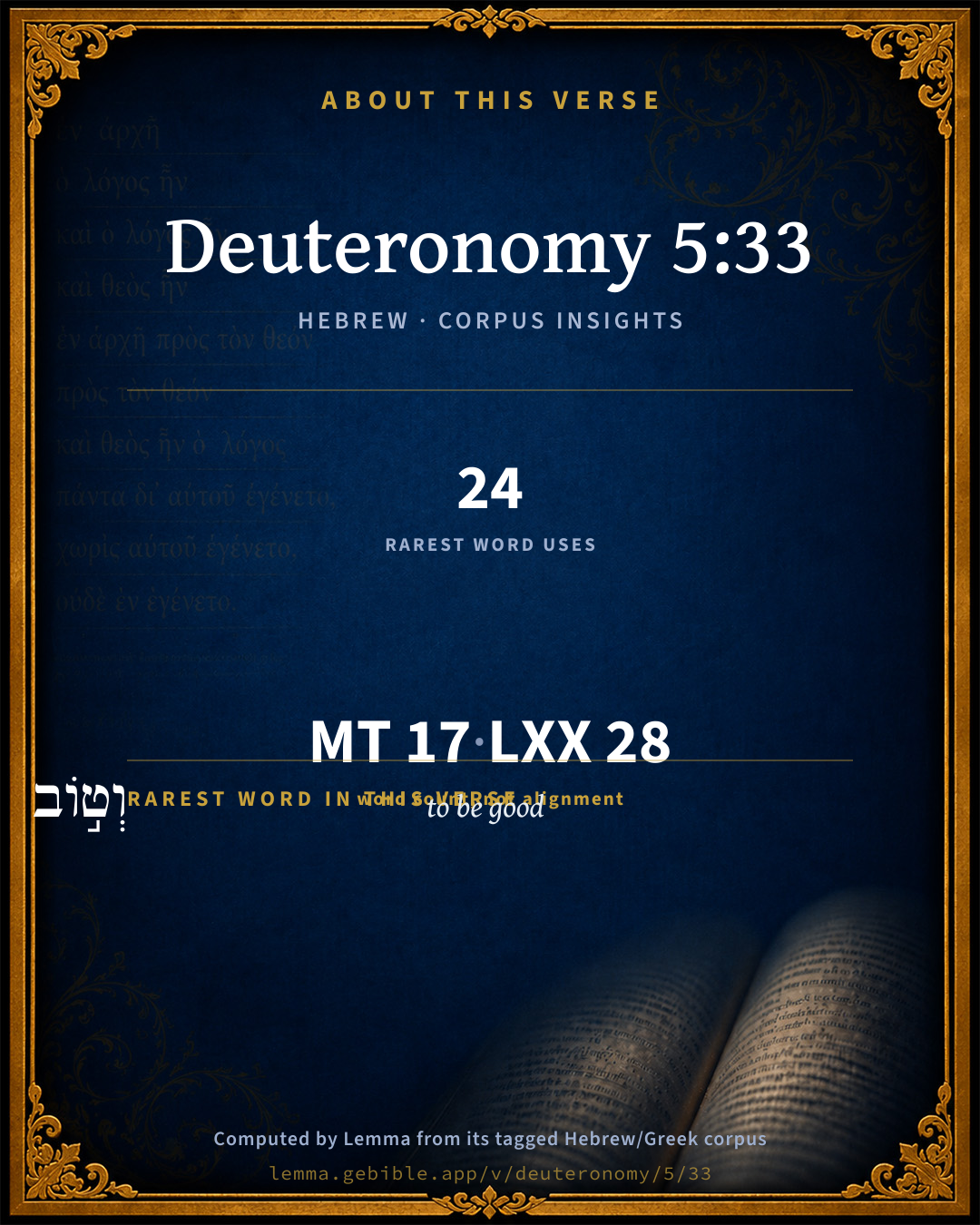
The rarest word here is וְט֣וֹב to be good H2895 — appearing just 24 times in the whole Hebrew Bible.

Shared distinctive vocabulary

וְט֣וֹב to be good H2895 occurs in 24 verses of the Hebrew Bible. Also found in:

Grammatical profile

  • 6 verbs
  • 6 nouns
  • 2 prepositions
  • 3 particles

Verb forms

  • צִוָּ֜ה Piel · Perfect
  • תֵּלֵ֑כוּ Qal · Imperfect
  • תִּֽחְיוּן֙ Qal · Imperfect
  • וְט֣וֹב Qal · Sequential Perfect
  • וְהַאֲרַכְתֶּ֣ם Hiphil · Sequential Perfect
  • תִּֽירָשֽׁוּן Qal · Imperfect

Repetition

A word recurs within this verse — often emphatic in Hebrew:

  • אֲשֶׁ֨ר which H834 ×2

Hebrew & Septuagint length

In English translation the verse runs 40 words from the Hebrew and 43 from the Septuagint (LXX English) — closely comparable.

A rough comparison of the two English renderings, which tokenize alike — not a word-level alignment.

Word counts can differ between the Hebrew and the Greek without any difference in meaning — e.g. the Hebrew direct-object marker אֵת has no separate Greek word, and Greek often adds the article ὁ.

In the original languages it is 17 Hebrew tokens and 28 Greek tokens — but the two are counted differently (Hebrew bundles its prefixes and suffixes into one token; the Greek is in lemma form), so that isn’t a like-for-like length.

Cross-references

8

Topical passages linked to Deuteronomy 5:33 in the Treasury of Scripture Knowledge — connected by theme and wording, ordered by reader-vote popularity; previews shown in the World English Bible.

  • Jeremiah 7:23 but this thing I commanded them, saying, Listen to my voice, and I will be your God, and you shall be my people; and walk you in all the way that I command you, that it may be well with you.
  • Deuteronomy 4:40 You shall keep his statutes, and his commandments, which I command you this day, that it may go well with you, and with your children after you, and that you may prolong your days in the land, which Yahweh your God gives you, forever.
  • Luke 1:6 They were both righteous before God, walking blamelessly in all the commandments and ordinances of the Lord.
  • Deuteronomy 10:12 Now, Israel, what does Yahweh your God require of you, but to fear Yahweh your God, to walk in all his ways, and to love him, and to serve Yahweh your God with all your heart and with all your soul,
  • 1 Timothy 4:8 For bodily exercise has some value, but godliness has value for all things, having the promise of the life which is now, and of that which is to come.
  • Romans 2:7 to those who by patience in well-doing seek for glory and honor and incorruptibility, eternal life;
  • Psalms 119:6 Then I wouldn't be disappointed, When I consider all of your commandments.
  • Deuteronomy 5:29 Oh that there were such a heart in them, that they would fear me, and keep all my commandments always, that it might be well with them, and with their children forever!

Cross-references courtesy of OpenBible.info (CC BY 4.0).

Hebrew and Greek witnesses Masoretic Hebrew ↔ Greek Septuagint

The same verse in the two great witnesses to the Old Testament, shown verse-for-verse.

These are two independent witnesses, not word-aligned to each other, and the Septuagint is shown in lemma (dictionary) form.

Hebrew Deuteronomy 5:33 Masoretic · Westminster Leningrad Codex

בְּכָל הַדֶּ֗רֶךְ אֲשֶׁ֨ר צִוָּ֜ה יְהוָ֧ה אֱלֹהֵיכֶ֛ם אֶתְכֶ֖ם תֵּלֵ֑כוּ לְמַ֤עַן תִּֽחְיוּן֙ וְט֣וֹב לָכֶ֔ם וְהַאֲרַכְתֶּ֣ם יָמִ֔ים בָּאָ֖רֶץ אֲשֶׁ֥ר תִּֽירָשֽׁוּן

You shall walk in all the way which Yahweh your God has commanded you, that you may live, and that it may be well with you, and that you may prolong your days in the land which you shall possess.

World English Bible · Public Domain

Greek LXX Deuteronomy 5:33 Septuagint · lemma form

κατά πᾶς ὁ ὁδός ὅς ἐντέλλομαι σύ κύριος ὁ θεός σύ πορεύομαι ἐν αὐτός ὅπως καταπαύω σύ καί εὖ σύ εἰμί καί μακροημερεύω ἐπί ὁ γῆ ὅς κληρονομέω

according to all the way which the Lord your God commanded you to walk in it, that he may give you rest; and that it may be well with you, and you⌃ may prolong your days on the land which you⌃ shall inherit.

LXX2012 (modern English Septuagint) · Public Domain

Hebrew: Westminster Leningrad Codex (CC BY 4.0). Greek: Septuagint (public domain); English from LXX2012 (modern English Septuagint) (Public Domain). How the Septuagint differs from the Hebrew →

Commentary

Notes on Deuteronomy 5:33 from classic Christian and Jewish commentators (each source and its license shown beneath its notes). The classic Christian expositions comment on the surrounding passage and are grouped to its opening verse, so a note may address several verses; the Jewish commentaries on the Tanakh (Rashi and others) are per-verse, so they appear only where the commentator wrote on this verse.

Lemma curates 59 commentaries, every one of them public domain or Creative Commons licensed, each selected and text-cleaned for this edition rather than reprinted as found. About our sources →

The Biblical Illustrator

Joseph S. Exell

Deu_5:33

That ye may live, and . . . prolong your days.

Prosperity and adversity

I. We fall, I conceive, into a very inaccurate method of speech, when we say that the prize which God proposes to His people is set forth in one of these clauses; the duty, or performance by which they are to earn that prize, in the other. Moses teaches his countrymen that God has conferred upon them the highest prize which man can conceive, freely and without any merit on their part.

II. Is there no duty, then, enjoined in the words of my text? Does it merely speak of a blessing or a privilege? Certainly when it is said, Ye shall walk in all the ways which the Lord your God hath commanded you, it must be meant that there was something required on the part of the creature as well as something bestowed by the Creator. If we believe that an actual living being to whom we are related has put us in this way, and that it is a way of dependence upon Himself, we can understand how the preservation of it becomes a duty to Him; we begin in fact to know what duty is. If, finally, we believe that He who puts us in this way is the only person who can keep us in it, or prevent us from going out of it, we may feel that His command is itself a power; that it does not merely say, Thus and thus you must do, thus and thus you must not do; but, This will I enable you to do, this will I prevent you from doing.

III. We come then at length to this class of blessings which are shortly gathered up in the words: That ye may live, and that it may be well with you, and that ye may prolong your days in the land which ye shall possess. It is here signified in very simple, clear language, which admits, I conceive, of no double sense, that a people in a right, orderly, godly state shall be a well-doing people; a people with all the signs and tokens of strength, growth, triumph; a people marked for permanence and indefinite expansion. I cannot put another meaning upon these words; I should think that a wish to dilute their force was a proof of the greatest carelessness about the authority from which they proceed, as well as of the most shocking inhumanity. If it be the distinction of saints and spiritual men that they do not trouble themselves about the external prosperity of a land, that they do not care whether the oxen are strong to labour, whether the sheep are bringing forth thousands and ten thousands, whether there is no complaining in the streets; if they are so occupied in the future as to have no interest in the present, too busy with their souls to have leisure for thinking about the ruin which may be threatening the bodies of their fellow men--then I say at once Moses, David, Isaiah, Jeremiah, were not saints and spiritual men. Since they held that Gods order was the perfectly right and living order, they could not but think that all disorder, all wrong and death which had invaded it, must have come through mans neglect to fulfil the part which had been assigned him;--through his unwillingness to till and subdue the earth which he was meant to till and subdue; through his idleness and distrust and self-seeking, his refusal to walk in the ways which God had commanded.

IV. And therefore it cannot be true--the whole history of the Jews declares it not to be true--that the blessings of adversity were unknown to them, were reserved for a later period. Which of the good men of the Old Testament was not proved in a furnace? Into whose soul did the iron at some time not enter? It was not because they believed in Gods promises to their nation, and were sure that its outward prosperity must and would at last correspond to its inward health and vitality; it was not because they longed for the earth to bring forth and bud, to have heaps of corn upon it, that its presses might burst forth with new wine; it was not on this account that they had to endure less of inward sadness, or fewer reproaches from the kings and priests and people to whom they spoke. No; the more strong their feeling was that God had chosen their nation and made a covenant with it, the greater was the struggle with their individual selfishness. (F. D. Maurice, M. A.)

.

The Biblical Illustrator, edited by Joseph S. Exell (c. 1880s–1900s) — public domain. Text from a community e-Sword module.

Tyndale Open Study Notes

Tyndale Open Resources

5:33 Stay on the path: This figure of speech compares the course of life to making a journey. Israel was called to live in such a way that the nation would not be sidetracked from the purposes for which it had been chosen and equipped.

Tyndale Open Study Notes — © Tyndale Open Resources, licensed CC BY-SA 4.0. Text via the HelloAO Bible API.

Geneva Bible (1599)

Geneva Bible translators

As by obedience, God giveth us all felicity: so of disobeying God proceed all our miseries.

Geneva Bible (1599) marginal notes — public domain. Text via Bolls.life.

Adam Clarke's Commentary

Verse 33. Ye shall walk in all the ways, c.] God never gave a commandment to man which he did not design that he should obey. He who selects from the Divine testimonies such precepts as he feels but little inclination to transgress, and lives in the breach of others, sins against the grand legislative authority of God, and shall be treated as a rebel.

That ye may live] תחיון ticheyun, that ye may enjoy life, (for the paragogic ן nun, at the end of the word, deepens the sense), that it may be well with you ותוב לכם vetob lachem, and good shall be to you - God will prosper you in all things essential to the welfare of your bodies, and the salvation of your souls.

That ye may prolong your days in the land] That ye may arrive at a good old age, and grow more and more meet for the inheritance among the saints in light.

On this very important verse we may remark, a long life is a great blessing, if a man live to God, because it is in life, and in life alone, that a preparation for eternal glory may be acquired. Those who wish to die soon, have never yet learned to live, and know not the value of life or time. Many have a vain hope that they shall get either in death, or in the other world, a preparation for glory. This is a fatal error. Here, alone, we may acquaint ourselves with God, and receive that holiness without which none can see him. Reader, be thankful to him that thou art still in a state of probation and pray that thou mayest live for eternity.

Adam Clarke's Commentary on the Bible (1810–1826) — public domain. Text from a community e-Sword/MySword module.

Lesson kit

Teaching starters — assembled from the data on this page, not authored interpretation. Every prompt links to the verse data it draws on. Edit before teaching.

Deuteronomy, in the Pentateuch, opens this verse with 17 words (15 distinct Hebrew lemmas). Its most distinctive word is ṭôwb (“to be good”). A historical commentator’s framing appears above. Read the whole chapter for the surrounding context.

Discussion questions

  1. The word ṭôwb carries the sense “to be good.” How does it shape the verse?
  2. Numbers 11:18 shares the word «to be good» with this verse. How do the two illuminate each other?
  3. “which” occurs 2× in this one verse. What is the effect of the repetition?
  4. These translations render this verse differently. What is at stake in choosing one wording over another?
  5. The verb «צִוָּ֜ה» is Piel Perfect. How does its form color the action?
  6. Reading how The Biblical Illustrator and Tyndale Open Study Notes read this verse, where do the two commentators agree and where do they part?

Things to notice

Reading settings

Reading text

Shown beneath each verse's original-language words.

Old Testament
Old Testament edition

Read the OT as the Masoretic Hebrew (MT) or the Greek Septuagint (LXX).

English shown for the Greek Septuagint (in the Hebrew ↔ Greek comparison).

Comparing translations? Open the Compare panel on any verse page to stack up to four side by side.