
Psalms 111:9

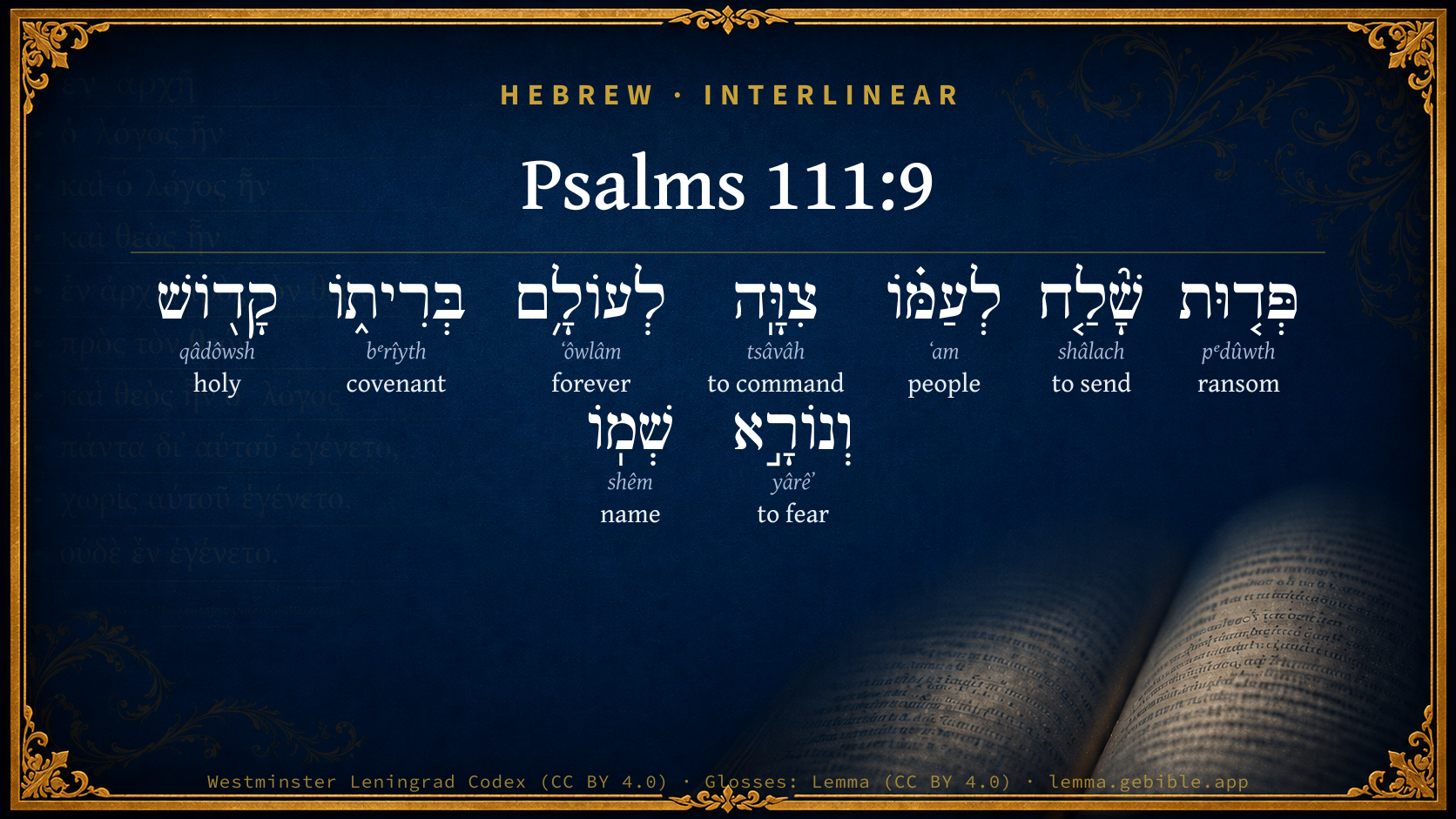
Hebrew (Westminster Leningrad Codex) Psalms 111:9 appears in the Hebrew Old Testament. The text above is from the Westminster Leningrad Codex. Each word links to its Strong’s number, a concise gloss, and parsing drawn from the Open Scriptures Hebrew Bible morphology. Click any word for its full Brown-Driver-Briggs (BDB) entry.
Download image
Cite this verse

Psalms 111:9 (World English Bible). Public Domain. Lemma interlinear Bible study tool, https://lemma.gebible.app/v/psalms/111/9.

Show BibTeX & RIS
BibTeX
RIS
English Translation
He has sent redemption to his people. He has ordained his covenant forever. His name is holy and awesome!
World English Bible · Public Domain
Download a study sheet

One document with this verse’s original text, its word-by-word gloss line, the meaning frame, cross-references with their text, attributed commentary, and full source and license credits — printable, and it pastes into notes with its structure intact.

This verse Autodidact and up

Study sheet (.html) Plain text (.txt)

A passage Seminary Student

Up to 50 verses in one chapter. A passage sheet keeps up to 6 commentary sources and 12 cross-references per verse, in the order this page ranks them, and says so on the sheet whenever that leaves anything out. Ask for a single verse and you get the Autodidact verse sheet above.

Everything on this page stays free to read, with no account — the sheet is a download of what is already on screen, not access to it.

Want to remove ads? Support Godless Engineer
Compare translations 3

The same verse in 3 English versions, stacked beneath the original-language interlinear above. Click any original word for its lexicon entry.

Each is an independent rendering of the whole verse — the interlinear is not word-aligned to these translations.

Highlighted words mark where these versions differ — a whole-verse word diff, not a word-by-word alignment.

  • World English Bible Public Domain
    He has sent redemption to his people. He has ordained his covenant forever. His name is holy and awesome!
  • King James Version Public Domain
    He sent redemption unto his people: he hath commanded his covenant for ever: holy and reverend is his name.
  • unfoldingWord Literal Text CC BY-SA 4.0
    He has sent redemption to his people; he ordained his covenant forever; holy and awesome his name.

unfoldingWord Literal Text — © unfoldingWord, licensed CC BY-SA 4.0. Word-aligned USFM3 via Door43 (git.door43.org/unfoldingWord/en_ult).

Versions to compare (up to 4)

3 of 4 selected

Show all 18 translations

Every available English version of this verse, each an independent rendering of the whole verse.

  • World English Bible Public Domain
    He has sent redemption to his people. He has ordained his covenant forever. His name is holy and awesome!
  • Berean Standard Bible Public Domain
    He has sent redemption to His people; He has ordained His covenant forever; holy and awesome is His name.
  • Majority Standard Bible Public Domain
    He has sent redemption to His people; He has ordained His covenant forever; holy and awesome is His name.
  • King James Version Public Domain
    He sent redemption unto his people: he hath commanded his covenant for ever: holy and reverend is his name.
  • American Standard Version (1901) Public Domain
    He hath sent redemption unto his people; He hath commanded his covenant for ever: Holy and reverend is his name.
  • Revised Version (1885) Public Domain
    He hath sent redemption unto his people; he hath commanded his covenant for ever: holy and reverend is his name.
  • Geneva Bible (1599) Public Domain
    He sent redemption vnto his people: he hath commanded his couenant for euer: holy and fearefull is his Name.
  • Douay-Rheims (1899) Public Domain
    He hath sent redemption to his people: he hath commanded his covenant for ever. Holy and terrible is his name:
  • Young's Literal Translation Public Domain
    Redemption He hath sent to His people, He hath appointed to the age His covenant, Holy and fearful `is' His name.
  • Literal Standard Version CC BY-SA 4.0
    He has sent redemption to His people, || He has appointed His covenant for all time, || His Name [is] holy and fearful.
  • Unlocked Literal Bible CC BY-SA 4.0
    He gave victory to his people; he ordained his covenant forever; holy and awesome is his name.
  • unfoldingWord Literal Text CC BY-SA 4.0
    He has sent redemption to his people; he ordained his covenant forever; holy and awesome his name.
  • Darby Bible Public Domain
    He sent deliverance unto his people; he hath commanded his covenant for ever: holy and terrible is his name.
  • World Messianic Bible Public Domain
    He has sent redemption to his people. He has ordained his covenant forever. His name is holy and awesome!
  • Webster's Bible Public Domain
    He sent redemption to his people: he hath commanded his covenant for ever: holy and reverend is his name.
  • Free Bible Version CC BY-SA 4.0
    He delivered his people. He commanded that his agreement would continue forever. How holy and awesome is his reputation!
  • Bible in Basic English Public Domain
    He has sent salvation to his people; he has given his word for ever: holy is his name and greatly to be feared.
  • JPS Tanakh (1917) Public Domain
    He hath sent redemption unto His people; He hath commanded His covenant for ever; Holy and awful is His name.

Literal Standard Version (2020), Covenant Press — licensed CC BY-SA 4.0. Text via the HelloAO Bible API (eBible.org). Unlocked Literal Bible (unfoldingWord) — licensed CC BY-SA 4.0. Text via the HelloAO Bible API (eBible.org). unfoldingWord Literal Text — © unfoldingWord, licensed CC BY-SA 4.0. Word-aligned USFM3 via Door43 (git.door43.org/unfoldingWord/en_ult). Free Bible Version, Dr. Jonathan Gallagher — licensed CC BY-SA 4.0. Text via the HelloAO Bible API (eBible.org).

Word by word

More ways to search: Search by grammar → Find every occurrence → Compare this word →

Practice this passage: Drill this verse → Learn its vocabulary →

פְּד֤וּת
pᵉdûwth
H6304
“ransom”
Noun, Common, Feminine, Singular, Absolute
Part of Speech
Noun
Type
Common
Gender
Feminine
Number
Singular
State
Absolute
Full BDB Definition

Origin: from H6929

TWOT: 1734b

ransom
  1. שָׁ֘לַ֤ח shâlach H7971 “to send” Verb, Qal, Perfect, 3rd Person, Masculine, Singular
  2. לְעַמּ֗וֹ ʻam H5971 “to/for · people · his” Preposition + Noun, Common, Masculine, Singular, Construct + Suffix, Personal, 3rd Person, Masculine, Singular
  3. צִוָּֽה tsâvâh H6680 “to command” Verb, Piel, Perfect, 3rd Person, Masculine, Singular
  4. לְעוֹלָ֥ם ʻôwlâm H5769 “to/for · forever” Preposition + Noun, Common, Masculine, Singular, Absolute
  5. בְּרִית֑וֹ bᵉrîyth H1285 “covenant · his” Noun, Common, Feminine, Singular, Construct + Suffix, Personal, 3rd Person, Masculine, Singular
  6. קָד֖וֹשׁ qâdôwsh H6918 “holy” Adjective, Adjective, Masculine, Singular, Absolute
  7. וְנוֹרָ֣א yârêʼ H3372 “and · fearing” Conjunction + Verb, Niphal, Participle Active, Masculine, Singular, Absolute
  8. שְׁמֽוֹ shêm H8034 “name · his” Noun, Common, Masculine, Singular, Construct + Suffix, Personal, 3rd Person, Masculine, Singular

About this verse

These counts appear in no published source. They are computed here, from the morphology-tagged text and Lemma’s own curated glosses. What Lemma adds →

9
words
9
distinct lemmas
Wisdom
section

Notable vocabulary

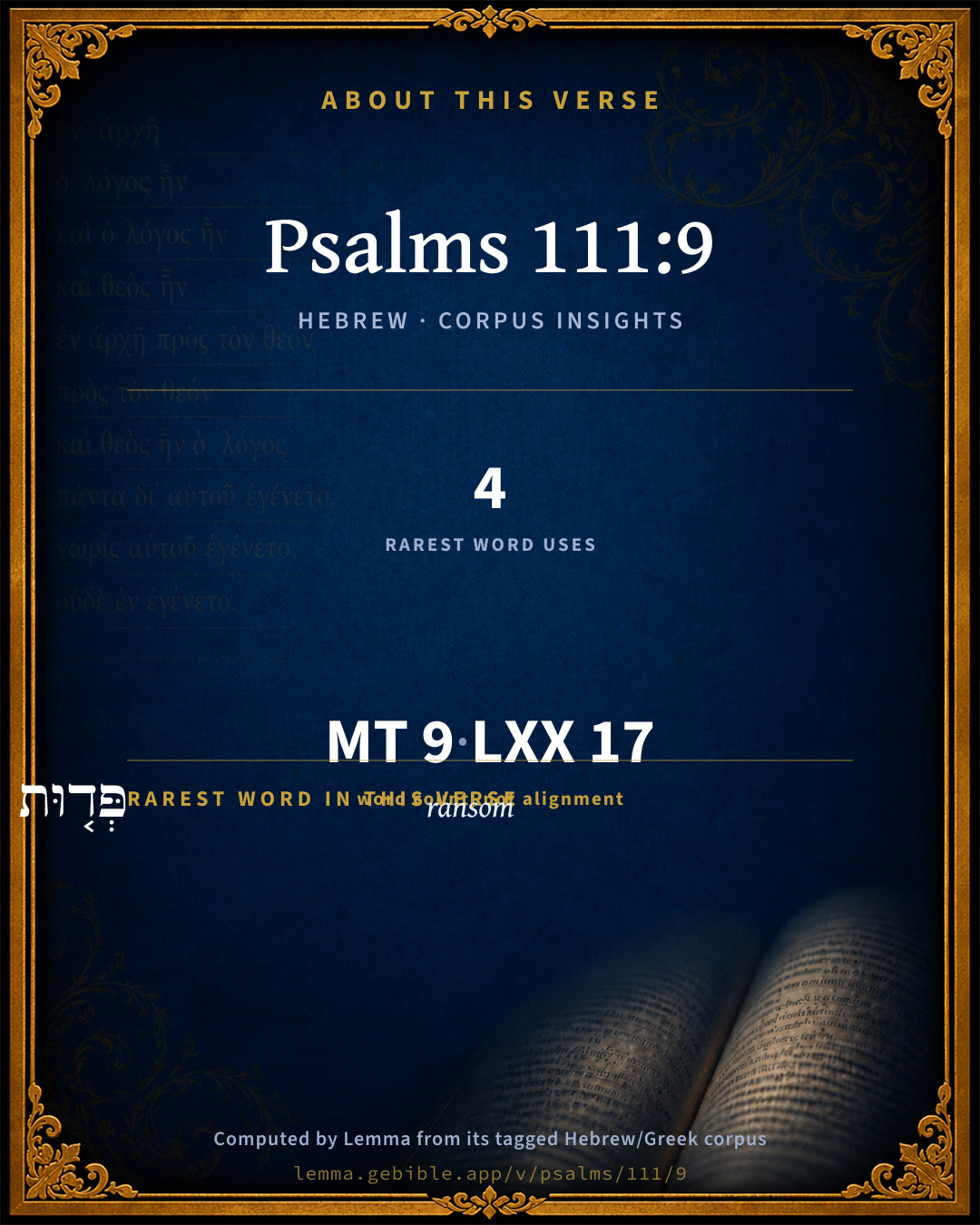
The rarest word here is פְּד֤וּת ransom H6304 — appearing just 4 times in the whole Hebrew Bible.

Shared distinctive vocabulary

פְּד֤וּת ransom H6304 occurs in 4 verses of the Hebrew Bible. Also found in:

Grammatical profile

  • 3 verbs
  • 5 nouns
  • 1 adjective

Verb forms

  • שָׁ֘לַ֤ח Qal · Perfect
  • צִוָּֽה Piel · Perfect
  • וְנוֹרָ֣א Niphal · Participle Active

Hebrew & Septuagint length

In English translation the verse runs 19 words from the Hebrew and 18 from the Septuagint (LXX English) — closely comparable.

A rough comparison of the two English renderings, which tokenize alike — not a word-level alignment.

Word counts can differ between the Hebrew and the Greek without any difference in meaning — e.g. the Hebrew direct-object marker אֵת has no separate Greek word, and Greek often adds the article ὁ.

In the original languages it is 9 Hebrew tokens and 17 Greek tokens — but the two are counted differently (Hebrew bundles its prefixes and suffixes into one token; the Greek is in lemma form), so that isn’t a like-for-like length.

Cross-references

31

Topical passages linked to Psalms 111:9 in the Treasury of Scripture Knowledge — connected by theme and wording, ordered by reader-vote popularity; previews shown in the World English Bible.

  • Psalms 99:3 Let them praise your great and awesome name. He is Holy!
  • Luke 1:49 For he who is mighty has done great things for me. Holy is his name.
  • Luke 1:68 "Blessed be the Lord, the God of Israel, For he has visited and worked redemption for his people;
  • Titus 2:14 who gave himself for us, that he might redeem us from all iniquity, and purify for himself a people for his own possession, zealous for good works.
  • Revelation 5:9 They sang a new song, saying, "You are worthy to take the book, And to open its seals: For you were killed, And bought us for God with your blood, Out of every tribe, language, people, and nation,
  • Hebrews 9:12 nor yet through the blood of goats and calves, but through his own blood, entered in once for all into the Holy Place, having obtained eternal redemption.
  • Hebrews 13:20 Now may the God of peace, who brought again from the dead the great shepherd of the sheep with the blood of an eternal covenant, our Lord Jesus,
  • Deuteronomy 28:58 If you will not observe to do all the words of this law that are written in this book, that you may fear this glorious and fearful name, YAHWEH YOUR GOD;
  • Jeremiah 33:20–21 Thus says Yahweh: If you can break my covenant of the day, and my covenant of the night, so that there shall not be day and night in their season;
  • Ephesians 1:7 in whom we have our redemption through his blood, the forgiveness of our trespasses, according to the riches of his grace,
  • Ephesians 1:14 who is a pledge of our inheritance, to the redemption of God's own possession, to the praise of his glory.
  • Revelation 4:8 The four living creatures, each one of them having six wings, are full of eyes around about and within. They have no rest day and night, saying, "Holy, holy, holy, holy, holy, holy, holy, holy, holy is the Lord God, the Almighty, who was and who is and who is to come!"
  • Isaiah 55:3 Turn your ear, and come to me; hear, and your soul shall live: and I will make an everlasting covenant with you, even the sure mercies of David.
  • Malachi 1:11 For from the rising of the sun even to the going down of the same, my name is great among the nations, and in every place incense will be offered to my name, and a pure offering: for my name is great among the nations," says Yahweh of Hosts.
  • Matthew 1:21 She shall bring forth a son. You shall call his name Jesus, for it is he who shall save his people from their sins."
  • 1 Peter 1:18–20 knowing that you were redeemed, not with corruptible things, with silver or gold, from the useless way of life handed down from your fathers,
  • Exodus 15:11 Who is like you, Yahweh, among the gods? Who is like you, glorious in holiness, Fearful in praises, doing wonders?
  • 2 Samuel 23:5 Most assuredly my house is not so with God; Yet he has made with me an everlasting covenant, Ordered in all things, and sure: For it is all my salvation, and all [my] desire, Although he doesn't make it grow.
  • 1 Chronicles 16:15 Remember his covenant forever, The word which he commanded to a thousand generations,
  • Psalms 111:5 He has given food to those who fear him. He always remembers his covenant.
  • Isaiah 44:6 Thus says Yahweh, the King of Israel, and his Redeemer, Yahweh of Hosts: I am the first, and I am the last; and besides me there is no God.
  • Isaiah 63:9 In all their affliction he was afflicted, and the angel of his presence saved them: in his love and in his pity he redeemed them; and he bore them, and carried them all the days of old.
  • Galatians 3:15–17 Brothers, I speak like men. Though it is only a man's covenant, yet when it has been confirmed, no one makes it void, or adds to it.
  • Exodus 15:13 "You, in your loving kindness, have led the people that you have redeemed. You have guided them in your strength to your holy habitation.
  • Deuteronomy 15:15 You shall remember that you were a bondservant in the land of Egypt, and Yahweh your God redeemed you: therefore I command you this thing today.
  • Psalms 89:7 A very awesome God in the council of the holy ones, To be feared above all those who are around him?
  • Psalms 99:5 Exalt Yahweh our God. Worship at his footstool. He is Holy!
  • Psalms 99:9 Exalt Yahweh, our God. Worship at his holy hill, For Yahweh, our God, is holy!
  • Psalms 130:7–8 Israel, hope in Yahweh, For with Yahweh there is loving kindness. With him is abundant redemption.
  • Isaiah 6:3 One called to another, and said, "Holy, holy, holy, is Yahweh of Hosts! The whole earth is full of his glory!"
  • Malachi 2:2 If you will not listen, and if you will not lay it to heart, to give glory to my name," says Yahweh of Hosts, "then will I send the curse on you, and I will curse your blessings. Indeed, I have cursed them already, because you do not lay it to heart.

Cross-references courtesy of OpenBible.info (CC BY 4.0).

Hebrew and Greek witnesses Masoretic Hebrew ↔ Greek Septuagint

The same verse in the two great witnesses to the Old Testament, shown verse-for-verse.

You’re reading Greek Psalm 110 (Hebrew Psalm 111). The Septuagint counts the superscription, so verse numbers can differ from the Hebrew — chapter-level alignment, not verse-by-verse. Numbering follows Rahlfs.

These are two independent witnesses, not word-aligned to each other, and the Septuagint is shown in lemma (dictionary) form.

Hebrew Psalms 111:9 Masoretic · Westminster Leningrad Codex

פְּד֤וּת שָׁ֘לַ֤ח לְעַמּ֗וֹ צִוָּֽה לְעוֹלָ֥ם בְּרִית֑וֹ קָד֖וֹשׁ וְנוֹרָ֣א שְׁמֽוֹ

He has sent redemption to his people. He has ordained his covenant forever. His name is holy and awesome!

World English Bible · Public Domain

Greek LXX Greek Psalm 110:9 Septuagint · lemma form

λύτρωσις ἀποστέλλω ὁ λαός αὐτός ἐντέλλομαι εἰς ὁ αἰών διαθήκη αὐτός ἅγιος καί φοβερός ὁ ὄνομα αὐτός

He sent redemption to his people: he commanded his covenant for ever: holy and fearful is his name.

LXX2012 (modern English Septuagint) · Public Domain

Hebrew: Westminster Leningrad Codex (CC BY 4.0). Greek: Septuagint (public domain); English from LXX2012 (modern English Septuagint) (Public Domain). How the Septuagint differs from the Hebrew →

Commentary

Notes on Psalms 111:9 from classic Christian and Jewish commentators (each source and its license shown beneath its notes). The classic Christian expositions comment on the surrounding passage and are grouped to its opening verse, so a note may address several verses; the Jewish commentaries on the Tanakh (Rashi and others) are per-verse, so they appear only where the commentator wrote on this verse.

Lemma curates 59 commentaries, every one of them public domain or Creative Commons licensed, each selected and text-cleaned for this edition rather than reprinted as found. About our sources →

Trapp's Complete Commentary

John Trapp

Psa 111:9 He sent redemption unto his people: he hath commanded his covenant for ever: holy and reverend [is] his name.

Ver. 9. He sent redemption unto his people] Once out of Egypt, ever out of Satan’s thraldom.

He hath commanded his covenant for ever] Sic cum populo suo pactus est ut de ipsius paeti observatione certis edictis caverit, as he covenanted, so he looketh his commandments should be respected, which are as binding to us as his covenant is to him; and, through grace, his covenant is as binding to him as those are to us.

Holy and reverend is his name] Which, therefore, we should not presume in a sudden unmannerliness to blurt out. The Jews would not pronounce it. The Grecians (as Suidas observeth), when they would swear by their Jupiter, forbare to mention him. This is cheek to the profaneness common among us. Let those that would have their name reverend labour to be holy as God is holy.

John Trapp, A Commentary or Exposition upon All the Books of the Old and New Testament (1647–1656) — public domain. Text from a community e-Sword module.

The Biblical Illustrator

Joseph S. Exell

Psa_111:9

He sent redemption unto His people.

Redemption and atonement

Theology has frequently confused redemption and the atonement. The atonement for sin offered by Christ on Calvary was universal, but redemption is limited to those that accept the conditions as specified in the Scriptures. Christ died for all, but, as a fact, only they that believe are saved. The atonement is Gods provision for the salvation of the world, redemption of the sinner is the object God has in view. There could be no redemption without the atonement, but if redemption is not appropriated the atonement still remains. The work of atonement was the act of one person, but redemption involves several agencies. Christ, by suffering the death of the cross, made the atonement; in effecting redemption, the subject works, the teacher works in presenting Gods truth, the Holy Spirit works and applies the Gospel with power to the heart. By this threefold agency redemption is effected. The atonement came without the worlds request; but redemption never comes without the earnest seeking of the individual. The atonement was an event that took place once for all, at one period, on Calvary, two thousand years ago; redemption is constantly taking place in all parts of the world, and in all periods of human history. This is the correct Biblical distinction between the two theological terms as used in the Scriptures. (R. Venting.)

Holy and reverend is His name.--

Scriptural piety

I. What it is. We take the term reverence to denote respect; and with this latter term we associate generally a more definite meaning. In the case, indeed, of God, respect must be of the very highest description, to rise to the character of reverence.

II. Its foundation. Let the mind be informed, not only that God has given a conscience to rebuke, but that God has met the rebuke of conscience, to redeem the party rebuked from despair by holding out His own Son as the vindication of His holiness. The foundation, therefore, you perceive, of Scriptural piety, is the knowledge of the Divine character.

III. The means of its cultivation. Shall we pray that God would enlighten us, while we refuse to come to the means, by which He has Himself told us we are to be enlightened? Shall we seek that He would give us of the Spirit, whilst we neglect the fruits of the inspiration of that Spirit, as those fruits are laid down in the testimony of Divine truth?

IV. Its fruits. Piety is not a faculty of the mind; it is an influence, pervading all the faculties. Piety is not some particular mental power; it is an energy, that tells on the whole man. If such be the fruits of Scriptural piety upon the mind itself, what must be its fruits upon society generally? Even the ungodly and unthinking world, when they discover that piety is thus enlightened by the word of truth, and that in the Church of God there is not a greater degree of warmth than there is of light, will be compelled to confess that God is in us of a truth. (John Burnet)

The Biblical Illustrator, edited by Joseph S. Exell (c. 1880s–1900s) — public domain. Text from a community e-Sword module.

J. A. Alexander on Psalms

Joseph Addison Alexander

9. (Psa 111:9) Redemption he has sent to his people; he has ordained to eternity his, covenant; holy and fearful is his name. That this verse was intended to consist of three clauses, is clear from the fact that it contains three letters of the alphabet in regular succession. The same thing is true of the remaining verse. The first clause relates mainly, not exclusively, to the deliverance from Egypt. As in Psa 111:5, the second clause affirms a general truth, attested and exemplified by the particular fact mentioned in the first. Fearful, not merely to his foes but to his people, who can never cease to worship him with holy awe.

Joseph Addison Alexander, The Psalms Translated and Explained (1850) — public domain. Text from a community e-Sword module.

Tyndale Open Study Notes

Tyndale Open Resources

111:9 The people of the Exodus generation went free because of God’s grace.

Tyndale Open Study Notes — © Tyndale Open Resources, licensed CC BY-SA 4.0. Text via the HelloAO Bible API.

Adam Clarke's Commentary

Verse 9. He sent redemption] He sent Moses to redeem them out of Egypt; various judges to deliver them out of the hands of their oppressors; Ezra, Nehemiah, and Zerubbabel, to deliver them from Babylon; and the Lord Jesus to redeem a whole lost world from sin, misery, and death.

Holy and reverend is his name.] The word reverend comes to us from the Latins, reverendus, and is compounded of re, intensive, and vereor, to be feared; and most or right reverend, reverendissimus, signifies to be greatly feared. These terms are now only titles of ecclesiastical respect, especially in the Protestant ministry; but there was a time in which these were no empty titles. Such was the power of the clergy, that, when they walked not in the fear of the Lord, they caused the people to fear, and they themselves were to be feared; but, when the secular power was added to the spiritual, they were then truly reverendi and reverendissimi, to be feared and greatly to be feared. But reverend is not applied to God in this way; nor does the word nora bear this signification; it rather means terrible: Holy and terrible, or holy and tremendous, is his name. This title belongs not to man; nor does any minister, in assuming the title reverend, assume this. Indeed, the word reverend, as now used, gives us a very imperfect conception of the original term. Holy and tremendous is God's name. He is glorious in holiness, fearful in praises, doing wonders, both in the way of judgment and in the way of mercy.

Adam Clarke's Commentary on the Bible (1810–1826) — public domain. Text from a community e-Sword/MySword module.

John Calvin's Commentaries

9 He sent redemption to his people What he had already stated is here repeated in different words. And as the deliverance of his people was the commencement of their salvation, it is first introduced; next is subjoined its confirmation in the law, by reason of which it comes to pass that God’s adoption could never fail. For though, long prior to this, God had established his covenant with Abraham, which also was the occasion of the redemption of the people; yet what is here mentioned refers exclusively to the law, by which the covenant was ratified, never to be disannulled. The amount is, that, in the deliverance of the people, God did not act the part of a beneficial father, merely for a day, but that, in the promulgation of the law, he also establishedhis grace, that the hope of eternal life might continue for ever in the Church. Moreover, you must attend carefully to what I have elsewhere cautioned you against, and to which I shall advert more at length on Psalm 119, where the law is spoken of, That the commandments must not be taken always abstractly, for the Holy Spirit, in an especial manner, refers to the promises which are in Christ, by which God, in gathering his chosen people to himself, hath begotten them again to eternal life.

John Calvin's Commentaries (1540-1563) — public domain. Text from the Calvin Translation Society English edition (1840s-50s) via the Christian Classics Ethereal Library (ccel.org). Calvin's coverage is partial (roughly two-thirds of the Bible); uncommented books and verses are honest gaps, never fabricated. The 19th-century editor's footnotes and remarks are omitted so the notes are faithfully Calvin's own voice.

The Cambridge Bible for Schools and Colleges

gen. ed. J. J. S. Perowne

9. He hath sent redemption] The primary reference is to the deliverance from Egypt (Deu_7:8 and often), and the ratification of the covenant at Sinai: but the restoration from exile in Babylon had been a second and scarcely less notable act of redemption. By it Jehovah had given proof of His faithfulness to His covenant, which in the dark days of the Exile might have seemed abrogated for ever (Jer_33:20 ff.; Isa_49:14).

holy and reverend is his name] To be feared (Psa_96:4); elsewhere rendered fearful (Deu_28:58) or terrible (Psa_99:3). By these deliverances and acts of grace Jehovah has revealed Himself as a God Who is holy and must be feared (Exo_15:11; Isa_29:23; Isa_8:13).

9, 10. A final summary of God’s love and man’s duty.

The Cambridge Bible for Schools and Colleges (gen. ed. J. J. S. Perowne; Cambridge University Press, 1878–1918) — public domain. Text from a community e-Sword module.

John Gill's Exposition

He sent redemption unto his people,.... Or one to redeem them, who effected it; Moses to redeem Israel out of Egypt, and Christ to redeem his people from sin, Satan, and the law, and who has done it; and having obtained eternal redemption, he sent his ministers to publish it in the world, and his Spirit to apply it, and to show his people their interest in it; and make it over to them, and the blessings of it, that they may enjoy it, and all the comforts and advantages arising from it; temporal redemption, as typical of the spiritual and eternal one, is here meant.

He hath commanded his covenant for ever; which cannot be the covenant of circumcision, or that at Sinai, neither of which were for ever; but the covenant of grace made with Christ, and which stands fast with him for ever; it is everlasting, sure, and can never be removed; its blessings and promises are for ever; and it is so made and framed, and so kept and observed, as that it shall always continue, which is meant by its being "commanded": as well as it may denote the decree and resolution of God never to break and alter it; see Psa 89:3.

Holy and reverend is his name; the name of God is "holy"; it is his nature, and appears in all his works; and in which he is glorious, and so is reverend; he is to be feared and reverenced by all his creatures, and among his saints, as he is by the angels in heaven.

John Gill's Exposition of the Whole Bible (1746–1763) — public domain (CC PDM 1.0). Text via the HelloAO Bible API.

Albert Barnes' Notes on the Bible

He sent redemption unto his people - In their deliverance from Egypt. He has now sent it in a higher sense under the great Deliverer, the Saviour.

He hath commanded his covenant for ever - He has ordained or appointed it. The covenant is here represented as if it were obedient to the will of God, or under his control. The covenant refers to his arrangements with his people; his assurances of favor, with the terms on which that favor will be shown.

Holy and reverend is his name - Holy and to be venerated; literally, “to be feared.” That is, he has shown in all this that he is holy, and that he is a Being who is to be had in reverence.

Albert Barnes' Notes on the Bible (1834–1885) — public domain. Text from a community e-Sword/MySword module.

Matthew Poole's English Annotations

Redemption; that deliverance out of Egypt, which was a type and pledge of that greater and higher redemption by Christ.

Commanded, i.e. appointed or established firmly by his power and authority. And so this word is oft used, as Psa 33:9; 42:8; 105:31,34. See Poole "Psa 111:7", the ground of which signification may be taken from hence, that the command of a sufficient authority concerning any thing doth commonly establish and effect it. For ever; through all successive generations of his people to the end of the world; for the covenant is the same for substance in all, and differed only in circumstances.

Holy and reverend; terrible to his enemies, and venerable in his people’s eyes, and holy in all his dealings with all men.

Matthew Poole's English Annotations on the Holy Bible (1683–1685) — public domain. Text from a community e-Sword/MySword module.

The Treasury of David

Charles H. Spurgeon

Ver. 9. He sent redemption unto his people. When they were in Egypt he sent not only a deliverer, but an actual deliverance; not only a redeemer, but complete redemption. He has done the like spiritually for all his people, having first by blood purchased them out of the hand of the enemy, and then by power rescued them from the bondage of their sins. Redemption we can sing of as an accomplished act: it has been wrought for us, sent to us, and enjoyed by us, and we are in very deed the Lord's redeemed.

He hath commanded his covenant for ever. His divine decree has made the covenant of his grace a settled and eternal institution: redemption by blood proves that the covenant cannot be altered, for it ratifies and establishes it beyond all recall. This, too, is reason for the loudest praise. Redemption is a fit theme for the heartiest music, and when it is seen to be connected with gracious engagements from which the Lord's truth cannot swerve, it becomes a subject fitted to arouse the soul to an ecstasy of gratitude. Redemption and the covenant are enough to make the tongue of the dumb sing.

Holy and reverend is his name. Well may he say this. The whole name or character of God is worthy of profoundest awe, for it is perfect and complete, whole or holy. It ought not to be spoken without solemn thought, and never heard without profound homage. His name is to be trembled at, it is something terrible; even those who know him best rejoice with trembling before him. How good men can endure to be called "reverend" we know not. Being unable to discover any reason why our fellow men should reverence us, we half suspect that in other men there is not very much which can entitle them to be called reverend, very reverend, right reverend, and so on. It may seem a trifling matter, but for that very reason we would urge that the foolish custom should be allowed to fall into disuse.

Ver. 9. He sent redemption to his people. Once out of Egypt, ever out of Satan's thraldom. John Trapp.

Ver. 9. Sent redemption...commanded his covenant. The deliverance was the more thankworthy, as being upon a covenant account: for thus every mercy is a token of the Lord's favour to his favourite: it is this which makes common mercies to become special mercies. Carnal men, so that they enjoy mercies, they mind not which way they come in, so as they can but have them; but a child of God knows that everything that comes through the Redeemer's hands and by his covenant is the better for it, and tastes the sweeter by far. William Cooper, in the Morning Exercises.

Ver. 9. Redemption. Praise our Triune Jehovah for his redemption. Write it down where you may read it. Affix it where you may see it. Engrave it on your heart that you may understand it. It is a word big with importance. In it is enfolded your destinies and those of the Church, to all future ages. There are heights in it you never can have scaled, and depths you never can have fathomed. You have never taken the wings of the morning, and gained the utmost parts of earth, to measure the length and breadth of it. Wear it as a seal on your arm, as a signet on your right hand, for Jesus is the author of it. O! prize it as a precious stone, more precious than rubies...Let it express your best hopes while living, and dwell on your trembling lips in the moment of dissolution; for it shall form the chorus of the song of the redeemed throughout eternity. Isaac Saunders, 1818.

Ver. 9. He hath commanded his covenant for ever. As he covenanted, so he looketh that his covenants should be respected, which are as binding to us, as his covenant is to him; and, through grace, his covenant is as binding to him, as those are to us. John Trapp.

Ver. 9. Holy and reverend, or, terrible, is his name. "Holy is his name, "and therefore "terrible" to those who, under all the means of grace, continue unholy. George Horne.

Ver. 9. Holy and reverend is his name. Which therefore we should not presume on a sudden to blurt out. The Jews would not pronounce it. The Grecians (as Suidas observeth), when they would swear by their Jupiter, forbare to mention him. This should act as a check to the profaneness common amongst us. Let those that would have their name reverend, labour to be holy as God is holy. John Trapp.

Ver. 9. Redemption. Conceived, arranged, executed, and applied by God. By price and by power. From sin and death. That we may be free, the Lord's own, the Lord's glory.

Ver. 9. Redemption.

1. Its author: "He sent."

2. Its objects: "Unto his people."

3. The pledge it gives us: "He hath commanded his covenant, "etc.

4. The praise it creates in us.

Ver. 9. Holy and reverend.

1. The holiness of God the object of our reverence.

2. Such reverence has much useful influence over us.

3. It should always accompany our faith in redemption and covenant. See preceding clauses of verse.

Psalms 111:10*

Charles H. Spurgeon's The Treasury of David (1869–1885) — public domain. Psalms only. Text from a community e-Sword/MySword module.

Whedon's Commentary on the Bible

Daniel D. Whedon

9. He sent redemption—It is better to understand this of a recent “redemption,” as that from Babylon, rather than that of Israel from Egypt.

He hath commanded his covenant—That is, he hath established, made firm, his covenant, which he made first with Abraham, and again with the body of the Israelites at Sinai.

Daniel D. Whedon (gen. ed.), Commentary on the Old and New Testaments (1874–1909) — public domain. Text from a community e-Sword module.

The Pulpit Commentary

He sent redemption unto his people. The "redemption" from Egypt (Exo_6:6) is perhaps especially in the writer"s mind, but he may be thinking also of other deliverances. He hath commanded his covenant forever. (comp. Gen_9:12 Gen_17:13 Exo_31:16, etc.) Holy and reverend is his Name. Intrinsically "holy," and therefore "reverend," or to be reverenced.

Reverence for the Name.

"Holy and reverend is his Name." "Reverend" here means "worthy of reverence." Horace Bushnell has a striking sentence: "This age is at the point of apogee from all the robuster notions of Deity." And therefore this age is an irreverent age. Even in the shaping of religious beliefs there are signs of undue familiarity with God. And that undue familiarity explains much of the weakness of Christian living, and lightness of Christian worship. The nineteenth century lacks awe of God.

I JEWISH REVERENCE FOR THE NAME. Explain that in older times a name was supposed to gather up, and suggestively express, the attributes of a person. Moses asked for a name which would express God stand for God to the people. And though the word given him was, properly, a declaration of fact rather than a name, it came to be treated as God"s Name, and such a superstitious reverence for it grew up, that the Jewish people persisted in altering the vowels of it, so that never, by any accident, should they pronounce the hallowed Name. There was at least the danger of their coming to reverence the Name, rather than the Divine Being who was represented by the Name. If they did, their honoring of God was but a helpless and degrading formalism. A proper reverence for the sacred Name was enjoined in the third commandment; (Exo_20:7) and such reverence was characteristic of all loyal and saintly souls. See Abraham; (Gen_18:22-23) Jacob; (Gen_32:29) Moses; (Exo_3:13, Exo_3:14) Joshua; (Jos_7:9) and also the psalmists and prophets. It may be said that reverence for the sacred Name was the key-note of the Jewish system. Of nothing were they more jealous. And if in this they were sometimes wrong, they were mostly right; for holy and reverend is his Name.

II CHRISTIAN REVERENCE FOR THE NAME. The Name of God revealed in Christianity is not the same as that revealed in Judaism. To the Jewish Church God is the one Existence, unique, spiritual; absolute Being. To the Christian Church God exists in relations, and only the highest and dearest of human relations is fitting to represent him. He is our Father. But that is the most reverend of all names. And the filial feeling ought to triumph over the superstitious. Show the reverence that is due from us in all our relations with the heavenly Father, the holy Father, the righteous Father. The Father-Name must never be "taken in vain. R.T.

The Pulpit Commentary (1880–1919), ed. H.D.M. Spence-Jones & Joseph S. Exell — public domain. Text from a community e-Sword module.

John Wesley's Explanatory Notes

Redemption - The deliverance out of Egypt, which was a type of that higher redemption by Christ. Commanded - Appointed, or established firmly by his power and authority. For ever - Through all successive generations of his people to the end of the world. Reverend - Terrible to his enemies, venerable in his peoples eyes, and holy in all his dealings with all men.

John Wesley, Explanatory Notes Upon the Whole Bible (1754–1765) — public domain. Text via the GEBible commentary corpus.

Scofield Reference Notes

C. I. Scofield

redemption

(See Scofield "Isa 59:20"). See Scofield "Exo 14:30".

The Scofield Reference Bible (1917 edition), notes by C. I. Scofield — public domain. Text from a community e-Sword module.

Lesson kit

Teaching starters — assembled from the data on this page, not authored interpretation. Every prompt links to the verse data it draws on. Edit before teaching.

Psalms, in the Wisdom, opens this verse with 9 words (9 distinct Hebrew lemmas). Its most distinctive word is pᵉdûwth (“ransom”). A historical commentator’s framing appears above. Read the whole chapter for the surrounding context.

Discussion questions

  1. The word pᵉdûwth carries the sense “ransom.” How does it shape the verse?
  2. Exodus 8:23 shares the word «ransom» with this verse. How do the two illuminate each other?
  3. The translations on this page render this verse differently — a whole-verse word diff, not a word-by-word alignment. What might account for the different wordings?
  4. The verb «שָׁ֘לַ֤ח» is Qal Perfect. How does its form color the action?
  5. Reading how Trapp's Complete Commentary and The Biblical Illustrator read this verse, where do the two commentators agree and where do they part?

Things to notice

Reading settings

Reading text

Shown beneath each verse's original-language words.

Old Testament
Old Testament edition

Read the OT as the Masoretic Hebrew (MT) or the Greek Septuagint (LXX).

English shown for the Greek Septuagint (in the Hebrew ↔ Greek comparison).

Comparing translations? Open the Compare panel on any verse page to stack up to four side by side.