
Deuteronomy 28:13

Hebrew (Westminster Leningrad Codex) Deuteronomy 28:13 appears in the Hebrew Old Testament. The text above is from the Westminster Leningrad Codex. Each word links to its Strong’s number, a concise gloss, and parsing drawn from the Open Scriptures Hebrew Bible morphology. Click any word for its full Brown-Driver-Briggs (BDB) entry.
Download image
Cite this verse

Deuteronomy 28:13 (World English Bible). Public Domain. Lemma interlinear Bible study tool, https://lemma.gebible.app/v/deuteronomy/28/13.

Show BibTeX & RIS
BibTeX
RIS
English Translation
Yahweh will make you the head, and not the tail; and you shall be above only, and you shall not be beneath; if you shall listen to the commandments of Yahweh your God, which I command you this day, to observe and to do [them],
World English Bible · Public Domain
Download a study sheet

One document with this verse’s original text, its word-by-word gloss line, the meaning frame, cross-references with their text, attributed commentary, and full source and license credits — printable, and it pastes into notes with its structure intact.

This verse Autodidact and up

Study sheet (.html) Plain text (.txt)

A passage Seminary Student

Up to 50 verses in one chapter. A passage sheet keeps up to 6 commentary sources and 12 cross-references per verse, in the order this page ranks them, and says so on the sheet whenever that leaves anything out. Ask for a single verse and you get the Autodidact verse sheet above.

Everything on this page stays free to read, with no account — the sheet is a download of what is already on screen, not access to it.

Want to remove ads? Support Godless Engineer
Compare translations 3

The same verse in 3 English versions, stacked beneath the original-language interlinear above. Click any original word for its lexicon entry.

Each is an independent rendering of the whole verse — the interlinear is not word-aligned to these translations.

Highlighted words mark where these versions differ — a whole-verse word diff, not a word-by-word alignment.

  • World English Bible Public Domain
    Yahweh will make you the head, and not the tail; and you shall be above only, and you shall not be beneath; if you shall listen to the commandments of Yahweh your God, which I command you this day, to observe and to do [them],
  • King James Version Public Domain
    And the LORD shall make thee the head, and not the tail; and thou shalt be above only, and thou shalt not be beneath; if that thou hearken unto the commandments of the LORD thy God, which I command thee this day, to observe and to do them:
  • unfoldingWord Literal Text CC BY-SA 4.0
    And Yahweh will set you as head, and not as tail, and you will be only above, and you will not be beneath, if you listen to the commandments of Yahweh your God that I am commanding you today, to keep and do,

unfoldingWord Literal Text — © unfoldingWord, licensed CC BY-SA 4.0. Word-aligned USFM3 via Door43 (git.door43.org/unfoldingWord/en_ult).

Versions to compare (up to 4)

3 of 4 selected

Show all 18 translations

Every available English version of this verse, each an independent rendering of the whole verse.

  • World English Bible Public Domain
    Yahweh will make you the head, and not the tail; and you shall be above only, and you shall not be beneath; if you shall listen to the commandments of Yahweh your God, which I command you this day, to observe and to do [them],
  • Berean Standard Bible Public Domain
    The LORD will make you the head and not the tail; you will only move upward and never downward, if you hear and carefully follow the commandments of the LORD your God, which I am giving you today.
  • Majority Standard Bible Public Domain
    The LORD will make you the head and not the tail; you will only move upward and never downward, if you hear and carefully follow the commandments of the LORD your God, which I am giving you today.
  • King James Version Public Domain
    And the LORD shall make thee the head, and not the tail; and thou shalt be above only, and thou shalt not be beneath; if that thou hearken unto the commandments of the LORD thy God, which I command thee this day, to observe and to do them:
  • American Standard Version (1901) Public Domain
    And Jehovah will make thee the head, and not the tail; and thou shalt be above only, and thou shalt not be beneath; if thou shalt hearken unto the commandments of Jehovah thy God, which I command thee this day, to observe and to do `them',
  • Revised Version (1885) Public Domain
    And the LORD shall make thee the head, and not the tail; and thou shalt be above only, and thou shalt not be beneath; if thou shalt hearken unto the commandments of the LORD thy God, which I command thee this day, to observe and to do them;
  • Geneva Bible (1599) Public Domain
    And the Lord shall make thee the head, and not the tayle, and thou shalt be aboue onely, and shalt not bee beneath, if thou obey the commandements of the Lord thy God, which I command thee this day, to keepe and to do them.
  • Douay-Rheims (1899) Public Domain
    And the Lord shall make thee the head and not the tail: and thou shalt be always above, and not beneath: yet so if thou wilt hear the commandments of the Lord thy God which I command thee this day, and keep and do them,
  • Young's Literal Translation Public Domain
    `And Jehovah hath given thee for head, and not for tail; and thou hast been only above, and art not beneath, for thou dost hearken unto the commands of Jehovah thy God, which I am commanding thee to-day, to keep and to do,
  • Literal Standard Version CC BY-SA 4.0
    And YHWH has set you for head and not for tail; and you have been only above, and are not beneath, for you listen to the commands of your God YHWH, which I am commanding you today, to keep and to do,
  • Unlocked Literal Bible CC BY-SA 4.0
    Yahweh will make you the head, and not the tail; you will be only above, and you will never be beneath, if you listen to the commandments of Yahweh your God that I am commanding you today, so as to observe and to do them,
  • unfoldingWord Literal Text CC BY-SA 4.0
    And Yahweh will set you as head, and not as tail, and you will be only above, and you will not be beneath, if you listen to the commandments of Yahweh your God that I am commanding you today, to keep and do,
  • Darby Bible Public Domain
    And Jehovah will make thee the head, and not the tail; and thou shalt be above only, and thou shalt not be beneath; if thou hearken unto the commandments of Jehovah thy God, which I command thee this day, to keep and to do them,
  • World Messianic Bible Public Domain
    The LORD will make you the head, and not the tail. You will be above only, and you will not be beneath, if you listen to the commandments of the LORD your God which I command you today, to observe and to do,
  • Webster's Bible Public Domain
    And the LORD shall make thee the head, and not the tail; and thou shalt be above only, and thou shalt not be beneath; if thou shalt hearken to the commandments of the LORD thy God, which I command thee this day, to observe and to do them:
  • Free Bible Version CC BY-SA 4.0
    The Lord will put you in first place, not the last. You will only go up, never down, as long as you listen to and follow carefully the commandments of the Lord your God that I'm giving you today.
  • Bible in Basic English Public Domain
    The Lord will make you the head and not the tail; and you will ever have the highest place, if you give ear to the orders of the Lord your God which I give you today, to keep and to do them;
  • JPS Tanakh (1917) Public Domain
    And the LORD will make thee the head, and not the tail; and thou shalt be above only, and thou shalt not be beneath; if thou shalt hearken unto the commandments of the LORD thy God, which I command thee this day, to observe and to do them;

Literal Standard Version (2020), Covenant Press — licensed CC BY-SA 4.0. Text via the HelloAO Bible API (eBible.org). Unlocked Literal Bible (unfoldingWord) — licensed CC BY-SA 4.0. Text via the HelloAO Bible API (eBible.org). unfoldingWord Literal Text — © unfoldingWord, licensed CC BY-SA 4.0. Word-aligned USFM3 via Door43 (git.door43.org/unfoldingWord/en_ult). Free Bible Version, Dr. Jonathan Gallagher — licensed CC BY-SA 4.0. Text via the HelloAO Bible API (eBible.org).

Word by word

More ways to search: Search by grammar → Find every occurrence → Compare this word →

Practice this passage: Drill this verse → Learn its vocabulary →

לְזָנָ֔ב
zânâb
H2180
“to/for · tail”
Preposition + Noun, Common, Masculine, Singular, Absolute
Part of Speech
Preposition + Noun
Type
Common
Gender
Masculine
Number
Singular
State
Absolute
Full BDB Definition

Origin: from H2179 (in the original sense of flapping)

TWOT: 562a

tail, end, stump
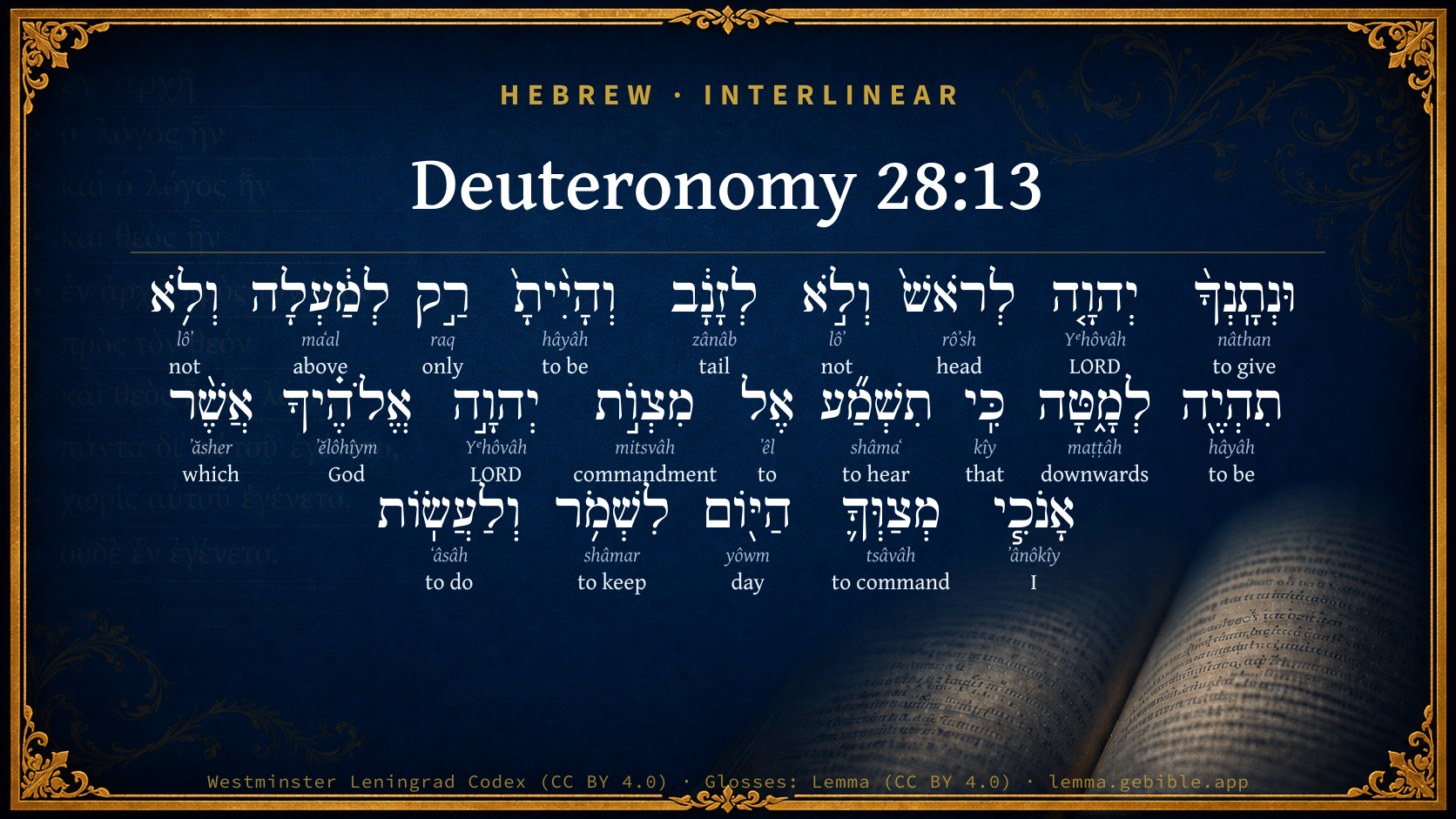
  1. וּנְתָֽנְךָ֨ nâthan H5414 “and · to give · you” Conjunction + Verb, Qal, Sequential Perfect, 3rd Person, Masculine, Singular + Suffix, Personal, 2nd Person, Masculine, Singular
  2. יְהוָ֤ה Yᵉhôvâh H3068 “LORD” Noun, Proper
  3. לְרֹאשׁ֙ rôʼsh H7218 “to/for · head” Preposition + Noun, Common, Masculine, Singular, Absolute
  4. וְלֹ֣א lôʼ H3808 “and · not” Conjunction + Particle, Negative
  5. וְהָיִ֨יתָ֙ hâyâh H1961 “and · to be” Conjunction + Verb, Qal, Sequential Perfect, 2nd Person, Masculine, Singular
  6. רַ֣ק raq H7535 “only” Particle, Accusative
  7. לְמַ֔עְלָה maʻal H4605 “to/for · above · toward” Preposition + Adverb + Suffix, Demonstrative
  8. וְלֹ֥א lôʼ H3808 “and · not” Conjunction + Particle, Negative
  9. תִהְיֶ֖ה hâyâh H1961 “to be” Verb, Qal, Imperfect, 2nd Person, Masculine, Singular
  10. לְמָ֑טָּה maṭṭâh H4295 “to/for · downwards” Preposition + Adverb
  11. כִּֽי kîy H3588 “that” Conjunction
  12. תִשְׁמַ֞ע shâmaʻ H8085 “to hear” Verb, Qal, Imperfect, 2nd Person, Masculine, Singular
  13. אֶל ʼêl H413 “to” Preposition
  14. מִצְוֺ֣ת mitsvâh H4687 “commandments of” Noun, Common, Feminine, Plural, Construct
  15. יְהוָ֣ה Yᵉhôvâh H3068 “LORD” Noun, Proper
  16. אֱלֹהֶ֗יךָ ʼĕlôhîym H430 “God(s) · your” Noun, Common, Masculine, Plural, Construct + Suffix, Personal, 2nd Person, Masculine, Singular
  17. אֲשֶׁ֨ר ʼăsher H834 “which” Particle, Relative
  18. אָנֹכִ֧י ʼânôkîy H595 “I” Pronoun, Personal, 1st Person, Common, Singular
  19. מְצַוְּךָ֛ tsâvâh H6680 “commanding · you” Verb, Piel, Participle Active, Masculine, Singular, Construct + Suffix, Personal, 2nd Person, Masculine, Singular
  20. הַיּ֖וֹם yôwm H3117 “the · day” Particle, Definite Article + Noun, Common, Masculine, Singular, Absolute
  21. לִשְׁמֹ֥ר shâmar H8104 “to keep” Preposition + Verb, Qal, Infinitive Construct
  22. וְלַעֲשֽׂוֹת ʻâsâh H6213 “and · to do” Conjunction + Preposition + Verb, Qal, Infinitive Construct

About this verse

These counts appear in no published source. They are computed here, from the morphology-tagged text and Lemma’s own curated glosses. What Lemma adds →

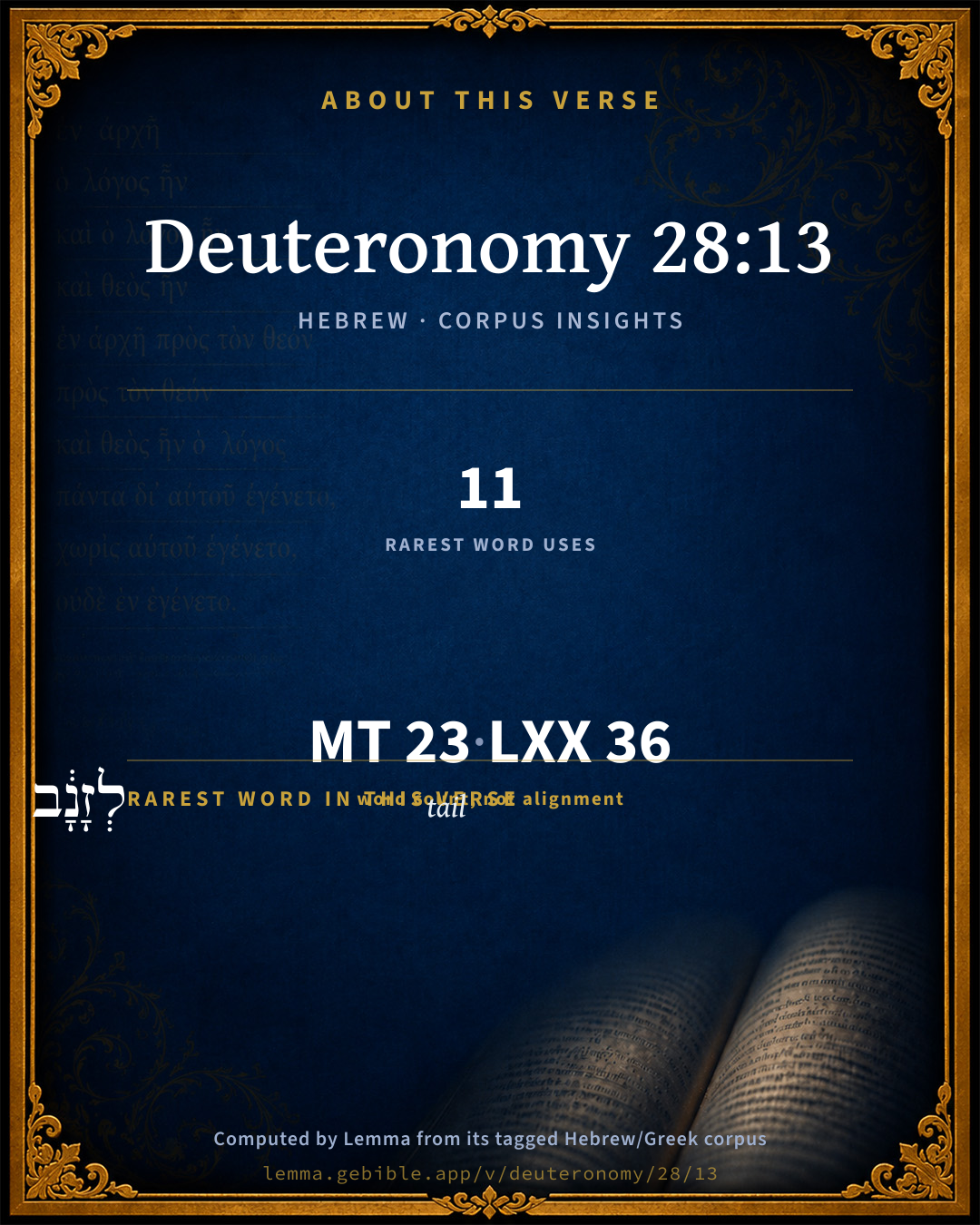
23
words
20
distinct lemmas
Pentateuch
section

Notable vocabulary

The rarest word here is לְזָנָ֔ב tail H2180 — appearing just 11 times in the whole Hebrew Bible.

Shared distinctive vocabulary

לְזָנָ֔ב tail H2180 occurs in 9 verses of the Hebrew Bible. Also found in:

Grammatical profile

  • 7 verbs
  • 7 nouns
  • 1 pronoun
  • 1 preposition
  • 1 conjunction
  • 2 adverbs
  • 4 particles

Verb forms

  • וּנְתָֽנְךָ֨ Qal · Sequential Perfect
  • וְהָיִ֨יתָ֙ Qal · Sequential Perfect
  • תִהְיֶ֖ה Qal · Imperfect
  • תִשְׁמַ֞ע Qal · Imperfect
  • מְצַוְּךָ֛ Piel · Participle Active
  • לִשְׁמֹ֥ר Qal · Infinitive Construct
  • וְלַעֲשֽׂוֹת Qal · Infinitive Construct

Repetition

Words recur within this verse — often emphatic in Hebrew:

  • יְהוָ֤ה LORD H3068 ×2
  • וְהָיִ֨יתָ֙ to be H1961 ×2
  • וְלֹ֣א not H3808 ×2

Hebrew & Septuagint length

In English translation the verse runs 45 words from the Hebrew and 47 from the Septuagint (LXX English) — closely comparable.

A rough comparison of the two English renderings, which tokenize alike — not a word-level alignment.

Word counts can differ between the Hebrew and the Greek without any difference in meaning — e.g. the Hebrew direct-object marker אֵת has no separate Greek word, and Greek often adds the article ὁ.

In the original languages it is 23 Hebrew tokens and 36 Greek tokens — but the two are counted differently (Hebrew bundles its prefixes and suffixes into one token; the Greek is in lemma form), so that isn’t a like-for-like length.

Cross-references

3

Topical passages linked to Deuteronomy 28:13 in the Treasury of Scripture Knowledge — connected by theme and wording, ordered by reader-vote popularity; previews shown in the World English Bible.

  • Deuteronomy 28:1 It shall happen, if you shall listen diligently to the voice of Yahweh your God, to observe to do all his commandments which I command you this day, who Yahweh your God will set you on high above all the nations of the earth:
  • Deuteronomy 4:6–9 Keep therefore and do them; for this is your wisdom and your understanding in the sight of the peoples, who shall hear all these statutes, and say, Surely this great nation is a wise and understanding people.
  • Philippians 1:27 Only let your manner of life be worthy of the Gospel of Christ, that, whether I come and see you or am absent, I may hear of your state, that you stand firm in one spirit, with one soul striving for the faith of the Gospel;

Cross-references courtesy of OpenBible.info (CC BY 4.0).

Hebrew and Greek witnesses Masoretic Hebrew ↔ Greek Septuagint

The same verse in the two great witnesses to the Old Testament, shown verse-for-verse.

These are two independent witnesses, not word-aligned to each other, and the Septuagint is shown in lemma (dictionary) form.

Hebrew Deuteronomy 28:13 Masoretic · Westminster Leningrad Codex

וּנְתָֽנְךָ֨ יְהוָ֤ה לְרֹאשׁ֙ וְלֹ֣א לְזָנָ֔ב וְהָיִ֨יתָ֙ רַ֣ק לְמַ֔עְלָה וְלֹ֥א תִהְיֶ֖ה לְמָ֑טָּה כִּֽי תִשְׁמַ֞ע אֶל מִצְוֺ֣ת יְהוָ֣ה אֱלֹהֶ֗יךָ אֲשֶׁ֨ר אָנֹכִ֧י מְצַוְּךָ֛ הַיּ֖וֹם לִשְׁמֹ֥ר וְלַעֲשֽׂוֹת

Yahweh will make you the head, and not the tail; and you shall be above only, and you shall not be beneath; if you shall listen to the commandments of Yahweh your God, which I command you this day, to observe and to do [them],

World English Bible · Public Domain

Greek LXX Deuteronomy 28:13 Septuagint · lemma form

καταἵστημι σύ κύριος ὁ θεός σύ εἰς κεφαλή καί μή εἰς οὐρά καί εἰμί τότε ἐπάνω καί οὐ εἰμί ὑποκάτω ἐάν ἀκούω ὁ ἐντολή κύριος ὁ θεός σύ ὅσος ἐγώ ἐντέλλομαι σύ σήμερον φυλάσσω καί ποιέω

The Lord your God make you the head, and not the tail; and you shall then be above and you shall not be below, if you will listen to the voice of the Lord your God, in all things that I charge you this day to observe.

LXX2012 (modern English Septuagint) · Public Domain

Hebrew: Westminster Leningrad Codex (CC BY 4.0). Greek: Septuagint (public domain); English from LXX2012 (modern English Septuagint) (Public Domain). How the Septuagint differs from the Hebrew →

Targum (Aramaic paraphrase)

2

The Targum is the ancient Jewish Aramaic paraphrase of the Hebrew Scriptures — an interpretive translation, not the Hebrew text itself. Onkelos (literal) and Pseudo-Jonathan (expansive) render the Torah, and Jonathan the Prophets. Coverage is partial: where no permissively-licensed English translation exists for a verse, only the Aramaic is shown. This is verse-level text, not a word-by-word alignment to the Hebrew.

  1. Targum Onkelos Torah (Genesis–Deuteronomy)
    וְיִתְּנִנָךְ יְיָ לְתַקִיף וְלָא לְחַלָשׁ וּתְהֵי בְּרַם לְעֵלָא וְלָא תְהֵי לְתַחְתָּא אֲרֵי תְקַבֵּל לְפִקוּדַיָא דַיְיָ אֱלָהָךְ דִי אֲנָא מְפַקְדָךְ יוֹמָא דֵין לְמִטַר וּלְמֶעְבָּד

    (no public-domain English translation for this verse)

    Targum Onkelos — Aramaic: “Onkelos Genesis” (public domain); “Onkelos Exodus” (public domain); “Onkelos Leviticus” (public domain); “Onkelos Numbers” (public domain); “Onkelos Deuteronomy” (public domain). English: “Sefaria Community Translation” (CC0 1.0 (public-domain dedication)); “J.W. Etheridge. The Targums of Onkelos and Jonathan Ben Uzziel on the Pentateuch. London: Longmans, Green, 1862” (public domain). Text via Sefaria.

  2. Targum Pseudo-Jonathan Torah (Genesis–Deuteronomy)
    וְיִמְנֵי מֵימְרָא דַיְיָ יַתְכוֹן לְמַלְכִין וְלָא לְהֶדְיוֹטִין וְתֶהֱווּן לְחוֹד מְנַטְלִין וְלָא תְהוֹן לְמָאִיסִין אֲרוּם תְּקַבְּלוּן לְפִקוּדַיָא דַיְיָ אֱלָהָכוֹן דַאֲנָא מְפַקֵיד לְכוֹן יוֹמָנָא לְמִנְטוֹר וּלְמֶעֱבַד

    And the Word of the Lord will appoint you to be kings and not subjects, and to be ennobled and not abased, when you have hearkened to the commandments of the Lord your God which I command you this day to keep and perform.

    Targum Pseudo-Jonathan — Aramaic: “Targum Jonathan on Genesis” (public domain); “Targum Jonathan on Exodus” (public domain); “Targum Jonathan on Leviticus” (public domain); “Targum Jonathan on Numbers” (public domain); “Targum Jonathan on Deuteronomy” (public domain). English: “The Targum of Jonathan ben Uzziel, trans. J. W. Etheridge, London, 1862” (public domain). Text via Sefaria.

Commentary

Notes on Deuteronomy 28:13 from classic Christian and Jewish commentators (each source and its license shown beneath its notes). The classic Christian expositions comment on the surrounding passage and are grouped to its opening verse, so a note may address several verses; the Jewish commentaries on the Tanakh (Rashi and others) are per-verse, so they appear only where the commentator wrote on this verse.

Lemma curates 59 commentaries, every one of them public domain or Creative Commons licensed, each selected and text-cleaned for this edition rather than reprinted as found. About our sources →

Trapp's Complete Commentary

John Trapp

Deu 28:13 And the LORD shall make thee the head, and not the tail; and thou shalt be above only, and thou shalt not be beneath; if that thou hearken unto the commandments of the LORD thy God, which I command thee this day, to observe and to do [them]:

Ver. 13. And the Lord shall make thee.] See a parallel place. {Hos 13:1} "When Ephraim spake, there was trembling; he exalted himself in Israel; but when he offended in Baal, he died." Before, none durst budge against the name of Ephraim; but after he offended in Baal, every paltry adversary trampled upon him as a dead man.

John Trapp, A Commentary or Exposition upon All the Books of the Old and New Testament (1647–1656) — public domain. Text from a community e-Sword module.

The Biblical Illustrator

Joseph S. Exell

Deu_28:13

The head, and not the tail.

The saints leading the way

If we obey the Lord He will compel our adversaries to see that His blessing rests upon us. Though this be a promise of the law, yet it stands good to the people of God; for Jesus has removed the curse, but He has established the blessing. It is for saints to lead the way among men by holy influence: they are not to be the tail, to be dragged hither and thither by others. We must not yield to the spirit of the age, but compel the age to do homage to Christ. If the Lord be with us we shall not crave toleration for religion, but we shall seek to seat it on the throne of society. Has not the Lord Jesus made His people priests? Surely they are to teach, and must not be learners from the philosophies of unbelievers. Are we not in Christ made kings to reign upon the earth? How, then, can we be the servants of custom, the slaves of human opinion! Have you taken up your true position for Jesus? Too many are silent because diffident, if not cowardly. Should we allow the name of the Lord Jesus to be kept in the background? Should our religion drag along as a tail? Should it not rather lead the way, and be the ruling force with ourselves and others? (C. H. Spurgeon.)

The Biblical Illustrator, edited by Joseph S. Exell (c. 1880s–1900s) — public domain. Text from a community e-Sword module.

Joseph Benson's Commentary

Deu 28:13. The head — The chief of all people in power, or at least in dignity and privileges; so that even they that are not under thy authority shall reverence thy greatness and excellence. So it was in David’s and Solomon’s time, and so it should have been oftener and much more, if they had performed the conditions.

Joseph Benson's Commentary on the Old and New Testaments (1811–1818) — public domain. Text from a community e-Sword module.

Tyndale Open Study Notes

Tyndale Open Resources

28:13 the head and not the tail: If Israel obeyed the terms of the covenant, it would lead the nations and not be subject to them.

Tyndale Open Study Notes — © Tyndale Open Resources, licensed CC BY-SA 4.0. Text via the HelloAO Bible API.

Geneva Bible (1599)

Geneva Bible translators

Or, the lowest

Geneva Bible (1599) marginal notes — public domain. Text via Bolls.life.

Jamieson, Fausset & Brown

Robert Jamieson, A. R. Fausset & David Brown

the head, and not the tail--an Oriental form of expression, indicating the possession of independent power and great dignity and acknowledged excellence (Isa 9:14; Isa 19:15).

Jamieson, Fausset & Brown — Commentary Critical and Explanatory on the Whole Bible (1871) — public domain (CC PDM 1.0). Text via the HelloAO Bible API.

The Cambridge Bible for Schools and Colleges

gen. ed. J. J. S. Perowne

13. the head, and not the tail] Isa_9:14; Isa_19:15.

only] Heb. raḳ; see on Deu_10:15. Here = nothing but.

if thou shalt] Rather (as in Deu_28:9), for thou wilt, or in case thou shalt.

to observe and to do] See on Deu_4:6, Deu_5:32.

The Cambridge Bible for Schools and Colleges (gen. ed. J. J. S. Perowne; Cambridge University Press, 1878–1918) — public domain. Text from a community e-Sword module.

John Gill's Exposition

And thou shall not go aside from any of the words which I command thee this day,.... Depart from them as a rule to walk by, turn out from them as a path to walk in, neglect and disobey them, and go into practices contrary to them: turning

to the right hand or to the left, to go after other gods to serve them; which to do was to break the first and principal table of the law, than which nothing was more abominable and provoking to God.

John Gill's Exposition of the Whole Bible (1746–1763) — public domain (CC PDM 1.0). Text via the HelloAO Bible API.

Haydock's Catholic Bible Commentary

Tail, as he had promised, ver. 1. (Menochius) --- You shall have dominion over others. (Calmet) --- So Isaias (ix. 14,) says, the Lord shall destroy the head, (the magistrate) and the tail, or (ver. 15,) the lying prophet. (Haydock)

George Leo Haydock (1774–1849), Haydock's Catholic Family Bible and Commentary, 1859 edition — public domain. Excludes Psalms (Douay-Rheims chapter numbering differs from Protestant) and Deuterocanonical books (Catholic canon only).

Matthew Poole's English Annotations

The head; the chief of all people in power, or at least in dignity and privileges; so that even they that are not under thine authority shall reverence thy greatness and excellency. So it was in David’s and Solomon’s time, and so it should have been much oftener and much more, if they had performed the conditions here required. For the phrase, see Isa 9:14,15; 19:15.

Matthew Poole's English Annotations on the Holy Bible (1683–1685) — public domain. Text from a community e-Sword/MySword module.

The Pulpit Commentary

They should be manifestly superior to other nations, heading them and being above them, their leader and not their subject or follower. (Isa_9:13) Note the contrast in vers. 43, 44.

Moral gravitation.

In studying the histories of the good men of the Bible, we notice how, notwithstanding the numerous causes which act adversely to their fortunes, the constant tendency of their piety is to lift them upwards. A law is none the less a law because other laws come in to interfere with, modify, suspend, or counteract its operation. A cork or other light body may be pushed under water, but the law of its nature is to rise to the top. Violence may abnormally depress the righteous man"s fortunes, but the "law" of piety is to elevate them. Mingle lighter and heavier bodies in water, and the heavier gradually sink, while the lighter mount surfacewards. So piety, both from its own nature and by the blessing of God upon it, tends to raise a man in favor and influence, and gradually to improve his fortunes; while ungodliness as invariably drags him down. The good man gains ground; his enemies lose it. He mounts to be the head, and they sink to be the tail. He is uppermost; they are undermost. Illustrate from the histories of Joseph, David, Daniel. It is the same today. As years advance, the good man grows in influence; slowly but surely overcomes his first difficulties; is trusted, sought after, looked up to; rises in social position; ultimately occupies the seats of honor; while those who started life with him, but took a different course, gradually lose their advantages, fall one by one out of rank, and are driven to the wall. J.O. (cf. Pro_4:8 Pro_13:22, etc.)

The Pulpit Commentary (1880–1919), ed. H.D.M. Spence-Jones & Joseph S. Exell — public domain. Text from a community e-Sword module.

John Wesley's Explanatory Notes

The head - The chief of all people in power, or at least in dignity and privileges; so that even they that are not under thine authority shall reverence thy greatness and excellency. So it was in David's and Solomon's time, and so it should have been much oftner and much more, if they had performed the conditions.

John Wesley, Explanatory Notes Upon the Whole Bible (1754–1765) — public domain. Text via the GEBible commentary corpus.

unfoldingWord translationNotes

Door43 World Missions Community

General Information:

Moses speaks to the Israelites as if they were one man, so the words "you" and "your" here are singular. (See: Forms of You)

the head, and not the tail

This metaphor describes the nation of Israel as an animal and means the Israelites will always be the leaders over other nations and never the servants following behind them. The Israelites will be superior in power, money, and honor. (See: Metaphor)

will be only above ... will never be beneath

The Israelites will rule over others but never have others rule them.

I am commanding you

Moses is speaking to all the Israelites, so the word "you" is plural. (See: Forms of You)

if you do not turn away from any of the words that I am commanding you today, to the right hand or to the left, so as to go after other gods to serve them

Disobeying Yahweh and worshiping other gods is spoken of as if a person physically turned and went in a different direction from Yahweh's words. AT: "if you do not disobey what I am commanding you today by serving other gods" (See: Metaphor)

translationWords

head

command

God

turn

word

false god

servant

unfoldingWord translationNotes — © Distant Shores Media and the Door43 World Missions Community, licensed CC BY-SA 4.0. Source: git.door43.org/Door43/en_tn.

Ramban (Nachmanides)

Rabbi Moshe ben Nachman (Ramban / Nachmanides)

AND THE ETERNAL WILL MAKE THEE THE HEAD, AND NOT THE TAIL. The meaning thereof is that He will make you the head of all peoples and not the tail of any one of the nations, for it is possible that you will be the head of many peoples and yet be the tail of one nation more distinguished than you. The correct interpretation is that He will henceforth make you the head and at no time will you ever be the tail. Similarly, thou shalt be above only always, and thou shalt not be beneath forever.

Ramban (Nachmanides) on the Tanakh — English translation: “Commentary on the Torah by Ramban (Nachmanides). Translated and annotated by Charles B. Chavel. New York, Shilo Pub. House, 1971-1976” (CC BY 4.0). Text via Sefaria.

Lesson kit

Teaching starters — assembled from the data on this page, not authored interpretation. Every prompt links to the verse data it draws on. Edit before teaching.

Deuteronomy, in the Pentateuch, opens this verse with 23 words (20 distinct Hebrew lemmas). Its most distinctive word is zânâb (“tail”). A historical commentator’s framing appears above. Read the whole chapter for the surrounding context.

Discussion questions

  1. How does “tail” (zânâb) shape what this verse is saying?
  2. How does Exodus 4:4, which shares the word «tail», read alongside this verse?
  3. What does the repetition of “LORD” (2× in this one verse) do in this verse?
  4. The translations on this page render this verse differently — a whole-verse word diff, not a word-by-word alignment. What might account for the different wordings?
  5. «וּנְתָֽנְךָ֨» is a Qal Sequential Perfect verb. How does that grammatical form shape the action described?
  6. Compare how Trapp's Complete Commentary and The Biblical Illustrator read this verse. Where do they agree or differ?

Things to notice

Reading settings

Reading text

Shown beneath each verse's original-language words.

Old Testament
Old Testament edition

Read the OT as the Masoretic Hebrew (MT) or the Greek Septuagint (LXX).

English shown for the Greek Septuagint (in the Hebrew ↔ Greek comparison).

Comparing translations? Open the Compare panel on any verse page to stack up to four side by side.