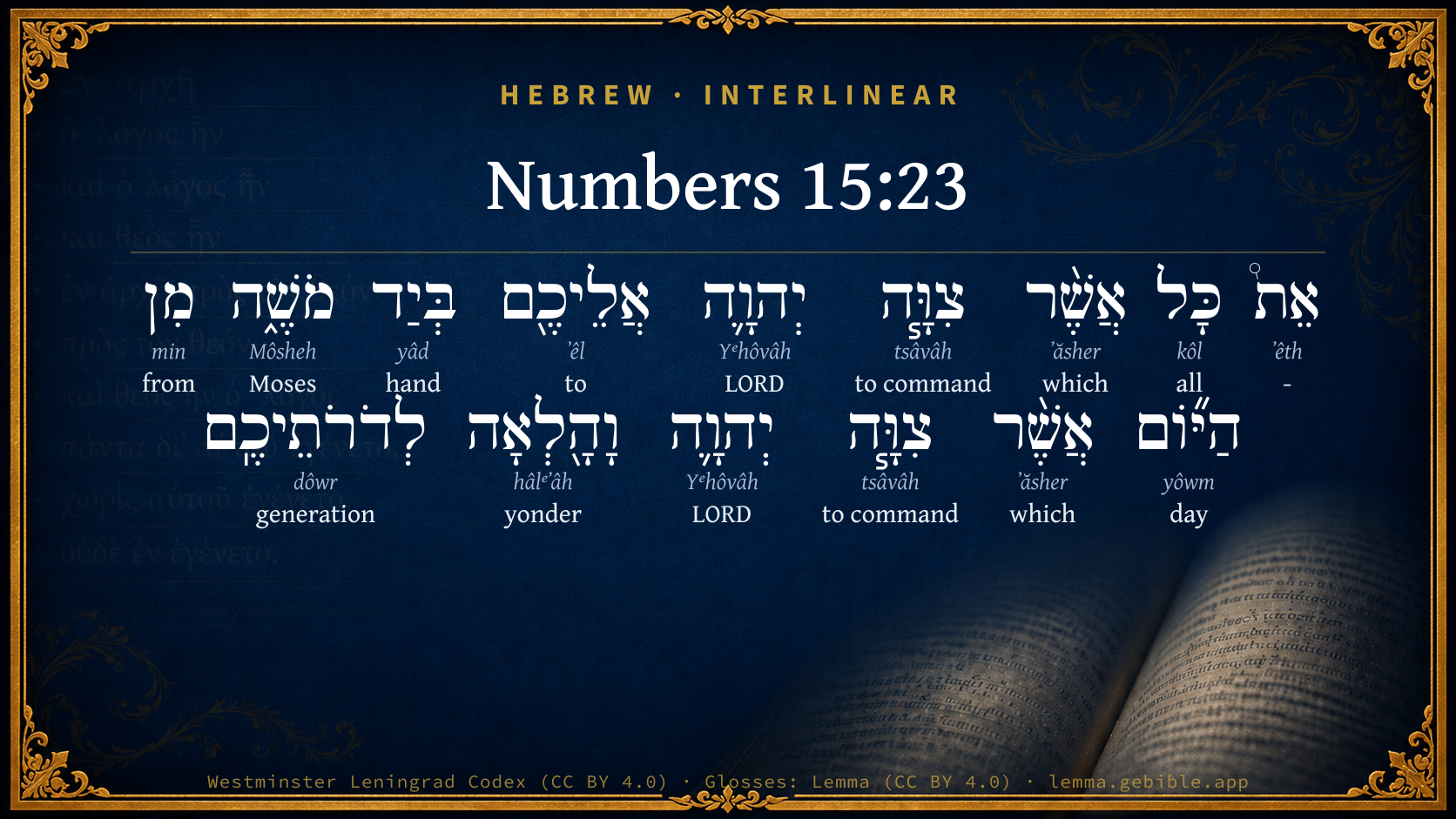
Numbers 15:23

Hebrew (Westminster Leningrad Codex) Numbers 15:23 appears in the Hebrew Old Testament. The text above is from the Westminster Leningrad Codex. Each word links to its Strong’s number, a concise gloss, and parsing drawn from the Open Scriptures Hebrew Bible morphology. Click any word for its full Brown-Driver-Briggs (BDB) entry.
Download image
Cite this verse

Numbers 15:23 (World English Bible). Public Domain. Lemma interlinear Bible study tool, https://lemma.gebible.app/v/numbers/15/23.

Show BibTeX & RIS
BibTeX
RIS
English Translation
even all that Yahweh has commanded you by Moses, from the day that Yahweh gave commandment, and onward throughout your generations;
World English Bible · Public Domain
Download a study sheet

One document with this verse’s original text, its word-by-word gloss line, the meaning frame, cross-references with their text, attributed commentary, and full source and license credits — printable, and it pastes into notes with its structure intact.

This verse Autodidact and up

Study sheet (.html) Plain text (.txt)

A passage Seminary Student

Up to 50 verses in one chapter. A passage sheet keeps up to 6 commentary sources and 12 cross-references per verse, in the order this page ranks them, and says so on the sheet whenever that leaves anything out. Ask for a single verse and you get the Autodidact verse sheet above.

Everything on this page stays free to read, with no account — the sheet is a download of what is already on screen, not access to it.

Want to remove ads? Support Godless Engineer
Compare translations 3

The same verse in 3 English versions, stacked beneath the original-language interlinear above. Click any original word for its lexicon entry.

Each is an independent rendering of the whole verse — the interlinear is not word-aligned to these translations.

Highlighted words mark where these versions differ — a whole-verse word diff, not a word-by-word alignment.

  • World English Bible Public Domain
    even all that Yahweh has commanded you by Moses, from the day that Yahweh gave commandment, and onward throughout your generations;
  • King James Version Public Domain
    Even all that the LORD hath commanded you by the hand of Moses, from the day that the LORD commanded Moses, and henceforward among your generations;
  • unfoldingWord Literal Text CC BY-SA 4.0
    all that Yahweh has commanded to you in the hand of Moses, from the day that Yahweh commanded and beyond for your generations,

unfoldingWord Literal Text — © unfoldingWord, licensed CC BY-SA 4.0. Word-aligned USFM3 via Door43 (git.door43.org/unfoldingWord/en_ult).

Versions to compare (up to 4)

3 of 4 selected

Show all 18 translations

Every available English version of this verse, each an independent rendering of the whole verse.

  • World English Bible Public Domain
    even all that Yahweh has commanded you by Moses, from the day that Yahweh gave commandment, and onward throughout your generations;
  • Berean Standard Bible Public Domain
    all that the LORD has commanded you through Moses from the day the LORD gave them and continuing through the generations to come—
  • Majority Standard Bible Public Domain
    all that the LORD has commanded you through Moses from the day the LORD gave them and continuing through the generations to come—
  • King James Version Public Domain
    Even all that the LORD hath commanded you by the hand of Moses, from the day that the LORD commanded Moses, and henceforward among your generations;
  • American Standard Version (1901) Public Domain
    even all that Jehovah hath commanded you by Moses, from the day that Jehovah gave commandment, and onward throughout your generations;
  • Revised Version (1885) Public Domain
    even all that the LORD hath commanded you by the hand of Moses, from the day that the LORD gave commandment, and onward throughout your generations;
  • Geneva Bible (1599) Public Domain
    Euen all that the Lord hath commanded you by the hand of Moses, from the first day that the Lord commanded Moses, and hence forward among your generations:
  • Douay-Rheims (1899) Public Domain
    And by him hath commanded you, from the day that he began to command and thenceforward,
  • Young's Literal Translation Public Domain
    the whole that Jehovah hath charged upon you by the hand of Moses, from the day that Jehovah hath commanded, and henceforth, to your generations,
  • Literal Standard Version CC BY-SA 4.0
    the whole that YHWH has charged on you by the hand of Moses, from the day that YHWH has commanded and from now on, throughout your generations—
  • Unlocked Literal Bible CC BY-SA 4.0
    everything that I have commanded you through Moses from the day that I began to give you commands and onward throughout your people's generations.
  • unfoldingWord Literal Text CC BY-SA 4.0
    all that Yahweh has commanded to you in the hand of Moses, from the day that Yahweh commanded and beyond for your generations,
  • Darby Bible Public Domain
    all that Jehovah hath commanded you through Moses, from the day that Jehovah gave commandment, and henceforward throughout your generations;
  • World Messianic Bible Public Domain
    even all that the LORD has commanded you by Moses, from the day that the LORD gave commandment and onward throughout your generations—
  • Webster's Bible Public Domain
    Even all that the LORD hath commanded you by the hand of Moses, from the day that the LORD commanded Moses, and henceforward among your generations;
  • Free Bible Version CC BY-SA 4.0
    everything that the Lord has ordered you to do through Moses from the time that the Lord gave them and for all future generations—
  • Bible in Basic English Public Domain
    All the laws which the Lord has given you by the hand of Moses, from the day when the Lord gave them, and ever after from generation to generation;
  • JPS Tanakh (1917) Public Domain
    even all that the LORD hath commanded you by the hand of Moses, from the day that the LORD gave commandment, and onward throughout your generations;

Literal Standard Version (2020), Covenant Press — licensed CC BY-SA 4.0. Text via the HelloAO Bible API (eBible.org). Unlocked Literal Bible (unfoldingWord) — licensed CC BY-SA 4.0. Text via the HelloAO Bible API (eBible.org). unfoldingWord Literal Text — © unfoldingWord, licensed CC BY-SA 4.0. Word-aligned USFM3 via Door43 (git.door43.org/unfoldingWord/en_ult). Free Bible Version, Dr. Jonathan Gallagher — licensed CC BY-SA 4.0. Text via the HelloAO Bible API (eBible.org).

Word by word

More ways to search: Search by grammar → Find every occurrence → Compare this word →

Practice this passage: Drill this verse → Learn its vocabulary →

וָהָ֖לְאָה
hâlᵉʼâh
H1973
“and · yonder”
Conjunction + Adverb
Part of Speech
Conjunction + Adverb
Full BDB Definition

Origin: from the primitive form of the article [hal]

TWOT: 496a

out there, onwards, further - yonder, beyond (of place) - onwards (of time)
  1. אֵת֩ ʼêth H853 “-” Particle, Direct Object
  2. כָּל kôl H3605 “all of” Noun, Common, Masculine, Singular, Construct
  3. אֲשֶׁ֨ר ʼăsher H834 “which” Particle, Relative
  4. צִוָּ֧ה tsâvâh H6680 “to command” Verb, Piel, Perfect, 3rd Person, Masculine, Singular
  5. יְהוָ֛ה Yᵉhôvâh H3068 “LORD” Noun, Proper
  6. אֲלֵיכֶ֖ם ʼêl H413 “to · you” Preposition + Suffix, Personal, 2nd Person, Masculine, Plural
  7. בְּיַד yâd H3027 “in/at · hand of” Preposition + Noun, Common, Both, Singular, Construct
  8. מֹשֶׁ֑ה Môsheh H4872 “Moses” Noun, Proper
  9. מִן min H4480 “from” Preposition
  10. הַיּ֞וֹם yôwm H3117 “the · day” Particle, Definite Article + Noun, Common, Masculine, Singular, Absolute
  11. אֲשֶׁ֨ר ʼăsher H834 “which” Particle, Relative
  12. צִוָּ֧ה tsâvâh H6680 “to command” Verb, Piel, Perfect, 3rd Person, Masculine, Singular
  13. יְהוָ֛ה Yᵉhôvâh H3068 “LORD” Noun, Proper
  14. לְדֹרֹתֵיכֶֽם dôwr H1755 “to/for · generations · your” Preposition + Noun, Common, Masculine, Plural, Construct + Suffix, Personal, 2nd Person, Masculine, Plural

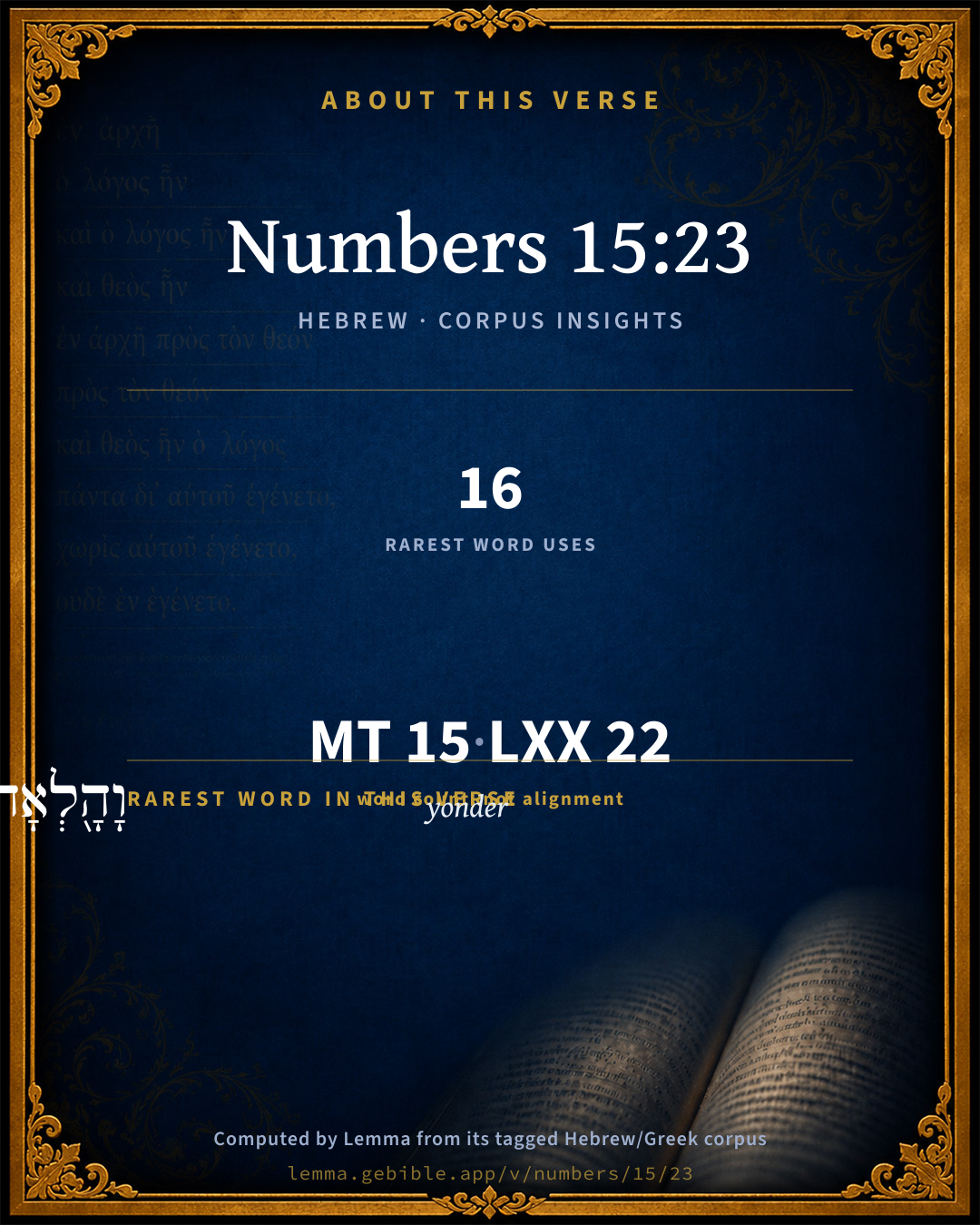
About this verse

These counts appear in no published source. They are computed here, from the morphology-tagged text and Lemma’s own curated glosses. What Lemma adds →

15
words
12
distinct lemmas
Pentateuch
section

Notable vocabulary

The rarest word here is וָהָ֖לְאָה yonder H1973 — appearing just 16 times in the whole Hebrew Bible.

Shared distinctive vocabulary

וָהָ֖לְאָה yonder H1973 occurs in 16 verses of the Hebrew Bible. Also found in:

Grammatical profile

  • 2 verbs
  • 7 nouns
  • 2 prepositions
  • 1 adverb
  • 3 particles

Verb forms

  • צִוָּ֧ה Piel · Perfect
  • צִוָּ֧ה Piel · Perfect

Repetition

Words recur within this verse — often emphatic in Hebrew:

  • צִוָּ֧ה to command H6680 ×2
  • יְהוָ֛ה LORD H3068 ×2
  • אֲשֶׁ֨ר which H834 ×2

Hebrew & Septuagint length

In English translation the verse runs 21 words from the Hebrew and 23 from the Septuagint (LXX English) — closely comparable.

A rough comparison of the two English renderings, which tokenize alike — not a word-level alignment.

Word counts can differ between the Hebrew and the Greek without any difference in meaning — e.g. the Hebrew direct-object marker אֵת has no separate Greek word, and Greek often adds the article ὁ.

In the original languages it is 15 Hebrew tokens and 22 Greek tokens — but the two are counted differently (Hebrew bundles its prefixes and suffixes into one token; the Greek is in lemma form), so that isn’t a like-for-like length.

Hebrew and Greek witnesses Masoretic Hebrew ↔ Greek Septuagint

The same verse in the two great witnesses to the Old Testament, shown verse-for-verse.

These are two independent witnesses, not word-aligned to each other, and the Septuagint is shown in lemma (dictionary) form.

Hebrew Numbers 15:23 Masoretic · Westminster Leningrad Codex

אֵת֩ כָּל אֲשֶׁ֨ר צִוָּ֧ה יְהוָ֛ה אֲלֵיכֶ֖ם בְּיַד מֹשֶׁ֑ה מִן הַיּ֞וֹם אֲשֶׁ֨ר צִוָּ֧ה יְהוָ֛ה וָהָ֖לְאָה לְדֹרֹתֵיכֶֽם

even all that Yahweh has commanded you by Moses, from the day that Yahweh gave commandment, and onward throughout your generations;

World English Bible · Public Domain

Greek LXX Numbers 15:23 Septuagint · lemma form

καθά συντάσσω κύριος πρός σύ ἐν χείρ μωυσῆς ἀπό ὁ ἡμέρα ὅς συντάσσω κύριος πρός σύ καί ἐπέκεινα εἰς ὁ γενεά σύ

as the Lord appointed you by the hand of Moses, from the day which the Lord appointed you and forward throughout your generations,

LXX2012 (modern English Septuagint) · Public Domain

Hebrew: Westminster Leningrad Codex (CC BY 4.0). Greek: Septuagint (public domain); English from LXX2012 (modern English Septuagint) (Public Domain). How the Septuagint differs from the Hebrew →

Targum (Aramaic paraphrase)

2

The Targum is the ancient Jewish Aramaic paraphrase of the Hebrew Scriptures — an interpretive translation, not the Hebrew text itself. Onkelos (literal) and Pseudo-Jonathan (expansive) render the Torah, and Jonathan the Prophets. Coverage is partial: where no permissively-licensed English translation exists for a verse, only the Aramaic is shown. This is verse-level text, not a word-by-word alignment to the Hebrew.

  1. Targum Onkelos Torah (Genesis–Deuteronomy)
    יָת כָּל דִי פַקִיד יְיָ יָתְכוֹן בִּידָא דְמשֶׁה מִן יוֹמָא דִי פָקִיד יְיָ וּלְהָלָא לְדָרֵיכוֹן

    (no public-domain English translation for this verse)

    Targum Onkelos — Aramaic: “Onkelos Genesis” (public domain); “Onkelos Exodus” (public domain); “Onkelos Leviticus” (public domain); “Onkelos Numbers” (public domain); “Onkelos Deuteronomy” (public domain). English: “Sefaria Community Translation” (CC0 1.0 (public-domain dedication)); “J.W. Etheridge. The Targums of Onkelos and Jonathan Ben Uzziel on the Pentateuch. London: Longmans, Green, 1862” (public domain). Text via Sefaria.

  2. Targum Pseudo-Jonathan Torah (Genesis–Deuteronomy)
    יַת כָּל מַה דְפַקֵיד יְיָ לְוַתְכוֹן בִּידָא דְמשֶׁה מִן יוֹמָא דְפַקֵיד יְיָ וּלְהָלָא לְדָרֵיכוֹן

    whatsoever the Lord hath commanded you by Mosheh from the day He commanded it, and thenceforth unto your generations -

    Targum Pseudo-Jonathan — Aramaic: “Targum Jonathan on Genesis” (public domain); “Targum Jonathan on Exodus” (public domain); “Targum Jonathan on Leviticus” (public domain); “Targum Jonathan on Numbers” (public domain); “Targum Jonathan on Deuteronomy” (public domain). English: “The Targum of Jonathan ben Uzziel, trans. J. W. Etheridge, London, 1862” (public domain). Text via Sefaria.

Commentary

Notes on Numbers 15:23 from classic Christian and Jewish commentators (each source and its license shown beneath its notes). The classic Christian expositions comment on the surrounding passage and are grouped to its opening verse, so a note may address several verses; the Jewish commentaries on the Tanakh (Rashi and others) are per-verse, so they appear only where the commentator wrote on this verse.

Lemma curates 59 commentaries, every one of them public domain or Creative Commons licensed, each selected and text-cleaned for this edition rather than reprinted as found. About our sources →

Ellicott's Commentary for English Readers

(23) And henceforward.—Rather, and onward, or thenceforward. There is nothing in the word which is here used to denote whether the reference is or is not to legislation of a later date than that at which the words were spoken. The terminus a quo is expressed in the preceding words. Comp. Isa_18:2, where the meaning seems to be up to the present time, and Eze_39:22, where the reference is to the indefinite future.

A Bible Commentary for English Readers, edited by Charles John Ellicott (1878–1897) — public domain. Text from a community e-Sword module.

John Gill's Exposition

Then it shall be, if ought be committed by ignorance,.... Of the law of God, not clearly understanding the meaning of it, or not knowing of the several precepts of it, and the circumstances of each, and the manner of performing obedience thereunto:

without the knowledge of the congregation; or they being ignorant of the true intent of the law and form of obeying it; for this is to be understood not of the sin of a private person through ignorance, but of the body of the people; or of a congregation of them in some particular place, ignorantly and unawares falling into idolatry, or rather into a breach of any of the laws of God, moral or ceremonial:

that all the congregation shall offer one young bullock for a burnt offering, for a sweet savour unto the Lord; as an acceptable sacrifice to him; by which it appears that this law is different from that in Lev 4:13; since the bullock there was for a sin offering, this for a burnt offering; and besides another creature was to be for a sin offering, as after expressed:

with his meat offering and his drink offering, according to the manner; a meat offering, consisting of such a quantity of flour and oil, and a drink offering of such a quantity of wine as directed to, Num 15:9,

and one kid of the goats for a sin offering; which though mentioned last was offered first, as an expiatory sacrifice for sin, typical of Christ, who was made an offering for sin, and then the burnt offering by way of thankfulness for the acceptance of the other.

John Gill's Exposition of the Whole Bible (1746–1763) — public domain (CC PDM 1.0). Text via the HelloAO Bible API.

The Pulpit Commentary

From the day that the Lord commanded... and henceforward among your generations. Or, "thenceforward according to your generations." These words are obscure, because they point apparently to a much larger lapse of time since the first giving of the Law than had really occurred. It may be that they include the possibility of fresh revelations of the Divine will in the time to come.

The Pulpit Commentary (1880–1919), ed. H.D.M. Spence-Jones & Joseph S. Exell — public domain. Text from a community e-Sword module.

Rashi

Rabbi Shlomo Yitzchaki (Rashi)

את כל אשר צוה וגו׳ EVEN ALL THAT [THE LORD] HATH COMMANDED [YOU] etc. — This tells us that he who acknowledges the divinity of an idol is like one who denies the Torah in its entirety and all that the prophets prophesied, because it states, “[and if yo have erred and not done … all that the Lord hath commanded by Moses] from the day that the Lord commanded (Moses), and hence forth [throughout all your generations]” (cf. Sifrei Bamidbar 111:1).

Rashi on the Tanakh — English translations: “The Judaica Press complete Tanach with Rashi, translated by A. J. Rosenberg” (CC BY 4.0); “Pentateuch with Rashi's commentary by M. Rosenbaum and A.M. Silbermann, 1929-1934” (public domain); “The Metsudah Tanach series, Lakewood, N.J” (CC BY 4.0); and “The Book of Joshua, Metsudah Publications, 1997” (CC BY 4.0). Text via Sefaria.

Lesson kit

Teaching starters — assembled from the data on this page, not authored interpretation. Every prompt links to the verse data it draws on. Edit before teaching.

Numbers, in the Pentateuch, opens this verse with 15 words (12 distinct Hebrew lemmas). Its most distinctive word is hâlᵉʼâh (“yonder”). A historical commentator’s framing appears above. Read the whole chapter for the surrounding context.

Discussion questions

  1. The word hâlᵉʼâh carries the sense “yonder.” How does it shape the verse?
  2. How does Genesis 19:9, which shares the word «yonder», read alongside this verse?
  3. What does the repetition of “to command” (2× in this one verse) do in this verse?
  4. The translations on this page render this verse differently — a whole-verse word diff, not a word-by-word alignment. What might account for the different wordings?
  5. «צִוָּ֧ה» is a Piel Perfect verb. How does that grammatical form shape the action described?
  6. Compare how Ellicott's Commentary for English Readers and John Gill's Exposition read this verse. Where do they agree or differ?

Things to notice

Reading settings

Reading text

Shown beneath each verse's original-language words.

Old Testament
Old Testament edition

Read the OT as the Masoretic Hebrew (MT) or the Greek Septuagint (LXX).

English shown for the Greek Septuagint (in the Hebrew ↔ Greek comparison).

Comparing translations? Open the Compare panel on any verse page to stack up to four side by side.