Judges 3:4

Hebrew (Westminster Leningrad Codex) Judges 3:4 appears in the Hebrew Old Testament. The text above is from the Westminster Leningrad Codex. Each word links to its Strong’s number, a concise gloss, and parsing drawn from the Open Scriptures Hebrew Bible morphology. Click any word for its full Brown-Driver-Briggs (BDB) entry.
Download image
Cite this verse

Judges 3:4 (World English Bible). Public Domain. Lemma interlinear Bible study tool, https://lemma.gebible.app/v/judges/3/4.

Show BibTeX & RIS
BibTeX
RIS
English Translation
They were [left], to prove Israel by them, to know whether they would listen to the commandments of Yahweh, which he commanded their fathers by Moses.
World English Bible · Public Domain
Download a study sheet

One document with this verse’s original text, its word-by-word gloss line, the meaning frame, cross-references with their text, attributed commentary, and full source and license credits — printable, and it pastes into notes with its structure intact.

This verse Autodidact and up

Study sheet (.html) Plain text (.txt)

A passage Seminary Student

Up to 50 verses in one chapter. A passage sheet keeps up to 6 commentary sources and 12 cross-references per verse, in the order this page ranks them, and says so on the sheet whenever that leaves anything out. Ask for a single verse and you get the Autodidact verse sheet above.

Everything on this page stays free to read, with no account — the sheet is a download of what is already on screen, not access to it.

Want to remove ads? Support Godless Engineer
Compare translations 3

The same verse in 3 English versions, stacked beneath the original-language interlinear above. Click any original word for its lexicon entry.

Each is an independent rendering of the whole verse — the interlinear is not word-aligned to these translations.

Highlighted words mark where these versions differ — a whole-verse word diff, not a word-by-word alignment.

  • World English Bible Public Domain
    They were [left], to prove Israel by them, to know whether they would listen to the commandments of Yahweh, which he commanded their fathers by Moses.
  • King James Version Public Domain
    And they were to prove Israel by them, to know whether they would hearken unto the commandments of the LORD, which he commanded their fathers by the hand of Moses.
  • unfoldingWord Literal Text CC BY-SA 4.0
    And they were for the testing of Israel by them, to know whether they would hear the commandments of Yahweh, which he commanded their fathers by the hand of Moses.

unfoldingWord Literal Text — © unfoldingWord, licensed CC BY-SA 4.0. Word-aligned USFM3 via Door43 (git.door43.org/unfoldingWord/en_ult).

Versions to compare (up to 4)

3 of 4 selected

Show all 18 translations

Every available English version of this verse, each an independent rendering of the whole verse.

  • World English Bible Public Domain
    They were [left], to prove Israel by them, to know whether they would listen to the commandments of Yahweh, which he commanded their fathers by Moses.
  • Berean Standard Bible Public Domain
    These nations were left to test the Israelites, to find out whether they would keep the commandments of the LORD, which He had given their fathers through Moses.
  • Majority Standard Bible Public Domain
    These nations were left to test the Israelites, to find out whether they would keep the commandments of the LORD, which He had given their fathers through Moses.
  • King James Version Public Domain
    And they were to prove Israel by them, to know whether they would hearken unto the commandments of the LORD, which he commanded their fathers by the hand of Moses.
  • American Standard Version (1901) Public Domain
    And they were `left', to prove Israel by them, to know whether they would hearken unto the commandments of Jehovah, which he commanded their fathers by Moses.
  • Revised Version (1885) Public Domain
    And they were for to prove Israel by them, to know whether they would hearken unto the commandments of the LORD, which he commanded their fathers by the hand of Moses.
  • Geneva Bible (1599) Public Domain
    And these remayned to proue Israel by them, to wit, whether they would obey the commandements of the Lord, which he commanded their fathers by the hand of Moses.
  • Douay-Rheims (1899) Public Domain
    And he left them, that he might try Israel by them, whether they would hear the commandments of the Lord, which he had commanded their fathers by the hand of Moses, or not.
  • Young's Literal Translation Public Domain
    and they are to prove Israel by them, to know whether they obey the commands of Jehovah that He commanded their fathers by the hand of Moses.
  • Literal Standard Version CC BY-SA 4.0
    and they are to prove Israel by them, to know whether they obey the commands of YHWH that He commanded their fathers by the hand of Moses.
  • Unlocked Literal Bible CC BY-SA 4.0
    These nations were left as a means by which Yahweh would test Israel, to confirm whether they would obey the commands he gave their ancestors through Moses.
  • unfoldingWord Literal Text CC BY-SA 4.0
    And they were for the testing of Israel by them, to know whether they would hear the commandments of Yahweh, which he commanded their fathers by the hand of Moses.
  • Darby Bible Public Domain
    They were for the testing of Israel, to know whether Israel would obey the commandments of the LORD, which he commanded their fathers by Moses.
  • World Messianic Bible Public Domain
    They were left to test Israel by them, to know whether they would listen to the LORD’s commandments, which he commanded their fathers by Moses.
  • Webster's Bible Public Domain
    And they were to prove Israel by them, to know whether they would hearken to the commandments of the LORD, which he commanded their fathers by the hand of Moses.
  • Free Bible Version CC BY-SA 4.0
    They were left there be to a test for the Israelites, to find out whether the Israelites would keep the Lord's commandments which he had given their forefathers through Moses.
  • Bible in Basic English Public Domain
    For the purpose of testing Israel by them, to see if they would give ear to the orders of the Lord, which he had given to their fathers by the hand of Moses.
  • JPS Tanakh (1917) Public Domain
    And they were there, to prove Israel by them, to know whether they would hearken unto the commandments of the LORD, which He commanded their fathers by the hand of Moses.

Literal Standard Version (2020), Covenant Press — licensed CC BY-SA 4.0. Text via the HelloAO Bible API (eBible.org). Unlocked Literal Bible (unfoldingWord) — licensed CC BY-SA 4.0. Text via the HelloAO Bible API (eBible.org). unfoldingWord Literal Text — © unfoldingWord, licensed CC BY-SA 4.0. Word-aligned USFM3 via Door43 (git.door43.org/unfoldingWord/en_ult). Free Bible Version, Dr. Jonathan Gallagher — licensed CC BY-SA 4.0. Text via the HelloAO Bible API (eBible.org).

Word by word

More ways to search: Search by grammar → Find every occurrence → Compare this word →

Practice this passage: Drill this verse → Learn its vocabulary →

לְנַסּ֥וֹת
nâçâh
H5254
“to test”
Preposition + Verb, Piel, Infinitive Construct
Part of Speech
Preposition + Verb
Stem
Piel
Form
Infinitive Construct
Full BDB Definition

Origin: a primitive root

TWOT: 1373

to test, try, prove, tempt, assay, put to the proof or test - (Piel) - to test, try - to attempt, assay, try - to test, try, prove, tempt
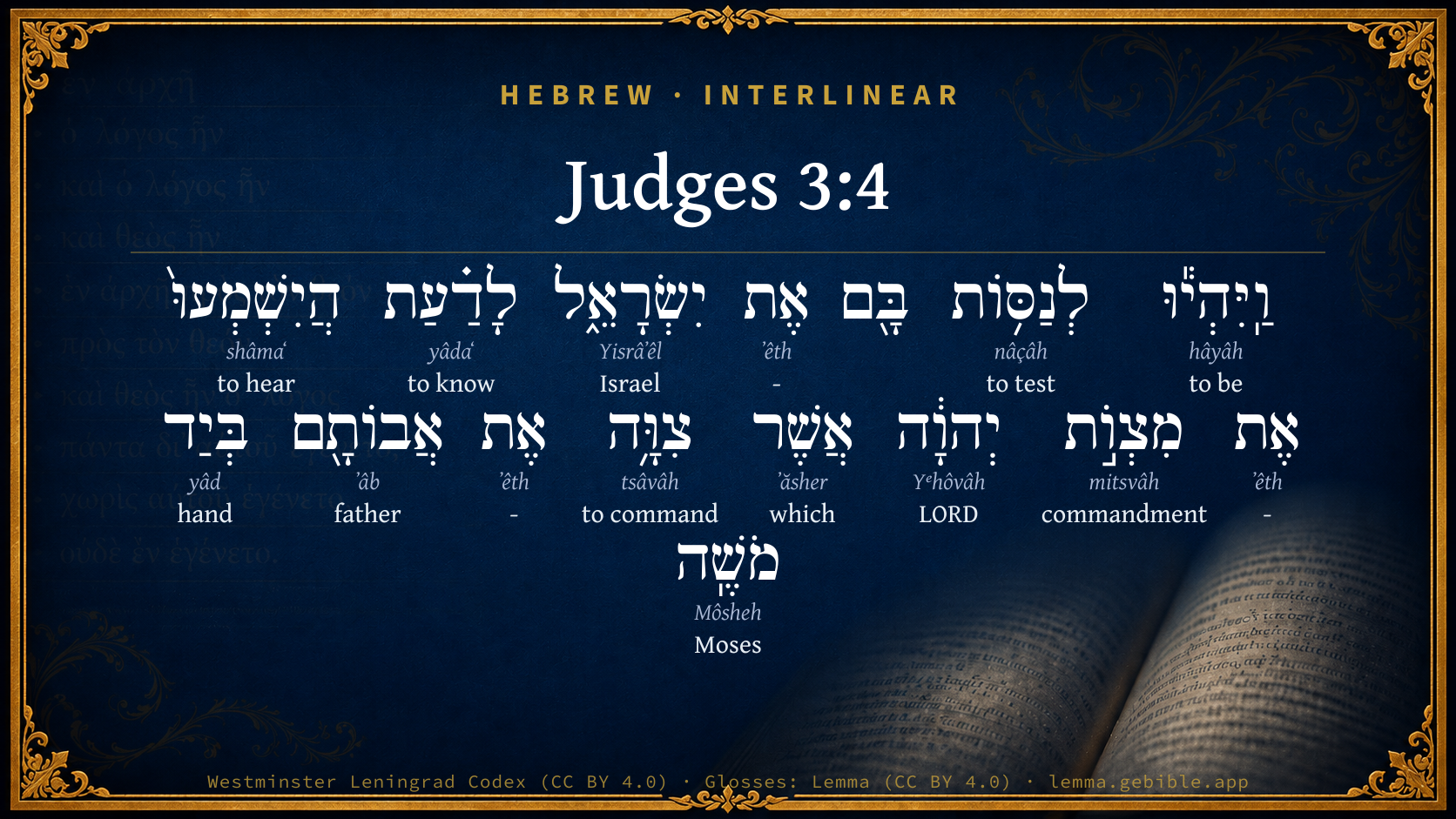
  1. וַֽיִּהְי֕וּ hâyâh H1961 “and · to be” Conjunction + Verb, Qal, Sequential Imperfect, 3rd Person, Masculine, Plural
  2. אֶת ʼêth H853 “-” Particle, Direct Object
  3. יִשְׂרָאֵ֑ל Yisrâʼêl H3478 “Israel” Noun, Proper
  4. לָדַ֗עַת yâdaʻ H3045 “to know” Preposition + Verb, Qal, Infinitive Construct
  5. הֲיִשְׁמְעוּ֙ shâmaʻ H8085 “to hear” Particle, Interrogative + Verb, Qal, Imperfect, 3rd Person, Masculine, Plural
  6. אֶת ʼêth H853 “-” Particle, Direct Object
  7. מִצְוֺ֣ת mitsvâh H4687 “commandments of” Noun, Common, Feminine, Plural, Construct
  8. יְהוָ֔ה Yᵉhôvâh H3068 “LORD” Noun, Proper
  9. אֲשֶׁר ʼăsher H834 “which” Particle, Relative
  10. צִוָּ֥ה tsâvâh H6680 “to command” Verb, Piel, Perfect, 3rd Person, Masculine, Singular
  11. אֶת ʼêth H853 “-” Particle, Direct Object
  12. אֲבוֹתָ֖ם ʼâb H1 “fathers · their” Noun, Common, Masculine, Plural, Construct + Suffix, Personal, 3rd Person, Masculine, Plural
  13. בְּיַד yâd H3027 “in/at · hand of” Preposition + Noun, Common, Both, Singular, Construct
  14. מֹשֶֽׁה Môsheh H4872 “Moses” Noun, Proper

About this verse

These counts appear in no published source. They are computed here, from the morphology-tagged text and Lemma’s own curated glosses. What Lemma adds →

16
words
13
distinct lemmas
Historical
section

Shared distinctive vocabulary

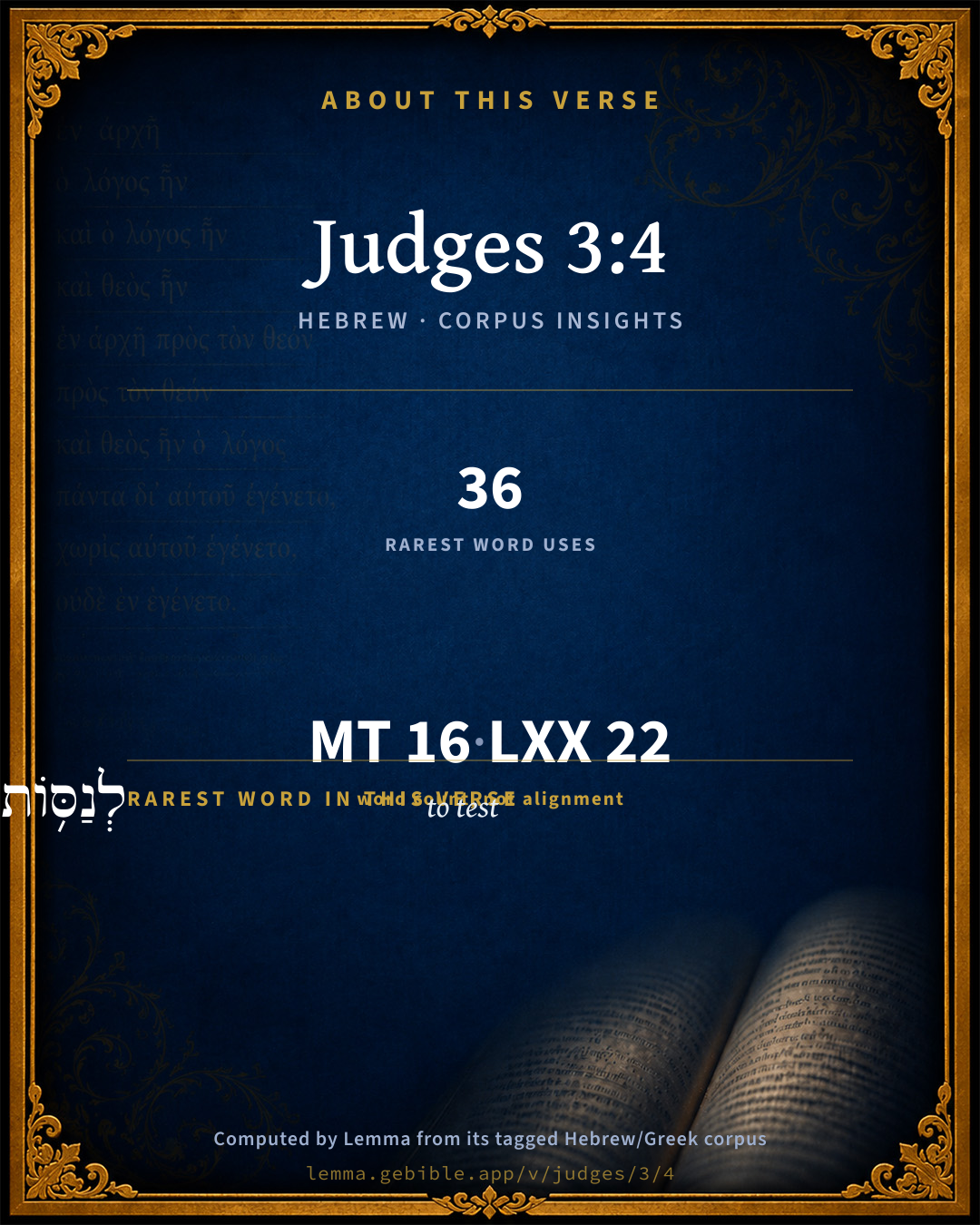
לְנַסּ֥וֹת to test H5254 occurs in 34 verses of the Hebrew Bible. Also found in:

Grammatical profile

  • 5 verbs
  • 6 nouns
  • 1 preposition
  • 4 particles

Verb forms

  • וַֽיִּהְי֕וּ Qal · Sequential Imperfect
  • לְנַסּ֥וֹת Piel · Infinitive Construct
  • לָדַ֗עַת Qal · Infinitive Construct
  • הֲיִשְׁמְעוּ֙ Qal · Imperfect
  • צִוָּ֥ה Piel · Perfect

Hebrew & Septuagint length

In English translation the verse runs 26 words from the Hebrew and 32 from the Septuagint (LXX English) — closely comparable.

A rough comparison of the two English renderings, which tokenize alike — not a word-level alignment.

Word counts can differ between the Hebrew and the Greek without any difference in meaning — e.g. the Hebrew direct-object marker אֵת has no separate Greek word, and Greek often adds the article ὁ.

In the original languages it is 16 Hebrew tokens and 22 Greek tokens — but the two are counted differently (Hebrew bundles its prefixes and suffixes into one token; the Greek is in lemma form), so that isn’t a like-for-like length.

Cross-references

7

Topical passages linked to Judges 3:4 in the Treasury of Scripture Knowledge — connected by theme and wording, ordered by reader-vote popularity; previews shown in the World English Bible.

  • Judges 2:22 that by them I may prove Israel, whether they will keep the way of Yahweh to walk therein, as their fathers did keep it, or not.
  • Judges 3:1 Now these are the nations which Yahweh left, to prove Israel by them, even as many [of Israel] as had not known all the wars of Canaan;
  • Exodus 15:25 Then he cried to Yahweh. Yahweh shown him a tree, and he threw it into the waters, and the waters were made sweet. There he made a statute and an ordinance for them, and there he tested them;
  • Deuteronomy 8:2 You shall remember all the way which Yahweh your God has led you these forty years in the wilderness, that he might humble you, to prove you, to know what was in your heart, whether you would keep his commandments, or not.
  • Deuteronomy 33:8 Of Levi he said, Your Thummim and your Urim are with your godly one, Whom you did prove at Massah, With whom you did strive at the waters of Meribah;
  • 1 Corinthians 11:19 For there also must be factions among you, that those who are approved may be revealed among you.
  • 2 Thessalonians 2:9–12 even he whose coming is according to the working of Satan with all power and signs and lying wonders,

Cross-references courtesy of OpenBible.info (CC BY 4.0).

Hebrew and Greek witnesses Masoretic Hebrew ↔ Greek Septuagint

The same verse in the two great witnesses to the Old Testament, shown verse-for-verse.

These are two independent witnesses, not word-aligned to each other, and the Septuagint is shown in lemma (dictionary) form.

Hebrew Judges 3:4 Masoretic · Westminster Leningrad Codex

וַֽיִּהְי֕וּ לְנַסּ֥וֹת בָּ֖ם אֶת יִשְׂרָאֵ֑ל לָדַ֗עַת הֲיִשְׁמְעוּ֙ אֶת מִצְוֺ֣ת יְהוָ֔ה אֲשֶׁר צִוָּ֥ה אֶת אֲבוֹתָ֖ם בְּיַד מֹשֶֽׁה

They were [left], to prove Israel by them, to know whether they would listen to the commandments of Yahweh, which he commanded their fathers by Moses.

World English Bible · Public Domain

Greek LXX Judges 3:4 Septuagint · lemma form

καί γίγνομαι ὥστε πειράζω ἐν αὐτός ὁ ἰσραήλ γιγνώσκω εἰ ἀκούω ὁ ἐντολή κύριος ὅς ἐντέλλομαι ὁ πατήρ αὐτός ἐν χείρ μωυσῆς

And this was done in order to prove Israel by them, to know whether they would obey the commands of the Lord, which he charged their fathers by the hand of Moses.

LXX2012 (modern English Septuagint) · Public Domain

Hebrew: Westminster Leningrad Codex (CC BY 4.0). Greek: Septuagint (public domain); English from LXX2012 (modern English Septuagint) (Public Domain). How the Septuagint differs from the Hebrew →

Targum (Aramaic paraphrase)

1

The Targum is the ancient Jewish Aramaic paraphrase of the Hebrew Scriptures — an interpretive translation, not the Hebrew text itself. Onkelos (literal) and Pseudo-Jonathan (expansive) render the Torah, and Jonathan the Prophets. Coverage is partial: where no permissively-licensed English translation exists for a verse, only the Aramaic is shown. This is verse-level text, not a word-by-word alignment to the Hebrew.

  1. Targum Jonathan Prophets (Joshua–Malachi)
    וַהֲווֹ לְנַסָאָה בְּהוֹן יַת יִשְׂרָאֵל לְמִידַע הַיְקַבְּלוּן יַת פִּקוּדַיָא דַייָ דְפַקֵד יַת אֲבָהַתְהוֹן בִּידָא דְמֹשֶׁה:

    (no public-domain English translation for this verse)

    Targum Jonathan — Aramaic: “Mikraot Gedolot” (public domain). English: “Sefaria Community Translation” (CC0 1.0 (public-domain dedication)); “London "Chaldee Paraphrase," 1871” (public domain). Text via Sefaria.

Commentary

Notes on Judges 3:4 from classic Christian and Jewish commentators (each source and its license shown beneath its notes). The classic Christian expositions comment on the surrounding passage and are grouped to its opening verse, so a note may address several verses; the Jewish commentaries on the Tanakh (Rashi and others) are per-verse, so they appear only where the commentator wrote on this verse.

Lemma curates 59 commentaries, every one of them public domain or Creative Commons licensed, each selected and text-cleaned for this edition rather than reprinted as found. About our sources →

Trapp's Complete Commentary

John Trapp

Jdg 3:4 And they were to prove Israel by them, to know whether they would hearken unto the commandments of the LORD, which he commanded their fathers by the hand of Moses.

Ver. 4. And they were to prove.] See Jdg 3:1.

John Trapp, A Commentary or Exposition upon All the Books of the Old and New Testament (1647–1656) — public domain. Text from a community e-Sword module.

Joseph Benson's Commentary

Jdg 3:4. To prove Israel — That their piety and faithfulness to the one living and true God might appear, if they did not imitate these nations, and relapse into idolatry, and their baseness and degeneracy if they did. To know whether they would hearken — That is, that they themselves and others might know by experience.

Joseph Benson's Commentary on the Old and New Testaments (1811–1818) — public domain. Text from a community e-Sword module.

Adam Clarke's Commentary

Verse 4. To know whether they would hearken] This would be the consequence of the Canaanites being left among them: if they should be faithful to God, their enemies would not be able to enslave them; should they be rebellious, the Lord would abandon them to their foes.

Adam Clarke's Commentary on the Bible (1810–1826) — public domain. Text from a community e-Sword/MySword module.

Ellicott's Commentary for English Readers

(4) To prove Israel.—See Jdg_2:22.

A Bible Commentary for English Readers, edited by Charles John Ellicott (1878–1897) — public domain. Text from a community e-Sword module.

The Cambridge Bible for Schools and Colleges

gen. ed. J. J. S. Perowne

4. to prove Israel] leads back to the thought of Jdg_2:22 and Jdg_3:1, and prepares the way for Jdg_3:5. The verse seems to be a later editorial adaptation.

The Cambridge Bible for Schools and Colleges (gen. ed. J. J. S. Perowne; Cambridge University Press, 1878–1918) — public domain. Text from a community e-Sword module.

John Gill's Exposition

And they were to prove Israel by them,.... They were left in the land, as to inure them to war, and try their courage, so to prove their faithfulness to God:

to know whether they would hearken to the commandments, of the Lord,

which he commanded their fathers by the hand of Moses; even all the commandments of the Lord delivered to them by Moses, moral, civil, and ceremonial, and particularly those that concerned the destruction of the Canaanites, their altars, and their idols, Deu 7:1.

John Gill's Exposition of the Whole Bible (1746–1763) — public domain (CC PDM 1.0). Text via the HelloAO Bible API.

Haydock's Catholic Bible Commentary

Not. Various reasons are assigned, on the part of God, for not exterminating these nations at once. But their being spared so long, must be imputed to the disobedience of the Israelites, otherwise they would surely never have been tolerated with their idol-worship in the land of promise, to contaminate, by their wicked example, the manners of God’s people. If they would have redeemed their lives, they must at least have given up the land and their idols. As the Israelites proved so little zealous in destroying the latter, they were justly punished by God, in being deprived of what would have contributed to make them richer and more comfortable in this world. (Haydock)

George Leo Haydock (1774–1849), Haydock's Catholic Family Bible and Commentary, 1859 edition — public domain. Excludes Psalms (Douay-Rheims chapter numbering differs from Protestant) and Deuterocanonical books (Catholic canon only).

Matthew Poole's English Annotations

To know, i.e. that they and others might know by experience.

Matthew Poole's English Annotations on the Holy Bible (1683–1685) — public domain. Text from a community e-Sword/MySword module.

Whedon's Commentary on the Bible

Daniel D. Whedon

4. To prove Israel — This is the topic and key-note of the following history, and is accordingly emphasized by a fuller repetition from Jdg_3:1-2.

Daniel D. Whedon (gen. ed.), Commentary on the Old and New Testaments (1874–1909) — public domain. Text from a community e-Sword module.

John Wesley's Explanatory Notes

To know - That is, that they and others might know by experience.

John Wesley, Explanatory Notes Upon the Whole Bible (1754–1765) — public domain. Text via the GEBible commentary corpus.

unfoldingWord translationNotes

Door43 World Missions Community

These nations were left

This can be stated in active form. AT: "Yahweh left these nations in Canaan" or "Yahweh allowed these nations to continue to live in Canaan" (See: Active or Passive)

as a means

"as a way"

whether they would ... gave their ancestors

The words "they" and "their" refer to the people of Israel.

the commands he gave

"the commands Yahweh gave"

translationWords

command

Moses

Canaan

Hittite

Amorite

Perizzite

Hivite

Jebus

unfoldingWord translationNotes — © Distant Shores Media and the Door43 World Missions Community, licensed CC BY-SA 4.0. Source: git.door43.org/Door43/en_tn.

Lesson kit

Teaching starters — assembled from the data on this page, not authored interpretation. Every prompt links to the verse data it draws on. Edit before teaching.

Judges, in the Historical, opens this verse with 16 words (13 distinct Hebrew lemmas). Its most distinctive word is nâçâh (“to test”). A historical commentator’s framing appears above. Read the whole chapter for the surrounding context.

Discussion questions

  1. What does “to test” (nâçâh) contribute to the verse as a whole?
  2. How does Genesis 22:1, which shares the word «to test», read alongside this verse?
  3. These translations render this verse differently. What is at stake in choosing one wording over another?
  4. «וַֽיִּהְי֕וּ» is a Qal Sequential Imperfect verb. How does that grammatical form shape the action described?
  5. Compare how Trapp's Complete Commentary and Joseph Benson's Commentary read this verse. Where do they agree or differ?

Things to notice

Reading settings

Reading text

Shown beneath each verse's original-language words.

Old Testament
Old Testament edition

Read the OT as the Masoretic Hebrew (MT) or the Greek Septuagint (LXX).

English shown for the Greek Septuagint (in the Hebrew ↔ Greek comparison).

Comparing translations? Open the Compare panel on any verse page to stack up to four side by side.