
Joshua 8:31

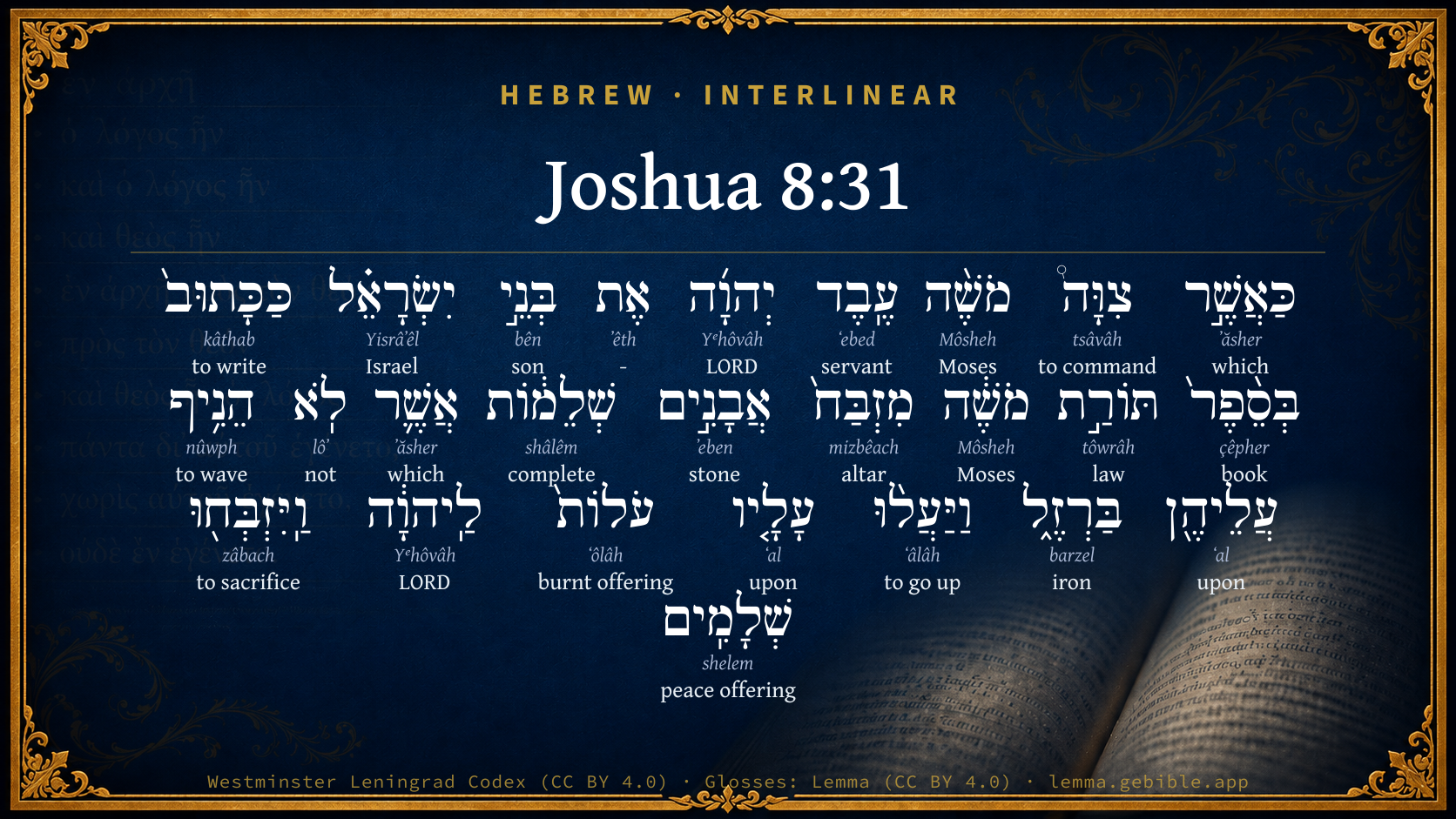
Hebrew (Westminster Leningrad Codex) Joshua 8:31 appears in the Hebrew Old Testament. The text above is from the Westminster Leningrad Codex. Each word links to its Strong’s number, a concise gloss, and parsing drawn from the Open Scriptures Hebrew Bible morphology. Click any word for its full Brown-Driver-Briggs (BDB) entry.
Download image
Cite this verse

Joshua 8:31 (World English Bible). Public Domain. Lemma interlinear Bible study tool, https://lemma.gebible.app/v/joshua/8/31.

Show BibTeX & RIS
BibTeX
RIS
English Translation
as Moses the servant of Yahweh commanded the children of Israel, as it is written in the book of the law of Moses, an altar of uncut stones, on which no man had lifted up any iron: and they offered thereon burnt offerings to Yahweh, and sacrificed peace-offerings.
World English Bible · Public Domain
Download a study sheet

One document with this verse’s original text, its word-by-word gloss line, the meaning frame, cross-references with their text, attributed commentary, and full source and license credits — printable, and it pastes into notes with its structure intact.

This verse Autodidact and up

Study sheet (.html) Plain text (.txt)

A passage Seminary Student

Up to 50 verses in one chapter. A passage sheet keeps up to 6 commentary sources and 12 cross-references per verse, in the order this page ranks them, and says so on the sheet whenever that leaves anything out. Ask for a single verse and you get the Autodidact verse sheet above.

Everything on this page stays free to read, with no account — the sheet is a download of what is already on screen, not access to it.

Want to remove ads? Support Godless Engineer
Compare translations 3

The same verse in 3 English versions, stacked beneath the original-language interlinear above. Click any original word for its lexicon entry.

Each is an independent rendering of the whole verse — the interlinear is not word-aligned to these translations.

Highlighted words mark where these versions differ — a whole-verse word diff, not a word-by-word alignment.

  • World English Bible Public Domain
    as Moses the servant of Yahweh commanded the children of Israel, as it is written in the book of the law of Moses, an altar of uncut stones, on which no man had lifted up any iron: and they offered thereon burnt offerings to Yahweh, and sacrificed peace-offerings.
  • King James Version Public Domain
    As Moses the servant of the LORD commanded the children of Israel, as it is written in the book of the law of Moses, an altar of whole stones, over which no man hath lift up any iron: and they offered thereon burnt offerings unto the LORD, and sacrificed peace offerings.
  • unfoldingWord Literal Text CC BY-SA 4.0
    just as Moses, the servant of Yahweh, had commanded the sons of Israel, as written in the Book of the Law of Moses, “An altar of whole stones, over which one has not wielded an iron tool.” And they offered on it burnt offerings to Yahweh, and they sacrificed peace offerings.

unfoldingWord Literal Text — © unfoldingWord, licensed CC BY-SA 4.0. Word-aligned USFM3 via Door43 (git.door43.org/unfoldingWord/en_ult).

Versions to compare (up to 4)

3 of 4 selected

Show all 18 translations

Every available English version of this verse, each an independent rendering of the whole verse.

  • World English Bible Public Domain
    as Moses the servant of Yahweh commanded the children of Israel, as it is written in the book of the law of Moses, an altar of uncut stones, on which no man had lifted up any iron: and they offered thereon burnt offerings to Yahweh, and sacrificed peace-offerings.
  • Berean Standard Bible Public Domain
    just as Moses the servant of the LORD had commanded the Israelites. He built it according to what is written in the Book of the Law of Moses: “an altar of uncut stones on which no iron tool has been used.” And on it they offered burnt offerings to the LORD, and they sacrificed peace offerings.
  • Majority Standard Bible Public Domain
    just as Moses the servant of the LORD had commanded the Israelites. He built it according to what is written in the Book of the Law of Moses: “an altar of uncut stones on which no iron tool has been used.” And on it they offered burnt offerings to the LORD, and they sacrificed peace offerings.
  • King James Version Public Domain
    As Moses the servant of the LORD commanded the children of Israel, as it is written in the book of the law of Moses, an altar of whole stones, over which no man hath lift up any iron: and they offered thereon burnt offerings unto the LORD, and sacrificed peace offerings.
  • American Standard Version (1901) Public Domain
    as Moses the servant of Jehovah commanded the children of Israel, as it is written in the book of the law of Moses, an altar of unhewn stones, upon which no man had lifted up any iron: and they offered thereon burnt-offerings unto Jehovah, and sacrificed peace-offerings.
  • Revised Version (1885) Public Domain
    as Moses the servant of the LORD commanded the children of Israel, as it is written in the book of the law of Moses, an altar of unhewn stones, upon which no man had lift up any iron: and they offered thereon burnt offerings unto the LORD, and sacrificed peace offerings.
  • Geneva Bible (1599) Public Domain
    As Moses the seruant of the Lord had commanded the children of Israel, as it is written in the booke of the Lawe of Moses, an altar of whole stone, ouer which no man had lift an yron: and they offered thereon burnt offrings vnto the Lord, and sacrificed peace offerings.
  • Douay-Rheims (1899) Public Domain
    As Moses the servant of the Lord had commanded the children of Israel, and it is written in the book of the law of Moses: an altar of unhewn stones which iron had not touched: and he offered upon it holocausts to the Lord, and immolated victims of peace offerings.
  • Young's Literal Translation Public Domain
    as Moses, servant of Jehovah, commanded the sons of Israel, as it is written in the book of the law of Moses -- an altar of whole stones, over which he hath not waved iron -- and they cause to go up upon it burnt-offerings to Jehovah, and sacrifice peace-offerings;
  • Literal Standard Version CC BY-SA 4.0
    as Moses, servant of YHWH, commanded the sons of Israel, as it is written in the Scroll of the Law of Moses—an altar of whole stones, over which he has not waved iron—and they cause burnt-offerings to go up on it to YHWH, and sacrifice peace-offerings;
  • Unlocked Literal Bible CC BY-SA 4.0
    just as Moses the servant of Yahweh had commanded the people of Israel, as it was written in the Book of the Law of Moses: “An altar from uncut stones, on which no one has wielded an iron tool.” He offered on the altar burnt offerings to Yahweh, and they sacrificed peace offerings.
  • unfoldingWord Literal Text CC BY-SA 4.0
    just as Moses, the servant of Yahweh, had commanded the sons of Israel, as written in the Book of the Law of Moses, “An altar of whole stones, over which one has not wielded an iron tool.” And they offered on it burnt offerings to Yahweh, and they sacrificed peace offerings.
  • Darby Bible Public Domain
    as Moses the servant of Jehovah had commanded the children of Israel, as it is written in the book of the law of Moses, an altar of whole stones, over which iron had not been lifted up. And they offered up burnt-offerings on it to Jehovah, and sacrificed peace-offerings.
  • World Messianic Bible Public Domain
    as Moses the servant of the LORD commanded the children of Israel, as it is written in the scroll of the Torah of Moses: an altar of uncut stones, on which no one had lifted up any iron. They offered burnt offerings on it to the LORD and sacrificed peace offerings.
  • Webster's Bible Public Domain
    As Moses the servant of the LORD commanded the children of Israel, as it is written in the book of the law of Moses, an altar of whole stones, over which no man hath lifted up any iron: and they offered upon it burnt-offerings to the LORD, and sacrificed peace-offerings.
  • Free Bible Version CC BY-SA 4.0
    He did what Moses, the servant of the Lord, had told the Israelites to do, as recorded in the book of the Law of Moses: an altar of uncut stones which no one has worked with iron tools. On the altar they made burnt offerings and friendship offerings to the Lord.
  • Bible in Basic English Public Domain
    In the way ordered by Moses, the servant of the Lord, as it is recorded in the book of the law of Moses, an altar of uncut stones, untouched by any iron instrument: and on it they made burned offerings and peace-offerings to the Lord.
  • JPS Tanakh (1917) Public Domain
    as Moses the servant of the LORD commanded the children of Israel, as it is written in the book of the law of Moses, an altar of unhewn stones, upon which no man had lifted up any iron; and they offered thereon burnt-offerings unto the LORD, and sacrificed peace-offerings.

Literal Standard Version (2020), Covenant Press — licensed CC BY-SA 4.0. Text via the HelloAO Bible API (eBible.org). Unlocked Literal Bible (unfoldingWord) — licensed CC BY-SA 4.0. Text via the HelloAO Bible API (eBible.org). unfoldingWord Literal Text — © unfoldingWord, licensed CC BY-SA 4.0. Word-aligned USFM3 via Door43 (git.door43.org/unfoldingWord/en_ult). Free Bible Version, Dr. Jonathan Gallagher — licensed CC BY-SA 4.0. Text via the HelloAO Bible API (eBible.org).

Word by word

More ways to search: Search by grammar → Find every occurrence → Compare this word →

Practice this passage: Drill this verse → Learn its vocabulary →

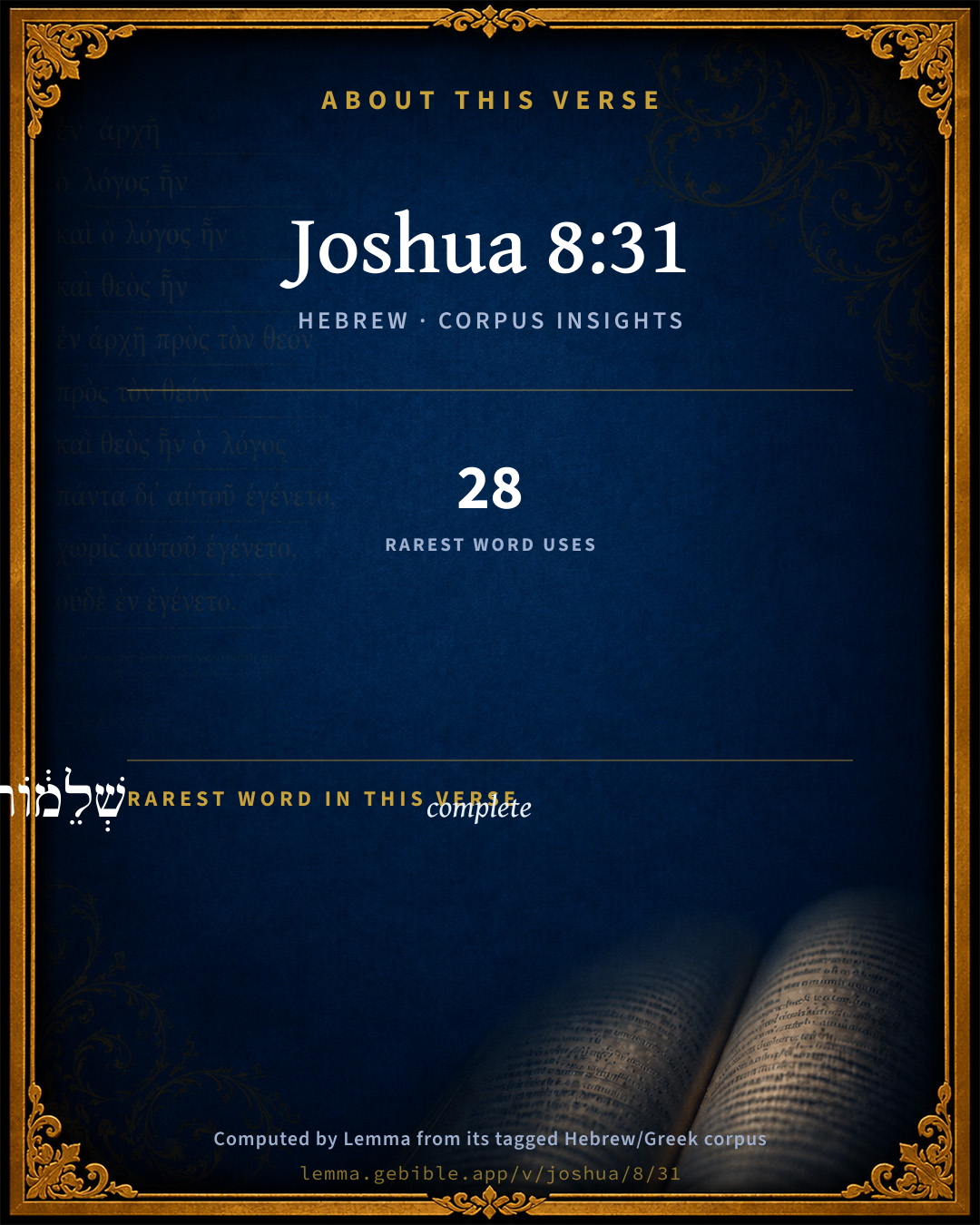
שְׁלֵמ֔וֹת
shâlêm
H8003
“complete”
Adjective, Adjective, Feminine, Plural, Absolute
Part of Speech
Adjective
Type
Adjective
Gender
Feminine
Number
Plural
State
Absolute
Full BDB Definition

Origin: from H7999

TWOT: 2401d

complete, safe, peaceful, perfect, whole, full, at peace - complete - full, perfect - finished - safe, unharmed - peace (of covenant of peace, mind) - perfect, complete (of keeping covenant relation)
  1. כַּאֲשֶׁ֣ר ʼăsher H834 “like/as · which” Preposition + Particle, Relative
  2. צִוָּה֩ tsâvâh H6680 “to command” Verb, Piel, Perfect, 3rd Person, Masculine, Singular
  3. מֹשֶׁ֨ה Môsheh H4872 “Moses” Noun, Proper
  4. עֶֽבֶד ʻebed H5650 “servant of” Noun, Common, Masculine, Singular, Construct
  5. יְהוָ֜ה Yᵉhôvâh H3068 “LORD” Noun, Proper
  6. אֶת ʼêth H853 “-” Particle, Direct Object
  7. בְּנֵ֣י bên H1121 “sons of” Noun, Common, Masculine, Plural, Construct
  8. יִשְׂרָאֵ֗ל Yisrâʼêl H3478 “Israel” Noun, Proper
  9. כַּכָּתוּב֙ kâthab H3789 “like/as the · written” Preposition, Determined + Verb, Qal, Participle Passive, Masculine, Singular, Absolute
  10. בְּסֵ֨פֶר֙ çêpher H5612 “in/at · book of” Preposition + Noun, Common, Masculine, Singular, Construct
  11. תּוֹרַ֣ת tôwrâh H8451 “law of” Noun, Common, Feminine, Singular, Construct
  12. מֹשֶׁ֔ה Môsheh H4872 “Moses” Noun, Proper
  13. מִזְבַּח֙ mizbêach H4196 “altar of” Noun, Common, Masculine, Singular, Construct
  14. אֲבָנִ֣ים ʼeben H68 “stones” Noun, Common, Feminine, Plural, Absolute
  15. אֲשֶׁ֛ר ʼăsher H834 “which” Particle, Relative
  16. לֹֽא lôʼ H3808 “not” Particle, Negative
  17. הֵנִ֥יף nûwph H5130 “to wave” Verb, Hiphil, Perfect, 3rd Person, Masculine, Singular
  18. עֲלֵיהֶ֖ן ʻal H5921 “upon · them” Preposition + Suffix, Personal, 3rd Person, Feminine, Plural
  19. בַּרְזֶ֑ל barzel H1270 “iron” Noun, Common, Masculine, Singular, Absolute
  20. וַיַּעֲל֨וּ ʻâlâh H5927 “and · to go up” Conjunction + Verb, Hiphil, Sequential Imperfect, 3rd Person, Masculine, Plural
  21. עָלָ֤יו ʻal H5921 “upon · him” Preposition + Suffix, Personal, 3rd Person, Masculine, Singular
  22. עֹלוֹת֙ ʻôlâh H5930 “burnt offerings” Noun, Common, Feminine, Plural, Absolute
  23. לַֽיהוָ֔ה Yᵉhôvâh H3068 “to/for · LORD” Preposition + Noun, Proper
  24. וַֽיִּזְבְּח֖וּ zâbach H2076 “and · to sacrifice” Conjunction + Verb, Qal, Sequential Imperfect, 3rd Person, Masculine, Plural
  25. שְׁלָמִֽים shelem H8002 “peace offerings” Noun, Common, Masculine, Plural, Absolute

About this verse

These counts appear in no published source. They are computed here, from the morphology-tagged text and Lemma’s own curated glosses. What Lemma adds →

26
words
22
distinct lemmas
Historical
section

Shared distinctive vocabulary

שְׁלֵמ֔וֹת complete H8003 occurs in 27 verses of the Hebrew Bible. Also found in:

Grammatical profile

  • 5 verbs
  • 14 nouns
  • 1 adjective
  • 2 prepositions
  • 4 particles

Verb forms

  • צִוָּה֩ Piel · Perfect
  • כַּכָּתוּב֙ Qal · Participle Passive
  • הֵנִ֥יף Hiphil · Perfect
  • וַיַּעֲל֨וּ Hiphil · Sequential Imperfect
  • וַֽיִּזְבְּח֖וּ Qal · Sequential Imperfect

Repetition

Words recur within this verse — often emphatic in Hebrew:

  • מֹשֶׁ֨ה Moses H4872 ×2
  • יְהוָ֜ה LORD H3068 ×2
  • עֲלֵיהֶ֖ן upon H5921 ×2
  • כַּאֲשֶׁ֣ר which H834 ×2

Hebrew & Septuagint length

In English translation the verse runs 48 words from the Hebrew and 47 from the Septuagint (LXX English) — closely comparable.

A rough comparison of the two English renderings, which tokenize alike — not a word-level alignment.

Word counts can differ between the Hebrew and the Greek without any difference in meaning — e.g. the Hebrew direct-object marker אֵת has no separate Greek word, and Greek often adds the article ὁ.

Cross-references

14

Topical passages linked to Joshua 8:31 in the Treasury of Scripture Knowledge — connected by theme and wording, ordered by reader-vote popularity; previews shown in the World English Bible.

  • Deuteronomy 27:5–7 There shall you build an altar to Yahweh your God, an altar of stones: you shall lift up no iron [tool] on them.
  • Exodus 20:24–25 You shall make an altar of earth for me, and shall sacrifice on it your burnt offerings and your peace-offerings, your sheep and your oxen. In every place where I record my name I will come to you and I will bless you.
  • Exodus 18:12 Jethro, Moses' father-in-law, took a burnt offering and sacrifices for God. Aaron came with all of the elders of Israel, to eat bread with Moses' father-in-law before God.
  • Exodus 24:5 He sent young men of the children of Israel, who offered burnt offerings and sacrificed peace-offerings of oxen to Yahweh.
  • Joshua 1:8 This book of the law shall not depart out of your mouth, but you shall meditate thereon day and night, that you may observe to do according to all that is written therein: for then you shall make your way prosperous, and then you shall have good success.
  • Joshua 8:34–35 Afterward he read all the words of the law, the blessing and the curse, according to all that is written in the book of the law.
  • 1 Kings 18:31–32 Elijah took twelve stones, according to the number of the tribes of the sons of Jacob, to whom the word of Yahweh came, saying, Israel shall be your name.
  • 2 Kings 14:6 but the children of the murderers he didn't put to death; according to that which is written in the book of the law of Moses, as Yahweh commanded, saying, The fathers shall not be put to death for the children, nor the children be put to death for the fathers; but every man shall die for his own sin.
  • 2 Kings 22:8 Hilkiah the high priest said to Shaphan the scribe, I have found the book of the law in the house of Yahweh. Hilkiah delivered the book to Shaphan, and he read it.
  • 2 Chronicles 25:4 But he didn't put their children to death, but did according to that which is written in the law in the book of Moses, as Yahweh commanded, saying, The fathers shall not die for the children, neither shall the children die for the fathers; but every man shall die for his own sin.
  • 2 Chronicles 35:12 They removed the burnt offerings, that they might give them according to the divisions of the fathers' houses of the children of the people, to offer to Yahweh, as it is written in the book of Moses. So did they with the oxen.
  • Ezra 6:18 They set the priests in their divisions, and the Levites in their courses, for the service of God, which is at Jerusalem; as it is written in the book of Moses.
  • Nehemiah 13:1 On that day they read in the book of Moses in the audience of the people; and therein was found written, that an Ammonite and a Moabite should not enter into the assembly of God forever,
  • Matthew 12:26 If Satan casts out Satan, he is divided against himself. How then will his kingdom stand?

Cross-references courtesy of OpenBible.info (CC BY 4.0).

Hebrew and Greek witnesses Masoretic Hebrew ↔ Greek Septuagint

The same verse in the two great witnesses to the Old Testament, shown verse-for-verse.

These are two independent witnesses, not word-aligned to each other, and the Septuagint is shown in lemma (dictionary) form.

Hebrew Joshua 8:31 Masoretic · Westminster Leningrad Codex

כַּאֲשֶׁ֣ר צִוָּה֩ מֹשֶׁ֨ה עֶֽבֶד יְהוָ֜ה אֶת בְּנֵ֣י יִשְׂרָאֵ֗ל כַּכָּתוּב֙ בְּסֵ֨פֶר֙ תּוֹרַ֣ת מֹשֶׁ֔ה מִזְבַּח֙ אֲבָנִ֣ים שְׁלֵמ֔וֹת אֲשֶׁ֛ר לֹֽא הֵנִ֥יף עֲלֵיהֶ֖ן בַּרְזֶ֑ל וַיַּעֲל֨וּ עָלָ֤יו עֹלוֹת֙ לַֽיהוָ֔ה וַֽיִּזְבְּח֖וּ שְׁלָמִֽים

as Moses the servant of Yahweh commanded the children of Israel, as it is written in the book of the law of Moses, an altar of uncut stones, on which no man had lifted up any iron: and they offered thereon burnt offerings to Yahweh, and sacrificed peace-offerings.

World English Bible · Public Domain

Greek LXX Joshua 8:31 Septuagint · lemma form
as Moses the servant of the Lord commanded the children of Israel, as it is written in the law of Moses, an altar of unhewn stones, on which iron had not been lifted up; and he offered there whole burnt offerings to the Lord, and a peace-offering.

LXX2012 (modern English Septuagint) · Public Domain

Hebrew: Westminster Leningrad Codex (CC BY 4.0). Greek: Septuagint (public domain); English from LXX2012 (modern English Septuagint) (Public Domain). How the Septuagint differs from the Hebrew →

Targum (Aramaic paraphrase)

1

The Targum is the ancient Jewish Aramaic paraphrase of the Hebrew Scriptures — an interpretive translation, not the Hebrew text itself. Onkelos (literal) and Pseudo-Jonathan (expansive) render the Torah, and Jonathan the Prophets. Coverage is partial: where no permissively-licensed English translation exists for a verse, only the Aramaic is shown. This is verse-level text, not a word-by-word alignment to the Hebrew.

  1. Targum Jonathan Prophets (Joshua–Malachi)
    כְּמָא דְפַקֵיד מֹשֶׁה עַבְדָא דַייָ יַת בְּנֵי יִשְׂרָאֵל כְּמָא דִכְתִיב בִּסְפַר אוֹרַיְיתָא דְמֹשֶׁה מַדְבַּח אַבְנִין שַׁלְמִין דְלָא אִתְּרַם עֲלֵיהוֹן בַּרְזְלָא וְאַסִיקוּ עֲלוֹהִי עֲלָוָן קֳדָם יְיָ וּנְכִיסוּ נִיכְסַת קוּדְשִׁין:

    (no public-domain English translation for this verse)

    Targum Jonathan — Aramaic: “Mikraot Gedolot” (public domain). English: “Sefaria Community Translation” (CC0 1.0 (public-domain dedication)); “London "Chaldee Paraphrase," 1871” (public domain). Text via Sefaria.

Commentary

Notes on Joshua 8:31 from classic Christian and Jewish commentators (each source and its license shown beneath its notes). The classic Christian expositions comment on the surrounding passage and are grouped to its opening verse, so a note may address several verses; the Jewish commentaries on the Tanakh (Rashi and others) are per-verse, so they appear only where the commentator wrote on this verse.

Lemma curates 59 commentaries, every one of them public domain or Creative Commons licensed, each selected and text-cleaned for this edition rather than reprinted as found. About our sources →

Trapp's Complete Commentary

John Trapp

Jos 8:31 As Moses the servant of the LORD commanded the children of Israel, as it is written in the book of the law of Moses, an altar of whole stones, over which no man hath lift up [any] iron: and they offered thereon burnt offerings unto the LORD, and sacrificed peace offerings.

Ver. 31. Over which no man hath llft up any iron.] To polish or garnish it; for this was to defile it. {Exo 20:25 Deu 27:5} In God’s service we must neither be curious nor careless. Holy things must be handled Sancte magis quam scite, neither is it for men to worship God as they please.

John Trapp, A Commentary or Exposition upon All the Books of the Old and New Testament (1647–1656) — public domain. Text from a community e-Sword module.

Jamieson, Fausset & Brown

Robert Jamieson, A. R. Fausset & David Brown

an altar of whole stones--according to the instructions given to Moses (Exo 20:25; Deu 27:5).

over which no man hath lifted up any iron--that is, iron tool. The reason for this was that every altar of the true God ought properly to have been built of earth (Exo 20:24); and if it was constructed of stone, rough, unhewn stones were to be employed that it might retain both the appearance and nature of earth, since every bloody sacrifice was connected with sin and death, by which man, the creature of earth, is brought to earth again [KEIL].

they offered thereon burnt offerings unto the Lord, and sacrificed peace offerings--This had been done when the covenant was established (Exo 24:5); and by the observance of these rites (Deu 27:6), the covenant was solemnly renewed--the people were reconciled to God by the burnt offering, and this feast accompanying the peace or thank offering, a happy communion with God was enjoyed by all the families in Israel.

Jamieson, Fausset & Brown — Commentary Critical and Explanatory on the Whole Bible (1871) — public domain (CC PDM 1.0). Text via the HelloAO Bible API.

The Cambridge Bible for Schools and Colleges

gen. ed. J. J. S. Perowne

31. an altar of whole (or, “unhewn”) stones] Thus the Law required in general (Exo_20:25), and in this case it had been specially ordained.

The Cambridge Bible for Schools and Colleges (gen. ed. J. J. S. Perowne; Cambridge University Press, 1878–1918) — public domain. Text from a community e-Sword module.

John Gill's Exposition

As Moses the servant of the Lord commanded the children of Israel, as it is written in the book of the law of Moses,.... Deu 27:5,

an altar of whole stones, on which no man hath lift up any iron; See Gill on Exo 20:25; see Gill on Deu 27:5, and; see Gill on Deu 27:6,

and they offered thereon burnt offerings unto the Lord, and sacrificed peace offerings; by way of thanksgiving for the good land they were introduced into, and this was what they were ordered to do by Moses, Deu 27:6.

John Gill's Exposition of the Whole Bible (1746–1763) — public domain (CC PDM 1.0). Text via the HelloAO Bible API.

Haydock's Catholic Bible Commentary

Iron. Spencer complains that the Protestants have not translated barzel, "iron tool," as [in] Deuteronomy xxvii. 5. This translation is found in their more ancient editions of 1537-49, &c. (Kennicott) --- But the difference is very unimportant. The reason of this prohibition is given, Exodus xx. 25. --- He offered; so we read that he wrote, blessed and cursed, &c., because these things were done at least by his authority. It is not necessary to suppose that he engraved the words of the law with his own hands, or that he passed from Garizim, where he had been pronouncing the blessings, to Hebal, in order to denounce the curses. (Haydock) --- He probably commissioned some of the princes on Hebal to perform the office of cursing, after he had repeated the blessings himself from Garizim; and the select company of Levites before the ark, having answered or repeated the words, the whole multitude stationed at the foot of Hebal, giving their consent that the transgressors should be cursed. (Kennicott) --- Hence Josue must have sacrificed by the hands of the priests. (Haydock) --- Various instances are produced to show that princes and prophets have, on extraordinary occasions, performed this office themselves, 1 Kings vi. 15., and vii. 9., and 3 Kings xviii. 32. (Calmet) --- But these must have either received a dispensation from God, or they must have employed the ministry of the legal priests; or, in fine, their actions, like that of Saul, (1 Kings xiii. 9,) of Absalom, (1 Kings i. 9,) Herod, &c., may have been deserving of blame. (Haydock) --- The Jews assert that in the desert no one was permitted to sacrifice, except in the tabernacle; but that this prohibition ceased at Galgal, as the ark had no fixed abode, and thus Josue might offer sacrifice himself. Afterwards the law was enforced, while the ark was at Silo. But upon its being removed to Nobe, Maspha, and Gabaon, people resumed their former liberty; and hence there was nothing to hinder Samuel, Saul, and David from offering sacrifice, till the temple was erected. (Outram de Sac. i. 2; Grotius in Deuteronomy xii. 8.) This sacred office was formerly exercised by kings, particularly at Athens, where, after the people became more numerous, Theseus appointed the king of sacrifices to keep up the memory of the ancient practice. (Demost. c. Neream.) (Calmet) The like was done at Rome under the republic. (Haydock)

George Leo Haydock (1774–1849), Haydock's Catholic Family Bible and Commentary, 1859 edition — public domain. Excludes Psalms (Douay-Rheims chapter numbering differs from Protestant) and Deuterocanonical books (Catholic canon only).

Whedon's Commentary on the Bible

Daniel D. Whedon

31. An altar of whole stones — That is, stones on which no tool of iron had been used to chisel down or polish. According to the law of Exo_20:25, a stone altar must not be built of hewn stones, for the touch of an iron tool upon it was regarded as a pollution. And an unhewn stone would the better symbolize that Living Stone, (1Pe_2:4.) cut out of the mountain without hands, (Dan_2:45,) which has become the head of the corner, (Eph_2:20,) and certainly owes none of its excellence to human culture or polish.

Daniel D. Whedon (gen. ed.), Commentary on the Old and New Testaments (1874–1909) — public domain. Text from a community e-Sword module.

The Pulpit Commentary

As Moses the servant of the Lord commanded. (see Exo_20:25 Deu_27:4, Deu_27:5) Here, and in ver. 33, we find the writer making an extract from the Book of Deuteronomy. As has been before said, the natural explanation is that the Book of Joshua was written after the Book of Deuteronomy, and that the Book of Deuteronomy was written by Moses, or how could Joshua have carried out instructions which had never been given? The Elohist, Jehovist, and Denteronomist theory supposes the compiler of the Book of Joshua to have done his work in so perfunctory a fashion, that it is quite possible for critics living at a distance of three thousand years and more to detect the various fragments of which his mosaic is constructed. He is so void of common sense as to have inserted this narrative in a place so obviously unsuitable that it involves a palpable contradiction to probability and common sense, and this when he could have placed it in a dozen other parts of the book where no such improbability would be involved. Yet, in spite of the incredible carelessness with which he put his materials together, we are required to believe that "the Deuteronomist" had the foresight to insert the fulfilment of the command of Moses which he had invented in Deu_11:26-30, Deu_27:1-26; and that in so doing he abbreviated the narrative so as to leave out many details of his own invention. Now, under the supposition of a later fabrication of supplementary observances to be imposed upon the children of Israel, it is hardly probable that the account of the plaster with which the stones were to be plastered, and the enumeration of the tribes and the curses, would be omitted, since by the hypothesis the object of the Deuteronomist was to secure implicit obedience to the sacerdotal enactments he was inventing. But on the hypothesis of the genuineness of both writings everything fits in naturally enough. An altar of whole stones, over which no man hath lift up any iron. As though to intimate (see Exo_20:25) that all should be natural and spontaneous in the worship of God, and that as little of human devising should be introduced as possible. The altar must be raised by man, but the principles of the worship must not be devised by him. This interpretation, however, is rejected by Calvin, who thinks that all that was meant was to preclude the perpetual existence of the altar (though how the substitution of whole for hewn stones could effect this is not apparent); and Keil and Bahr ("Symbolik," 1. pp. 487, 488), who think that the altar ought (Exo_20:24) properly to be of earth, since sacrifice is rendered necessary by man"s earthly or carnal nature, and that unhewn stone is the only substitute for earth which is allowed. But surely man"s handiwork is the offspring of his unregenerate nature, and therefore may, from this point of view, be rightly employed in sacrifice. Hengstenberg ("Gesehichte des Reiches Gottes," p. 223) thinks that the reason of the command was that, since only one place of worship was permitted for all Israel, an altar had sometimes to be hastily thrown up. But when we consider the symbolic character of the Mosaic worship, we are compelled to reject this interpretation as unsatisfactory. Benjamin of Tudela (see Drusius in loc. ) appears to have supposed that these stones were those which had been taken out of Jordan. Masius devotes considerable space to the refutation of this opinion (see also note on last verse). And they offered thereon. Delitzsch remarks on the inversion of the order here, as compared with Deuteronomy 27. But this is obviously the true order. The worship would naturally precede the ceremony rather than follow it.

The Pulpit Commentary (1880–1919), ed. H.D.M. Spence-Jones & Joseph S. Exell — public domain. Text from a community e-Sword module.

Lesson kit

Teaching starters — assembled from the data on this page, not authored interpretation. Every prompt links to the verse data it draws on. Edit before teaching.

Joshua, in the Historical, opens this verse with 26 words (22 distinct Hebrew lemmas). Its most distinctive word is shâlêm (“complete”). A historical commentator’s framing appears above. Read the whole chapter for the surrounding context.

Discussion questions

  1. What does “complete” (shâlêm) contribute to the verse as a whole?
  2. Genesis 15:16 shares the word «complete» with this verse. How do the two illuminate each other?
  3. “Moses” occurs 2× in this one verse. What is the effect of the repetition?
  4. The translations on this page render this verse differently — a whole-verse word diff, not a word-by-word alignment. What might account for the different wordings?
  5. The verb «צִוָּה֩» is Piel Perfect. How does its form color the action?
  6. Reading how Trapp's Complete Commentary and Jamieson, Fausset & Brown read this verse, where do the two commentators agree and where do they part?

Things to notice

Reading settings

Reading text

Shown beneath each verse's original-language words.

Old Testament
Old Testament edition

Read the OT as the Masoretic Hebrew (MT) or the Greek Septuagint (LXX).

English shown for the Greek Septuagint (in the Hebrew ↔ Greek comparison).

Comparing translations? Open the Compare panel on any verse page to stack up to four side by side.