
Joshua 11:15

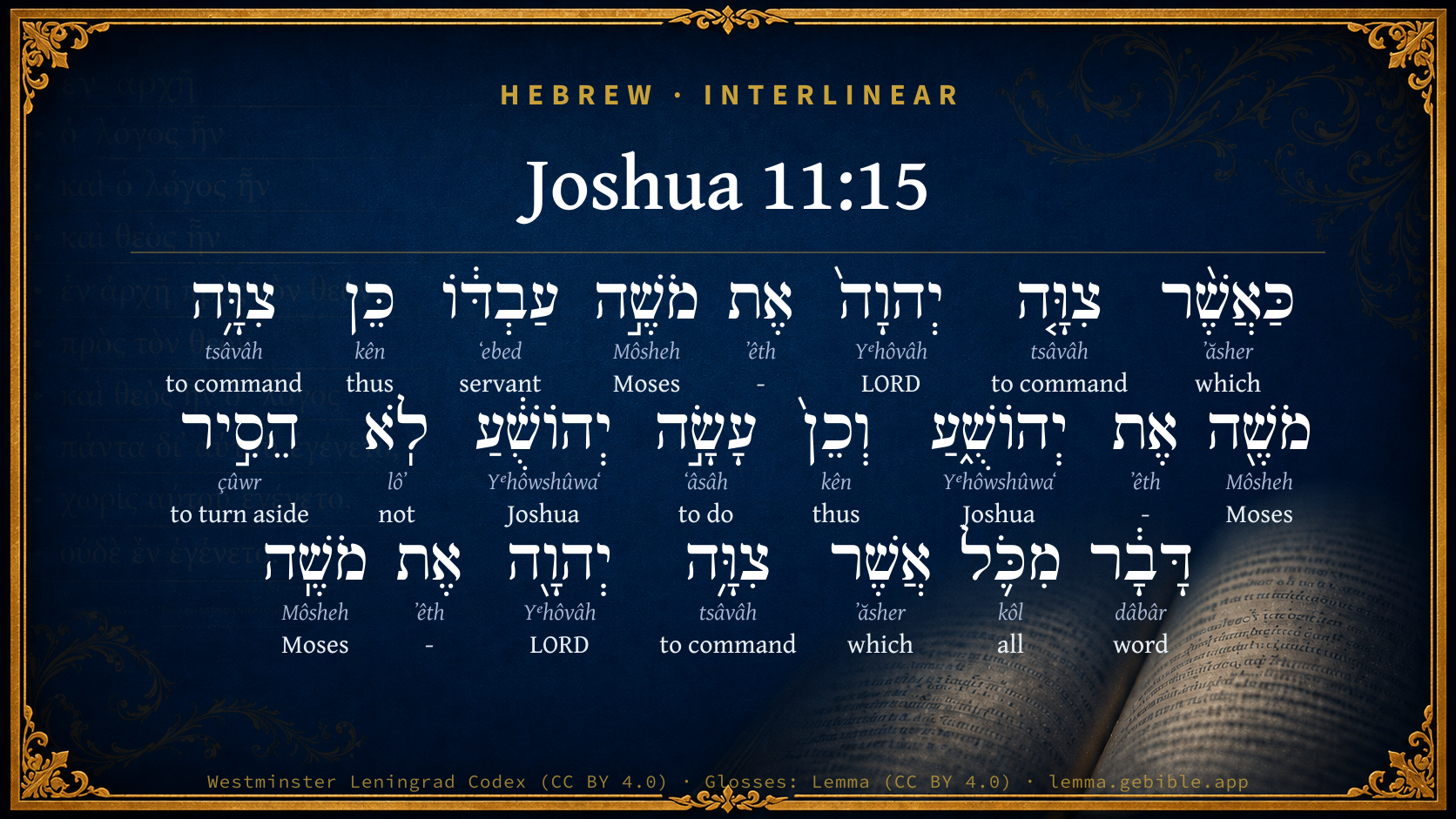
Hebrew (Westminster Leningrad Codex) Joshua 11:15 appears in the Hebrew Old Testament. The text above is from the Westminster Leningrad Codex. Each word links to its Strong’s number, a concise gloss, and parsing drawn from the Open Scriptures Hebrew Bible morphology. Click any word for its full Brown-Driver-Briggs (BDB) entry.
Download image
Cite this verse

Joshua 11:15 (World English Bible). Public Domain. Lemma interlinear Bible study tool, https://lemma.gebible.app/v/joshua/11/15.

Show BibTeX & RIS
BibTeX
RIS
English Translation
As Yahweh commanded Moses his servant, so did Moses command Joshua: and so did Joshua; he left nothing undone of all that Yahweh commanded Moses.
World English Bible · Public Domain
Download a study sheet

One document with this verse’s original text, its word-by-word gloss line, the meaning frame, cross-references with their text, attributed commentary, and full source and license credits — printable, and it pastes into notes with its structure intact.

This verse Autodidact and up

Study sheet (.html) Plain text (.txt)

A passage Seminary Student

Up to 50 verses in one chapter. A passage sheet keeps up to 6 commentary sources and 12 cross-references per verse, in the order this page ranks them, and says so on the sheet whenever that leaves anything out. Ask for a single verse and you get the Autodidact verse sheet above.

Everything on this page stays free to read, with no account — the sheet is a download of what is already on screen, not access to it.

Want to remove ads? Support Godless Engineer
Compare translations 3

The same verse in 3 English versions, stacked beneath the original-language interlinear above. Click any original word for its lexicon entry.

Each is an independent rendering of the whole verse — the interlinear is not word-aligned to these translations.

Highlighted words mark where these versions differ — a whole-verse word diff, not a word-by-word alignment.

  • World English Bible Public Domain
    As Yahweh commanded Moses his servant, so did Moses command Joshua: and so did Joshua; he left nothing undone of all that Yahweh commanded Moses.
  • King James Version Public Domain
    As the LORD commanded Moses his servant, so did Moses command Joshua, and so did Joshua; he left nothing undone of all that the LORD commanded Moses.
  • unfoldingWord Literal Text CC BY-SA 4.0
    Just as Yahweh had commanded Moses his servant, thus Moses had commanded Joshua, and thus Joshua did. He did not turn aside a thing from all that Yahweh had commanded Moses.

unfoldingWord Literal Text — © unfoldingWord, licensed CC BY-SA 4.0. Word-aligned USFM3 via Door43 (git.door43.org/unfoldingWord/en_ult).

Versions to compare (up to 4)

3 of 4 selected

Show all 18 translations

Every available English version of this verse, each an independent rendering of the whole verse.

  • World English Bible Public Domain
    As Yahweh commanded Moses his servant, so did Moses command Joshua: and so did Joshua; he left nothing undone of all that Yahweh commanded Moses.
  • Berean Standard Bible Public Domain
    As the LORD had commanded His servant Moses, so Moses commanded Joshua. That is what Joshua did, leaving nothing undone of all that the LORD had commanded Moses.
  • Majority Standard Bible Public Domain
    As the LORD had commanded His servant Moses, so Moses commanded Joshua. That is what Joshua did, leaving nothing undone of all that the LORD had commanded Moses.
  • King James Version Public Domain
    As the LORD commanded Moses his servant, so did Moses command Joshua, and so did Joshua; he left nothing undone of all that the LORD commanded Moses.
  • American Standard Version (1901) Public Domain
    As Jehovah commanded Moses his servant, so did Moses command Joshua: and so did Joshua; he left nothing undone of all that Jehovah commanded Moses.
  • Revised Version (1885) Public Domain
    As the LORD commanded Moses his servant, so did Moses command Joshua: and so did Joshua; he left nothing undone of all that the LORD commanded Moses.
  • Geneva Bible (1599) Public Domain
    As the Lord had commanded Moses his seruant, so did Moses commande Ioshua, and so did Ioshua: he left nothing vndone of all that the Lord had commanded Moses.
  • Douay-Rheims (1899) Public Domain
    As the Lord had commanded Moses his servant, so did Moses command Josue, and he accomplished all: he left not one thing undone of all the commandments which the Lord had commanded Moses.
  • Young's Literal Translation Public Domain
    As Jehovah commanded Moses His servant, so did Moses command Joshua, and so hath Joshua done; he hath not turned aside a thing of all that Jehovah commanded Moses.
  • Literal Standard Version CC BY-SA 4.0
    As YHWH commanded His servant Moses, so Moses commanded Joshua, and so Joshua has done; he has not turned aside a thing of all that YHWH commanded Moses.
  • Unlocked Literal Bible CC BY-SA 4.0
    Just as Yahweh had commanded his servant Moses, in the same way, Moses commanded Joshua, and so Joshua did it. He left nothing undone of all that Yahweh commanded Moses to do.
  • unfoldingWord Literal Text CC BY-SA 4.0
    Just as Yahweh had commanded Moses his servant, thus Moses had commanded Joshua, and thus Joshua did. He did not turn aside a thing from all that Yahweh had commanded Moses.
  • Darby Bible Public Domain
    As Jehovah had commanded Moses his servant, so did Moses command Joshua, and so did Joshua: he let nothing fail of all that Jehovah had commanded Moses.
  • World Messianic Bible Public Domain
    As the LORD commanded Moses his servant, so Moses commanded Joshua. Joshua did so. He left nothing undone of all that the LORD commanded Moses.
  • Webster's Bible Public Domain
    As the LORD commanded Moses his servant, so did Moses command Joshua, and so did Joshua: he left nothing undone of all that the LORD commanded Moses.
  • Free Bible Version CC BY-SA 4.0
    As the Lord had instructed Moses, so Moses had instructed Joshua. Joshua did what he had been told—he did everything that the Lord had instructed Moses.
  • Bible in Basic English Public Domain
    As the Lord had given orders to Moses his servant, so Moses gave orders to Joshua, and so Joshua did; every order which the Lord had given to Moses was done.
  • JPS Tanakh (1917) Public Domain
    As the LORD commanded Moses His servant, so did Moses command Joshua; and so did Joshua; he left nothing undone of all that the LORD commanded Moses.

Literal Standard Version (2020), Covenant Press — licensed CC BY-SA 4.0. Text via the HelloAO Bible API (eBible.org). Unlocked Literal Bible (unfoldingWord) — licensed CC BY-SA 4.0. Text via the HelloAO Bible API (eBible.org). unfoldingWord Literal Text — © unfoldingWord, licensed CC BY-SA 4.0. Word-aligned USFM3 via Door43 (git.door43.org/unfoldingWord/en_ult). Free Bible Version, Dr. Jonathan Gallagher — licensed CC BY-SA 4.0. Text via the HelloAO Bible API (eBible.org).

Word by word

More ways to search: Search by grammar → Find every occurrence → Compare this word →

Practice this passage: Drill this verse → Learn its vocabulary →

יְהוֹשֻׁ֑עַ
Yᵉhôwshûwaʻ
H3091
“Joshua”
Noun, Proper
Part of Speech
Noun
Type
Proper
Full BDB Definition

Origin: from H3068 and H3467

TWOT: None

Joshua or Jehoshua = "Jehovah is salvation" - son of Nun of the tribe of Ephraim and successor to Moses as the leader of the children of Israel; led the conquest of Canaan - a resident of Beth-shemesh on whose land the Ark of the Covenant came to a stop after the Philistines returned it - son of Jehozadak and high priest after the restoration - governor of Jerusalem under king Josiah who gave his name to a gate of the city of Jerusalem
  1. כַּאֲשֶׁ֨ר ʼăsher H834 “like/as · which” Preposition + Particle, Relative
  2. צִוָּ֤ה tsâvâh H6680 “to command” Verb, Piel, Perfect, 3rd Person, Masculine, Singular
  3. יְהוָה֙ Yᵉhôvâh H3068 “LORD” Noun, Proper
  4. אֶת ʼêth H853 “-” Particle, Direct Object
  5. מֹשֶׁ֣ה Môsheh H4872 “Moses” Noun, Proper
  6. עַבְדּ֔וֹ ʻebed H5650 “servant · his” Noun, Common, Masculine, Singular, Construct + Suffix, Personal, 3rd Person, Masculine, Singular
  7. כֵּן kên H3651 “thus” Particle, Demonstrative
  8. צִוָּ֥ה tsâvâh H6680 “to command” Verb, Piel, Perfect, 3rd Person, Masculine, Singular
  9. מֹשֶׁ֖ה Môsheh H4872 “Moses” Noun, Proper
  10. אֶת ʼêth H853 “-” Particle, Direct Object
  11. וְכֵן֙ kên H3651 “and · thus” Conjunction + Particle, Demonstrative
  12. עָשָׂ֣ה ʻâsâh H6213 “to do” Verb, Qal, Perfect, 3rd Person, Masculine, Singular
  13. יְהוֹשֻׁ֔עַ Yᵉhôwshûwaʻ H3091 “Joshua” Noun, Proper
  14. לֹֽא lôʼ H3808 “not” Particle, Negative
  15. הֵסִ֣יר çûwr H5493 “to turn aside” Verb, Hiphil, Perfect, 3rd Person, Masculine, Singular
  16. דָּבָ֔ר dâbâr H1697 “word” Noun, Common, Masculine, Singular, Absolute
  17. מִכֹּ֛ל kôl H3605 “from · all” Preposition + Noun, Common, Masculine, Singular, Absolute
  18. אֲשֶׁר ʼăsher H834 “which” Particle, Relative
  19. צִוָּ֥ה tsâvâh H6680 “to command” Verb, Piel, Perfect, 3rd Person, Masculine, Singular
  20. יְהוָ֖ה Yᵉhôvâh H3068 “LORD” Noun, Proper
  21. אֶת ʼêth H853 “-” Particle, Direct Object
  22. מֹשֶֽׁה Môsheh H4872 “Moses” Noun, Proper

About this verse

These counts appear in no published source. They are computed here, from the morphology-tagged text and Lemma’s own curated glosses. What Lemma adds →

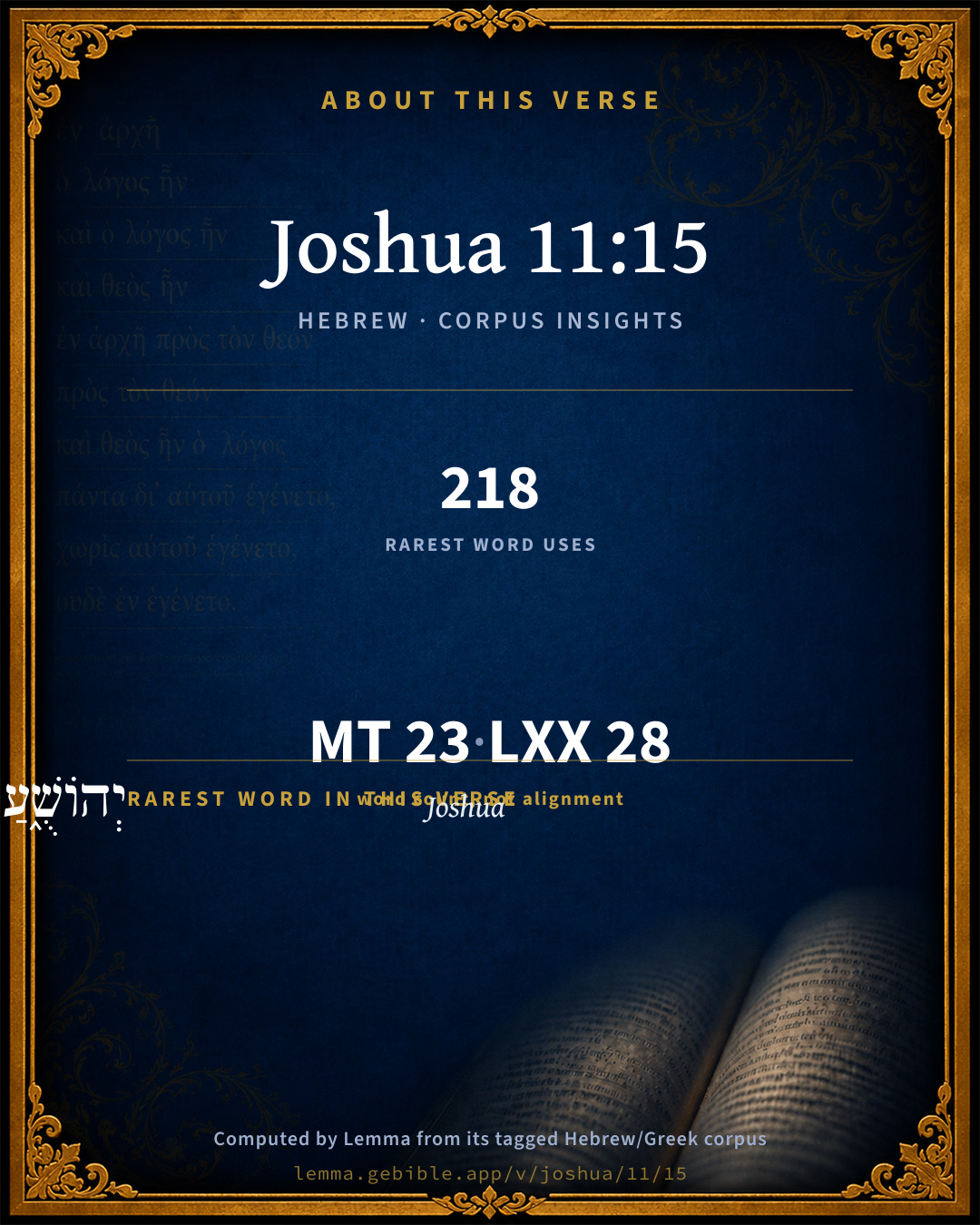
23
words
13
distinct lemmas
Historical
section

Grammatical profile

  • 5 verbs
  • 10 nouns
  • 8 particles

Verb forms

  • צִוָּ֤ה Piel · Perfect
  • צִוָּ֥ה Piel · Perfect
  • עָשָׂ֣ה Qal · Perfect
  • הֵסִ֣יר Hiphil · Perfect
  • צִוָּ֥ה Piel · Perfect

Repetition

Words recur within this verse — often emphatic in Hebrew:

  • צִוָּ֤ה to command H6680 ×3
  • מֹשֶׁ֣ה Moses H4872 ×3
  • יְהוָה֙ LORD H3068 ×2
  • כֵּן thus H3651 ×2
  • יְהוֹשֻׁ֑עַ Joshua H3091 ×2
  • כַּאֲשֶׁ֨ר which H834 ×2

Hebrew & Septuagint length

In English translation the verse runs 25 words from the Hebrew and 26 from the Septuagint (LXX English) — closely comparable.

A rough comparison of the two English renderings, which tokenize alike — not a word-level alignment.

Word counts can differ between the Hebrew and the Greek without any difference in meaning — e.g. the Hebrew direct-object marker אֵת has no separate Greek word, and Greek often adds the article ὁ.

In the original languages it is 23 Hebrew tokens and 28 Greek tokens — but the two are counted differently (Hebrew bundles its prefixes and suffixes into one token; the Greek is in lemma form), so that isn’t a like-for-like length.

Cross-references

18

Topical passages linked to Joshua 11:15 in the Treasury of Scripture Knowledge — connected by theme and wording, ordered by reader-vote popularity; previews shown in the World English Bible.

  • Exodus 34:11–13 Observe that which I command you this day. Behold, I drive out before you the Amorite, the Canaanite, the Hittite, the Perizzite, the Hivite, and the Jebusite.
  • Joshua 1:7 Only be strong and very courageous, to observe to do according to all the law, which Moses my servant commanded you: don't turn from it to the right hand or to the left, that you may have good success wherever you go.
  • Deuteronomy 7:2 and when Yahweh your God shall deliver them up before you, and you shall strike them; then you shall utterly destroy them: you shall make no covenant with them, nor show mercy to them;
  • Acts 20:20 how I didn't shrink from declaring to you anything that was profitable, teaching you publicly and from house to house,
  • Deuteronomy 4:5 Behold, I have taught you statutes and ordinances, even as Yahweh my God commanded me, that you should do so in the midst of the land where you go in to possess it.
  • Deuteronomy 12:32 Whatever thing I command you, that shall you observe to do: you shall not add thereto, nor diminish from it.
  • Deuteronomy 31:7 Moses called to Joshua, and said to him in the sight of all Israel, Be strong and of good courage: for you shall go with this people into the land which Yahweh has sworn to their fathers to give them; and you shall cause them to inherit it.
  • 2 Chronicles 30:12 Also on Judah came the hand of God to give them one heart, to do the commandment of the king and of the princes by the word of Yahweh.
  • Deuteronomy 4:2 You shall not add to the word which I command you, neither shall you diminish from it, that you may keep the commandments of Yahweh your God which I command you.
  • Acts 20:27 for I didn't shrink from declaring to you the whole counsel of God.
  • Exodus 39:42–43 According to all that Yahweh commanded Moses, so the children of Israel did all the work.
  • Joshua 11:12 All the cities of those kings, and all the kings of them, did Joshua take, and he struck them with the edge of the sword, and utterly destroyed them; as Moses the servant of Yahweh commanded.
  • 1 Samuel 15:1–3 Samuel said to Saul, Yahweh sent me to anoint you to be king over his people, over Israel: now therefore listen you to the voice of the words of Yahweh.
  • 1 Samuel 15:8–9 He took Agag the king of the Amalekites alive, and utterly destroyed all the people with the edge of the sword.
  • 1 Samuel 15:11 It repents me that I have set up Saul to be king; for he is turned back from following me, and has not performed my commandments. Samuel was angry; and he cried to Yahweh all night.
  • 1 Samuel 15:19–22 Why then didn't you obey the voice of Yahweh, but flew on the spoil, and did that which was evil in the sight of Yahweh?"
  • Matthew 23:23 "Woe to you, scribes and Pharisees, hypocrites! For you tithe mint, dill, and cumin, and have left undone the weightier matters of the law: justice, mercy, and faith. But you ought to have done these, and not to have left the other undone.
  • Luke 11:42 But woe to you Pharisees! For you tithe mint and rue and every herb, but you bypass justice and the love of God. You ought to have done these, and not to have left the other undone.

Cross-references courtesy of OpenBible.info (CC BY 4.0).

Hebrew and Greek witnesses Masoretic Hebrew ↔ Greek Septuagint

The same verse in the two great witnesses to the Old Testament, shown verse-for-verse.

These are two independent witnesses, not word-aligned to each other, and the Septuagint is shown in lemma (dictionary) form.

Hebrew Joshua 11:15 Masoretic · Westminster Leningrad Codex

כַּאֲשֶׁ֨ר צִוָּ֤ה יְהוָה֙ אֶת מֹשֶׁ֣ה עַבְדּ֔וֹ כֵּן צִוָּ֥ה מֹשֶׁ֖ה אֶת יְהוֹשֻׁ֑עַ וְכֵן֙ עָשָׂ֣ה יְהוֹשֻׁ֔עַ לֹֽא הֵסִ֣יר דָּבָ֔ר מִכֹּ֛ל אֲשֶׁר צִוָּ֥ה יְהוָ֖ה אֶת מֹשֶֽׁה

As Yahweh commanded Moses his servant, so did Moses command Joshua: and so did Joshua; he left nothing undone of all that Yahweh commanded Moses.

World English Bible · Public Domain

Greek LXX Joshua 11:15 Septuagint · lemma form

ὅς τρόπος συντάσσω κύριος ὁ μωυσῆς ὁ παῖς αὐτός καί μωυσῆς ὡσαύτως ἐντέλλομαι ὁ ἰησοῦς καί οὕτως ποιέω ἰησοῦς οὐ παραβαίνω οὐδείς ἀπό πᾶς ὅς συντάσσω αὐτός μωυσῆς

As the Lord commanded his servant Moses, even so Moses commanded Joshua; and so Joshua did, he transgressed no precept of all that Moses commanded him.

LXX2012 (modern English Septuagint) · Public Domain

Hebrew: Westminster Leningrad Codex (CC BY 4.0). Greek: Septuagint (public domain); English from LXX2012 (modern English Septuagint) (Public Domain). How the Septuagint differs from the Hebrew →

Targum (Aramaic paraphrase)

1

The Targum is the ancient Jewish Aramaic paraphrase of the Hebrew Scriptures — an interpretive translation, not the Hebrew text itself. Onkelos (literal) and Pseudo-Jonathan (expansive) render the Torah, and Jonathan the Prophets. Coverage is partial: where no permissively-licensed English translation exists for a verse, only the Aramaic is shown. This is verse-level text, not a word-by-word alignment to the Hebrew.

  1. Targum Jonathan Prophets (Joshua–Malachi)
    כְּמָא דְפַקֵיד יְיָ יַת מֹשֶׁה עַבְדֵיהּ כֵן פַּקֵד מֹשֶׁה יַת יְהוֹשֻׁעַ וְכֵן עֲבַד יְהוֹשֻׁעַ לָא בַטֵיל פִּתְגָמָא מִכָּל דְפַקֵיד יְיָ יַת מֹשֶׁה:

    (no public-domain English translation for this verse)

    Targum Jonathan — Aramaic: “Mikraot Gedolot” (public domain). English: “Sefaria Community Translation” (CC0 1.0 (public-domain dedication)); “London "Chaldee Paraphrase," 1871” (public domain). Text via Sefaria.

Commentary

Notes on Joshua 11:15 from classic Christian and Jewish commentators (each source and its license shown beneath its notes). The classic Christian expositions comment on the surrounding passage and are grouped to its opening verse, so a note may address several verses; the Jewish commentaries on the Tanakh (Rashi and others) are per-verse, so they appear only where the commentator wrote on this verse.

Lemma curates 59 commentaries, every one of them public domain or Creative Commons licensed, each selected and text-cleaned for this edition rather than reprinted as found. About our sources →

Matthew Henry's Commentary

We have here the conclusion of this whole matter.

I. A short account is here given of what was done in four things: - 1. The obstinacy of the Canaanites in their opposition to the Israelites. It was strange that though it appeared so manifestly that God fought for Israel, and in every engagement the Canaanites had the worst of it, yet they stood it out to the last; not one city made peace with Israel, but the Gibeonites only, who understood the things that belonged to their peace better than their neighbours, Jos 11:19. It is intimated that other cities might have made as good terms for themselves, without ragged clothes and clouted shoes, if they would have humbled themselves, but they never so much as desired conditions of peace. We here are told whence this unaccountable infatuation came: It was of the Lord to harden their hearts, Jos 11:20. As Pharaoh's heart was hardened by his own pride and wilfulness first, and afterwards by the righteous judgment of God, to his destruction, so were the hearts of these Canaanites. To punish them for all their other follies, God left them to this, to make those their enemies whom they might have made their friends. This was it that ruined them: they came against Israel in battle, and gave the first blow, and therefore might have no favour shown them. Those know not what they do who give the provocation to divine justice, or the authorized instruments of it. Are we stronger than God? Observe here, That hardness of heart is the ruin of sinners. Those that are stupid and secure, and heedless of divine warnings, are already marked for destruction. What hope is there of those concerning whom God has said, Go, make their hearts fat? 2. The constancy of the Israelites in prosecuting this war (Jos 11:18): Joshua made war a long time; some reckon it five years, others seven, that were spent in subduing this land: so long God would train up Israel to war, and give them repeated instances of his power and goodness in every new victory that he gave them. 3. The conquest of the Anakim at last, Jos 11:21, Jos 11:22. Either this was done as they met with them where they were dispersed, as some think, or rather it should seem the Anakim had retired to their fastnesses, and so were hunted out and cut off at last, after all the rest of Israel's enemies. The mountains of Judah and Israel were the habitations of those mountains of men; but not their height, nor the strength of their caves, nor the difficulty of the passes to them, could secure, no, not these mighty men, from the sword of Joshua. The cutting off of the sons of Anak is particularly mentioned because these had been such a terror to the spies forty years before, and their bulk and strength had been thought an insuperable difficulty in the way of the reducing of Canaan, Num 13:28, Num 13:33. Even that opposition which seemed invincible was got over. Never let the sons of Anak be a terror to the Israel of God, for even their day will come to fall. Giants are dwarfs to Omnipotence; yet this struggle with the Anakim was reserved for the latter end of the war, when the Israelites had become more expert in the arts of war, and had had more experience of the power and goodness of God. Note, God sometimes reserves the sharpest trials of his people by affliction and temptation for the latter end of their days. Therefore let not him that girds on the harness boast as he that puts it off. Death, that tremendous son of Anak, is the last enemy that is to be encountered; but it is to be destroyed, Co1 15:26. Thanks be to God, who will give us the victory. 4. The end and issue of this long war. The Canaanites were rooted out, not perfectly (as we shall find after in the book of Judges), but in a good measure; they were not able to make any head either, (1.) So as to keep the Israelites out of possession of the land: Joshua took all that land, Jos 11:16, Jos 11:17. And we may suppose the people dispersed themselves and their families into the countries they had conquered, at least those that lay nearest to the head-quarters at Gilgal, until an orderly distribution should be made by lot, that every man might know his own. Or, (2.) So as to keep them in action, or give them any molestation (Jos 11:23): The land rested from war. It ended not in a peace with the Canaanites (that was forbidden), but in a peace from them. There is a rest, a rest from war, remaining for the people of God, into which they shall enter when their warfare is accomplished.

II. That which was now done is here compared with that which had been said to Moses. God's word and his works, if viewed and considered together, will mutually illustrate each other. It is here observed in the close, 1. That all the precepts God had given to Moses relating to the conquest of Canaan were obeyed on the people's part, at least while Joshua lived. See how solemnly this is remarked (Jos 11:15): As the Lord commanded Moses his servant, by whose hand the law was given, so did Moses command Joshua, for Moses was faithful, as a law-giver, to him that appointed him; he did his part, and then he died: but were the commands of Moses observed when he was in his grave? Yes, they were: So did Joshua, who was, in his place, as faithful as Moses in his. He left nothing undone (Heb. he removed nothing) of all that the Lord commanded Moses. Those that leave their duty undone do what they can to remove or make void the command of God, by which they are bound to do it; but Joshua, by performing the precept, confirmed it, as the expression is, Deu 27:26. Joshua was himself a great commander, and yet nothing was more his praise than his obedience. Those that rule others at their will must themselves be ruled by the divine will; then their power is indeed their honour, and not otherwise. The pious obedience for which Joshua is here commended respects especially the command to destroy the Canaanites, and to break down their altars and burn their images, Deu 7:2-5; Exo 23:24; Exo 34:13. Joshua, in his zeal for the Lord of hosts, spared neither the idols nor the idolaters. Saul's disobedience, or rather his partial obedience, to the command of God, for the utter destruction of the Amalekites, cost him his kingdom. It should seem Joshua himself gives this account of his most careful and punctual observance of his orders in the execution of his commission, that in all respects he had done as Moses commanded him; and then it intimates that he had more pleasure and satisfaction in reflecting upon his obedience to the commands of God in all this war, and valued himself more upon that, than upon all the gains and triumphs with which he was enriched and advanced. 2. That all the promises God had given to Moses relating to this conquest were accomplished on his part, Jos 11:23. Joshua took the whole land, conquered it, and took possession of it, according to all that the Lord said unto Moses. God had promised to drive out the nations before them (Exo 33:2; Exo 34:11), and to bring them down, Deu 9:3. And now it was done. There failed not one word of the promise. Our successes and enjoyments are then doubly sweet and comfortable to us when we see them flowing to us from the promise (this is according to what the Lord said), as our obedience is then acceptable to God when it has an eye to the precept. And, if we make conscience of our duty, we need not question the performance of the promise.

Matthew Henry's Commentary on the Whole Bible (1708–1710) — public domain (CC PDM 1.0). Text via the HelloAO Bible API.

Trapp's Complete Commentary

John Trapp

Jos 11:15 As the LORD commanded Moses his servant, so did Moses command Joshua, and so did Joshua; he left nothing undone of all that the LORD commanded Moses.

Ver. 15. As the Lord commanded.] This is often repeated, to free Joshua from suspicion of inhumanity and cruelty in all these bloody executions. Julius Caesar, and such like conquerors, had no such warrant for his slaughtering a million of men, after three hundred nations vanquished, and three thousand towns taken by him.

John Trapp, A Commentary or Exposition upon All the Books of the Old and New Testament (1647–1656) — public domain. Text from a community e-Sword module.

The Biblical Illustrator

Joseph S. Exell

Jos_11:15

He left nothing undone of all that the Lord commanded Moses.

Things undone

This year omissions have distressed me more than anything. So speaks Andrew A. Bonar, concluding one of the years of his life. How many of us are similarly distressed!

I. The things undone are many. We have not left undone a duty here or there merely, but we have the painful consciousness of having missed so much that more seems undone than done. Darwins biographer relates that the great scientist never wasted a few spare minutes from thinking that it was not worth while to set to work. His golden rule was taking care of the minutes. And so he became rich and accurate in knowledge. How much more might we have done in the home! We deal negligently with those about us until change or death takes them away I How much more might we have done in the world! We have loitered in the sheepfold to hear the bleating of the sheep, when we ought to have been in the high places of the field. How much more might we have given and taught and toiled in the Church of God! We are always evading manifest obligations, which are also precious privileges. With what fiery energy the bird, the bee, the butterfly, carry out the special commission with which they are entrusted! In nature everything seems to be done that can be done with the granted measure of time, space, material, and energy. But we are conscious of a very different and far less satisfactory state of things in the human sphere. Here inertia, laziness, slipperiness, procrastination, prevail. There are great gaps in our work.

II. The things undone are often the things of the greatest consequence. Emerson speaks of the science of omitting. A very necessary and much-neglected science. The artist, says Schiller, may be known rather by what he omits. The master of literary style is best recognised by his tact of omission. The orator declares his genius as much by what he leaves out as by what he puts into his discourses. And in life the science of omission must have a large place. Life on its moral side, in its highest sense, becomes complete and successful by exclusion: if we are to make anything of it, we must reject much. When, however, an artist understands the science of omission, he leaves out the trivial, the vulgar, the irrelevant. Pater, speaking of Watteau, the French artist, says, Sketching the scene to the life, but with a kind of grace, a marvellous tact of omission in dealing with the vulgar reality seen from ones own window. Yes, leaving out the vulgar features and commonplace detail. But the defect in our moral life is that in our science of omission we too often leave out the primary, the highest, the essential. The trivial, the fugitive, the inferior, the accidental, are given a place in our life, whilst the large, the noble, the precious, and the supreme are excluded. It is thus with us in questions of character. The weightier matters are more difficult, and we evade them. It is thus with matters of duty. We shirk the calls demanding courage, diligence, sacrifice, and content ourselves by doing abundantly the things which are more immediately connected with our pride, our interest, or our pleasure. Here we are often condemned. Great principles are left out of our character, because they are difficult to acquire and maintain; great duties are ignored, because they mean heroism and suffering; great opportunities are forfeited, because they demand promptitude and resolution; great works are declined, because they involve consecration and sacrifice.

III. The things undone are things for which we must be held responsible. We are often deeply concerned, as, indeed, we ought to be, with the things we have done amiss; but we are less troubled by the things left undone. Yet the negative side is as really sin as is the positive side. In these modern days it is rather fashionable for men of a certain type to stand quite aside from an active career. They are deeply impressed by the seriousness of life, by its difficulties, its mysteries; they decline, as far as may be, its relationships, its obligations, its trials, its honours, its sorrows. They will tell you that they have no gifts, no calling, no opportunity. But, however disguised, these lives are slothful and guilty. But most of us have somewhat of this slothful temper. True, we gloss with mild names this skirking of duty. We call it expediency, standing over, modesty, deliberation, forgetfulness, oversight; but it ought to be called sloth, hypocrisy, cowardice, sin. How much undone for God, for man, for our own perfecting! And as for the future, let us put into life more purpose, passion, and will. Let us be more definite, prompt, unflinching. Let us be at once more enthusiastic and more methodical. (W. L. Watkinson.)

It was of the Lord to harden their hearts.--

Resisted conviction

We must not suppose, of course, that God stepped in to produce, in the case of these Canaanites, a result which would not have accrued to them by the working out of the natural laws which He had instituted. God loved them as He loves the world. They were included in the propitiation of Christ. They might have been saved, as Rahab was. And when it is said that God hardened their hearts, we must understand that their hearts became hardened by sinning against their light, in accordance with that great principle which God has established, that if a man resists his convictions of right he becomes more inveterate in his sinful ways. God is thus said to do what is done by the working out of the laws of that moral universe which He has constituted. It is clear that the Canaanites knew that God was with Israel. Rahab said (Jos_2:10-11). And the Gibeonites (Jos_9:10). There is no doubt, then, that throughout the land there had gone forth the fame of God; and when the kings flung their hosts in battle against Israel it was as it has always been (Psa_2:2). (F. B. Meyer, B. A.)

Hardening the heart

I remember one day, in our natural history class, the professor explained to us how sponges became flints. He had all his specimens arranged along his table. He took the soft sponge, elastic and flaccid, that could bend any way--beautifully soft and fine. Then he took the next one; it was not so flexible: and he went on, each one only a little more flinty than the former, till he had the flint. That had been a sponge; though now its heart was so hard that you could strike fire from it with a steel. The sponge will become flint. There are little silicious particles that gather in the soft sponge; and by and by the silex is deposited in the interstices of the sponge; and on it goes till the silica has the victory, and the sponge becomes flint. A wonderful sermon from science. I have had companions like that--young men with hearts, oh, so soft I at their first revival. Impressions went home to them; they had tears and anxiety; yet, as years have passed, the hardness of heart has increased, as with one whom I met recently, who, since then, has bolted to America with a heart of flint instead of a soft heart. As the days went by, hardness increased; the silicious particles of rejection of Christ multiplied in number, till the man became a reprobate. Perhaps you are in that position. As I am preaching from the presence of God it has no effect. You are hearing it, but it is going in at the one ear and out at the other. See to it that the judicial hardening of your heart does not overtake you, and you learn by experience the despair of a lost soul. (J. Robertson.)

So Joshua took the whole land.--

The people for whom the Lord fights

I. The magnitude of their difficulties should be regarded as only the measure of their victories. Joshua took the whole land.

II. Their most signal victories are ever incomplete. The whole land, yet not the whole (Jos_8:1).

III. The triumphs which they do win are ever the fruit of Gods promises.

1. According to all that the Lord said unto Moses. This clause serves also to limit and explain the former. God had specially told Moses that the whole land should not be conquered too suddenly (Exo_23:29-30).

IV. The inheritance thus given by god should be the inheritance of all Gods people. Joshua gave it for an inheritance unto Israel according to their divisions by their tribes.

V. The rest which they obtain here faintly foreshadows the perfect rest hereafter. And the land rested from war.

1. Rest after severe strife.

2. Rest only through faith and obedience.

3. Rest, but rest which still requires that they watch and pray.

4. Rest, which though but an imperfect pattern, should stand for a sure prophecy of the rest which is perfect, If we really enter into the rest of faith, it will be by that holy Spirit of promise, which is the earnest of our inheritance until the redemption of the purchased possession. (F. G. Marchant.)

The Biblical Illustrator, edited by Joseph S. Exell (c. 1880s–1900s) — public domain. Text from a community e-Sword module.

Joseph Benson's Commentary

Jos 11:15. As the Lord commanded Moses, &c. — See Exo 34:11,

12; Deu 31:7. So did Joshua: he left nothing undone — This is a demonstration that Moses left in writing what the Lord commanded, as we read in the foregoing books, and that they were not written, as some have pretended, in later times. For it would have been impossible for Joshua to have executed every thing which had been commanded by Moses, unless he had had the book of the law before him for his direction.

Joseph Benson's Commentary on the Old and New Testaments (1811–1818) — public domain. Text from a community e-Sword module.

The Preacher's Complete Homiletical Commentary

Joseph S. Exell (gen. ed.)

CRITICAL NOTES.—

Jos_11:17. From the mount Halak] Marg. =“The smooth mountain;” or “the bare” or “bald” mountain: thought by Robinson and others to be a row of white cliffs, from sixty to eighty feet high, a few miles south of the Dead Sea, and supposed to be identical with the “ascent of Akrabbim.” Unto Baal-gad] Schwarz supposes this to be identical with the modern Banias (Cæsarea Philippi). These two extreme points are given to mark the extent, southwards and northwards, of Joshua’s conquest.

Jos_11:18. A long time] Comparing chap. Jos_14:7; Jos_14:10, and the date of sending the spies from Kadesh-Barnea (which Fay seems to forget was between one and two years after the exodus), the war of Joshua with the Canaanites must have lasted between six and seven years. Perhaps about a year was employed in the first general overrunning of the south, the remaining period of somewhat more than five years being spent in subduing the north, and in rendering the southern conquests more complete. Jos_11:21 obviously points to a return of the campaign to the southern part of the land, and is not to be read as merely a supplementary account of the same conflict recorded in chap. Jos_10:36-41.

Jos_11:21. Anab] Mentioned also in chap Jos_15:50. “It has retained its ancient name, and lies among the hills about ten miles S.S.W. of Hebron, close to Shoco and Eshtemoa (Robinson i. 494).” [Smith’s Bib. Dict.]

Jos_11:22. Gaza] This was one of the five chief cities of the Philistines. It was the frontier city on the way towards Egypt. It sustained for five months a siege by Alexander the Great, whose character, says Dean Stanley, suffers severely in the history of that event. (Cf. Grote’s “Hist. Greece,” xii. 193.) The coast line from Gaza to Cæsarea is remarkable in connection with the ministry of the apostles. Gath] Another of the five principal cities of Philistia. Mr. Porter concluded that it was situated on the hill now known as Tell-es-Safieh. Goliath, whose home was here, may have been a descendant of the Anakim. Ashdod] Now called Ashdud; the Azotus of Act_8:40. It was in the lot of Judah (chap. Jos_15:47), but seems never to have been entirely subdued. It preserved a language distinct from that of the Jews, till after the return from the captivity (Neh_13:23-24). The siege by Psammetichus, the longest on record, lasted twenty-seven years, and is thought to be alluded to in Jer_25:20. It was destroyed by the Maccabees (1Ma_5:68; 1Ma_10:84).

Jos_11:23. And the land rested from war] This marks the close of the first division of the book. In a general sense, it is said that Joshua had taken “the whole land;” in the details given in the second part of the book we learn that this is not to be understood absolutely; thus Jehovah Himself says (chap. Jos_13:1), “There remaineth yet very much land to be possessed.”

OUTLINES AND COMMENTS ON THE PARAGRAPH.—Jos_11:15-23

Jos_11:15-18. FIDELITY TO THE COMMANDS OF GOD.

I. True fidelity has regard, not to the commandment, but to God, from whom the commandment comes. Joshua “left nothing undone” which the Lord had bidden. Joshua’s instructions came to him indirectly. He received the Lord’s words through Moses. Joshua was concerned not so much with the stream, or its channel, as with the source from which it issued. He had submitted himself to another will, and like a true servant he set himself to obey. Nor was this implicit obedience either blind or unintelligent. To really trust God is to believe that He cannot do wrong; that He cannot fail in righteousness; that He cannot lack knowledge; that He cannot want love.

1. Some men are faithful only in things which are pleasant. Where God’s commands and their own desires run in parallel lines, they go in the same direction as the commandments. Let not such deceive themselves; they are not in the way of the Lord. It is simply that their own way runs, for a little season, alongside the way of God. “He that offendeth in one point is guilty of all.”

2. Others only obey where they can understand. Unless they can see what they think some adequate reason for obedience, they choose to regard obedience as unimportant. This is really to question the wisdom of God.

3. True fidelity to God finds its controlling influences in God Himself. To a noble-minded man like Joshua, this work of blood and judgment must have been one of pain. Like a true soldier, and a true servant, he had respect to his Commander rather than to the nature of the command.

4. Such fidelity is a trust left to us by faithful predecessors. These commands had been given to Moses. (Cf. Exo_34:11-14; Num_33:50-56; Deu_20:16-18.) So far as he could, Moses had been obedient to the Divine word (Heb_3:5). Had Joshua been disobedient, he would have impaired the faithful work of his predecessor. Each of us is called to continue the faithful service of some who have gone before us. For us to fail is to mar the work on which they so conscientiously laboured.

II. Fidelity that is thorough is also fruitful.

1. The good results of faithful service are foretold (Exo_23:20-23). We also have exceeding great and precious promises.

2. The good results of faithful service are attested by human experience. Did ever any labour conscientiously for God, and find that he had served in vain?

3. The good results of faithful service are not of man’s efforts, but of God’s grace. This the Israelites themselves cheerfully acknowledged for many centuries after (Psa_44:1-3).

III. The fruits of fidelity have to be gathered with patience. The war lasted for nearly seven years. (Cf. Jos_11:18, and Critical Notes.)

1. Patience is essential to faithfulness. Unless men had to wait, there would be no time for testing or shewing fidelity.

2. Patience cultivates faithfulness. To wait well is to discipline ourselves in fidelity.

3. Patience is often necessary for the very prosperity which we seek. God repeatedly told the Israelites that sudden success would be harmful to the very estate which they sought to inherit (Exo_23:29-30; Deu_7:22).

4. Patience does not reap less because it reaps slowly. To wait for God never means to wait for nothing. “The vision is yet for an appointed time, but at the end it shall speak, and not lie.”

“Even the weariest river

Winds somewhere safe to sea.”

No man can conscientiously and perseveringly do the will of his Father in heaven, to find, ultimately, that he has laboured in vain. There is no field so fruitful as that which we plough at the bidding of God.

Jos_11:18-19.

I. The patience of the Lord’s servants.

II. The persistence of the Lord’s enemies.

“THE EXTIRPATION OF THE CANAANITES:

1. Due to their idolatry and immorality.

2. Executed through a Divine command.

3. Set as a warning example for all times.

“They left nothing remaining which had breath. So when a whole people have sinned, the less guilty and the guilty fall together.”—[Fay.]

Jos_11:20.—HARDENED HEARTS.

This cannot mean that God directly influenced the Canaanites to resist Himself and all repentance of their sin. The thought is too dreadful to be entertained even for a moment. It would be God’s active participation in the Canaanites’ guilt. Whether in the time of the Old Testament or in that of the New, “God cannot be tempted with evil, neither tempteth He any man.” On this authority of the Holy Spirit, then, Calvin is simply wrong when be says: “The Lord commanded Moses to destroy the nations whom He had doomed to destruction; and He accordingly opened a way for His own decree when He hardened the reprobate.… God hardens them for this very end, that they may shut themselves out from mercy.” On the other hand, the words mean more than that God permitted the Canaanites to become hardened. God had been permitting the Canaanites to have their way ever since they settled in the land. He had warned them repeatedly; His Spirit had striven with them in those warnings; but God had done nothing to coerce them. To that extent, the Lord always permits everybody to have his own way. Even to the apostles, Jesus Christ says, “Will ye also go away?” They had liberty to depart, if they chose. God ever leaves so much of liberty to every man. Were it not so, saved men would no more be holy than a criminal is holy, who happens to be temporarily redeemed from the actual commission of guilt, and who walks, by a compulsion he cannot resist, the successive rounds of the treadmill. God had always “permitted” these Canaanites, in the sense of not coercing them. We must look for the Divine meaning, then, somewhere between these two positions. The essentially holy God could not influence these men to sin: yet God, who calls nothing holy which does not come from the choice of our hearts, had always permitted these men to sin. When it is said “It was of the Lord to harden their hearts,” if the words are not meaningless, some change is indicated in the Divine attitude towards these Canaanites. This change must lie somewhere between the two positions indicated. What is the change of attitude intended? Perhaps it may be defined, as nearly as we can define it, in some such thoughts as the following:—

I. God’s ordinary way with all men is to actively promote their sanctification. Solemn and cheering providences. Messages of warning, or mercy. Examples and consequences of piety, and wickedness. Perhaps, also, the direct influences of His Spirit on the heart (cf. Gen_6:3).

II. In the resistance which men offer to God, there is a certain point at which God forsakes those who are determined to transgress. Were this not the case, no man could ever be lost hopelessly. If God were actively working for the lost in perdition itself, there must be hope even there. Nothing can be hopeless that is furthered by the hand of the Infinite. But perdition is without hope. It follows that, at some time or other before perdition, God must refrain from all His ordinary active interference for the salvation of those who are about to enter that state. That cessation of God’s active interference is the time of God’s forsaking.

III. When God so forsakes men, they may be said to be given over by Him to hardness of heart. He does not actively work the hardness. He no longer works to hinder it. True, this may be called “permitting” men to harden their own hearts; but the liberty to sin is so enlarged, it is so removed from all the direct gracious influences of heavenly constraint, that the “permission” must not be confused with that ordinary measure of liberty which God gives to all men. Henceforth, the result is so certain that language like that of the text is at least appropriate. If, in these New Testament times, no man can call Jesus Lord “but by the Holy Ghost,” the issue in those Old Testament times must have been so certain that it was proper to speak of God as having already given the transgressors over to judgment. In fact, when God leaves a man in absolute freedom to sin, to that man the beginnings of judgment have come already.

IV. Past that point at which God gives men up as hopeless, all influences which tend to the shortening of life are merciful rather than otherwise. Sin would be aggravated, indeed, by a prolonged life in such a state of heart. Surely no words ever breathed on earth were more profoundly full of pity than the words of Jesus to Judas, after all the “wooing of the betrayer” at the table had failed: “What thou doest, do quickly.” Mercy had said, “It were good for that man that he had never been born.” The birth and the life, however, were irremediable. The next best thing that Mercy could devise was that the end should come as soon as possible. Hence those words of terribly significant pity: “What thou doest, do quickly.”

Jos_11:21-22.—THE OVERTHROW OF THE ANAKIM.

The Anakim were a race of people of gigantic stature, descended from Arba (chap. Jos_14:15; Jos_15:13). From passages like the former, it has been concluded that the word Anak was not the name of an individual, but of the race. Hebron seems to have been their principal city previous to their destruction by Joshua and Caleb. The chief tribes of this people appear to have been named after Ahiman, Sheshai, and Talmai.

I. The Anakim as an old occasion of fear and unbelief. The spies saw these giants, and reported, “We were in our own sight as grasshoppers, and so we were in their sight” (cf. Num_13:22-33). At the time referred to in this passage, the Israelites refused to trust God.

1. They preferred to walk by sight rather than by faith. From Deu_1:22 it seems that the wish to send spies had originated with the people; and thus Num_13:1-3 must be read merely as shewing that God had acceded to this wish, taking the direction of the matter, however, into His own hands. God had declared the land good, and had promised it to the people for an inheritance. They wished to send and see for themselves.

2. When the spies did see, they were less able to believe than before. The cities were walled, and these sons of Anak looked so huge. Seeing made believing harder than ever. This is not an unusual result of trying to walk by sight, where God asks for our trust. He who depends on his intelligence for his faith must not wonder if he soon has cause to question both.

3. The unbelief of the ten spies resulted in the unbelief of nearly all the host. Only Moses, Joshua, and Caleb seem to have escaped the contagion. He who believes well generally leads others also to faith. Unbelief is even more fruitful than faith. No man can doubt to himself.

II. The fear and unbelief of the past becoming victory and joy in the present. The forty years in the wilderness had not been in vain. The Israelites had grown in grace. Where they had once sought to flee, they had now strength to fight. Where of old they had come to shame, they now found victory. Where they had formerly gathered a terrible heritage of pain, they now entered into joy and honour. There are fields of conflict behind most of us which yet wait to be redeemed from shame. The spiritual foes of our past, from whom we have fled in unbelief, should be confronted and conquered at the first opportunity.

III. The fear and unbelief of the past turned into victory and joy only by the grace of God. Divine mercy had led and taught these Israelites till at last they did not fear to attack even the Anakim.

1. God’s patience in training.

2. God’s encouragements through mighty works.

3. God’s perseverance unto the end. It is He who “giveth the oil of joy for mourning, and the garment of praise for the spirit of heaviness.” His love and power, as seen in the past, should make us strong in faith to meet the enemies of the future.

“Even that opposition which seemed invincible was got over. Never let the sons of Anak be a terror to the Israel of God, for even their day to fall will come. Giants are dwarfs to Omnipotence.

“This struggle with the Anakim was reserved for the latter end of the war, when the Israelites were become more expert, and had more experience of the power and goodness of God. God sometimes reserves the sharpest trials of His people, by affliction and temptation, for the latter end of their days. Therefore ‘let not him that girdeth on the harness boast as he that puts it off.’ ” [Henry.]

Jos_11:23.—THE PEOPLE FOR WHOM THE LORD FIGHTS.

I. The magnitude of their difficulties should be regarded as only the measure of their victories. “Joshua took the whole land.”

II. Their most signal earthly victories are ever incomplete. The whole land, yet not the whole (cf. chap. Jos_13:1).

III. The triumphs which they do win are ever the fruit of God’s promises. “According to all that the Lord said unto Moses.” This clause serves also to limit and explain the former. God had specially told Moses that the whole land should not be conquered too suddenly (Exo_23:29-30).

IV. The inheritance thus given by God should be the inheritance of all God’s people. “Joshua gave it for an inheritance unto Israel according to their divisions by their tribes.”

V. The rest which they obtain here faintly foreshadows the perfect rest hereafter. “And the land rested from war.”

1. Rest after severe strife.

2. Rest only through faith and obedience.

3. Rest, but rest which still requires that they watch and pray.

4. Rest, which though but an imperfect pattern, should stand for a sure prophecy of the rest which is perfect. If we really enter into the rest of faith, it will be by that Holy Spirit of promise, “which is the earnest of our inheritance until the redemption of the purchased possession.”

The Preacher's Complete Homiletical Commentary (gen. ed. Joseph S. Exell; Funk & Wagnalls, c. 1892) — public domain (pre-1929). A full-Bible homiletical/sermon-outline anthology covering 65 of 66 books (2 John is absent from the source module). Text from a community e-Sword module.

Tyndale Open Study Notes

Tyndale Open Resources

11:15 God commanded Joshua to exercise faithfulness to Moses’ torah, or “Book of Instruction” (1:7-10). At the conclusion of the two major campaigns to occupy Canaan, the narrator reported that Joshua had obeyed all the commands faithfully.

Tyndale Open Study Notes — © Tyndale Open Resources, licensed CC BY-SA 4.0. Text via the HelloAO Bible API.

The Cambridge Bible for Schools and Colleges

gen. ed. J. J. S. Perowne

15. As the Lord commanded Moses] For this command of God to Moses comp. (a) Exo_34:11-16; (b) Num_33:51-54; (c) Deu_20:16; and for the transference of the command to Joshua comp. (a) Num_27:18-23; (b) Deu_3:21.

he left nothing undone] “he passide not beside of alle the maundementis,” Wyclif. Conscientiousness in carrying out the Divine commands is thus represented as a prominent feature in Joshua’s character.

The Cambridge Bible for Schools and Colleges (gen. ed. J. J. S. Perowne; Cambridge University Press, 1878–1918) — public domain. Text from a community e-Sword module.

John Gill's Exposition

As the Lord commanded Moses his servant, so did Moses command Joshua,.... Which was to destroy the people of the land, Deu 7:1,

so did Joshua, he left nothing undone of all that the Lord commanded Moses; both with respect to the destruction of the people, and of all their images, pictures, altars, groves, and high places; see Exo 34:11.

John Gill's Exposition of the Whole Bible (1746–1763) — public domain (CC PDM 1.0). Text via the HelloAO Bible API.

Haydock's Catholic Bible Commentary

Moses. It is not to be doubted but that the lawgiver would communicate many instructions, by word of mouth, to his successor. He would also tell him, in general, to observe whatever laws had been given to regulate the conduct of the leaders, (Calmet) as they were given not only to Moses, but to all who should afterwards occupy his post. (Haydock)

George Leo Haydock (1774–1849), Haydock's Catholic Family Bible and Commentary, 1859 edition — public domain. Excludes Psalms (Douay-Rheims chapter numbering differs from Protestant) and Deuterocanonical books (Catholic canon only).

Whedon's Commentary on the Bible

Daniel D. Whedon

15. He left nothing undone — Joshua here evinces two cardinal virtues: (1) diligent study of the recorded precepts; (2) perfect obedience. Here is the model of all righteous living — the intellect exercised in discovering God’s will, and the heart so imbued with love as to sway the will to execute every dictate of the conscience.

Daniel D. Whedon (gen. ed.), Commentary on the Old and New Testaments (1874–1909) — public domain. Text from a community e-Sword module.

The Pulpit Commentary

As the Lord Commanded Moses. (see note on Jos_10:40) So did Joshua. The implicit obedience of Joshua to all the commands he had received of God, whether directly or indirectly through Moses, is a striking feature of his character. Like most great soldiers, he possessed remarkable simplicity of disposition. He reminds us, in his rapidity of conception and execution, of Napoleon, but in his single minded eye to duty he is much more like our own Wellington. Only one instance in which he erred, that of the league with Gibeon, is recorded, and this was but an illlustration of the unsuspicious straightforwardness of his character. (see notes on Jos_19:49-51 Jos_23:2 Jos_24:15)

HOMILIES BY W.F. ADENEY Ver. 15. God"s commandment and man"s faithfulness.

I GOD"S COMMANDMENT IS ENDURING. The commandment to Moses is transmitted to Joshua. God"s will is changeless. What is right is right eternally. We must not regard God"s laws as obsolete when they are ancient. The precepts of the Bible are not the less binding upon us because they are old. (Psa_119:160 Isa_40:8) Nevertheless

(a) what God commands relative to certain circumstances will be modified if those circumstances are changed;

(b) a larger commandment coming later exonerates from the observance of the details of a smaller commandment when these are by their nature preparatory to the larger. Thus the larger Christian law of love frees us from the narrower preparatory law of ordinances. (Rom_13:10)

II FAITHFULNESS TO GOD CONSISTS IN SERVING GOD IN OBEDIENCE TO ALL HE COMMANDS US.

(1) Faithfulness is shown in devotion to God. Moses and Joshua regarded themselves as God"s servants. The Christian is not to live for self, but for Christ. (Rom_14:8)

(2) This devotion must be exercised in active service. Belief, religious feeling, and acts of worship will not satisfy God. We are called to do His will. (Mat_7:24-27)

(3) Faithful service is obedient service. We must not simply work for God, but work for God in His way, doing His will, and fulfilling His commandments. Self will is fatal to the merit of the most zealous service. Much of our most devoted service is spent in serving God according to our own will instead of simply doing His will. (Psa_40:8 Joh_6:38)

(4) Perfect fidelity requires obedience in all things. We are tempted to choose our favourite commandments for obedience, and to neglect others. Some are not obvious; we should search for them. Some are difficult; we should seek special strength to do them. Some are dangerous; we should be brave and firm before them. Some are distasteful; we should sacrifice our feelings to God"s will.

(5) Perfect fidelity will make us endeavour to secure the fulfilment of God"s commandments by others when we cannot accomplish all ourselves. Moses transmitted the commandment to Joshua. We should think more of the execution of the work than of the honour of the agent. Jealousy sometimes leads us to refuse sympathy for a good work if we cannot do it ourselves.

(6) The justifying grace of God in Christ does not free us from the obligation of perfect fidelity. No man is perfectly faithful. As Christians, we are accepted by God, not on account of our fidelity, but for the sake of Christ and through the mercy of God. But the receipt of God"s forgiving grace brings upon us the greater obligation to be faithful to Him in the future. (Rom_6:1)

(7) The liberty of the gospel does not exonerate us from the duty of fidelity. We are freed from the bondage of the letter of the law that we may obey the spirit of it. We are delivered from the legal servitude of fear that we may serve the better in the "sweet lawlessness of love". W.F.A. (Rom_8:3, Rom_8:4)

The Pulpit Commentary (1880–1919), ed. H.D.M. Spence-Jones & Joseph S. Exell — public domain. Text from a community e-Sword module.

Lesson kit

Teaching starters — assembled from the data on this page, not authored interpretation. Every prompt links to the verse data it draws on. Edit before teaching.

Joshua, in the Historical, opens this verse with 23 words (13 distinct Hebrew lemmas). Its most distinctive word is Yᵉhôwshûwaʻ (“Joshua”). A historical commentator’s framing appears above. Read the whole chapter for the surrounding context.

Discussion questions

  1. The word Yᵉhôwshûwaʻ carries the sense “Joshua.” How does it shape the verse?
  2. Exodus 34:11–13 shares this passage’s theme. How do the two illuminate each other?
  3. “to command” occurs 3× in this one verse. What is the effect of the repetition?
  4. These translations render this verse differently; the difference is in the English rendering, not the original. What questions does that raise?
  5. The verb «צִוָּ֤ה» is Piel Perfect. How does its form color the action?
  6. Reading how Matthew Henry's Commentary and Trapp's Complete Commentary read this verse, where do the two commentators agree and where do they part?

Things to notice

Reading settings

Reading text

Shown beneath each verse's original-language words.

Old Testament
Old Testament edition

Read the OT as the Masoretic Hebrew (MT) or the Greek Septuagint (LXX).

English shown for the Greek Septuagint (in the Hebrew ↔ Greek comparison).

Comparing translations? Open the Compare panel on any verse page to stack up to four side by side.