
2 Samuel 18:12

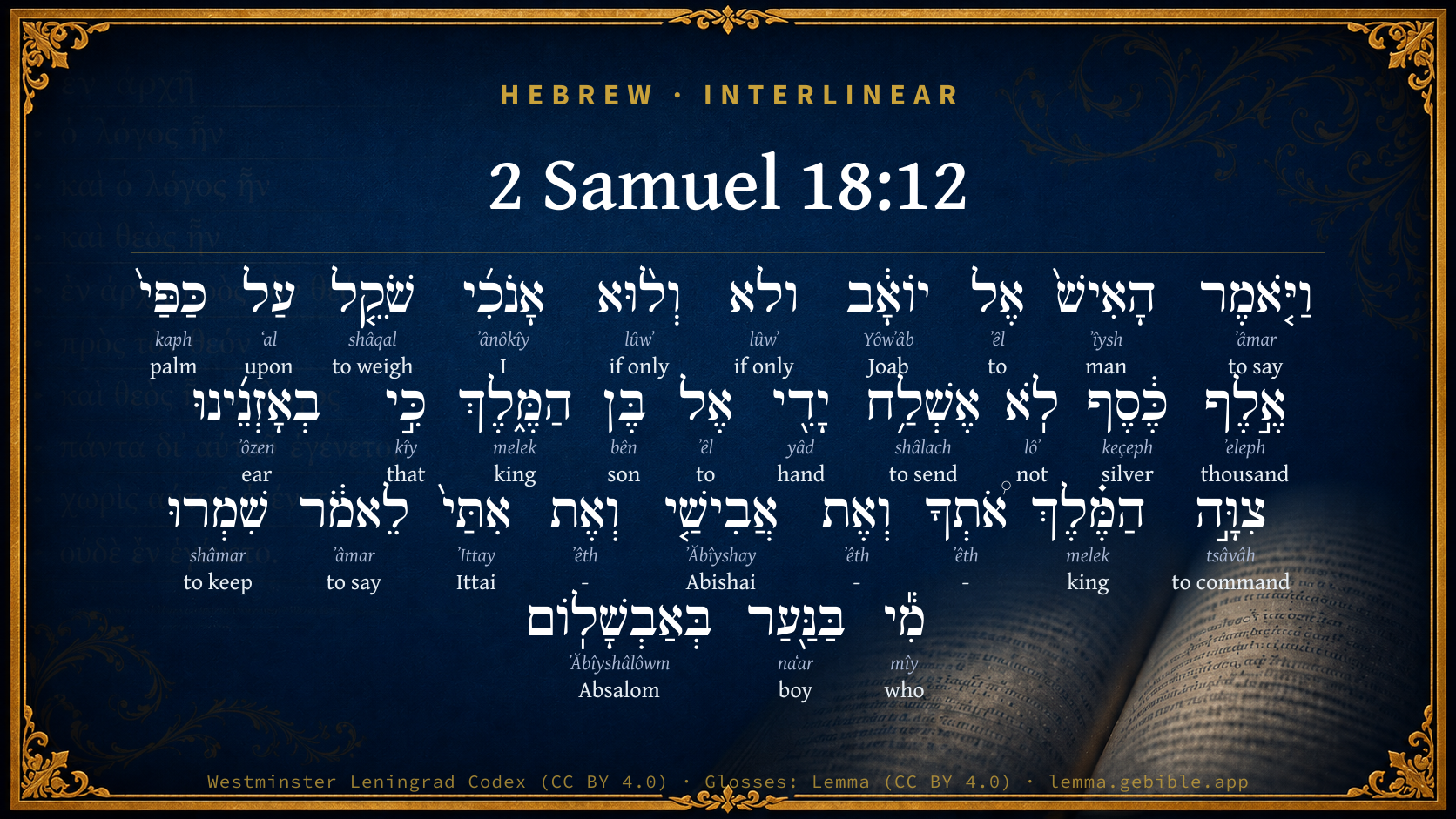
Hebrew (Westminster Leningrad Codex) 2 Samuel 18:12 appears in the Hebrew Old Testament. The text above is from the Westminster Leningrad Codex. Each word links to its Strong’s number, a concise gloss, and parsing drawn from the Open Scriptures Hebrew Bible morphology. Click any word for its full Brown-Driver-Briggs (BDB) entry.
Download image
Cite this verse

2 Samuel 18:12 (World English Bible). Public Domain. Lemma interlinear Bible study tool, https://lemma.gebible.app/v/2-samuel/18/12.

Show BibTeX & RIS
BibTeX
RIS
English Translation
The man said to Joab, Though I should receive a thousand [pieces of] silver in my hand, I still wouldn't put forth my hand against the king's son; for in our hearing the king charged you and Abishai and Ittai, saying, Beware that none touch the young man Absalom.
World English Bible · Public Domain
Download a study sheet

One document with this verse’s original text, its word-by-word gloss line, the meaning frame, cross-references with their text, attributed commentary, and full source and license credits — printable, and it pastes into notes with its structure intact.

This verse Autodidact and up

Study sheet (.html) Plain text (.txt)

A passage Seminary Student

Up to 50 verses in one chapter. A passage sheet keeps up to 6 commentary sources and 12 cross-references per verse, in the order this page ranks them, and says so on the sheet whenever that leaves anything out. Ask for a single verse and you get the Autodidact verse sheet above.

Everything on this page stays free to read, with no account — the sheet is a download of what is already on screen, not access to it.

Want to remove ads? Support Godless Engineer
Compare translations 3

The same verse in 3 English versions, stacked beneath the original-language interlinear above. Click any original word for its lexicon entry.

Each is an independent rendering of the whole verse — the interlinear is not word-aligned to these translations.

Highlighted words mark where these versions differ — a whole-verse word diff, not a word-by-word alignment.

  • World English Bible Public Domain
    The man said to Joab, Though I should receive a thousand [pieces of] silver in my hand, I still wouldn't put forth my hand against the king's son; for in our hearing the king charged you and Abishai and Ittai, saying, Beware that none touch the young man Absalom.
  • King James Version Public Domain
    And the man said unto Joab, Though I should receive a thousand shekels of silver in mine hand, yet would I not put forth mine hand against the king's son: for in our hearing the king charged thee and Abishai and Ittai, saying, Beware that none touch the young man Absalom.
  • unfoldingWord Literal Text CC BY-SA 4.0
    And the man said to Joab, “Even if I were weighing on my palm a thousand silver, I would not stretch out my hand against the son of the king. For in our ears the king commanded you and Abishai and Ittai, saying, ‘Guard who upon the young man Absalom.’

unfoldingWord Literal Text — © unfoldingWord, licensed CC BY-SA 4.0. Word-aligned USFM3 via Door43 (git.door43.org/unfoldingWord/en_ult).

Versions to compare (up to 4)

3 of 4 selected

Show all 18 translations

Every available English version of this verse, each an independent rendering of the whole verse.

  • World English Bible Public Domain
    The man said to Joab, Though I should receive a thousand [pieces of] silver in my hand, I still wouldn't put forth my hand against the king's son; for in our hearing the king charged you and Abishai and Ittai, saying, Beware that none touch the young man Absalom.
  • Berean Standard Bible Public Domain
    The man replied, “Even if a thousand shekels of silver were weighed out into my hands, I would not raise my hand against the son of the king. For we heard the king command you and Abishai and Ittai, ‘Protect the young man Absalom for my sake.’
  • Majority Standard Bible Public Domain
    The man replied, “Even if a thousand shekels of silver were weighed out into my hands, I would not raise my hand against the son of the king. For we heard the king command you and Abishai and Ittai, ‘Protect the young man Absalom for my sake.’
  • King James Version Public Domain
    And the man said unto Joab, Though I should receive a thousand shekels of silver in mine hand, yet would I not put forth mine hand against the king's son: for in our hearing the king charged thee and Abishai and Ittai, saying, Beware that none touch the young man Absalom.
  • American Standard Version (1901) Public Domain
    And the man said unto Joab, Though I should receive a thousand `pieces of' silver in my hand, yet would I not put forth my hand against the king's son; for in our hearing the king charged thee and Abishai and Ittai, saying, Beware that none touch the young man Absalom.
  • Revised Version (1885) Public Domain
    And the man said unto Joab, Though I should receive a thousand pieces of silver in mine hand, yet would I not put forth mine hand against the king’s son: for in our hearing the king charged thee and Abishai and Ittai, saying, Beware that none touch the young man Absalom.
  • Geneva Bible (1599) Public Domain
    Then the man saide vnto Ioab, Though I should receiue a thousande shekels of siluer in mine hande, yet woulde I not lay mine hande vpon the Kings sonne: for in our hearing the King charged thee, and Abishai, and Ittai, saying, Beware, least any touche the yong man Absalom.
  • Douay-Rheims (1899) Public Domain
    And he said to Joab: If thou wouldst have paid down in my hands a thousand pieces of silver, I would not lay my hands upon the king's son: for in our hearing he king charged thee, and Abisai, and Ethai, saying: Save me the boy Absalom.
  • Young's Literal Translation Public Domain
    And the man saith unto Joab, `Yea, though I am weighing on my hand a thousand silverlings, I do not put forth my hand unto the son of the king; for in our ears hath the king charged thee, and Abishai, and Ittai, saying, Observe ye who `is' against the youth -- against Absalom;
  • Literal Standard Version CC BY-SA 4.0
    And the man says to Joab, “Indeed, though I am weighing on my hand one thousand pieces of silver, I do not put forth my hand to the son of the king; for in our ears the king has charged you, and Abishai, and Ittai, saying, Observe who [is] against the youth—against Absalom;
  • Unlocked Literal Bible CC BY-SA 4.0
    The man replied to Joab, “Even if I received a thousand silver shekels, still I would not have reached out my hand against the king's son, because we all heard the king command you, Abishai, and Ittai, saying, 'No one must touch the young man Absalom.'
  • unfoldingWord Literal Text CC BY-SA 4.0
    And the man said to Joab, “Even if I were weighing on my palm a thousand silver, I would not stretch out my hand against the son of the king. For in our ears the king commanded you and Abishai and Ittai, saying, ‘Guard who upon the young man Absalom.’
  • Darby Bible Public Domain
    And the man said to Joab, Though I should receive a thousand silver pieces in my hand, yet would I not put forth my hand against the king's son; for in our hearing the king charged thee and Abishai and Ittai, saying, Take care, whoever it be [of you], of the young man Absalom.
  • World Messianic Bible Public Domain
    The man said to Joab, “Though I should receive a thousand pieces of silver in my hand, I still wouldn’t stretch out my hand against the king’s son; for in our hearing the king commanded you and Abishai and Ittai, saying, ‘Beware that no one touch the young man Absalom.’
  • Webster's Bible Public Domain
    And the man said to Joab, Though I should receive a thousand shekels of silver in my hand, yet would I not put forth my hand against the king's son: for in our hearing the king charged thee and Abishai and Ittai, saying, Beware that none touch the young man Absalom.
  • Free Bible Version CC BY-SA 4.0
    But the man replied, “Even if you gave me a thousand shekels of silver, I wouldn't hurt the king's son. We all heard the king give the order to you, Abishai, and Ittai, ‘Look after young Absalom for me.’
  • Bible in Basic English Public Domain
    And the man said to Joab, Even if you gave me a thousand bits of silver, I would not put out my hand against the king's son: for in our hearing the king gave orders to you and Abishai and Ittai, saying, Take care that the young man Absalom is not touched.
  • JPS Tanakh (1917) Public Domain
    And the man said unto Joab: 'Though I should receive a thousand pieces of silver in my hand, yet would I not put forth my hand against the king's son; for in our hearing the king charged thee and Abishai and Ittai, saying: Beware that none touch the young man Absalom.

Literal Standard Version (2020), Covenant Press — licensed CC BY-SA 4.0. Text via the HelloAO Bible API (eBible.org). Unlocked Literal Bible (unfoldingWord) — licensed CC BY-SA 4.0. Text via the HelloAO Bible API (eBible.org). unfoldingWord Literal Text — © unfoldingWord, licensed CC BY-SA 4.0. Word-aligned USFM3 via Door43 (git.door43.org/unfoldingWord/en_ult). Free Bible Version, Dr. Jonathan Gallagher — licensed CC BY-SA 4.0. Text via the HelloAO Bible API (eBible.org).

Word by word

More ways to search: Search by grammar → Find every occurrence → Compare this word →

Practice this passage: Drill this verse → Learn its vocabulary →

אִתַּי֙
ʼIttay
H863
“Ittai”
Noun, Proper
Part of Speech
Noun
Type
Proper
Full BDB Definition

Origin: from H854

TWOT: None

Ittai or Ithai = "with me" - a Gittite commander from Gath in David's army - one of David's 30 mighty warriors, a Benjamite
  1. וַיֹּ֤אמֶר ʼâmar H559 “and · to say” Conjunction + Verb, Qal, Sequential Imperfect, 3rd Person, Masculine, Singular
  2. הָאִישׁ֙ ʼîysh H376 “the · man” Particle, Definite Article + Noun, Common, Masculine, Singular, Absolute
  3. אֶל ʼêl H413 “to” Preposition
  4. יוֹאָ֔ב Yôwʼâb H3097 “Joab” Noun, Proper
  5. ולא lûwʼ H3863 “and · if only” Conjunction + Conjunction
  6. וְל֨וּא lûwʼ H3863 “and · if only” Conjunction + Conjunction
  7. אָנֹכִ֜י ʼânôkîy H595 “I” Pronoun, Personal, 1st Person, Common, Singular
  8. שֹׁקֵ֤ל shâqal H8254 “weighing” Verb, Qal, Participle Active, Masculine, Singular, Absolute
  9. עַל ʻal H5921 “upon” Preposition
  10. כַּפַּי֙ kaph H3709 “palms · my” Noun, Common, Feminine, Dual, Construct + Suffix, Personal, 1st Person, Common, Singular
  11. אֶ֣לֶף ʼeleph H505 “thousand” Adjective, Cardinal number, Both, Singular, Absolute
  12. כֶּ֔סֶף keçeph H3701 “silver” Noun, Common, Masculine, Singular, Absolute
  13. לֹֽא lôʼ H3808 “not” Particle, Negative
  14. אֶשְׁלַ֥ח shâlach H7971 “to send” Verb, Qal, Imperfect, 1st Person, Common, Singular
  15. יָדִ֖י yâd H3027 “hand · my” Noun, Common, Both, Singular, Construct + Suffix, Personal, 1st Person, Common, Singular
  16. אֶל ʼêl H413 “to” Preposition
  17. בֶּן bên H1121 “son of” Noun, Common, Masculine, Singular, Construct
  18. הַמֶּ֑לֶךְ melek H4428 “the · king” Particle, Definite Article + Noun, Common, Masculine, Singular, Absolute
  19. כִּ֣י kîy H3588 “that” Conjunction
  20. בְאָזְנֵ֜ינוּ ʼôzen H241 “in/at · ears · our” Preposition + Noun, Common, Feminine, Dual, Construct + Suffix, Personal, 1st Person, Common, Plural
  21. צִוָּ֣ה tsâvâh H6680 “to command” Verb, Piel, Perfect, 3rd Person, Masculine, Singular
  22. הַמֶּ֗לֶךְ melek H4428 “the · king” Particle, Definite Article + Noun, Common, Masculine, Singular, Absolute
  23. אֹ֠תְךָ ʼêth H853 “- · you” Particle, Direct Object + Suffix, Personal, 2nd Person, Masculine, Singular
  24. וְאֶת ʼêth H853 “and · -” Conjunction + Particle, Direct Object
  25. אֲבִישַׁ֤י ʼĂbîyshay H52 “Abishai” Noun, Proper
  26. וְאֶת ʼêth H853 “and · -” Conjunction + Particle, Direct Object
  27. לֵאמֹ֔ר ʼâmar H559 “to say” Preposition + Verb, Qal, Infinitive Construct
  28. שִׁמְרוּ shâmar H8104 “keep” Verb, Qal, Imperative, 2nd Person, Masculine, Plural
  29. מִ֕י mîy H4310 “who” Particle, Interrogative
  30. בַּנַּ֖עַר naʻar H5288 “in/at the · boy” Preposition, Determined + Noun, Common, Masculine, Singular, Absolute
  31. בְּאַבְשָׁלֽוֹם ʼĂbîyshâlôwm H53 “in/at · Absalom” Preposition + Noun, Proper

About this verse

These counts appear in no published source. They are computed here, from the morphology-tagged text and Lemma’s own curated glosses. What Lemma adds →

32
words
26
distinct lemmas
Historical
section

Notable vocabulary

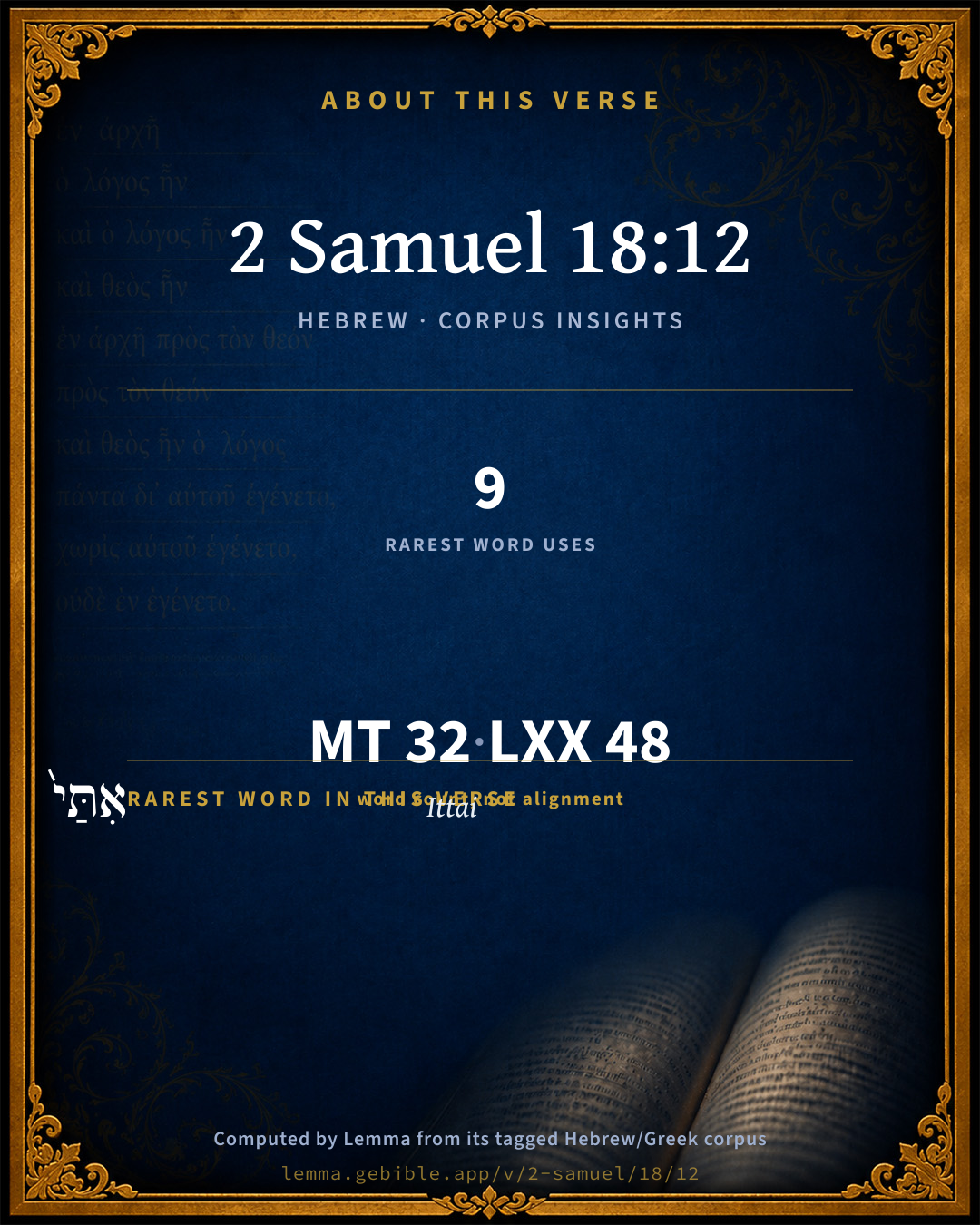
The rarest word here is אִתַּי֙ Ittai H863 — appearing just 9 times in the whole Hebrew Bible.

Shared distinctive vocabulary

אִתַּי֙ Ittai H863 occurs in 8 verses of the Hebrew Bible. Also found in:

Grammatical profile

  • 6 verbs
  • 13 nouns
  • 1 adjective
  • 1 pronoun
  • 3 prepositions
  • 3 conjunctions
  • 5 particles

Verb forms

  • וַיֹּ֤אמֶר Qal · Sequential Imperfect
  • שֹׁקֵ֤ל Qal · Participle Active
  • אֶשְׁלַ֥ח Qal · Imperfect
  • צִוָּ֣ה Piel · Perfect
  • לֵאמֹ֔ר Qal · Infinitive Construct
  • שִׁמְרוּ Qal · Imperative

Repetition

Words recur within this verse — often emphatic in Hebrew:

  • וַיֹּ֤אמֶר to say H559 ×2
  • ולא if only H3863 ×2
  • הַמֶּ֑לֶךְ king H4428 ×2
  • אֶל to H413 ×2

Hebrew & Septuagint length

In English translation the verse runs 49 words from the Hebrew and 48 from the Septuagint (LXX English) — closely comparable.

A rough comparison of the two English renderings, which tokenize alike — not a word-level alignment.

Word counts can differ between the Hebrew and the Greek without any difference in meaning — e.g. the Hebrew direct-object marker אֵת has no separate Greek word, and Greek often adds the article ὁ.

In the original languages it is 32 Hebrew tokens and 48 Greek tokens — but the two are counted differently (Hebrew bundles its prefixes and suffixes into one token; the Greek is in lemma form), so that isn’t a like-for-like length.

Cross-references

1

Topical passages linked to 2 Samuel 18:12 in the Treasury of Scripture Knowledge — connected by theme and wording, ordered by reader-vote popularity; previews shown in the World English Bible.

  • 2 Samuel 18:5 The king commanded Joab and Abishai and Ittai, saying, Deal gently for my sake with the young man, even with Absalom. All the people heard when the king gave all the captains charge concerning Absalom.

Cross-references courtesy of OpenBible.info (CC BY 4.0).

Hebrew and Greek witnesses Masoretic Hebrew ↔ Greek Septuagint

The same verse in the two great witnesses to the Old Testament, shown verse-for-verse.

These are two independent witnesses, not word-aligned to each other, and the Septuagint is shown in lemma (dictionary) form.

Hebrew 2 Samuel 18:12 Masoretic · Westminster Leningrad Codex

וַיֹּ֤אמֶר הָאִישׁ֙ אֶל יוֹאָ֔ב ולא וְל֨וּא אָנֹכִ֜י שֹׁקֵ֤ל עַל כַּפַּי֙ אֶ֣לֶף כֶּ֔סֶף לֹֽא אֶשְׁלַ֥ח יָדִ֖י אֶל בֶּן הַמֶּ֑לֶךְ כִּ֣י בְאָזְנֵ֜ינוּ צִוָּ֣ה הַמֶּ֗לֶךְ אֹ֠תְךָ וְאֶת אֲבִישַׁ֤י וְאֶת אִתַּי֙ לֵאמֹ֔ר שִׁמְרוּ מִ֕י בַּנַּ֖עַר בְּאַבְשָׁלֽוֹם

The man said to Joab, Though I should receive a thousand [pieces of] silver in my hand, I still wouldn't put forth my hand against the king's son; for in our hearing the king charged you and Abishai and Ittai, saying, Beware that none touch the young man Absalom.

World English Bible · Public Domain

Greek LXX 2 Samuel 18:12 Septuagint · lemma form

εἶπον δέ ὁ ἀνήρ πρός ιωαβ καί ἐγώ εἰμί ἵστημι ἐπί ὁ χείρ ἐγώ χίλιοι σίκλος ἀργύριον οὐ μή ἐπιβάλλω χείρ ἐγώ ἐπί ὁ υἱός ὁ βασιλεύς ὅτι ἐν ὁ οὖς ἐγώ ἐντέλλω ὁ βασιλεύς σύ καί αβεσσα καί ὁ εθθι λέγω φυλάσσω ἐγώ ὁ παιδάριον ὁ αβεσσαλωμ

And the man said to Joab, Were I even to receive a thousand shekels of silver, I would not lift my hand against the king's son; for in our ears the king charged you and Abessa and Ethi, saying, Take care of the young man Abessalom for me,

LXX2012 (modern English Septuagint) · Public Domain

Hebrew: Westminster Leningrad Codex (CC BY 4.0). Greek: Septuagint (public domain); English from LXX2012 (modern English Septuagint) (Public Domain). How the Septuagint differs from the Hebrew →

Targum (Aramaic paraphrase)

1

The Targum is the ancient Jewish Aramaic paraphrase of the Hebrew Scriptures — an interpretive translation, not the Hebrew text itself. Onkelos (literal) and Pseudo-Jonathan (expansive) render the Torah, and Jonathan the Prophets. Coverage is partial: where no permissively-licensed English translation exists for a verse, only the Aramaic is shown. This is verse-level text, not a word-by-word alignment to the Hebrew.

  1. Targum Jonathan Prophets (Joshua–Malachi)
    וַאֲמַר גַבְרָא לְיוֹאָב וְלוּ אַנָא תָּקֵל עַל כַּפֵּי אֲלַף סִלְעִין דִכְסַף לָא אוֹשִׁיט יְדֵי בְּבַר מַלְכָּא אֲרֵי קֳדָמָנָא פַּקֵיד מַלְכָּא יָתָךְ וְיַת אֲבִישַׁי וְיַת אִתַּי לְמֵימַר אִסְתַּמָרוּ לִי בְעוּלֵימָא בְּאַבְשָׁלוֹם:

    (no public-domain English translation for this verse)

    Targum Jonathan — Aramaic: “Mikraot Gedolot” (public domain). English: “Sefaria Community Translation” (CC0 1.0 (public-domain dedication)); “London "Chaldee Paraphrase," 1871” (public domain). Text via Sefaria.

Commentary

Notes on 2 Samuel 18:12 from classic Christian and Jewish commentators (each source and its license shown beneath its notes). The classic Christian expositions comment on the surrounding passage and are grouped to its opening verse, so a note may address several verses; the Jewish commentaries on the Tanakh (Rashi and others) are per-verse, so they appear only where the commentator wrote on this verse.

Lemma curates 59 commentaries, every one of them public domain or Creative Commons licensed, each selected and text-cleaned for this edition rather than reprinted as found. About our sources →

Trapp's Complete Commentary

John Trapp

2Sa 18:12 And the man said unto Joab, Though I should receive a thousand [shekels] of silver in mine hand, [yet] would I not put forth mine hand against the king’s son: for in our hearing the king charged thee and Abishai and Ittai, saying, Beware that none [touch] the young man Absalom.

Ver. 12. Yet would I not put forth mine hand.] Because it would be as much as my life is worth. How mad, then, are they who for a few paltry shillings part with their precious souls!

“ Hoc Ithacus velit, hoc magno mercentur Achivi. ”

John Trapp, A Commentary or Exposition upon All the Books of the Old and New Testament (1647–1656) — public domain. Text from a community e-Sword module.

Geneva Bible (1599)

Geneva Bible translators

Hebrew, weigh upon mine hand.

Geneva Bible (1599) marginal notes — public domain. Text via Bolls.life.

The Cambridge Bible for Schools and Colleges

gen. ed. J. J. S. Perowne

12. Beware that none touch] Or, Have a care, all of you, of the young man Absalom: lit. as in the margin, whosoever ye be. But the Sept. and Vulg. read for my sake, as in 2Sa_18:5, in place of whosoever.

The Cambridge Bible for Schools and Colleges (gen. ed. J. J. S. Perowne; Cambridge University Press, 1878–1918) — public domain. Text from a community e-Sword module.

John Gill's Exposition

And the man said unto Joab,.... Disdaining his proposal:

though I should receive a thousand shekels of silver in mine hand; or such a sum should be offered to me; the Arabic version is a million:

yet would I not put forth my hand against the king's son; to smite him, and slay him:

for in our hearing the king charged thee, and Abishai, and Ittai; his three generals:

saying, beware that none touch the young man Absalom; so as to slay him; they were charged to abstain from it themselves, and to watch and observe others, and keep them from doing it.

John Gill's Exposition of the Whole Bible (1746–1763) — public domain (CC PDM 1.0). Text via the HelloAO Bible API.

Haydock's Catholic Bible Commentary

Save. Protestants, "beware that none touch the young man."

George Leo Haydock (1774–1849), Haydock's Catholic Family Bible and Commentary, 1859 edition — public domain. Excludes Psalms (Douay-Rheims chapter numbering differs from Protestant) and Deuterocanonical books (Catholic canon only).

Matthew Poole's English Annotations

Or, take heed what (for so the Hebrew pronoun mi is sometimes used, as Jdg 13:17) ye do with the young man. He expresseth David’s sense, though not his words.

Matthew Poole's English Annotations on the Holy Bible (1683–1685) — public domain. Text from a community e-Sword/MySword module.

Whedon's Commentary on the Bible

Daniel D. Whedon

12. As the dew falleth — Covering all things, so that nothing on the ground escapes its touch.

Daniel D. Whedon (gen. ed.), Commentary on the Old and New Testaments (1874–1909) — public domain. Text from a community e-Sword module.

The Pulpit Commentary

Though I should receive. The Hebrew text expresses the horror of the man at Joab"s proposal much more vividly than the tame correction of the Massorites admitted into the Authorized Version: "And I, no! weighing in my palm a thousand of silver, I would not put forth my hand against the son of the king."

The Pulpit Commentary (1880–1919), ed. H.D.M. Spence-Jones & Joseph S. Exell — public domain. Text from a community e-Sword module.

Keil & Delitzsch

C. F. Keil & F. Delitzsch

But the man replied, "And I ... not weighing a thousand shekels in my hand ... might not stretch out my hand to the king's son," i.e., I could not do it for a reward of a thousand shekels. This is the meaning of the Chethib ולא; the Masoretes, on the other hand, have substituted ולוּ, which is the reading adopted in most of the ancient versions, and the one preferred by the majority of expositors: "if I weighed ... I would not," etc. But there is no necessity for this alteration, as the Chethib is quite in accordance with the character of the words. "For before our ears the king commanded" (cf. Sa2 18:5): מי שׁמרוּ, "take care whoever (it be) of the boy Absalom." On this use of מי, see Ewald, 104, d., a. The Keri לי is merely a conjecture, notwithstanding the fact that all the versions follow it, and that one of the Codices in Kennicott has לי. "or," continued the man (Sa2 18:13), "should I have acted deceitfully towards his life (i.e., have slain him secretly, which he calls שׁקר, cheating, because it was opposed to the king's open command): and nothing remains hidden from the king; ... thou wouldst have set thyself in opposition to me," i.e., have risen up against me before the king. The middle clause is a circumstantial one, as the fact that וכל־דּבר is placed first clearly shows; so that it cannot be regarded as introducing the apodosis, which really follows in the clause commencing with ואתּה.

Keil & Delitzsch — Biblical Commentary on the Old Testament (1861–1891) — public domain (CC PDM 1.0). Text via the HelloAO Bible API. (Old Testament only.)

unfoldingWord translationNotes

Door43 World Missions Community

a thousand silver shekels

"1,000 silver shekels." This can be stated in modern units. AT: "1,000 silver coins" or "11 kilograms of silver" (See: Biblical Money and Numbers)

would not have reached out my hand against the king's son

The phrase "reached out my hand" means to attack. AT: "would not have attacked the king's son" (See: Idiom)

No one must touch

Here "touching" refers to "harming." AT: "No none must harm" or "Do not harm" (See: Idiom)

a falsehood

The word "falsehood" can be expressed with a verb phrase. Also, this refers to disobeying the king's command. This can be stated clearly. AT: "doing something that is wrong" or "by disobeying the king" (See: Abstract Nouns and Assumed Knowledge and Implicit Information)

there is nothing hidden from the king

Here the man speaks about how the king knows about almost everything that happens as if everything were a physical object he knew the location of. AT: "there is nothing that the king does not know" or "the king hears about everything that happens" (See: Metaphor)

translationWords

receive

hand

Absalom

life

unfoldingWord translationNotes — © Distant Shores Media and the Door43 World Missions Community, licensed CC BY-SA 4.0. Source: git.door43.org/Door43/en_tn.

Rashi

Rabbi Shlomo Yitzchaki (Rashi)

Beware that none harm the young man. Everyone who meets up with him should preserve him.

Rashi on the Tanakh — English translations: “The Judaica Press complete Tanach with Rashi, translated by A. J. Rosenberg” (CC BY 4.0); “Pentateuch with Rashi's commentary by M. Rosenbaum and A.M. Silbermann, 1929-1934” (public domain); “The Metsudah Tanach series, Lakewood, N.J” (CC BY 4.0); and “The Book of Joshua, Metsudah Publications, 1997” (CC BY 4.0). Text via Sefaria.

Lesson kit

Teaching starters — assembled from the data on this page, not authored interpretation. Every prompt links to the verse data it draws on. Edit before teaching.

2 Samuel, in the Historical, opens this verse with 32 words (26 distinct Hebrew lemmas). Its most distinctive word is ʼIttay (“Ittai”). A historical commentator’s framing appears above. Read the whole chapter for the surrounding context.

Discussion questions

  1. How does “Ittai” (ʼIttay) shape what this verse is saying?
  2. How does 2 Samuel 15:19, which shares the word «Ittai», read alongside this verse?
  3. What does the repetition of “to say” (2× in this one verse) do in this verse?
  4. The translations on this page render this verse differently — a whole-verse word diff, not a word-by-word alignment. What might account for the different wordings?
  5. «וַיֹּ֤אמֶר» is a Qal Sequential Imperfect verb. How does that grammatical form shape the action described?
  6. Compare how Trapp's Complete Commentary and Geneva Bible (1599) read this verse. Where do they agree or differ?

Things to notice

Reading settings

Reading text

Shown beneath each verse's original-language words.

Old Testament
Old Testament edition

Read the OT as the Masoretic Hebrew (MT) or the Greek Septuagint (LXX).

English shown for the Greek Septuagint (in the Hebrew ↔ Greek comparison).

Comparing translations? Open the Compare panel on any verse page to stack up to four side by side.