
Deuteronomy 15:11

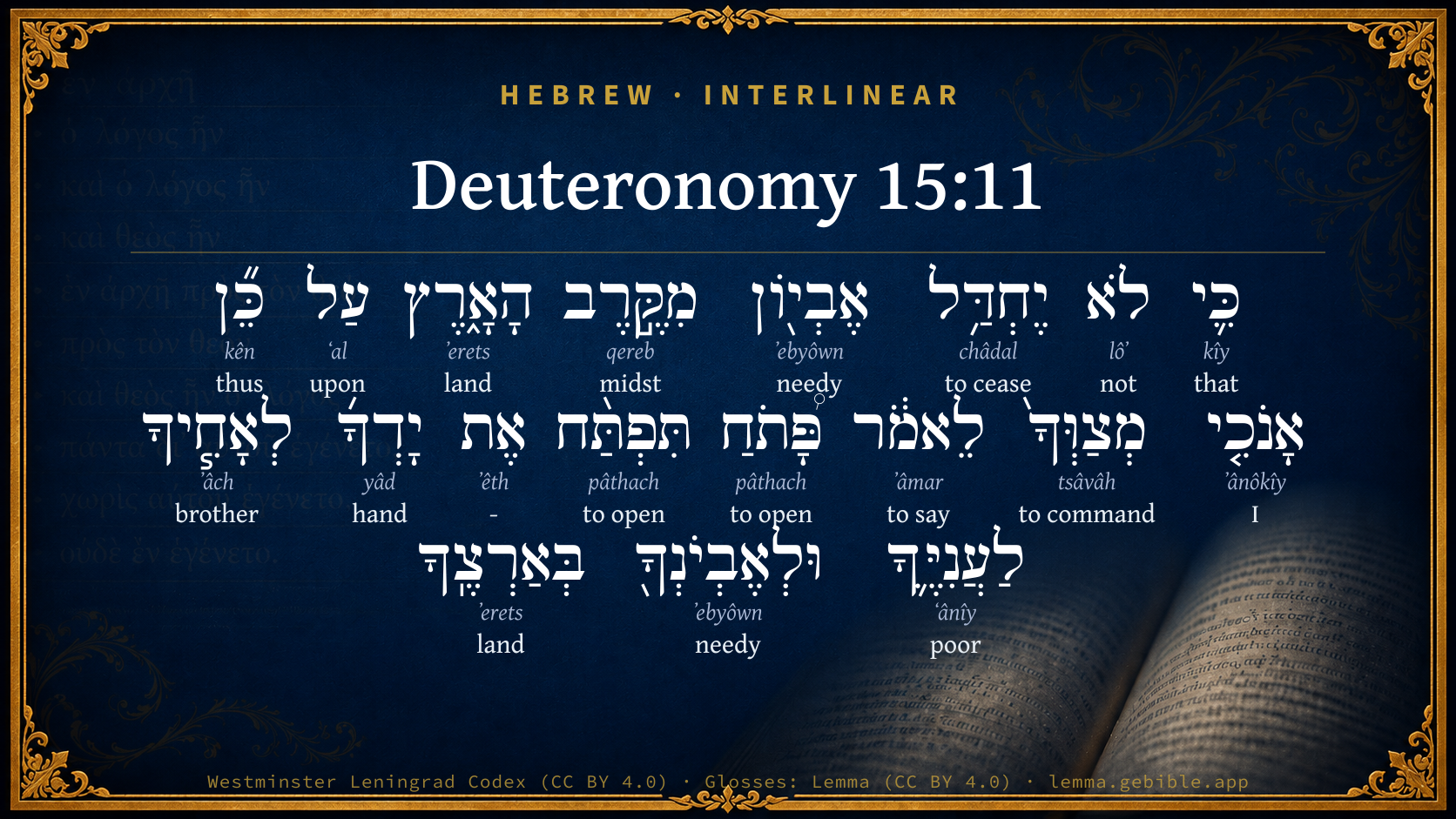
Hebrew (Westminster Leningrad Codex) Deuteronomy 15:11 appears in the Hebrew Old Testament. The text above is from the Westminster Leningrad Codex. Each word links to its Strong’s number, a concise gloss, and parsing drawn from the Open Scriptures Hebrew Bible morphology. Click any word for its full Brown-Driver-Briggs (BDB) entry.
Download image
Cite this verse

Deuteronomy 15:11 (World English Bible). Public Domain. Lemma interlinear Bible study tool, https://lemma.gebible.app/v/deuteronomy/15/11.

Show BibTeX & RIS
BibTeX
RIS
English Translation
For the poor will never cease out of the land: therefore I command you, saying, You shall surely open your hand to your brother, to your needy, and to your poor, in your land.
World English Bible · Public Domain
Download a study sheet

One document with this verse’s original text, its word-by-word gloss line, the meaning frame, cross-references with their text, attributed commentary, and full source and license credits — printable, and it pastes into notes with its structure intact.

This verse Autodidact and up

Study sheet (.html) Plain text (.txt)

A passage Seminary Student

Up to 50 verses in one chapter. A passage sheet keeps up to 6 commentary sources and 12 cross-references per verse, in the order this page ranks them, and says so on the sheet whenever that leaves anything out. Ask for a single verse and you get the Autodidact verse sheet above.

Everything on this page stays free to read, with no account — the sheet is a download of what is already on screen, not access to it.

Want to remove ads? Support Godless Engineer
Compare translations 3

The same verse in 3 English versions, stacked beneath the original-language interlinear above. Click any original word for its lexicon entry.

Each is an independent rendering of the whole verse — the interlinear is not word-aligned to these translations.

Highlighted words mark where these versions differ — a whole-verse word diff, not a word-by-word alignment.

  • World English Bible Public Domain
    For the poor will never cease out of the land: therefore I command you, saying, You shall surely open your hand to your brother, to your needy, and to your poor, in your land.
  • King James Version Public Domain
    For the poor shall never cease out of the land: therefore I command thee, saying, Thou shalt open thine hand wide unto thy brother, to thy poor, and to thy needy, in thy land.
  • unfoldingWord Literal Text CC BY-SA 4.0
    For the poor will not cease to be among the land; therefore I command you, saying, ‘Opening, you shall open your hand to your brother, to your needy, and to your poor in your land.’

unfoldingWord Literal Text — © unfoldingWord, licensed CC BY-SA 4.0. Word-aligned USFM3 via Door43 (git.door43.org/unfoldingWord/en_ult).

Versions to compare (up to 4)

3 of 4 selected

Show all 18 translations

Every available English version of this verse, each an independent rendering of the whole verse.

  • World English Bible Public Domain
    For the poor will never cease out of the land: therefore I command you, saying, You shall surely open your hand to your brother, to your needy, and to your poor, in your land.
  • Berean Standard Bible Public Domain
    For there will never cease to be poor in the land; that is why I am commanding you to open wide your hand to your brother and to the poor and needy in your land.
  • Majority Standard Bible Public Domain
    For there will never cease to be poor in the land; that is why I am commanding you to open wide your hand to your brother and to the poor and needy in your land.
  • King James Version Public Domain
    For the poor shall never cease out of the land: therefore I command thee, saying, Thou shalt open thine hand wide unto thy brother, to thy poor, and to thy needy, in thy land.
  • American Standard Version (1901) Public Domain
    For the poor will never cease out of the land: therefore I command thee, saying, Thou shalt surely open thy hand unto thy brother, to thy needy, and to thy poor, in thy land.
  • Revised Version (1885) Public Domain
    For the poor shall never cease out of the land: therefore I command thee, saying, Thou shalt surely open thine hand unto thy brother, to thy needy, and to thy poor, in thy land.
  • Geneva Bible (1599) Public Domain
    Because there shall be euer some poore in the land, therefore I command thee, saying, Thou shalt open thine hand vnto thy brother, to thy needie, and to thy poore in thy land.
  • Douay-Rheims (1899) Public Domain
    There will not be wanting poor in the land of thy habitation: therefore I command thee to open thy hand to thy needy and poor brother, that liveth in the land.
  • Young's Literal Translation Public Domain
    because the needy one doth not cease out of the land, therefore I am commanding thee, saying, Thou dost certainly open thy hand to thy brother, to thy poor, and to thy needy one, in thy land.
  • Literal Standard Version CC BY-SA 4.0
    because the poor does not cease out of the land, therefore I am commanding you, saying, You certainly open your hand to your brother, to your poor and to your needy one in your land.
  • Unlocked Literal Bible CC BY-SA 4.0
    For the poor will never cease to exist in the land; therefore I command you and say, 'You must surely open your hand to your brother, to your needy, and to your poor in your land.'
  • unfoldingWord Literal Text CC BY-SA 4.0
    For the poor will not cease to be among the land; therefore I command you, saying, ‘Opening, you shall open your hand to your brother, to your needy, and to your poor in your land.’
  • Darby Bible Public Domain
    For the needy shall never cease from within the land; therefore I command thee, saying, Thou shalt open thy hand bountifully unto thy brother, to thy poor and to thy needy, in thy land.
  • World Messianic Bible Public Domain
    For the poor will never cease out of the land. Therefore I command you to surely open your hand to your brother, to your needy, and to your poor, in your land.
  • Webster's Bible Public Domain
    For the poor shall never cease from the land: therefore I command thee, saying, Thou shalt open thy hand wide to thy brother, to thy poor, and to thy needy, in thy land.
  • Free Bible Version CC BY-SA 4.0
    You will always have those who are poor and in need among you, so that's why I'm telling you to give generously to them.
  • Bible in Basic English Public Domain
    For there will never be a time when there are no poor in the land; and so I give orders to you, Let your hand be open to your countrymen, to those who are poor and in need in your land.
  • JPS Tanakh (1917) Public Domain
    For the poor shall never cease out of the land; therefore I command thee, saying: 'Thou shalt surely open thy hand unto thy poor and needy brother, in thy land.'

Literal Standard Version (2020), Covenant Press — licensed CC BY-SA 4.0. Text via the HelloAO Bible API (eBible.org). Unlocked Literal Bible (unfoldingWord) — licensed CC BY-SA 4.0. Text via the HelloAO Bible API (eBible.org). unfoldingWord Literal Text — © unfoldingWord, licensed CC BY-SA 4.0. Word-aligned USFM3 via Door43 (git.door43.org/unfoldingWord/en_ult). Free Bible Version, Dr. Jonathan Gallagher — licensed CC BY-SA 4.0. Text via the HelloAO Bible API (eBible.org).

Word by word

More ways to search: Search by grammar → Find every occurrence → Compare this word →

Practice this passage: Drill this verse → Learn its vocabulary →

יֶחְדַּ֥ל
châdal
H2308
“to cease”
Verb, Qal, Imperfect, 3rd Person, Masculine, Singular
Part of Speech
Verb
Stem
Qal
Form
Imperfect
Person
3rd Person
Gender
Masculine
Number
Singular
Full BDB Definition

Origin: a primitive root

TWOT: 609

to stop, cease, desist, forego, cease to be, leave undone, forbear - (Qal) - to cease, come to an end - to cease, leave off
  1. כִּ֛י kîy H3588 “that” Conjunction
  2. לֹא lôʼ H3808 “not” Particle, Negative
  3. אֶבְי֖וֹן ʼebyôwn H34 “needy” Adjective, Adjective, Masculine, Singular, Absolute
  4. מִקֶּ֣רֶב qereb H7130 “from · midst of” Preposition + Noun, Common, Masculine, Singular, Construct
  5. הָאָ֑רֶץ ʼerets H776 “the · land” Particle, Definite Article + Noun, Common, Both, Singular, Absolute
  6. עַל ʻal H5921 “upon” Preposition
  7. כֵּ֞ן kên H3651 “thus” Particle, Demonstrative
  8. אָנֹכִ֤י ʼânôkîy H595 “I” Pronoun, Personal, 1st Person, Common, Singular
  9. מְצַוְּךָ֙ tsâvâh H6680 “commanding · you” Verb, Piel, Participle Active, Masculine, Singular, Construct + Suffix, Personal, 2nd Person, Masculine, Singular
  10. לֵאמֹ֔ר ʼâmar H559 “to say” Preposition + Verb, Qal, Infinitive Construct
  11. פָּ֠תֹחַ pâthach H6605 “to open” Verb, Qal, Infinitive Absolute
  12. תִּפְתַּ֨ח pâthach H6605 “to open” Verb, Qal, Imperfect, 2nd Person, Masculine, Singular
  13. אֶת ʼêth H853 “-” Particle, Direct Object
  14. יָדְךָ֜ yâd H3027 “hand · your” Noun, Common, Both, Singular, Construct + Suffix, Personal, 2nd Person, Masculine, Singular
  15. לְאָחִ֧יךָ ʼâch H251 “to/for · brother · your” Preposition + Noun, Common, Masculine, Singular, Construct + Suffix, Personal, 2nd Person, Masculine, Singular
  16. לַעֲנִיֶּ֛ךָ ʻânîy H6041 “to/for · poor · your” Preposition + Adjective, Adjective, Masculine, Singular, Construct + Suffix, Personal, 2nd Person, Masculine, Singular
  17. וּלְאֶבְיֹנְךָ֖ ʼebyôwn H34 “and · to/for · needy · your” Conjunction + Preposition + Adjective, Adjective, Masculine, Singular, Construct + Suffix, Personal, 2nd Person, Masculine, Singular
  18. בְּאַרְצֶֽךָ ʼerets H776 “in/at · land · your” Preposition + Noun, Common, Both, Singular, Construct + Suffix, Personal, 2nd Person, Masculine, Singular

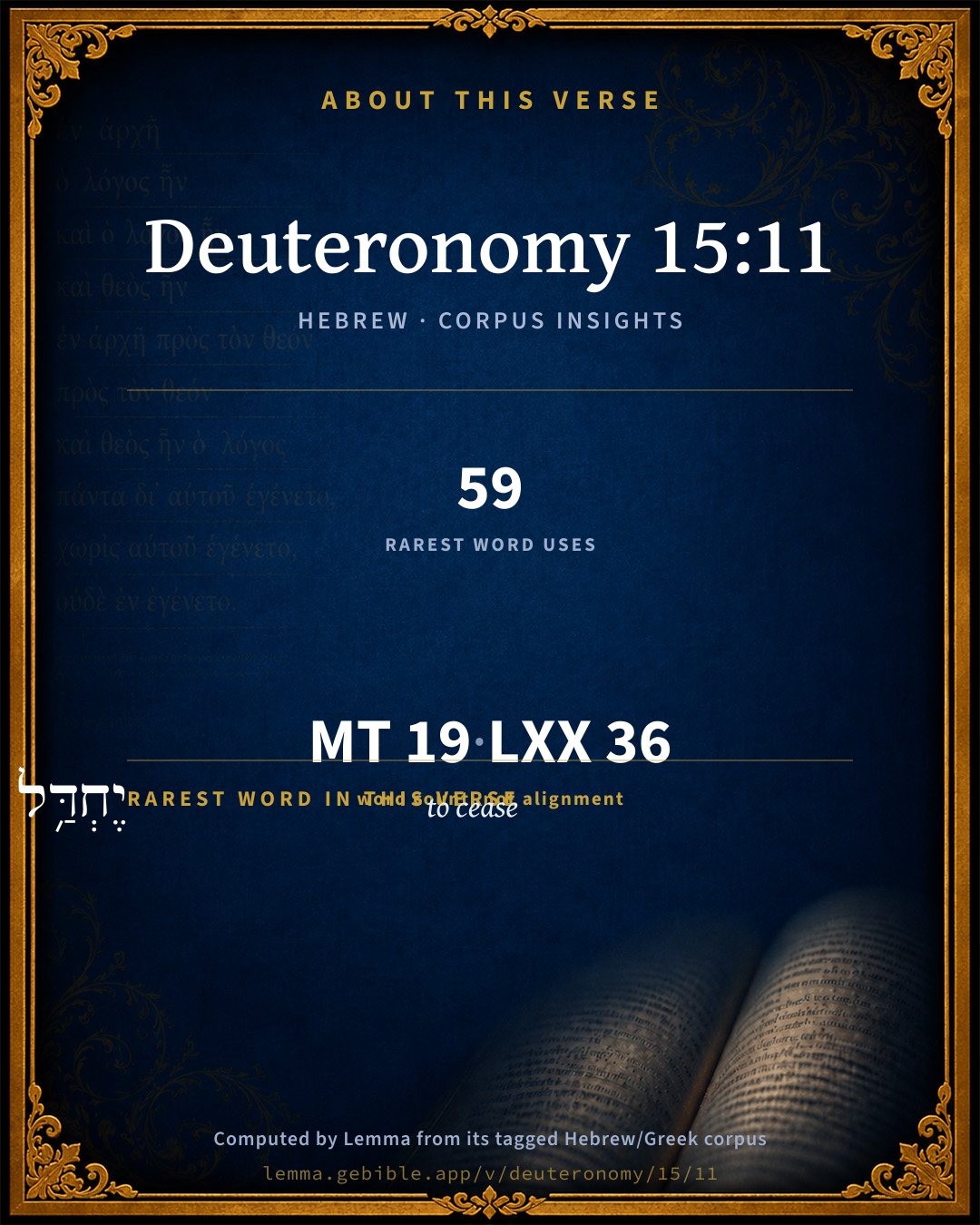
About this verse

These counts appear in no published source. They are computed here, from the morphology-tagged text and Lemma’s own curated glosses. What Lemma adds →

19
words
16
distinct lemmas
Pentateuch
section

Shared distinctive vocabulary

יֶחְדַּ֥ל to cease H2308 occurs in 56 verses of the Hebrew Bible. Also found in:

Grammatical profile

  • 5 verbs
  • 5 nouns
  • 3 adjectives
  • 1 pronoun
  • 1 preposition
  • 1 conjunction
  • 3 particles

Verb forms

  • יֶחְדַּ֥ל Qal · Imperfect
  • מְצַוְּךָ֙ Piel · Participle Active
  • לֵאמֹ֔ר Qal · Infinitive Construct
  • פָּ֠תֹחַ Qal · Infinitive Absolute
  • תִּפְתַּ֨ח Qal · Imperfect

Repetition

Words recur within this verse — often emphatic in Hebrew:

  • אֶבְי֖וֹן needy H34 ×2
  • הָאָ֑רֶץ land H776 ×2
  • פָּ֠תֹחַ to open H6605 ×2

Hebrew & Septuagint length

In English translation the verse runs 34 words from the Hebrew and 37 from the Septuagint (LXX English) — closely comparable.

A rough comparison of the two English renderings, which tokenize alike — not a word-level alignment.

Word counts can differ between the Hebrew and the Greek without any difference in meaning — e.g. the Hebrew direct-object marker אֵת has no separate Greek word, and Greek often adds the article ὁ.

In the original languages it is 19 Hebrew tokens and 36 Greek tokens — but the two are counted differently (Hebrew bundles its prefixes and suffixes into one token; the Greek is in lemma form), so that isn’t a like-for-like length.

Cross-references

12

Topical passages linked to Deuteronomy 15:11 in the Treasury of Scripture Knowledge — connected by theme and wording, ordered by reader-vote popularity; previews shown in the World English Bible.

  • Matthew 26:11 For you always have the poor with you; but you don't always have me.
  • Mark 14:7 For you always have the poor with you, and whenever you want to, you can do them good; but you will not always have me.
  • John 12:8 For you always have the poor with you, but you don't always have me."
  • Deuteronomy 15:8 but you shall surely open your hand to him, and shall surely lend him sufficient for his need [in that] which he wants.
  • Proverbs 22:2 The rich and the poor have this in common: Yahweh is the maker of them all.
  • 1 John 3:16–18 By this we know love, because he laid down his life for us. And we ought to lay down our lives for the brothers.
  • Acts 4:32–35 The multitude of those who believed were of one heart and soul. Not one of them claimed that anything of the things which he possessed was his own, but they had all things in common.
  • Luke 12:33 Sell that which you have, and give gifts to the needy. Make for yourselves purses which don't grow old, a treasure in the heavens that doesn't fail, where no thief approaches, neither moth destroys.
  • Matthew 5:42 Give to him who asks you, and don't turn away him who desires to borrow from you.
  • Acts 2:45 They sold their possessions and goods, and distributed them to all, according as anyone had need.
  • 2 Corinthians 8:2–9 how that in much proof of affliction the abundance of their joy and their deep poverty abounded to the riches of their liberality.
  • Acts 11:28–30 One of them named Agabus stood up, and indicated by the Spirit that there should be a great famine all over the world, which also happened in the days of Claudius.

Cross-references courtesy of OpenBible.info (CC BY 4.0).

Hebrew and Greek witnesses Masoretic Hebrew ↔ Greek Septuagint

The same verse in the two great witnesses to the Old Testament, shown verse-for-verse.

These are two independent witnesses, not word-aligned to each other, and the Septuagint is shown in lemma (dictionary) form.

Hebrew Deuteronomy 15:11 Masoretic · Westminster Leningrad Codex

כִּ֛י לֹא יֶחְדַּ֥ל אֶבְי֖וֹן מִקֶּ֣רֶב הָאָ֑רֶץ עַל כֵּ֞ן אָנֹכִ֤י מְצַוְּךָ֙ לֵאמֹ֔ר פָּ֠תֹחַ תִּפְתַּ֨ח אֶת יָדְךָ֜ לְאָחִ֧יךָ לַעֲנִיֶּ֛ךָ וּלְאֶבְיֹנְךָ֖ בְּאַרְצֶֽךָ

For the poor will never cease out of the land: therefore I command you, saying, You shall surely open your hand to your brother, to your needy, and to your poor, in your land.

World English Bible · Public Domain

Greek LXX Deuteronomy 15:11 Septuagint · lemma form

οὐ γάρ μή ἐκλείπω ἐνδεής ἀπό ὁ γῆ διά οὗτος ἐγώ σύ ἐντέλλομαι ποιέω ὁ ῥῆμα οὗτος λέγω ἀναοἴγω ἀναοἴγω ὁ χείρ σύ ὁ ἀδελφός σύ ὁ πένης καί ὁ ἐπιδέω ὁ ἐπί ὁ γῆ σύ

For the poor shall not fail off your land, therefore I charge you to do this thing, saying, You shall surely open your hands to your poor brother, and to him that is distressed upon your land.

LXX2012 (modern English Septuagint) · Public Domain

Hebrew: Westminster Leningrad Codex (CC BY 4.0). Greek: Septuagint (public domain); English from LXX2012 (modern English Septuagint) (Public Domain). How the Septuagint differs from the Hebrew →

Targum (Aramaic paraphrase)

2

The Targum is the ancient Jewish Aramaic paraphrase of the Hebrew Scriptures — an interpretive translation, not the Hebrew text itself. Onkelos (literal) and Pseudo-Jonathan (expansive) render the Torah, and Jonathan the Prophets. Coverage is partial: where no permissively-licensed English translation exists for a verse, only the Aramaic is shown. This is verse-level text, not a word-by-word alignment to the Hebrew.

  1. Targum Onkelos Torah (Genesis–Deuteronomy)
    אֲרֵי לָא יִפְסוֹק מִסְכֵּנָא מִגוֹ אַרְעָא עַל כֵּן אֲנָא מְפַקְדָךְ לְמֵימַר מִפְתַּח תִּפְתַּח יָת יְדָךְ לַאֲחוּךְ לְעַנְיָךְ וּלְמִסְכֵּנָךְ בְּאַרְעָךְ

    (no public-domain English translation for this verse)

    Targum Onkelos — Aramaic: “Onkelos Genesis” (public domain); “Onkelos Exodus” (public domain); “Onkelos Leviticus” (public domain); “Onkelos Numbers” (public domain); “Onkelos Deuteronomy” (public domain). English: “Sefaria Community Translation” (CC0 1.0 (public-domain dedication)); “J.W. Etheridge. The Targums of Onkelos and Jonathan Ben Uzziel on the Pentateuch. London: Longmans, Green, 1862” (public domain). Text via Sefaria.

  2. Targum Pseudo-Jonathan Torah (Genesis–Deuteronomy)
    אֲרוּם מְטוּל דְּלָא צַיְיתִין בֵּית יִשְרָאֵל בְּמִצְוָותָא דְאוֹרַיְיתָא לָא פַסְקִין מַסְכְּנִין מִגּוֹ אַרְעָא בְּגִין כֵּן אֲנָא מְפַקִידְכוֹן לְמֵימָר מִפְתַּח תִּפְתְּחוּן יַת יְדֵיכוֹן לְקָרִיבֵיכוֹן וּלְעַנְיֵי שִׁיבְבוּתְכוֹן וּלְמִסְכְּנֵי אַרְעֲכוֹן

    But forasmuch as the house of Israel will not rest in the commandments of the law, the poor will not cease in the land: therefore I command you, saying: You shall verily open your hands toward your neighbours, to the afflicted around you, and to the poor of your country.

    Targum Pseudo-Jonathan — Aramaic: “Targum Jonathan on Genesis” (public domain); “Targum Jonathan on Exodus” (public domain); “Targum Jonathan on Leviticus” (public domain); “Targum Jonathan on Numbers” (public domain); “Targum Jonathan on Deuteronomy” (public domain). English: “The Targum of Jonathan ben Uzziel, trans. J. W. Etheridge, London, 1862” (public domain). Text via Sefaria.

Commentary

Notes on Deuteronomy 15:11 from classic Christian and Jewish commentators (each source and its license shown beneath its notes). The classic Christian expositions comment on the surrounding passage and are grouped to its opening verse, so a note may address several verses; the Jewish commentaries on the Tanakh (Rashi and others) are per-verse, so they appear only where the commentator wrote on this verse.

Lemma curates 59 commentaries, every one of them public domain or Creative Commons licensed, each selected and text-cleaned for this edition rather than reprinted as found. About our sources →

Trapp's Complete Commentary

John Trapp

Deu 15:11 For the poor shall never cease out of the land: therefore I command thee, saying, Thou shalt open thine hand wide unto thy brother, to thy poor, and to thy needy, in thy land.

Ver. 11. For the poor.] {See Trapp on "Mat 26:11"} Aged and impotent poor, whose misery moves compassion without an orator; called here our poor, as well as our brethren.

John Trapp, A Commentary or Exposition upon All the Books of the Old and New Testament (1647–1656) — public domain. Text from a community e-Sword module.

Joseph Benson's Commentary

Deu 15:11. The poor shall never cease — God, by his providence, will so order it, partly for the punishment of your disobedience, and partly for the trial and exercise of your obedience to him, and charity to your brother.

Joseph Benson's Commentary on the Old and New Testaments (1811–1818) — public domain. Text from a community e-Sword module.

Tyndale Open Study Notes

Tyndale Open Resources

15:11 The reality that there will always be some . . . who are poor in a fallen world is no excuse for indifference to their plight. Instead, it should emphasize the need for the rich to contribute to the well-being of the poor (Matt 26:6-13).

Tyndale Open Study Notes — © Tyndale Open Resources, licensed CC BY-SA 4.0. Text via the HelloAO Bible API.

Geneva Bible (1599)

Geneva Bible translators

To try your charity, Matt. 26:11.

Thou shalt be liberal.

Geneva Bible (1599) marginal notes — public domain. Text via Bolls.life.

Jamieson, Fausset & Brown

Robert Jamieson, A. R. Fausset & David Brown

For the poor shall never cease out of the land--Although every Israelite on the conquest of Canaan became the owner of property, yet in the providence of God who foresaw the event, it was permitted, partly as a punishment of disobedience and partly for the exercise of benevolent and charitable feelings, that "the poor should never cease out of the land."

Jamieson, Fausset & Brown — Commentary Critical and Explanatory on the Whole Bible (1871) — public domain (CC PDM 1.0). Text via the HelloAO Bible API.

Adam Clarke's Commentary

Verse 11. For the poor shall never cease out of the land] To this passage our Lord appears to allude Mr 14:7: For ye have the poor with you always. God leaves these in mercy among men to exercise the feelings of compassion, tenderness, mercy, &c. And without occasions afforded to exercise these, man would soon become a Stoic or a brute.

Adam Clarke's Commentary on the Bible (1810–1826) — public domain. Text from a community e-Sword/MySword module.

Ellicott's Commentary for English Readers

(11) For the poor shall never cease.—There is no contradiction between this verse and Deu_15:4 above. There will always be some men falling into poverty; but it is our business to see that they do not remain in want. The poor will never cease, except by the provision made for them by their brethren. God will never make all men absolutely equal in this world.

Thy brother, thy poor, and thy needy.-According to Rashi, the word translated “needy” is stronger than the word for “poor.” The “poor” are in humble circumstances; the “needy” are actually in want. In commenting on this verse, Rashi asks a similar question to that of the lawyer in Luk_10:29, “Who is this brother? Thy poor man.” He might have added that “thy poor” and “thy needy” are expressions teaching the truth that we are “members one of another.” We may not pass by our poorer brethren, and say we have nothing to do with them. Jehovah calls them ours—“thy poor man,” and “thy needy man.” The words are both in the singular number in the Hebrew. We cannot shake off the relationship or the responsibility in any one case.

A Bible Commentary for English Readers, edited by Charles John Ellicott (1878–1897) — public domain. Text from a community e-Sword module.

The Cambridge Bible for Schools and Colleges

gen. ed. J. J. S. Perowne

11. For the poor shall never cease, etc.] See introd. note.

to thy needy, and to thy poor] Two of the three Hebrew synonyms for poor. The first is a passive form, forced, afflicted, then wretched, whether under persecution, poverty or exile, arid so also subdued, mild, meek. The second is the Lat. egenus, needy.

The Cambridge Bible for Schools and Colleges (gen. ed. J. J. S. Perowne; Cambridge University Press, 1878–1918) — public domain. Text from a community e-Sword module.

John Gill's Exposition

For the poor shall never cease out of the land,.... There would be always such objects to exercise their charity and beneficence towards, Joh 12:8, which is no contradiction to Deu 15:4 for had they been obedient to the laws of God, they would have been so blessed that there would have been none; so the Targums; but he foresaw that they would not keep his commands, and so this would be the case, and which he foretells that they might expect it, and do their duty to them, as here directed:

therefore I command thee, saying, thou shalt open thine hand wide unto thy brother; not give sparingly, but largely, in proportion to the necessities of the poor, and according to the abilities of the lender or giver; and this must be done to a brother, one that is near in the bonds of consanguinity, and to him a man must give or lend first, as Aben Ezra observes, and then "to thy poor"; the poor of thy family, as the same writer:

and to thy needy in the land; that are in very distressed circumstances, though not related, and particularly such as are in the same place where a man dwells; for, as the same writer remarks, the poor of thy land are to be preferred to the poor of another place,

John Gill's Exposition of the Whole Bible (1746–1763) — public domain (CC PDM 1.0). Text via the HelloAO Bible API.

Haydock's Catholic Bible Commentary

Needy. Hebrew expresses the order to be observed in giving alms, "open thy hand wide (give with profusion) to thy brother, (or relations,) to thy needy, (in extreme want,) and to thy poor in the land," whoever they may be. (Calmet) --- To exercise the charity of his people, God suffered some to be poor. (Worthington)

George Leo Haydock (1774–1849), Haydock's Catholic Family Bible and Commentary, 1859 edition — public domain. Excludes Psalms (Douay-Rheims chapter numbering differs from Protestant) and Deuterocanonical books (Catholic canon only).

Matthew Poole's English Annotations

The poor shall never cease out of the land; God by his providence will so order it, partly for the punishment of your disobedience, and partly for the trial and exercise of your obedience to me, and charity to your brother, both which are best discovered by your performance of costly duties.

Matthew Poole's English Annotations on the Holy Bible (1683–1685) — public domain. Text from a community e-Sword/MySword module.

Whedon's Commentary on the Bible

Daniel D. Whedon

11. The poor shall never cease out of the land — Our Lord says, “Ye have the poor with you always.” Mar_14:7. Here Moses lays down rules which the people were to observe in the case of Hebrew slaves. The earlier legislation is recorded in Exo_21:2-6.

Daniel D. Whedon (gen. ed.), Commentary on the Old and New Testaments (1874–1909) — public domain. Text from a community e-Sword module.

The Pulpit Commentary

They were to open their hand wide to their poorer brethren, for there should always be such in the land. This statement is not inconsistent with that in ver. 4, for there it is the prevention of poverty by not dealing harshly with the poor that is spoken of; here it is the continuance of occasion for the relief of the poor that is referred to.

The poor in the land.

The meaning is that there will always be greater or less scope for the exercise of the virtues of kindness and liberality, that it is vain to hope for a Utopian condition of society in which there shall be absolutely no poor.

I THIS DOES NOT IMPLY:

1. That many existing causes of poverty cannot be permanently removed.

2. That every attempt ought not to be made to reduce poverty within its narrowest limits. The saying, "Ye have the poor always with you", (Mat_26:11) is no utterance of fatalism. Much can be done to reduce poverty. With the growth of society, still more as a result of the spread of Christian principles, numbers of the causes of poverty now existing may be expected to disappear (idleness, intemperance, bad laws, merciless competition, class antagonisms, unfavorable sanitary conditions, etc.).

II IT DOES IMPLY:

1. That under the most favorable conditions of existence on earth a residuum of poverty is still to be looked for.

(1) There are diversities of talents. There will always be those whose abilities only fit them for the humblest positions in society. And these may be left friendless, or health may fail them, or they may live to old age, and become dependent.

(2) There are vicissitudes of fortune. These come to the most fortunate of men, reducing them oftentimes to great straits. And it is too much to expect that, even under millennial conditions, the causes of such vicissitudes will altogether cease to operate.

2. That while poverty lasts, it is our duty to help to bear its burden. Poverty, in a state of society such as we anticipate as the goal of history, need never be the painful thing it is now. With loving hearts, and hands ready to help, its sting will be taken away. J.O.

The Pulpit Commentary (1880–1919), ed. H.D.M. Spence-Jones & Joseph S. Exell — public domain. Text from a community e-Sword module.

John Wesley's Explanatory Notes

The poor shall never cease - God by his providence will so order it, partly for the punishment of your disobedience, and partly for the trial and exercise of your obedience to him and charity to your brother.

John Wesley, Explanatory Notes Upon the Whole Bible (1754–1765) — public domain. Text via the GEBible commentary corpus.

Keil & Delitzsch

C. F. Keil & F. Delitzsch

For the poor will never cease in the land, even the land that is richly blessed, because poverty is not only the penalty of sin, but is ordained by God for punishment and discipline.

Keil & Delitzsch — Biblical Commentary on the Old Testament (1861–1891) — public domain (CC PDM 1.0). Text via the HelloAO Bible API. (Old Testament only.)

unfoldingWord translationNotes

Door43 World Missions Community

For the poor will never cease to exist in the land

This can be stated in positive form. AT: "For there will always be poor people in the land" (See: Double Negatives)

For the poor

The nominal adjective "the poor" can be stated as an adjective. AT: "For poor people" (See: Nominal Adjectives)

I command you and say, 'You must surely open your hand ... in your land.'

This has a quotation within a quotation. A direct quotation can be stated as an indirect quotation. AT: "I command you to open your hand ... in your land" (See:Quotes Within Quotes and Direct and Indirect Quotations)

open your hand to your brother, to your needy, and to your poor

A person who is willing to help someone else is spoken of as if his hand were open. AT: "help your fellow Israelite, those who are needy, and those who are poor" (See: Metaphor)

your brother, to your needy, and to your poor

The words "needy" and "poor" mean basically the same thing and emphasize that these are people who cannot help themselves. AT: "help your fellow Israelites who cannot help themselves" (See: Doublet)

translationWords

command

hand

brother

unfoldingWord translationNotes — © Distant Shores Media and the Door43 World Missions Community, licensed CC BY-SA 4.0. Source: git.door43.org/Door43/en_tn.

Rashi

Rabbi Shlomo Yitzchaki (Rashi)

על כן means מפני כן BECAUSE OF THIS.

לאמר suggests: I give you good advice for your own benefit (Sifrei Devarim 118:2).

לאחיך לעניך [THOU SHALT SURELY OPEN THINE HAND] UNTO THY BROTHER, TO THY POOR — open thine hand to thy brother, to which brother? To the poor one.

לעניך written with one Jod denotes one poor man, but ענייך with two Jods denotes two (or many) poor, i.e. it is a plural form.

Rashi on the Tanakh — English translations: “The Judaica Press complete Tanach with Rashi, translated by A. J. Rosenberg” (CC BY 4.0); “Pentateuch with Rashi's commentary by M. Rosenbaum and A.M. Silbermann, 1929-1934” (public domain); “The Metsudah Tanach series, Lakewood, N.J” (CC BY 4.0); and “The Book of Joshua, Metsudah Publications, 1997” (CC BY 4.0). Text via Sefaria.

Ramban (Nachmanides)

Rabbi Moshe ben Nachman (Ramban / Nachmanides)

FOR THE POOR SHALL NEVER CEASE OUT OF THE LAND. Commentators have said that the meaning thereof is that the poor shall never cease out of the Land at any of all times, for there will always be poor in the Land, for it was apparent before Him that they will not do [to make possible] what he said to them, But there shall be no needy among you, if only thou diligently hearken unto the voice of the Eternal thy G-d to observe to do all this commandment. But it is not correct in my opinion, for the Torah may allude to what will be but it would not explicitly prophesy about them [the Israelites] that they will not fulfill the Torah, nor would he have commanded them [to observe the commandments while foretelling] that they would always transgress them. Forbid it! It is only by way of warning that he mentions [their transgressions].The correct interpretation is that he says that it is impossible for the poor to cease so that none should ever exist. He [Moses] mentioned this because, having assured them that there would be no needy if they observe all the commandments he said: “But I know that not all generations forever will observe all the commandments in which case there would be no need to charge you concerning the poor, for perhaps, at some time, there will exist poor and so I command you about him if he will be found.” He states out of the Land [for the poor shall never cease ‘out of the Land’] in order to allude to the entire habitation [anywhere on earth], for the promise that there would not be needy among us applies in the Land which the Eternal our G-d giveth us for an inheritance if we will fulfill there all the commandments. And now he said that it is possible that, at some period or at some place where you will have settled, there be found a poor man among you. For the meaning of the expression in thy Land [If there be among you a needy man … ‘in thy Land’] is like in all your habitations — within the Land of Israel and outside of the Land.

UNTO THY BROTHER, UNTO THY POOR, AND UNTO THY NEEDY IN THY LAND. The meaning thereof is as if he said: “to your poor brother, and to all the needy in your Land.” For because the commandment is addressed to Israel he mentions thy brother, and he joins in explanation “your brother and all the needy in your Land,” to command concerning the whole of Israel. And its homiletic interpretation is as follows: 116. “This teaches that [in giving charity] precedence be given to those nearer” [to you so that the poor of your own city or land have priority over the poor of distant places].He mentions that there is also a release for a [Hebrew] servant in his seventh year, for that release [of a servant] is also like the release [of loans in the Sabbatical year] mentioned [and hence the proximity of the subjects], all of them being to remember the days of old, as I have hinted in its place., p. 349. There it is alluded that the expression and he shall be thy bondman forever is to be taken in its plain sense. Now he repeated this commandment in order to explain in it the outfitting of the emancipated servant.

Ramban (Nachmanides) on the Tanakh — English translation: “Commentary on the Torah by Ramban (Nachmanides). Translated and annotated by Charles B. Chavel. New York, Shilo Pub. House, 1971-1976” (CC BY 4.0). Text via Sefaria.

Lesson kit

Teaching starters — assembled from the data on this page, not authored interpretation. Every prompt links to the verse data it draws on. Edit before teaching.

Deuteronomy, in the Pentateuch, opens this verse with 19 words (16 distinct Hebrew lemmas). Its most distinctive word is châdal (“to cease”). A historical commentator’s framing appears above. Read the whole chapter for the surrounding context.

Discussion questions

  1. How does “to cease” (châdal) shape what this verse is saying?
  2. How does Genesis 11:8, which shares the word «to cease», read alongside this verse?
  3. What does the repetition of “needy” (2× in this one verse) do in this verse?
  4. These translations render this verse differently. What is at stake in choosing one wording over another?
  5. «יֶחְדַּ֥ל» is a Qal Imperfect verb. How does that grammatical form shape the action described?
  6. Compare how Trapp's Complete Commentary and Joseph Benson's Commentary read this verse. Where do they agree or differ?

Things to notice

Reading settings

Reading text

Shown beneath each verse's original-language words.

Old Testament
Old Testament edition

Read the OT as the Masoretic Hebrew (MT) or the Greek Septuagint (LXX).

English shown for the Greek Septuagint (in the Hebrew ↔ Greek comparison).

Comparing translations? Open the Compare panel on any verse page to stack up to four side by side.