
1 Kings 13:21

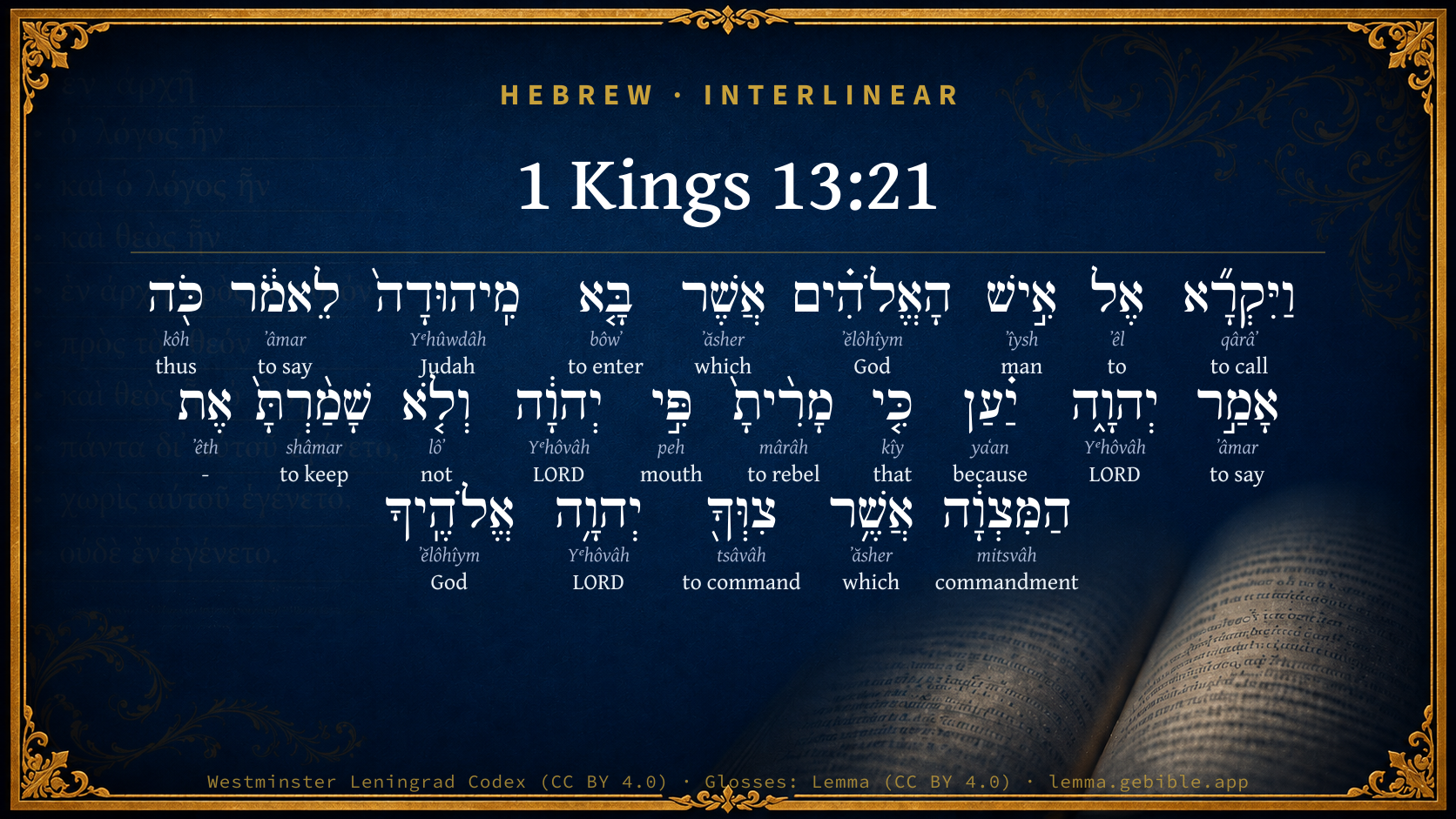
Hebrew (Westminster Leningrad Codex) 1 Kings 13:21 appears in the Hebrew Old Testament. The text above is from the Westminster Leningrad Codex. Each word links to its Strong’s number, a concise gloss, and parsing drawn from the Open Scriptures Hebrew Bible morphology. Click any word for its full Brown-Driver-Briggs (BDB) entry.
Download image
Cite this verse

1 Kings 13:21 (World English Bible). Public Domain. Lemma interlinear Bible study tool, https://lemma.gebible.app/v/1-kings/13/21.

Show BibTeX & RIS
BibTeX
RIS
English Translation
and he cried to the man of God who came from Judah, saying, Thus says Yahweh, Because you have been disobedient to the mouth of Yahweh, and have not kept the commandment which Yahweh your God commanded you,
World English Bible · Public Domain
Download a study sheet

One document with this verse’s original text, its word-by-word gloss line, the meaning frame, cross-references with their text, attributed commentary, and full source and license credits — printable, and it pastes into notes with its structure intact.

This verse Autodidact and up

Study sheet (.html) Plain text (.txt)

A passage Seminary Student

Up to 50 verses in one chapter. A passage sheet keeps up to 6 commentary sources and 12 cross-references per verse, in the order this page ranks them, and says so on the sheet whenever that leaves anything out. Ask for a single verse and you get the Autodidact verse sheet above.

Everything on this page stays free to read, with no account — the sheet is a download of what is already on screen, not access to it.

Want to remove ads? Support Godless Engineer
Compare translations 3

The same verse in 3 English versions, stacked beneath the original-language interlinear above. Click any original word for its lexicon entry.

Each is an independent rendering of the whole verse — the interlinear is not word-aligned to these translations.

Highlighted words mark where these versions differ — a whole-verse word diff, not a word-by-word alignment.

  • World English Bible Public Domain
    and he cried to the man of God who came from Judah, saying, Thus says Yahweh, Because you have been disobedient to the mouth of Yahweh, and have not kept the commandment which Yahweh your God commanded you,
  • King James Version Public Domain
    And he cried unto the man of God that came from Judah, saying, Thus saith the LORD, Forasmuch as thou hast disobeyed the mouth of the LORD, and hast not kept the commandment which the LORD thy God commanded thee,
  • unfoldingWord Literal Text CC BY-SA 4.0
    And he cried out to the man of God who had come from Judah, saying, “Thus says Yahweh, ‘Because you have disobeyed the mouth of Yahweh and you have not kept the command that Yahweh your God commanded you,

unfoldingWord Literal Text — © unfoldingWord, licensed CC BY-SA 4.0. Word-aligned USFM3 via Door43 (git.door43.org/unfoldingWord/en_ult).

Versions to compare (up to 4)

3 of 4 selected

Show all 18 translations

Every available English version of this verse, each an independent rendering of the whole verse.

  • World English Bible Public Domain
    and he cried to the man of God who came from Judah, saying, Thus says Yahweh, Because you have been disobedient to the mouth of Yahweh, and have not kept the commandment which Yahweh your God commanded you,
  • Berean Standard Bible Public Domain
    and the prophet cried out to the man of God who had come from Judah, “This is what the LORD says: ‘Because you have defied the word of the LORD and have not kept the commandment that the LORD your God gave you,
  • Majority Standard Bible Public Domain
    and the prophet cried out to the man of God who had come from Judah, “This is what the LORD says: ‘Because you have defied the word of the LORD and have not kept the commandment that the LORD your God gave you,
  • King James Version Public Domain
    And he cried unto the man of God that came from Judah, saying, Thus saith the LORD, Forasmuch as thou hast disobeyed the mouth of the LORD, and hast not kept the commandment which the LORD thy God commanded thee,
  • American Standard Version (1901) Public Domain
    and he cried unto the man of God that came from Judah, saying, Thus saith Jehovah, Forasmuch as thou hast been disobedient unto the mouth of Jehovah, and hast not kept the commandment which Jehovah thy God commanded thee,
  • Revised Version (1885) Public Domain
    and he cried unto the man of God that came from Judah, saying, Thus saith the LORD, Forasmuch as thou hast been disobedient unto the mouth of the LORD, and hast not kept the commandment which the LORD thy God commanded thee,
  • Geneva Bible (1599) Public Domain
    And hee cried vnto the man of God that came from Iudah, saying, Thus sayeth the Lord, Because thou hast disobeyed the mouth of the Lord, and hast not kept the commandement which the Lord thy God commanded thee,
  • Douay-Rheims (1899) Public Domain
    And he cried out to the man of God who came out of Juda, saying: Thus saith the Lord: Because thou hast not been obedient to the Lord, and hast not kept the commandment which the Lord thy God commanded thee,
  • Young's Literal Translation Public Domain
    and he calleth unto the man of God who came from Judah, saying, `Thus said Jehovah, Because that thou hast provoked the mouth of Jehovah, and hast not kept the command that Jehovah thy God charged thee,
  • Literal Standard Version CC BY-SA 4.0
    and he calls to the man of God who came from Judah, saying, “Thus said YHWH: Because that you have provoked the mouth of YHWH, and have not kept the command that your God YHWH charged you,
  • Unlocked Literal Bible CC BY-SA 4.0
    and he cried to the man of God who came from Judah, saying, “Yahweh says, 'Because you have been disobedient to the word of Yahweh and have not kept the command that Yahweh your God gave you,
  • unfoldingWord Literal Text CC BY-SA 4.0
    And he cried out to the man of God who had come from Judah, saying, “Thus says Yahweh, ‘Because you have disobeyed the mouth of Yahweh and you have not kept the command that Yahweh your God commanded you,
  • Darby Bible Public Domain
    and he cried to the man of God that came from Judah, saying, Thus saith Jehovah: Forasmuch as thou hast disobeyed the word of Jehovah, and hast not kept the commandment that Jehovah thy God commanded thee,
  • World Messianic Bible Public Domain
    and he cried out to the man of God who came from Judah, saying, “The LORD says, ‘Because you have been disobedient to the LORD’s word, and have not kept the commandment which the LORD your God commanded you,
  • Webster's Bible Public Domain
    And he cried to the man of God that came from Judah, saying, Thus saith the LORD, Forasmuch as thou hast disobeyed the mouth of the LORD, and hast not kept the commandment which the LORD thy God commanded thee,
  • Free Bible Version CC BY-SA 4.0
    He called out to the man of God who had come from Judah, “This is what the Lord says: Because you have disobeyed the word of the Lord and have not followed the orders that the Lord your God gave you,
  • Bible in Basic English Public Domain
    And crying out to the man of God who came from Judah, he said, The Lord says, Because you have gone against the voice of the Lord, and have not done as you were ordered by the Lord,
  • JPS Tanakh (1917) Public Domain
    And he cried unto the man of God that came from Judah, saying: 'Thus saith the LORD: Forasmuch as thou hast rebelled against the word of the LORD, and hast not kept the commandment which the LORD thy God commanded thee,

Literal Standard Version (2020), Covenant Press — licensed CC BY-SA 4.0. Text via the HelloAO Bible API (eBible.org). Unlocked Literal Bible (unfoldingWord) — licensed CC BY-SA 4.0. Text via the HelloAO Bible API (eBible.org). unfoldingWord Literal Text — © unfoldingWord, licensed CC BY-SA 4.0. Word-aligned USFM3 via Door43 (git.door43.org/unfoldingWord/en_ult). Free Bible Version, Dr. Jonathan Gallagher — licensed CC BY-SA 4.0. Text via the HelloAO Bible API (eBible.org).

Word by word

More ways to search: Search by grammar → Find every occurrence → Compare this word →

Practice this passage: Drill this verse → Learn its vocabulary →

מָרִ֨יתָ֙
mârâh
H4784
“to rebel”
Verb, Qal, Perfect, 2nd Person, Masculine, Singular
Part of Speech
Verb
Stem
Qal
Form
Perfect
Person
2nd Person
Gender
Masculine
Number
Singular
Full BDB Definition

Origin: a primitive root

TWOT: 1242

to be contentious, be rebellious, be refractory, be disobedient towards, be rebellious against - (Qal) to be disobedient, be rebellious - towards father - towards God - (Hiphil) to show rebelliousness, show disobedience, disobey
  1. וַיִּקְרָ֞א qârâʼ H7121 “and · to call” Conjunction + Verb, Qal, Sequential Imperfect, 3rd Person, Masculine, Singular
  2. אֶל ʼêl H413 “to” Preposition
  3. אִ֣ישׁ ʼîysh H376 “man of” Noun, Common, Masculine, Singular, Construct
  4. הָאֱלֹהִ֗ים ʼĕlôhîym H430 “the · God(s)” Particle, Definite Article + Noun, Common, Masculine, Plural, Absolute
  5. אֲשֶׁר ʼăsher H834 “which” Particle, Relative
  6. בָּ֤א bôwʼ H935 “to enter” Verb, Qal, Perfect, 3rd Person, Masculine, Singular
  7. מִֽיהוּדָה֙ Yᵉhûwdâh H3063 “from · Judah” Preposition + Noun, Proper
  8. לֵאמֹ֔ר ʼâmar H559 “to say” Preposition + Verb, Qal, Infinitive Construct
  9. כֹּ֖ה kôh H3541 “thus” Adverb
  10. אָמַ֣ר ʼâmar H559 “to say” Verb, Qal, Perfect, 3rd Person, Masculine, Singular
  11. יְהוָ֑ה Yᵉhôvâh H3068 “LORD” Noun, Proper
  12. יַ֗עַן yaʻan H3282 “because” Conjunction
  13. כִּ֤י kîy H3588 “that” Conjunction
  14. פִּ֣י peh H6310 “mouth of” Noun, Common, Masculine, Singular, Construct
  15. יְהוָ֔ה Yᵉhôvâh H3068 “LORD” Noun, Proper
  16. וְלֹ֤א lôʼ H3808 “and · not” Conjunction + Particle, Negative
  17. שָׁמַ֨רְתָּ֙ shâmar H8104 “to keep” Verb, Qal, Perfect, 2nd Person, Masculine, Singular
  18. אֶת ʼêth H853 “-” Particle, Direct Object
  19. הַמִּצְוָ֔ה mitsvâh H4687 “the · commandment” Particle, Definite Article + Noun, Common, Feminine, Singular, Absolute
  20. אֲשֶׁ֥ר ʼăsher H834 “which” Particle, Relative
  21. צִוְּךָ֖ tsâvâh H6680 “to command · you” Verb, Piel, Perfect, 3rd Person, Masculine, Singular + Suffix, Personal, 2nd Person, Masculine, Singular
  22. יְהוָ֥ה Yᵉhôvâh H3068 “LORD” Noun, Proper
  23. אֱלֹהֶֽיךָ ʼĕlôhîym H430 “God(s) · your” Noun, Common, Masculine, Plural, Construct + Suffix, Personal, 2nd Person, Masculine, Singular

About this verse

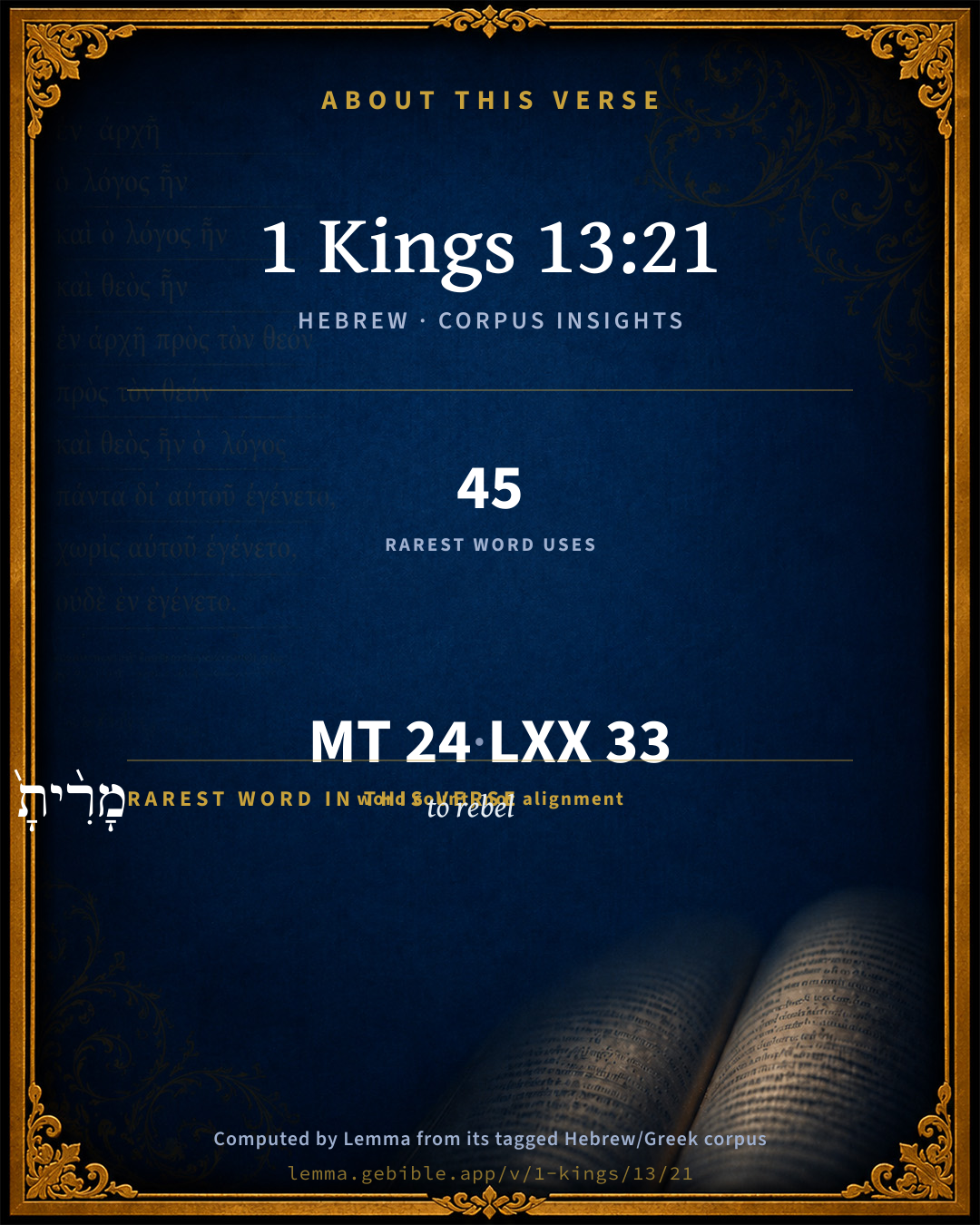
These counts appear in no published source. They are computed here, from the morphology-tagged text and Lemma’s own curated glosses. What Lemma adds →

24
words
19
distinct lemmas
Historical
section

Shared distinctive vocabulary

מָרִ֨יתָ֙ to rebel H4784 occurs in 44 verses of the Hebrew Bible. Also found in:

Grammatical profile

  • 7 verbs
  • 9 nouns
  • 1 preposition
  • 2 conjunctions
  • 1 adverb
  • 4 particles

Verb forms

  • וַיִּקְרָ֞א Qal · Sequential Imperfect
  • בָּ֤א Qal · Perfect
  • לֵאמֹ֔ר Qal · Infinitive Construct
  • אָמַ֣ר Qal · Perfect
  • מָרִ֨יתָ֙ Qal · Perfect
  • שָׁמַ֨רְתָּ֙ Qal · Perfect
  • צִוְּךָ֖ Piel · Perfect

Repetition

Words recur within this verse — often emphatic in Hebrew:

  • יְהוָ֑ה LORD H3068 ×3
  • הָאֱלֹהִ֗ים God H430 ×2
  • לֵאמֹ֔ר to say H559 ×2
  • אֲשֶׁר which H834 ×2

Hebrew & Septuagint length

In English translation the verse runs 38 words from the Hebrew and 40 from the Septuagint (LXX English) — closely comparable.

A rough comparison of the two English renderings, which tokenize alike — not a word-level alignment.

Word counts can differ between the Hebrew and the Greek without any difference in meaning — e.g. the Hebrew direct-object marker אֵת has no separate Greek word, and Greek often adds the article ὁ.

In the original languages it is 24 Hebrew tokens and 33 Greek tokens — but the two are counted differently (Hebrew bundles its prefixes and suffixes into one token; the Greek is in lemma form), so that isn’t a like-for-like length.

Cross-references

16

Topical passages linked to 1 Kings 13:21 in the Treasury of Scripture Knowledge — connected by theme and wording, ordered by reader-vote popularity; previews shown in the World English Bible.

  • Genesis 3:7 Both of their eyes were opened, and they knew that they were naked. They sewed fig leaves together, and made themselves aprons.
  • Leviticus 10:3 Then Moses said to Aaron, "This is what Yahweh spoke of, saying, "'I will show myself holy to those who come near me, And before all the people I will be glorified.'" Aaron held his peace.
  • Numbers 20:12 Yahweh said to Moses and Aaron, Because you didn't believe in me, to sanctify me in the eyes of the children of Israel, therefore you shall not bring this assembly into the land which I have given them.
  • Numbers 20:24 Aaron shall be gathered to his people; for he shall not enter into the land which I have given to the children of Israel, because you rebelled against my word at the waters of Meribah.
  • 1 Samuel 4:18 It happened, when he made mention of the ark of God, that [Eli] fell from off his seat backward by the side of the gate; and his neck broke, and he died: for he was an old man, and heavy. He had judged Israel forty years.
  • 1 Samuel 13:13–14 Samuel said to Saul, You have done foolishly; you have not kept the commandment of Yahweh your God, which he commanded you: for now would Yahweh have established your kingdom on Israel forever.
  • 1 Samuel 15:19 Why then didn't you obey the voice of Yahweh, but flew on the spoil, and did that which was evil in the sight of Yahweh?"
  • 1 Samuel 15:22–24 Samuel said, Has Yahweh as great delight in burnt offerings and sacrifices, as in obeying the voice of Yahweh? Behold, to obey is better than sacrifice, and to listen than the fat of rams.
  • 2 Samuel 6:7 The anger of Yahweh was kindled against Uzzah; and God struck him there for his error; and there he died by the ark of God.
  • 2 Samuel 12:9–11 Why have you despised the word of Yahweh, to do that which is evil in his sight? You have struck Uriah the Hittite with the sword, and have taken his wife to be your wife, and have slain him with the sword of the children of Ammon.
  • 2 Samuel 24:13 So Gad came to David, and told him, and said to him, Shall seven years of famine come to you in your land? or will you flee three months before your foes while they pursue you? or shall there be three days' pestilence in your land? now advise you, and consider what answer I shall return to him who sent me.
  • 1 Kings 13:17 for it was said to me by the word of Yahweh, You shall eat no bread nor drink water there, nor turn again to go by the way that you came.
  • Esther 6:13 Haman recounted to Zeresh his wife and all his friends everything that had happened to him. Then his wise men and Zeresh his wife said to him, If Mordecai, before whom you have begun to fall, be of the seed of the Jews, you shall not prevail against him, but shall surely fall before him.
  • Jeremiah 2:19 Your own wickedness shall correct you, and your backsliding shall reprove you: know therefore and see that it is an evil thing and a bitter, that you have forsaken Yahweh your God, and that my fear is not in you, says the Lord, Yahweh of Hosts.
  • Galatians 1:8–9 But even though we, or an angel from heaven, should preach to you any gospel other than that which we preached to you, let him be cursed.
  • Revelation 3:19 As many as I love, I reprove and chasten. Be zealous therefore, and repent.

Cross-references courtesy of OpenBible.info (CC BY 4.0).

Hebrew and Greek witnesses Masoretic Hebrew ↔ Greek Septuagint

The same verse in the two great witnesses to the Old Testament, shown verse-for-verse.

These are two independent witnesses, not word-aligned to each other, and the Septuagint is shown in lemma (dictionary) form.

Hebrew 1 Kings 13:21 Masoretic · Westminster Leningrad Codex

וַיִּקְרָ֞א אֶל אִ֣ישׁ הָאֱלֹהִ֗ים אֲשֶׁר בָּ֤א מִֽיהוּדָה֙ לֵאמֹ֔ר כֹּ֖ה אָמַ֣ר יְהוָ֑ה יַ֗עַן כִּ֤י מָרִ֨יתָ֙ פִּ֣י יְהוָ֔ה וְלֹ֤א שָׁמַ֨רְתָּ֙ אֶת הַמִּצְוָ֔ה אֲשֶׁ֥ר צִוְּךָ֖ יְהוָ֥ה אֱלֹהֶֽיךָ

and he cried to the man of God who came from Judah, saying, Thus says Yahweh, Because you have been disobedient to the mouth of Yahweh, and have not kept the commandment which Yahweh your God commanded you,

World English Bible · Public Domain

Greek LXX 1 Kings 13:21 Septuagint · lemma form

καί εἶπον πρός ὁ ἄνθρωπος ὁ θεός ὁ ἥκω ἐκ ιουδα λέγω ὅδε λέγω κύριος ἀντί ὅς παραπικραίνω ὁ ῥῆμα κύριος καί οὐ φυλάσσω ὁ ἐντολή ὅς ἐντέλλομαι σύ κύριος ὁ θεός σύ

and he spoke to the man of God that came out of Juda, saying, Thus says the Lord, Because you have resisted the word of the Lord, and have not kept the commandment which the Lord your God commanded you,

LXX2012 (modern English Septuagint) · Public Domain

Hebrew: Westminster Leningrad Codex (CC BY 4.0). Greek: Septuagint (public domain); English from LXX2012 (modern English Septuagint) (Public Domain). How the Septuagint differs from the Hebrew →

Targum (Aramaic paraphrase)

1

The Targum is the ancient Jewish Aramaic paraphrase of the Hebrew Scriptures — an interpretive translation, not the Hebrew text itself. Onkelos (literal) and Pseudo-Jonathan (expansive) render the Torah, and Jonathan the Prophets. Coverage is partial: where no permissively-licensed English translation exists for a verse, only the Aramaic is shown. This is verse-level text, not a word-by-word alignment to the Hebrew.

  1. Targum Jonathan Prophets (Joshua–Malachi)
    וְאִתְנַבֵּי עַל נְבִיָא דַייָ דַאֲתָא מִשִׁבְטָא יְהוּדָה לְמֵימָר כִּדְנַן אֲמַר יְיָ חֲלַף דְסַרֵיבְתָּא עַל מֵימְרָא דַייָ וְלָא נְטַרְתָּא יַת תַּפְקֵדְתָּא דְפַקְדָךְ יְיָ אֱלָהָךְ:

    (no public-domain English translation for this verse)

    Targum Jonathan — Aramaic: “Mikraot Gedolot” (public domain). English: “Sefaria Community Translation” (CC0 1.0 (public-domain dedication)); “London "Chaldee Paraphrase," 1871” (public domain). Text via Sefaria.

Commentary

Notes on 1 Kings 13:21 from classic Christian and Jewish commentators (each source and its license shown beneath its notes). The classic Christian expositions comment on the surrounding passage and are grouped to its opening verse, so a note may address several verses; the Jewish commentaries on the Tanakh (Rashi and others) are per-verse, so they appear only where the commentator wrote on this verse.

Lemma curates 59 commentaries, every one of them public domain or Creative Commons licensed, each selected and text-cleaned for this edition rather than reprinted as found. About our sources →

Trapp's Complete Commentary

John Trapp

1Ki 13:21 And he cried unto the man of God that came from Judah, saying, Thus saith the LORD, Forasmuch as thou hast disobeyed the mouth of the LORD, and hast not kept the commandment which the LORD thy God commanded thee,

Ver. 21. Forasmuch as thou hast disobeyed.] Thus this old impostor was forced to condemn himself for deceit, as well as the other prophet for disobedience.

John Trapp, A Commentary or Exposition upon All the Books of the Old and New Testament (1647–1656) — public domain. Text from a community e-Sword module.

Geneva Bible (1599)

Geneva Bible translators

God would reprove his folly by him, who was the occasion to bring him into error.

Geneva Bible (1599) marginal notes — public domain. Text via Bolls.life.

Jamieson, Fausset & Brown

Robert Jamieson, A. R. Fausset & David Brown

he cried unto the man of God that came from Judah--rather, "it cried," that is, the word of the Lord.

Jamieson, Fausset & Brown — Commentary Critical and Explanatory on the Whole Bible (1871) — public domain (CC PDM 1.0). Text via the HelloAO Bible API.

Adam Clarke's Commentary

Verse 21. And he] That is, according to the above interpretation, the voice of God from heaven addressing the man of God, the old prophet having nothing to do in this business.

Adam Clarke's Commentary on the Bible (1810–1826) — public domain. Text from a community e-Sword/MySword module.

The Cambridge Bible for Schools and Colleges

gen. ed. J. J. S. Perowne

21. as thou hast disobeyed] The expression is precisely the same as in 1Ki_13:26 below. There the A.V. has ‘disobedient unto’, and for the sake of consistency that rendering has been adopted here by R.V. ‘as thou hast been disobedient unto’. A very frequent translation is ‘to rebel against the word of the Lord’. See margin of R.V.

The Cambridge Bible for Schools and Colleges (gen. ed. J. J. S. Perowne; Cambridge University Press, 1878–1918) — public domain. Text from a community e-Sword module.

John Gill's Exposition

And it came to pass, after he had eaten bread, and after he had drunk,.... That is, had finished the meal; for he had begun to eat and drink before the word came, which came while they were eating and drinking; and it seems this did not hinder their proceeding to make an end of their meal, which one would have thought would have spoiled their appetite:

that he saddled for him the ass, to wit, for the prophet whom he had brought back; he ordered his sons to get it ready for him, that he might not walk on foot as he had; though it does not appear that either he or any of his servants accompanied him, but the contrary.

John Gill's Exposition of the Whole Bible (1746–1763) — public domain (CC PDM 1.0). Text via the HelloAO Bible API.

Albert Barnes' Notes on the Bible

Forasmuch as thou hast disobeyed the mouth of the Lord - It was his duty not to have suffered himself to be persuaded. He should have felt that his obedience was being tried, and should have required, ere he considered himself released, “the same, or as strong, evidence,” as that on which he had received the obligation. Disobedience to certain positive commands of God, was one which it was at this time very important to punish signally, since it was exactly the sin of Jeroboam and his adherents.

Albert Barnes' Notes on the Bible (1834–1885) — public domain. Text from a community e-Sword/MySword module.

Matthew Poole's English Annotations

He cried with a loud voice, the effect of his passion, both for his own guilt and shame, and for the prophet’s approaching misery, and his unhappy influence both in procuring and in denouncing of it.

The mouth, i.e. the word of command coming out of his mouth; a metonymy of the cause for the effect.

Matthew Poole's English Annotations on the Holy Bible (1683–1685) — public domain. Text from a community e-Sword/MySword module.

The Pulpit Commentary

And he cried same word as in ver. 2. He who denounced the "sin of Jeroboam" is now denounced in turn unto the man of God that came from Judah, saying, Thus saith the Lord, Forasmuch as thou hast disobeyed the mouth of the Lord, and hast not kept the commandment which the Lord thy God commanded thee.

Vers. 21 sqq.

The Man of God and the People of God.

The morning of that fifteenth day of the eighth month, that black day in the Hebrew Kalendar, that birthday of division, was hardly more memorable or eventful than the evening. In the morning the Bethelites saw the signs of the man of God; in the evening they saw in him a sign, a parable, and a terrible warning. The lesson of the rent altar and the rigid hand was followed by the lesson of the lion and the ass and the rigid corpse. Truly, of that day it might be truly said, "The evening and the morning were one day.

For we may be sure, when the old prophet came back from his quest of the body, and brought with him that melancholy burden, swinging across the ass, the men of Bethel, who had already heard from wayfarers of the tragedy, would crowd the streets or lanes for Bethel was probably little more than a village to meet him, and would gaze, hushed and awestruck, into the dumb and helpless face of the man whose words and deeds bad that day been so full of power. There was not a child that night but would leave his play to stare in silent wonder, or with whispered question, on the corpse. Of that sad funereal procession, the words which, near a thousand years later, described the entry of a living Prophet into an adjoining city, might justly be used, "All the city was moved, saying, Who is this?" (Mat_21:10) Nor would the language which described the effect of that same Prophet"s death a few days later be less applicable here, "All the people that came together to that sight, beholding the things which were done, smote their breasts and returned". (Luk_23:48)

Let us now suppose, however, for the sake of bringing out the lessons of this narrative, that there were some in the crowd as on the first feast day there may well have been strangers in Bethel (cf. Joh_12:20; Act_2:5-11) who did not understand the things which were come to pass there that day. Let us join them, as they go, carried by the stream, to meet the body; let us listen to their questions, and to the answers they receive. We shall not gather all the truth from the discourse we overhear, but we shall learn at all events one lesson which this tragedy had for the men of that time.

Now the first question which would rise to these strangers" lips, as they came upon the body, borne by the patient ass, which was the one terrified witness of the catastrophe, would be, "Who is this?" They think, perhaps, it is some peasant who has been slain as he tilled his fields, or some itinerant; chapman who has been murdered on his journey. But the bystanders speedily undeceive them. They tell them that this is "a man of God who came from Judah." His name, it may be, is unknown to them, but not his deeds. They relate, with breathless excitement, not unmixed with fear, how a few short hours ago he was amongst them; how on the morning of that very day he had confronted their king as he was in the act of sacrificing, had denounced his innovations, had foretold the overthrow of his policy and dynasty, and had then wrought wonderful works in attestation of his mission. The strangers listen with steadily increasing wonderment. Had this man been "a murderer whom vengeance suffered not to live," or a sinner above all men that dwelt in Bethel, they could have understood it. Such a one, however he might have met his end, would only have received the just reward of his deeds, but "a man of God," a man who wrought miracles, a favourite of Heaven! they cannot comprehend it, and they, as excited as their informants, hurriedly ask how he has come by his death.

lion slew him," is the answer. It is true no human eye saw the deed, but there can be no doubt as to the manner of his death. Then they tell how wayfaring men that afternoon had seen a strange sight, a corpse cast in the waywhose corpse they knew not and an ass and a lion standing as joint sentinels over it, etc. And then the strangers would understand that this man of God had died by the visitation of God. They would remember that the "teeth of evil beasts" were one of the plagues denounced in the law, and they would wonder, and they would ask, what this messenger of the Most High, this miracle worker, could have done between morning and evening to bring this terrible judgment down upon his head.

And this was a question which only the old prophet could rightly answer, and he had answered it already. He had told his sons and neighbours that afternoon, when first he heard of this tragedy, that it was the punishment of disobedience (ver. 26). Not improbably he proclaimed it again to the crowd which awaited his return. He had been charged," he would say, as they stood gazing on the helpless corpse, "to lay our city under a ban; he had been commanded to eat no bread, to drink no water here. And he came back, and he ate bread and he drank water in my house; therefore it is that "the lion hath torn him and slain him, according to the word of the Lord (ver. 26).

And so the men of Bethel, and the strangers among them and thousands of strangers would be present in Bethel at that time would understand that this man, albeit a prophet, and a doer of wondrous works, had paid the penalty of his partial disobedience with his life. They would perceive that God had not spared His own elect messenger. They would see that the man who had been commissioned to protest against Jeroboam"s will worship, who had courageously faced the king in his might, and had stood like an Athanase against the world, had received judgment without mercy when he overstepped the commandment of his God. And they would assuredly be reminded, some of them at least, how sinful and how dangerous must be that departure from the law which they had that day seen instituted amongst themselves. And as one by one they dropped off, and, deeply awed and impressed, returned to their tents or booths, the one thought which above all others filled their minds would be this how sure and swift and terrible was the recompense of disobedience.

But if these strangers, in their perplexity, proceeded to make further inquiries, as they may well have done; if they asked what could have led such a man as this to set at nought the plain commandment of God: if they discovered from the old prophet, or his sons, or others, the circumstances of his sin; if they learned that this man of God had resisted the entreaties of the king, had obeyed his own instructions to the letter, and had only come back and eaten bread on the solemn assurance of this old prophet himself that an angel from heaven had distinctly reversed his commission; if they understood that it was because he had taken this man at his word and trusted to his good faith, as they themselves would have done in like circumstances, that he had been induced to return; and that because of this, and nothing else, this ambassador of the Most Merciful had died by the stroke of a wild beast, we may imagine what their astonishment and horror would be like. "Who shall deliver us," they would cry, "out of the hand of this mighty God?" And it is probable that at first they would find it difficult to see wherein his sin lay, and to disentangle the right and the wrong in his conduct. They would say, and rightly, that he was much more sinned against than sinning. It would seem to them that the really guilty party escaped unpunished, whilst his innocent victim paid to the uttermost farthing. And it is possible that some found, at least for a time, in this episode, as some in later days have done, a riddle which they could not read. But its meaning could not be lost upon them all; if it had been, the Divine purpose in this visitation would have been defeated. It may be the old prophet himself expounded its lessons; it may be that "such as set their heart to seek the Lord and we may be sure that Jeroboam"s innovations had occasioned the gravest misgivings and fears in many minds found them out for themselves. But in any case some would not be longin discovering that these things were an allegory. "As hieroglyphics," says Lord Bacon, "preceded letters, so parables were more ancient than arguments." May we not add that acted parables were still more ancient than spoken ones. A Tarquin, striking off the heads of the tallest poppies, belongs to the beginnings of history. This was the age when men not only gave signs, but were such themselves (Isa_20:3; Eze_24:24; Mat_12:39, Mat_12:40) The death of the man of God" accordingly was a parable, an object lesson of the most impressive kind as to the doom of the unfaithful people of God. In his end, men might see a foreshadowing of their nation"s, if it should persevere in the worship of the calves.

For they would assuredly remember, as they pondered this history, that as this prophet of Judah was a man of God, precisely so was Israel the people of God (1Ki_8:43, 1Ki_8:52, 66 14:7; Lev_26:12; Deu_26:18) As he was to other men, so was Israel to other nations. Was he elect of God and precious? So were they. Had he a mission? So had they. Had God spoken to him? He had also spoken to them, and moreover had given them a charge not unlike his. For it is to be also considered that God had plainly spoken to Israel on this very subject of Divine worship. At the very threshold of the Decalogue, at the head of "the words of the covenant," stood the charge, "Thou shalt have none other gods but me. Thou shalt not make to thyself any graven image," etc. And it is to be noted here that these words stand side by side with the formula," I am the Lord thy God, which brought thee out of the land of Egypt the very words which Jeroboam had cited in instituting his new mode of worship; the very cry which had been raised before when Israel made its first golden calf. (Exo_32:8) It is almost certain, therefore, that these initial words of the covenant had been lately and forcibly recalled to their minds. But in any case they could not be ignorant that their forefathers had been expressly charged to make no similitude, no graven or molten image (Lev_26:1; Deu_4:16, 25 5:8 27:15, etc.) And this commandment. too, like the message of that morning, had been confirmed with signs following. The blackness, darkness, tempest, trumpet, fire, all these had attested that revelation of God"s will. It might possibly occur to some of their minds, therefore, that when the first protest against a corrupt following of the true God was raised, He "gave a sign the same day.

Such, then, was the commandment given to Israel. It was as explicit, as authoritative as that which this dead prophet had recently received. But of late a new teacher had appeared amongst them, in the person of their king, who presumed to countermand this law of the Almighty. We are not told, indeed, that Jeroboam claimed to be prophet as well as priest, but we find him acting as one, and received as one. It is hardly likely that he laid claim to any revelation from on high. He was not the man to pretend to visions of angels. It was his contention that he was re-vetting to the old form of religion, but that was all. At the same time, he was the great false prophet of the Old Testament. Just as Moses was the giver of the law, just as Elias was its restorer, so was Jeroboam its depraver. Precisely what the lying prophet taught the man of God, that had he taught the people of God, viz., that God"s command was somehow abrogated. Prophet of Bethel and priest king of Bethel were alike in this, that each met the Divine, Thou shalt not," with the human, Thou shalt." There was this difference between them, that the first inculcated disobedience to but one command, whilst the second contravened a whole system; but this very divergence would make the parallel all the more impressive. "If," they would argue, "if a prophet, a doer of signs and wonders, died without mercy because he listened to the voice of a brother prophet who swore that he had received a revelation concerning him and so was betrayed into breaking one commandment, of how much sorer punishment shall those be thought worthy who at the mere word of their king, albeit he claimed no spiritual authority, and acted from political motives only, reject the gracious covenant of heaven, confirmed by many signs, and go after false gods," etc. There were some, no doubt, would see in the corpse borne to its burial that day a foreshadowing of the more terrible judgment then hanging over their own heads.

And so we find this prophet of Judah has not lived or suffered in vain. His death, like that of Samson, wrought even more effectually than his life. He was set forth as it were appointed to death. (1Co_4:9) He silently and unconsciously mirrored forth the sin and the punishment of a disobedient people.

It now only remains for us to indicate briefly how the analogy between man of God and people of God received its completion in the punishment which befell the latter. The punishment of the prophet was death; of the people, whose sin was much greater, death and superadded infamy. We see this

1. In the case of Jeroboam"s house. For the family of the deceiver was the first to suffer. As in the case of the man of God, "swift retribution" followed upon sin. And what retribution! The death and destruction of the race. He himself was smitten of God. His seed was suddenly cut off. The sword of Baasha was as swift as the lion"s paw. Only one of his children "came to the grave." The rest were devoured of beasts and birds. (cf. 1Ki_14:11 with 1Ki_13:28)

2. In the case of his intrusive priests. If they escaped a violent death, their remains experienced disgrace worse than death (ver. 2). Here prophet and priests stand in contrast. The respect accorded to his ashes was denied to theirs.

3. In the case of the entire people. For the captivity, foretold in 1Ki_14:15, was the death of the kingdom, and the death knell of the people. The ten tribes soon lost their corporate existence. And what agonies preceded that dissolution! (See Jeremiah 52; Lamentations passim; (Ps 74 Ps 137) The people to death, the land to lions! (2Ki_17:25) Could the analogy be much closer?

But indeed the analogy does not end there. De te fabula narratur. The Christian Church has inherited the place, the privileges, the responsibilities of the Jewish people. If that Church, or if the individual Christian be unfaithful or disobedient, let them see their own fate glassed and pourtrayed in that of the disobedient prophet. "If God spared not the natural branches," etc. "I will remove thy candlestick out of his place." "Shame and everlasting contempt.

The Two Prophets. We have already considered the principal lesson which this strange history had for that time. Let us now indicate some of the lessons which it has for all time. The text, to borrow Bishop Ridley"s phrase, "shall lead us by the hand;" we will record them as we find them set down in the story. And first let us contemplate the OLD PROPHET. Observe

1. It was the false prophet that was old. Age should bring wisdom (Job., 1Ki_12:7) and piety. But see Homiletics, p. 225. The old (1Ki_11:4) and the old prophet alike remind us that there is "no sinner like an old sinner.

1. It was only the false teacher that was styled a prophet. Probably because he alone had been taught in the schools. He was, so to speak, in the prophetical succession. The man of God was an irregular, though not self-constituted messenger. But observe, when God employs an irregular, He authenticates his mission with a sign. And consider, too, the unworthiness of ministers argues nothing against the office or the succession. See Art. XXVI

2. The old prophet was in Bethel. "Where Satan"s seat is". (Rev_2:8) But God had not fixed the bounds of his habitation. What wonder if, like him who "pitched his tent toward Sodom", (Gen_13:12) he fell into temptation and sin? The old prophet, in his way, has "lifted up his eyes and beheld the plain of the Jordan, that it was well watered everywhere." He has remained here to worship the rising sun. Conscience bade him go. Convenience made him stay.

3. The old prophet tries to serve two masters. Though Jeroboam sets up molten images, a sanctuary, a priesthood, he raises no protest. But when Jeroboam burns incense and sacrifices, he does not sanction the proceeding by his presence, But he compromises the matter by sending his sons. Video meliora proboque, Deteriora sequor." "He that wavereth is like a wave of the sea driven with the wind and tossed. (Jam_1:6) The temporiser soon finds difficulties in his path. Those who try to gain both worlds generally contrive to lose both. After the conduct of ver. 18, he could not respect himself; and after the prophecy of ver. 32, he could expect no advancement from the king.

4. The old prophet stoops to lies. And yet he was a true prophet. A preacher of righteousness, yet he practised deceit. Bedlam has been called "a strange mixture of a man." This prophet"s character and conduct were equally strange. But, alas! it is a common thing to find men"s example differing widely from their precept; to find insight without holiness, light without love. Prophetic gifts do not imply piety. It is no new thing for God"s ministers to fall into sin.

5. The old prophet slays a man of God. It was his tongue, not the lion"s paw, really slew a man more righteous and better than he. A prophet is the instrument of a murder. (cf. Joh_8:44) "What shall be given unto thee,or what shall be done unto thee, thou false tongue?" (Psa_120:3) Let us take care lest we destroy with our meat one for whom Christ died. (Rom_14:15) Let us remember

What guilt, what grief may be incurred By one incautious, hasty word.

Now let us turn to the MAN OF GOD. Observe

1. The man of God believes every word. He was not altogether without excuse. False prophets were not as plentiful as they afterwards became. He was unprepared for such unblushing deceit. We should probably have done the same. Yet we have had manifold warnings (Mat_7:15 Mat_24:11.; Act_20:29; 1Jn_4:1; 1Ti_4:1, etc.) We have been taught that if "an angel from heaven preach any other gospel unto us," it is at our peril we listen. (Gal_1:8) We have been reminded that "Satan himself is transformed into an angel of light". (2Co_11:14)

2. The man of God is deceived by lies. It is a favourite device of the enemy. He is the "father of lies". (Joh_8:44) It was thus he deceived our first parents. That weapon has answered so well that he plies it again and again (cf. 2Co_4:4; 2Th_2:11)

3. The man of God goes back to Bethel. This faithful and courageous servant, who had defied the king, who had refused his dainties and rewards, etc., does not endure to the end. "Let him that thinketh he standeth," etc. "Whosoever shall keep the whole law and offend in one point he is guilty of all," because he is guilty of disobedience. "Evil is wrought by want of thought." The commands of God must be kept in their entirety.

4. The man of God is denounced by the prophet. Those who lead us into sin are the first to tax us with it afterwards. The deceiver turns upon his victim. We get scant comfort from companions in sin. "What is that to us? See thou to that". (Mat_27:4)

5. The man of God hears his doom in silence. "He was speechless." "I became dumb and opened not my mouth, for it was thy doing." "Being convicted by their own conscience". (Joh_8:9)

6. The man of God dies without mercy. Though a prophet, the teeth of an evil beast avenge his disobedience. Judgment begins at the house of God. (1Pe_4:17) The teacher shall receive the greater condemnation. (Jam_3:1) "Many stripes" are for those who knew and did not. "The wages of sin is death.

7. Yet his corpse is not mangled or dishonoured. It was partly for our admonition that he died. He was ordained to be a sign to that generation. Therefore, though deceived, he was not forsaken. The lion and the ass keep watch over his remains. "Precious in the sight of the Lord is the death of his saints." "A bone of him shall not be broken." "Let no man move his bones", (2Ki_23:18) His honourable funeral (cf. Isa_53:9; Mat_27:60) and the respect subsequently paid him show that he was no castaway.

And now that we have considered the prophet of Bethel and the prophet of Judah separated by deceit and death, let us see them for a moment reunited.

1. In their testimony. For to the witness of the man of God against the altar of Bethel was added the unwilling, and therefore powerful, witness of the old prophet (ver. 32). Jeroboam has gained nothing by the death of the man who had denounced him and his rites. Though dead, he speaks, and speaks as he could never have done in life. And now "one of themselves, even a prophet of their own," has been constrained to echo and enforce his testimony. The king has now the testimony of two unimpeachable witnesses against his impious proceedings.

2. In their grave. "Lay my bones beside his bones." Like Balaam, this old prophet would "die the death of the righteous." "Gather not my soul with sinners" (Psa_26:9) is his cry. Sit anima mea cum illo." He will take his chance with the man of God rather than with the king. "I had rather be," says one, "with Origen wherever he is than with Justinian and Theodora wherever they are," "In death they were not divided.

But how different their lot in life. The deceived dies; the deceiver lives. The lion which slew the comparatively innocent man of God would not touch the lying prophet. Though old, he is spared to grow older, while the other"s sun went down at noon. What an illustration this of the strange confusion of this present life; (cf. Ps 69 Ps 73., etc.) what a proof of a life to come, where each shall receive his just recompense of reward! To the Jew, suckled in a creed of temporal rewards, etc., this history would present some anxious problems, all of which are clear since our Prophet, Priest, and King "brought life and immortality to light."

The Pulpit Commentary (1880–1919), ed. H.D.M. Spence-Jones & Joseph S. Exell — public domain. Text from a community e-Sword module.

John Wesley's Explanatory Notes

Cried - With a loud voice, the effect of his passion, both for his own guilt and shame, and for the prophet's approaching misery.

John Wesley, Explanatory Notes Upon the Whole Bible (1754–1765) — public domain. Text via the GEBible commentary corpus.

Rashi

Rabbi Shlomo Yitzchaki (Rashi)

And he called. The old prophet called the man of God.

Rashi on the Tanakh — English translations: “The Judaica Press complete Tanach with Rashi, translated by A. J. Rosenberg” (CC BY 4.0); “Pentateuch with Rashi's commentary by M. Rosenbaum and A.M. Silbermann, 1929-1934” (public domain); “The Metsudah Tanach series, Lakewood, N.J” (CC BY 4.0); and “The Book of Joshua, Metsudah Publications, 1997” (CC BY 4.0). Text via Sefaria.

Lesson kit

Teaching starters — assembled from the data on this page, not authored interpretation. Every prompt links to the verse data it draws on. Edit before teaching.

1 Kings, in the Historical, opens this verse with 24 words (19 distinct Hebrew lemmas). Its most distinctive word is mârâh (“to rebel”). A historical commentator’s framing appears above. Read the whole chapter for the surrounding context.

Discussion questions

  1. How does “to rebel” (mârâh) shape what this verse is saying?
  2. Numbers 20:10 shares the word «to rebel» with this verse. How do the two illuminate each other?
  3. “LORD” occurs 3× in this one verse. What is the effect of the repetition?
  4. These translations render this verse differently. What is at stake in choosing one wording over another?
  5. The verb «וַיִּקְרָ֞א» is Qal Sequential Imperfect. How does its form color the action?
  6. Reading how Trapp's Complete Commentary and Geneva Bible (1599) read this verse, where do the two commentators agree and where do they part?

Things to notice

Reading settings

Reading text

Shown beneath each verse's original-language words.

Old Testament
Old Testament edition

Read the OT as the Masoretic Hebrew (MT) or the Greek Septuagint (LXX).

English shown for the Greek Septuagint (in the Hebrew ↔ Greek comparison).

Comparing translations? Open the Compare panel on any verse page to stack up to four side by side.