
Deuteronomy 27:4

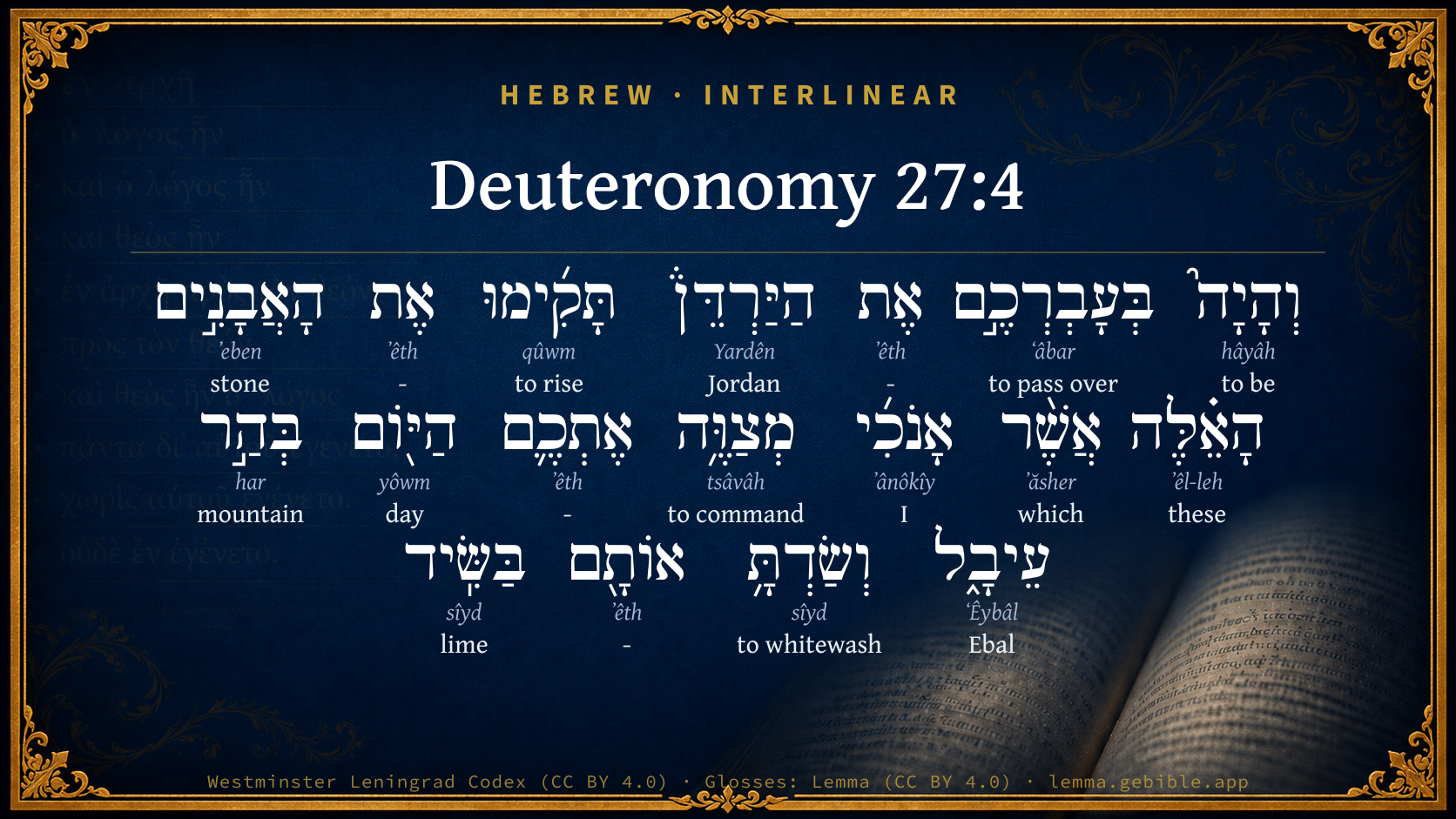
Hebrew (Westminster Leningrad Codex) Deuteronomy 27:4 appears in the Hebrew Old Testament. The text above is from the Westminster Leningrad Codex. Each word links to its Strong’s number, a concise gloss, and parsing drawn from the Open Scriptures Hebrew Bible morphology. Click any word for its full Brown-Driver-Briggs (BDB) entry.
Download image
Cite this verse

Deuteronomy 27:4 (World English Bible). Public Domain. Lemma interlinear Bible study tool, https://lemma.gebible.app/v/deuteronomy/27/4.

Show BibTeX & RIS
BibTeX
RIS
English Translation
It shall be, when you are passed over the Jordan, that you shall set up these stones, which I command you this day, in Mount Ebal, and you shall plaster them with plaster.
World English Bible · Public Domain
Download a study sheet

One document with this verse’s original text, its word-by-word gloss line, the meaning frame, cross-references with their text, attributed commentary, and full source and license credits — printable, and it pastes into notes with its structure intact.

This verse Autodidact and up

Study sheet (.html) Plain text (.txt)

A passage Seminary Student

Up to 50 verses in one chapter. A passage sheet keeps up to 6 commentary sources and 12 cross-references per verse, in the order this page ranks them, and says so on the sheet whenever that leaves anything out. Ask for a single verse and you get the Autodidact verse sheet above.

Everything on this page stays free to read, with no account — the sheet is a download of what is already on screen, not access to it.

Want to remove ads? Support Godless Engineer
Compare translations 3

The same verse in 3 English versions, stacked beneath the original-language interlinear above. Click any original word for its lexicon entry.

Each is an independent rendering of the whole verse — the interlinear is not word-aligned to these translations.

Highlighted words mark where these versions differ — a whole-verse word diff, not a word-by-word alignment.

  • World English Bible Public Domain
    It shall be, when you are passed over the Jordan, that you shall set up these stones, which I command you this day, in Mount Ebal, and you shall plaster them with plaster.
  • King James Version Public Domain
    Therefore it shall be when ye be gone over Jordan, that ye shall set up these stones, which I command you this day, in mount Ebal, and thou shalt plaster them with plaster.
  • unfoldingWord Literal Text CC BY-SA 4.0
    And it will be, when you have crossed the Jordan, erect these stones that I am commanding you today, on Mount Ebal, and plaster them with plaster.

unfoldingWord Literal Text — © unfoldingWord, licensed CC BY-SA 4.0. Word-aligned USFM3 via Door43 (git.door43.org/unfoldingWord/en_ult).

Versions to compare (up to 4)

3 of 4 selected

Show all 18 translations

Every available English version of this verse, each an independent rendering of the whole verse.

  • World English Bible Public Domain
    It shall be, when you are passed over the Jordan, that you shall set up these stones, which I command you this day, in Mount Ebal, and you shall plaster them with plaster.
  • Berean Standard Bible Public Domain
    And when you have crossed the Jordan, you are to set up these stones on Mount Ebal, as I am commanding you today, and you are to coat them with plaster.
  • Majority Standard Bible Public Domain
    And when you have crossed the Jordan, you are to set up these stones on Mount Ebal, as I am commanding you today, and you are to coat them with plaster.
  • King James Version Public Domain
    Therefore it shall be when ye be gone over Jordan, that ye shall set up these stones, which I command you this day, in mount Ebal, and thou shalt plaster them with plaster.
  • American Standard Version (1901) Public Domain
    And it shall be, when ye are passed over the Jordan, that ye shall set up these stones, which I command you this day, in mount Ebal, and thou shalt plaster them with plaster.
  • Revised Version (1885) Public Domain
    And it shall be when ye are passed over Jordan, that ye shall set up these stones, which I command you this day, in mount Ebal, and thou shalt plaister them with plaister.
  • Geneva Bible (1599) Public Domain
    Therefore when ye shall passe ouer Iorden, ye shall set vp these stones, which I command you this daye in mount Ebal, and thou shalt plaister them with plaister.
  • Douay-Rheims (1899) Public Domain
    Therefore when you are passed over the Jordan, set up the stones which I command you this day, in mount Hebal, and thou shalt plaster them with plaster:
  • Young's Literal Translation Public Domain
    `And it hath been, in your passing over the Jordan, ye raise up these stones which I am commanding you to-day, in mount Ebal, and thou hast plaistered them with plaister,
  • Literal Standard Version CC BY-SA 4.0
    And it has been, in your passing over the Jordan, you raise up these stones which I am commanding you today, in Mount Ebal, and you have plastered them with plaster,
  • Unlocked Literal Bible CC BY-SA 4.0
    When you have passed over the Jordan, set up these stones that I am commanding you about today, on Mount Ebal, and plaster them with plaster.
  • unfoldingWord Literal Text CC BY-SA 4.0
    And it will be, when you have crossed the Jordan, erect these stones that I am commanding you today, on Mount Ebal, and plaster them with plaster.
  • Darby Bible Public Domain
    And it shall be when ye go over the Jordan, that ye shall set up these stones, as I command you this day, on mount Ebal, and thou shalt plaster them with plaster.
  • World Messianic Bible Public Domain
    It shall be, when you have crossed over the Jordan, that you shall set up these stones, which I command you today, on Mount Ebal, and you shall coat them with plaster.
  • Webster's Bible Public Domain
    Therefore it shall be when ye have gone over Jordan, that ye shall set up these stones, which I command you this day, in mount Ebal, and thou shalt plaster them with plaster.
  • Free Bible Version CC BY-SA 4.0
    After you've crossed the Jordan, you are to set up these stones on Mount Ebal, having painted them with whitewash, as I've ordered you to do today.
  • Bible in Basic English Public Domain
    And when you have gone over Jordan, you are to put up these stones, as I have said to you today, in Mount Ebal, and have them coated with building-paste.
  • JPS Tanakh (1917) Public Domain
    And it shall be when ye are passed over the Jordan, that ye shall set up these stones, which I command you this day, in mount Ebal, and thou shalt plaster them with plaster.

Literal Standard Version (2020), Covenant Press — licensed CC BY-SA 4.0. Text via the HelloAO Bible API (eBible.org). Unlocked Literal Bible (unfoldingWord) — licensed CC BY-SA 4.0. Text via the HelloAO Bible API (eBible.org). unfoldingWord Literal Text — © unfoldingWord, licensed CC BY-SA 4.0. Word-aligned USFM3 via Door43 (git.door43.org/unfoldingWord/en_ult). Free Bible Version, Dr. Jonathan Gallagher — licensed CC BY-SA 4.0. Text via the HelloAO Bible API (eBible.org).

Word by word

More ways to search: Search by grammar → Find every occurrence → Compare this word →

Practice this passage: Drill this verse → Learn its vocabulary →

וְשַׂדְתָּ֥
sîyd
H7874
“and · to whitewash”
Conjunction + Verb, Qal, Sequential Perfect, 2nd Person, Masculine, Singular
Part of Speech
Conjunction + Verb
Stem
Qal
Form
Sequential Perfect
Person
2nd Person
Gender
Masculine
Number
Singular
Full BDB Definition

Origin: a primitive root probably meaning to boil up (compare H7736 )

TWOT: 2254

(Qal) to whitewash
  1. וְהָיָה֮ hâyâh H1961 “and · to be” Conjunction + Verb, Qal, Sequential Perfect, 3rd Person, Masculine, Singular
  2. בְּעָבְרְכֶ֣ם ʻâbar H5674 “in/at · to pass over · you” Preposition + Verb, Qal, Infinitive Construct + Suffix, Personal, 2nd Person, Masculine, Plural
  3. אֶת ʼêth H853 “-” Particle, Direct Object
  4. הַיַּרְדֵּן֒ Yardên H3383 “the · Jordan” Particle, Definite Article + Noun, Proper
  5. תָּקִ֜ימוּ qûwm H6965 “to rise” Verb, Hiphil, Imperfect, 2nd Person, Masculine, Plural
  6. אֶת ʼêth H853 “-” Particle, Direct Object
  7. הָאֲבָנִ֣ים ʼeben H68 “the · stones” Particle, Definite Article + Noun, Common, Feminine, Plural, Absolute
  8. הָאֵ֗לֶּה ʼêl-leh H428 “the · these” Particle, Definite Article + Pronoun, Demonstrative, Common, Plural
  9. אֲשֶׁ֨ר ʼăsher H834 “which” Particle, Relative
  10. אָנֹכִ֜י ʼânôkîy H595 “I” Pronoun, Personal, 1st Person, Common, Singular
  11. מְצַוֶּ֥ה tsâvâh H6680 “commanding” Verb, Piel, Participle Active, Masculine, Singular, Absolute
  12. אֶתְכֶ֛ם ʼêth H853 “- · you” Particle, Direct Object + Suffix, Personal, 2nd Person, Masculine, Plural
  13. הַיּ֖וֹם yôwm H3117 “the · day” Particle, Definite Article + Noun, Common, Masculine, Singular, Absolute
  14. בְּהַ֣ר har H2022 “in/at · mountain of” Preposition + Noun, Common, Masculine, Singular, Construct
  15. עֵיבָ֑ל ʻÊybâl H5858 “Ebal” Noun, Proper
  16. אוֹתָ֖ם ʼêth H853 “- · them” Particle, Direct Object + Suffix, Personal, 3rd Person, Masculine, Plural
  17. בַּשִּֽׂיד sîyd H7875 “in/at the · lime” Preposition, Determined + Noun, Common, Masculine, Singular, Absolute

About this verse

These counts appear in no published source. They are computed here, from the morphology-tagged text and Lemma’s own curated glosses. What Lemma adds →

18
words
15
distinct lemmas
Pentateuch
section

Notable vocabulary

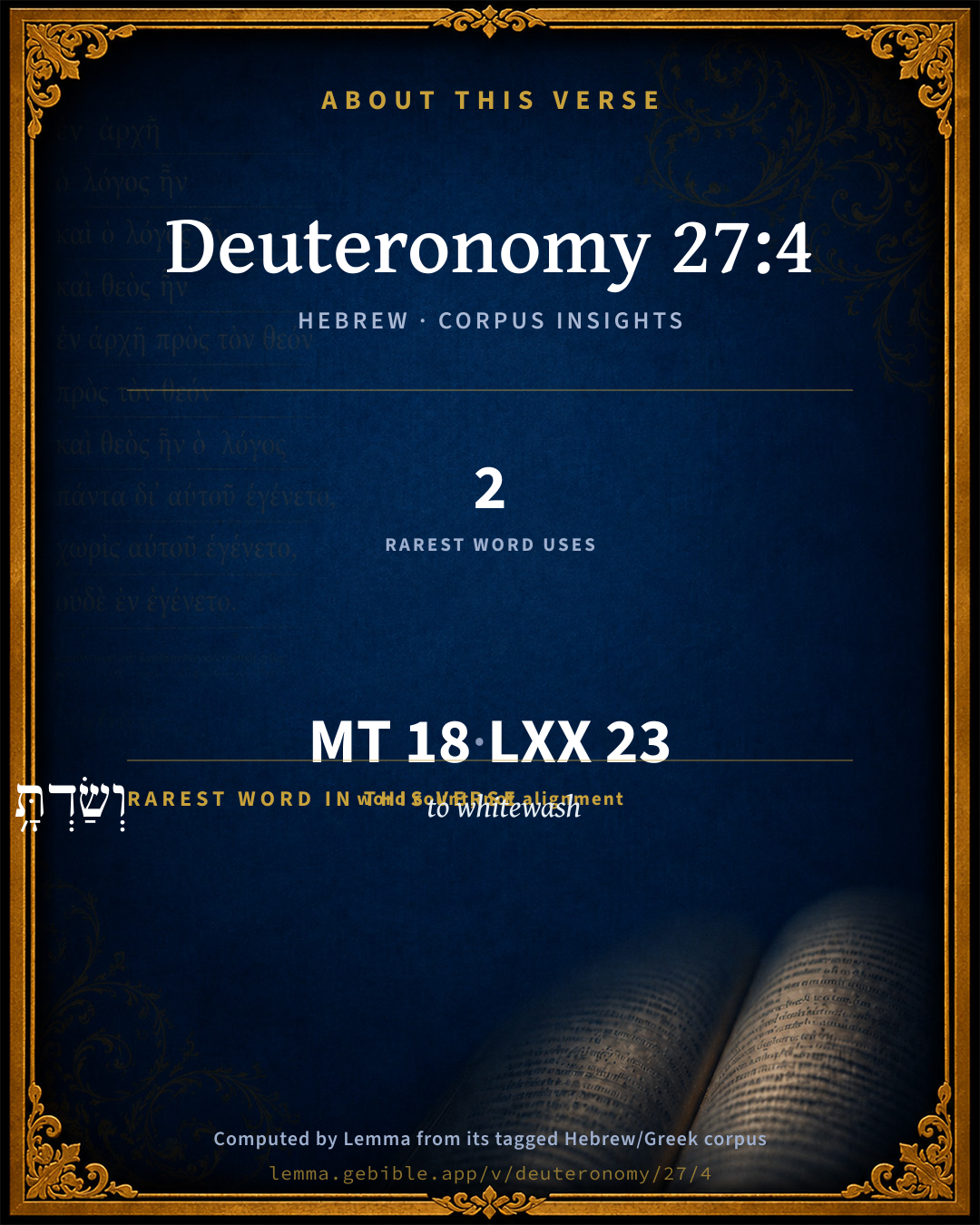
The rarest word here is וְשַׂדְתָּ֥ to whitewash H7874 — appearing just 2 times in the whole Hebrew Bible.

Shared distinctive vocabulary

וְשַׂדְתָּ֥ to whitewash H7874 occurs in 2 verses of the Hebrew Bible. Also found in:

Grammatical profile

  • 5 verbs
  • 6 nouns
  • 2 pronouns
  • 5 particles

Verb forms

  • וְהָיָה֮ Qal · Sequential Perfect
  • בְּעָבְרְכֶ֣ם Qal · Infinitive Construct
  • תָּקִ֜ימוּ Hiphil · Imperfect
  • מְצַוֶּ֥ה Piel · Participle Active
  • וְשַׂדְתָּ֥ Qal · Sequential Perfect

Hebrew & Septuagint length

In English translation the verse runs 33 words from the Hebrew and 34 from the Septuagint (LXX English) — closely comparable.

A rough comparison of the two English renderings, which tokenize alike — not a word-level alignment.

Word counts can differ between the Hebrew and the Greek without any difference in meaning — e.g. the Hebrew direct-object marker אֵת has no separate Greek word, and Greek often adds the article ὁ.

In the original languages it is 18 Hebrew tokens and 23 Greek tokens — but the two are counted differently (Hebrew bundles its prefixes and suffixes into one token; the Greek is in lemma form), so that isn’t a like-for-like length.

Cross-references

2

Topical passages linked to Deuteronomy 27:4 in the Treasury of Scripture Knowledge — connected by theme and wording, ordered by reader-vote popularity; previews shown in the World English Bible.

  • Deuteronomy 11:29–30 It shall happen, when Yahweh your God shall bring you into the land where you go to possess it, that you shall set the blessing on Mount Gerizim, and the curse on Mount Ebal.
  • Joshua 8:30–33 Then Joshua built an altar to Yahweh, the God of Israel, in Mount Ebal,

Cross-references courtesy of OpenBible.info (CC BY 4.0).

Hebrew and Greek witnesses Masoretic Hebrew ↔ Greek Septuagint

The same verse in the two great witnesses to the Old Testament, shown verse-for-verse.

These are two independent witnesses, not word-aligned to each other, and the Septuagint is shown in lemma (dictionary) form.

Hebrew Deuteronomy 27:4 Masoretic · Westminster Leningrad Codex

וְהָיָה֮ בְּעָבְרְכֶ֣ם אֶת הַיַּרְדֵּן֒ תָּקִ֜ימוּ אֶת הָאֲבָנִ֣ים הָאֵ֗לֶּה אֲשֶׁ֨ר אָנֹכִ֜י מְצַוֶּ֥ה אֶתְכֶ֛ם הַיּ֖וֹם בְּהַ֣ר עֵיבָ֑ל וְשַׂדְתָּ֥ אוֹתָ֖ם בַּשִּֽׂיד

It shall be, when you are passed over the Jordan, that you shall set up these stones, which I command you this day, in Mount Ebal, and you shall plaster them with plaster.

World English Bible · Public Domain

Greek LXX Deuteronomy 27:4 Septuagint · lemma form

καί εἰμί ὡς ἄν διαβαίνω ὁ ἰορδάνης ἵστημι ὁ λίθος οὗτος ὅς ἐγώ ἐντέλλομαι σύ σήμερον ἐν ὄρος γαιβαλ καί κονιάω αὐτός κονία

And it shall be as soon as you⌃ are gone over Jordan, you⌃ shall set up these stones, which I command you this day, on mount Gaebal, and you shall plaster them with plaster.

LXX2012 (modern English Septuagint) · Public Domain

On this verse, The Cambridge Bible for Schools and Colleges discusses the Septuagint’s reading. Read the note in Commentary ↓

Hebrew: Westminster Leningrad Codex (CC BY 4.0). Greek: Septuagint (public domain); English from LXX2012 (modern English Septuagint) (Public Domain). How the Septuagint differs from the Hebrew →

Targum (Aramaic paraphrase)

2

The Targum is the ancient Jewish Aramaic paraphrase of the Hebrew Scriptures — an interpretive translation, not the Hebrew text itself. Onkelos (literal) and Pseudo-Jonathan (expansive) render the Torah, and Jonathan the Prophets. Coverage is partial: where no permissively-licensed English translation exists for a verse, only the Aramaic is shown. This is verse-level text, not a word-by-word alignment to the Hebrew.

  1. Targum Onkelos Torah (Genesis–Deuteronomy)
    וִיהֵי בְּמֵעֲבָרְכוֹן יָת יַרְדְנָא תְּקִימוּן יָת אַבְנַיָא הָאִלֵין דִי אֲנָא מְפַקֵד יָתְכוֹן יוֹמָא דֵין בְּטּוּרָא דְעֵיבָל וּתְסוּד יָתְהוֹן בְּסִידָא

    (no public-domain English translation for this verse)

    Targum Onkelos — Aramaic: “Onkelos Genesis” (public domain); “Onkelos Exodus” (public domain); “Onkelos Leviticus” (public domain); “Onkelos Numbers” (public domain); “Onkelos Deuteronomy” (public domain). English: “Sefaria Community Translation” (CC0 1.0 (public-domain dedication)); “J.W. Etheridge. The Targums of Onkelos and Jonathan Ben Uzziel on the Pentateuch. London: Longmans, Green, 1862” (public domain). Text via Sefaria.

  2. Targum Pseudo-Jonathan Torah (Genesis–Deuteronomy)
    וִיהֵי בִּזְמַן דְתַעַבְרוּן יַת יוֹרְדְנָא תְקִימוּן יַת אַבְנַיָא הָאִילֵין דַאֲנָא מְפַקֵיד יַתְכוֹן בְּטַוְורָא דְעֵיבָל וּתְשׁוּעוּן יַתְהוֹן בְּגִירָא

    When you pass over Jordana, you shall erect the stones that I command you on the mountain of Ebal, and plaster them with lime;

    Targum Pseudo-Jonathan — Aramaic: “Targum Jonathan on Genesis” (public domain); “Targum Jonathan on Exodus” (public domain); “Targum Jonathan on Leviticus” (public domain); “Targum Jonathan on Numbers” (public domain); “Targum Jonathan on Deuteronomy” (public domain). English: “The Targum of Jonathan ben Uzziel, trans. J. W. Etheridge, London, 1862” (public domain). Text via Sefaria.

Commentary

Notes on Deuteronomy 27:4 from classic Christian and Jewish commentators (each source and its license shown beneath its notes). The classic Christian expositions comment on the surrounding passage and are grouped to its opening verse, so a note may address several verses; the Jewish commentaries on the Tanakh (Rashi and others) are per-verse, so they appear only where the commentator wrote on this verse.

Lemma curates 59 commentaries, every one of them public domain or Creative Commons licensed, each selected and text-cleaned for this edition rather than reprinted as found. About our sources →

Trapp's Complete Commentary

John Trapp

Deu 27:4 Therefore it shall be when ye be gone over Jordan, [that] ye shall set up these stones, which I command you this day, in mount Ebal, and thou shalt plaister them with plaister.

Ver. 4. In mount Ebal.] Where the curse was denounced, {Deu 27:13} to signify, that those that sought salvation in the law, must needs be left under the curse. The law is a yoke of bondage, as Jerome calls it; and they who look for righteousness from thence are like oxen, who toil and draw, and when they have done their labour, are fatted for slaughter.

John Trapp, A Commentary or Exposition upon All the Books of the Old and New Testament (1647–1656) — public domain. Text from a community e-Sword module.

Tyndale Open Study Notes

Tyndale Open Resources

27:4 The covenant ceremony was to take place at Mount Ebal, a mountain east of Shechem (see Josh 8:30-35). The Samaritan Pentateuch reads “Mount Gerizim” here, an obvious attempt to justify the existence of the Samaritan temple on that mountain (see Deut 11:29).

Tyndale Open Study Notes — © Tyndale Open Resources, licensed CC BY-SA 4.0. Text via the HelloAO Bible API.

Adam Clarke's Commentary

Verse 4. Set up these stones - in Mount Ebal] So the present Hebrew text, but the Samaritan has Mount Gerizim. Dr. Kennicott has largely defended the reading of the Samaritan in his second dissertation on the present state of the Hebrew text, and Dr. Parry has defended the Hebrew against the Samaritan in his Case between Gerizim and Ebal fairly stated. So has J. H. Verschuir, in his Dissert. Critica. Many still think Dr. Kennicott's arguments unanswerable, and have no doubt that the Jews have here corrupted the text through their enmity to the Samaritans. On all hands it is allowed that Gerizim abounds with springs, gardens, and orchards, and that it is covered with a beautiful verdure, while Ebal is as naked and as barren as a rock. On this very account the former was highly proper for the ceremony of blessing, and the latter for the ceremony of cursing.

Adam Clarke's Commentary on the Bible (1810–1826) — public domain. Text from a community e-Sword/MySword module.

The Cambridge Bible for Schools and Colleges

gen. ed. J. J. S. Perowne

4. which I command you] LXX B, etc., thee; other codd. you.

in mount Ebal] See on Deu_11:29, and introd. note to this passage. Sam. Gerizîm, the sacred mountain of the Samaritans. How far this direction for the site of the erected stones is consistent with that in Deu_27:2, on the day on which ye shall pass over Jordan, may be seen from the following. Mt ‘Ebal is about 18 miles from the nearest of the Jordan fords, at the present Jisr ed-Damieh, the most natural place of passage from E. to W. Palestine. Even if the writer intended this as the place of Israel’s crossing of the Jordan the interval is considerable between it and their arrival at Shechem. And, of course, the interval between Israel’s crossing at Jericho and their attainment of Shechem, as recorded in the Book of Joshua, is very much greater.

The Cambridge Bible for Schools and Colleges (gen. ed. J. J. S. Perowne; Cambridge University Press, 1878–1918) — public domain. Text from a community e-Sword module.

John Gill's Exposition

And therefore it shall be, when ye be gone over Jordan,.... Some time after they had passed that river:

that ye shall set up these stones, which I command you this day, in Mount Ebal; a mountain near Shechem in Samaria, and was, as Benjamin of Tudela says (r), dry as stones and rocks itself, and perhaps had its name, as some think (s), from the root in the Arabic language which signifies to strip a tree of its leaves, and a derivative from it, white stones and a mountain in which such are found. Hither the stones commanded to be set up were to be brought, and fixed here; from whence it is not certain; it may be from some part of the mountain. Here the Samaritan version has Gerizim instead of Ebal, which is generally thought to be a wilful corruption of the Samaritans, in favour of their temple built at Gerizim:

and thou shall plaster them with plaster; as before directed, Deu 27:2.

(r) Itinerar. p. 40. (s) Reland. Dissert. 3. de Monte Gerizim, p. 128. See Castel. Lexic. Heptaglott col 2642.

John Gill's Exposition of the Whole Bible (1746–1763) — public domain (CC PDM 1.0). Text via the HelloAO Bible API.

Albert Barnes' Notes on the Bible

In mount Ebal - Compare the marginal references. The Samaritan Pentateuch and Version read here Gerizim instead of Ebal; but the original text was probably, as nearly all modern authorities hold, altered in order to lend a show of scriptural sanction to the Samaritan temple on Mount Gerizim.

The erection of the altar, the offering thereon burnt-offerings and peace-offerings Deu 27:6-7, the publication of the Law in writing, form altogether a solemn renewal of the covenant on the entrance of the people into the promised land, and recall the ceremonies observed on the original grant of the covenant at Sinai (compare Exo 24:5). And Ebal (the mount of “barrenness “),the mount of cursing, was the fitting spot on which to celebrate them. For the curses were the penalties under which the children of Israel bound themselves to keep the Law. Suitably also was the same place selected as that in which were to be set up both the monumental stones containing the Law, and the altar at which the covenant was to be renewed. We must note too the fact that Deu 27:15 ff set out verbatim the curses only, the blessings being omitted. The law because of man’s sinfulness brings on him first and chiefly a curse: compare Deu 31:16-17; Gal 3:10.

Albert Barnes' Notes on the Bible (1834–1885) — public domain. Text from a community e-Sword/MySword module.

Haydock's Catholic Bible Commentary

Hebal. It affords a matter of surprise to Ludolf, that this barren mountain of cursing, (ver. 13,) should be fixed upon by God for the erection of his altar and for solemn feasting, instead of Garizim, which is most luxuriant. Reland believes that their very names designate sterility and fruitfulness. But we must observe that the Samaritan copy, both here and Exodus xx., specifies that Garizim was to be the place so highly distinguished. Almost all interpreters agree in condemning the Samaritans of a wilful corruption of their text, on this account. But Kennicott adduces several very plausible arguments in their defence, and even throws the blame upon the Jews, who are accused of having taken similar liberties with their text, by St. Jerome, (Galatians iii. 10,) in leaving out the word col, all, which he found in the Samaritan Pentateuch, (ver. 26,) as well as in St. Paul. It is remarkable that the Protestant "version allows the corruption of the present Hebrew copies. For as it inserts other necessary words elsewhere, so here, says the Doctor, it inserts the word all, noting it with a different character, as deficient in the present Hebrew." Another plain instance of fraud is acknowledged by many of the Jews, (Judges xviii. 30,) where, because the grandson of their lawgiver became the first priest of Michas’ idol, in the tribe of Dan, they have inserted an n over or in the name of Moses, to change it into Manasseh. "The letter nun was written, says Jarchi, in order to change the name for the honour of Moses." (Talmud, fol. 109.) Michaelis adduces the same reason for Abendana, (Gottingen, comment. 4, 1753) thus acknowledging a wilful corruption made by the Jews, which in the former volume he had asserted had never yet been clearly proved against them. Kennicott himself had once been of the same persuasion. Josue xv. 60, eleven cities are omitted, perhaps originally by mistake, though St. Jerome thinks that they may have been left out by the ancient Jews, agreeably to the prophecy of Micheas v. 2. It seems, therefore, that the Jews were as capable of falsifying the test as the Samaritans. Their hatred against the latter was also excessive, insomuch that they vented all sorts of imprecations against them, and even decreed, "that no Israelites eat of any thing that is a Samaritan’s, nor that nay Samaritan be proselyted to Israel, nor have nay part in the resurrection." (R. Tanchum.) (Walton, proleg. 11. 4.) --- Hence we read, (John iv. 9,) the Jews do not communicate with the Samaritans. See Ecclesiasticus l. 25.[28.?] Many passages of the New Testament set the character of the latter, however, in a more favourable light than that of the Jews. They were open to conviction, on the preaching of Christ and of the apostles. See St. Chrysostom on John iv., and the history of the Samaritan cured of the leprosy, whose behaviour, contrasted with the ingratitude of the nine Jews, obtained the glorious approbation of the Son of God, who disdained not to describe himself, on another occasion , under the character of the good Samaritan, Luke x., and xvii. The Samaritans are also acknowledged by the Jews themselves, to be more zealous for the law of Moses, and more rigid observers of the letter of it, than the people of their own nation. (Obadias; Hottinger.) --- It is not probable, therefore, that they would designedly interpolate that very law, which alone they received as of divine authority among the writings of the prophets. Besides, what interest could they have on this occasion to substitute Garizim? As they had possession of both the mountains in question, if they had known that Hebal had been honoured with the altar, &c., what hindered them from building their temple upon it? What could be the reason why Joatham chose Mount Garizim as the place from which he might address the men of Sichem, to bring them to a sense of their duty? unless because he was convinced not only that Abraham had sacrificed there when he first came into Chanaan, (Genesis xii. 6,) but also that God had chosen it for the place where his covenant with Israel should be ratified, as soon as the Israelites had taken possession of the country. But it may be said all the ancient versions agree with the Hebrew. No doubt those which have been taken from that text agree with it. But the Samaritans have a version in their own dialect, and another in Arabic, both which were in the possession of Walton, who believes that the former "was made not long after the days of Esdras, while the Samaritans and the Jews followed the same religion." This, as well as the Arabic, which is extant in this place, both in its own and in the Samaritan character, all admit the word Garizim; and the Greek version, which some believe was made from the same text soon after the reign of Alexander the Great, (Hottinger) if it really ever existed, must no doubt have retained the same reading. These versions claim a higher antiquity than that of the Septuagint. But in reality the version can prove nothing on either side, in the present case, as the interpolation is supposed to have taken place before they were made, and soon after the building of the famous temple of Sanaballat, which Prideaux places about the year 409, B.C. This temple chiefly enkindled the mortal hatred of the Jews against the Samaritans; and as it was built upon Mount Garizim, they were afraid lest they might from this text conciliate greater authority to that place, and assert that it was the house of the sanctuary, as they afterwards did, having priests of the stock of Aaron, who there offered holocausts, when Benjamin visited them above four hundred years ago. Their claim however was unjustifiable, and their priesthood schismatical. Though Moses commanded that an altar should be erected on one of these mountains, he did not determine that the ark was to remain there for ever, nor does he seem to have decided where it was to be fixed. God afterward chose Mount Sion for his habitation, and revealed his will by his prophets. These the Samaritans ought to have obeyed, as well as the pastors, whom the Almighty had commissioned to determine all difficult matters, chap. xvii. The text before us decides nothing in their favour. The substitution of Hebal makes nothing against them, much less does it establish the pretensions of the Jews, who, if they had intended to authorize the building of the temple at Jerusalem, ought rather, it should seem, to have written Moria or Sion. As they have not done this, perhaps it may be as well to admit that this variation may have happened, by the inadvertency or malice of some transcriber of great authority, whose copy being followed by others for some time, without any criminal design, might at last supercede the proper word, particularly when the erroneous reading was become common, and was found to annoy an enemy. Authors of great eminence are forced, at least, to account for many variations of equal importance in this manner. It seems difficult to lay the blame of such mistakes upon a whole nation, which can never be prevailed upon to join in the collusion so heartily, but that some man of more conscience than the rest will expose the imposture. When this variation took place, we may well suppose that the copies of the law were not very numerous. After a succession of wicked princes had reigned in Judea, they drew down the vengeance of God upon the whole nation, and almost all were led away captives to Babylon, where they remained seventy years. In this state of confusion, while impiety overflowed the land, how few would have an opportunity or a will to take an exact copy of the law! Some have thought that it was almost entirely forgotten in the days of Joas. Others have asserted that Esdras had to write afresh, as it were by inspiration, all that had been given by the more ancient penmen. These opinions are not indeed to be admitted, but they shew that many have supposed that the copies of the law were once exceedingly scarce. Perhaps they were never more so than when the Jews were just returning from captivity, the time when the schismatical temple of Garizim was erected, and when, we have before observed, this variation is supposed to have taken place. Josephus, though a bitter enemy of the Samaritans, speaks with hesitation respecting the precise situation of the altar prescribed by Moses. The ancient Fathers seem to have taken no notice of this controversy, perhaps because it was not yet agitated with so much heat as it has been since. Our Saviour condemns neither party. If however the Samaritan copy be in this respect interpolated, as we know the reason of it, the authority of the whole Pentateuch must not on that account be rejected, as Houbigant well observes. The Jews objected to the Samaritans, that they had inserted the word Sichem: (chap. xi. 30,) "I have said to you, O Samaritans, ye have falsified your law: for ye say the plain of More which is Sichem. (they add Sichem of their own accord.) We ourselves indeed confess that the plain of Moreh is Sichem." (Eliezer.) --- Lightfoot, who mentions these words, (V. ii. p. 505,) expresses great surprise at this Jew’s accusing the Samaritans of so slight a matter, and at his not at all mentioning that far greater subornation as to Mount Garizim. What seems still more wonderful is, that no such accusation is brought against them in that famous dispute which Josephus ([Antiquities?] xiii. 3,) informs us took place before king Ptolemy, in which the parties bound themselves by oath to produce their proofs according to the law; an yet the historian mentions not one text from it, nor does he insinuate that the Samaritans were arraigned on account of any wilful corruption, which might then have been so easily proved. The king condemned them unheard, if we believe Josephus, though the Samaritans give quite a different account, and say that Ptolemy decreed the victory to them. (Act. Erud. Lips. 1691.) See Josue viii. 30. (Kennicott) (Haydock)

George Leo Haydock (1774–1849), Haydock's Catholic Family Bible and Commentary, 1859 edition — public domain. Excludes Psalms (Douay-Rheims chapter numbering differs from Protestant) and Deuterocanonical books (Catholic canon only).

Matthew Poole's English Annotations

Mount Ebal; the mount of cursing. Here the law is written, to signify that a curse was due to the violators of it, and that no man could expect justification or blessing from the works of the law, by the sentence whereof all men are justly accursed, as being all guilty of the transgression of it in one kind and deuce or other. Here the sacrifices are to be offered, to show that there is no way to be delivered from this curse but by the blood of Christ, which all these sacrifices did typify, and by Christ’s being made a curse for us, Gal 3:13.

Matthew Poole's English Annotations on the Holy Bible (1683–1685) — public domain. Text from a community e-Sword/MySword module.

Whedon's Commentary on the Bible

Daniel D. Whedon

4. In Mount Ebal — The Samaritan Pentateuch reads Gerizim. This reading is adopted by Kennicott, Semler, Colenso, and others. The probability is that the original reading, Ebal, was changed by the Samaritans to make the place of their temple, which was on Gerizim, more sacred.

Daniel D. Whedon (gen. ed.), Commentary on the Old and New Testaments (1874–1909) — public domain. Text from a community e-Sword module.

The Pulpit Commentary

The stones were to be set up on Mount Ebal. (cf. Deu_11:29) The Samaritan Codex and Version have Gerizim here, in place of Ebal; but though some critics have accepted this, it is generally regarded as an arbitrary alteration introduced to favor Samaritan pretensions (see the exhaustive and conclusive Dissertation of Gesenius, "De Pentat. Samarit"). All the ancient versions, as well as all the Hebrew manuscripts, support the received text.

The Pulpit Commentary (1880–1919), ed. H.D.M. Spence-Jones & Joseph S. Exell — public domain. Text from a community e-Sword module.

John Wesley's Explanatory Notes

Mount Ebal - The mount of cursing. Here the law is written, to signify that a curse was due to the violators of it, and that no man could expect justification from the works of the law, by the sentence whereof all men are justly accused, as being all guilty of the transgression of it in one kind and degree or other. Here the sacrifices are to be offered, to shew that there is no way to be delivered from this curse, but by the blood of Christ, which all these sacrifices did typify, and by Christ's being made a curse for us.

John Wesley, Explanatory Notes Upon the Whole Bible (1754–1765) — public domain. Text via the GEBible commentary corpus.

unfoldingWord translationNotes

Door43 World Missions Community

General Information:

Moses speaks to the Israelites as if they were one man, so the words "you" and "your" here are singular. (See: Forms of You)

you have passed ... set up ... I am commanding you

Moses is addressing the Israelites as a group, so the instances of "you" and the command "set up" are plural. (See: Forms of You)

plaster them with plaster

"spread plaster on them" or "make them so you can write on them." See how you translated this in Deuteronomy 27:2.

Mount Ebal

This is a mountain near Shechem. See how you translated it in Deuteronomy 11:29.

you must raise no iron tool to work the stones

This refers to the chisels that would make the stones smoother, in order that they might fit together better. The full meaning of this statement can be made explicit. AT: "you will not shape the altar stones with iron tools" (See: Assumed Knowledge and Implicit Information)

translationWords

altar

unfoldingWord translationNotes — © Distant Shores Media and the Door43 World Missions Community, licensed CC BY-SA 4.0. Source: git.door43.org/Door43/en_tn.

Lesson kit

Teaching starters — assembled from the data on this page, not authored interpretation. Every prompt links to the verse data it draws on. Edit before teaching.

Deuteronomy, in the Pentateuch, opens this verse with 18 words (15 distinct Hebrew lemmas). Its most distinctive word is sîyd (“to whitewash”). A historical commentator’s framing appears above. Read the whole chapter for the surrounding context.

Discussion questions

  1. What does “to whitewash” (sîyd) contribute to the verse as a whole?
  2. Deuteronomy 27:2 shares the word «to whitewash» with this verse. How do the two illuminate each other?
  3. These translations render this verse differently; the difference is in the English rendering, not the original. What questions does that raise?
  4. The verb «וְהָיָה֮» is Qal Sequential Perfect. How does its form color the action?
  5. Reading how Trapp's Complete Commentary and Tyndale Open Study Notes read this verse, where do the two commentators agree and where do they part?

Things to notice

Reading settings

Reading text

Shown beneath each verse's original-language words.

Old Testament
Old Testament edition

Read the OT as the Masoretic Hebrew (MT) or the Greek Septuagint (LXX).

English shown for the Greek Septuagint (in the Hebrew ↔ Greek comparison).

Comparing translations? Open the Compare panel on any verse page to stack up to four side by side.