
Joshua 10:40

Hebrew (Westminster Leningrad Codex) Joshua 10:40 appears in the Hebrew Old Testament. The text above is from the Westminster Leningrad Codex. Each word links to its Strong’s number, a concise gloss, and parsing drawn from the Open Scriptures Hebrew Bible morphology. Click any word for its full Brown-Driver-Briggs (BDB) entry.
Download image
Cite this verse

Joshua 10:40 (World English Bible). Public Domain. Lemma interlinear Bible study tool, https://lemma.gebible.app/v/joshua/10/40.

Show BibTeX & RIS
BibTeX
RIS
English Translation
So Joshua struck all the land, the hill-country, and the South, and the lowland, and the slopes, and all their kings: he left none remaining, but he utterly destroyed all that breathed, as Yahweh, the God of Israel, commanded.
World English Bible · Public Domain
Download a study sheet

One document with this verse’s original text, its word-by-word gloss line, the meaning frame, cross-references with their text, attributed commentary, and full source and license credits — printable, and it pastes into notes with its structure intact.

This verse Autodidact and up

Study sheet (.html) Plain text (.txt)

A passage Seminary Student

Up to 50 verses in one chapter. A passage sheet keeps up to 6 commentary sources and 12 cross-references per verse, in the order this page ranks them, and says so on the sheet whenever that leaves anything out. Ask for a single verse and you get the Autodidact verse sheet above.

Everything on this page stays free to read, with no account — the sheet is a download of what is already on screen, not access to it.

Want to remove ads? Support Godless Engineer
Compare translations 3

The same verse in 3 English versions, stacked beneath the original-language interlinear above. Click any original word for its lexicon entry.

Each is an independent rendering of the whole verse — the interlinear is not word-aligned to these translations.

Highlighted words mark where these versions differ — a whole-verse word diff, not a word-by-word alignment.

  • World English Bible Public Domain
    So Joshua struck all the land, the hill-country, and the South, and the lowland, and the slopes, and all their kings: he left none remaining, but he utterly destroyed all that breathed, as Yahweh, the God of Israel, commanded.
  • King James Version Public Domain
    So Joshua smote all the country of the hills, and of the south, and of the vale, and of the springs, and all their kings: he left none remaining, but utterly destroyed all that breathed, as the LORD God of Israel commanded.
  • unfoldingWord Literal Text CC BY-SA 4.0
    And Joshua struck all of the land, the hill country and the Negev and the lowland and the slopes, and all of their kings. He did not leave a survivor. And he devoted every breathing thing, just as Yahweh, the God of Israel, had commanded.

unfoldingWord Literal Text — © unfoldingWord, licensed CC BY-SA 4.0. Word-aligned USFM3 via Door43 (git.door43.org/unfoldingWord/en_ult).

Versions to compare (up to 4)

3 of 4 selected

Show all 18 translations

Every available English version of this verse, each an independent rendering of the whole verse.

  • World English Bible Public Domain
    So Joshua struck all the land, the hill-country, and the South, and the lowland, and the slopes, and all their kings: he left none remaining, but he utterly destroyed all that breathed, as Yahweh, the God of Israel, commanded.
  • Berean Standard Bible Public Domain
    So Joshua conquered the whole region—the hill country, the Negev, the foothills, and the slopes, together with all their kings—leaving no survivors. He devoted to destruction everything that breathed, just as the LORD, the God of Israel, had commanded.
  • Majority Standard Bible Public Domain
    So Joshua conquered the whole region—the hill country, the Negev, the foothills, and the slopes, together with all their kings—leaving no survivors. He devoted to destruction everything that breathed, just as the LORD, the God of Israel, had commanded.
  • King James Version Public Domain
    So Joshua smote all the country of the hills, and of the south, and of the vale, and of the springs, and all their kings: he left none remaining, but utterly destroyed all that breathed, as the LORD God of Israel commanded.
  • American Standard Version (1901) Public Domain
    So Joshua smote all the land, the hill-country, and the South, and the lowland, and the slopes, and all their kings: he left none remaining, but he utterly destroyed all that breathed, as Jehovah, the God of Israel, commanded.
  • Revised Version (1885) Public Domain
    So Joshua smote all the land, the hill country, and the South, and the lowland, and the slopes, and all their kings; he left none remaining: but he utterly destroyed all that breathed, as the LORD, the God of Israel, commanded.
  • Geneva Bible (1599) Public Domain
    So Ioshua smote all the hill countreys, and the South countreys, and the valleys, and the hill sides, and all their Kings, and let none remaine, but vtterly destroyed euery soule, as the Lord God of Israel had commanded.
  • Douay-Rheims (1899) Public Domain
    So Josue conquered all the country of the hills and of the south and of the plain, and of Asedoth, with their kings: he left not any remains therein, but slew all that breathed, as the Lord the God of Israel had commanded him,
  • Young's Literal Translation Public Domain
    And Joshua smiteth all the land of the hill-country, and of the south, and of the low-country, and of the springs, and all their kings -- he hath not left a remnant, and all that doth breathe he hath devoted, as Jehovah, God of Israel, commanded.
  • Literal Standard Version CC BY-SA 4.0
    And Joshua strikes all the land of the hill-country, and of the south, and of the low-country, and of the springs, and all their kings—he has not left a remnant, and he has devoted all that breathe, as YHWH, God of Israel, commanded.
  • Unlocked Literal Bible CC BY-SA 4.0
    Joshua conquered all the land, the hill country, the Negev, the lowlands, and the foothills. Of all their kings he left not one survivor. He completely destroyed every living thing, just as Yahweh, the God of Israel, had commanded.
  • unfoldingWord Literal Text CC BY-SA 4.0
    And Joshua struck all of the land, the hill country and the Negev and the lowland and the slopes, and all of their kings. He did not leave a survivor. And he devoted every breathing thing, just as Yahweh, the God of Israel, had commanded.
  • Darby Bible Public Domain
    And Joshua smote the whole country, the mountain, and the south, and the lowland, and the hill-slopes, and all their kings: he let none remain, but he utterly destroyed all that breathed, as Jehovah the God of Israel had commanded.
  • World Messianic Bible Public Domain
    So Joshua struck all the land, the hill country, the South, the lowland, the slopes, and all their kings. He left no one remaining, but he utterly destroyed all that breathed, as the LORD, the God of Israel, commanded.
  • Webster's Bible Public Domain
    So Joshua smote all the country of the hills, and of the south, and of the vale, and of the springs, and all their kings: he left none remaining, but utterly destroyed all that breathed, as the LORD God of Israel commanded.
  • Free Bible Version CC BY-SA 4.0
    So Joshua conquered the whole land—the hill country, the Negev, the foothills, and the slopes—and all their kings. He didn't leave a single survivor. He killed everyone as the Lord, the God of Israel, had commanded.
  • Bible in Basic English Public Domain
    So Joshua overcame all the land, the hill-country and the South and the lowland and the mountain slopes, and all their kings; all were put to death: and every living thing he gave up to the curse, as the Lord, the God of Israel, had given him orders.
  • JPS Tanakh (1917) Public Domain
    So Joshua smote all the land, the hill-country, and the South, and the Lowland, and the slopes, and all their kings; he left none remaining; but he utterly destroyed all that breathed, as the LORD, the God of Israel, commanded.

Literal Standard Version (2020), Covenant Press — licensed CC BY-SA 4.0. Text via the HelloAO Bible API (eBible.org). Unlocked Literal Bible (unfoldingWord) — licensed CC BY-SA 4.0. Text via the HelloAO Bible API (eBible.org). unfoldingWord Literal Text — © unfoldingWord, licensed CC BY-SA 4.0. Word-aligned USFM3 via Door43 (git.door43.org/unfoldingWord/en_ult). Free Bible Version, Dr. Jonathan Gallagher — licensed CC BY-SA 4.0. Text via the HelloAO Bible API (eBible.org).

Word by word

More ways to search: Search by grammar → Find every occurrence → Compare this word →

Practice this passage: Drill this verse → Learn its vocabulary →

וְהָאֲשֵׁד֗וֹת
ʼăshêdâh
H794
“and · the · foundations”
Conjunction + Particle, Definite Article + Noun, Common, Feminine, Plural, Absolute
Part of Speech
Conjunction + Particle + Noun
Type
Common
Gender
Feminine
Number
Plural
State
Absolute
Full BDB Definition

Origin: from H793

TWOT: 174b

foundation, slope
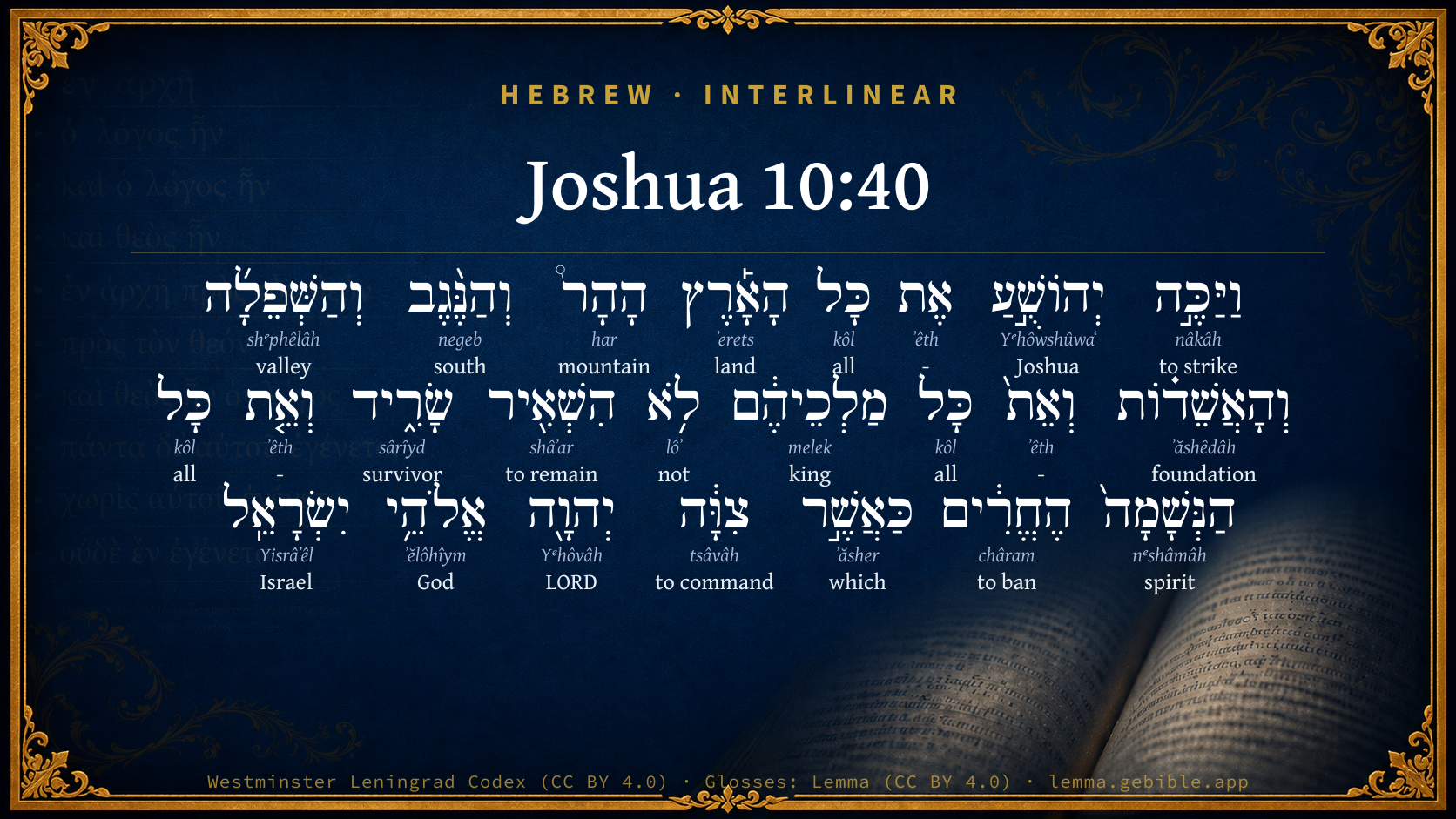
  1. וַיַּכֶּ֣ה nâkâh H5221 “and · to strike” Conjunction + Verb, Hiphil, Sequential Imperfect, 3rd Person, Masculine, Singular
  2. יְהוֹשֻׁ֣עַ Yᵉhôwshûwaʻ H3091 “Joshua” Noun, Proper
  3. אֶת ʼêth H853 “-” Particle, Direct Object
  4. כָּל kôl H3605 “all of” Noun, Common, Masculine, Singular, Construct
  5. הָאָ֡רֶץ ʼerets H776 “the · land” Particle, Definite Article + Noun, Common, Both, Singular, Absolute
  6. הָהָר֩ har H2022 “the · mountain” Particle, Definite Article + Noun, Common, Masculine, Singular, Absolute
  7. וְהַנֶּ֨גֶב negeb H5045 “and · the · south” Conjunction + Particle, Definite Article + Noun, Common, Masculine, Singular, Absolute
  8. וְהַשְּׁפֵלָ֜ה shᵉphêlâh H8219 “and · the · valley” Conjunction + Particle, Definite Article + Noun, Common, Feminine, Singular, Absolute
  9. וְאֵת֙ ʼêth H853 “and · -” Conjunction + Particle, Direct Object
  10. כָּל kôl H3605 “all of” Noun, Common, Masculine, Singular, Construct
  11. מַלְכֵיהֶ֔ם melek H4428 “kings · their” Noun, Common, Masculine, Plural, Construct + Suffix, Personal, 3rd Person, Masculine, Plural
  12. לֹ֥א lôʼ H3808 “not” Particle, Negative
  13. הִשְׁאִ֖יר shâʼar H7604 “to remain” Verb, Hiphil, Perfect, 3rd Person, Masculine, Singular
  14. שָׂרִ֑יד sârîyd H8300 “survivor” Noun, Common, Masculine, Singular, Absolute
  15. וְאֵ֤ת ʼêth H853 “and · -” Conjunction + Particle, Direct Object
  16. כָּל kôl H3605 “all of” Noun, Common, Masculine, Singular, Construct
  17. הַנְּשָׁמָה֙ nᵉshâmâh H5397 “the · spirit” Particle, Definite Article + Noun, Common, Feminine, Singular, Absolute
  18. הֶחֱרִ֔ים châram H2763 “to ban” Verb, Hiphil, Perfect, 3rd Person, Masculine, Singular
  19. כַּאֲשֶׁ֣ר ʼăsher H834 “like/as · which” Preposition + Particle, Relative
  20. צִוָּ֔ה tsâvâh H6680 “to command” Verb, Piel, Perfect, 3rd Person, Masculine, Singular
  21. יְהוָ֖ה Yᵉhôvâh H3068 “LORD” Noun, Proper
  22. אֱלֹהֵ֥י ʼĕlôhîym H430 “God(s) of” Noun, Common, Masculine, Plural, Construct
  23. יִשְׂרָאֵֽל Yisrâʼêl H3478 “Israel” Noun, Proper

About this verse

These counts appear in no published source. They are computed here, from the morphology-tagged text and Lemma’s own curated glosses. What Lemma adds →

24
words
20
distinct lemmas
Historical
section

Notable vocabulary

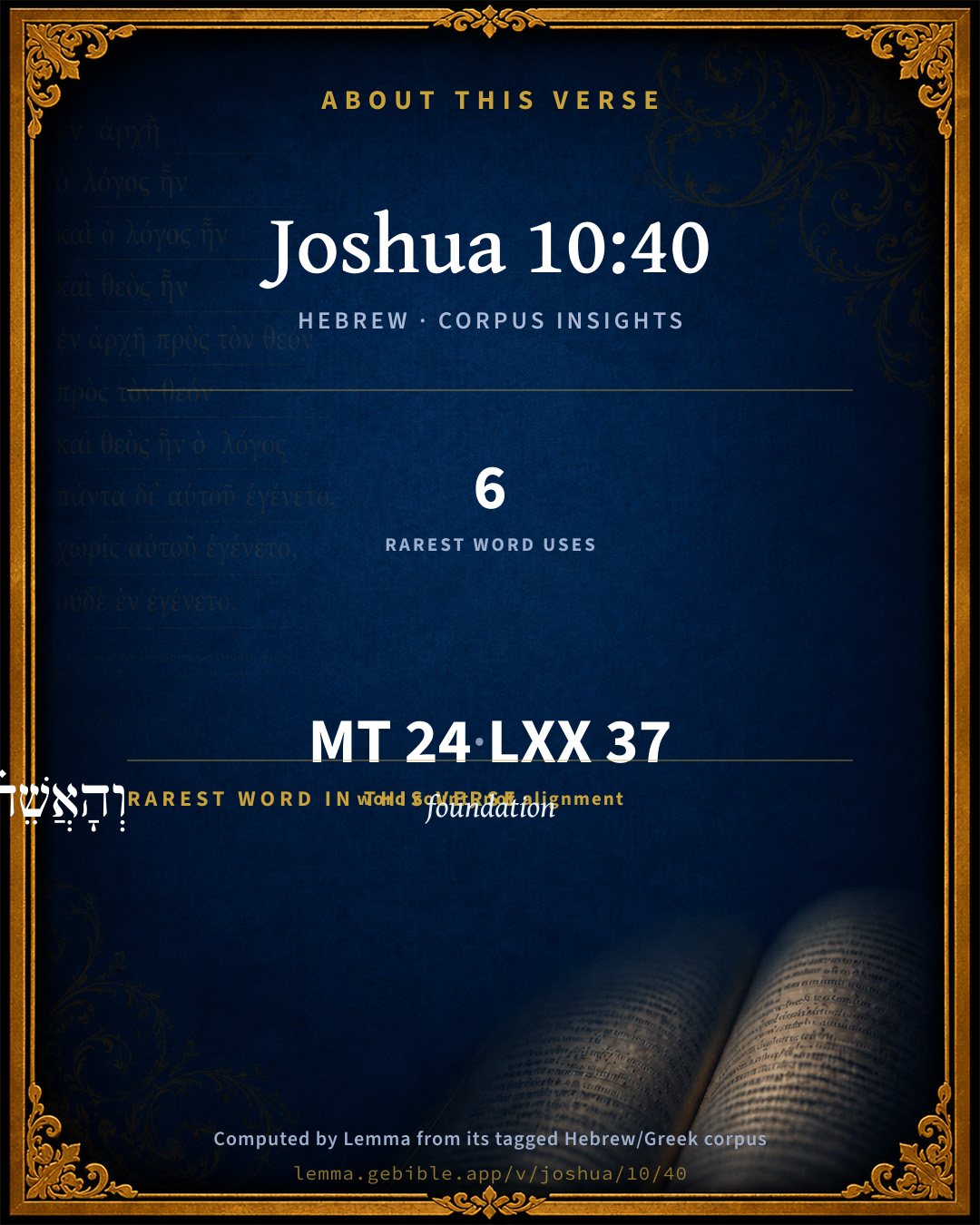
The rarest word here is וְהָאֲשֵׁד֗וֹת foundation H794 — appearing just 6 times in the whole Hebrew Bible.

Shared distinctive vocabulary

וְהָאֲשֵׁד֗וֹת foundation H794 occurs in 6 verses of the Hebrew Bible. Also found in:

Grammatical profile

  • 4 verbs
  • 15 nouns
  • 5 particles

Verb forms

  • וַיַּכֶּ֣ה Hiphil · Sequential Imperfect
  • הִשְׁאִ֖יר Hiphil · Perfect
  • הֶחֱרִ֔ים Hiphil · Perfect
  • צִוָּ֔ה Piel · Perfect

Repetition

A word recurs within this verse — often emphatic in Hebrew:

Hebrew & Septuagint length

In English translation the verse runs 39 words from the Hebrew and 50 from the Septuagint (LXX English) — closely comparable.

A rough comparison of the two English renderings, which tokenize alike — not a word-level alignment.

Word counts can differ between the Hebrew and the Greek without any difference in meaning — e.g. the Hebrew direct-object marker אֵת has no separate Greek word, and Greek often adds the article ὁ.

In the original languages it is 24 Hebrew tokens and 37 Greek tokens — but the two are counted differently (Hebrew bundles its prefixes and suffixes into one token; the Greek is in lemma form), so that isn’t a like-for-like length.

Cross-references

20

Topical passages linked to Joshua 10:40 in the Treasury of Scripture Knowledge — connected by theme and wording, ordered by reader-vote popularity; previews shown in the World English Bible.

  • Deuteronomy 7:2–16 and when Yahweh your God shall deliver them up before you, and you shall strike them; then you shall utterly destroy them: you shall make no covenant with them, nor show mercy to them;
  • Exodus 23:31–33 I will set your border from the Red Sea even to the sea of the Philistines, and from the wilderness to the River; for I will deliver the inhabitants of the land into your hand, and you shall drive them out before you.
  • Deuteronomy 7:24 He will deliver their kings into your hand, and you shall make their name to perish from under the sky: there shall no man be able to stand before you, until you have destroyed them.
  • Deuteronomy 20:16–17 But of the cities of these peoples, that Yahweh your God gives you for an inheritance, you shall save alive nothing that breathes;
  • Joshua 6:17 The city shall be devoted, even it and all that is therein, to Yahweh: only Rahab the prostitute shall live, she and all who are with her in the house, because she hid the messengers that we sent.
  • Joshua 8:2 You shall do to Ai and her king as you did to Jericho and her king: only the spoil of it, and the cattle of it, shall you take for a prey to yourselves: set you an ambush for the city behind it.
  • Joshua 8:27 Only the cattle and the spoil of that city Israel took for prey to themselves, according to the word of Yahweh which he commanded Joshua.
  • Joshua 9:24 They answered Joshua, and said, Because it was certainly told your servants, how that Yahweh your God commanded his servant Moses to give you all the land, and to destroy all the inhabitants of the land from before you; therefore we were sore afraid for our lives because of you, and have done this thing.
  • Joshua 10:35 and they took it on that day, and struck it with the edge of the sword; and all the souls who were therein he utterly destroyed that day, according to all that he had done to Lachish.
  • Joshua 10:37 and they took it, and struck it with the edge of the sword, and the king of it, and all the cities of it, and all the souls who were therein; he left none remaining, according to all that he had done to Eglon; but he utterly destroyed it, and all the souls who were therein.
  • 1 Kings 15:29 It happened that, as soon as he was king, he struck all the house of Jeroboam: he didn't leave to Jeroboam any who breathed, until he had destroyed him; according to the saying of Yahweh, which he spoke by his servant Ahijah the Shilonite;
  • Psalms 9:17 The wicked shall be turned back to Sheol, Even all the nations that forget God.
  • 2 Thessalonians 1:7–9 and to give relief to you that are afflicted with us, when the Lord Jesus is revealed from heaven with his mighty angels in flaming fire,
  • Exodus 34:12 Be careful, lest you make a covenant with the inhabitants of the land where you are going, lest it be for a snare in the midst of you:
  • Deuteronomy 1:7 turn you, and take your journey, and go to the hill-country of the Amorites, and to all [the places] near thereunto, in the Arabah, in the hill-country, and in the lowland, and in the South, and by the sea-shore, the land of the Canaanites, and Lebanon, as far as the great river, the river Euphrates.
  • Deuteronomy 26:16–17 This day Yahweh your God commands you to do these statutes and ordinances: you shall therefore keep and do them with all your heart, and with all your soul.
  • Joshua 12:8 in the hill-country, and in the lowland, and in the Arabah, and in the slopes, and in the wilderness, and in the South; the Hittite, the Amorite, and the Canaanite, the Perizzite, the Hivite, and the Jebusite:
  • Joshua 15:21–63 The uttermost cities of the tribe of the children of Judah toward the border of Edom in the South were Kabzeel, and Eder, and Jagur,
  • Joshua 18:21–19:8 Now the cities of the tribe of the children of Benjamin according to their families were Jericho, and Beth Hoglah, and Emek Keziz,
  • Joshua 19:40–48 The seventh lot came out for the tribe of the children of Dan according to their families.

Cross-references courtesy of OpenBible.info (CC BY 4.0).

Hebrew and Greek witnesses Masoretic Hebrew ↔ Greek Septuagint

The same verse in the two great witnesses to the Old Testament, shown verse-for-verse.

These are two independent witnesses, not word-aligned to each other, and the Septuagint is shown in lemma (dictionary) form.

Hebrew Joshua 10:40 Masoretic · Westminster Leningrad Codex

וַיַּכֶּ֣ה יְהוֹשֻׁ֣עַ אֶת כָּל הָאָ֡רֶץ הָהָר֩ וְהַנֶּ֨גֶב וְהַשְּׁפֵלָ֜ה וְהָאֲשֵׁד֗וֹת וְאֵת֙ כָּל מַלְכֵיהֶ֔ם לֹ֥א הִשְׁאִ֖יר שָׂרִ֑יד וְאֵ֤ת כָּל הַנְּשָׁמָה֙ הֶחֱרִ֔ים כַּאֲשֶׁ֣ר צִוָּ֔ה יְהוָ֖ה אֱלֹהֵ֥י יִשְׂרָאֵֽל

So Joshua struck all the land, the hill-country, and the South, and the lowland, and the slopes, and all their kings: he left none remaining, but he utterly destroyed all that breathed, as Yahweh, the God of Israel, commanded.

World English Bible · Public Domain

Greek LXX Joshua 10:40 Septuagint · lemma form

καί πατάσσω ἰησοῦς πᾶς ὁ γῆ ὁ ὀρεινή καί ὁ ναγεβ καί ὁ πεδεινός καί ὁ ασηδωθ καί ὁ βασιλεύς αὐτός οὐ καταλείπω αὐτός σώζω καί πᾶς ἐμπνέος ζωή ἐκὀλεθρεύω ὅς τρόπος ἐντέλλομαι κύριος ὁ θεός ἰσραήλ

And Joshua struck all the land of the hill country, and Nageb and the plain country, and Asedoth, and her kings, they did not leave of them one that was saved: and they utterly destroyed every thing that had the breath of life, as the Lord God of Israel commanded,

LXX2012 (modern English Septuagint) · Public Domain

On this verse, The Cambridge Bible for Schools and Colleges discusses the Septuagint’s reading. Read the note in Commentary ↓

Hebrew: Westminster Leningrad Codex (CC BY 4.0). Greek: Septuagint (public domain); English from LXX2012 (modern English Septuagint) (Public Domain). How the Septuagint differs from the Hebrew →

Targum (Aramaic paraphrase)

1

The Targum is the ancient Jewish Aramaic paraphrase of the Hebrew Scriptures — an interpretive translation, not the Hebrew text itself. Onkelos (literal) and Pseudo-Jonathan (expansive) render the Torah, and Jonathan the Prophets. Coverage is partial: where no permissively-licensed English translation exists for a verse, only the Aramaic is shown. This is verse-level text, not a word-by-word alignment to the Hebrew.

  1. Targum Jonathan Prophets (Joshua–Malachi)
    וּמְחָא יְהוֹשֻׁעַ יַת כָּל אַרְעָא טוּרָא וְדָרוֹמָא וּשְׁפֶלְתָּא וּמַשְׁפַּךְ מְרָמָתָא וְיַת כָּל מַלְכֵיהוֹן לָא אַשְׁאַר מְשֵׁזִיב וְיַת כָּל נִשְׁמָא גַמַר כְּמָא דְפַקֵד יְיָ אֱלָהָא דְיִשְׂרָאֵל:

    (no public-domain English translation for this verse)

    Targum Jonathan — Aramaic: “Mikraot Gedolot” (public domain). English: “Sefaria Community Translation” (CC0 1.0 (public-domain dedication)); “London "Chaldee Paraphrase," 1871” (public domain). Text via Sefaria.

Commentary

Notes on Joshua 10:40 from classic Christian and Jewish commentators (each source and its license shown beneath its notes). The classic Christian expositions comment on the surrounding passage and are grouped to its opening verse, so a note may address several verses; the Jewish commentaries on the Tanakh (Rashi and others) are per-verse, so they appear only where the commentator wrote on this verse.

Lemma curates 59 commentaries, every one of them public domain or Creative Commons licensed, each selected and text-cleaned for this edition rather than reprinted as found. About our sources →

Trapp's Complete Commentary

John Trapp

Jos 10:40 So Joshua smote all the country of the hills, and of the south, and of the vale, and of the springs, and all their kings: he left none remaining, but utterly destroyed all that breathed, as the LORD God of Israel commanded.

Ver. 40. As the Lord God of Israel commanded.] It was not therefore cruelty, but obedience, to slay so many thousands. There is a pious cruelty, saith one. And Magna quidem est in ilia severitate pietas per quam tollitur peccandi libertas, saith another: {a} there is great piety in that severity which taketh away licentious liberty.

{a} Gregory.

John Trapp, A Commentary or Exposition upon All the Books of the Old and New Testament (1647–1656) — public domain. Text from a community e-Sword module.

Joseph Benson's Commentary

Jos 10:40. All that breathed — That is, all mankind; they reserved the cattle for their own uses. As God had commanded — This is added for the vindication of the Israelites, whom God would not have to suffer in their reputation for executing his commands; and therefore, he acquits them of that cruelty which they might be thought guilty of, and ascribes it to his own just indignation. And hereby was typified the final destruction of all the impenitent enemies of the Lord Jesus, who, having slighted the riches of his grace, must for ever feel the weight of his wrath.

Joseph Benson's Commentary on the Old and New Testaments (1811–1818) — public domain. Text from a community e-Sword module.

Tyndale Open Study Notes

Tyndale Open Resources

10:40 Joshua’s southern campaign cleared the way for the southern tribes to occupy this whole region when the settlement process began. • the western foothills: See study note on Deut 1:7.

Tyndale Open Study Notes — © Tyndale Open Resources, licensed CC BY-SA 4.0. Text via the HelloAO Bible API.

Geneva Bible (1599)

Geneva Bible translators

Some read, Ashedoth, which signifieth the descents of the hills.

Geneva Bible (1599) marginal notes — public domain. Text via Bolls.life.

Adam Clarke's Commentary

Verse 40. All the country of the hills] See Clarke on De 1:7.

Destroyed all that breathed] Every person found in arms who continued to resist; these were all destroyed, - those who submitted were spared: but many no doubt made their escape, and afterwards reoccupied certain parts of the land. See Jos 10:36-37.

Adam Clarke's Commentary on the Bible (1810–1826) — public domain. Text from a community e-Sword/MySword module.

John Calvin's Commentaries

40. So Joshua smote all the country, etc Here the divine authority is again interposed in order completely to acquit Joshua of any charge of cruelty. Had he proceeded of his own accord to commit an indiscriminate massacre of women and children, no excuse could have exculpated him from the guilt of detestable cruelty, cruelty surpassing anything of which we read as having been perpetrated by savage tribes scarcely raised above the level of the brutes. But that at which all would otherwise be justly horrified, it becomes them to embrace with reverence, as proceeding from God. Clemency is justly praised as one of the principal virtues; but it is the clemency of those who moderate their wrath when they have been injured, and when they would have been justified, as individuals, in shedding blood. But as God had destined the swords of his people for the slaughter of the Amorites, Joshua could do nothing else than obey his command.

By this fact, then, not only are all mouths stopped, but all minds also are restrained from presuming to pass censure. When any one hears it said that Joshua slew all who came in his way without distinction, although they threw down their arms and suppliantly begged for mercy, the calmest minds are aroused by the bare and simple statement, but when it is added, that so God had commanded, there is no more ground for obloquy against him, than there is against those who pronounce sentence on criminals. Though, in our judgment at least, the children and many of the women also were without blame, let us remember that the judgment-seat of heaven is not subject to our laws. Nay, rather when we see how the green plants are thus burned, let us, who are dry wood, fear a heavier judgment for ourselves. And certainly, any man who will thoroughly examine himself, will find that he is deserving of a hundred deaths. Why, then, should not the Lord perceive just ground for one death in any infant which has only passed from its mother’s womb? In vain shall we murmur or make noisy complaint, that he has doomed the whole offspring of an accursed race to the same destruction; the potter will nevertheless have absolute power over his own vessels, or rather over his own clay.

The last verse confirms the observation already made, that the fixed station of the whole people was in Gilgal; and that the soldiers who had gone out to war, returned thither, both that they might rest from their fatigues, and place their booty in safety. It would not have been proper to allow them to be more widely scattered till the casting of the lot had shown where each was to have his permanent abode.

John Calvin's Commentaries (1540-1563) — public domain. Text from the Calvin Translation Society English edition (1840s-50s) via the Christian Classics Ethereal Library (ccel.org). Calvin's coverage is partial (roughly two-thirds of the Bible); uncommented books and verses are honest gaps, never fabricated. The 19th-century editor's footnotes and remarks are omitted so the notes are faithfully Calvin's own voice.

Ellicott's Commentary for English Readers

(40) Of the hills—i.e., the mountains of Judah and Ephraim.

The south—i.e., the Nêgeb.

The vale—i.e., Shephêlah, the plain of the coast, but not apparently including the Philistine territory, which was not conquered by Joshua.

The springs—or Áshdoth. Some render it the slopes or declivities, the country between the high hills and the low plain of the coast.

A Bible Commentary for English Readers, edited by Charles John Ellicott (1878–1897) — public domain. Text from a community e-Sword module.

The Cambridge Bible for Schools and Colleges

gen. ed. J. J. S. Perowne

40–43. Survey of the Results of the Campaign in Southern Canaan

40. all the country] Rather, all the land, the hill country, &c. The entire region is comprehensively surveyed, and then treated with special detail: (a) The Hills; (b) The South; (c) The Vale; (d) The Springs.

(a) The Hills, i.e. the mountain district of Judah extending southward from Jerusalem. It consists of calcareous limestone, and forms the water-parting between the Mediterranean and the Dead Sea, rising to the height of 3000 feet. It is generally, especially in the southern portion, an uneven and rocky district.

(b) The South = the Negeb, the “land of the south,” the dry, parched land, where the mountain-brooks fail in the summer (Psa_126:4). It is a limestone district, a land intermediate between wilderness and cultivated land, like the steppes of southern Russia. Because it lay in the south of Palestine, “Negeb” comes to mean generally “south” (comp. Num_35:5; Exo_40:24; Jos_17:9-10). It must, however, have once been fertile, for Palmer and Drake found grape-mounds all round the western border. “Almost sudden was the transition to the upland wilderness, the ‘Negeb,’ or south country—a series of rolling hills, clad with scanty herbage here and there, especially on their northern faces; and steadily rising, till the barometer, falling three and a half inches, told us that we had mounted 3,200 feet above our camp of the morning.”—Tristram’s Land of Israel, pp. 365, 366.

(c) The Vale, i.e. the Lowlands, or Shephêlah, a strip of land in southern Palestine stretching alone from Joppa to Gaza, “the plain of the Philistines.” “Viewed from the sea this maritime region appears as a long low coast of white or cream-coloured sand, its slight undulations rising occasionally into mounds or cliffs, which in one or two places almost aspire to the dignity of headlands.”

(d) The Springs, rather the Slopes or Declivities. The verb from which the original word is formed, denotes to pour, to rush down. Hence it means (i) an outpouring; (ii) a place, upon which something pours out. Comp. Deu_3:17, “from Chinnereth even unto the sea of the plain, even the salt sea, under Ashdoth-pisgah” = the springs or slopes of Pisgah (see margin), where the LXX. and English Version treat the word as a proper name. The word here denotes the district of undulating ground between the Shephêlah or “lowlands,” just mentioned, and the hill or “mountain” of the centre.

as the Lord] See Deu_20:16-17.

The Cambridge Bible for Schools and Colleges (gen. ed. J. J. S. Perowne; Cambridge University Press, 1878–1918) — public domain. Text from a community e-Sword module.

John Gill's Exposition

And Joshua smote them, from Kadeshbarnea,.... Which lay to the south of the land of Canaan, Num 13:17,

even unto Gaza, which lay to the southwest, and was one of the five principalities of the Philistines; of which city See Gill on Amo 1:7; and See Gill on Act 8:26,

and all the country of Goshen, even unto Gibeon; to which he returned back in his way to his camp at Gilgal, having conquered all the southern part of the country. This country of Goshen is not that in the land of Egypt, as Kimchi rightly remarks. Bishop Cumberland (m) is of opinion, that the Phoenician or Canaanitish pastors, who were driven out of Egypt before their expulsion, inhabited that part of Egypt called Goshen, which the Israelites some years after dwelt in; and when those shepherds were driven out, they came into this part of the land of Canaan, and called it after the name of the country they left in Egypt; and might perhaps the rather choose to give it this name, because of the goodness and fruitfulness of it, in which it resembled the country they had formerly dwelt in.

(m) Remarks on the History of Sanchoniatho, p. 380, 381.

John Gill's Exposition of the Whole Bible (1746–1763) — public domain (CC PDM 1.0). Text via the HelloAO Bible API.

Albert Barnes' Notes on the Bible

See Jos 9:1. “The south” was the Negeb Num 13:17. Render “the springs” “slopes.” The word here means the district of undulating ground between “the vale” (or שׁפלה shephêlâh) last named and “the hills.”

Albert Barnes' Notes on the Bible (1834–1885) — public domain. Text from a community e-Sword/MySword module.

Haydock's Catholic Bible Commentary

Hills of Judea. --- South of the promised land. --- Plain. Hebrew, Sephela, a flat country near Eleutheropolis. (St. Jerome in Abd. i. 19; 1 Machabees xii. 38.) --- Asedoth, "of the springs." --- Remains. God ordered these people to be utterly destroyed, in punishment of their manifold abominations; and that they might not draw the Israelites into the like sins. (Challoner)

George Leo Haydock (1774–1849), Haydock's Catholic Family Bible and Commentary, 1859 edition — public domain. Excludes Psalms (Douay-Rheims chapter numbering differs from Protestant) and Deuterocanonical books (Catholic canon only).

Matthew Poole's English Annotations

All that breathed, i.e. all mankind, by a synecdoche; for they reserved the cattle for their own uses.

As the Lord God of Israel commanded: this is added for the vindication of the Israelites, whom God would not have to suffer in their reputation for executing his commands; and therefore he acquits them of that implacable hatred and heinous cruelty which they might be thought guilty of, and ascribes it to himself and his own just indignation against this most wicked people.

Matthew Poole's English Annotations on the Holy Bible (1683–1685) — public domain. Text from a community e-Sword/MySword module.

Whedon's Commentary on the Bible

Daniel D. Whedon

40. Country of the hills — The mountain ridge, which is the backbone of the Holy Land, is cut up into hills by ravines which stretch away to the Dead Sea and the Mediterranean. The heads of these valleys often interlap for a considerable distance, forming numerous steep hills.

The south — The Negeb. This term designates that territory which was subsequently occupied by Judah and Simeon, and also a portion of Edom. It is a geographical term, used constantly to designate the land lying to the south of Palestine, and should always be translated the south country, as it is in Gen_20:1. In later Hebrew writers it extended from Southern Canaan to Arabia Petraea and Egypt.

The vale — The shephelah. This word, with one exception, (Jos_11:16,) always designates the maritime plain of Philistia, from Joppa to the borders of Egypt.

The springs — אשׁדות, slopes where torrents flow together; ravines.

Daniel D. Whedon (gen. ed.), Commentary on the Old and New Testaments (1874–1909) — public domain. Text from a community e-Sword module.

The Pulpit Commentary

So Joshua smote. We have now before us the defined locale of Joshua"s operations. He smote "the hills," or rather the "hill country," a tract of country extending from Jerusalem southward. This limestone range formed the watershed between the Mediterranean and the Dead Sea. The south, now often spoken of by travellers by its Hebrew name of Negeb, was, as the name signifies, an almost waste district of limestone hills. (cf. the Mount Halak, or smooth mountain, of Jos_11:19) It was once more fertile than it is at present, but could never have been a very fruitful region. As Knobel says, it is midway between waste and fertile land. It possesses grass and herbs and flowers, especially in the rainy season, and is thus suitable for pasture. But there are many tracts of sand and heath, and it is not watered by brooks, characteristics it has in common with the wilderness. It was also hilly, though not so precipitous as the mountain district. Tristram ("Land of Israel," pp. 365, 366) describes some of the mountains as rising gradually to a height of 3, 200 feet. Bartlett, however, who devoted more time to the south country, describes it as treeless, but fertile as a corn producing country, and as very distinct in its physical features from the desert, or what is known as the "Wilderness of Judaea" ("From Egypt to Palestine," ch. 17., 18.). The best description of this region is found, however, in "Scripture Lands," by the late Rev. G. S. Drew. He says (p. 6), "For a few weeks late in spring time a smiling aspect is thrown over the broad downs, when the ground is reddened by the anemone in contrast with the soft white of the daisy and the deep yellow of the tulip and marigold. But this flush of beauty soon passes, and the permanent aspect of the country is not wild indeed, or hideous, or frightfully desolate, but, as we may say, austerely plain; a tame, unpleasing aspect, not causing absolute discomfort while one is in it, but left without one lingering reminiscence of anything lovely, awful, or sublime." The rocks are occasionally rendered fertile by the system of terrace cultivation, more common, as almost every traveller since Maundrell has remarked, in former times than now. That keen observer remarks, that if any one were to object that Palestine could not have maintained the vast population stated in Scripture to have inhabited it, he would be confuted by the fact that the most cursory observation shows that "the very rocks were made fruitful," perhaps even to a greater extent than plains could be, "by this method." The "vale," or Shephelah (see note on Jos_9:1), was a low strip of coast extending from the foot of Carmel to near Gaza. The twdvea, or "springs, as it is translated in our version (better, "watercourses," or "slopes," as Knobel), was a fertile country, intersected by ravines and brooks, situated between the mountains and the sea. The word only occurs in the Pentateuch and Joshua (a fact to be noted in forming an opinion on the genuineness of these books). See Num_21:15 (where it is translated stream in our version; Deu_3:17 Deu_4:49. The root, signifying pouring forth, is found in Chaldee and Syriac. The LXX renders this, as well as "the south," strange to say, as a proper name. See note on Jos_15:19. The Vulgate follows its example in the former case, but not in the latter. The Syriac also renders as a proper name. Utterly destroyed all that breathed, as the Lord God of Israel commanded. See for the word translated "utterly destroyed," Jos_6:17. These words are a quotation from Deu_20:16, Deu_20:17. It seems impossible to evade one of the alternatives, either that Deuteronomy was written before the events recorded in the book of Joshua, or that we have no historical evidence that Joshua did "utterly destroy all that breathed." The hypothesis that the Divine sanction for such a war of extermination was invented centuries after the Israelites had come to terms with the inhabitants and were daily utterly violating its spirit, and that they then readily allowed themselves to believe it to be of Divine origin, will scarcely bear examination. The attitude of the people toward Gentiles after their captivity is only to be explained by the hypothesis that it was the result of a belief that their misfortunes were due to a law which they had previously received and neglected to obey. Calvin observes how thoroughly these passages bear witness to the fact that the Israelites felt themselves to be the ministers of a Divine purpose in this slaughter. Origen (Hom. 15 on Joshua) says that the Apostles gave order that the Scriptures of the Old Testament were to be read in church, which, he adds, "they would not have done had not these carnal wars prefigured the spiritual warfare which we have to carry on against principalities, against powers, against the rulers of the darkness of this world, against spiritual wickedness in high places. Gaza. Hebrew Azzah (or strong), as in 1Ki_4:24. Joshua"s conquests extended to, but did not comprise, Gaza. (Jos_11:22 Jos_13:2, Jos_13:3) It was to have been the uttermost limit of the Israelitish territory. (see Gen_10:19) It actually was so in the days of Solomon. (1Ki_4:24) But until then the Israelites had not been able to subdue it, though (Jos_15:45-47) the whole land of the Philistines was assigned to Judah. What results this failure produced upon the after history of Israel we read in the Books of Judges and Samuel. Not till the reign of David was the Philistine power entirely broken. And Gaza played a very important part in the Philistine confederation. See Jud 16:1-4, 21-23 1Sa_6:16, 1Sa_6:17. Gaza has retained its importance even to the present day. Its situation near the sea, and, still more, its position upon the high road from Palestine to Egypt, and from the Mediterranean to Arabia Petraea, have secured it this permanence. When Robinson visited it its population was between fifteen and sixteen thousand larger even than that of Jerusalem. And it seems to have largely increased in population since the beginning of the century. Goshen. Gosom LXX Not, of course, identical with the land of Goshen in Egypt, but inasmuch as it lay to the southeast of Palestine, in the direction of their former habitation, it may possibly have been so named in memory of that sojourn. A city of that name is mentioned in the mountains of Judah, together with Debir. (Jos_15:51) It clearly (Jos_11:16) refers to a large district in the southeast, but its precise locality is not known. Even unto Gibeon. The conquests of Israel did not extend further in the northwest than Gibeon, from whence Joshua had set out on his triumphant campaign.

The extermination of the Canaanites.

The apparent cruelty of the Israelites in the conquest of Canaan arouses moral and religious questions of great interest, especially those which are suggested by the conduct of Joshua, the relation of God to the slaughter of the Canaanites, and the contrast between the earlier and the later religious dispensations.

I THE CONDUCT OF JOSHUA. This appears cruel and murderous. But note:

(1) It was in accordance with the customs of the times. Christian lenity was unknown. A man must be judged in the light of his age. It is wrong to "follow a multitude to do evil", (Exo_23:2) when we know it is doing evil, because the number of guilty persons does not mitigate the guilt of each individual. But our own judgment of what is right and wrong is largely determined by the prevalent ideas and unblamed conduct of our contemporaries; and if, when we have used the best light at our command, "our hearts condemn us not", (1Jn_3:21) we cannot be accounted guilty.

(2) It was in obedience to the understood command of God. A supposed command from heaven is no justification for an act which a man sincerely believes to be wrong, because in no case is he justified in violating conscience, and because he has more reason for doubting the Divine origin of the voice without than that of the voice within. But when the certainty of the Divine command is so strong that it carries conviction to the conscience, it becomes right for a man to obey.

(3) It was in execution of what was believed to be a Divine decree of judgment. Joshua did not consider that he was destroying the Canaanites simply to make way for the Israelites. He believed that he was a "scourge of God," sent to bring doom to the guilty, to rid the land of men who lived only to dishonour it, and to introduce a better race in their stead.

II THE RELATION OF GOD TO THE SLAUGHTER OF THE CANAANITES. Did God really command it? and if so, how can we reconcile this with His character of goodness?

(1) If God commanded this slaughter, He was ordering no more than He does directly in natural events in tempests, earthquakes, famines, plagues, and visitations of death generally.

(2) If men deserve destruction for their sins, it is really no more harsh for this to be sent by human agency than for it to come from physical causes, as with the destruction of Sodom and Gomorrah.

(3) If the punishment of sin generally is reconcilable with the goodness of God, this particular instance may be so.

(4) The extermination of the Canaanites was a blessing to the world.

(5) It was no real evil to the Canaanites. If men are living in sin and will not repent, the judgment which shortens their lives and prevents further evil is rather a blessing than a curse; for any loss or suffering is better for us than that we should be permitted to live on in sin. (Luk_17:1, Luk_17:2) It is better for us that we should be punished for sin than that we should continue in sin unpunished.

III THE CONTRAST BETWEEN THE EARLIER AND THE LATER DISPENSATIONS.

(1) Joshua brought punishment and destruction to sinners. Christ brings forgiveness and life.

(2) Joshua could only find room for his people after exterminating their predecessors. Christ has room for all who will come to His kingdom. (Luk_14:22)

(3) Joshua proved himself fit for the inheritance of his nation by the exercise of destructive warfare. Christians arc made meet for their inheritance by the practice of Christ-like deeds of charity. W.F.A. (Mat_25:34-36)

HOMILIES BY S.R. ALDRIDGE Ver. 40. The extermination of the Canaanites.

"So Joshua smote all the country of the hills, and of the south, and of the vale, and of the springs, and all their kings: he left none remaining, but utterly destroyed all that breathed, as the Lord God of Israel commanded." The attributes of God are the foundation of religion. From the relation in which we stand to Him as His creatures some regards are due to Him; but this relationship of inferiority could not of itself suffice to demand that entire devotedness to His services, that complete surrender of our affection which we denominate religion. God"s requirement (as stated in Deu_10:12) can only be justified by reference to the perfections of His character. If there be the least flaw, implicit trust cannot be expected of us. Herein all heathen systems of religion are defective, presenting to us a deity whom we cannot worship, a creature maimed, liable to the same passions as ourselves. The Christian religion bears traces of its Divine origin in the grandeur of its conceptions concerning the character of God. There is a height that dwarfs into littleness the puny gods invented by man; there is a many sidedness of view which could not have been the product of imagination. Just and holy, merciful and gracious, all knowing and Almighty, the Creator and Sustainer, a Friend and Judge, our Father and King, such He is declared to be. Hence it is that those objections are felt to be most serious which are urged, with any show of reason, against the reality of God"s perfections. Especially when His benevolence is challenged do we fear lest the dark shadow becloud the skies and chill our hearts. Now, in the text there is an account of a sweeping destruction executed on the south of Canaan by command of God. No quarter was given. So dreadful the desolation that some have called it cruelty. And though it is not incumbent on us to justify all the ways of God, yet as some are led from passages like the present to entertain hard thoughts of God, it may be well for once to look the implied objection calmly in the face.

A command from God may render that action lawful and right, which done without His authority would be deserving of reprobation. He is the Lord and owner of life. He gave, and it is His to take away. He commits no more injustice than when a parent redemands from his children the goods of which they are making an improper use. The text is therefore no excuse for the unauthorized seizure of the land of one nation by another, or for those violent acts for which no direct behest of God can be alleged.

These were single detached commands against particular foes. There was no injunction "to cultivate the principles of treachery or cruelty;" "none of these precepts are contrary to immutable morality "(Bp. Butler). When an army was led blindly into Samaria the king said, "Shall I smite them?" "No," answered the prophet Elisha in effect. (2Ki_6:21, 2Ki_6:22) On another occasion the prophet Elijah had rebuked King Ahab because he had allowed a king to escape, whom "the Lord had appointed to utter destruction." The reason of the case alters the nature of the action. The extermination of the Canaanites was a punishment for wickedness. See Le 18. "The land is defiled... vomiteth out her inhabitants." The very earth stank with their practices, and yearned to be rid of its unhallowed burden. "Ye shall not walk in the manners... for they committed all these things, therefore I abhorred him." Again, in De 18, "Because of their abominations the Lord doth drive them out from before thee." So also Deu_9:5. It is to be remembered that the things censured were not merely occasional acts, but abominable customs. Indeed, the odious practices were a part of their religion, incorporated into their most solemn services. So degraded had they become.

A considerable period of respite had been granted, but without avail. God had said to Abraham, "The iniquity of the Amorites is not yet full." When the cup of iniquity was filled to overflowing, then did the righteous fiat issue. During that period warnings of the severest character were given. Sodom and Gomorrah perished in a terrible manner, and later the kings of Og and Sihon had fallen. Still no repentance. It is useless to say that the warnings were not sufficiently distinct. We see the same indifference today. Men destroy their health by sinful habits, grow worse and worse. Do they need a Divine hand on their shoulder or an actual voice in their ear to warn them? The warning is plain, if only they will attend to it. But no I and the fearful end arrives.

The method of punishment adopted was one of which the nations of Palestine would not complain, since it was in keeping with their own conduct. They would find no injustice done them. They would defeat other nations and dispossess them of life and territory if they could. They believed in the tenure or lease of the strong arm. Granted, therefore, that God was executing righteous judgment, the prevailing code removes all charge of cruelty. The judgments as well as the favours of God must be conditioned as to form by men"s surroundings. In legislating for the Israelites, whilst we expect and find such purity and such an anticipation of the opinions of modern times as justly entitles the "the law of Moses" to be considered a revelation from God, yet would it have been Quixotic to take no account of prevalent opinions and tendencies, to demand of the Israelites exactly what Christianity now demands after so many centuries of civilisation. There is no change, therefore, in the character of God, no advance in wisdom or love supposed, only such a difference of reputation as is necessitated by a due regard for the condition of those to whom Divine commands are given. We must not, therefore, talk of a contradiction between the spirit of the gospel maxim, "love your enemies," and the precept followed in the text as seeming to say, "act with barbarity." As a rule, God"s judgments here do not distinguish degrees of guilt. Famines and pestilences of old times scourged a whole neighbourhood. So in the present instance the sword visited all with punishment. Let us not forget, however, that these judgments are not final. Nothing is determined respecting the ultimate state of those involved in the general destruction. Minute discrimination is for the other world.

Is not God"s love exemplified even in the stern precept of the text?

1. Love to surrounding nations. This terrible example might prove beneficial The only proof to them of superior power was prowess in war. This alone could bring them to acknowledge that the God of Israel, "he was Lord.

2. To His own people. The danger was lest the Israelites should be contaminated, and after events showed the wisdom of God"s command. The people were so easily seduced from their allegiance to Jehovah, And God was impartial. He threatened that if the Israelites did evil, their fate should be similar.

3. To the whole world. Since if the chosen people had utterly lost the truth, the light would have been universally extinguished. Through Israel the promised Messiah was to Come. Woe to the world if the way were blocked up, and no Saviour appeared dawning as the Sun of Righteousness on this benighted earth.

Many lessons may be drawn. We learn the authority of God, and His hatred of sin. Ours is no emasculated religion. If God were a being of kindness only, then kindness with sin would mean total misery. "Except we repent, we shall all likewise perish." When we look at His anxiety for the welfare of His people, and the preparation made for the gift of His Son, we are taught "the goodness and severity of God", (Rom_11:22) A.

The Pulpit Commentary (1880–1919), ed. H.D.M. Spence-Jones & Joseph S. Exell — public domain. Text from a community e-Sword module.

John Wesley's Explanatory Notes

All that breathed - That is, all mankind, they reserved the cattle for their own uses. As God had commanded - This is added for the vindication of the Israelites, whom God would not have to suffer in their reputation for executing his commands; and therefore he acquits them of that cruelty, which they might be thought guilty of, and ascribes it to his own just indignation. And hereby was typified the final destruction of all the impenitent enemies of the Lord Jesus, who having slighted the riches of his grace, must forever feel the weight of his wrath.

John Wesley, Explanatory Notes Upon the Whole Bible (1754–1765) — public domain. Text via the GEBible commentary corpus.

Keil & Delitzsch

C. F. Keil & F. Delitzsch

Summary of the Conquest of the Whole of Southern Canaan. - In the further prosecution of his victory over the five allied kings, Joshua smote the whole land, i.e., the whole of the south of Canaan from Gibeon onwards, in all its districts, namely the mountains (Jos 15:48), the Negeb (the south land, Jos 15:21), the lowlands (Jos 15:33), and the slopes, i.e., the hill region (Jos 12:8, and comm. on Num 21:15), and all the kings of these different districts, banning every living thing (כּל־נשׁמה = כּל־נפשׁ, Jos 10:28, Jos 10:30, i.e., all the men; vid., Deu 7:1-2; Deu 20:16. He smote them from Kadesh-barnea, on the southern boundary of Canaan (Jos 15:3; see at Num 12:16), to Gaza (see at Gen 10:9), and all the country of Goshen, a different place from the Goshen of Egypt, deriving its name in all probability from the town of Goshen on the southern portion of the mountains (Jos 15:51). As the line "from Kadesh-barnea to Gaza" defines the extent of the conquered country from south to north on the western side, so the parallel clause, "all the country of Goshen, even unto Gibeon," defines the extent from south to north on the eastern side. There is no tenable ground for the view expressed by Knobel, which rests upon very uncertain etymological combinations, that the land of Goshen signifies the hill country between the mountains and the plain, and is equivalent to אשׁדות.

Keil & Delitzsch — Biblical Commentary on the Old Testament (1861–1891) — public domain (CC PDM 1.0). Text via the HelloAO Bible API. (Old Testament only.)

unfoldingWord translationNotes

Door43 World Missions Community

Of all their kings he left not one survivor. He completely destroyed every living thing

These two phrases share similar meanings and emphasize the complete destruction that the people of Israel accomplished at Yahweh's command. (See: Parallelism)

translationWords

Joshua

Negev

king

Yahweh

God

Israel

command

Kadesh

Gaza

Goshen

Gibeon

unfoldingWord translationNotes — © Distant Shores Media and the Door43 World Missions Community, licensed CC BY-SA 4.0. Source: git.door43.org/Door43/en_tn.

Rashi

Rabbi Shlomo Yitzchaki (Rashi)

The river valleys. The place where the water of the hills rush down.

Rashi on the Tanakh — English translations: “The Judaica Press complete Tanach with Rashi, translated by A. J. Rosenberg” (CC BY 4.0); “Pentateuch with Rashi's commentary by M. Rosenbaum and A.M. Silbermann, 1929-1934” (public domain); “The Metsudah Tanach series, Lakewood, N.J” (CC BY 4.0); and “The Book of Joshua, Metsudah Publications, 1997” (CC BY 4.0). Text via Sefaria.

Lesson kit

Teaching starters — assembled from the data on this page, not authored interpretation. Every prompt links to the verse data it draws on. Edit before teaching.

Joshua, in the Historical, opens this verse with 24 words (20 distinct Hebrew lemmas). Its most distinctive word is ʼăshêdâh (“foundation”). A historical commentator’s framing appears above. Read the whole chapter for the surrounding context.

Discussion questions

  1. What does “foundation” (ʼăshêdâh) contribute to the verse as a whole?
  2. How does Deuteronomy 3:17, which shares the word «foundation», read alongside this verse?
  3. What does the repetition of “all” (3× in this one verse) do in this verse?
  4. The translations on this page render this verse differently — a whole-verse word diff, not a word-by-word alignment. What might account for the different wordings?
  5. «וַיַּכֶּ֣ה» is a Hiphil Sequential Imperfect verb. How does that grammatical form shape the action described?
  6. Compare how Trapp's Complete Commentary and Joseph Benson's Commentary read this verse. Where do they agree or differ?

Things to notice

Reading settings

Reading text

Shown beneath each verse's original-language words.

Old Testament
Old Testament edition

Read the OT as the Masoretic Hebrew (MT) or the Greek Septuagint (LXX).

English shown for the Greek Septuagint (in the Hebrew ↔ Greek comparison).

Comparing translations? Open the Compare panel on any verse page to stack up to four side by side.