
Deuteronomy 13:5

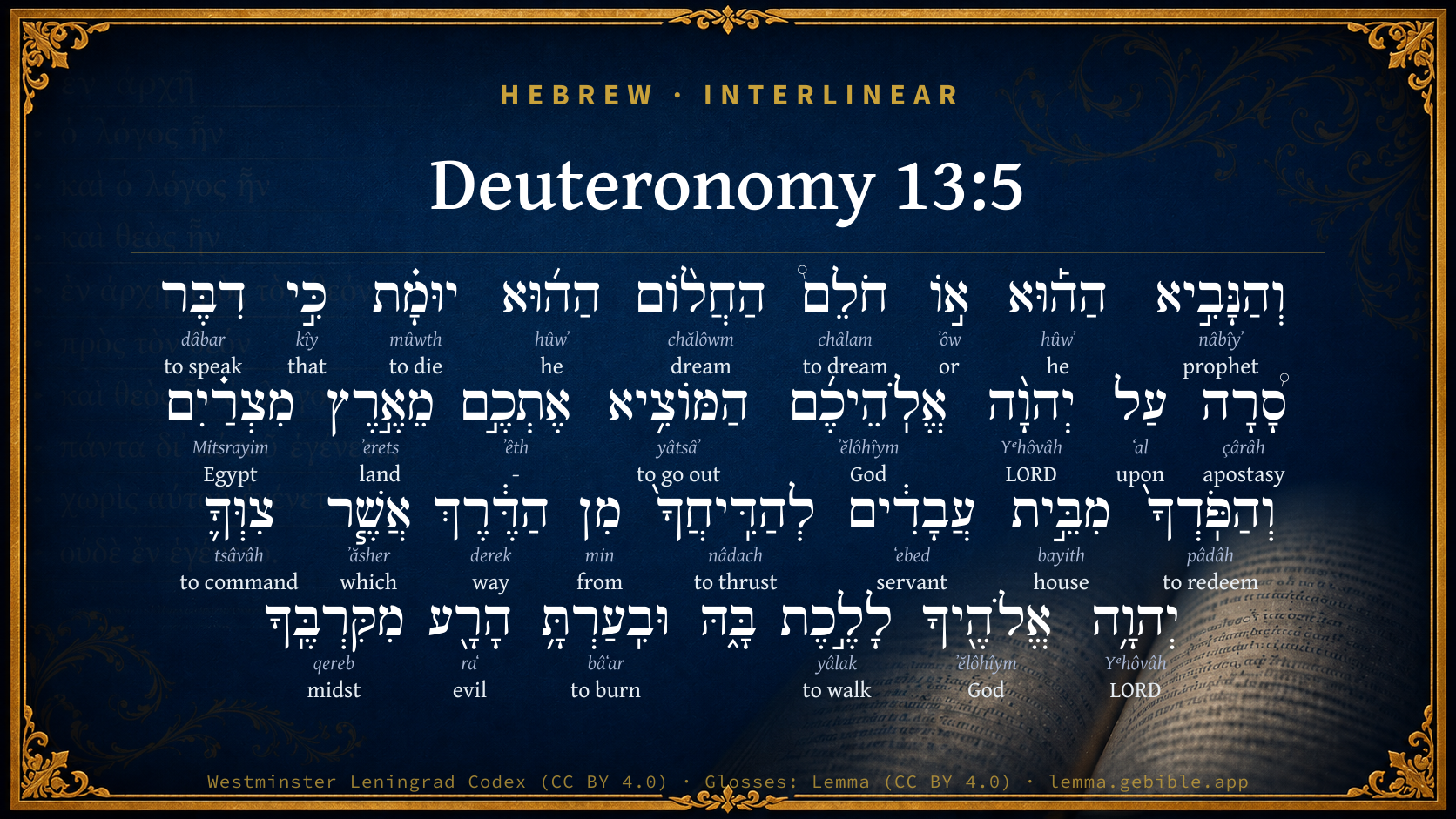
Hebrew (Westminster Leningrad Codex) Deuteronomy 13:5 appears in the Hebrew Old Testament. The text above is from the Westminster Leningrad Codex. Each word links to its Strong’s number, a concise gloss, and parsing drawn from the Open Scriptures Hebrew Bible morphology. Click any word for its full Brown-Driver-Briggs (BDB) entry.
Download image
Cite this verse

Deuteronomy 13:5 (World English Bible). Public Domain. Lemma interlinear Bible study tool, https://lemma.gebible.app/v/deuteronomy/13/5.

Show BibTeX & RIS
BibTeX
RIS
English Translation
That prophet, or that dreamer of dreams, shall be put to death, because he has spoken rebellion against Yahweh your God, who brought you out of the land of Egypt, and redeemed you out of the house of bondage, to draw you aside out of the way which Yahweh your God commanded you to walk in. So shall you put away the evil from the midst of you.
World English Bible · Public Domain
Highlights
  • 1 first appearance in the Hebrew Bible
Full analysis ↓
Download a study sheet

One document with this verse’s original text, its word-by-word gloss line, the meaning frame, cross-references with their text, attributed commentary, and full source and license credits — printable, and it pastes into notes with its structure intact.

This verse Autodidact and up

Study sheet (.html) Plain text (.txt)

A passage Seminary Student

Up to 50 verses in one chapter. A passage sheet keeps up to 6 commentary sources and 12 cross-references per verse, in the order this page ranks them, and says so on the sheet whenever that leaves anything out. Ask for a single verse and you get the Autodidact verse sheet above.

Everything on this page stays free to read, with no account — the sheet is a download of what is already on screen, not access to it.

Want to remove ads? Support Godless Engineer
Compare translations 3

The same verse in 3 English versions, stacked beneath the original-language interlinear above. Click any original word for its lexicon entry.

Each is an independent rendering of the whole verse — the interlinear is not word-aligned to these translations.

Highlighted words mark where these versions differ — a whole-verse word diff, not a word-by-word alignment.

  • World English Bible Public Domain
    That prophet, or that dreamer of dreams, shall be put to death, because he has spoken rebellion against Yahweh your God, who brought you out of the land of Egypt, and redeemed you out of the house of bondage, to draw you aside out of the way which Yahweh your God commanded you to walk in. So shall you put away the evil from the midst of you.
  • King James Version Public Domain
    And that prophet, or that dreamer of dreams, shall be put to death; because he hath spoken to turn you away from the LORD your God, which brought you out of the land of Egypt, and redeemed you out of the house of bondage, to thrust thee out of the way which the LORD thy God commanded thee to walk in. So shalt thou put the evil away from the midst of thee.
  • unfoldingWord Literal Text CC BY-SA 4.0
    And that prophet or that dreamer of dreams shall be put to death because he has spoken rebellion against Yahweh your God, who brought you out from the land of Egypt, and who redeemed you from the house of slaves, to drive you out from the way in which Yahweh your God commanded you to walk. And you shall remove the evil from among you.

unfoldingWord Literal Text — © unfoldingWord, licensed CC BY-SA 4.0. Word-aligned USFM3 via Door43 (git.door43.org/unfoldingWord/en_ult).

Versions to compare (up to 4)

3 of 4 selected

Show all 18 translations

Every available English version of this verse, each an independent rendering of the whole verse.

  • World English Bible Public Domain
    That prophet, or that dreamer of dreams, shall be put to death, because he has spoken rebellion against Yahweh your God, who brought you out of the land of Egypt, and redeemed you out of the house of bondage, to draw you aside out of the way which Yahweh your God commanded you to walk in. So shall you put away the evil from the midst of you.
  • Berean Standard Bible Public Domain
    Such a prophet or dreamer must be put to death, because he has advocated rebellion against the LORD your God, who brought you out of the land of Egypt and redeemed you from the house of slavery; he has tried to turn you from the way in which the LORD your God has commanded you to walk. So you must purge the evil from among you.
  • Majority Standard Bible Public Domain
    Such a prophet or dreamer must be put to death, because he has advocated rebellion against the LORD your God, who brought you out of the land of Egypt and redeemed you from the house of slavery; he has tried to turn you from the way in which the LORD your God has commanded you to walk. So you must purge the evil from among you.
  • King James Version Public Domain
    And that prophet, or that dreamer of dreams, shall be put to death; because he hath spoken to turn you away from the LORD your God, which brought you out of the land of Egypt, and redeemed you out of the house of bondage, to thrust thee out of the way which the LORD thy God commanded thee to walk in. So shalt thou put the evil away from the midst of thee.
  • American Standard Version (1901) Public Domain
    And that prophet, or that dreamer of dreams, shall be put to death, because he hath spoken rebellion against Jehovah your God, who brought you out of the land of Egypt, and redeemed thee out of the house of bondage, to draw thee aside out of the way which Jehovah thy God commanded thee to walk in. So shalt thou put away the evil from the midst of thee.
  • Revised Version (1885) Public Domain
    And that prophet, or that dreamer of dreams, shall be put to death; because he hath spoken rebellion against the LORD your God, which brought you out of the land of Egypt, and redeemed thee out of the house of bondage, to draw thee aside out of the way which the LORD thy God commanded thee to walk in. So shalt thou put away the evil from the midst of thee.
  • Geneva Bible (1599) Public Domain
    But that prophet, or that dreamer of dreames, he shall be slaine, because hee hath spoken to turne you away from the Lord your God (which brought you out of the lande of Egypt, and deliuered you out of the house of bodage) to thrust thee out of the way, wherein the Lord thy God commanded thee to walke: so shalt thou take the euill away foorth of the middes of thee.
  • Douay-Rheims (1899) Public Domain
    And that prophet or forger of dreams shall be slain: because he spoke to draw you away from the Lord your God, who brought you out of the land of Egypt, and redeemed you from the house of bondage: to make thee go out of the way, which the Lord thy God commanded thee: and thou shalt take away the evil out of the midst of thee.
  • Young's Literal Translation Public Domain
    `And that prophet, or that dreamer of the dream, is put to death, for he hath spoken apostacy against Jehovah your God (who is bringing you out of the land of Egypt, and hath ransomed you out of a house of servants), to drive you out of the way in which Jehovah thy God hath commanded thee to walk, and thou hast put away the evil thing from thy midst.
  • Literal Standard Version CC BY-SA 4.0
    And that prophet or that dreamer of the dream is put to death, for he has spoken apostasy against your God YHWH (who is bringing you out of the land of Egypt, and has ransomed you out of a house of servants), to drive you out of the way in which your God YHWH has commanded you to walk, and you have put away evil from your midst.
  • Unlocked Literal Bible CC BY-SA 4.0
    That prophet or that dreamer of dreams will be put to death, because he has spoken rebellion against Yahweh your God, who brought you out of the land of Egypt, and who redeemed you out of the house of bondage. That prophet wants to draw you out of the way in which Yahweh your God commanded you to walk. So put away the evil from among you.
  • unfoldingWord Literal Text CC BY-SA 4.0
    And that prophet or that dreamer of dreams shall be put to death because he has spoken rebellion against Yahweh your God, who brought you out from the land of Egypt, and who redeemed you from the house of slaves, to drive you out from the way in which Yahweh your God commanded you to walk. And you shall remove the evil from among you.
  • Darby Bible Public Domain
    And that prophet, or that dreamer of dreams, shall be put to death; for he hath spoken revolt against Jehovah your God who brought you out of the land of Egypt, and redeemed you out of the house of bondage, -- to draw thee out of the way that Jehovah thy God commanded thee to walk in; and thou shalt put evil away from thy midst.
  • World Messianic Bible Public Domain
    That prophet, or that dreamer of dreams, shall be put to death, because he has spoken rebellion against the LORD your God, who brought you out of the land of Egypt and redeemed you out of the house of bondage, to draw you aside out of the way which the LORD your God commanded you to walk in. So you shall remove the evil from among you.
  • Webster's Bible Public Domain
    And that prophet, or that dreamer of dreams, shall be put to death; because he hath spoken to turn you away from the LORD your God, who brought you out of the land of Egypt, and redeemed you from the house of bondage, to thrust thee out of the way which the LORD thy God commanded thee to walk in. So shalt thou remove the evil from the midst of thee.
  • Free Bible Version CC BY-SA 4.0
    These kinds of prophets or dreamers must be executed, because they have promoted rebellion against the Lord your God, who led you out of Egypt and rescued you from the prison-house of slavery. They have tried to lead you from the way that the Lord your God has ordered you to follow. You must eliminate the evil among you.
  • Bible in Basic English Public Domain
    And that prophet or that dreamer of dreams is to be put to death; for his words were said with the purpose of turning you away from the Lord your God, who took you out of the land of Egypt and made you free from the prison-house; and of forcing you out of the way in which the Lord your God has given you orders to go. So you are to put away the evil from among you.
  • JPS Tanakh (1917) Public Domain
    (13-6) And that prophet, or that dreamer of dreams, shall be put to death; because he hath spoken perversion against the LORD your God, who brought you out of the land of Egypt, and redeemed thee out of the house of bondage, to draw thee aside out of the way which the LORD thy God commanded thee to walk in. So shalt thou put away the evil from the midst of thee.

Literal Standard Version (2020), Covenant Press — licensed CC BY-SA 4.0. Text via the HelloAO Bible API (eBible.org). Unlocked Literal Bible (unfoldingWord) — licensed CC BY-SA 4.0. Text via the HelloAO Bible API (eBible.org). unfoldingWord Literal Text — © unfoldingWord, licensed CC BY-SA 4.0. Word-aligned USFM3 via Door43 (git.door43.org/unfoldingWord/en_ult). Free Bible Version, Dr. Jonathan Gallagher — licensed CC BY-SA 4.0. Text via the HelloAO Bible API (eBible.org).

Word by word

More ways to search: Search by grammar → Find every occurrence → Compare this word →

Practice this passage: Drill this verse → Learn its vocabulary →

סָ֠רָה
çârâh
H5627
“apostasy”
Noun, Common, Feminine, Singular, Absolute
Part of Speech
Noun
Type
Common
Gender
Feminine
Number
Singular
State
Absolute
Full BDB Definition

Origin: from H5493

TWOT: 1480a

apostasy, defection, turning aside, withdrawal - defection (of moral or legal offenses) - apostasy - withdrawal (negated)
  1. וְהַנָּבִ֣יא nâbîyʼ H5030 “and · the · prophet” Conjunction + Particle, Definite Article + Noun, Common, Masculine, Singular, Absolute
  2. הַה֡וּא hûwʼ H1931 “the · he” Particle, Definite Article + Pronoun, Personal, 3rd Person, Masculine, Singular
  3. א֣וֹ ʼôw H176 “or” Conjunction
  4. חֹלֵם֩ châlam H2492 “dreaming” Verb, Qal, Participle Active, Masculine, Singular, Construct
  5. הַחֲל֨וֹם chălôwm H2472 “the · dream” Particle, Definite Article + Noun, Common, Masculine, Singular, Absolute
  6. הַה֜וּא hûwʼ H1931 “the · he” Particle, Definite Article + Pronoun, Personal, 3rd Person, Masculine, Singular
  7. יוּמָ֗ת mûwth H4191 “to die” Verb, Hophal, Imperfect, 3rd Person, Masculine, Singular
  8. כִּ֣י kîy H3588 “that” Conjunction
  9. דִבֶּר dâbar H1696 “to speak” Verb, Piel, Perfect, 3rd Person, Masculine, Singular
  10. עַל ʻal H5921 “upon” Preposition
  11. יְהוָ֨ה Yᵉhôvâh H3068 “LORD” Noun, Proper
  12. אֱלֹֽהֵיכֶ֜ם ʼĕlôhîym H430 “God(s) · your” Noun, Common, Masculine, Plural, Construct + Suffix, Personal, 2nd Person, Masculine, Plural
  13. הַמּוֹצִ֥יא yâtsâʼ H3318 “the · going out” Particle, Definite Article + Verb, Hiphil, Participle Active, Masculine, Singular, Absolute
  14. אֶתְכֶ֣ם ʼêth H853 “- · you” Particle, Direct Object + Suffix, Personal, 2nd Person, Masculine, Plural
  15. מֵאֶ֣רֶץ ʼerets H776 “from · land of” Preposition + Noun, Common, Both, Singular, Construct
  16. מִצְרַ֗יִם Mitsrayim H4714 “Egypt” Noun, Proper
  17. וְהַפֹּֽדְךָ֙ pâdâh H6299 “and · the · redeeming · you” Conjunction + Particle, Definite Article + Verb, Qal, Participle Active, Masculine, Singular, Construct + Suffix, Personal, 2nd Person, Masculine, Singular
  18. מִבֵּ֣ית bayith H1004 “from · house of” Preposition + Noun, Common, Masculine, Singular, Construct
  19. עֲבָדִ֔ים ʻebed H5650 “servants” Noun, Common, Masculine, Plural, Absolute
  20. לְהַדִּֽיחֲךָ֙ nâdach H5080 “to thrust · you” Preposition + Verb, Hiphil, Infinitive Construct + Suffix, Personal, 2nd Person, Masculine, Singular
  21. מִן min H4480 “from” Preposition
  22. הַדֶּ֔רֶךְ derek H1870 “the · way” Particle, Definite Article + Noun, Common, Both, Singular, Absolute
  23. אֲשֶׁ֧ר ʼăsher H834 “which” Particle, Relative
  24. צִוְּךָ֛ tsâvâh H6680 “to command · you” Verb, Piel, Perfect, 3rd Person, Masculine, Singular + Suffix, Personal, 2nd Person, Masculine, Singular
  25. יְהוָ֥ה Yᵉhôvâh H3068 “LORD” Noun, Proper
  26. אֱלֹהֶ֖יךָ ʼĕlôhîym H430 “God(s) · your” Noun, Common, Masculine, Plural, Construct + Suffix, Personal, 2nd Person, Masculine, Singular
  27. לָלֶ֣כֶת yâlak H3212 “to walk” Preposition + Verb, Qal, Infinitive Construct
  28. וּבִֽעַרְתָּ֥ bâʻar H1197 “and · to burn” Conjunction + Verb, Piel, Sequential Perfect, 2nd Person, Masculine, Singular
  29. הָרָ֖ע raʻ H7451 “the · evil” Particle, Definite Article + Adjective, Adjective, Masculine, Singular, Absolute
  30. מִקִּרְבֶּֽךָ qereb H7130 “from · midst · your” Preposition + Noun, Common, Masculine, Singular, Construct + Suffix, Personal, 2nd Person, Masculine, Singular

About this verse

These counts appear in no published source. They are computed here, from the morphology-tagged text and Lemma’s own curated glosses. What Lemma adds →

32
words
28
distinct lemmas
Pentateuch
section

Notable vocabulary

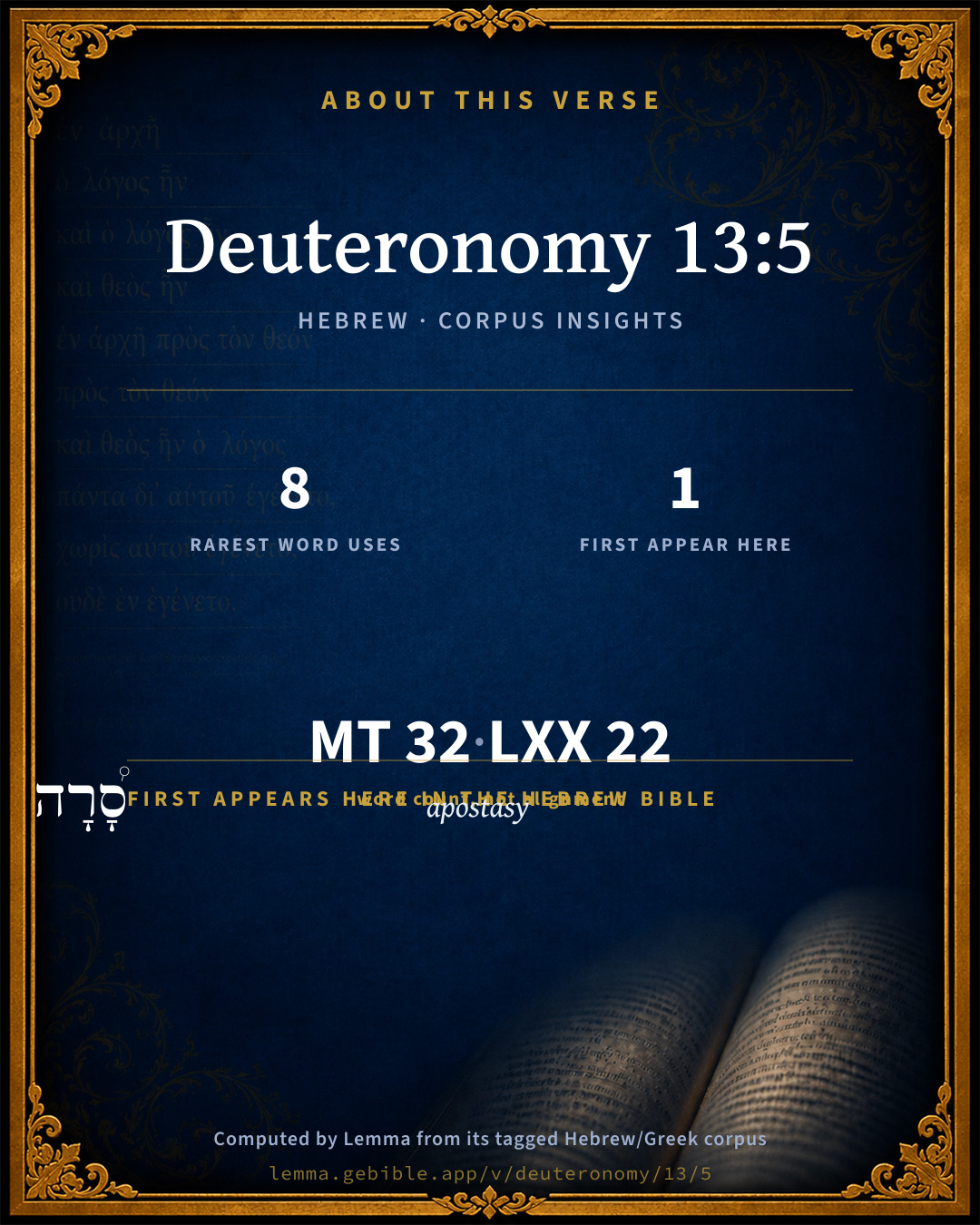
The rarest word here is סָ֠רָה apostasy H5627 — appearing just 8 times in the whole Hebrew Bible.

First appearance in Scripture

This word makes its first canonical appearance in the Hebrew Bible here:

  • סָ֠רָה apostasy H5627

Shared distinctive vocabulary

סָ֠רָה apostasy H5627 occurs in 8 verses of the Hebrew Bible. Also found in:

Grammatical profile

  • 9 verbs
  • 13 nouns
  • 1 adjective
  • 2 pronouns
  • 3 prepositions
  • 2 conjunctions
  • 2 particles

Verb forms

  • חֹלֵם֩ Qal · Participle Active
  • יוּמָ֗ת Hophal · Imperfect
  • דִבֶּר Piel · Perfect
  • הַמּוֹצִ֥יא Hiphil · Participle Active
  • וְהַפֹּֽדְךָ֙ Qal · Participle Active
  • לְהַדִּֽיחֲךָ֙ Hiphil · Infinitive Construct
  • צִוְּךָ֛ Piel · Perfect
  • לָלֶ֣כֶת Qal · Infinitive Construct
  • וּבִֽעַרְתָּ֥ Piel · Sequential Perfect

Repetition

Words recur within this verse — often emphatic in Hebrew:

  • יְהוָ֨ה LORD H3068 ×2
  • אֱלֹֽהֵיכֶ֜ם God H430 ×2
  • הַה֡וּא he H1931 ×2

Hebrew & Septuagint length

In English translation the verse runs 68 words from the Hebrew and 64 from the Septuagint (LXX English) — closely comparable.

A rough comparison of the two English renderings, which tokenize alike — not a word-level alignment.

Word counts can differ between the Hebrew and the Greek without any difference in meaning — e.g. the Hebrew direct-object marker אֵת has no separate Greek word, and Greek often adds the article ὁ.

In the original languages it is 32 Hebrew tokens and 22 Greek tokens — but the two are counted differently (Hebrew bundles its prefixes and suffixes into one token; the Greek is in lemma form), so that isn’t a like-for-like length.

Cross-references

21

Topical passages linked to Deuteronomy 13:5 in the Treasury of Scripture Knowledge — connected by theme and wording, ordered by reader-vote popularity; previews shown in the World English Bible.

  • Deuteronomy 18:20 But the prophet, who shall speak a word presumptuously in my name, which I have not commanded him to speak, or who shall speak in the name of other gods, that same prophet shall die.
  • 1 Corinthians 5:13 But those who are outside, God judges. "Put away the wicked man from among yourselves."
  • Deuteronomy 13:10 You shall stone him to death with stones, because he has sought to draw you away from Yahweh your God, who brought you out of the land of Egypt, out of the house of bondage.
  • Deuteronomy 17:7 The hand of the witnesses shall be first on him to put him to death, and afterward the hand of all the people. So you shall put away the evil from the midst of you.
  • Deuteronomy 19:19 then shall you do to him, as he had thought to do to his brother: so shall you put away the evil from the midst of you.
  • Deuteronomy 22:21 then they shall bring out the young lady to the door of her father's house, and the men of her city shall stone her to death with stones, because she has done folly in Israel, to play the prostitute in her father's house: so shall you put away the evil from the midst of you.
  • Deuteronomy 24:7 If a man be found stealing any of his brothers of the children of Israel, and he deal with him as a slave, or sell him; then that thief shall die: so shall you put away the evil from the midst of you.
  • Jeremiah 14:15 Therefore thus says Yahweh concerning the prophets who prophesy in my name, and I didn't send them, yet they say, Sword and famine shall not be in this land: By sword and famine shall those prophets be consumed.
  • Deuteronomy 22:24 then you shall bring them both out to the gate of that city, and you shall stone them to death with stones; the lady, because she didn't cry, being in the city; and the man, because he has humbled his neighbor's wife: so you shall put away the evil from the midst of you.
  • 1 Kings 18:40 and Elijah said to them, Take the prophets of Baal; don't let one of them escape. They took them; and Elijah brought them down to the brook Kishon, and killed them there.
  • Isaiah 9:14–15 Therefore Yahweh will cut off from Israel head and tail, palm-branch and rush, in one day.
  • Isaiah 28:17–18 I will make justice the line, and righteousness the plummet; and the hail shall sweep away the refuge of lies, and the waters shall overflow the hiding-place.
  • Jeremiah 28:15–17 Then said the prophet Jeremiah to Hananiah the prophet, Hear now, Hananiah: Yahweh has not sent you; but you make this people to trust in a lie.
  • Jeremiah 29:21–22 Thus says Yahweh of Hosts, the God of Israel, concerning Ahab the son of Kolaiah, and concerning Zedekiah the son of Maaseiah, who prophesy a lie to you in my name: Behold, I will deliver them into the hand of Nebuchadrezzar king of Babylon; and he shall kill them before your eyes;
  • Jeremiah 50:6 My people have been lost sheep: their shepherds have caused them to go astray; they have turned them away on the mountains; they have gone from mountain to hill; they have forgotten their resting-place.
  • Zechariah 13:3 It will happen that, when anyone still prophesies, then his father and his mother who bore him will tell him, 'You must die, because you speak lies in the name of Yahweh;' and his father and his mother who bore him will stab him when he prophesies.
  • Acts 13:8 But Elymas the sorcerer (for so is his name by interpretation) withstood them, seeking to turn aside the proconsul from the faith.
  • 2 Timothy 4:4–5 and will turn away their ears from the truth, and turn aside to fables.
  • Hebrews 12:14–15 Follow after peace with all men, and the sanctification without which no man will see the Lord,
  • Revelation 19:20 The beast was taken, and with him the false prophet who worked the signs in his sight, with which he deceived those who had received the mark of the beast and those who worshiped his image. These two were thrown alive into the lake of fire that burns with sulfur.
  • Deuteronomy 7:4 For he will turn away your son from following me, that they may serve other gods: so will the anger of Yahweh be kindled against you, and he will destroy you quickly.

Cross-references courtesy of OpenBible.info (CC BY 4.0).

Hebrew and Greek witnesses Masoretic Hebrew ↔ Greek Septuagint

The same verse in the two great witnesses to the Old Testament, shown verse-for-verse.

These are two independent witnesses, not word-aligned to each other, and the Septuagint is shown in lemma (dictionary) form.

Hebrew Deuteronomy 13:5 Masoretic · Westminster Leningrad Codex

וְהַנָּבִ֣יא הַה֡וּא א֣וֹ חֹלֵם֩ הַחֲל֨וֹם הַה֜וּא יוּמָ֗ת כִּ֣י דִבֶּר סָ֠רָה עַל יְהוָ֨ה אֱלֹֽהֵיכֶ֜ם הַמּוֹצִ֥יא אֶתְכֶ֣ם מֵאֶ֣רֶץ מִצְרַ֗יִם וְהַפֹּֽדְךָ֙ מִבֵּ֣ית עֲבָדִ֔ים לְהַדִּֽיחֲךָ֙ מִן הַדֶּ֔רֶךְ אֲשֶׁ֧ר צִוְּךָ֛ יְהוָ֥ה אֱלֹהֶ֖יךָ לָלֶ֣כֶת בָּ֑הּ וּבִֽעַרְתָּ֥ הָרָ֖ע מִקִּרְבֶּֽךָ

That prophet, or that dreamer of dreams, shall be put to death, because he has spoken rebellion against Yahweh your God, who brought you out of the land of Egypt, and redeemed you out of the house of bondage, to draw you aside out of the way which Yahweh your God commanded you to walk in. So shall you put away the evil from the midst of you.

World English Bible · Public Domain

Greek LXX Deuteronomy 13:5 Septuagint · lemma form

ὀπίσω κύριος ὁ θεός σύ πορεύομαι καί αὐτός φοβέω καί ὁ ἐντολή αὐτός φυλάσσω καί ὁ φωνή αὐτός ἀκούω καί αὐτός προςτίθημι

And that prophet or that dreamer of a dream, shall die; for he has spoken to make you err from the Lord your God who brought you out of the land of Egypt, who redeemed you from bondage, to thrust you out of the way which the Lord your God commanded you to walk in: so shall you abolish the evil from among you.

LXX2012 (modern English Septuagint) · Public Domain

Hebrew: Westminster Leningrad Codex (CC BY 4.0). Greek: Septuagint (public domain); English from LXX2012 (modern English Septuagint) (Public Domain). How the Septuagint differs from the Hebrew →

Targum (Aramaic paraphrase)

2

The Targum is the ancient Jewish Aramaic paraphrase of the Hebrew Scriptures — an interpretive translation, not the Hebrew text itself. Onkelos (literal) and Pseudo-Jonathan (expansive) render the Torah, and Jonathan the Prophets. Coverage is partial: where no permissively-licensed English translation exists for a verse, only the Aramaic is shown. This is verse-level text, not a word-by-word alignment to the Hebrew.

  1. Targum Onkelos Torah (Genesis–Deuteronomy)
    בָּתַר דַחַלְתָּא דַיְיָ אֱלָהֲכוֹן תְהָכוּן וְיָתֵהּ תִּדְחֲלוּן וְיָת פִּקוּדוֹהִי תִטְּרוּן וּלְמֵימְרֵהּ תְּקַבְּלוּן וְקָדָמוֹהִי תִפְלְחוּן וּבְדַחַלְתֵּהּ תִּתְקָרְבוּן

    (no public-domain English translation for this verse)

    Targum Onkelos — Aramaic: “Onkelos Genesis” (public domain); “Onkelos Exodus” (public domain); “Onkelos Leviticus” (public domain); “Onkelos Numbers” (public domain); “Onkelos Deuteronomy” (public domain). English: “Sefaria Community Translation” (CC0 1.0 (public-domain dedication)); “J.W. Etheridge. The Targums of Onkelos and Jonathan Ben Uzziel on the Pentateuch. London: Longmans, Green, 1862” (public domain). Text via Sefaria.

  2. Targum Pseudo-Jonathan Torah (Genesis–Deuteronomy)
    בָּתַר פּוּלְחָנָא דַיְיָ אֱלָהָכוֹן תְּהָכוּן וְיָתֵיהּ תְּדַחֲלוּן וְיַת פִּקּוּדוֹי תִּנְטְרוּן וּלְמֵימְרֵיהּ תְּקַבְּלוּן וּקְדָמוֹי תִּצְלוּן וּבְדַחַלְתֵּיהּ תִּתְקַרְבוּן

    You shall walk after the service of the Lord your God, and Him shall you fear, and keep His commandments, hearken to His word, pray before Him, and cleave unto His fear.

    Targum Pseudo-Jonathan — Aramaic: “Targum Jonathan on Genesis” (public domain); “Targum Jonathan on Exodus” (public domain); “Targum Jonathan on Leviticus” (public domain); “Targum Jonathan on Numbers” (public domain); “Targum Jonathan on Deuteronomy” (public domain). English: “The Targum of Jonathan ben Uzziel, trans. J. W. Etheridge, London, 1862” (public domain). Text via Sefaria.

Commentary

Notes on Deuteronomy 13:5 from classic Christian and Jewish commentators (each source and its license shown beneath its notes). The classic Christian expositions comment on the surrounding passage and are grouped to its opening verse, so a note may address several verses; the Jewish commentaries on the Tanakh (Rashi and others) are per-verse, so they appear only where the commentator wrote on this verse.

Lemma curates 59 commentaries, every one of them public domain or Creative Commons licensed, each selected and text-cleaned for this edition rather than reprinted as found. About our sources →

Trapp's Complete Commentary

John Trapp

Deu 13:5 And that prophet, or that dreamer of dreams, shall be put to death; because he hath spoken to turn [you] away from the LORD your God, which brought you out of the land of Egypt, and redeemed you out of the house of bondage, to thrust thee out of the way which the LORD thy God commanded thee to walk in. So shalt thou put the evil away from the midst of thee.

Ver. 5. Shall be put to death.] This power is still in the Christian magistrate, to inflict capital punishment on gross heretics; such as was Servetus at Geneva, and Campian here, who spider-like was swept down by the hand of justice, and drew his last thread in the triangle of Tyburn, as the historian wittily phraseth it. {a} Quid Imperatori cum ecclesia? was a question moved by the old Donatists. Libertas prophetandi, is much challenged by the Arminians, and other sectaries. But if in matter of religion every man should think what he lists, and utter what he thinks, and defend what he utters, and publish what he defends, and gather disciples to what he publisheth, this liberty, or licentiousness rather, would soon be the bane of any church.

{a} Speed’s Hist of Eng., 1176.

John Trapp, A Commentary or Exposition upon All the Books of the Old and New Testament (1647–1656) — public domain. Text from a community e-Sword module.

Joseph Benson's Commentary

Deu 13:5. Because he hath spoken — Taught, or persuaded you. To turn you away from the Lord — To induce you to forsake God and his worship. This shows that the most certain character of a true prophet is to be taken from his doctrine, rather than from his miracles. To thrust thee out of the way — This phrase denotes the great force and power of seducers to corrupt men’s minds. So shalt thou put the evil away — Thou shalt remove the guilt, by removing the guilty.

Joseph Benson's Commentary on the Old and New Testaments (1811–1818) — public domain. Text from a community e-Sword module.

Tyndale Open Study Notes

Tyndale Open Resources

13:5 visionaries: Literally dreamer of dreams. • purge (literally burn): God wanted false prophets to be completely eliminated, leaving no residue of their evil ways. See also 17:12; 19:13.

Tyndale Open Study Notes — © Tyndale Open Resources, licensed CC BY-SA 4.0. Text via the HelloAO Bible API.

Geneva Bible (1599)

Geneva Bible translators

Being convicted by testimonies, and condemned by the judge.

Geneva Bible (1599) marginal notes — public domain. Text via Bolls.life.

John Gill's Exposition

And that prophet, or that dreamer of dreams, shall be put to death,.... Which death, according to the Targum of Jonathan, was to be killed with the sword:

because he hath spoken to turn you away from the Lord your God; or "spoken revolt against the Lord" (l), high treason against him, delivering out doctrine that tends to cause his subjects to rebel against him, and revolt from him; and therefore he is justly deserving of death, to draw off a people from him he had been so good and kind unto; so that to apostasy would be added the sin of ingratitude:

which brought you out of the land of Egypt, and redeemed you out of the house of bondage; and so was not only their Lord by creation whom they ought to serve, but by redemption, which laid them under double obligation to serve him:

to thrust thee out of the way which the Lord thy God commanded thee to walk in; not by external force, but by the power of persuasion, by enticing words and arguments:

so shalt thou put the evil away from the midst of thee; the evil man, by putting him to death, and the evil of idolatry, by not listening to the words of the false prophet.

(l) "apostasiam", Junius & Tremellius, Piscator; "defectionem", Tigurine version.

John Gill's Exposition of the Whole Bible (1746–1763) — public domain (CC PDM 1.0). Text via the HelloAO Bible API.

Albert Barnes' Notes on the Bible

The context and parallel passages (compare Deu 17:7; Lev 20:2) indicate that there was to be a regular judicial procedure, and that the manner of the execution was to be by stoning. In this the community was to take its part in order to show its horror at the crime, and to clear itself of complicity therein.

Albert Barnes' Notes on the Bible (1834–1885) — public domain. Text from a community e-Sword/MySword module.

Haydock's Catholic Bible Commentary

Forger. Hebrew, "dreamer," to whom God reveals his secrets in the night, as he does to the prophet while he is awake. --- Slain. Philo says, without any trial or delay; but the Rabbins allow that, although the impostor was not to receive an admonition, no ignorance being able to excuse him, as in other cases, he was to be brought before the Sanhedrim, at Jerusalem, and strangled. See Luke xiii. 33. The Jews, it is thought, condemned our Saviour on the plea that he was a false prophet, Matthew xxvi. 57. They commonly required before this condemnation, that a person should have assumed the character of a prophet, and not barely that he should have performed some wonderful work by his ingenuity. For if he only did the latter, and thereby endeavoured to withdraw the people from the service of the true God, he was punished as a seducer. They also refused to condemn one who had foretold evils, if they did not take place, because God, being merciful, might have pardoned those who did penance, (Calmet) as was the case with Jonas and the Ninivites. (Haydock) --- But those who taught or did any thing contrary to the law, in quality of prophets, were in danger of condemnation, unless their great reputation might screen them from suspicion. Thus Elias offered sacrifice on Mount Carmel, without giving offence, 3 Kings xviii. 23. If a true prophet bore witness to another, the latter might also claim respect. (Calmet) --- Yet though St. John the Baptist had repeatedly commended Jesus Christ, the Jews did not hesitate to call him a seducer, and to put him to death. (Haydock) --- The evil "one," (Syriac,) 1 Corinthians v. 13.

George Leo Haydock (1774–1849), Haydock's Catholic Family Bible and Commentary, 1859 edition — public domain. Excludes Psalms (Douay-Rheims chapter numbering differs from Protestant) and Deuterocanonical books (Catholic canon only).

Matthew Poole's English Annotations

He hath spoken, i.e. taught or persuaded you.

To turn you away from the Lord; to forsake God and his worship. He shows that the chiefest and most certain character of a true prophet, is to be taken from his doctrine rather than from his miracles.

To thrust thee out of the way: this phrase denotes the great force and power of seducers to corrupt men’s minds. Compare Deu 4:19; 2Ki 17:21; Mat 24:2,14.

The evil; either

1. That evil thing, that wicked doctrine and practice. Or,

2. That wicked and scandalous man, that idolater and seducer.

Matthew Poole's English Annotations on the Holy Bible (1683–1685) — public domain. Text from a community e-Sword/MySword module.

Whedon's Commentary on the Bible

Daniel D. Whedon

5. That prophet, or that dreamer… shall be put to death — The endeavour to turn the people from the worship of Jehovah, in the condition the nation then was, constituted one of the greatest of crimes. The very existence of the nation depended upon their fidelity to the God who had led them out of Egypt and through the wilderness. Idolatry was treason.

Daniel D. Whedon (gen. ed.), Commentary on the Old and New Testaments (1874–1909) — public domain. Text from a community e-Sword module.

John Wesley's Explanatory Notes

To thrust - This phrase notes the great force and power of seducers to corrupt men's minds. So shalt thou put the evil away - Thou shalt remove the guilt, by removing the guilty.

John Wesley, Explanatory Notes Upon the Whole Bible (1754–1765) — public domain. Text via the GEBible commentary corpus.

Keil & Delitzsch

C. F. Keil & F. Delitzsch

Israel was to adhere firmly to the Lord its God (cf. Deu 4:4), and to put to death the prophet who preached apostasy from Jehovah, the Redeemer of Israel out of the slave-house of Egypt. להדּיחך, "to force thee from the way in which Jehovah hath commanded thee to walk." The execution of seducers to idolatry is enjoined upon the people, i.e., the whole community, not upon single individuals, but upon the authorities who had to maintain and administer justice. "So shalt thou put the evil away from the midst of thee." הרע is neuter, as we may see from Deu 17:7, as comp. with Deu 13:2. The formula, "so shalt thou put the evil away from the midst of thee," which occurs again in Deu 17:7, Deu 17:12; Deu 19:19; Deu 21:21; Deu 22:21-22, Deu 22:24, and Deu 24:7 (cf. Deu 19:13, and Deu 21:9), belongs to the hortatory character of Deuteronomy, in accordance with which a reason is given for all the commandments, and the observance of them is urged upon the congregation as a holy affair of the heart, which could not be expected in the objective legislation of the earlier books.

Keil & Delitzsch — Biblical Commentary on the Old Testament (1861–1891) — public domain (CC PDM 1.0). Text via the HelloAO Bible API. (Old Testament only.)

Scofield Reference Notes

C. I. Scofield

redeemed

(See Scofield "Exo 14:30").

The Scofield Reference Bible (1917 edition), notes by C. I. Scofield — public domain. Text from a community e-Sword module.

Rashi

Rabbi Shlomo Yitzchaki (Rashi)

ואת מצותיו תשמורו HIS COMMANDMENTS YE SHALL KEEP — the Law of Moses,

ובקלו תשמעו HIS VOICE YE SHALL OBEY — the voice of the prophets,

ואתו תעבדו HIM YE SHALL SERVE in His Temple (Sifrei Devarim 85:5).

ובו תדבקון AND UNTO HIM YE SHALL CLEAVE — i.e. cleave to His ways: do kindly actions, bury the dead, visit the sick, as did the Holy One, blessed be He (Sotah 14a).

Rashi on the Tanakh — English translations: “The Judaica Press complete Tanach with Rashi, translated by A. J. Rosenberg” (CC BY 4.0); “Pentateuch with Rashi's commentary by M. Rosenbaum and A.M. Silbermann, 1929-1934” (public domain); “The Metsudah Tanach series, Lakewood, N.J” (CC BY 4.0); and “The Book of Joshua, Metsudah Publications, 1997” (CC BY 4.0). Text via Sefaria.

Ramban (Nachmanides)

Rabbi Moshe ben Nachman (Ramban / Nachmanides)

AFTER THE ETERNAL YOUR G-D SHALL YE WALK. This is a commandment that we follow His counsel, and of Him alone shall we inquire concerning every hidden thing and inquire concerning the future, as it is written, and she went to inquire of the Eternal; because the people come unto me to inquire of G-d. And so did the Israelites do with the prophets, [as it is said,] Is there not here a prophet of the Eternal, that we may inquire of the Eternal through him?; that the Eternal thy G-d may tell us the way wherein we should walk, and the thing we should do. And in the Sifre it is stated: 85. “After the Eternal your G-d [shall ye walk] — this refers to the cloud [of Glory].” This is as we have explained, that we are to hearken to the “voice” of His signs and follow His counsel.

AND HIM SHALL YE FEAR. You are to believe that it is He in Whose hand is the soul of every living thing, and it is in His power to kill and to make alive, visiting iniquity, and rewarding for meritorious deeds.

AND HIS COMMANDMENTS SHALL YE KEEP. This refers to the Law of Moses.

AND UNTO HIS VOICE SHALL YE HEARKEN — to do whatever He commands us to do aside from the Torah, such as Samuel said [to Saul], Thou hast done foolishly; thou hast not kept the commandment of the Eternal thy G-d [referring to a commandment transmitted to Saul by Samuel]. It is this which is explained further, A prophet will the Eternal raise up unto thee, of thy brethren, like unto me; unto him ye shall hearken, and it states, And it shall come to pass, that whosoever will not hearken unto My words which he shall speak in My Name, I will require it of him, Verse 19. meaning that he will be liable to death by the hand of Heaven, and as it happened because of the prophet’s command, “Smite me, and wound me by the word of the Eternal” [and when the man refused to obey he was slain by a lion]., Verse 36. And so also the Rabbis said in the Sifre: 85. “And unto His voice shall ye hearken — the voice of His prophets.”

AND HIM SHALL YE SERVE, AND UNTO HIM SHALL YE CLEAVE. I have already explained this. Now it has already been stated, Thou shalt fear the Eternal thy G-d, and Him shalt thou serve., 6:13. But he repeated it here to negate [any consideration of obedience to a false prophet,] that we are not to fear the words of a [false] prophet because of the sign or wonder, and that we should not transgress the service of G-d because of the prophet’s words, for it is the Eternal alone that we are to fear, and no other god. [It was also repeated here] to add, and unto His voice shall ye hearken.

Ramban (Nachmanides) on the Tanakh — English translation: “Commentary on the Torah by Ramban (Nachmanides). Translated and annotated by Charles B. Chavel. New York, Shilo Pub. House, 1971-1976” (CC BY 4.0). Text via Sefaria.

Lesson kit

Teaching starters — assembled from the data on this page, not authored interpretation. Every prompt links to the verse data it draws on. Edit before teaching.

Deuteronomy, in the Pentateuch, opens this verse with 32 words (28 distinct Hebrew lemmas). Its most distinctive word is çârâh (“apostasy”). A historical commentator’s framing appears above. Read the whole chapter for the surrounding context.

Discussion questions

  1. How does “apostasy” (çârâh) shape what this verse is saying?
  2. The word “apostasy” first appears here in Scripture. What is being introduced at this debut?
  3. Deuteronomy 19:16 shares the word «apostasy» with this verse. How do the two illuminate each other?
  4. “LORD” occurs 2× in this one verse. What is the effect of the repetition?
  5. These translations render this verse differently. What is at stake in choosing one wording over another?
  6. The verb «חֹלֵם֩» is Qal Participle Active. How does its form color the action?
  7. Reading how Trapp's Complete Commentary and Joseph Benson's Commentary read this verse, where do the two commentators agree and where do they part?

Things to notice

Reading settings

Reading text

Shown beneath each verse's original-language words.

Old Testament
Old Testament edition

Read the OT as the Masoretic Hebrew (MT) or the Greek Septuagint (LXX).

English shown for the Greek Septuagint (in the Hebrew ↔ Greek comparison).

Comparing translations? Open the Compare panel on any verse page to stack up to four side by side.