
1 Kings 9:4

Hebrew (Westminster Leningrad Codex) 1 Kings 9:4 appears in the Hebrew Old Testament. The text above is from the Westminster Leningrad Codex. Each word links to its Strong’s number, a concise gloss, and parsing drawn from the Open Scriptures Hebrew Bible morphology. Click any word for its full Brown-Driver-Briggs (BDB) entry.
Download image
Cite this verse

1 Kings 9:4 (World English Bible). Public Domain. Lemma interlinear Bible study tool, https://lemma.gebible.app/v/1-kings/9/4.

Show BibTeX & RIS
BibTeX
RIS
English Translation
As for you, if you will walk before me, as David your father walked, in integrity of heart, and in uprightness, to do according to all that I have commanded you, and will keep my statutes and my ordinances;
World English Bible · Public Domain
Download a study sheet

One document with this verse’s original text, its word-by-word gloss line, the meaning frame, cross-references with their text, attributed commentary, and full source and license credits — printable, and it pastes into notes with its structure intact.

This verse Autodidact and up

Study sheet (.html) Plain text (.txt)

A passage Seminary Student

Up to 50 verses in one chapter. A passage sheet keeps up to 6 commentary sources and 12 cross-references per verse, in the order this page ranks them, and says so on the sheet whenever that leaves anything out. Ask for a single verse and you get the Autodidact verse sheet above.

Everything on this page stays free to read, with no account — the sheet is a download of what is already on screen, not access to it.

Want to remove ads? Support Godless Engineer
Compare translations 3

The same verse in 3 English versions, stacked beneath the original-language interlinear above. Click any original word for its lexicon entry.

Each is an independent rendering of the whole verse — the interlinear is not word-aligned to these translations.

Highlighted words mark where these versions differ — a whole-verse word diff, not a word-by-word alignment.

  • World English Bible Public Domain
    As for you, if you will walk before me, as David your father walked, in integrity of heart, and in uprightness, to do according to all that I have commanded you, and will keep my statutes and my ordinances;
  • King James Version Public Domain
    And if thou wilt walk before me, as David thy father walked, in integrity of heart, and in uprightness, to do according to all that I have commanded thee, and wilt keep my statutes and my judgments:
  • unfoldingWord Literal Text CC BY-SA 4.0
    And you, if you walk to my face just as David your father walked, in integrity of heart and in uprightness, to do according to all that I have commanded you, you keep my statutes and my judgments,

unfoldingWord Literal Text — © unfoldingWord, licensed CC BY-SA 4.0. Word-aligned USFM3 via Door43 (git.door43.org/unfoldingWord/en_ult).

Versions to compare (up to 4)

3 of 4 selected

Show all 18 translations

Every available English version of this verse, each an independent rendering of the whole verse.

  • World English Bible Public Domain
    As for you, if you will walk before me, as David your father walked, in integrity of heart, and in uprightness, to do according to all that I have commanded you, and will keep my statutes and my ordinances;
  • Berean Standard Bible Public Domain
    And as for you, if you walk before Me as your father David walked, with a heart of integrity and uprightness, doing all I have commanded you, and if you keep My statutes and ordinances,
  • Majority Standard Bible Public Domain
    And as for you, if you walk before Me as your father David walked, with a heart of integrity and uprightness, doing all I have commanded you, and if you keep My statutes and ordinances,
  • King James Version Public Domain
    And if thou wilt walk before me, as David thy father walked, in integrity of heart, and in uprightness, to do according to all that I have commanded thee, and wilt keep my statutes and my judgments:
  • American Standard Version (1901) Public Domain
    And as for thee, if thou wilt walk before me, as David thy father walked, in integrity of heart, and in uprightness, to do according to all that I have commanded thee, and wilt keep my statutes and mine ordinances;
  • Revised Version (1885) Public Domain
    And as for thee, if thou wilt walk before me, as David thy father walked, in integrity of heart, and in uprightness, to do according to all that I have commanded thee, and wilt keep my statutes and my judgments;
  • Geneva Bible (1599) Public Domain
    And if thou wilt walke before mee (as Dauid thy father walked in purenesse of heart and in righteousnesse) to doe according to al that I haue commanded thee, and keepe my statutes, and my iudgements,
  • Douay-Rheims (1899) Public Domain
    And if thou wilt walk before me, as thy father walked, in simplicity of heart, and in uprightness: and wilt do all that I have commanded thee, and wilt keep my ordinances and my judgments,
  • Young's Literal Translation Public Domain
    `And thou -- if thou dost walk before Me as David thy father walked, in simplicity of heart, and in uprightness, to do according to all that I have commanded thee -- My statutes and My judgments thou dost keep --
  • Literal Standard Version CC BY-SA 4.0
    And you—if you walk before Me as your father David walked, in simplicity of heart, and in uprightness, to do according to all that I have commanded you, [and] you keep My statutes and My judgments,
  • Unlocked Literal Bible CC BY-SA 4.0
    As for you, if you walk before me as David your father walked in integrity of heart and in uprightness, obeying all that I have commanded you and keeping my statutes and my decrees,
  • unfoldingWord Literal Text CC BY-SA 4.0
    And you, if you walk to my face just as David your father walked, in integrity of heart and in uprightness, to do according to all that I have commanded you, you keep my statutes and my judgments,
  • Darby Bible Public Domain
    And [as for] thee, if thou wilt walk before me, as David thy father walked, in integrity of heart, and in uprightness, to do according to all that I have commanded thee, [and] wilt keep my statutes and mine ordinances;
  • World Messianic Bible Public Domain
    As for you, if you will walk before me as David your father walked, in integrity of heart and in uprightness, to do according to all that I have commanded you, and will keep my statutes and my ordinances,
  • Webster's Bible Public Domain
    And if thou wilt walk before me, as David thy father walked, in integrity of heart, and in uprightness, to do according to all that I have commanded thee, and wilt keep my statutes and my judgments:
  • Free Bible Version CC BY-SA 4.0
    As for you, if you follow my ways as your father David did, doing everything I've told you to do, and if you keep my laws and regulations,
  • Bible in Basic English Public Domain
    As for you, if you will go on your way before me, as David your father did, uprightly and with a true heart, doing what I have given you orders to do, keeping my laws and my decisions;
  • JPS Tanakh (1917) Public Domain
    And as for thee, if thou wilt walk before Me, as David thy father walked, in integrity of heart, and in uprightness, to do according to all that I have commanded thee, and wilt keep My statutes and Mine ordinances;

Literal Standard Version (2020), Covenant Press — licensed CC BY-SA 4.0. Text via the HelloAO Bible API (eBible.org). Unlocked Literal Bible (unfoldingWord) — licensed CC BY-SA 4.0. Text via the HelloAO Bible API (eBible.org). unfoldingWord Literal Text — © unfoldingWord, licensed CC BY-SA 4.0. Word-aligned USFM3 via Door43 (git.door43.org/unfoldingWord/en_ult). Free Bible Version, Dr. Jonathan Gallagher — licensed CC BY-SA 4.0. Text via the HelloAO Bible API (eBible.org).

Word by word

More ways to search: Search by grammar → Find every occurrence → Compare this word →

Practice this passage: Drill this verse → Learn its vocabulary →

וּבְיֹ֔שֶׁר
yôsher
H3476
“and · in/at · uprightness”
Conjunction + Preposition + Noun, Common, Masculine, Singular, Absolute
Part of Speech
Conjunction + Preposition + Noun
Type
Common
Gender
Masculine
Number
Singular
State
Absolute
Full BDB Definition

Origin: from H3474

TWOT: 930b

straightness, uprightness - straightness, evenness (moral implications) - rightness, uprightness - what is right, what is due
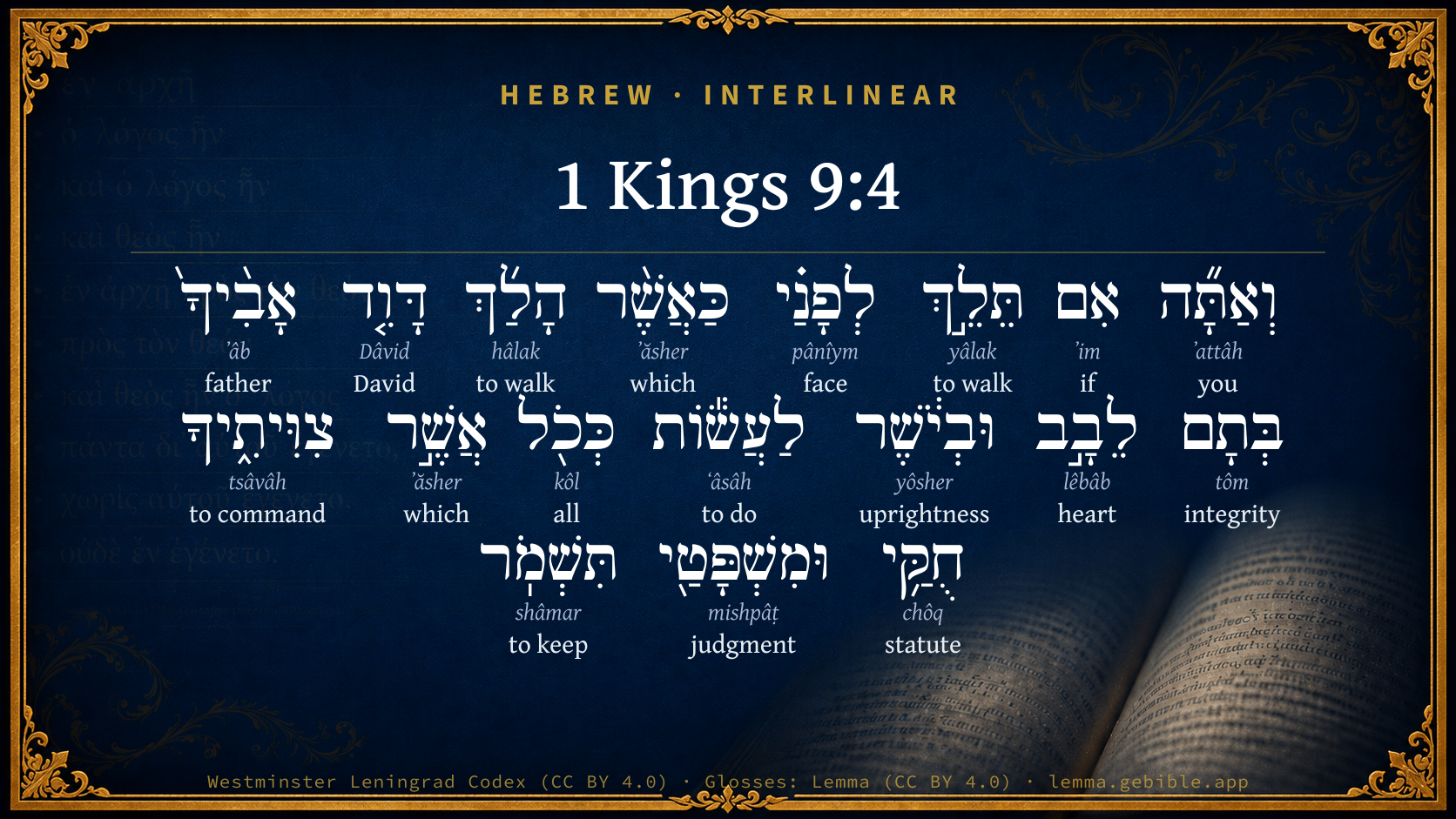
  1. וְאַתָּ֞ה ʼattâh H859 “and · you” Conjunction + Pronoun, Personal, 2nd Person, Masculine, Singular
  2. אִם ʼim H518 “if” Conjunction
  3. תֵּלֵ֣ךְ yâlak H3212 “to walk” Verb, Qal, Imperfect, 2nd Person, Masculine, Singular
  4. לְפָנַ֗י pânîym H6440 “to/for · face(s) · my” Preposition + Noun, Common, Both, Plural, Construct + Suffix, Personal, 1st Person, Common, Singular
  5. כַּאֲשֶׁ֨ר ʼăsher H834 “like/as · which” Preposition + Particle, Relative
  6. הָלַ֜ךְ hâlak H1980 “to walk” Verb, Qal, Perfect, 3rd Person, Masculine, Singular
  7. דָּוִ֤ד Dâvid H1732 “David” Noun, Proper
  8. אָבִ֨יךָ֙ ʼâb H1 “father · your” Noun, Common, Masculine, Singular, Construct + Suffix, Personal, 2nd Person, Masculine, Singular
  9. בְּתָם tôm H8537 “in/at · integrity of” Preposition + Noun, Common, Masculine, Singular, Construct
  10. לֵבָ֣ב lêbâb H3824 “heart” Noun, Common, Masculine, Singular, Absolute
  11. לַעֲשׂ֕וֹת ʻâsâh H6213 “to do” Preposition + Verb, Qal, Infinitive Construct
  12. כְּכֹ֖ל kôl H3605 “like/as · all” Preposition + Noun, Common, Masculine, Singular, Absolute
  13. אֲשֶׁ֣ר ʼăsher H834 “which” Particle, Relative
  14. צִוִּיתִ֑יךָ tsâvâh H6680 “to command · you” Verb, Piel, Perfect, 1st Person, Common, Singular + Suffix, Personal, 2nd Person, Masculine, Singular
  15. חֻקַּ֥י chôq H2706 “statutes · my” Noun, Common, Masculine, Plural, Construct + Suffix, Personal, 1st Person, Common, Singular
  16. וּמִשְׁפָּטַ֖י mishpâṭ H4941 “and · judgments · my” Conjunction + Noun, Common, Masculine, Plural, Construct + Suffix, Personal, 1st Person, Common, Singular
  17. תִּשְׁמֹֽר shâmar H8104 “to keep” Verb, Qal, Imperfect, 2nd Person, Masculine, Singular

About this verse

These counts appear in no published source. They are computed here, from the morphology-tagged text and Lemma’s own curated glosses. What Lemma adds →

18
words
17
distinct lemmas
Historical
section

Notable vocabulary

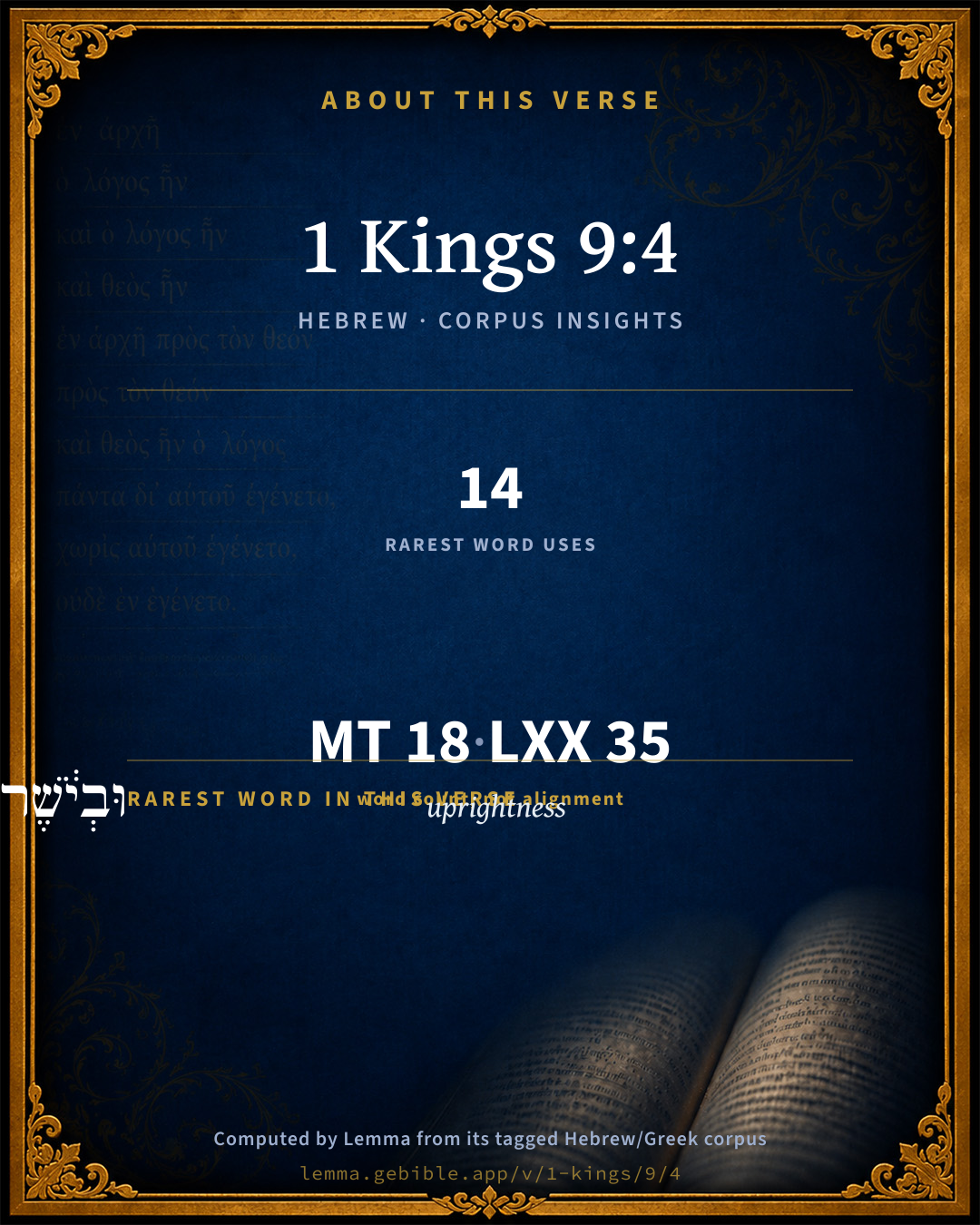
The rarest word here is וּבְיֹ֔שֶׁר uprightness H3476 — appearing just 14 times in the whole Hebrew Bible.

Shared distinctive vocabulary

וּבְיֹ֔שֶׁר uprightness H3476 occurs in 14 verses of the Hebrew Bible. Also found in:

Grammatical profile

  • 5 verbs
  • 9 nouns
  • 1 pronoun
  • 1 conjunction
  • 2 particles

Verb forms

  • תֵּלֵ֣ךְ Qal · Imperfect
  • הָלַ֜ךְ Qal · Perfect
  • לַעֲשׂ֕וֹת Qal · Infinitive Construct
  • צִוִּיתִ֑יךָ Piel · Perfect
  • תִּשְׁמֹֽר Qal · Imperfect

Repetition

A word recurs within this verse — often emphatic in Hebrew:

  • כַּאֲשֶׁ֨ר which H834 ×2

Hebrew & Septuagint length

In English translation the verse runs 39 words from the Hebrew and 38 from the Septuagint (LXX English) — closely comparable.

A rough comparison of the two English renderings, which tokenize alike — not a word-level alignment.

Word counts can differ between the Hebrew and the Greek without any difference in meaning — e.g. the Hebrew direct-object marker אֵת has no separate Greek word, and Greek often adds the article ὁ.

In the original languages it is 18 Hebrew tokens and 35 Greek tokens — but the two are counted differently (Hebrew bundles its prefixes and suffixes into one token; the Greek is in lemma form), so that isn’t a like-for-like length.

Cross-references

20

Topical passages linked to 1 Kings 9:4 in the Treasury of Scripture Knowledge — connected by theme and wording, ordered by reader-vote popularity; previews shown in the World English Bible.

  • 1 Kings 15:5 because David did that which was right in the eyes of Yahweh, and didn't turn aside from anything that he commanded him all the days of his life, except only in the matter of Uriah the Hittite.
  • 1 Kings 3:14 If you will walk in my ways, to keep my statutes and my commandments, as your father David did walk, then I will lengthen your days.
  • Genesis 17:1 When Abram was ninety-nine years old, Yahweh appeared to Abram, and said to him, "I am God Almighty. Walk before me, and be blameless.
  • 1 Kings 11:4 For it happened, when Solomon was old, that his wives turned away his heart after other gods; and his heart was not perfect with Yahweh his God, as was the heart of David his father.
  • 1 Kings 11:6 Solomon did that which was evil in the sight of Yahweh, and didn't go fully after Yahweh, as did David his father.
  • Deuteronomy 28:1 It shall happen, if you shall listen diligently to the voice of Yahweh your God, to observe to do all his commandments which I command you this day, who Yahweh your God will set you on high above all the nations of the earth:
  • 1 Kings 11:38 It shall be, if you will listen to all that I command you, and will walk in my ways, and do that which is right in my eyes, to keep my statutes and my commandments, as David my servant did; that I will be with you, and will build you a sure house, as I built for David, and will give Israel to you.
  • 1 Kings 14:8 and tore the kingdom away from the house of David, and gave it you; and yet you have not been as my servant David, who kept my commandments, and who followed me with all his heart, to do that only which was right in my eyes,
  • Psalms 26:11 But as for me, I will walk in my integrity. Redeem me, and be merciful to me.
  • Proverbs 28:18 Whoever walks blamelessly is kept safe; But one with perverse ways will fall suddenly.
  • Zechariah 3:7 "Thus says Yahweh of hosts: 'If you will walk in my ways, and if you will keep my charge, then you also shall judge my house, and shall also keep my courts, and I will give you a place of access among these who stand by.
  • Luke 1:6 They were both righteous before God, walking blamelessly in all the commandments and ordinances of the Lord.
  • 1 Kings 8:25 Now therefore, Yahweh, the God of Israel, keep with your servant David my father that which you have promised him, saying, There shall not fail you a man in my sight to sit on the throne of Israel, if only your children take heed to their way, to walk before me as you have walked before me.
  • 2 Chronicles 7:17–18 As for you, if you will walk before me as David your father walked, and do according to all that I have commanded you, and will keep my statutes and my ordinances;
  • Job 23:11–12 My foot has held fast to his steps. His way have I kept, and not turned aside.
  • Psalms 15:2 He who walks blamelessly does what is right, And speaks truth in his heart;
  • Psalms 26:1 Judge me, Yahweh, for I have walked in my integrity. I have trusted also in Yahweh without wavering.
  • 1 Thessalonians 4:1–2 Finally then, brothers, we beg and exhort you in the Lord Jesus, that as you received from us how you ought to walk and to please God, that you abound more and more.
  • Proverbs 10:9 He who walks blamelessly walks surely, But he who perverts his ways will be found out.
  • Proverbs 20:7 A righteous man walks in integrity. Blessed are his children after him.

Cross-references courtesy of OpenBible.info (CC BY 4.0).

Hebrew and Greek witnesses Masoretic Hebrew ↔ Greek Septuagint

The same verse in the two great witnesses to the Old Testament, shown verse-for-verse.

These are two independent witnesses, not word-aligned to each other, and the Septuagint is shown in lemma (dictionary) form.

Hebrew 1 Kings 9:4 Masoretic · Westminster Leningrad Codex

וְאַתָּ֞ה אִם תֵּלֵ֣ךְ לְפָנַ֗י כַּאֲשֶׁ֨ר הָלַ֜ךְ דָּוִ֤ד אָבִ֨יךָ֙ בְּתָם לֵבָ֣ב וּבְיֹ֔שֶׁר לַעֲשׂ֕וֹת כְּכֹ֖ל אֲשֶׁ֣ר צִוִּיתִ֑יךָ חֻקַּ֥י וּמִשְׁפָּטַ֖י תִּשְׁמֹֽר

As for you, if you will walk before me, as David your father walked, in integrity of heart, and in uprightness, to do according to all that I have commanded you, and will keep my statutes and my ordinances;

World English Bible · Public Domain

Greek LXX 1 Kings 9:4 Septuagint · lemma form

καί σύ ἐάν πορεύομαι ἐνώπιον ἐγώ καθώς πορεύομαι δαυίδ ὁ πατήρ σύ ἐν ὁσιότης καρδία καί ἐν εὐθύτης καί ὁ ποιέω κατά πᾶς ὅς ἐντέλλομαι αὐτός καί ὁ πρόσταγμα ἐγώ καί ὁ ἐντολή ἐγώ φυλάσσω

And if you will walk before me as David your father walked, in holiness of heart and uprightness, and so as to do according to all that I commanded him, and shall keep my ordinances and my commandments:

LXX2012 (modern English Septuagint) · Public Domain

On this verse, Keil & Delitzsch discusses the Septuagint’s reading. Read the note in Commentary ↓

Hebrew: Westminster Leningrad Codex (CC BY 4.0). Greek: Septuagint (public domain); English from LXX2012 (modern English Septuagint) (Public Domain). How the Septuagint differs from the Hebrew →

Targum (Aramaic paraphrase)

1

The Targum is the ancient Jewish Aramaic paraphrase of the Hebrew Scriptures — an interpretive translation, not the Hebrew text itself. Onkelos (literal) and Pseudo-Jonathan (expansive) render the Torah, and Jonathan the Prophets. Coverage is partial: where no permissively-licensed English translation exists for a verse, only the Aramaic is shown. This is verse-level text, not a word-by-word alignment to the Hebrew.

  1. Targum Jonathan Prophets (Joshua–Malachi)
    וְאַתְּ אִם תְהַךְ קֳדָמַי כְּמָא דְהַלִיךְ דָוִד אֲבוּךְ בְּקַשִׁיטוּת לִבָּא וּבִתְרִיצוּתָא לְמֶעְבַּד כְּכֹל דְפַקֵידְתָּךְ קְיָמַי וְדִינַי תִּטַר:

    (no public-domain English translation for this verse)

    Targum Jonathan — Aramaic: “Mikraot Gedolot” (public domain). English: “Sefaria Community Translation” (CC0 1.0 (public-domain dedication)); “London "Chaldee Paraphrase," 1871” (public domain). Text via Sefaria.

Commentary

Notes on 1 Kings 9:4 from classic Christian and Jewish commentators (each source and its license shown beneath its notes). The classic Christian expositions comment on the surrounding passage and are grouped to its opening verse, so a note may address several verses; the Jewish commentaries on the Tanakh (Rashi and others) are per-verse, so they appear only where the commentator wrote on this verse.

Lemma curates 59 commentaries, every one of them public domain or Creative Commons licensed, each selected and text-cleaned for this edition rather than reprinted as found. About our sources →

Trapp's Complete Commentary

John Trapp

1Ki 9:4 And if thou wilt walk before me, as David thy father walked, in integrity of heart, and in uprightness, to do according to all that I have commanded thee, [and] wilt keep my statutes and my judgments:

Ver. 4. To do according to all.] "All" is a little word, but of large extent. He doeth not God’s will, but his own will, who doeth no more than himself will. Everything must be done as well as anything, else we do nothing.

John Trapp, A Commentary or Exposition upon All the Books of the Old and New Testament (1647–1656) — public domain. Text from a community e-Sword module.

The Biblical Illustrator

Joseph S. Exell

1Ki_9:4

If thou writ walk before Me, as David thy father walked.

Imperativeness of law

General Grant, while president, caused the injury of a woman by his fast driving. He invited a police officer to enter his buggy, and drove with him to the police station, where he paid a fine of twenty dollars for fast and reckless driving. President MKinley once had to reprove his driver for crossing a chalk-line which marked the limit of space allowed to carriages. He leaned his head out of the window, apologised to the policeman in charge, and ordered his driver to obey the rule at once. Obedience comes hard when we think that for some reason we ought to be exceptions to the rules that govern others. (J. B. Morgan.)

The power of a sainted parent

After the news of his fathers death, Thomas Carlyle set himself to describe with pride his peasant parent. A living picture he gives: the large head, grey ever since he could remember; the strong face, full of earnestness; the clear eyes, through which honesty streamed--his dear, good father! Only a common farmer, though. Digging and ditching were part of his work. He drove the plough through the furrow. But, writes Thomas, his son also is part of his work. An inspiring example I owe him. The pale face stiffened into death will certainly impel me. I seem to myself the second volume of my father. The dead spirit of the Ecclefechan farmer lived in the brilliant writer of books. The instructions of his father soaked into his very flesh and bone. He, being dead, yet shaped his life. O blessed office of parenthood! (F. Y. Leggatt.)

The law of obedience

To that law of truth that firmly fixes foundations for cathedrals, Ruskin adds the law of obedience. In springing his wall the architect must plumb the stones of obedience to the law of gravity. In springing his arch he must brace it, obeying the laws of resistance. In lifting his tower he must relate it to the temple, obeying the law of proportion and symmetry; and he who disobeys one fundamental law will find great nature puking his towers down over his head. For no architect builds as he pleases, but only as nature pleases, through laws of gravity, and stone and steel. In the kingdom of the soul also obedience is strength and life, and disobedience is weakness and death. In the last analysis liberty is a phantom, a dream, a mere figment of the brain. Societys greatest peril of to-day is the demagogues who teach, and the ignorant classes who believe that there is such a thing as liberty. The planets have no liberty; they follow their sun. The seas know no liberty; they follow the moon in tidal waves. When the river refuses to keep within its banks, it becomes a curse and a destruction. It is the stream that is restrained by its banks that turns mill wheels for men. The clouds, too, have their beauty in that they are led forth in ranks and columns generaled by the night winds. And in proportion as things pass from littleness towards largeness they go toward obedience to law. (N. D. Hillis, D. D.)

The Biblical Illustrator, edited by Joseph S. Exell (c. 1880s–1900s) — public domain. Text from a community e-Sword module.

Joseph Benson's Commentary

1Ki 9:4-5. If thou wilt walk before me, &c. — He shows him that he and his people were for the future upon their good behaviour: Let them not be secure now, as if they might conduct themselves as they please, having the temple of the Lord, the temple of the Lord among them, Jer 7:4. No: this house was designed to protect them in their allegiance to God, not in their rebellion against him, or disobedience to him. As David thy father walked — Who, though he foully miscarried in some things, yet in the general course of his life was upright and faithful, especially in things relating to the worship of God and civil government. Then will I establish the throne of thy kingdom — Upon that condition, and not otherwise; for my promise to David was conditional, Psa 132:12. If we perform our part of the condition, God will not fail to perform his. If we improve the grace God has given us, he will confirm us to the end. Let not the children of godly parents expect the entail of the blessing, unless they tread in the steps of those that are gone before them, and keep up the virtue and piety of their ancestors.

Joseph Benson's Commentary on the Old and New Testaments (1811–1818) — public domain. Text from a community e-Sword module.

Keil & Delitzsch

C. F. Keil & F. Delitzsch

Kg1 9:4, Kg1 9:5 contain the special answer to Kg1 8:25, Kg1 8:26. - Kg1 9:6-9 refer to the prayer for the turning away of the curse, to which the Lord replies: If ye and your children turn away from me, and do not keep my commandments, but worship other gods, this house will not protect you from the curses threatened in the law, but they will be fulfilled in all their terrible force upon you and upon this temple. This threat follows the Pentateuch exactly in the words in which it is expressed; Kg1 9:7 being founded upon Deu 28:37, Deu 28:45, Deu 28:63, and the curse pronounced upon Israel in Deu 29:23-26 being transferred to the temple in Kg1 9:8, Kg1 9:9. - פּני מעל שׁלּח, to dismiss, i.e., to reject from before my face. "This house will be עליון," i.e., will stand high, or through its rejection will be a lofty example for all that pass by. The temple stood upon a high mountain, so that its ruins could not fail to attract the attention of all who went past. The expression עליון is selected with an implied allusion to Deu 26:19 and Deu 28:1. God there promises to make Israel עליון, high, exalted above all nations. This blessing will be turned into a curse. The temple, which was high and widely renowned, shall continue to be high, but in the opposite sense, as an example of the rejection of Israel from the presence of God.

(Note: The conjecture of Bttcher, Thenius, and Bertheau, that עליון should be altered into עיּים, has no support in Mic 3:12; Jer 26:18, and Psa 79:1, and has all the ancient versions against it; for they all contain the Masoretic text, either in a verbal translation (lxx), or in a paraphrase, as for example the Chaldee, "the house that was high shall be destroyed;" the Syriac and Arabic, "this house will be destroyed;" and the Vulgate, domus haec erit in exemplum. - In Ch2 7:21 the thought is somewhat varied by the alteration of יהיה into היה אשׁר. For it would never enter the mind of any sober critic to attribute this variation to a misinterpretation of our text. Still less can it be an unsuccessful attempt to explain or rectify our text, as Bttcher imagines, since the assertion of this critic, that עליון is only used to signify an exalted position, and never the exaltation of dignity or worth, is proved to be erroneous by Deu 26:19 and Deu 28:1.)

Keil & Delitzsch — Biblical Commentary on the Old Testament (1861–1891) — public domain (CC PDM 1.0). Text via the HelloAO Bible API. (Old Testament only.)

Geneva Bible (1599)

Geneva Bible translators

If thou walk in my fear, and withdraw thyself from the common manner of men, which follow their sensuality.

Geneva Bible (1599) marginal notes — public domain. Text via Bolls.life.

The Cambridge Bible for Schools and Colleges

gen. ed. J. J. S. Perowne

4. I have commanded thee] The LXX. reads ‘I commanded him,’ making the clause refer to David.

The Cambridge Bible for Schools and Colleges (gen. ed. J. J. S. Perowne; Cambridge University Press, 1878–1918) — public domain. Text from a community e-Sword module.

John Gill's Exposition

And if thou wilt walk before me, as David thy father walked, in integrity of heart, and in uprightness..... Who, though guilty of many sins and failings in life, yet was sincere and upright in the worship of God, never apostatized from it, or fell into idolatry, which is what is chiefly respected:

to do according to all that I have commanded thee, and wilt keep my statutes and my judgments; observe all the laws of God, moral, ceremonial, and judicial.

John Gill's Exposition of the Whole Bible (1746–1763) — public domain (CC PDM 1.0). Text via the HelloAO Bible API.

Albert Barnes' Notes on the Bible

See 1Ki 3:14. Solomon’s subsequent fall lends to these repeated warnings a special interest.

Albert Barnes' Notes on the Bible (1834–1885) — public domain. Text from a community e-Sword/MySword module.

Haydock's Catholic Bible Commentary

Simplicity of heart. That is, in the sincerity and integrity of a single heart, as opposite to all double-dealing and deceit. (Challoner) --- External worship alone will not be acceptable. (Worthington) --- "God is worshipped by faith, hope, and charity." (St. Augustine, Ench. iii.)

George Leo Haydock (1774–1849), Haydock's Catholic Family Bible and Commentary, 1859 edition — public domain. Excludes Psalms (Douay-Rheims chapter numbering differs from Protestant) and Deuterocanonical books (Catholic canon only).

Matthew Poole's English Annotations

As David thy father walked; who, though he miscarried in some things, yet in the general course of his life was upright and faithful towards me.

Matthew Poole's English Annotations on the Holy Bible (1683–1685) — public domain. Text from a community e-Sword/MySword module.

The Pulpit Commentary

And Heb. And thou, emphatic if thou wilt walk before me as David thy father walked, in integrity of heart before me and in uprightness. (cf. 1Ki_3:6, 14 11:34) David was not perfect, as our author tells us elsewhere (1Ki_15:5; cf. 1Ki_1:6; 2Sa_24:10) His integrity consisted in his unvarying loyalty to the true God. Even when overcome by that fierce temptation (2Sa 11) he never faltered in his allegiance to the truth. There was no coquetting with idolatrous practices; cf., Psa_18:20-24 to do according to all that I have commanded thee, and wilt keep my statutes and my judgments the echo of David"s last words, 1Ki_2:3, 1Ki_2:4. It is probable, however, that the historian has only preserved the substance of the message. It is doubtful whether Solomon himself would remember the exact words.

The Pulpit Commentary (1880–1919), ed. H.D.M. Spence-Jones & Joseph S. Exell — public domain. Text from a community e-Sword module.

unfoldingWord translationNotes

Door43 World Missions Community

if you walk before me as David your father walked

The way a person lives is spoken of as if that person were walking on a path. AT: "if you live the way I want you to live, just as David your father did" (See: Metaphor)

in integrity of heart and in uprightness

These two phrases mean basically the same thing and emphasize how righteous David was. (See: Doublet)

the throne of your kingdom

Here "throne" refers to his reign. AT: "your dynasty" or "your reign" (See: Metonymy)

will never fail to be on the throne of Israel

The action of ruling a kingdom is spoken of as if it were a person sitting on a throne. This can be expressed positively. AT: "will always rule over Israel" (See: Metonymy and Litotes)

translationWords

walk

David

integrity

heart

obey

command

statute

decree

throne

kingdom

Israel

eternity

descend

unfoldingWord translationNotes — © Distant Shores Media and the Door43 World Missions Community, licensed CC BY-SA 4.0. Source: git.door43.org/Door43/en_tn.

Lesson kit

Teaching starters — assembled from the data on this page, not authored interpretation. Every prompt links to the verse data it draws on. Edit before teaching.

1 Kings, in the Historical, opens this verse with 18 words (17 distinct Hebrew lemmas). Its most distinctive word is yôsher (“uprightness”). A historical commentator’s framing appears above. Read the whole chapter for the surrounding context.

Discussion questions

  1. How does “uprightness” (yôsher) shape what this verse is saying?
  2. Deuteronomy 9:5 shares the word «uprightness» with this verse. How do the two illuminate each other?
  3. “which” occurs 2× in this one verse. What is the effect of the repetition?
  4. These translations render this verse differently; the difference is in the English rendering, not the original. What questions does that raise?
  5. The verb «תֵּלֵ֣ךְ» is Qal Imperfect. How does its form color the action?
  6. Reading how Trapp's Complete Commentary and The Biblical Illustrator read this verse, where do the two commentators agree and where do they part?

Things to notice

Reading settings

Reading text

Shown beneath each verse's original-language words.

Old Testament
Old Testament edition

Read the OT as the Masoretic Hebrew (MT) or the Greek Septuagint (LXX).

English shown for the Greek Septuagint (in the Hebrew ↔ Greek comparison).

Comparing translations? Open the Compare panel on any verse page to stack up to four side by side.