

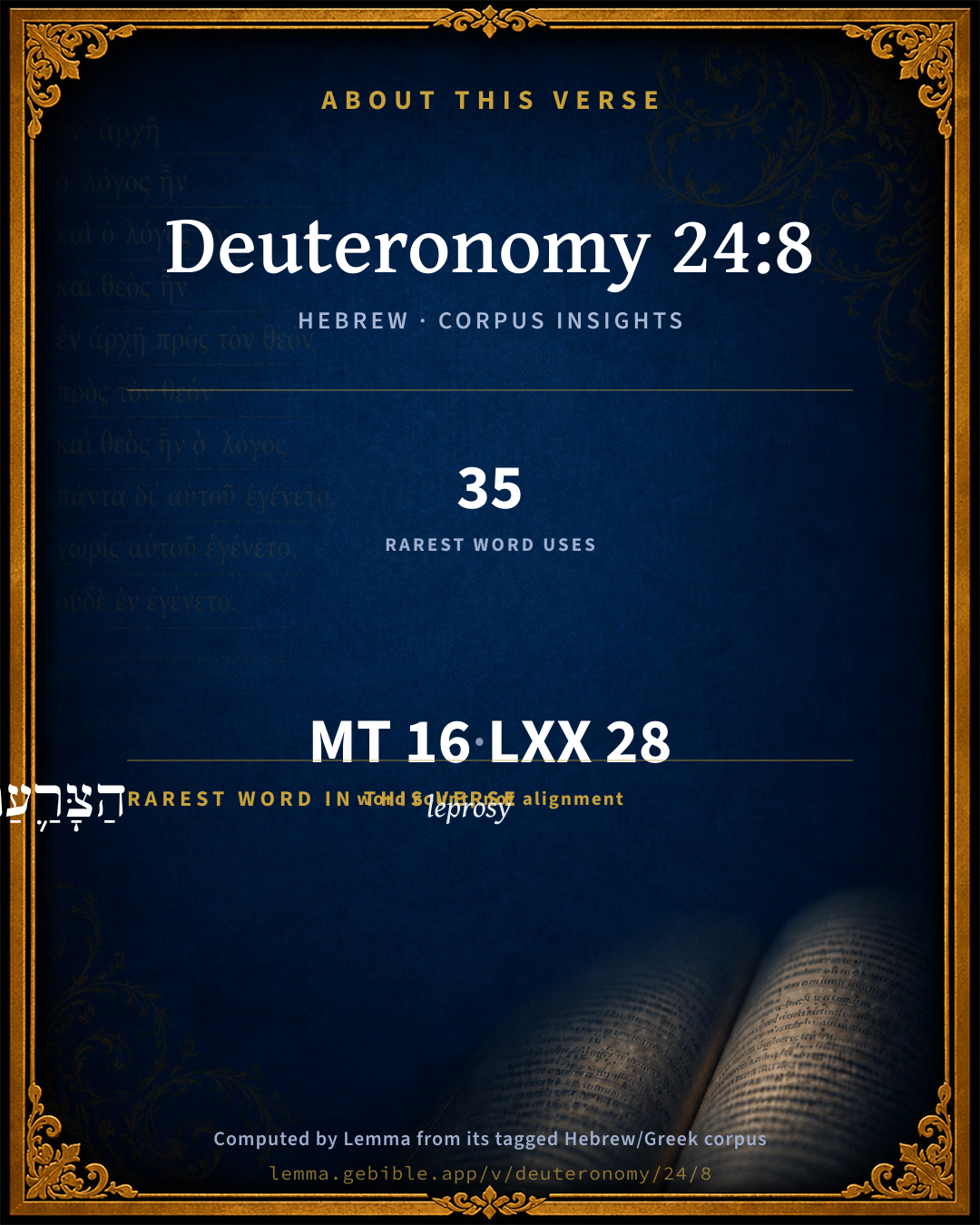
Deuteronomy 24:8

Hebrew (Westminster Leningrad Codex) Deuteronomy 24:8 appears in the Hebrew Old Testament. The text above is from the Westminster Leningrad Codex. Each word links to its Strong’s number, a concise gloss, and parsing drawn from the Open Scriptures Hebrew Bible morphology. Click any word for its full Brown-Driver-Briggs (BDB) entry.
Download image
Cite this verse

Deuteronomy 24:8 (World English Bible). Public Domain. Lemma interlinear Bible study tool, https://lemma.gebible.app/v/deuteronomy/24/8.

Show BibTeX & RIS
BibTeX
RIS
English Translation
Take heed in the plague of leprosy, that you observe diligently, and do according to all that the priests the Levites shall teach you: as I commanded them, so you shall observe to do.
World English Bible · Public Domain
Download a study sheet

One document with this verse’s original text, its word-by-word gloss line, the meaning frame, cross-references with their text, attributed commentary, and full source and license credits — printable, and it pastes into notes with its structure intact.

This verse Autodidact and up

Study sheet (.html) Plain text (.txt)

A passage Seminary Student

Up to 50 verses in one chapter. A passage sheet keeps up to 6 commentary sources and 12 cross-references per verse, in the order this page ranks them, and says so on the sheet whenever that leaves anything out. Ask for a single verse and you get the Autodidact verse sheet above.

Everything on this page stays free to read, with no account — the sheet is a download of what is already on screen, not access to it.

Want to remove ads? Support Godless Engineer
Compare translations 3

The same verse in 3 English versions, stacked beneath the original-language interlinear above. Click any original word for its lexicon entry.

Each is an independent rendering of the whole verse — the interlinear is not word-aligned to these translations.

Highlighted words mark where these versions differ — a whole-verse word diff, not a word-by-word alignment.

  • World English Bible Public Domain
    Take heed in the plague of leprosy, that you observe diligently, and do according to all that the priests the Levites shall teach you: as I commanded them, so you shall observe to do.
  • King James Version Public Domain
    Take heed in the plague of leprosy, that thou observe diligently, and do according to all that the priests the Levites shall teach you: as I commanded them, so ye shall observe to do.
  • unfoldingWord Literal Text CC BY-SA 4.0
    Guard against a plague of skin disease, to firmly keep and do according to all that the priests, the Levites, teach you; as I commanded them, you shall keep doing.

unfoldingWord Literal Text — © unfoldingWord, licensed CC BY-SA 4.0. Word-aligned USFM3 via Door43 (git.door43.org/unfoldingWord/en_ult).

Versions to compare (up to 4)

3 of 4 selected

Show all 18 translations

Every available English version of this verse, each an independent rendering of the whole verse.

  • World English Bible Public Domain
    Take heed in the plague of leprosy, that you observe diligently, and do according to all that the priests the Levites shall teach you: as I commanded them, so you shall observe to do.
  • Berean Standard Bible Public Domain
    In cases of infectious skin diseases, be careful to diligently follow everything the Levitical priests instruct you. Be careful to do as I have commanded them.
  • Majority Standard Bible Public Domain
    In cases of infectious skin diseases, be careful to diligently follow everything the Levitical priests instruct you. Be careful to do as I have commanded them.
  • King James Version Public Domain
    Take heed in the plague of leprosy, that thou observe diligently, and do according to all that the priests the Levites shall teach you: as I commanded them, so ye shall observe to do.
  • American Standard Version (1901) Public Domain
    Take heed in the plague of leprosy, that thou observe diligently, and do according to all that the priests the Levites shall teach you: as I commanded them, so ye shall observe to do.
  • Revised Version (1885) Public Domain
    Take heed in the plague of leprosy, that thou observe diligently, and do according to all that the priests the Levites shall teach you: as I commanded them, so ye shall observe to do.
  • Geneva Bible (1599) Public Domain
    Take heede of the plague of leprosie, that thou obserue diligently, and doe according to all that the Priestes of the Leuites shall teach you: take heede ye doe as I commanded them.
  • Douay-Rheims (1899) Public Domain
    Observe diligently that thou incur not the stroke of the leprosy, but thou shalt do whatsoever the priests of the Levitical race shall teach thee, according to what I have commanded them, and fulfil thou it carefully.
  • Young's Literal Translation Public Domain
    `Take heed, in the plague of leprosy, to watch greatly, and to do according to all that the priests, the Levites, teach you; as I have commanded them ye observe to do;
  • Literal Standard Version CC BY-SA 4.0
    Take heed in the plague of leprosy, to watch greatly, and to do according to all that the priests, the Levites, teach you; you observe to do as I have commanded them;
  • Unlocked Literal Bible CC BY-SA 4.0
    Take heed regarding any plague of leprosy, so that you carefully observe and follow every instruction given to you which the priests, the Levites, teach you; as I commanded them, so you will act.
  • unfoldingWord Literal Text CC BY-SA 4.0
    Guard against a plague of skin disease, to firmly keep and do according to all that the priests, the Levites, teach you; as I commanded them, you shall keep doing.
  • Darby Bible Public Domain
    Take heed in the plague of leprosy, that thou take great heed, and do according to all that the priests the Levites shall teach you: as I commanded them shall ye take heed to do.
  • World Messianic Bible Public Domain
    Be careful in the plague of leprosy, that you observe diligently and do according to all that the Levitical priests teach you. As I commanded them, so you shall observe to do.
  • Webster's Bible Public Domain
    Take heed in the plague of leprosy, that thou observe diligently, and do according to all that the priests the Levites shall teach you: as I commanded them, so ye shall observe to do.
  • Free Bible Version CC BY-SA 4.0
    When it comes to infectious skin diseases, make sure you follow carefully all the instructions of the Levitical priests. Be careful to follow the orders I've given them.
  • Bible in Basic English Public Domain
    In connection with the leper's disease, take care to keep and do every detail of the teaching of the priests, the Levites: as I gave them orders, so you are to do.
  • JPS Tanakh (1917) Public Domain
    Take heed in the plague of leprosy, that thou observe diligently, and do according to all that the priests the Levites shall teach you, as I commanded them, so ye shall observe to do.

Literal Standard Version (2020), Covenant Press — licensed CC BY-SA 4.0. Text via the HelloAO Bible API (eBible.org). Unlocked Literal Bible (unfoldingWord) — licensed CC BY-SA 4.0. Text via the HelloAO Bible API (eBible.org). unfoldingWord Literal Text — © unfoldingWord, licensed CC BY-SA 4.0. Word-aligned USFM3 via Door43 (git.door43.org/unfoldingWord/en_ult). Free Bible Version, Dr. Jonathan Gallagher — licensed CC BY-SA 4.0. Text via the HelloAO Bible API (eBible.org).

Word by word

More ways to search: Search by grammar → Find every occurrence → Compare this word →

Practice this passage: Drill this verse → Learn its vocabulary →

הַצָּרַ֛עַת
tsâraʻath
H6883
“the · leprosy”
Particle, Definite Article + Noun, Common, Feminine, Singular, Absolute
Part of Speech
Particle + Noun
Type
Common
Gender
Feminine
Number
Singular
State
Absolute
Full BDB Definition

Origin: from H6879

TWOT: 1971a

leprosy - in people, malignant skin disease ( Lev. 13-14 ) - in clothing, a mildew or mould ( Lev 13:47-52 ) - in buildings, a mildew or mould ( Lev. 14:34-53 )
  1. הִשָּׁ֧מֶר shâmar H8104 “keep” Verb, Niphal, Imperative, 2nd Person, Masculine, Singular
  2. בְּנֶֽגַע negaʻ H5061 “in/at · plague of” Preposition + Noun, Common, Masculine, Singular, Construct
  3. לִשְׁמֹ֥ר shâmar H8104 “to keep” Preposition + Verb, Qal, Infinitive Construct
  4. מְאֹ֖ד mᵉʼôd H3966 “exceedingly” Adverb
  5. וְלַעֲשׂ֑וֹת ʻâsâh H6213 “and · to do” Conjunction + Preposition + Verb, Qal, Infinitive Construct
  6. כְּכֹל֩ kôl H3605 “like/as · all” Preposition + Noun, Common, Masculine, Singular, Absolute
  7. אֲשֶׁר ʼăsher H834 “which” Particle, Relative
  8. יוֹר֨וּ yârâh H3384 “to throw” Verb, Hiphil, Imperfect, 3rd Person, Masculine, Plural
  9. אֶתְכֶ֜ם ʼêth H853 “- · you” Particle, Direct Object + Suffix, Personal, 2nd Person, Masculine, Plural
  10. הַכֹּהֲנִ֧ים kôhên H3548 “the · priests” Particle, Definite Article + Noun, Common, Masculine, Plural, Absolute
  11. הַלְוִיִּ֛ם Lêvîyîy H3881 “the · Levites” Particle, Definite Article + Noun, Gentilic, Masculine, Plural, Absolute
  12. כַּאֲשֶׁ֥ר ʼăsher H834 “like/as · which” Preposition + Particle, Relative
  13. צִוִּיתִ֖ם tsâvâh H6680 “to command · them” Verb, Piel, Perfect, 1st Person, Common, Singular + Suffix, Personal, 3rd Person, Masculine, Plural
  14. תִּשְׁמְר֥וּ shâmar H8104 “to keep” Verb, Qal, Imperfect, 2nd Person, Masculine, Plural
  15. לַעֲשֽׂוֹת ʻâsâh H6213 “to do” Preposition + Verb, Qal, Infinitive Construct

About this verse

These counts appear in no published source. They are computed here, from the morphology-tagged text and Lemma’s own curated glosses. What Lemma adds →

16
words
12
distinct lemmas
Pentateuch
section

Shared distinctive vocabulary

הַצָּרַ֛עַת leprosy H6883 occurs in 33 verses of the Hebrew Bible. Also found in:

Grammatical profile

  • 7 verbs
  • 5 nouns
  • 1 adverb
  • 3 particles

Verb forms

  • הִשָּׁ֧מֶר Niphal · Imperative
  • לִשְׁמֹ֥ר Qal · Infinitive Construct
  • וְלַעֲשׂ֑וֹת Qal · Infinitive Construct
  • יוֹר֨וּ Hiphil · Imperfect
  • צִוִּיתִ֖ם Piel · Perfect
  • תִּשְׁמְר֥וּ Qal · Imperfect
  • לַעֲשֽׂוֹת Qal · Infinitive Construct

Repetition

Words recur within this verse — often emphatic in Hebrew:

  • הִשָּׁ֧מֶר to keep H8104 ×3
  • וְלַעֲשׂ֑וֹת to do H6213 ×2
  • אֲשֶׁר which H834 ×2

Hebrew & Septuagint length

In English translation the verse runs 34 words from the Hebrew and 24 from the Septuagint (LXX English) — the Septuagint runs noticeably shorter here. See the side-by-side →

A rough comparison of the two English renderings, which tokenize alike — not a word-level alignment.

Word counts can differ between the Hebrew and the Greek without any difference in meaning — e.g. the Hebrew direct-object marker אֵת has no separate Greek word, and Greek often adds the article ὁ.

In the original languages it is 16 Hebrew tokens and 28 Greek tokens — but the two are counted differently (Hebrew bundles its prefixes and suffixes into one token; the Greek is in lemma form), so that isn’t a like-for-like length.

Cross-references

8

Topical passages linked to Deuteronomy 24:8 in the Treasury of Scripture Knowledge — connected by theme and wording, ordered by reader-vote popularity; previews shown in the World English Bible.

  • Leviticus 14:2 "This shall be the law of the leper in the day of his cleansing. He shall be brought to the priest,
  • Leviticus 13:1–46 Yahweh spoke to Moses and to Aaron, saying,
  • Leviticus 13:57 and if it appears again in the garment, either in the warp, or in the woof, or in anything of skin, it is spreading. You shall burn with fire that in which the plague is.
  • Leviticus 14:9–10 It shall be on the seventh day, that he shall shave all his hair off his head and his beard and his eyebrows, even all his hair he shall shave off. He shall wash his clothes, and he shall bathe his body in water, then he shall be clean.
  • Matthew 8:4 Jesus said to him, "See that you tell nobody, but go, show yourself to the priest, and offer the gift that Moses commanded, as a testimony to them."
  • Mark 1:44 and said to him, "See you say nothing to anybody, but go show yourself to the priest, and offer for your cleansing the things which Moses commanded, for a testimony to them."
  • Luke 5:14 He charged him to tell no one, "But go your way, and show yourself to the priest, and offer for your cleansing according to what Moses commanded, for a testimony to them."
  • Luke 17:14 When he saw them, he said to them, "Go and show yourselves to the priests." It happened that as they went, they were cleansed.

Cross-references courtesy of OpenBible.info (CC BY 4.0).

Hebrew and Greek witnesses Masoretic Hebrew ↔ Greek Septuagint

The same verse in the two great witnesses to the Old Testament, shown verse-for-verse.

Here the Septuagint runs noticeably shorter than the Hebrew — LXX2012 (modern English Septuagint) 24 words vs World English Bible 34. A rough length comparison of the two English translations, not a word-level alignment — read both below.

These are two independent witnesses, not word-aligned to each other, and the Septuagint is shown in lemma (dictionary) form.

Hebrew Deuteronomy 24:8 Masoretic · Westminster Leningrad Codex

הִשָּׁ֧מֶר בְּנֶֽגַע הַצָּרַ֛עַת לִשְׁמֹ֥ר מְאֹ֖ד וְלַעֲשׂ֑וֹת כְּכֹל֩ אֲשֶׁר יוֹר֨וּ אֶתְכֶ֜ם הַכֹּהֲנִ֧ים הַלְוִיִּ֛ם כַּאֲשֶׁ֥ר צִוִּיתִ֖ם תִּשְׁמְר֥וּ לַעֲשֽׂוֹת

Take heed in the plague of leprosy, that you observe diligently, and do according to all that the priests the Levites shall teach you: as I commanded them, so you shall observe to do.

World English Bible · Public Domain

Greek LXX Deuteronomy 24:8 Septuagint · lemma form

προςἔχω σεαυτοῦ ἐν ὁ ἁφή ὁ λέπρα φυλάσσω σφόδρα ποιέω κατά πᾶς ὁ νόμος ὅς ἐάν ἀναἀγγέλλω σύ ὁ ἱερεύς ὁ λευίτης ὅς τρόπος ἐντέλλομαι σύ φυλάσσω ποιέω

You shall not take for a pledge the under millstone, nor the upper millstone; for he who does so takes life for a pledge.

LXX2012 (modern English Septuagint) · Public Domain

On this verse, The Cambridge Bible for Schools and Colleges discusses the Septuagint’s reading. Read the note in Commentary ↓

Hebrew: Westminster Leningrad Codex (CC BY 4.0). Greek: Septuagint (public domain); English from LXX2012 (modern English Septuagint) (Public Domain). How the Septuagint differs from the Hebrew →

Targum (Aramaic paraphrase)

2

The Targum is the ancient Jewish Aramaic paraphrase of the Hebrew Scriptures — an interpretive translation, not the Hebrew text itself. Onkelos (literal) and Pseudo-Jonathan (expansive) render the Torah, and Jonathan the Prophets. Coverage is partial: where no permissively-licensed English translation exists for a verse, only the Aramaic is shown. This is verse-level text, not a word-by-word alignment to the Hebrew.

  1. Targum Onkelos Torah (Genesis–Deuteronomy)
    אִסְתַּמַר בְּמַכְתַּשׁ סְגִירוּ לְמִטַּר לַחֲדָא וּלְמֶעְבָּד כְּכֹל דִי יַלְפוּן יָתְכוֹן כָּהֲנַיָא לֵוָאֵי כְּמָא דִי פַקֶדְתִּנוּן תִּטְרוּן לְמֶעְבָּד

    (no public-domain English translation for this verse)

    Targum Onkelos — Aramaic: “Onkelos Genesis” (public domain); “Onkelos Exodus” (public domain); “Onkelos Leviticus” (public domain); “Onkelos Numbers” (public domain); “Onkelos Deuteronomy” (public domain). English: “Sefaria Community Translation” (CC0 1.0 (public-domain dedication)); “J.W. Etheridge. The Targums of Onkelos and Jonathan Ben Uzziel on the Pentateuch. London: Longmans, Green, 1862” (public domain). Text via Sefaria.

  2. Targum Pseudo-Jonathan Torah (Genesis–Deuteronomy)
    אִסְתַּמָּרוּ דְלָא לְמִקְטוֹעַ בִּישְרָא דְבֵיהּ בַּהֲקֵי אֱלָהֵן לְמִנְטוֹר לַחֲדָא לְמֶעֱבַד בֵּינֵי מַכְתַּשׁ צוּרְעָתָא לְמַכְתַּשׁ נוּתְקָא בֵּינֵי מְסָאָבָא לְבֵינֵי דַכְיָא הֵי כְּכָל מַה דְּיַלְפוּן יַתְכוֹן כַּהֲנַיָא דְּמִילְשֵׁבַט לֵוִי הֵיכְמָא דְפַקֵידְתִּינוּן תִּנְטְרוּן לְמֶעֱבַד

    Take heed that you cut not into flesh in which there is an ulcer; but make careful distinction between the plague of leprosy and ulceration; between the unclean and clean, according to all that the priests of the tribe of Levi shall teach you: whatever, they prescribe to you be observant to perform.

    Targum Pseudo-Jonathan — Aramaic: “Targum Jonathan on Genesis” (public domain); “Targum Jonathan on Exodus” (public domain); “Targum Jonathan on Leviticus” (public domain); “Targum Jonathan on Numbers” (public domain); “Targum Jonathan on Deuteronomy” (public domain). English: “The Targum of Jonathan ben Uzziel, trans. J. W. Etheridge, London, 1862” (public domain). Text via Sefaria.

Commentary

Notes on Deuteronomy 24:8 from classic Christian and Jewish commentators (each source and its license shown beneath its notes). The classic Christian expositions comment on the surrounding passage and are grouped to its opening verse, so a note may address several verses; the Jewish commentaries on the Tanakh (Rashi and others) are per-verse, so they appear only where the commentator wrote on this verse.

Lemma curates 59 commentaries, every one of them public domain or Creative Commons licensed, each selected and text-cleaned for this edition rather than reprinted as found. About our sources →

Trapp's Complete Commentary

John Trapp

Deu 24:8 Take heed in the plague of leprosy, that thou observe diligently, and do according to all that the priests the Levites shall teach you: as I commanded them, [so] ye shall observe to do.

Ver. 8. The Levites shall teach you.] Not the history only, but the mystery too. {See Trapp on "Lev 13:2"} &c.

John Trapp, A Commentary or Exposition upon All the Books of the Old and New Testament (1647–1656) — public domain. Text from a community e-Sword module.

Tyndale Open Study Notes

Tyndale Open Resources

24:8 serious skin diseases: Medical science has determined that this does not refer to leprosy (i.e., Hansen’s disease) per se.

Tyndale Open Study Notes — © Tyndale Open Resources, licensed CC BY-SA 4.0. Text via the HelloAO Bible API.

Jamieson, Fausset & Brown

Robert Jamieson, A. R. Fausset & David Brown

Take heed in the plague of leprosy--(See Lev 13:14).

Jamieson, Fausset & Brown — Commentary Critical and Explanatory on the Whole Bible (1871) — public domain (CC PDM 1.0). Text via the HelloAO Bible API.

Adam Clarke's Commentary

Verse 8. - 9. The plague of leprosy] See on Le 13:1-14:57

Adam Clarke's Commentary on the Bible (1810–1826) — public domain. Text from a community e-Sword/MySword module.

The Cambridge Bible for Schools and Colleges

gen. ed. J. J. S. Perowne

8, 9. Precautions in Leprosy. Israel shall diligently observe these as taught by the priests under divine command, remembering how God treated the leprous Miriam on the way from Egypt.—Full of deuteronomic phrases; on take heed, see Deu_4:9; observe and do, Deu_4:6; observe to do, Deu_5:1; priests = Levites, Deu_18:1; as I have commanded, Deu_8:1; remember, Deu_7:18, Deu_25:17; in the way as ye came, etc., Deu_23:4 (5), Deu_25:17, etc. The accumulation of these formulas, as in several secondary passages, along with the changes between the Sg. and Pl. forms of address (confirmed by Sam., LXX), suggests that the passage has been expanded by editors. In 8 b read all the Torah (Sam., LXX) that the priests the Levites teach you. If 8 b is original to D this Torah need not be the detailed instructions on leprosy now found in P, Leviticus 13 f., but some earlier priestly Torah from which those have developed; but if 8 b is secondary its reference will be to Leviticus 13 f. Deu_24:9 refers to Miriam’s seclusion from the camp, Num_12:14 f. (So even Calvin.)

Steuern. holds as original only the first clause of 8 and 9a, and revives the opinion (as old as the Vulgate, and favoured by Michaelis, Knobel, etc.) that the law is a call, not to take such precautions in a plague of leprosy as are illustrated by Miriam’s seclusion, but (by general obedience) to guard against the leprosy which fell on Miriam as the punishment for disobedience. Against this is the Heb. construction, in the plague of leprosy; so Steuern. suggests that the original reading was from the plague, etc. But all this interpretation renders the appeal to Miriam’s case much less natural.

The Cambridge Bible for Schools and Colleges (gen. ed. J. J. S. Perowne; Cambridge University Press, 1878–1918) — public domain. Text from a community e-Sword module.

John Gill's Exposition

Take heed, in the plague of leprosy,.... Whether in the bodies of men, or in houses, or in garments, not to hide and conceal it; or, as Jarchi, weaken the signs of it, or cut out the bright spot; so the Targum of Jonathan:

that thou observe diligently, and do according to all the priests the Levites shall teach you: according to the laws and rules given in such cases, whether they order to shut up persons, houses, or clothes, or pronounce unclean or clean; in all things they were to do as they directed, which appeared to be agreeably to the said rules; for the judgment, management, and ordering of these things, belonged to the priests: of which see Lev 13:1,

as I commanded them, so shall ye observe to do: which shows the they were not to comply with their orders, and conform to them, any further than they agreed with the commands of God, and the instructions he had given them in the places referred to.

John Gill's Exposition of the Whole Bible (1746–1763) — public domain (CC PDM 1.0). Text via the HelloAO Bible API.

Haydock's Catholic Bible Commentary

Leprosy. Do nothing which may expose you to the danger of being infected, and if you have the misfortune to contract it, obey the directions of the priests. (Calmet) --- It seems from this and the following verse that God frequently punished disobedience to his ministers, as he did Mary [Miriam], (Numbers xii.,) by inflicting upon them this shameful disorder. (Haydock) --- So he punished king Ozias, 2 Paralipomenon xxvi. (Menochius) --- The design of this precept is, therefore, not so much to order people not to contract a disease, which they cannot perhaps always avoid, as to caution them against pride and rebellion. (Haydock)

George Leo Haydock (1774–1849), Haydock's Catholic Family Bible and Commentary, 1859 edition — public domain. Excludes Psalms (Douay-Rheims chapter numbering differs from Protestant) and Deuterocanonical books (Catholic canon only).

Matthew Poole's English Annotations

By which words he plainly intimates, that they were not only to have an eye to the Levites’ instructions, but also and especially unto the word and command of God, and that if the Levites’ sentence were manifestly contrary to the command of God, it were not to be obeyed. As now if a Levite or priest should, for fear, or favour, or gain, pronounce a person to be clean, who were really and manifestly unclean, and had the unquestionable marks of leprosy upon him, I suppose no man in his wits will question but every man that saw and knew this were bound to avoid the touching of him, and that if he did touch him he should be defiled by it.

Matthew Poole's English Annotations on the Holy Bible (1683–1685) — public domain. Text from a community e-Sword/MySword module.

Whedon's Commentary on the Bible

Daniel D. Whedon

8. Take heed in the plague of leprosy — Keil understands the meaning of the passage to be, Be on thy guard because of the plague of leprosy, that thou dost not have to bear it as the punishment for thy rebellion against what the priests teach according to the commandment of the Lord.

Daniel D. Whedon (gen. ed.), Commentary on the Old and New Testaments (1874–1909) — public domain. Text from a community e-Sword module.

The Pulpit Commentary

Vers. 8, 9. The law concerning the leprosy is in Le 13 Le 14. By this law the priests are directed how to proceed with those afflicted with leprosy; and here the people are counseled by Moses to follow the directions of the priests in this case, however painful it might be for them to submit to the restrictions that would be thereby imposed upon them, remembering what the Lord did to Miriam the sister of Moses, how even she was separated from the camp by the express command of God until she was healed. (Num_12:14) Michaelis, Keil, and others, following the Vulgate ("Observa diligenter ne incurras plagam leprae sed facies quaecunque docuerint to sacerdotes"), understand this passage as inculcating obedience to the priests, lest leprosy should be incurred as a punishment for disobedience. But it is improbable that a general counsel to submit to the priests should be introduced among the special counsels here given; and besides, the formula b Rm,v; hi means, "Take heed to yourself in respect of". (of 2Sa_20:10; Jer_17:21) rather than "Beware of," or "Be on your guard against.

Leprosy.

I A JUDGMENT TO BE DREADED. Leprosy is viewed here, as usually in Scripture:

1. As a stroke of Divine judgment. It was not always such. (Job 2) Nor did the stroke of Divine judgment always take this form (Uzzah, Jeroboam, Ananias, etc.). But it was a frequent form of punishment for sins of a theocratic nature (Uzziah, Gehazi, etc.). It is seldom safe to interpret judgments, (Luk_13:1-6) but we may expect God"s stroke in some way to fall upon ourselves if we persistently despise his laws.

2. As a symbol of spiritual corruption. The worst penalty with which God can visit any one is to smite him with soul leprosy, to leave sin to have its natural dominion over him, to allow its corruption to work and spread through his inner man.

II A WARNING TO BE PONDERED. They are bid remember the case of Miriam. We do well to lay to heart the instances we have known of sin working out punishment and death. Miriam"s case suggests the additional thought of pardon on repentance, and of the prevalence of intercession in obtaining forgiveness for offences. J.O. (Num_12:9-16)

Vers. 8, 9. Leprosy symbolic.

God has intended the material world to be a schoolhouse, and every event a vehicle of moral instruction. The sick-chamber may become an audience-room, where lessons of heavenly wisdom are conveyed by the Spirit of truth. Leprosy was singled out by God to be a visible picture of sin; so that "out of the eater there might come forth meat." Out of seeming evil, good can be distilled.

I LEPROSY HAD A RELIGIOUS CHARACTER. More was meant by the infliction than was seen by the bodily eye. It was mysterious in its origin, and irresistible in its progress. It gradually spread and covered the whole man. It touched and injured every faculty. The intention was salutary, viz. to lead the sufferer"s thoughts to the discovery of a deeper malady, and to awaken desire for a more enduring cure. The outward is an index of the inward. Leprosy is a type and picture of sin.

II LEPROSY REQUIRED RELIGIOUS TREATMENT. It was vain to seek the offices of an ordinary physician. Earthly remedy was and still is unknown. The sufferer was required to visit the priest. Direct application to God was to be made. Meanwhile, the leper was to be completely isolated. He might not consort with his fellows. Hereby he might learn the disastrous effects of sin, viz. in disintegrating society; and hereby he might in solitude mourn over sin, and seek its cure. The only possibility of the removal of leprosy was in religious obedience. Every part of the prescription was furnished by God, and was to be applied by God"s ministers. Completest submission was a condition of cure.

III LEPROSY, IN ITS CAUSE AND CURE, HAD A HISTORIC TYPE. This type was furnished by Miriam. Her specific sin was known; it was insubordination to authority. Her chastisement was sudden. It came direct from God in the form of leprosy. The injured man became her intercessor. God graciously responded to the suit of Moses. Temporary separation and strict seclusion were the method of cure. Golden lessons lie here. Every leper may confidently follow this indication of God"s will. If he healed Miriam, can he not also heal me?

IV LEPROSY HEALED WAS CHARGED WITH RELIGIOUS OBLIGATIONS. As a healed man will cheerfully recompense the physician for his pains, so God required the restored leper to express his gratitude in the form of animal sacrifice. His gratitude could not be expressed in empty words. He was not permitted to bring that "which cost him nothing." In the slaughter of the devoted victim, the grateful man would confess that he himself had deserved to die, and that God had permitted a substitute. If the man were fully penitent, the sight of the dying substitute would vividly impress his heart with a sense of God"s mercy. In every arrangement which God made, the good of man was sought. The method will often seem strange to our dim vision, but respecting the beneficent end there can be no question. D.

The Pulpit Commentary (1880–1919), ed. H.D.M. Spence-Jones & Joseph S. Exell — public domain. Text from a community e-Sword module.

unfoldingWord translationNotes

Door43 World Missions Community

General Information:

Moses continues speaking to the people of Israel.

Take heed ... you carefully observe ... Call to mind what Yahweh your God

Moses speaks to the Israelites here as if they were one man, so the words "you" and "your" and the commands "take heed" and "call to mind" are singular. (See: Forms of You)

Take heed regarding any plague of leprosy

"Pay attention if you suffer from leprosy" or "Pay attention if you have leprosy"

every instruction given to you which the priests, the Levites, teach you

This can be stated in active form. AT: "all of the instructions that I have given you and that the priests, who are Levites, teach you to do" (See: Active or Passive)

teach you ... you will act ... you were coming out

Moses here speaks to the Israelites as a group, so these instances of the word "you" are plural. (See: Forms of You)

as I commanded them, so you will act

"you must make sure that you do exactly what I have commanded them"

commanded them

The word "them" refers to the priests, who are Levites.

Call to mind

This is an idiom. AT: "Remember" (See: Idiom)

as you were coming out of Egypt

"during the time when you were leaving Egypt"

translationWords

plague

leper

priest

Levi

command

mind

Miriam

Egypt

unfoldingWord translationNotes — © Distant Shores Media and the Door43 World Missions Community, licensed CC BY-SA 4.0. Source: git.door43.org/Door43/en_tn.

Rashi

Rabbi Shlomo Yitzchaki (Rashi)

השמר בנגע צרעת TAKE HEED IN THE AFFLICTION OF LEPROSY — take heed that you pluck not out the symptoms of uncleanness (cf. Leviticus ch. XIII.), nor cut out the leprous spot (Makkot 22a).

ככל אשר יורו אתכם ACCORDING TO ALL THAT [THE PRIESTS …] SHALL TEACH YOU — whether to place the leper in quarantine, or to declare him definitely unclean or clean.

Rashi on the Tanakh — English translations: “The Judaica Press complete Tanach with Rashi, translated by A. J. Rosenberg” (CC BY 4.0); “Pentateuch with Rashi's commentary by M. Rosenbaum and A.M. Silbermann, 1929-1934” (public domain); “The Metsudah Tanach series, Lakewood, N.J” (CC BY 4.0); and “The Book of Joshua, Metsudah Publications, 1997” (CC BY 4.0). Text via Sefaria.

Ramban (Nachmanides)

Rabbi Moshe ben Nachman (Ramban / Nachmanides)

TAKE HEED IN THE PLAGUE OF LEPROSY. This is an explanatory commandment, adding a prohibition against one who cuts out the leprous spot, and also one who avoids showing his plague to the priest. Now, concerning the law of the plagues themselves, he mentioned nothing here, except to state and do according to all that the priests the Levites shall teach you, as I commanded them, because the priests are scrupulous, and whatever He commanded is sufficient for them, as I have already explained.

Ramban (Nachmanides) on the Tanakh — English translation: “Commentary on the Torah by Ramban (Nachmanides). Translated and annotated by Charles B. Chavel. New York, Shilo Pub. House, 1971-1976” (CC BY 4.0). Text via Sefaria.

Lesson kit

Teaching starters — assembled from the data on this page, not authored interpretation. Every prompt links to the verse data it draws on. Edit before teaching.

Deuteronomy, in the Pentateuch, opens this verse with 16 words (12 distinct Hebrew lemmas). Its most distinctive word is tsâraʻath (“leprosy”). The Greek Septuagint runs shorter here. A historical commentator’s framing appears above. Read the whole chapter for the surrounding context.

Discussion questions

  1. How does “leprosy” (tsâraʻath) shape what this verse is saying?
  2. How does Leviticus 13:2, which shares the word «leprosy», read alongside this verse?
  3. What does the repetition of “to keep” (3× in this one verse) do in this verse?
  4. The Septuagint runs shorter here than the Hebrew. What might account for the difference?
  5. These translations render this verse differently; the difference is in the English rendering, not the original. What questions does that raise?
  6. «הִשָּׁ֧מֶר» is a Niphal Imperative verb. How does that grammatical form shape the action described?
  7. Compare how Trapp's Complete Commentary and Tyndale Open Study Notes read this verse. Where do they agree or differ?

Things to notice

Reading settings

Reading text

Shown beneath each verse's original-language words.

Old Testament
Old Testament edition

Read the OT as the Masoretic Hebrew (MT) or the Greek Septuagint (LXX).

English shown for the Greek Septuagint (in the Hebrew ↔ Greek comparison).

Comparing translations? Open the Compare panel on any verse page to stack up to four side by side.