
Deuteronomy 20:17

Hebrew (Westminster Leningrad Codex) Deuteronomy 20:17 appears in the Hebrew Old Testament. The text above is from the Westminster Leningrad Codex. Each word links to its Strong’s number, a concise gloss, and parsing drawn from the Open Scriptures Hebrew Bible morphology. Click any word for its full Brown-Driver-Briggs (BDB) entry.
Download image
Cite this verse

Deuteronomy 20:17 (World English Bible). Public Domain. Lemma interlinear Bible study tool, https://lemma.gebible.app/v/deuteronomy/20/17.

Show BibTeX & RIS
BibTeX
RIS
English Translation
but you shall utterly destroy them: the Hittite, and the Amorite, the Canaanite, and the Perizzite, the Hivite, and the Jebusite; as Yahweh your God has commanded you;
World English Bible · Public Domain
Download a study sheet

One document with this verse’s original text, its word-by-word gloss line, the meaning frame, cross-references with their text, attributed commentary, and full source and license credits — printable, and it pastes into notes with its structure intact.

This verse Autodidact and up

Study sheet (.html) Plain text (.txt)

A passage Seminary Student

Up to 50 verses in one chapter. A passage sheet keeps up to 6 commentary sources and 12 cross-references per verse, in the order this page ranks them, and says so on the sheet whenever that leaves anything out. Ask for a single verse and you get the Autodidact verse sheet above.

Everything on this page stays free to read, with no account — the sheet is a download of what is already on screen, not access to it.

Want to remove ads? Support Godless Engineer
Compare translations 3

The same verse in 3 English versions, stacked beneath the original-language interlinear above. Click any original word for its lexicon entry.

Each is an independent rendering of the whole verse — the interlinear is not word-aligned to these translations.

Highlighted words mark where these versions differ — a whole-verse word diff, not a word-by-word alignment.

  • World English Bible Public Domain
    but you shall utterly destroy them: the Hittite, and the Amorite, the Canaanite, and the Perizzite, the Hivite, and the Jebusite; as Yahweh your God has commanded you;
  • King James Version Public Domain
    But thou shalt utterly destroy them; namely, the Hittites, and the Amorites, the Canaanites, and the Perizzites, the Hivites, and the Jebusites; as the LORD thy God hath commanded thee:
  • unfoldingWord Literal Text CC BY-SA 4.0
    But devoting, you shall devote them: the Hittite, and the Amorite, the Canaanite and the Perizzite, the Hivite, and the Jebusite, as Yahweh your God has commanded you,

unfoldingWord Literal Text — © unfoldingWord, licensed CC BY-SA 4.0. Word-aligned USFM3 via Door43 (git.door43.org/unfoldingWord/en_ult).

Versions to compare (up to 4)

3 of 4 selected

Show all 18 translations

Every available English version of this verse, each an independent rendering of the whole verse.

  • World English Bible Public Domain
    but you shall utterly destroy them: the Hittite, and the Amorite, the Canaanite, and the Perizzite, the Hivite, and the Jebusite; as Yahweh your God has commanded you;
  • Berean Standard Bible Public Domain
    For you must devote them to complete destruction—the Hittites, Amorites, Canaanites, Perizzites, Hivites, and Jebusites—as the LORD your God has commanded you,
  • Majority Standard Bible Public Domain
    For you must devote them to complete destruction—the Hittites, Amorites, Canaanites, Perizzites, Hivites, and Jebusites—as the LORD your God has commanded you,
  • King James Version Public Domain
    But thou shalt utterly destroy them; namely, the Hittites, and the Amorites, the Canaanites, and the Perizzites, the Hivites, and the Jebusites; as the LORD thy God hath commanded thee:
  • American Standard Version (1901) Public Domain
    but thou shalt utterly destroy them: the Hittite, and the Amorite, the Canaanite, and the Perizzite, the Hivite, and the Jebusite; as Jehovah thy God hath commanded thee;
  • Revised Version (1885) Public Domain
    but thou shalt utterly destroy them; the Hittite, and the Amorite, the Canaanite, and the Perizzite, the Hivite, and the Jebusite; as the LORD thy God hath commanded thee:
  • Geneva Bible (1599) Public Domain
    But shalt vtterly destroy them: to wit, the Hittites, and the Amorites, the Canaanites, and the Perizzites, the Hiuites, and the Iebusites, as the Lord thy God hath commanded thee,
  • Douay-Rheims (1899) Public Domain
    But shalt kill them with the edge of the sword, to wit, the Hethite, and the Amorrhite, and the Chanaanite, the Pherezite, and the Hevite, and the Jebusite, as the Lord thy God hath commanded thee:
  • Young's Literal Translation Public Domain
    for thou dost certainly devote the Hittite, and the Amorite, the Canaanite, and the Perizzite, the Hivite, and the Jebusite, as Jehovah thy God hath commanded thee,
  • Literal Standard Version CC BY-SA 4.0
    for you certainly devote the Hittite, and the Amorite, the Canaanite, and the Perizzite, the Hivite, and the Jebusite, as your God YHWH has commanded you,
  • Unlocked Literal Bible CC BY-SA 4.0
    Instead, you must completely destroy them: the Hittite, and the Amorite, the Canaanite, the Perizzite, the Hivite, and the Jebusite, as Yahweh your God has commanded you.
  • unfoldingWord Literal Text CC BY-SA 4.0
    But devoting, you shall devote them: the Hittite, and the Amorite, the Canaanite and the Perizzite, the Hivite, and the Jebusite, as Yahweh your God has commanded you,
  • Darby Bible Public Domain
    but shalt utterly devote them to destruction, the Hittites and the Amorites, the Canaanites and the Perizzites, the Hivites and the Jebusites, as Jehovah thy God hath commanded thee;
  • World Messianic Bible Public Domain
    but you shall utterly destroy them: the Hittite, the Amorite, the Canaanite, the Perizzite, the Hivite, and the Jebusite, as the LORD your God has commanded you;
  • Webster's Bible Public Domain
    But thou shalt utterly destroy them, namely, the Hittites, and the Amorites, the Canaanites, and the Perizzites, the Hivites, and the Jebusites, as the LORD thy God hath commanded thee:
  • Free Bible Version CC BY-SA 4.0
    Set them apart for complete destruction—the Hittites, Amorites, Canaanites, Perizzites, Hivites, and Jebusites—as the Lord your God has ordered you to do.
  • Bible in Basic English Public Domain
    Give them up to the curse; the Hittite, the Amorite, the Canaanite, the Perizzite, the Hivite, and the Jebusite, as the Lord your God has given you orders:
  • JPS Tanakh (1917) Public Domain
    but thou shalt utterly destroy them: the Hittite, and the Amorite, the Canaanite, and the Perizzite, the Hivite, and the Jebusite; as the LORD thy God hath commanded thee;

Literal Standard Version (2020), Covenant Press — licensed CC BY-SA 4.0. Text via the HelloAO Bible API (eBible.org). Unlocked Literal Bible (unfoldingWord) — licensed CC BY-SA 4.0. Text via the HelloAO Bible API (eBible.org). unfoldingWord Literal Text — © unfoldingWord, licensed CC BY-SA 4.0. Word-aligned USFM3 via Door43 (git.door43.org/unfoldingWord/en_ult). Free Bible Version, Dr. Jonathan Gallagher — licensed CC BY-SA 4.0. Text via the HelloAO Bible API (eBible.org).

Word by word

More ways to search: Search by grammar → Find every occurrence → Compare this word →

Practice this passage: Drill this verse → Learn its vocabulary →

וְהַפְּרִזִּ֔י
Pᵉrizzîy
H6522
“and · the · Perizzite”
Conjunction + Particle, Definite Article + Noun, Gentilic, Masculine, Singular, Absolute
Part of Speech
Conjunction + Particle + Noun
Type
Gentilic
Gender
Masculine
Number
Singular
State
Absolute
Full BDB Definition

Origin: for H6521

TWOT: None

Perizzite = "belonging to a village" - a people who inhabited southern Canaan prior to the conquest
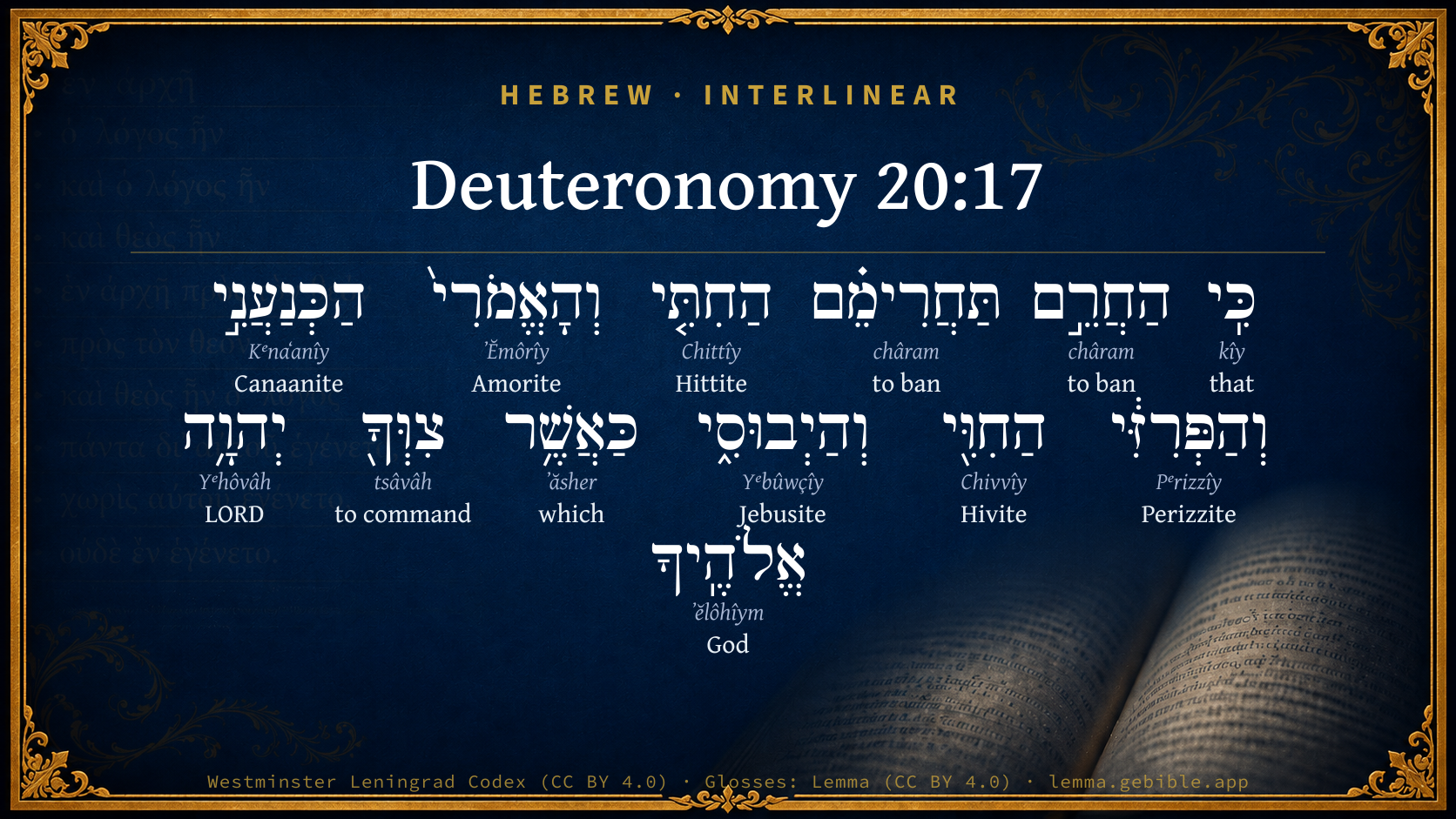
  1. כִּֽי kîy H3588 “that” Conjunction
  2. הַחֲרֵ֣ם châram H2763 “to ban” Verb, Hiphil, Infinitive Absolute
  3. תַּחֲרִימֵ֗ם châram H2763 “to ban · them” Verb, Hiphil, Imperfect, 2nd Person, Masculine, Singular + Suffix, Personal, 3rd Person, Masculine, Plural
  4. הַחִתִּ֤י Chittîy H2850 “the · Hittite” Particle, Definite Article + Noun, Gentilic, Masculine, Singular, Absolute
  5. וְהָאֱמֹרִי֙ ʼĔmôrîy H567 “and · the · Amorite” Conjunction + Particle, Definite Article + Noun, Gentilic, Masculine, Singular, Absolute
  6. הַכְּנַעֲנִ֣י Kᵉnaʻanîy H3669 “the · Canaanite” Particle, Definite Article + Noun, Gentilic, Masculine, Singular, Absolute
  7. הַחִוִּ֖י Chivvîy H2340 “the · Hivite” Particle, Definite Article + Noun, Gentilic, Masculine, Singular, Absolute
  8. וְהַיְבוּסִ֑י Yᵉbûwçîy H2983 “and · the · Jebusite” Conjunction + Particle, Definite Article + Noun, Gentilic, Masculine, Singular, Absolute
  9. כַּאֲשֶׁ֥ר ʼăsher H834 “like/as · which” Preposition + Particle, Relative
  10. צִוְּךָ֖ tsâvâh H6680 “to command · you” Verb, Piel, Perfect, 3rd Person, Masculine, Singular + Suffix, Personal, 2nd Person, Masculine, Singular
  11. יְהוָ֥ה Yᵉhôvâh H3068 “LORD” Noun, Proper
  12. אֱלֹהֶֽיךָ ʼĕlôhîym H430 “God(s) · your” Noun, Common, Masculine, Plural, Construct + Suffix, Personal, 2nd Person, Masculine, Singular

About this verse

These counts appear in no published source. They are computed here, from the morphology-tagged text and Lemma’s own curated glosses. What Lemma adds →

13
words
12
distinct lemmas
Pentateuch
section

Notable vocabulary

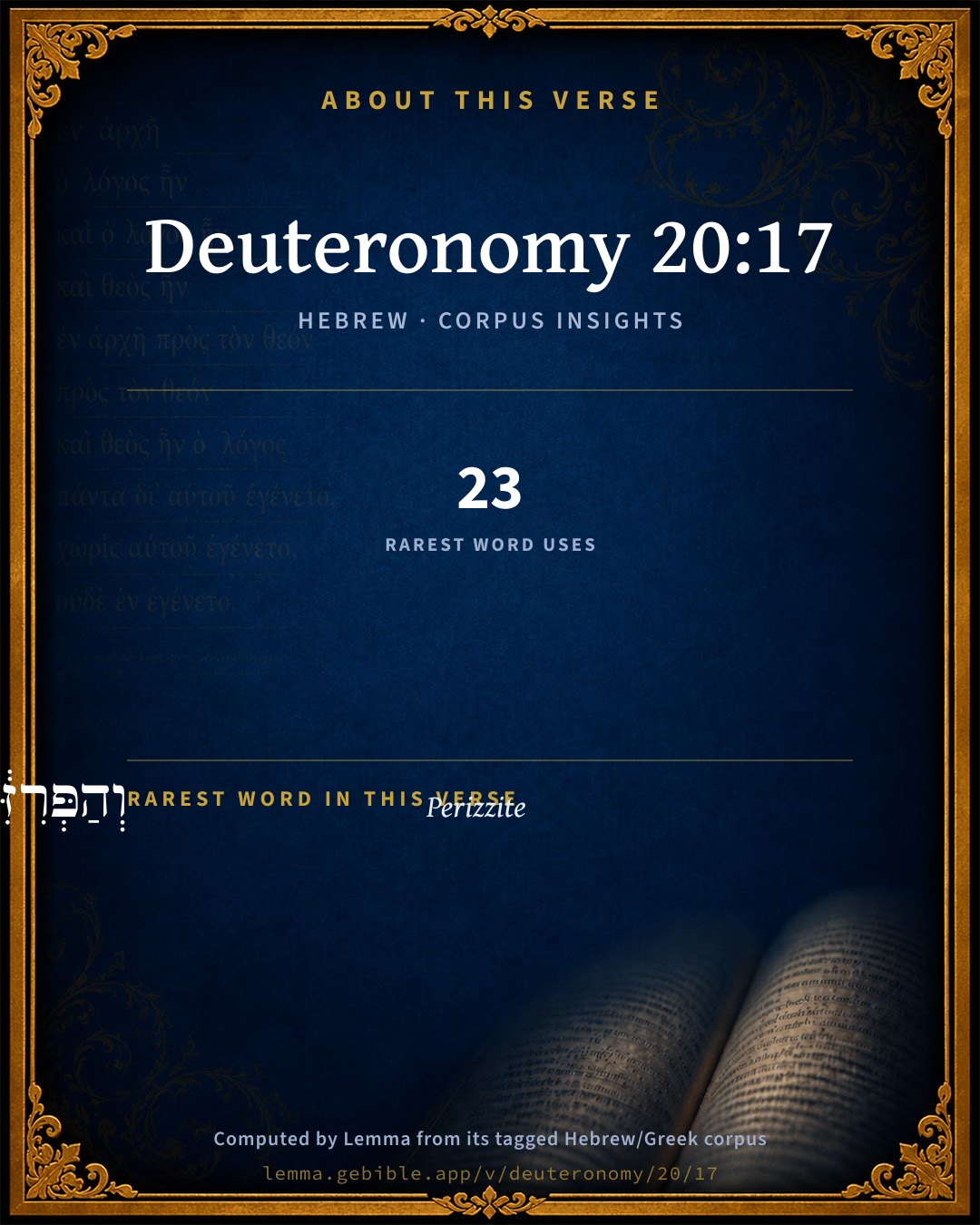
The rarest word here is וְהַפְּרִזִּ֔י Perizzite H6522 — appearing just 23 times in the whole Hebrew Bible.

Shared distinctive vocabulary

וְהַפְּרִזִּ֔י Perizzite H6522 occurs in 23 verses of the Hebrew Bible. Also found in:

Grammatical profile

  • 3 verbs
  • 8 nouns
  • 1 conjunction
  • 1 particle

Verb forms

  • הַחֲרֵ֣ם Hiphil · Infinitive Absolute
  • תַּחֲרִימֵ֗ם Hiphil · Imperfect
  • צִוְּךָ֖ Piel · Perfect

Repetition

A word recurs within this verse — often emphatic in Hebrew:

  • הַחֲרֵ֣ם to ban H2763 ×2

Hebrew & Septuagint length

In English translation the verse runs 28 words from the Hebrew and 33 from the Septuagint (LXX English) — closely comparable.

A rough comparison of the two English renderings, which tokenize alike — not a word-level alignment.

Word counts can differ between the Hebrew and the Greek without any difference in meaning — e.g. the Hebrew direct-object marker אֵת has no separate Greek word, and Greek often adds the article ὁ.

Cross-references

6

Topical passages linked to Deuteronomy 20:17 in the Treasury of Scripture Knowledge — connected by theme and wording, ordered by reader-vote popularity; previews shown in the World English Bible.

  • Deuteronomy 7:1–2 When Yahweh your God shall bring you into the land where you go to possess it, and shall cast out many nations before you, the Hittite, and the Girgashite, and the Amorite, and the Canaanite, and the Perizzite, and the Hivite, and the Jebusite, seven nations greater and mightier than you;
  • Isaiah 34:5–6 For my sword has drunk its fill in the sky: behold, it shall come down on Edom, and on the people of my curse, to judgment.
  • Jeremiah 48:10 Cursed be he who does the work of Yahweh negligently; and cursed be he who keeps back his sword from blood.
  • Jeremiah 50:35–40 A sword is on the Chaldeans, says Yahweh, and on the inhabitants of Babylon, and on her princes, and on her wise men.
  • Ezekiel 38:21–23 I will call for a sword against him to all my mountains, says the Lord Yahweh: every man's sword shall be against his brother.
  • Revelation 19:18 that you may eat the flesh of kings, the flesh of captains, the flesh of mighty men, and the flesh of horses and of those who sit on them, and the flesh of all men, both free and slave, and small and great."

Cross-references courtesy of OpenBible.info (CC BY 4.0).

Hebrew and Greek witnesses Masoretic Hebrew ↔ Greek Septuagint

The same verse in the two great witnesses to the Old Testament, shown verse-for-verse.

These are two independent witnesses, not word-aligned to each other, and the Septuagint is shown in lemma (dictionary) form.

Hebrew Deuteronomy 20:17 Masoretic · Westminster Leningrad Codex

כִּֽי הַחֲרֵ֣ם תַּחֲרִימֵ֗ם הַחִתִּ֤י וְהָאֱמֹרִי֙ הַכְּנַעֲנִ֣י וְהַפְּרִזִּ֔י הַחִוִּ֖י וְהַיְבוּסִ֑י כַּאֲשֶׁ֥ר צִוְּךָ֖ יְהוָ֥ה אֱלֹהֶֽיךָ

but you shall utterly destroy them: the Hittite, and the Amorite, the Canaanite, and the Perizzite, the Hivite, and the Jebusite; as Yahweh your God has commanded you;

World English Bible · Public Domain

Greek LXX Deuteronomy 20:17 Septuagint · lemma form

ἀλλά ἤ ἀνάθεμα ἀναθεματίζω αὐτός ὁ χετταῖος καί ἀμορραῖος καί χαναναῖος καί φερεζαῖος καί ευαῖος καί ιεβουσαῖος καί γεργεσαῖος ὅς τρόπος ἐντέλλομαι σύ κύριος ὁ θεός σύ

but you⌃ shall surely curse them, the Chettite, and the Amorite, and the Chananite, and the Pherezite, and the Evite, and the Jebusite, and the Gergesite; as the Lord your God commanded you:

LXX2012 (modern English Septuagint) · Public Domain

On this verse, The Cambridge Bible for Schools and Colleges discusses the Septuagint’s reading. Read the note in Commentary ↓

Hebrew: Westminster Leningrad Codex (CC BY 4.0). Greek: Septuagint (public domain); English from LXX2012 (modern English Septuagint) (Public Domain). How the Septuagint differs from the Hebrew →

Targum (Aramaic paraphrase)

2

The Targum is the ancient Jewish Aramaic paraphrase of the Hebrew Scriptures — an interpretive translation, not the Hebrew text itself. Onkelos (literal) and Pseudo-Jonathan (expansive) render the Torah, and Jonathan the Prophets. Coverage is partial: where no permissively-licensed English translation exists for a verse, only the Aramaic is shown. This is verse-level text, not a word-by-word alignment to the Hebrew.

  1. Targum Onkelos Torah (Genesis–Deuteronomy)
    אֲרֵי גַמָרָא תְגַמְרִנוּן חִתָּאֵי וֶאֱמֹרָאֵי כְּנַעֲנָאֵי וּפְרִזָאֵי חִוָאֵי וִיבוּסָאֵי כְּמָא דִי פַקְדָךְ יְיָ אֱלָהָךְ

    (no public-domain English translation for this verse)

    Targum Onkelos — Aramaic: “Onkelos Genesis” (public domain); “Onkelos Exodus” (public domain); “Onkelos Leviticus” (public domain); “Onkelos Numbers” (public domain); “Onkelos Deuteronomy” (public domain). English: “Sefaria Community Translation” (CC0 1.0 (public-domain dedication)); “J.W. Etheridge. The Targums of Onkelos and Jonathan Ben Uzziel on the Pentateuch. London: Longmans, Green, 1862” (public domain). Text via Sefaria.

  2. Targum Pseudo-Jonathan Torah (Genesis–Deuteronomy)
    אֲרוּם גַּמְרָא תְגַמְרִינוּן חִתָּאֵי וֶאֱמוֹרָאֵי כְּנַעֲנָאֵי וּפְרִיזָאֵי וְחִיוָואֵי וִיבוּסָאֵי הֵיכְמָא דְפַקֵּידְכוֹן יְיָ אֱלָהָכוֹן

    for destroying ye shall destroy them, Hittites, Amorites, Kenaanites, Pherizites, Hivites, and Jebusites, as the Lord your God hath commanded you;

    Targum Pseudo-Jonathan — Aramaic: “Targum Jonathan on Genesis” (public domain); “Targum Jonathan on Exodus” (public domain); “Targum Jonathan on Leviticus” (public domain); “Targum Jonathan on Numbers” (public domain); “Targum Jonathan on Deuteronomy” (public domain). English: “The Targum of Jonathan ben Uzziel, trans. J. W. Etheridge, London, 1862” (public domain). Text via Sefaria.

Commentary

Notes on Deuteronomy 20:17 from classic Christian and Jewish commentators (each source and its license shown beneath its notes). The classic Christian expositions comment on the surrounding passage and are grouped to its opening verse, so a note may address several verses; the Jewish commentaries on the Tanakh (Rashi and others) are per-verse, so they appear only where the commentator wrote on this verse.

Lemma curates 59 commentaries, every one of them public domain or Creative Commons licensed, each selected and text-cleaned for this edition rather than reprinted as found. About our sources →

Trapp's Complete Commentary

John Trapp

Deu 20:17 But thou shalt utterly destroy them; [namely], the Hittites, and the Amorites, the Canaanites, and the Perizzites, the Hivites, and the Jebusites; as the LORD thy God hath commanded thee:

Ver. 17. The Hivites and the Jebusites.] The Girgashites are not reckoned among the rest, as neither are they in Jos 9:1, haply because they accepted of conditions of peace.

John Trapp, A Commentary or Exposition upon All the Books of the Old and New Testament (1647–1656) — public domain. Text from a community e-Sword module.

Adam Clarke's Commentary

Verse 17. But thou shalt utterly destroy them] The above reasoning will gain considerable strength, provided we could translate כי החרם תחרימם hi hacharem tacharimem, thou shalt utterly subdue them - slaying them if they resist, and thus leaving nothing alive that breathed; or totally expel them from the land, or reduce them to a state of slavery in it, that they might no longer exist as a people. This certainly made them an anathema as a nation, wholly destroying their political existence. Probably this was so understood by the Gibeonites, viz., that they either must be slain or utterly leave the land, which last was certainly in their power, and therefore, by a stratagem, they got the princes of Israel to make a league with them. When the deceit was discovered, the Israelites, though not bound by their oath, because they were deceived by the Gibeonites, and therefore were under no obligation to fulfil their part of the covenant; yet, though they had this command before their eyes, did not believe that they were bound to put even those deceivers to death; but they destroyed their political existence, by making them hewers of wood and drawers of water to the congregation; i. e., slaves to the Israelites. (See Jos 9:23) Rahab and her household also were spared. So that it does not appear that the Israelites believed that they were bound to put every Canaanite to death. Their political existence was under the anathema, and this the Hebrews annihilated.

That many of the Canaanites continued in the land even to the days of Solomon, we have the fullest proof; for we read, 2Ch 8:7: "All the people of the land that were left of the Hittites, Amorites, Perizzites, Hivites, and Jebusites, who were left in the land, whom the children of Israel consumed not, them did Solomon make to pay tribute to this day." Thus Solomon destroyed their political existence, but did not consider himself bound by the law of God to put them to death.

Adam Clarke's Commentary on the Bible (1810–1826) — public domain. Text from a community e-Sword/MySword module.

The Cambridge Bible for Schools and Colleges

gen. ed. J. J. S. Perowne

17. utterly destroy them] put them to the ḥerem in its severer form (see on Deu_2:34). But from the passages quoted above on tributary, Deu_20:11, we see that Israel did not put these nations to the ban but only to forced labour. Here D did not mitigate but aggravate the fate of the peoples conquered by Israel, and as Islam did, from religious motives.

the Hittite, etc.] Six nations, but LXX adds the missing seventh, the Girgashite. See on Deu_7:1.

as … commanded thee] may be an editorial addition founded on Deu_7:2; Deu_7:25, cp. Exo_23:31-33.

The Cambridge Bible for Schools and Colleges (gen. ed. J. J. S. Perowne; Cambridge University Press, 1878–1918) — public domain. Text from a community e-Sword module.

John Gill's Exposition

But thou shalt utterly destroy them,.... Men, women, and children: some think this is to be understood only of such cities which did not accept of terms of peace; for they are of opinion that Joshua made proclamation of peace to all the cities of Canaan; which being not complied with, he destroyed them as they fell into his hands; and they suppose that the Gibeonites had not heard of such a proclamation, and therefore were spared; and it is certain that there were many who were suffered to live among them, who it may be thought were allowed on their becoming proselytes, which was one of the terms of peace, as Rahab and her household did, and which is the sense of some of the Jewish writers. Jarchi on the following verse observes, that if they repented, and became proselytes, they might be received: namely:

the Hittites and the Amorites, the Canaanites and the Perizzites, the Hivites and the Jebusites; one of the seven nations is here omitted, the Girgashites, as they are also in Exo 23:23. It is said (b), that"Joshua sent three letters into the land of Israel before they went into it; in the first, whoever would turn (and flee) might; in the second, whoever would make peace might; in the third, whoever would make war might: the Girgashites, believing God, went to Africa, according to Isa 36:17, the land there is Africa; the Gibeonites made peace and dwelt in the land; thirty one kings made war, and fell:"

as the Lord thy God hath commanded thee; Deu 7:1.

(b) T. Hieros. Shebiith, fol. 37. 3. Debarim Rabba, sect. 5. fol. 241. 2. Vid. Maimon. Hilchot Melachim, c. 6. sect. 5. & Migdol Oz in ib.

John Gill's Exposition of the Whole Bible (1746–1763) — public domain (CC PDM 1.0). Text via the HelloAO Bible API.

Haydock's Catholic Bible Commentary

Jebusite. Samaritan and Septuagint add, "the Gergesite." (Calmet)

George Leo Haydock (1774–1849), Haydock's Catholic Family Bible and Commentary, 1859 edition — public domain. Excludes Psalms (Douay-Rheims chapter numbering differs from Protestant) and Deuterocanonical books (Catholic canon only).

Rashi

Rabbi Shlomo Yitzchaki (Rashi)

כאשר צוך [BUT THOU SHALT DOOM THEM TO DESTRUCTION: THE HITTITES, … AND THE JEBUSITES,] AS [THE LORD THY GOD] HATH COMMANDED THEE — The words: “as God hath commanded thee” are intended to include the Girgashites (the seventh nation that is not mentioned here) (Sifrei Devarim 201:4).

Rashi on the Tanakh — English translations: “The Judaica Press complete Tanach with Rashi, translated by A. J. Rosenberg” (CC BY 4.0); “Pentateuch with Rashi's commentary by M. Rosenbaum and A.M. Silbermann, 1929-1934” (public domain); “The Metsudah Tanach series, Lakewood, N.J” (CC BY 4.0); and “The Book of Joshua, Metsudah Publications, 1997” (CC BY 4.0). Text via Sefaria.

Lesson kit

Teaching starters — assembled from the data on this page, not authored interpretation. Every prompt links to the verse data it draws on. Edit before teaching.

Deuteronomy, in the Pentateuch, opens this verse with 13 words (12 distinct Hebrew lemmas). Its most distinctive word is Pᵉrizzîy (“Perizzite”). A historical commentator’s framing appears above. Read the whole chapter for the surrounding context.

Discussion questions

  1. How does “Perizzite” (Pᵉrizzîy) shape what this verse is saying?
  2. How does Genesis 13:7, which shares the word «Perizzite», read alongside this verse?
  3. What does the repetition of “to ban” (2× in this one verse) do in this verse?
  4. These translations render this verse differently; the difference is in the English rendering, not the original. What questions does that raise?
  5. «הַחֲרֵ֣ם» is a Hiphil Infinitive Absolute verb. How does that grammatical form shape the action described?
  6. Compare how Trapp's Complete Commentary and Adam Clarke's Commentary read this verse. Where do they agree or differ?

Things to notice

Reading settings

Reading text

Shown beneath each verse's original-language words.

Old Testament
Old Testament edition

Read the OT as the Masoretic Hebrew (MT) or the Greek Septuagint (LXX).

English shown for the Greek Septuagint (in the Hebrew ↔ Greek comparison).

Comparing translations? Open the Compare panel on any verse page to stack up to four side by side.