Joshua 1:16

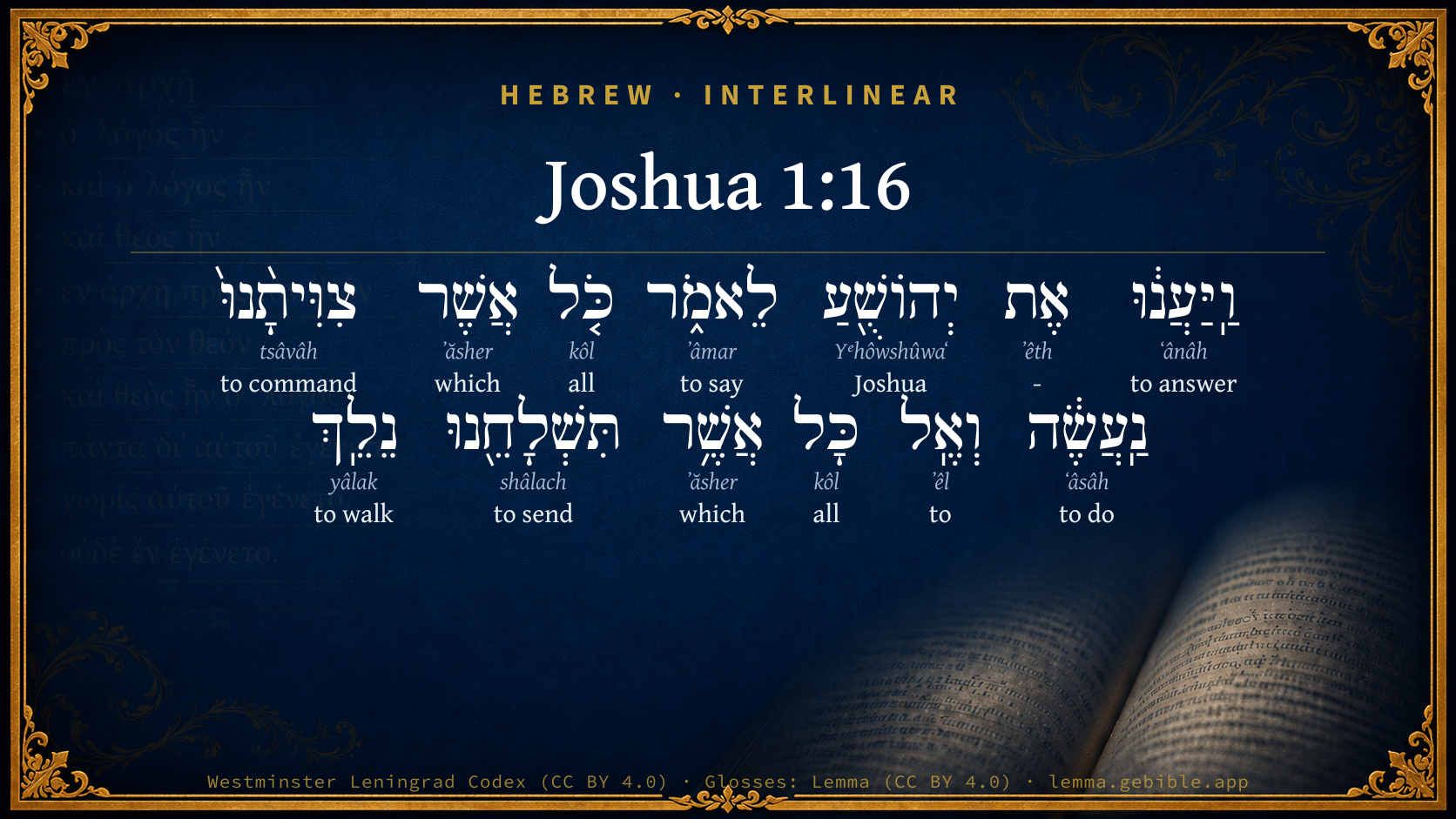
Hebrew (Westminster Leningrad Codex) Joshua 1:16 appears in the Hebrew Old Testament. The text above is from the Westminster Leningrad Codex. Each word links to its Strong’s number, a concise gloss, and parsing drawn from the Open Scriptures Hebrew Bible morphology. Click any word for its full Brown-Driver-Briggs (BDB) entry.
Download image
Cite this verse

Joshua 1:16 (World English Bible). Public Domain. Lemma interlinear Bible study tool, https://lemma.gebible.app/v/joshua/1/16.

Show BibTeX & RIS
BibTeX
RIS
English Translation
They answered Joshua, saying, All that you have commanded us we will do, and wherever you send us we will go.
World English Bible · Public Domain
Download a study sheet

One document with this verse’s original text, its word-by-word gloss line, the meaning frame, cross-references with their text, attributed commentary, and full source and license credits — printable, and it pastes into notes with its structure intact.

This verse Autodidact and up

Study sheet (.html) Plain text (.txt)

A passage Seminary Student

Up to 50 verses in one chapter. A passage sheet keeps up to 6 commentary sources and 12 cross-references per verse, in the order this page ranks them, and says so on the sheet whenever that leaves anything out. Ask for a single verse and you get the Autodidact verse sheet above.

Everything on this page stays free to read, with no account — the sheet is a download of what is already on screen, not access to it.

Want to remove ads? Support Godless Engineer
Compare translations 3

The same verse in 3 English versions, stacked beneath the original-language interlinear above. Click any original word for its lexicon entry.

Each is an independent rendering of the whole verse — the interlinear is not word-aligned to these translations.

Highlighted words mark where these versions differ — a whole-verse word diff, not a word-by-word alignment.

  • World English Bible Public Domain
    They answered Joshua, saying, All that you have commanded us we will do, and wherever you send us we will go.
  • King James Version Public Domain
    And they answered Joshua, saying, All that thou commandest us we will do, and whithersoever thou sendest us, we will go.
  • unfoldingWord Literal Text CC BY-SA 4.0
    And they answered Joshua, saying, “All of what you have commanded us, we will do, and to everywhere you send us, we will go.

unfoldingWord Literal Text — © unfoldingWord, licensed CC BY-SA 4.0. Word-aligned USFM3 via Door43 (git.door43.org/unfoldingWord/en_ult).

Versions to compare (up to 4)

3 of 4 selected

Show all 18 translations

Every available English version of this verse, each an independent rendering of the whole verse.

  • World English Bible Public Domain
    They answered Joshua, saying, All that you have commanded us we will do, and wherever you send us we will go.
  • Berean Standard Bible Public Domain
    So they answered Joshua, “Everything you have commanded us we will do, and everywhere you send us we will go.
  • Majority Standard Bible Public Domain
    So they answered Joshua, “Everything you have commanded us we will do, and everywhere you send us we will go.
  • King James Version Public Domain
    And they answered Joshua, saying, All that thou commandest us we will do, and whithersoever thou sendest us, we will go.
  • American Standard Version (1901) Public Domain
    And they answered Joshua, saying, All that thou hast commanded us we will do, and whithersoever thou sendest us we will go.
  • Revised Version (1885) Public Domain
    And they answered Joshua, saying, All that thou hast commanded us we will do, and whithersoever thou sendest us we will go.
  • Geneva Bible (1599) Public Domain
    Then they answered Ioshua, saying, Al that thou hast commanded vs, we will doe, and whithersoeuer thou sendest vs, we will goe.
  • Douay-Rheims (1899) Public Domain
    And they made answer to Josue, and said: All that thou hast commanded us we will do; and whithersoever thou shalt send us, we will go.
  • Young's Literal Translation Public Domain
    And they answer Joshua, saying, `All that thou hast commanded us we do; and unto every `place' whither thou dost send us, we go;
  • Literal Standard Version CC BY-SA 4.0
    And they answer Joshua, saying, “All that you have commanded us we do; and to every [place] to where you send us, we go;
  • Unlocked Literal Bible CC BY-SA 4.0
    Then they answered Joshua, saying, “All that you have commanded us we will do, and wherever you send us we will go.
  • unfoldingWord Literal Text CC BY-SA 4.0
    And they answered Joshua, saying, “All of what you have commanded us, we will do, and to everywhere you send us, we will go.
  • Darby Bible Public Domain
    And they answered Joshua, saying, All that thou hast commanded us will we do, and whither thou shalt send us will we go.
  • World Messianic Bible Public Domain
    They answered Joshua, saying, “All that you have commanded us we will do, and wherever you send us we will go.
  • Webster's Bible Public Domain
    And they answered Joshua, saying, All that thou commandest us, we will do, and whithersoever thou sendest us, we will go.
  • Free Bible Version CC BY-SA 4.0
    They said to Joshua, “We will do everything you have ordered us to do, and we will go wherever you send us.
  • Bible in Basic English Public Domain
    Then they said to Joshua in answer, Whatever you say to us we will do, and wherever you send us we will go.
  • JPS Tanakh (1917) Public Domain
    And they answered Joshua, saying: 'All that thou hast commanded us we will do, and whithersoever thou sendest us we will go.

Literal Standard Version (2020), Covenant Press — licensed CC BY-SA 4.0. Text via the HelloAO Bible API (eBible.org). Unlocked Literal Bible (unfoldingWord) — licensed CC BY-SA 4.0. Text via the HelloAO Bible API (eBible.org). unfoldingWord Literal Text — © unfoldingWord, licensed CC BY-SA 4.0. Word-aligned USFM3 via Door43 (git.door43.org/unfoldingWord/en_ult). Free Bible Version, Dr. Jonathan Gallagher — licensed CC BY-SA 4.0. Text via the HelloAO Bible API (eBible.org).

Word by word

More ways to search: Search by grammar → Find every occurrence → Compare this word →

Practice this passage: Drill this verse → Learn its vocabulary →

יְהוֹשֻׁ֖עַ
Yᵉhôwshûwaʻ
H3091
“Joshua”
Noun, Proper
Part of Speech
Noun
Type
Proper
Full BDB Definition

Origin: from H3068 and H3467

TWOT: None

Joshua or Jehoshua = "Jehovah is salvation" - son of Nun of the tribe of Ephraim and successor to Moses as the leader of the children of Israel; led the conquest of Canaan - a resident of Beth-shemesh on whose land the Ark of the Covenant came to a stop after the Philistines returned it - son of Jehozadak and high priest after the restoration - governor of Jerusalem under king Josiah who gave his name to a gate of the city of Jerusalem
  1. וַֽיַּעֲנ֔וּ ʻânâh H6030 “and · to answer” Conjunction + Verb, Qal, Sequential Imperfect, 3rd Person, Masculine, Plural
  2. אֶת ʼêth H853 “-” Particle, Direct Object
  3. לֵאמֹ֑ר ʼâmar H559 “to say” Preposition + Verb, Qal, Infinitive Construct
  4. כֹּ֤ל kôl H3605 “all” Noun, Common, Masculine, Singular, Absolute
  5. אֲשֶׁר ʼăsher H834 “which” Particle, Relative
  6. צִוִּיתָ֨נוּ֙ tsâvâh H6680 “to command · us” Verb, Piel, Perfect, 2nd Person, Masculine, Singular + Suffix, Personal, 1st Person, Common, Plural
  7. נַֽעֲשֶׂ֔ה ʻâsâh H6213 “to do” Verb, Qal, Imperfect, 1st Person, Common, Plural
  8. וְאֶֽל ʼêl H413 “and · to” Conjunction + Preposition
  9. כָּל kôl H3605 “all of” Noun, Common, Masculine, Singular, Construct
  10. אֲשֶׁ֥ר ʼăsher H834 “which” Particle, Relative
  11. תִּשְׁלָחֵ֖נוּ shâlach H7971 “to send · us” Verb, Qal, Imperfect, 2nd Person, Masculine, Singular + Suffix, Personal, 1st Person, Common, Plural
  12. נֵלֵֽךְ yâlak H3212 “to walk” Verb, Qal, Imperfect, 1st Person, Common, Plural

About this verse

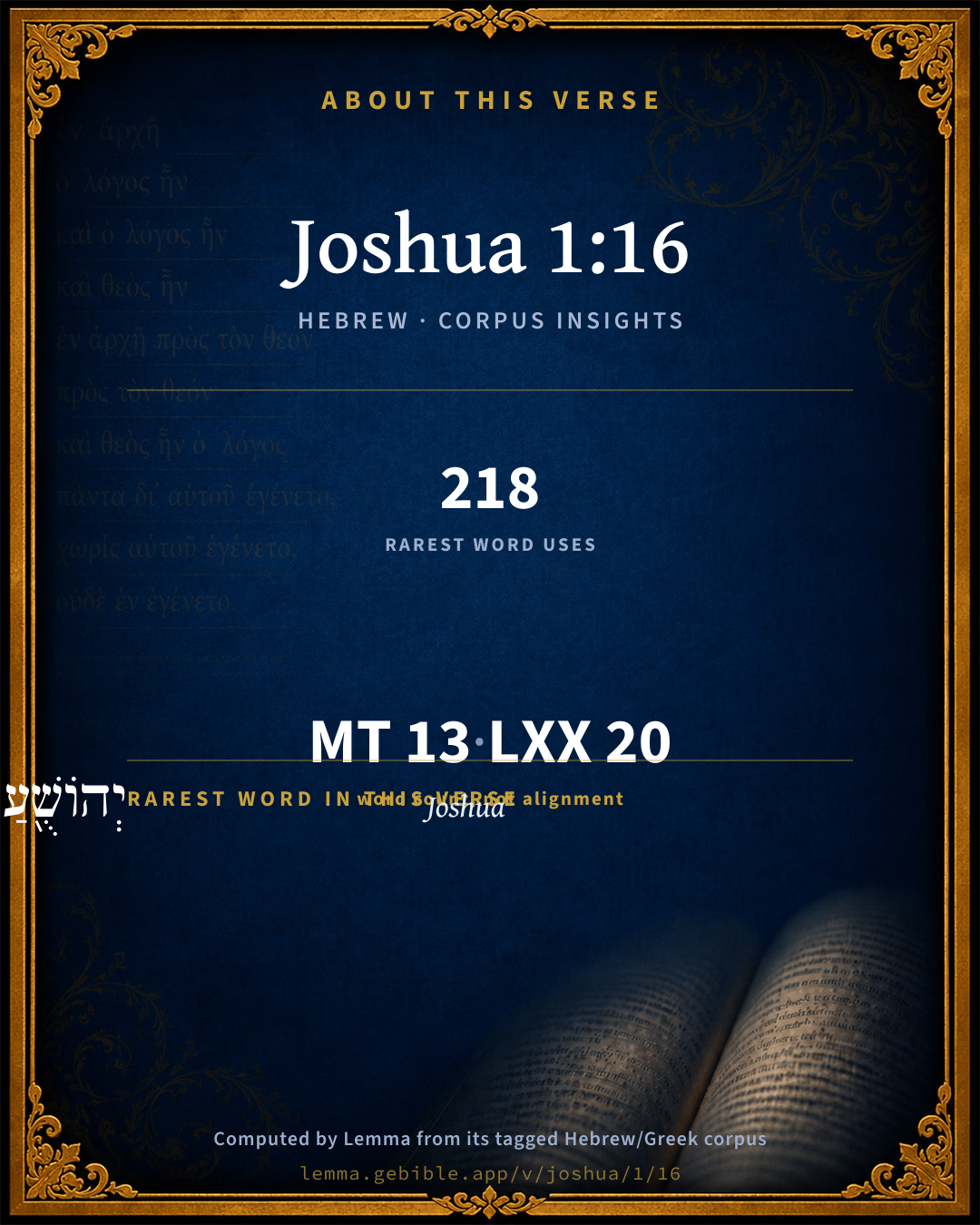
These counts appear in no published source. They are computed here, from the morphology-tagged text and Lemma’s own curated glosses. What Lemma adds →

13
words
11
distinct lemmas
Historical
section

Grammatical profile

  • 6 verbs
  • 3 nouns
  • 1 preposition
  • 3 particles

Verb forms

  • וַֽיַּעֲנ֔וּ Qal · Sequential Imperfect
  • לֵאמֹ֑ר Qal · Infinitive Construct
  • צִוִּיתָ֨נוּ֙ Piel · Perfect
  • נַֽעֲשֶׂ֔ה Qal · Imperfect
  • תִּשְׁלָחֵ֖נוּ Qal · Imperfect
  • נֵלֵֽךְ Qal · Imperfect

Repetition

Words recur within this verse — often emphatic in Hebrew:

  • כֹּ֤ל all H3605 ×2
  • אֲשֶׁר which H834 ×2

Hebrew & Septuagint length

In English translation the verse runs 21 words from the Hebrew and 27 from the Septuagint (LXX English) — closely comparable.

A rough comparison of the two English renderings, which tokenize alike — not a word-level alignment.

Word counts can differ between the Hebrew and the Greek without any difference in meaning — e.g. the Hebrew direct-object marker אֵת has no separate Greek word, and Greek often adds the article ὁ.

In the original languages it is 13 Hebrew tokens and 20 Greek tokens — but the two are counted differently (Hebrew bundles its prefixes and suffixes into one token; the Greek is in lemma form), so that isn’t a like-for-like length.

Cross-references

5

Topical passages linked to Joshua 1:16 in the Treasury of Scripture Knowledge — connected by theme and wording, ordered by reader-vote popularity; previews shown in the World English Bible.

  • Titus 3:1 Remind them to be in subjection to rulers and to authorities, to be obedient, to be ready for every good work,
  • Deuteronomy 5:27 Go you near, and hear all that Yahweh our God shall say: and speak you to us all that Yahweh our God shall speak to you; and we will hear it, and do it.
  • Romans 13:1–5 Let every soul be in subjection to the higher authorities, for there is no authority except from God, and those who exist are ordained by God.
  • 1 Peter 2:13–15 Therefore subject yourselves to every ordinance of man for the Lord's sake: whether to the king, as supreme;
  • Numbers 32:25 The children of Gad and the children of Reuben spoke to Moses, saying, Your servants will do as my lord commands.

Cross-references courtesy of OpenBible.info (CC BY 4.0).

Hebrew and Greek witnesses Masoretic Hebrew ↔ Greek Septuagint

The same verse in the two great witnesses to the Old Testament, shown verse-for-verse.

These are two independent witnesses, not word-aligned to each other, and the Septuagint is shown in lemma (dictionary) form.

Hebrew Joshua 1:16 Masoretic · Westminster Leningrad Codex

וַֽיַּעֲנ֔וּ אֶת יְהוֹשֻׁ֖עַ לֵאמֹ֑ר כֹּ֤ל אֲשֶׁר צִוִּיתָ֨נוּ֙ נַֽעֲשֶׂ֔ה וְאֶֽל כָּל אֲשֶׁ֥ר תִּשְׁלָחֵ֖נוּ נֵלֵֽךְ

They answered Joshua, saying, All that you have commanded us we will do, and wherever you send us we will go.

World English Bible · Public Domain

Greek LXX Joshua 1:16 Septuagint · lemma form

καί ἀποκρίνω ὁ ἰησοῦς εἶπον πᾶς ὅσος ἄν ἐντέλλομαι ἐγώ ποιέω καί εἰς πᾶς τόπος οὗ ἐάν ἀποστέλλω ἐγώ πορεύομαι

And they answered Joshua and said, We will do all things which you command us, and we will go to every place whither you shall send us.

LXX2012 (modern English Septuagint) · Public Domain

Hebrew: Westminster Leningrad Codex (CC BY 4.0). Greek: Septuagint (public domain); English from LXX2012 (modern English Septuagint) (Public Domain). How the Septuagint differs from the Hebrew →

Targum (Aramaic paraphrase)

1

The Targum is the ancient Jewish Aramaic paraphrase of the Hebrew Scriptures — an interpretive translation, not the Hebrew text itself. Onkelos (literal) and Pseudo-Jonathan (expansive) render the Torah, and Jonathan the Prophets. Coverage is partial: where no permissively-licensed English translation exists for a verse, only the Aramaic is shown. This is verse-level text, not a word-by-word alignment to the Hebrew.

  1. Targum Jonathan Prophets (Joshua–Malachi)
    וַאֲתִיבוּ יַת יְהוֹשֻׁעַ לְמֵימָר כֹּל דְפַקֵדְתָּנָא נַעֲבַד וּלְכָל אֲתַר דְתִשְׁלַחְנָנָא נְהַךְ:

    (no public-domain English translation for this verse)

    Targum Jonathan — Aramaic: “Mikraot Gedolot” (public domain). English: “Sefaria Community Translation” (CC0 1.0 (public-domain dedication)); “London "Chaldee Paraphrase," 1871” (public domain). Text via Sefaria.

Commentary

Notes on Joshua 1:16 from classic Christian and Jewish commentators (each source and its license shown beneath its notes). The classic Christian expositions comment on the surrounding passage and are grouped to its opening verse, so a note may address several verses; the Jewish commentaries on the Tanakh (Rashi and others) are per-verse, so they appear only where the commentator wrote on this verse.

Lemma curates 59 commentaries, every one of them public domain or Creative Commons licensed, each selected and text-cleaned for this edition rather than reprinted as found. About our sources →

Trapp's Complete Commentary

John Trapp

Jos 1:16 And they answered Joshua, saying, All that thou commandest us we will do, and whithersoever thou sendest us, we will go.

Ver. 16. And they answered.] Not the two tribes and half only, but the whole people promise homage and fidelity to Joshua, and wish well to his government.

All that thou commandest us.] A promise as large as that of Laelius in Lucan made to Caesar,

“ Iussa sequi tam velle mihi quam posse necesse est. ”

John Trapp, A Commentary or Exposition upon All the Books of the Old and New Testament (1647–1656) — public domain. Text from a community e-Sword module.

Joseph Benson's Commentary

Jos 1:16-17. And they answered — Not the two tribes and a half only, but the officers of all the people, in their name, concurring with the divine appointment, by which Joshua was set over them. Thus must we swear allegiance to our Lord Jesus, as the captain of our salvation. Will we hearken unto thee — The same obedience which we owed to Moses, we promise unto thee. With Moses — This is not a limitation of their obedience, as if they would not obey him any longer than he was prosperous, but an additional prayer for him. As we have hereby promised thee our obedience, so our prayer shall be, that God would bless and prosper thee, as he did Moses.

Joseph Benson's Commentary on the Old and New Testaments (1811–1818) — public domain. Text from a community e-Sword module.

Whedon's Commentary on the Bible

Daniel D. Whedon

OATH OF ALLEGIANCE TO JOSHUA, Jos_1:16-18.

16. That thou commandest we will do — A response not only from the eastern tribes, but also, probably, from the entire nation, encouraging to the spirit of the new commander. He must have regarded it as a formal expression of their loyalty to his authority. Like true patriots, in their nation’s extremity they volunteer under their great captain.

Daniel D. Whedon (gen. ed.), Commentary on the Old and New Testaments (1874–1909) — public domain. Text from a community e-Sword module.

Matthew Henry's Commentary

This answer was given not by the two tribes and a half only (though they are spoken of immediately before), but by the officers of all the people (Jos 1:10), as their representatives, concurring with the divine appointment, by which Joshua was set over them, and they did it heartily, and with a great deal of cheerfulness and resolution.

I. They promise him obedience (v. 16), not only as subjects to their prince, but as soldiers to their general, of whose particular orders they are to be observant. He that hath soldiers under him saith to this man, Go, and he goeth; and to another, Come, and he cometh, Mat 8:9. Thus the people of Joshua; "All that thou commandest us we will readily do, without murmuring or disputing; and whithersoever thou sends us, though upon the most difficult and perilous expedition, we will go." We must thus swear allegiance to our Lord Jesus, as the captain of our salvation, and bind ourselves to do what he commands us by his word, and to go where he sends us by his providence. And since Joshua, being humbly conscious to himself how far short he came of Moses, feared he should not have such an influence upon the people and such an interest in them as Moses had, they here promise that they will be as obedient to him as ever they had been to Moses, Jos 1:17. To speak truth, they had no reason to boast of their obedience to Moses; he had found them a stiff-necked people, Deu 9:24. But they meant that they would be as observant of Joshua as they should have been, and as some of them were (and the generality of them at least sometimes) of Moses. Note, We must not so magnify those that are gone, how eminent soever they were, either in the magistracy or in the ministry, as to be wanting in the honour and duty we owe to those that survive and succeed them, though in gifts they may come short of them. Obedience for conscience' sake will continue, though Providence change the hands by which it rules and acts.

II. They pray for the presence of God with him (Jos 1:17): "Only the Lord thy God be with thee, to bless and prosper thee, and give thee success, as he was with Moses." Prayers and supplications are to be made for all in authority, Ti1 2:1, Ti1 2:2. And the best thing we can ask of God for our magistrates is that they may have the presence of God with them; this will make them blessings to us, so that in seeking this for them we consult our own interest. A reason is here intimated why they would obey him as they had obeyed Moses, because they believed (and in faith prayed) that God's presence would be with him as it was with Moses. Those that we have reason to think have favour from God should have honour and respect from us. Some understand it as a limitation of their obedience: "We will obey only as far as we perceive the Lord is with thee, but no further. while thou keepest close to God we will keep close to thee; hitherto shall our obedience come, but no further." But they were so far from having any suspicion of Joshua's deviating from the divine rule that there needed not such a proviso.

III. They pass an act to make it death for any Israelite to disobey Joshua's orders, or rebel against his commandment, Jos 1:18. Perhaps if such a law had been made in Moses's time it might have prevented many of the rebellions that were formed against him; for most men fear the sword of the magistrate more than the justice of God. Yet there was a special reason for the making of this law now that they were entering upon the wars of Canaan; for in times of war the severity of military discipline is more necessary than at other times. Some think that in this statute they had an eye to that law concerning the prophet God would raise up like unto Moses, which they think, though it refer chiefly to Christ, yet takes in Joshua by the way as a type of him, that whosoever would not hearken to him should be cut off from his people. Deu 18:19, I will require it of him.

IV. They animate him to go on with cheerfulness in the work to which God had called him; and, in desiring that he would be strong and of a good courage, they did in effect promise him that they would do all they could, by an exact, bold, and cheerful observance of all his orders, to encourage him. It very much heartens those that lead in a good work to see those that follow follow with a good will. Joshua, though of approved valour, did not take it as an affront, but as a great kindness, for the people to bid him be strong and of a good courage.

Matthew Henry's Commentary on the Whole Bible (1708–1710) — public domain (CC PDM 1.0). Text via the HelloAO Bible API.

Adam Clarke's Commentary

Verse 16. All that thou commandest us we will do] Here they acknowledge the Divine mission of Joshua, as they had done that of Moses, and consequently promise to follow his directions in all things.

Adam Clarke's Commentary on the Bible (1810–1826) — public domain. Text from a community e-Sword/MySword module.

John Calvin's Commentaries

16. And they answered, etc They not only acquiesce, but freely admit and explicitly detail the obedience which they owe. Our obligations are duly discharged only when we perform them cheerfully, and not in sadness, as Paul expresses it. (2 Corinthians 9:7.) If it is objected that there is little modesty in their boast of having been obedient to Moses whom they had often contradicted, I answer, that though they did not always follow with becoming ardor, yet they were so much disposed to obey, that their moderation was not only tolerable, but worthy of the highest praise, when it is considered how proudly their fathers rebelled, and how perversely they endeavored to shake off a yoke divinely imposed upon them. For the persons who speak here were not those rebellious spirits of whom God complains (Psalm 95:8-11) that he was provoked by them, but persons who, subdued by the examples of punishment, had learned quietly to submit.

Indeed, it is not so much to herald their own virtues as to extol the authority of Joshua, when they declare that they will regard him in the same light in which they regarded Moses. The groundwork of their confidence is at the same time expressed in their wish or prayer, that God may be present to assist his servant Joshua as he assisted his servant Moses. They intimate that they will be ready to war under the auspices of their new leader, because they are persuaded that he is armed with the power and hope that he will be victorious by the assistance of God, as they had learned by experience how wonderfully God assisted them by the hand of Moses. We may infer, moreover, that they actually felt this confidence, both because they call to mind their experiences of God’s favor to animate themselves, and because they regard Joshua as the successor of Moses in regard to prosperous results.

The epithet thy God is not without weight, as it evidently points to a continued course of divine favor. The form of expression also is intermediate between the confidence of faith and prayer. Accordingly, while they intimate that they cherish good hope in their minds, they at the same time have recourse to prayer, under a conviction of the arduousness of the work. Immediately after, when they of their own accord exhort him to constancy, they show that they are ready to follow and to imitate him in his confidence. Here, it is to be observed, that though Joshua was a model of courage, and animated all, both by deed and precept, he was in his turn stimulated onwards, that his own alacrity might be more effectual in arousing that of the people.

John Calvin's Commentaries (1540-1563) — public domain. Text from the Calvin Translation Society English edition (1840s-50s) via the Christian Classics Ethereal Library (ccel.org). Calvin's coverage is partial (roughly two-thirds of the Bible); uncommented books and verses are honest gaps, never fabricated. The 19th-century editor's footnotes and remarks are omitted so the notes are faithfully Calvin's own voice.

Ellicott's Commentary for English Readers

(16) They answered Joshua, saying, All that thou commandest us we will do.—This promise of obedience may be taken as the reply of the whole people to Joshua’s orders, not that of the two and a half tribes alone. It is remarkable that they repeat to him the words of Jehovah, as most appropriate in their judgment: “Be strong and of a good courage” (Jos_1:18).

A Bible Commentary for English Readers, edited by Charles John Ellicott (1878–1897) — public domain. Text from a community e-Sword module.

The Cambridge Bible for Schools and Colleges

gen. ed. J. J. S. Perowne

16. All that thou commandest us] A joyful answer instinct with a spirit of true fraternal love and resolute obedience.

The Cambridge Bible for Schools and Colleges (gen. ed. J. J. S. Perowne; Cambridge University Press, 1878–1918) — public domain. Text from a community e-Sword module.

John Gill's Exposition

And they answered Joshua,.... The two tribes of Gad and Reuben, and the half tribe of Manasseh, the heads of them, such as were deputed for that purpose, and were their mouths to him:

saying, all that thou commandest we will do; with respect to this affair of going over Jordan with their brethren, to assist them in the conquest of the land of Canaan:

and whithersoever thou sendest us, we will go; in what position he would have them be in the army, and to whatsoever part of the country he should send them to subdue, and to whatsoever city he should order them to besiege.

John Gill's Exposition of the Whole Bible (1746–1763) — public domain (CC PDM 1.0). Text via the HelloAO Bible API.

Matthew Poole's English Annotations

They answered, i.e. the Reubenites, &c., mentioned Jos 1:12, to whom Joshua’s discourse is confined, Jos 1:13-15. No doubt the other tribes expressed the same thing; but this is only recorded concerning these, because that might seem most doubtful, and the obedience of the rest was unquestionable.

Matthew Poole's English Annotations on the Holy Bible (1683–1685) — public domain. Text from a community e-Sword/MySword module.

The Pulpit Commentary

THE PEOPLE"S ANSWER.

And they answered Joshua, saying. We may compare this joyful willingness with the murmurings of the people in the wilderness, and their rebellion after the death of those who led them into the promised land. (cf. Jos_24:31 with Jud_1:2:10, 11, etc.) Obedience is easy when all goes well with us, and when it makes no demand upon our faith. The Israelites murmured when the promise was as yet unfulfilled. They rebelled against God when obedience entailed serf sacrifice. But now all was hope and eagerness. So it is often with the young Christian at the outset of life"s battle, before he has begun to realise the exertion and self denial that can alone ensure him victory.

HOMILIES BY S.R. ALDRIDGE Vers. 16-18. Loyalty.

A demand had been made that the "men of valour" of these tribes should leave their relatives and property in the fenced cities of their inheritance, and head the advance of the Israelites into Canaan. A call to a dangerous position, to bear, as it seemed, the brunt of the enemy"s attack; a summons to exercise self denial in absence from home and possessions; the precept issuing, too, from unaccustomed lips, those of a new general. These verses record a courageous, generous response, which may well furnish matter for meditation and imitation.

I A DECLARATION OF OBEDIENCE.

1. A prompt assent. No time for thought and preparation asked for. No reasons invented for delay.

2. A hearty assent. It is expressed in three forms: a promise to do what is commanded, to go where sent, and to hearken when addressed. These phrases cover all possible kinds of precepts.

3. Promise of unreserved obedience. "All," "whithersoever," and "in all things," thus blocking the smallest loophole of escape in each case. No picking and choosing here of the mandates to which they will conform.

Such complete acquiescence as this can be required of us only with respect to Him who is the Captain of our salvation. With regard to other subalterns of His, and to the national sovereign, there are occasions on which refusal and resistance are justifiable. Consider the grounds on which we owe fealty to Jesus Christ. He is our Lord as Creator, "by him were all things made," and as Redeemer, "that they which live should not henceforth live unto themselves," etc.

II A PRAYER OFFERED FOR THE LEADER. "Only the Lord thy God be with thee as he was with Moses.

1. This petition recognised the fount of authority. The warriors readily complied with the demand of Joshua because they believed that he was appointed to occupy the place of Moses. Joshua was henceforth to receive and utter the directions of the Almighty, to be His vicegerent to the Israelites. And on this foundation Jesus Christ often based His claims to be heard by the Jews, viz., that He was sent from God and spoke the words of God. He pointed to His mighty works in evidence of the truth of His pretensions. Nicodemus declared, "No man can do these miracles that thou doest except God be with him." The Father openly signified His approval of the Son"s mission, "This is my beloved Son, hear ye him." The Jewish king was the "anointed of the Lord. "The powers that be are ordained of God." Pastors under the Christian dispensation are "over" men "in the Lord." "Remember them who have the rule over you, who have spoken unto you the word of God." "Obey them that have the rule over you, and submit yourselves, for they watch for your souls as they that must give account.

2. The prayer invokes the presence of God as the leader"s source of strength. By prayer we can commend to Divine grace "all that are in authority." How the Apostle Paul reiterated his request that the readers of his epistles would earnestly pray on his behalf! When Peter was miraculously released from prison he found "many gathered together praying." Thus may the people aid their minister, as Aaron and Hur upheld Moses" hands. There were seasons when the commands of the great legislator were received with murmuring, and when his right to rule was called in question. These Reubenites had not "in all things" hearkened unto Moses. Yet now they spontaneously avow that he had been supported by God. The death of a celebrated man calms passion, removes prejudice, and purges the vision.

III A STERN RESOLUTION. To inflict the punishment of death on any recalcitrant offender. Presumptuous refusal to hearken to the priest or judge was to be visited with this severe penalty. (Deu_17:12) This declaration by these tribes evinced their firm determination to abide by the decrees of their new ruler. Rebellion is treated as one of the worst crimes, inasmuch as whilst some illegal acts are only indirectly subversive of government, this strikes a blow at the very seat of authority, and endangers all order. Nor is it a matter of small moment whether men bow or not to the rule of Christ. Peter quoted the prophecy of Moses in reference to Christ and the terrible threat annexed, "Every soul which will not hear that prophet shall be destroyed from among the people." Our Lord, in the parable of the pounds, represents Himself as saying, "But those mine enemies... and slay before me.

IV ADMONITORY ADVICE. In olden days servants were much freer in speaking their mind to their masters, and soldiers to their generals. But Joshua"s humility in listening to this exhortation is worthy of being copied. The wisest may learn from the ignorant, and the meanest of the flock may sometimes suitably address their pastor. Nor need any of us be above accepting good counsel, from whatever quarter it proceeds. There is no intimation of weakness, but only that these tribes perceived the weighty enterprise in which Joshua was engaged, and the necessity of his exhibiting a fearless demeanour. They sympathised with him, and wished to inspirit him for his arduous, honourable work. They knew how much Commonly depends on the leader"s courage, and how quickly his fear would affect his subjects. It was advice in full accordance with their actions. They had gone the right way to strengthen Joshua by their instant submission to His will. They did not try to cheer him with words after having previously knocked the breath out of him with their deeds. Speech and conduct were in harmony, and lent each other force. Marvellous is the effect of an encouraging word! Is there not some one whom we can thus send to his post with augmented zeal and hope? Conclusion. Whom are we serving? Under whose banner enlisted, and what wages, what reward do we anticipate? The true Joshua, even Christ, demands, invites, yea, entreats our faithful adherence. A.

Vers. 16-18. The people"s answer.

This passage can only be interpreted of Jesus, of whom Joshua was the type. Implicit obedience is no longer due to any human leader, nor has been since Joshua"s death. Even a St. Paul can say, "I speak as to wise men, judge ye what I say". (1Co_10:15) And St. Peter urges the clergy to remember that they are not "lords over God"s heritage". (1Pe_5:8) And this because we each "have access by one Spirit to the Father by the faith of Jesus Christ". (Eph_2:18 Eph_3:12) We may remark

I THAT EVERY CHRISTIAN IS BOUND BY A VOW OF OBEDIENCE. Jesus is the Captain of our salvation. He leads us in the warfare against every kind of evil. To disobey is to mutiny, and mutiny in every army is a capital crime. Yet here we may remark on the forbearance of our Joshua. All his troops are more or less guilty of this crime. Yet

(1) He pardons it, and

(2) with His mutinous troops He has achieved, and will achieve, many a glorious victory.

But there is a limit to His patience (see below). Though we sin often we must take heed to repent as often, and strive to do better for the future. "If any man have not the Spirit of Christ," at least in such a manner as to make him strive sedulously after obedience, "he is none of his". (Rom_8:9) The best we can do is to ask Him to "renew our will from day to day," that so, after each of our frequent falls, we may brace ourselves up to a renewed obedience. And thus, by virtue of His merits, not of our own, shall we be recognised as faithful soldiers of the true Joshua Jesus Christ.

II THAT THE LAW IS STILL "OUR SCHOOLMASTER TO BRING US TO CHRIST." We must still "hearken to Moses" before we can hear the voice of Christ. Still in our childhood must we be subject to law, be under tutors and governors, have duties prescribed for us, obey precepts "contained in ordinances," before we reach the glorious liberty of the children of God," before we find the law "written in our hearts," and a power existing within us prompting us to a spontaneous obedience. We must all know the period of struggle, when, "after the inward man," we "delight in the law of God", (Rom_7:22, Rom_7:23) but find another law in our members at conflict with it. So must we learn to find the only deliverance from "the body of this death," in Jesus Christ our Lord, just as to follow Joshua was the only escape from the wilderness. And if we live up to the law that is set before us, we shall find through it a pathway to a better land, the land of promise. (Gal_3:18) For "the law is not against the promises of God, God forbid". (Gal_3:21) It is "holy, and the commandment holy, just, and good". (Rom_7:12) But its object was to show us "the exceeding sinfulness of sin," and the terrible reality of our bondage to it, that we might learn the infinite value of the reconciliation which has been effected for us in the Person and work of Jesus Christ.

III "THE WAGES OF SIN IS DEATH." This is recognised as a fact by the followers of Joshua. So the followers of Jesus must acknowledge the fact that to sin against Him, to refuse to obey His words, leads to destruction. And they must separate themselves from all that "walk disorderly". (2Th_3:6 1Ti_6:5 2Ti_3:5) For they only who do His commandments "have right to the tree of life." All they that do otherwise are "without," shut out from the joys of eternal life, and condemned to the "second death". (Rev_21:8 Rev_22:14, Rev_22:15)

The Pulpit Commentary (1880–1919), ed. H.D.M. Spence-Jones & Joseph S. Exell — public domain. Text from a community e-Sword module.

John Wesley's Explanatory Notes

And they answered - Not the two tribes and an half only, but the officers of all the people, in their name, concurring with the divine appointment, by which Joshua was set over them. Thus must we swear allegiance to our Lord Jesus, as the captain of our salvation.

John Wesley, Explanatory Notes Upon the Whole Bible (1754–1765) — public domain. Text via the GEBible commentary corpus.

unfoldingWord translationNotes

Door43 World Missions Community

General Information:

These Isrelites were specifically the Reubenites, Gadites, and the half tribe of Manasseh that replied to Joshua.

rebels against your commands and disobeys your words

These two phrases mean basically the same thing and emphasize that any form of disobedience will be punished. (See: Parallelism)

will be put to death

This can be stated in active form. AT: "we will put to death" (See: Active or Passive)

be strong and courageous

Israel and God considered both traits important for Joshua to pursue as their leader. (See: Parallelism)

translationWords

Joshua

command

obey

disobey

unfoldingWord translationNotes — © Distant Shores Media and the Door43 World Missions Community, licensed CC BY-SA 4.0. Source: git.door43.org/Door43/en_tn.

Lesson kit

Teaching starters — assembled from the data on this page, not authored interpretation. Every prompt links to the verse data it draws on. Edit before teaching.

Joshua, in the Historical, opens this verse with 13 words (11 distinct Hebrew lemmas). Its most distinctive word is Yᵉhôwshûwaʻ (“Joshua”). A historical commentator’s framing appears above. Read the whole chapter for the surrounding context.

Discussion questions

  1. The word Yᵉhôwshûwaʻ carries the sense “Joshua.” How does it shape the verse?
  2. Titus 3:1 shares this passage’s theme. How do the two illuminate each other?
  3. “all” occurs 2× in this one verse. What is the effect of the repetition?
  4. These translations render this verse differently; the difference is in the English rendering, not the original. What questions does that raise?
  5. The verb «וַֽיַּעֲנ֔וּ» is Qal Sequential Imperfect. How does its form color the action?
  6. Reading how Trapp's Complete Commentary and Joseph Benson's Commentary read this verse, where do the two commentators agree and where do they part?

Things to notice

Reading settings

Reading text

Shown beneath each verse's original-language words.

Old Testament
Old Testament edition

Read the OT as the Masoretic Hebrew (MT) or the Greek Septuagint (LXX).

English shown for the Greek Septuagint (in the Hebrew ↔ Greek comparison).

Comparing translations? Open the Compare panel on any verse page to stack up to four side by side.