
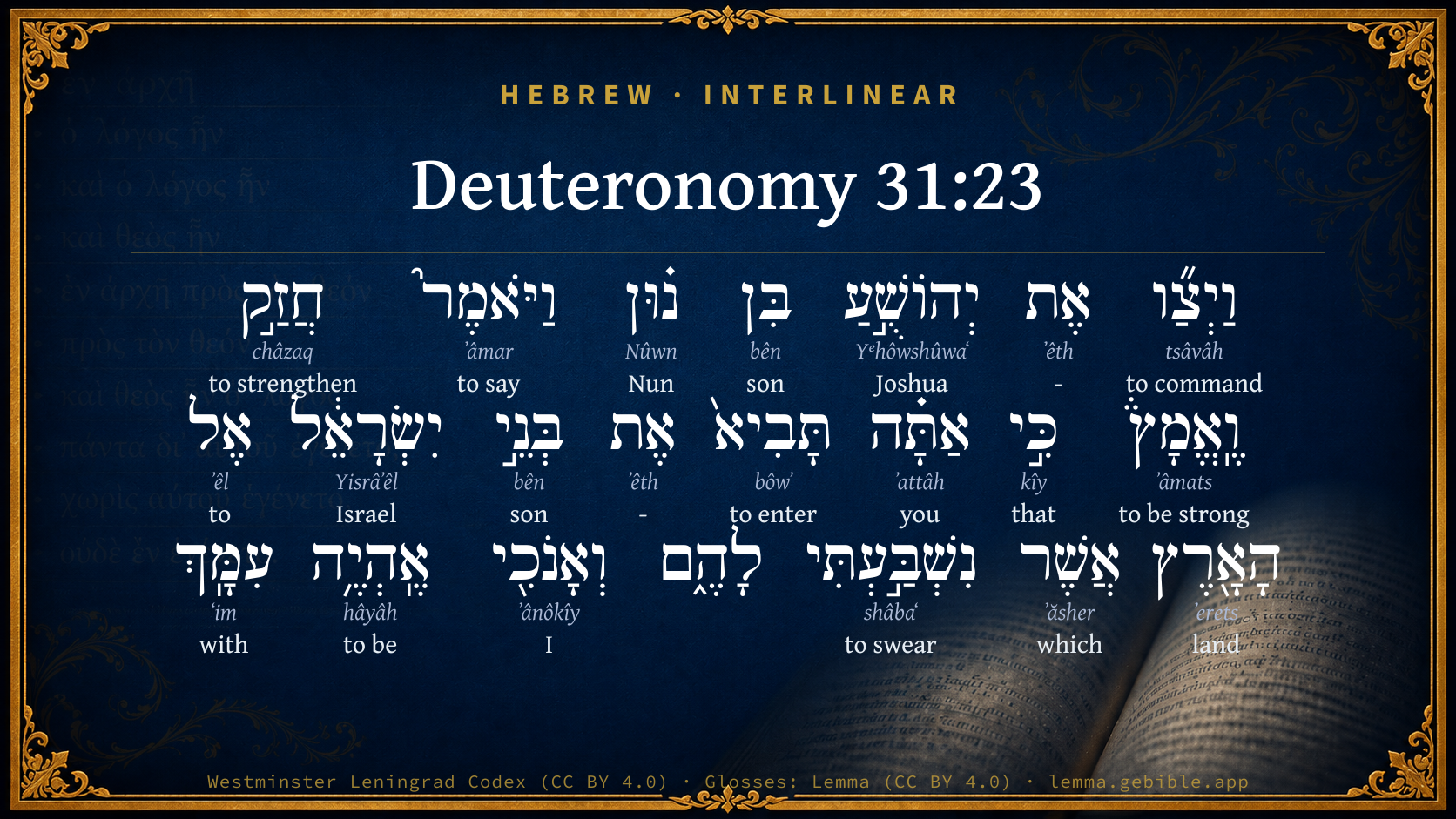
Deuteronomy 31:23

Hebrew (Westminster Leningrad Codex) Deuteronomy 31:23 appears in the Hebrew Old Testament. The text above is from the Westminster Leningrad Codex. Each word links to its Strong’s number, a concise gloss, and parsing drawn from the Open Scriptures Hebrew Bible morphology. Click any word for its full Brown-Driver-Briggs (BDB) entry.
Download image
Cite this verse

Deuteronomy 31:23 (World English Bible). Public Domain. Lemma interlinear Bible study tool, https://lemma.gebible.app/v/deuteronomy/31/23.

Show BibTeX & RIS
BibTeX
RIS
English Translation
He gave Joshua the son of Nun a charge, and said, Be strong and of good courage; for you shall bring the children of Israel into the land which I swore to them: and I will be with you.
World English Bible · Public Domain
Download a study sheet

One document with this verse’s original text, its word-by-word gloss line, the meaning frame, cross-references with their text, attributed commentary, and full source and license credits — printable, and it pastes into notes with its structure intact.

This verse Autodidact and up

Study sheet (.html) Plain text (.txt)

A passage Seminary Student

Up to 50 verses in one chapter. A passage sheet keeps up to 6 commentary sources and 12 cross-references per verse, in the order this page ranks them, and says so on the sheet whenever that leaves anything out. Ask for a single verse and you get the Autodidact verse sheet above.

Everything on this page stays free to read, with no account — the sheet is a download of what is already on screen, not access to it.

Want to remove ads? Support Godless Engineer
Compare translations 3

The same verse in 3 English versions, stacked beneath the original-language interlinear above. Click any original word for its lexicon entry.

Each is an independent rendering of the whole verse — the interlinear is not word-aligned to these translations.

Highlighted words mark where these versions differ — a whole-verse word diff, not a word-by-word alignment.

  • World English Bible Public Domain
    He gave Joshua the son of Nun a charge, and said, Be strong and of good courage; for you shall bring the children of Israel into the land which I swore to them: and I will be with you.
  • King James Version Public Domain
    And he gave Joshua the son of Nun a charge, and said, Be strong and of a good courage: for thou shalt bring the children of Israel into the land which I sware unto them: and I will be with thee.
  • unfoldingWord Literal Text CC BY-SA 4.0
    And he commanded Joshua, the son of Nun, and said, “Be strong and courageous; for you shall bring the sons of Israel into the land that I swore to them, and I will be with you.”

unfoldingWord Literal Text — © unfoldingWord, licensed CC BY-SA 4.0. Word-aligned USFM3 via Door43 (git.door43.org/unfoldingWord/en_ult).

Versions to compare (up to 4)

3 of 4 selected

Show all 18 translations

Every available English version of this verse, each an independent rendering of the whole verse.

  • World English Bible Public Domain
    He gave Joshua the son of Nun a charge, and said, Be strong and of good courage; for you shall bring the children of Israel into the land which I swore to them: and I will be with you.
  • Berean Standard Bible Public Domain
    Then the LORD commissioned Joshua son of Nun and said, “Be strong and courageous, for you will bring the Israelites into the land that I swore to give them, and I will be with you.”
  • Majority Standard Bible Public Domain
    Then the LORD commissioned Joshua son of Nun and said, “Be strong and courageous, for you will bring the Israelites into the land that I swore to give them, and I will be with you.”
  • King James Version Public Domain
    And he gave Joshua the son of Nun a charge, and said, Be strong and of a good courage: for thou shalt bring the children of Israel into the land which I sware unto them: and I will be with thee.
  • American Standard Version (1901) Public Domain
    And he gave Joshua the son of Nun a charge, and said, Be strong and of good courage; for thou shalt bring the children of Israel into the land which I sware unto them: and I will be with thee.
  • Revised Version (1885) Public Domain
    And he gave Joshua the son of Nun a charge, and said, Be strong and of a good courage: for thou shalt bring the children of Israel into the land which I sware unto them: and I will be with thee.
  • Geneva Bible (1599) Public Domain
    And God gaue Ioshua the sonne of Nun a charge, and said, Be strong, and of a good courage: for thou shalt bring the children of Israel into the lande, which I sware vnto them, and I will be with thee.
  • Douay-Rheims (1899) Public Domain
    And the Lord commanded Josue the son of Nun, and said: Take courage, and be valiant: for thou shalt bring the children of Israel into the land which I have promised, and I will be with thee.
  • Young's Literal Translation Public Domain
    and He commandeth Joshua son of Nun, and saith, `Be strong and courageous, for thou dost bring in the sons of Israel unto the land which I have sworn to them, and I -- I am with thee.'
  • Literal Standard Version CC BY-SA 4.0
    Then He commands Joshua son of Nun, and says, “Be strong and courageous, for you bring in the sons of Israel to the land which I have sworn to them, and I am with you.”
  • Unlocked Literal Bible CC BY-SA 4.0
    Yahweh gave Joshua son of Nun a command and said, “Be strong and of good courage; for you will bring the people of Israel into the land that I swore to them, and I will be with you.”
  • unfoldingWord Literal Text CC BY-SA 4.0
    And he commanded Joshua, the son of Nun, and said, “Be strong and courageous; for you shall bring the sons of Israel into the land that I swore to them, and I will be with you.”
  • Darby Bible Public Domain
    And [Jehovah] commanded Joshua the son of Nun, and said, Be strong and courageous; for thou shalt bring the children of Israel into the land which I have sworn unto them; and I will be with thee.
  • World Messianic Bible Public Domain
    He commissioned Joshua the son of Nun, and said, “Be strong and courageous; for you shall bring the children of Israel into the land which I swore to them. I will be with you.”
  • Webster's Bible Public Domain
    And he gave Joshua the son of Nun a charge, and said, Be strong and of a good courage: for thou shalt bring the children of Israel into the land which I swore to them: and I will be with thee.
  • Free Bible Version CC BY-SA 4.0
    Then the Lord appointed Joshua son of Nun as leader, and told him, “Be strong! Be brave! For you are going to lead the Israelites into the country that I promised to give them, and I will be with you.”
  • Bible in Basic English Public Domain
    Then he gave orders to Joshua, the son of Nun, saying to him, Be strong and take heart: for you are to go at the head of the children of Israel into the land which I made an oath to give them; and I will be with you.
  • JPS Tanakh (1917) Public Domain
    And he gave Joshua the son of Nun a charge, and said: 'Be strong and of good courage; for thou shalt bring the children of Israel into the land which I swore unto them; and I will be with thee.'

Literal Standard Version (2020), Covenant Press — licensed CC BY-SA 4.0. Text via the HelloAO Bible API (eBible.org). Unlocked Literal Bible (unfoldingWord) — licensed CC BY-SA 4.0. Text via the HelloAO Bible API (eBible.org). unfoldingWord Literal Text — © unfoldingWord, licensed CC BY-SA 4.0. Word-aligned USFM3 via Door43 (git.door43.org/unfoldingWord/en_ult). Free Bible Version, Dr. Jonathan Gallagher — licensed CC BY-SA 4.0. Text via the HelloAO Bible API (eBible.org).

Word by word

More ways to search: Search by grammar → Find every occurrence → Compare this word →

Practice this passage: Drill this verse → Learn its vocabulary →

נ֗וּן
Nûwn
H5126
“Nun”
Noun, Proper
Part of Speech
Noun
Type
Proper
Full BDB Definition

Origin: from H5125

TWOT: None

Nun = "fish" or " posterity" - father of Joshua the successor of Moses
  1. וַיְצַ֞ו tsâvâh H6680 “and · to command” Conjunction + Verb, Piel, Sequential Imperfect, 3rd Person, Masculine, Singular
  2. אֶת ʼêth H853 “-” Particle, Direct Object
  3. יְהוֹשֻׁ֣עַ Yᵉhôwshûwaʻ H3091 “Joshua” Noun, Proper
  4. בִּן bên H1121 “son of” Noun, Common, Masculine, Singular, Construct
  5. וַיֹּאמֶר֮ ʼâmar H559 “and · to say” Conjunction + Verb, Qal, Sequential Imperfect, 3rd Person, Masculine, Singular
  6. חֲזַ֣ק châzaq H2388 “strengthen” Verb, Qal, Imperative, 2nd Person, Masculine, Singular
  7. וֶֽאֱמָץ֒ ʼâmats H553 “and · be strong” Conjunction + Verb, Qal, Imperative, 2nd Person, Masculine, Singular
  8. כִּ֣י kîy H3588 “that” Conjunction
  9. אַתָּ֗ה ʼattâh H859 “you” Pronoun, Personal, 2nd Person, Masculine, Singular
  10. תָּבִיא֙ bôwʼ H935 “to enter” Verb, Hiphil, Imperfect, 2nd Person, Masculine, Singular
  11. אֶת ʼêth H853 “-” Particle, Direct Object
  12. בְּנֵ֣י bên H1121 “sons of” Noun, Common, Masculine, Plural, Construct
  13. יִשְׂרָאֵ֔ל Yisrâʼêl H3478 “Israel” Noun, Proper
  14. אֶל ʼêl H413 “to” Preposition
  15. הָאָ֖רֶץ ʼerets H776 “the · land” Particle, Definite Article + Noun, Common, Both, Singular, Absolute
  16. אֲשֶׁר ʼăsher H834 “which” Particle, Relative
  17. נִשְׁבַּ֣עְתִּי shâbaʻ H7650 “to swear” Verb, Niphal, Perfect, 1st Person, Common, Singular
  18. וְאָנֹכִ֖י ʼânôkîy H595 “and · I” Conjunction + Pronoun, Personal, 1st Person, Common, Singular
  19. אֶֽהְיֶ֥ה hâyâh H1961 “to be” Verb, Qal, Imperfect, 1st Person, Common, Singular
  20. עִמָּֽךְ ʻim H5973 “with · you” Preposition + Suffix, Personal, 2nd Person, Feminine, Singular

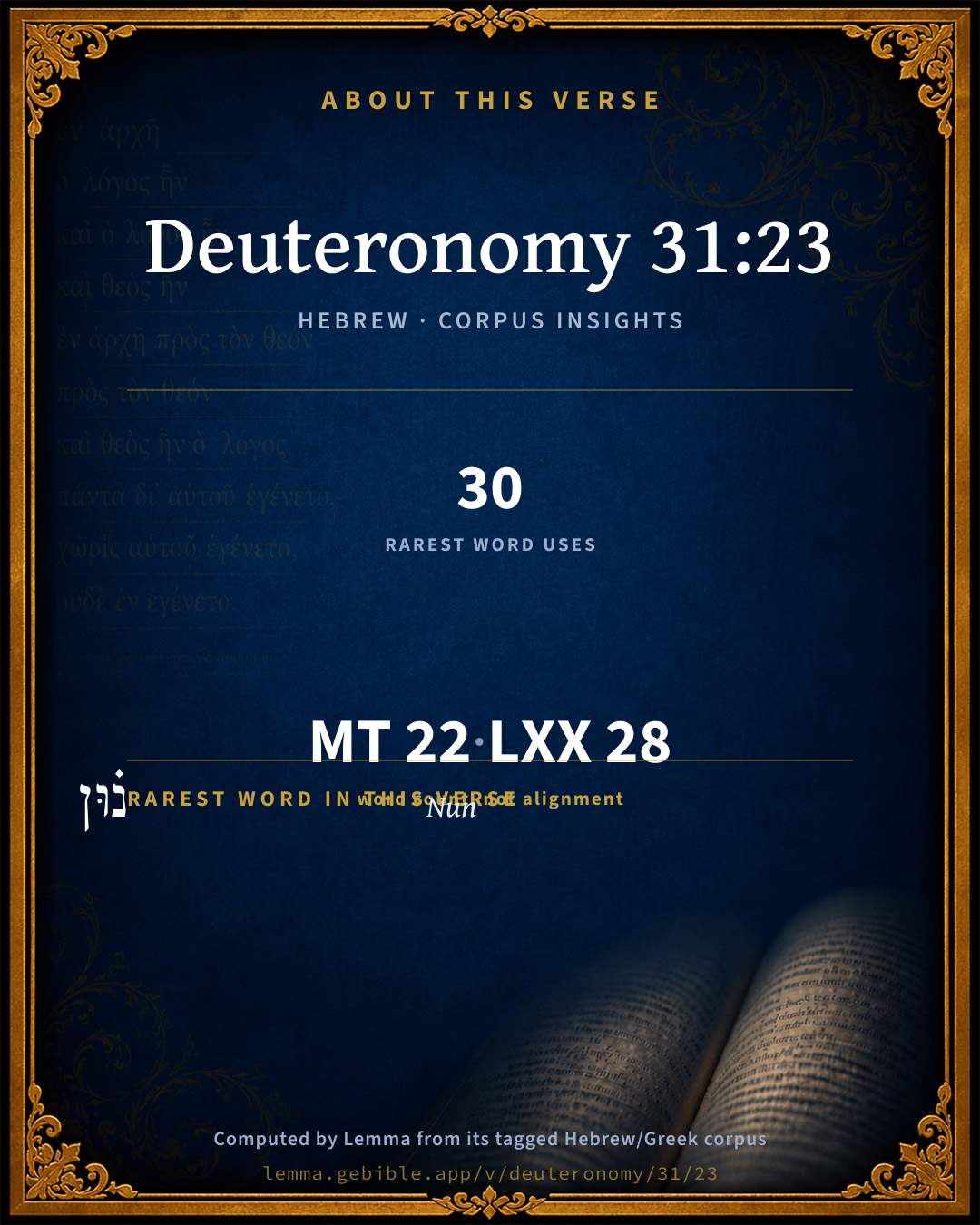
About this verse

These counts appear in no published source. They are computed here, from the morphology-tagged text and Lemma’s own curated glosses. What Lemma adds →

22
words
19
distinct lemmas
Pentateuch
section

Shared distinctive vocabulary

נ֗וּן Nun H5126 occurs in 30 verses of the Hebrew Bible. Also found in:

Grammatical profile

  • 7 verbs
  • 6 nouns
  • 2 pronouns
  • 3 prepositions
  • 1 conjunction
  • 3 particles

Verb forms

  • וַיְצַ֞ו Piel · Sequential Imperfect
  • וַיֹּאמֶר֮ Qal · Sequential Imperfect
  • חֲזַ֣ק Qal · Imperative
  • וֶֽאֱמָץ֒ Qal · Imperative
  • תָּבִיא֙ Hiphil · Imperfect
  • נִשְׁבַּ֣עְתִּי Niphal · Perfect
  • אֶֽהְיֶ֥ה Qal · Imperfect

Repetition

A word recurs within this verse — often emphatic in Hebrew:

Hebrew & Septuagint length

In English translation the verse runs 39 words from the Hebrew and 33 from the Septuagint (LXX English) — closely comparable.

A rough comparison of the two English renderings, which tokenize alike — not a word-level alignment.

Word counts can differ between the Hebrew and the Greek without any difference in meaning — e.g. the Hebrew direct-object marker אֵת has no separate Greek word, and Greek often adds the article ὁ.

In the original languages it is 22 Hebrew tokens and 28 Greek tokens — but the two are counted differently (Hebrew bundles its prefixes and suffixes into one token; the Greek is in lemma form), so that isn’t a like-for-like length.

Cross-references

6

Topical passages linked to Deuteronomy 31:23 in the Treasury of Scripture Knowledge — connected by theme and wording, ordered by reader-vote popularity; previews shown in the World English Bible.

  • Deuteronomy 31:7–8 Moses called to Joshua, and said to him in the sight of all Israel, Be strong and of good courage: for you shall go with this people into the land which Yahweh has sworn to their fathers to give them; and you shall cause them to inherit it.
  • Deuteronomy 31:14 Yahweh said to Moses, Behold, your days approach that you must die: call Joshua, and present yourselves in the tent of meeting, that I may give him a charge. Moses and Joshua went, and presented themselves in the tent of meeting.
  • Deuteronomy 3:28 But charge Joshua, and encourage him, and strengthen him; for he shall go over before this people, and he shall cause them to inherit the land which you shall see.
  • Acts 7:45 which also our fathers, in their turn, brought in with Joshua when they entered into the possession of the nations, whom God drove out before the face of our fathers, to the days of David,
  • Deuteronomy 31:3 Yahweh your God, he will go over before you; he will destroy these nations from before you, and you shall dispossess them: [and] Joshua, he shall go over before you, as Yahweh has spoken.
  • Joshua 1:5–9 There shall not any man be able to stand before you all the days of your life. As I was with Moses, so I will be with you; I will not fail you, nor forsake you.

Cross-references courtesy of OpenBible.info (CC BY 4.0).

Hebrew and Greek witnesses Masoretic Hebrew ↔ Greek Septuagint

The same verse in the two great witnesses to the Old Testament, shown verse-for-verse.

These are two independent witnesses, not word-aligned to each other, and the Septuagint is shown in lemma (dictionary) form.

Hebrew Deuteronomy 31:23 Masoretic · Westminster Leningrad Codex

וַיְצַ֞ו אֶת יְהוֹשֻׁ֣עַ בִּן נ֗וּן וַיֹּאמֶר֮ חֲזַ֣ק וֶֽאֱמָץ֒ כִּ֣י אַתָּ֗ה תָּבִיא֙ אֶת בְּנֵ֣י יִשְׂרָאֵ֔ל אֶל הָאָ֖רֶץ אֲשֶׁר נִשְׁבַּ֣עְתִּי לָהֶ֑ם וְאָנֹכִ֖י אֶֽהְיֶ֥ה עִמָּֽךְ

He gave Joshua the son of Nun a charge, and said, Be strong and of good courage; for you shall bring the children of Israel into the land which I swore to them: and I will be with you.

World English Bible · Public Domain

Greek LXX Deuteronomy 31:23 Septuagint · lemma form

καί ἐντέλλομαι μωυσῆς ἰησοῦς καί εἶπον αὐτός ἀνδρίζομαι καί ἰσχύω σύ γάρ εἰςἄγω ὁ υἱός ἰσραήλ εἰς ὁ γῆ ὅς ὄμνυμι κύριος αὐτός καί αὐτός εἰμί μετά σύ

And he charged Joshua, and said, Be courageous and strong, for you shall bring the sons of Israel into the land, which the Lord swore to them, and he shall be with you.

LXX2012 (modern English Septuagint) · Public Domain

On this verse, Haydock's Catholic Bible Commentary discusses the Septuagint’s reading. Read the note in Commentary ↓

Hebrew: Westminster Leningrad Codex (CC BY 4.0). Greek: Septuagint (public domain); English from LXX2012 (modern English Septuagint) (Public Domain). How the Septuagint differs from the Hebrew →

Targum (Aramaic paraphrase)

2

The Targum is the ancient Jewish Aramaic paraphrase of the Hebrew Scriptures — an interpretive translation, not the Hebrew text itself. Onkelos (literal) and Pseudo-Jonathan (expansive) render the Torah, and Jonathan the Prophets. Coverage is partial: where no permissively-licensed English translation exists for a verse, only the Aramaic is shown. This is verse-level text, not a word-by-word alignment to the Hebrew.

  1. Targum Onkelos Torah (Genesis–Deuteronomy)
    וּפַקִיד יָת יְהוֹשֻׁעַ בַּר נוּן וַאֲמַר תְּקֵף וְאַלִים אֲרֵי אַתְּ תָּעֵל יָת בְּנֵי יִשְׂרָאֵל לְאַרְעָא דִי קַיֵמִית לְהוֹן וּמֵימְרִי יְהֵי בְסַעְדָךְ

    (no public-domain English translation for this verse)

    Targum Onkelos — Aramaic: “Onkelos Genesis” (public domain); “Onkelos Exodus” (public domain); “Onkelos Leviticus” (public domain); “Onkelos Numbers” (public domain); “Onkelos Deuteronomy” (public domain). English: “Sefaria Community Translation” (CC0 1.0 (public-domain dedication)); “J.W. Etheridge. The Targums of Onkelos and Jonathan Ben Uzziel on the Pentateuch. London: Longmans, Green, 1862” (public domain). Text via Sefaria.

  2. Targum Pseudo-Jonathan Torah (Genesis–Deuteronomy)
    וּפַקֵיד יַת יְהוֹשׁוּעַ בַּר נוּן וַאֲמַר אִיתוֹקַף וְאִתְחַיֵיל אֲרוּם אַנְתְּ תָּעֵיל יַת בְּנֵי יִשְרָאֵל לְאַרְעָא דְקַיֵימִית לְהוֹן וּמֵימְרִי יְהֵי בְּסַעֲדָךְ

    And He commanded Jehoshua bar Nun, saying: Be strong and of good courage; for thou art to bring the sons of Israel into the land I have promised to them, and My Word shall be thy Helper.

    Targum Pseudo-Jonathan — Aramaic: “Targum Jonathan on Genesis” (public domain); “Targum Jonathan on Exodus” (public domain); “Targum Jonathan on Leviticus” (public domain); “Targum Jonathan on Numbers” (public domain); “Targum Jonathan on Deuteronomy” (public domain). English: “The Targum of Jonathan ben Uzziel, trans. J. W. Etheridge, London, 1862” (public domain). Text via Sefaria.

Commentary

Notes on Deuteronomy 31:23 from classic Christian and Jewish commentators (each source and its license shown beneath its notes). The classic Christian expositions comment on the surrounding passage and are grouped to its opening verse, so a note may address several verses; the Jewish commentaries on the Tanakh (Rashi and others) are per-verse, so they appear only where the commentator wrote on this verse.

Lemma curates 59 commentaries, every one of them public domain or Creative Commons licensed, each selected and text-cleaned for this edition rather than reprinted as found. About our sources →

Trapp's Complete Commentary

John Trapp

Deu 31:23 And he gave Joshua the son of Nun a charge, and said, Be strong and of a good courage: for thou shalt bring the children of Israel into the land which I sware unto them: and I will be with thee.

Ver. 23. I will be with thee.] This must needs put mettle into him; for "if God be with us, who can be against us?" {Rom 8:31} {See Trapp on "Rom 8:31"}

John Trapp, A Commentary or Exposition upon All the Books of the Old and New Testament (1647–1656) — public domain. Text from a community e-Sword module.

Tyndale Open Study Notes

Tyndale Open Resources

31:23 I will be with you: These words given to Joshua were the same words God spoke to Moses at the burning bush, when he called him to lead Israel out of Egypt (Exod 3:12). The same God, with the same assurance, was able to guarantee the same results.

Tyndale Open Study Notes — © Tyndale Open Resources, licensed CC BY-SA 4.0. Text via the HelloAO Bible API.

Ellicott's Commentary for English Readers

(23) And he (Jehovah) gave Joshua the son of Nun a charge.—This is the first record of God’s direct communion with Joshua. He was with Moses on the mount during the first forty days, and “departed not out of the Tabernacle” when they came down (Exo_24:13; Exo_33:11). But we have no note of any Divine communication made to Joshua apart from Moses before this. It ratifies Joshua’s appointment as leader of Israel.

Be strong . . .—Comp. Jos_1:2; Jos_1:6.

A Bible Commentary for English Readers, edited by Charles John Ellicott (1878–1897) — public domain. Text from a community e-Sword module.

The Cambridge Bible for Schools and Colleges

gen. ed. J. J. S. Perowne

23. The immediate continuation of 14 f., which we have seen reasons for assigning to E.

And he gave] The subject is not Moses, as the present context of this v. suggests, but must be Jehovah, as in Deu_31:15; this is quite certain. from the following I sware unto them and I will be with thee.

son of Nun] Deu_1:38.

Be strong and of a good courage] As in Deu_31:6-7; only found in Deut., and the deuteron. Jos_1:6; Jos_1:9; Jos_1:18; Jos_10:25; but possibly derived from E.

children of Israel] Not deuteronomic (see on Deu_4:44), but a frequent term for the people in E, Exo_3:9-11; Exo_3:13-15; Exo_9:35; Exo_10:20; Exo_10:23; Exo_13:18 f., Deu_14:10, Deut 20:22, Deu_24:5, Deu_32:20, Deu_33:5; and also found in J and P.

bring into the land] So in E, Jos_24:8, Exo_13:5; Exo_13:11.

I will be with thee] So in E, Exo_3:12, but also in J and in Deut.

The Cambridge Bible for Schools and Colleges (gen. ed. J. J. S. Perowne; Cambridge University Press, 1878–1918) — public domain. Text from a community e-Sword module.

John Gill's Exposition

And it came to pass, when Moses had made an end of writing the words of this law in a book,.... In this book of Deuteronomy, and which concluded the Pentateuch:

until they were finished; all the words of the law, and the whole five books of Moses, excepting some few verses, Deu 34:1, which were added by another hand, Joshua or Ezra.

John Gill's Exposition of the Whole Bible (1746–1763) — public domain (CC PDM 1.0). Text via the HelloAO Bible API.

Haydock's Catholic Bible Commentary

The Lord. Hebrew has not this word, so that it would seem as if Moses had given this charge to Josue; but the context shews (Calmet) that it was the Lord; (ver. 14,) for he swore to give the land of Israel. The Septuagint insert the words of Moses and the Lord. "And Moses commanded Josue....the land which the Lord swore." (Haydock) --- This is the first time that God addresses Josue, in order to confirm his authority. (Menochius)

George Leo Haydock (1774–1849), Haydock's Catholic Family Bible and Commentary, 1859 edition — public domain. Excludes Psalms (Douay-Rheims chapter numbering differs from Protestant) and Deuterocanonical books (Catholic canon only).

Matthew Poole's English Annotations

This wickedness of theirs which I now foresee and foretell shall not hinder me from bringing them into Canaan.

Matthew Poole's English Annotations on the Holy Bible (1683–1685) — public domain. Text from a community e-Sword/MySword module.

The Pulpit Commentary

And he gave, etc. The subject here is God, not Moses, as is evident partly from ver. 14, and partly from the expression, the land which I aware unto them; and I will be with thee. (cf. Exo_3:12)

The Pulpit Commentary (1880–1919), ed. H.D.M. Spence-Jones & Joseph S. Exell — public domain. Text from a community e-Sword module.

Rashi

Rabbi Shlomo Yitzchaki (Rashi)

ויצו את יהושע בן נון AND HE COMMANDED JOSHUA THE SON OF NUN — This has to be connected with v. 14 above, and it refers to the Shechinah (to God; “He commanded” means “God commanded”), as it distinctly states here “[for thou shalt bring the children of Israel] into the land which “I” swore unto them, [and “I” will be with thee]”.

Rashi on the Tanakh — English translations: “The Judaica Press complete Tanach with Rashi, translated by A. J. Rosenberg” (CC BY 4.0); “Pentateuch with Rashi's commentary by M. Rosenbaum and A.M. Silbermann, 1929-1934” (public domain); “The Metsudah Tanach series, Lakewood, N.J” (CC BY 4.0); and “The Book of Joshua, Metsudah Publications, 1997” (CC BY 4.0). Text via Sefaria.

Ramban (Nachmanides)

Rabbi Moshe ben Nachman (Ramban / Nachmanides)

AND HE COMMANDED JOSHUA THE SON OF NUN. “This [pronoun ‘He’] refers to the Divine Presence [mentioned] above as it is explained [here], into the Land which I swore unto them; and I will be with thee.” This is Rashi’s language. He has explained it well. And in the opinion of Rabbi Abraham ibn Ezra: “And he commanded Joshua — that is, Moses [commanded] by order of G-d, and therefore he said, into the Land which I swore unto them.” Similarly we find that Moses said, And I will give the rain of your Land in its season. So also, And I will give grass in thy fields for thy cattle., Verse 15. Likewise, that ye might know that I am the Eternal your G-d. And so also, The Eternal will send upon thee the scantiness etc. because of the evil doings, whereby thou hast forsaken Me. I have already discussed this.

Ramban (Nachmanides) on the Tanakh — English translation: “Commentary on the Torah by Ramban (Nachmanides). Translated and annotated by Charles B. Chavel. New York, Shilo Pub. House, 1971-1976” (CC BY 4.0). Text via Sefaria.

Lesson kit

Teaching starters — assembled from the data on this page, not authored interpretation. Every prompt links to the verse data it draws on. Edit before teaching.

Deuteronomy, in the Pentateuch, opens this verse with 22 words (19 distinct Hebrew lemmas). Its most distinctive word is Nûwn (“Nun”). A historical commentator’s framing appears above. Read the whole chapter for the surrounding context.

Discussion questions

  1. What does “Nun” (Nûwn) contribute to the verse as a whole?
  2. Exodus 33:11 shares the word «Nun» with this verse. How do the two illuminate each other?
  3. “son” occurs 2× in this one verse. What is the effect of the repetition?
  4. The translations on this page render this verse differently — a whole-verse word diff, not a word-by-word alignment. What might account for the different wordings?
  5. The verb «וַיְצַ֞ו» is Piel Sequential Imperfect. How does its form color the action?
  6. Reading how Trapp's Complete Commentary and Tyndale Open Study Notes read this verse, where do the two commentators agree and where do they part?

Things to notice

Reading settings

Reading text

Shown beneath each verse's original-language words.

Old Testament
Old Testament edition

Read the OT as the Masoretic Hebrew (MT) or the Greek Septuagint (LXX).

English shown for the Greek Septuagint (in the Hebrew ↔ Greek comparison).

Comparing translations? Open the Compare panel on any verse page to stack up to four side by side.