Amos 6:11

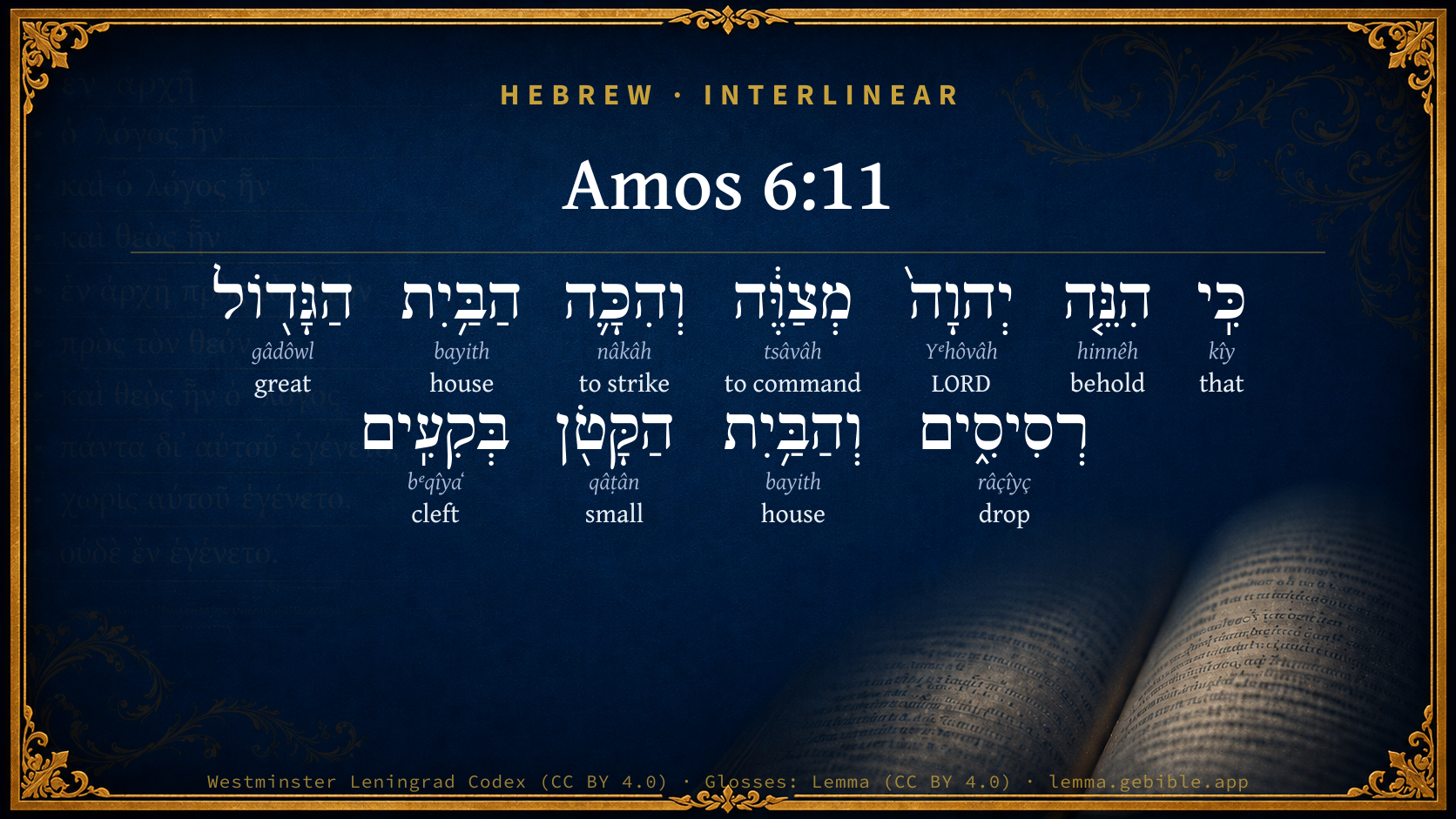
Hebrew (Westminster Leningrad Codex) Amos 6:11 appears in the Hebrew Old Testament. The text above is from the Westminster Leningrad Codex. Each word links to its Strong’s number, a concise gloss, and parsing drawn from the Open Scriptures Hebrew Bible morphology. Click any word for its full Brown-Driver-Briggs (BDB) entry.
Download image
Cite this verse

Amos 6:11 (World English Bible). Public Domain. Lemma interlinear Bible study tool, https://lemma.gebible.app/v/amos/6/11.

Show BibTeX & RIS
BibTeX
RIS
English Translation
"For, behold, Yahweh commands, and the great house will be smashed to pieces, And the little house into bits.
World English Bible · Public Domain
Download a study sheet

One document with this verse’s original text, its word-by-word gloss line, the meaning frame, cross-references with their text, attributed commentary, and full source and license credits — printable, and it pastes into notes with its structure intact.

This verse Autodidact and up

Study sheet (.html) Plain text (.txt)

A passage Seminary Student

Up to 50 verses in one chapter. A passage sheet keeps up to 6 commentary sources and 12 cross-references per verse, in the order this page ranks them, and says so on the sheet whenever that leaves anything out. Ask for a single verse and you get the Autodidact verse sheet above.

Everything on this page stays free to read, with no account — the sheet is a download of what is already on screen, not access to it.

Want to remove ads? Support Godless Engineer
Compare translations 3

The same verse in 3 English versions, stacked beneath the original-language interlinear above. Click any original word for its lexicon entry.

Each is an independent rendering of the whole verse — the interlinear is not word-aligned to these translations.

Highlighted words mark where these versions differ — a whole-verse word diff, not a word-by-word alignment.

  • World English Bible Public Domain
    "For, behold, Yahweh commands, and the great house will be smashed to pieces, And the little house into bits.
  • King James Version Public Domain
    For, behold, the LORD commandeth, and he will smite the great house with breaches, and the little house with clefts.
  • unfoldingWord Literal Text CC BY-SA 4.0
    For, behold, Yahweh will give a command, and the big house will be smashed to pieces, and the little house to bits.

unfoldingWord Literal Text — © unfoldingWord, licensed CC BY-SA 4.0. Word-aligned USFM3 via Door43 (git.door43.org/unfoldingWord/en_ult).

Versions to compare (up to 4)

3 of 4 selected

Show all 18 translations

Every available English version of this verse, each an independent rendering of the whole verse.

  • World English Bible Public Domain
    "For, behold, Yahweh commands, and the great house will be smashed to pieces, And the little house into bits.
  • Berean Standard Bible Public Domain
    For the LORD gives a command: “The great house will be smashed to pieces, and the small house to rubble.”
  • Majority Standard Bible Public Domain
    For the LORD gives a command: “The great house will be smashed to pieces, and the small house to rubble.”
  • King James Version Public Domain
    For, behold, the LORD commandeth, and he will smite the great house with breaches, and the little house with clefts.
  • American Standard Version (1901) Public Domain
    For, behold, Jehovah commandeth, and the great house shall be smitten with breaches, and the little house with clefts.
  • Revised Version (1885) Public Domain
    For, behold, the LORD commandeth, and the great house shall be smitten with breaches, and the little house with clefts.
  • Geneva Bible (1599) Public Domain
    For behold, the Lord commandeth, and he will smite the great house with breaches, and the litle house with clefts.
  • Douay-Rheims (1899) Public Domain
    And he shall answer: There is an end. And he shall any to him: Hold thy peace, and mention not the name of the Lord.
  • Young's Literal Translation Public Domain
    For lo, Jehovah is commanding, And He hath smitten the great house `with' breaches, And the little house `with' clefts.
  • Literal Standard Version CC BY-SA 4.0
    For behold, YHWH is commanding, || And He has struck the great house [with] breaches, || And the little house [with] clefts.
  • Unlocked Literal Bible CC BY-SA 4.0
    For, look, Yahweh will give a command, and the big house will be smashed to pieces, and the little house to bits.
  • unfoldingWord Literal Text CC BY-SA 4.0
    For, behold, Yahweh will give a command, and the big house will be smashed to pieces, and the little house to bits.
  • Darby Bible Public Domain
    For behold, Jehovah commandeth, and he will smite the great house with breaches, and the little house with clefts.
  • World Messianic Bible Public Domain
    “For, behold, the LORD commands, and the great house will be smashed to pieces, and the little house into bits.
  • Webster's Bible Public Domain
    For behold, the LORD commandeth, and he will smite the great house with breaches, and the little house with clefts.
  • Free Bible Version CC BY-SA 4.0
    Watch out! When the Lord gives the command, large houses will be reduced to rubble, and small houses smashed to pieces.
  • Bible in Basic English Public Domain
    For see, at the order of the Lord the great house will be full of cracks and the little house will be broken.
  • JPS Tanakh (1917) Public Domain
    For, behold, the LORD commandeth, and the great house shall be smitten into splinters, and the little house into chips.

Literal Standard Version (2020), Covenant Press — licensed CC BY-SA 4.0. Text via the HelloAO Bible API (eBible.org). Unlocked Literal Bible (unfoldingWord) — licensed CC BY-SA 4.0. Text via the HelloAO Bible API (eBible.org). unfoldingWord Literal Text — © unfoldingWord, licensed CC BY-SA 4.0. Word-aligned USFM3 via Door43 (git.door43.org/unfoldingWord/en_ult). Free Bible Version, Dr. Jonathan Gallagher — licensed CC BY-SA 4.0. Text via the HelloAO Bible API (eBible.org).

Word by word

More ways to search: Search by grammar → Find every occurrence → Compare this word →

Practice this passage: Drill this verse → Learn its vocabulary →

רְסִיסִ֑ים
râçîyç
H7447
“drops”
Noun, Common, Masculine, Plural, Absolute
Part of Speech
Noun
Type
Common
Gender
Masculine
Number
Plural
State
Absolute
Full BDB Definition

Origin: from H7450

TWOT: 2181a , 2182a

drop (of dew) - fragment
  1. כִּֽי kîy H3588 “that” Conjunction
  2. הִנֵּ֤ה hinnêh H2009 “behold” Particle, Demonstrative
  3. יְהוָה֙ Yᵉhôvâh H3068 “LORD” Noun, Proper
  4. מְצַוֶּ֔ה tsâvâh H6680 “commanding” Verb, Piel, Participle Active, Masculine, Singular, Absolute
  5. וְהִכָּ֛ה nâkâh H5221 “and · to strike” Conjunction + Verb, Hiphil, Sequential Perfect, 3rd Person, Masculine, Singular
  6. הַבַּ֥יִת bayith H1004 “the · house” Particle, Definite Article + Noun, Common, Masculine, Singular, Absolute
  7. הַגָּד֖וֹל gâdôwl H1419 “the · great” Particle, Definite Article + Adjective, Adjective, Masculine, Singular, Absolute
  8. וְהַבַּ֥יִת bayith H1004 “and · the · house” Conjunction + Particle, Definite Article + Noun, Common, Masculine, Singular, Absolute
  9. הַקָּטֹ֖ן qâṭân H6996 “the · small” Particle, Definite Article + Adjective, Adjective, Masculine, Singular, Absolute
  10. בְּקִעִֽים bᵉqîyaʻ H1233 “clefts” Noun, Common, Masculine, Plural, Absolute

About this verse

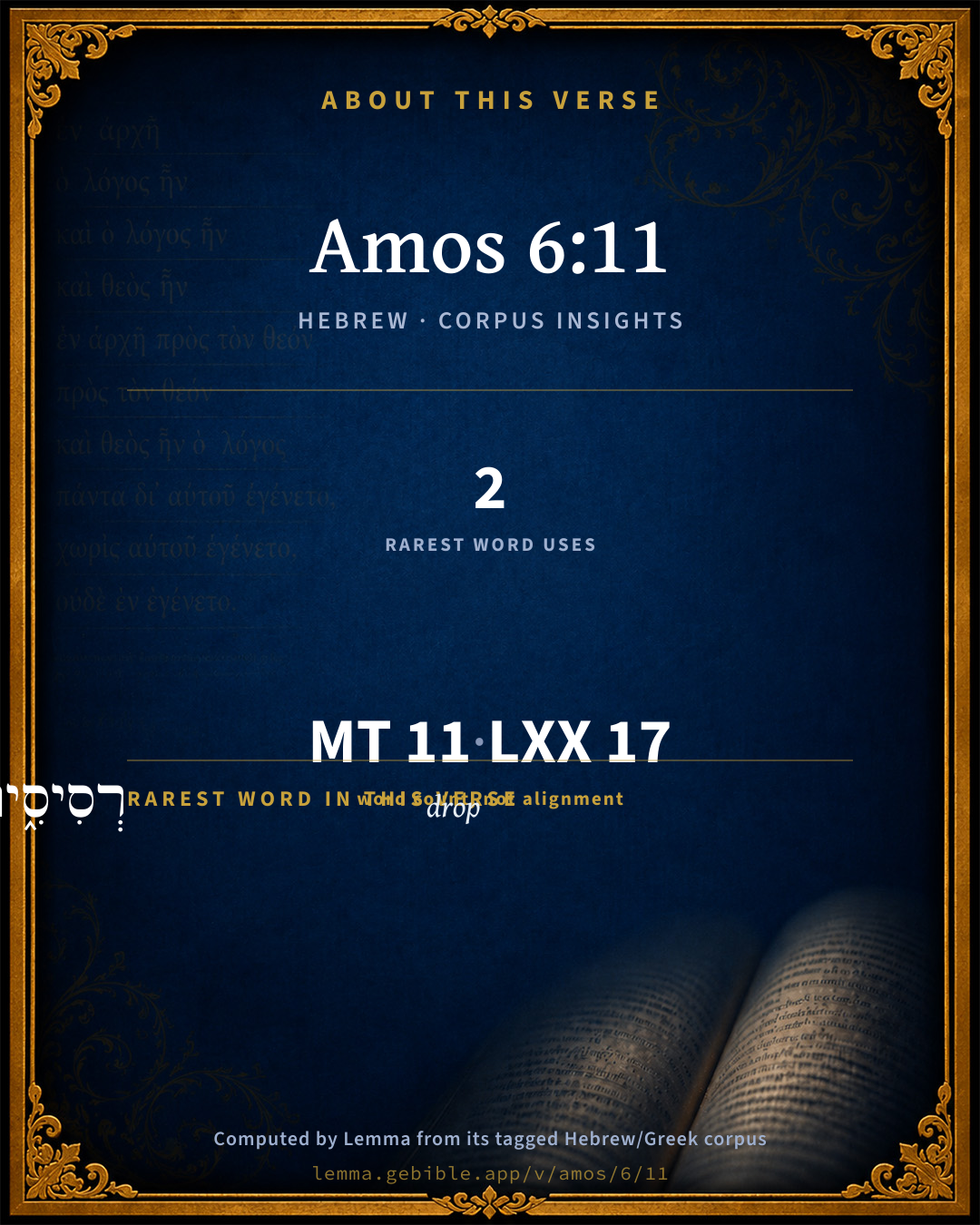
These counts appear in no published source. They are computed here, from the morphology-tagged text and Lemma’s own curated glosses. What Lemma adds →

11
words
10
distinct lemmas
Prophets
section

Notable vocabulary

The rarest word here is רְסִיסִ֑ים drop H7447 — appearing just 2 times in the whole Hebrew Bible.

Shared distinctive vocabulary

רְסִיסִ֑ים drop H7447 occurs in 2 verses of the Hebrew Bible. Also found in:

Grammatical profile

  • 2 verbs
  • 5 nouns
  • 2 adjectives
  • 1 conjunction
  • 1 particle

Verb forms

  • מְצַוֶּ֔ה Piel · Participle Active
  • וְהִכָּ֛ה Hiphil · Sequential Perfect

Repetition

A word recurs within this verse — often emphatic in Hebrew:

  • הַבַּ֥יִת house H1004 ×2

Hebrew & Septuagint length

In English translation the verse runs 19 words from the Hebrew and 23 from the Septuagint (LXX English) — closely comparable.

A rough comparison of the two English renderings, which tokenize alike — not a word-level alignment.

Word counts can differ between the Hebrew and the Greek without any difference in meaning — e.g. the Hebrew direct-object marker אֵת has no separate Greek word, and Greek often adds the article ὁ.

In the original languages it is 11 Hebrew tokens and 17 Greek tokens — but the two are counted differently (Hebrew bundles its prefixes and suffixes into one token; the Greek is in lemma form), so that isn’t a like-for-like length.

Cross-references

19

Topical passages linked to Amos 6:11 in the Treasury of Scripture Knowledge — connected by theme and wording, ordered by reader-vote popularity; previews shown in the World English Bible.

  • Amos 3:15 I will strike the winter house with the summer house; And the houses of ivory will perish, And the great houses will have an end," says Yahweh.
  • Isaiah 55:11 so shall my word be that goes forth out of my mouth: it shall not return to me void, but it shall accomplish that which I please, and it shall prosper in the thing whereto I sent it.
  • 2 Kings 25:9 He burnt the house of Yahweh, and the king's house; and all the houses of Jerusalem, even every great house, burnt he with fire.
  • Amos 6:8 "The Lord Yahweh has sworn by himself," says Yahweh, the God of hosts: "I abhor the pride of Jacob, And detest his fortresses. Therefore I will deliver up the city with all that is in it.
  • Amos 9:9 "For, behold, I will command, and I will sift the house of Israel among all the nations, as grain is sifted in a sieve, yet not the least kernel will fall on the earth.
  • Nahum 1:14 Yahweh has commanded concerning you: "No more descendants will bear your name. Out of the house of your gods, will I cut off the engraved image and the molten image. I will make your grave, for you are vile."
  • Zechariah 14:2 For I will gather all nations against Jerusalem to battle; and the city will be taken, the houses rifled, and the women ravished. half of the city will go out into captivity, and the rest of the people will not be cut off from the city.
  • Luke 19:44 and will dash you and your children within you to the ground. They will not leave in you one stone on another, because you didn't know the time of your visitation."
  • Psalms 105:16 He called for a famine on the land. He destroyed the food supplies.
  • Psalms 105:31 He spoke, and swarms of flies came, And lice in all their borders.
  • Psalms 105:34 He spoke, and the locusts came, And the grasshoppers, without number,
  • Ecclesiastes 10:18 By slothfulness the roof sinks in; And through idleness of the hands the house leaks.
  • Isaiah 10:5–6 Ho Assyrian, the rod of my anger, the staff in whose hand is my indignation!
  • Isaiah 13:3 I have commanded my consecrated ones, yes, I have called my mighty men for my anger, even my proudly exulting ones.
  • Isaiah 46:10–11 declaring the end from the beginning, and from ancient times things that are not [yet] done; saying, My counsel shall stand, and I will do all my pleasure;
  • Ezekiel 29:18–20 Son of man, Nebuchadrezzar king of Babylon caused his army to serve a great service against Tyre: every head was made bald, and every shoulder was worn; yet had he no wages, nor his army, from Tyre, for the service that he had served against it.
  • Hosea 13:16 Samaria will bear her guilt; For she has rebelled against her God. They will fall by the sword. Their infants will be dashed in pieces, And their pregnant women will be ripped open."
  • Amos 3:6–7 Does the trumpet alarm sound in a city, Without the people being afraid? Does evil happen to a city, And Yahweh hasn't done it?
  • Amos 9:1 I saw the Lord standing beside the altar, and he said, "Strike the tops of the pillars, that the thresholds may shake; and break them in pieces on the head of all of them; and I will kill the last of them with the sword: there shall not one of them flee away, and there shall not one of them escape.

Cross-references courtesy of OpenBible.info (CC BY 4.0).

Hebrew and Greek witnesses Masoretic Hebrew ↔ Greek Septuagint

The same verse in the two great witnesses to the Old Testament, shown verse-for-verse.

These are two independent witnesses, not word-aligned to each other, and the Septuagint is shown in lemma (dictionary) form.

Hebrew Amos 6:11 Masoretic · Westminster Leningrad Codex

כִּֽי הִנֵּ֤ה יְהוָה֙ מְצַוֶּ֔ה וְהִכָּ֛ה הַבַּ֥יִת הַגָּד֖וֹל רְסִיסִ֑ים וְהַבַּ֥יִת הַקָּטֹ֖ן בְּקִעִֽים

"For, behold, Yahweh commands, and the great house will be smashed to pieces, And the little house into bits.

World English Bible · Public Domain

Greek LXX Amos 6:11 Septuagint · lemma form

διότι ἰδού κύριος ἐντέλλομαι καί πατάσσω ὁ οἶκος ὁ μέγας θλάσμα καί ὁ οἶκος ὁ μικρός ῥάγμα

And he shall say, No one else. And the other shall say, Be silent, that you name not the name of the Lord.

LXX2012 (modern English Septuagint) · Public Domain

Hebrew: Westminster Leningrad Codex (CC BY 4.0). Greek: Septuagint (public domain); English from LXX2012 (modern English Septuagint) (Public Domain). How the Septuagint differs from the Hebrew →

Targum (Aramaic paraphrase)

1

The Targum is the ancient Jewish Aramaic paraphrase of the Hebrew Scriptures — an interpretive translation, not the Hebrew text itself. Onkelos (literal) and Pseudo-Jonathan (expansive) render the Torah, and Jonathan the Prophets. Coverage is partial: where no permissively-licensed English translation exists for a verse, only the Aramaic is shown. This is verse-level text, not a word-by-word alignment to the Hebrew.

  1. Targum Jonathan Prophets (Joshua–Malachi)
    אֲרֵי הָא יְיָ מְפַקֵיד וְיִמְחֵי מַלְכוּ רַבָּא מְחָא תַקִיפָא וּמַלְכוּ זְעֵירָא מְחָא חַלָשָׁא:

    (no public-domain English translation for this verse)

    Targum Jonathan — Aramaic: “Mikraot Gedolot” (public domain). English: “Sefaria Community Translation” (CC0 1.0 (public-domain dedication)); “London "Chaldee Paraphrase," 1871” (public domain). Text via Sefaria.

Commentary

Notes on Amos 6:11 from classic Christian and Jewish commentators (each source and its license shown beneath its notes). The classic Christian expositions comment on the surrounding passage and are grouped to its opening verse, so a note may address several verses; the Jewish commentaries on the Tanakh (Rashi and others) are per-verse, so they appear only where the commentator wrote on this verse.

Lemma curates 59 commentaries, every one of them public domain or Creative Commons licensed, each selected and text-cleaned for this edition rather than reprinted as found. About our sources →

Trapp's Complete Commentary

John Trapp

Amo 6:11 For, behold, the LORD commandeth, and he will smite the great house with breaches, and the little house with clefts.

Ver. 11. For, behold, the Lord commandeth] Calamities, and they come; the Chaldeans, and they are at hand with their battle axes, but it is he that gives them their commission, and biddeth them fall on.

And he will smite the great house with breaches, &c.] i.e. He will destroy rich and poor together; pale death will knock at both their houses with an even foot ( aequo pulsat pede), as in time of plague, earthquake, or the like epidemic evil. The grave is the congregation house of all living, Job 30:23, whereinto men chop often before they think; as a man that walks in the snow may fall into a clay pit. The mortal scythe is master of the royal sceptre; and it mows down the lilies of the crown as well as the grass of the field. Death is the only king "against whom there is no rising up," as Agur phraseth the most absolute predominance, Pro 30:31; it levelleth lords and lowlies, and lays all waste; breaking down the greater houses and cleaving the lesser, with an utter extermination of all. Search you therefore, search you, O nation not desired; before the decree come forth, &c., Zep 2:1-2. Being wise after the fact helps not; repentance, though true, may come too late in respect of temporal judgments, as in Moses, Deu 1:37, and David, 2Sa 12:10.

John Trapp, A Commentary or Exposition upon All the Books of the Old and New Testament (1647–1656) — public domain. Text from a community e-Sword module.

Jamieson, Fausset & Brown

Robert Jamieson, A. R. Fausset & David Brown

commandeth, and he will smite--His word of command, when once given, cannot but be fulfilled (Isa 55:11). His mere word is enough to smite with destruction.

great house . . . little house--He will spare none, great or small (Amo 3:15). JEROME interprets "the great house" as Israel, and "the small house" as Judah: the former being reduced to branches or ruins, literally, "small drops"; the latter, though injured with "clefts" or rents, which threaten its fall, yet still permitted to stand.

Jamieson, Fausset & Brown — Commentary Critical and Explanatory on the Whole Bible (1871) — public domain (CC PDM 1.0). Text via the HelloAO Bible API.

Adam Clarke's Commentary

Verse 11. He will smote the great house with breaches] The great and small shall equally suffer; no distinction shall be made; rich and poor shall fall together; death has received his commission, and he will spare none. Horace has a sentiment precisely like this, Carm. Lib. i., Od. iv., v. 13.

Pallida mors aequo pulsat pede pauperum TABERNAS,

Regumque TURRES.

With equal pace impartial fate

Knocks at the palace as the cottage gate.

But this may refer particularly to the houses of the poor in Eastern countries; their mud walls being frequently full of clefts; the earth of which they are built seldom adhering together because of its sandiness.

Adam Clarke's Commentary on the Bible (1810–1826) — public domain. Text from a community e-Sword/MySword module.

John Calvin's Commentaries

This verse is added only to confirm the former sentence. The Prophet indeed intimates, that the common people, as well as the chiefs, in vain trusted in their quiet state; for the Lord would destroy them all together, from the highest to the lowest. Behold, Jehovah, he says, commands etc.; by using the word commands, he means, that God had many reasons why he should take away and destroy them all. But he goes farther than this, and intimates that their destruction was dependent on the sole will of God; as though he said, “Though the Lord may not send for ministers of vengeance, though he may not prepare great forces, yet his word only, whenever it shall go forth, will consume you all.” We now then perceive what the Prophet means by the word “commands.”

He afterwards adds, He will smite the great house with confusions, or, according to some, with breaking רסס, resas, means properly to mingle. The Prophet therefore, I doubt not, refers here to those dreadful falls which commonly happen to great and splendid palaces. When a cottage is overturned so great a ruin is not occasioned by its weight; nay, when its ruin begins to appear, fragments fall down one after another, so that the whole work falls without any violence. This, I say, is the case with small and common houses; but when there is a great building, its downfall is tremendous. I am therefore inclined to render the word “confusion,” and the difference between small and great houses will then be more evident. Great houses then shall be smitten with confusions, (mixtionibus, with minglings) but small houses shall be smitten with fissures or clefts. But yet, as I have already reminded you, the Prophet means that there would be a ruin, both to the principal men and to the common people, so that they would all perish, from the least to the greatest. We hence learn how great was the corruption of that people; for God punishes none but the wicked. It then follows that equity was everywhere subverted and that all orders of men were become vicious and corrupt. It follows —

John Calvin's Commentaries (1540-1563) — public domain. Text from the Calvin Translation Society English edition (1840s-50s) via the Christian Classics Ethereal Library (ccel.org). Calvin's coverage is partial (roughly two-thirds of the Bible); uncommented books and verses are honest gaps, never fabricated. The 19th-century editor's footnotes and remarks are omitted so the notes are faithfully Calvin's own voice.

Ellicott's Commentary for English Readers

(11) Breaches.—For this read ruins. (See end of Note on Amo_6:8.) The overthrow of all classes of the population is here referred to.

A Bible Commentary for English Readers, edited by Charles John Ellicott (1878–1897) — public domain. Text from a community e-Sword module.

The Cambridge Bible for Schools and Colleges

gen. ed. J. J. S. Perowne

11. For behold, &c.] The words give the reason for Amo_6:8, rather than for Amo_6:9-10, which describe merely an episode in the ruin.

commandeth] viz. the human agents, by whose instrumentality (cf. Isa_10:6) He carries out His will. Who these agents are conceived by Amos to be will appear in Amo_6:14.

the great house into fragments and the little house into clefts] Neither the palaces of the wealthy, nor the more modest dwellings of the ordinary citizens, will escape the coming ruin.

The Cambridge Bible for Schools and Colleges (gen. ed. J. J. S. Perowne; Cambridge University Press, 1878–1918) — public domain. Text from a community e-Sword module.

John Gill's Exposition

For, behold, the Lord commandeth,.... Hath determined and ordered the judgment before, and what follows: Kimchi paraphrases it, hath decreed the earthquake, as in Amo 3:15; of which he understands the following:

and he will smite the great house with breaches; or "droppings" (h); so that the rain shall drop through:

and the little house with clefts; so that it shall fall to ruin; that is, he shall smite the houses both of great and small, of the princes, and of the common people, either with an earthquake, so that they shall part asunder and fall; or, being left without inhabitants, shall of course become desolate, there being none to repair their breaches. Some understand, by the "great house", the ten tribes of Israel; and, by the "little house", the two tribes of Judah and Benjamin; to which sense the Targum seems to incline,

"he will smite the great kingdom with a mighty stroke, and the little kingdom with a weak stroke.''

(h) "guttis, seu stillis", Piscator; "quae est minuta et rorans pluvia", Drusius.

John Gill's Exposition of the Whole Bible (1746–1763) — public domain (CC PDM 1.0). Text via the HelloAO Bible API.

Albert Barnes' Notes on the Bible

The Lord commandeth and He will smite - Jerome: “If He commandeth, how doth He smite? If He smiteth, how doth He command? In that thing which He “commands” and enjoins His ministers, He Himself is seen to “smite.” In Egypt the Lord declares that He killed the first-born, who, we read, were slain by “the destroyer” Exo 12:23. The “breaches” denote probably the larger, “the cleft” the smaller ruin. The greater pile was the more greatly destroyed.

Albert Barnes' Notes on the Bible (1834–1885) — public domain. Text from a community e-Sword/MySword module.

Haydock's Catholic Bible Commentary

Lord. He has done it. Do not repine. (Theodoret; St. Cyril) --- Hebrew, "Be silent, and not to remember the," &c. He will offer comfort. (Calmet) --- Still, none will return to the Lord. (St. Jerome)

George Leo Haydock (1774–1849), Haydock's Catholic Family Bible and Commentary, 1859 edition — public domain. Excludes Psalms (Douay-Rheims chapter numbering differs from Protestant) and Deuterocanonical books (Catholic canon only).

Matthew Poole's English Annotations

For, behold; consider this well: it seems to be the continued speech of him who took care of the dead, Amo 6:10.

The Lord commandeth; God, provoked by our sins, hath sent out thy enemies; war, famine, and pestilence all come commissioned of God, and when the arrow is shot it will hit and kill.

He will smite the great house with breaches; the palaces of great men, and their families, shall have great breaches made in them, by which they shall be ruined.

And the little house with clefts; the cottages and lesser dwellings of poor men, with their families, shall by lesser strokes be ruined, their clefts shall be enough to do this. All shall be overthrown, and we must submit to it.

Matthew Poole's English Annotations on the Holy Bible (1683–1685) — public domain. Text from a community e-Sword/MySword module.

The Pulpit Commentary

The prophet confirms the judgment denounced in ver. 8. The Lord commandeth, and he will smite. The expression, thus taken, implies that God executes his commands through the ministers of his judgment; but it may well be rendered, "and men shall smite". (comp. Amo_9:9) Breaches clefts. The great palace requires a breach to bring it to the ground; the little but is ruined by a small rent or cleft. All houses, great and small, shall be smitten. Possibly Israel and Judah are signified respectively by "the great house" and "the little house"; (comp. Amo_9:11) and their treatment by the Assyrians may be thus symbolized.

The Lord commandeth.

It was the office and function of a prophet to lose himself in becoming the vehicle of Divine communications, the organ of Divine decisions. His prefatory words were these: "Thus saith the Lord." He saw and felt the Lord"s presence, not only in his own ministry, but in all the events that occurred in the range of his observation, whether affecting individuals or nations.

I THERE IS AN ELEMENT OF AUTHORITY IN EVERY WORD OF THE LORD. Whether God addresses to men language of rebuke or reproach, of entreaty or of threatening, he speaks with authority. His invitation is that of a King; it is a command When our Lord Christ spoke in the course of his ministry, he spoke with authority. The Divine judgment is always correct, the Divine will is always obligatory.

II ALL AGENCIES AND INSTRUMENTALITIES ARE OBEDIENT TO THE LORD"S BEHESTS. It is so with the forces of nature. "The stormy wind fulfilleth his word;" "His ministers are a flaming fire." It is so with the institutions of human society, with the purposes and the activities of men. The hand which is visible in a work may be that of a creature; the power that directs that hand may, nevertheless, be creative wisdom and creative might. God gives the word; it is executed by ten thousand ministers of his holy will. He maketh even the wrath of man to praise him.

III THE POWER OF THE GREATEST AMONG MEN IS INCAPABLE OF RESISTING THE DIVINE COMMANDS. The "great house" and the "little house" alike are smitten when the Lord makes bare his arm. Israel and Judah, the prince and the husbandman, may know that nothing can protect them from the might of the Eternal when his decree of judgment has gone out against them. Well may the people that rebel against God tremble and fear, and remember that they are but men. T.

The Pulpit Commentary (1880–1919), ed. H.D.M. Spence-Jones & Joseph S. Exell — public domain. Text from a community e-Sword module.

John Wesley's Explanatory Notes

For behold - It seems to be the continued speech of him who took care of the dead, ver. 10, God hath sent out war, famine, and pestilence. The great house - The palaces of great men shall have great breaches made in them, and the cottages of poor men shall, by lesser strokes, be ruined.

John Wesley, Explanatory Notes Upon the Whole Bible (1754–1765) — public domain. Text via the GEBible commentary corpus.

unfoldingWord translationNotes

Door43 World Missions Community

look

"listen" or "pay attention"

the big house will be smashed to pieces, and the little house to bits

These two phrases share similar meanings. The contrast between "the big house" and "the little house" means that this refers to all houses. AT: "all the houses will be smashed into small pieces" (See: Parallelism and Merism)

the big house will be smashed to pieces

This can be stated in active form. AT: "the enemy will smash the big house to pieces" (See: Active or Passive)

to pieces ... to bits

You can use the same word for both of these phrases.

the little house to bits

This can be stated with the understood information included. AT: "enemies will smash the little house to bits" (See: Ellipsis)

translationWords

command

unfoldingWord translationNotes — © Distant Shores Media and the Door43 World Missions Community, licensed CC BY-SA 4.0. Source: git.door43.org/Door43/en_tn.

Rashi

Rabbi Shlomo Yitzchaki (Rashi)

into splinters—That it shall be splintered into fine chips.

chips—Larger than splinters. According to its prominence, shall be its destruction. In this manner did Jonathan render: And he shall smite the large kingdom with a mighty blow, and the small kingdom with a weak blow.

Rashi on the Tanakh — English translations: “The Judaica Press complete Tanach with Rashi, translated by A. J. Rosenberg” (CC BY 4.0); “Pentateuch with Rashi's commentary by M. Rosenbaum and A.M. Silbermann, 1929-1934” (public domain); “The Metsudah Tanach series, Lakewood, N.J” (CC BY 4.0); and “The Book of Joshua, Metsudah Publications, 1997” (CC BY 4.0). Text via Sefaria.

Lesson kit

Teaching starters — assembled from the data on this page, not authored interpretation. Every prompt links to the verse data it draws on. Edit before teaching.

Amos, in the Prophets, opens this verse with 11 words (10 distinct Hebrew lemmas). Its most distinctive word is râçîyç (“drop”). A historical commentator’s framing appears above. Read the whole chapter for the surrounding context.

Discussion questions

  1. How does “drop” (râçîyç) shape what this verse is saying?
  2. Song of Solomon 5:2 shares the word «drop» with this verse. How do the two illuminate each other?
  3. “house” occurs 2× in this one verse. What is the effect of the repetition?
  4. These translations render this verse differently; the difference is in the English rendering, not the original. What questions does that raise?
  5. The verb «מְצַוֶּ֔ה» is Piel Participle Active. How does its form color the action?
  6. Reading how Trapp's Complete Commentary and Jamieson, Fausset & Brown read this verse, where do the two commentators agree and where do they part?

Things to notice

Reading settings

Reading text

Shown beneath each verse's original-language words.

Old Testament
Old Testament edition

Read the OT as the Masoretic Hebrew (MT) or the Greek Septuagint (LXX).

English shown for the Greek Septuagint (in the Hebrew ↔ Greek comparison).

Comparing translations? Open the Compare panel on any verse page to stack up to four side by side.