
Joshua 10:27

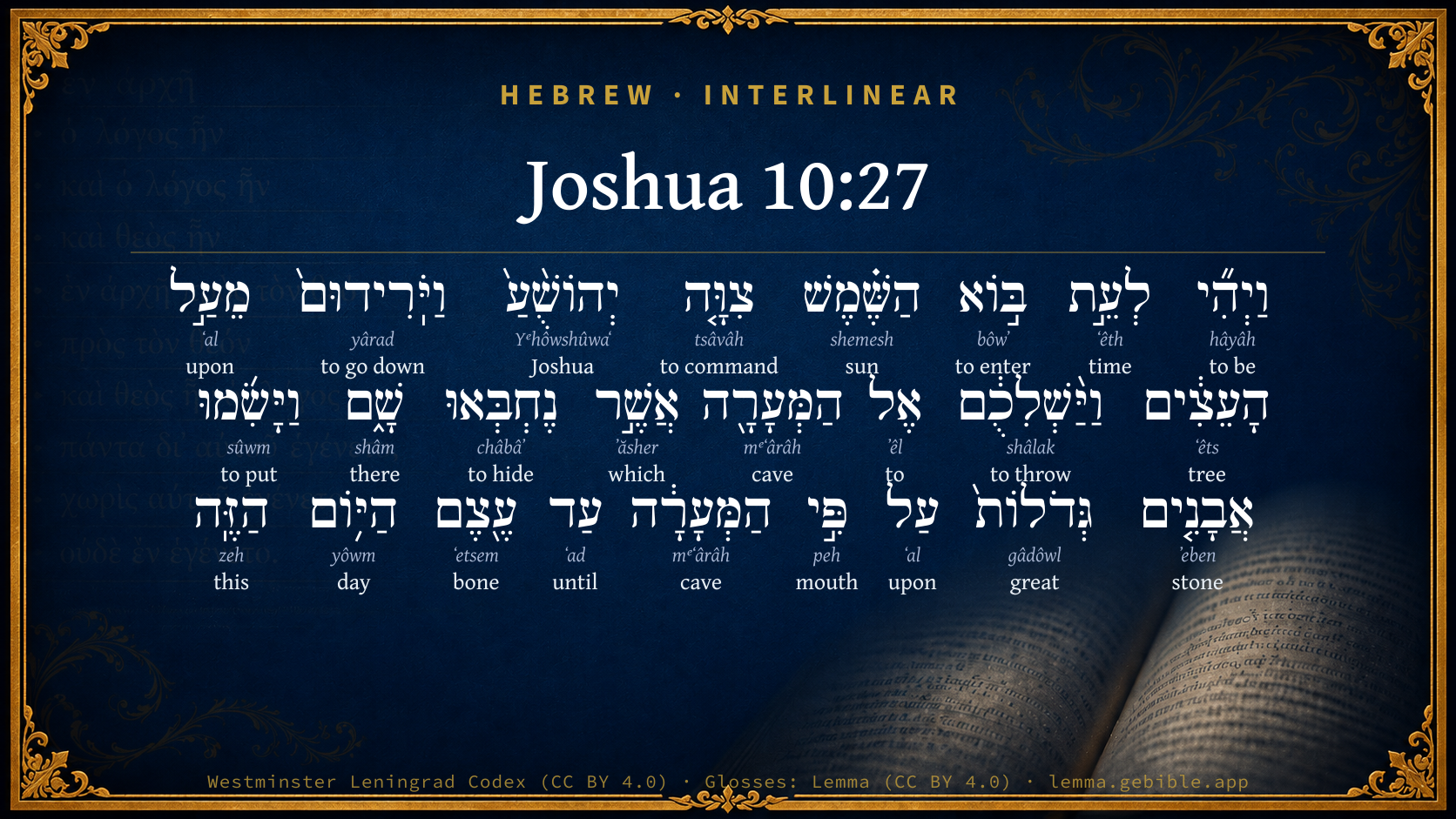
Hebrew (Westminster Leningrad Codex) Joshua 10:27 appears in the Hebrew Old Testament. The text above is from the Westminster Leningrad Codex. Each word links to its Strong’s number, a concise gloss, and parsing drawn from the Open Scriptures Hebrew Bible morphology. Click any word for its full Brown-Driver-Briggs (BDB) entry.
Download image
Cite this verse

Joshua 10:27 (World English Bible). Public Domain. Lemma interlinear Bible study tool, https://lemma.gebible.app/v/joshua/10/27.

Show BibTeX & RIS
BibTeX
RIS
English Translation
It happened at the time of the going down of the sun, that Joshua commanded, and they took them down off the trees, and cast them into the cave in which they had hidden themselves, and laid great stones on the mouth of the cave, to this very day.
World English Bible · Public Domain
Download a study sheet

One document with this verse’s original text, its word-by-word gloss line, the meaning frame, cross-references with their text, attributed commentary, and full source and license credits — printable, and it pastes into notes with its structure intact.

This verse Autodidact and up

Study sheet (.html) Plain text (.txt)

A passage Seminary Student

Up to 50 verses in one chapter. A passage sheet keeps up to 6 commentary sources and 12 cross-references per verse, in the order this page ranks them, and says so on the sheet whenever that leaves anything out. Ask for a single verse and you get the Autodidact verse sheet above.

Everything on this page stays free to read, with no account — the sheet is a download of what is already on screen, not access to it.

Want to remove ads? Support Godless Engineer
Compare translations 3

The same verse in 3 English versions, stacked beneath the original-language interlinear above. Click any original word for its lexicon entry.

Each is an independent rendering of the whole verse — the interlinear is not word-aligned to these translations.

Highlighted words mark where these versions differ — a whole-verse word diff, not a word-by-word alignment.

  • World English Bible Public Domain
    It happened at the time of the going down of the sun, that Joshua commanded, and they took them down off the trees, and cast them into the cave in which they had hidden themselves, and laid great stones on the mouth of the cave, to this very day.
  • King James Version Public Domain
    And it came to pass at the time of the going down of the sun, that Joshua commanded, and they took them down off the trees, and cast them into the cave wherein they had been hid, and laid great stones in the cave's mouth, which remain until this very day.
  • unfoldingWord Literal Text CC BY-SA 4.0
    And it happened at the time of the going of the sun that Joshua commanded, and they took them down from upon the trees and threw them into the cave where they had hidden themselves. And they put great stones over the mouth of the cave, to this same day.

unfoldingWord Literal Text — © unfoldingWord, licensed CC BY-SA 4.0. Word-aligned USFM3 via Door43 (git.door43.org/unfoldingWord/en_ult).

Versions to compare (up to 4)

3 of 4 selected

Show all 18 translations

Every available English version of this verse, each an independent rendering of the whole verse.

  • World English Bible Public Domain
    It happened at the time of the going down of the sun, that Joshua commanded, and they took them down off the trees, and cast them into the cave in which they had hidden themselves, and laid great stones on the mouth of the cave, to this very day.
  • Berean Standard Bible Public Domain
    At sunset Joshua ordered that they be taken down from the trees and thrown into the cave in which they had hidden. Then large stones were placed against the mouth of the cave, and the stones are there to this day.
  • Majority Standard Bible Public Domain
    At sunset Joshua ordered that they be taken down from the trees and thrown into the cave in which they had hidden. Then large stones were placed against the mouth of the cave, and the stones are there to this day.
  • King James Version Public Domain
    And it came to pass at the time of the going down of the sun, that Joshua commanded, and they took them down off the trees, and cast them into the cave wherein they had been hid, and laid great stones in the cave's mouth, which remain until this very day.
  • American Standard Version (1901) Public Domain
    And it came to pass at the time of the going down of the sun, that Joshua commanded, and they took them down off the trees, and cast them into the cave wherein they had hidden themselves, and laid great stones on the mouth of the cave, unto this very day.
  • Revised Version (1885) Public Domain
    And it came to pass at the time of the going down of the sun, that Joshua commanded, and they took them down off the trees, and cast them into the cave wherein they had hidden themselves, and laid great stones on the mouth of the cave, unto this very day.
  • Geneva Bible (1599) Public Domain
    And at the going downe of the sunne, Ioshua gaue commandement, that they should take them downe off the trees, and cast them into the caue (wherein they had bene hid) and they layde great stones vpon the caues mouth, which remaine vntill this day.
  • Douay-Rheims (1899) Public Domain
    And when the sun was down, he commanded the soldiers to take them down from the gibbets. And after they were taken down, they cast them into the cave where they had lain hid, and put great stones at the mouth thereof, which remain until this day.
  • Young's Literal Translation Public Domain
    And it cometh to pass, at the time of the going in of the sun, Joshua hath commanded, and they take them down from off the trees, and cast them unto the cave where they had been hid, and put great stones on the mouth of the cave till this very day.
  • Literal Standard Version CC BY-SA 4.0
    And it comes to pass, at the time of the going in of the sun, Joshua has commanded, and they take them down from off the trees, and cast them into the cave where they had been hid, and put great stones on the mouth of the cave until this very day.
  • Unlocked Literal Bible CC BY-SA 4.0
    When it was sunset, Joshua gave orders, and they took them down from the trees and threw them into the cave where they had hidden themselves. They put large stones over the mouth of the cave. Those stones remain there to this very day.
  • unfoldingWord Literal Text CC BY-SA 4.0
    And it happened at the time of the going of the sun that Joshua commanded, and they took them down from upon the trees and threw them into the cave where they had hidden themselves. And they put great stones over the mouth of the cave, to this same day.
  • Darby Bible Public Domain
    And it came to pass at the time of the going down of the sun, that Joshua commanded, and they took them down off the trees, and cast them into the cave where they had been hid, and laid great stones before the cave's mouth, [which remain] to this very day.
  • World Messianic Bible Public Domain
    At the time of the going down of the sun, Joshua commanded, and they took them down off the trees, and threw them into the cave in which they had hidden themselves, and laid great stones on the mouth of the cave, which remain to this very day.
  • Webster's Bible Public Domain
    And it came to pass at the time of the setting of the sun, that Joshua commanded, and they took them down from the trees, and cast them into the cave in which they had been hid, and laid great stones upon the cave's mouth, which remain until this very day.
  • Free Bible Version CC BY-SA 4.0
    As the sun went down Joshua gave the order to take their bodies down from the trees and throw them into the cave where they had been hiding. Then the Israelites piled up stones over the entrance to the cave, and they are there to this very day.
  • Bible in Basic English Public Domain
    And when the sun went down, they were taken down from the trees, by Joshua's orders, and put into the hole where they had gone to be safe; and great stones were placed at the mouth of the hole, where they are to this day.
  • JPS Tanakh (1917) Public Domain
    And it came to pass at the time of the going down of the sun, that Joshua commanded, and they took them down off the trees, and cast them into the cave wherein they had hidden themselves, and laid great stones on the mouth of the cave, unto this very day.

Literal Standard Version (2020), Covenant Press — licensed CC BY-SA 4.0. Text via the HelloAO Bible API (eBible.org). Unlocked Literal Bible (unfoldingWord) — licensed CC BY-SA 4.0. Text via the HelloAO Bible API (eBible.org). unfoldingWord Literal Text — © unfoldingWord, licensed CC BY-SA 4.0. Word-aligned USFM3 via Door43 (git.door43.org/unfoldingWord/en_ult). Free Bible Version, Dr. Jonathan Gallagher — licensed CC BY-SA 4.0. Text via the HelloAO Bible API (eBible.org).

Word by word

More ways to search: Search by grammar → Find every occurrence → Compare this word →

Practice this passage: Drill this verse → Learn its vocabulary →

נֶחְבְּאוּ
châbâʼ
H2244
“to hide”
Verb, Niphal, Perfect, 3rd Person, Common, Plural
Part of Speech
Verb
Stem
Niphal
Form
Perfect
Person
3rd Person
Gender
Common
Number
Plural
Full BDB Definition

Origin: a primitive root [compare H2245 ]

TWOT: 588

to withdraw, hide - (Niphal) to hide oneself - (Pual) to be forced into hiding - (Hiphil) to hide - (Hophal) to be hidden - (Hithpael) - to hide oneself, draw back - to draw together, thicken, harden
  1. וַיְהִ֞י hâyâh H1961 “and · to be” Conjunction + Verb, Qal, Sequential Imperfect, 3rd Person, Masculine, Singular
  2. לְעֵ֣ת ʻêth H6256 “to/for · time of” Preposition + Noun, Common, Both, Singular, Construct
  3. בּ֣וֹא bôwʼ H935 “to enter” Verb, Qal, Infinitive Construct
  4. הַשֶּׁ֗מֶשׁ shemesh H8121 “the · sun” Particle, Definite Article + Noun, Common, Both, Singular, Absolute
  5. צִוָּ֤ה tsâvâh H6680 “to command” Verb, Piel, Perfect, 3rd Person, Masculine, Singular
  6. יְהוֹשֻׁ֨עַ֙ Yᵉhôwshûwaʻ H3091 “Joshua” Noun, Proper
  7. וַיֹּֽרִידוּם֙ yârad H3381 “and · to go down · them” Conjunction + Verb, Hiphil, Sequential Imperfect, 3rd Person, Masculine, Plural + Suffix, Personal, 3rd Person, Masculine, Plural
  8. מֵעַ֣ל ʻal H5921 “from · upon” Preposition + Preposition
  9. הָעֵצִ֔ים ʻêts H6086 “the · trees” Particle, Definite Article + Noun, Common, Masculine, Plural, Absolute
  10. וַיַּ֨שְׁלִכֻ֔ם shâlak H7993 “and · to throw · them” Conjunction + Verb, Hiphil, Sequential Imperfect, 3rd Person, Masculine, Plural + Suffix, Personal, 3rd Person, Masculine, Plural
  11. אֶל ʼêl H413 “to” Preposition
  12. הַמְּעָרָ֖ה mᵉʻârâh H4631 “the · cave” Particle, Definite Article + Noun, Common, Feminine, Singular, Absolute
  13. אֲשֶׁ֣ר ʼăsher H834 “which” Particle, Relative
  14. שָׁ֑ם shâm H8033 “there” Adverb
  15. וַיָּשִׂ֜מוּ sûwm H7760 “and · to put” Conjunction + Verb, Qal, Sequential Imperfect, 3rd Person, Masculine, Plural
  16. אֲבָנִ֤ים ʼeben H68 “stones” Noun, Common, Feminine, Plural, Absolute
  17. גְּדֹלוֹת֙ gâdôwl H1419 “great” Adjective, Adjective, Feminine, Plural, Absolute
  18. עַל ʻal H5921 “upon” Preposition
  19. פִּ֣י peh H6310 “mouth of” Noun, Common, Masculine, Singular, Construct
  20. הַמְּעָרָ֔ה mᵉʻârâh H4631 “the · cave” Particle, Definite Article + Noun, Common, Feminine, Singular, Absolute
  21. עַד ʻad H5704 “until” Preposition
  22. עֶ֖צֶם ʻetsem H6106 “bone of” Noun, Common, Feminine, Singular, Construct
  23. הַיּ֥וֹם yôwm H3117 “the · day” Particle, Definite Article + Noun, Common, Masculine, Singular, Absolute
  24. הַזֶּֽה zeh H2088 “the · this” Particle, Definite Article + Pronoun, Demonstrative, Masculine, Singular

About this verse

These counts appear in no published source. They are computed here, from the morphology-tagged text and Lemma’s own curated glosses. What Lemma adds →

25
words
23
distinct lemmas
Historical
section

Shared distinctive vocabulary

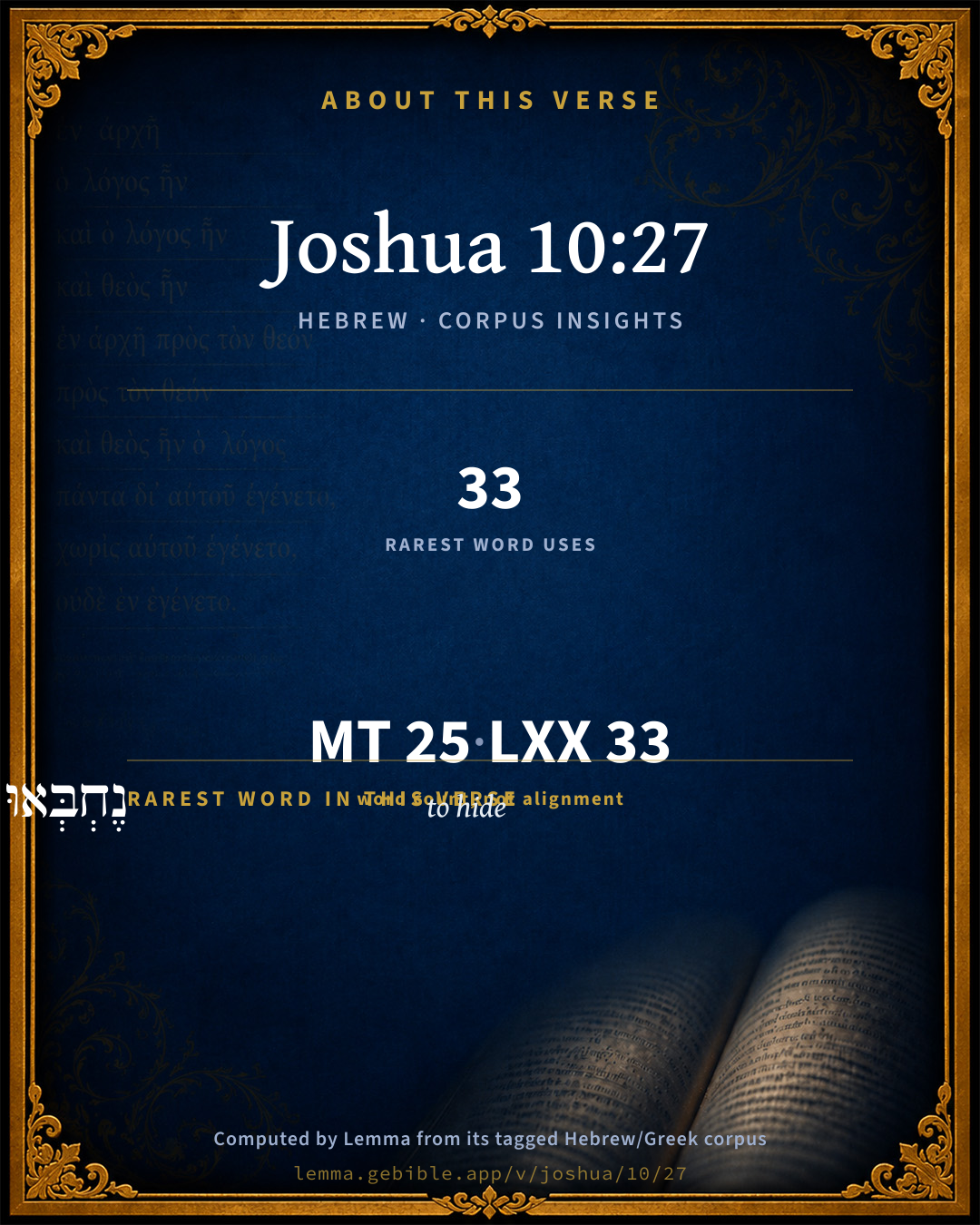
נֶחְבְּאוּ to hide H2244 occurs in 33 verses of the Hebrew Bible. Also found in:

Grammatical profile

  • 7 verbs
  • 10 nouns
  • 1 adjective
  • 1 pronoun
  • 4 prepositions
  • 1 adverb
  • 1 particle

Verb forms

  • וַיְהִ֞י Qal · Sequential Imperfect
  • בּ֣וֹא Qal · Infinitive Construct
  • צִוָּ֤ה Piel · Perfect
  • וַיֹּֽרִידוּם֙ Hiphil · Sequential Imperfect
  • וַיַּ֨שְׁלִכֻ֔ם Hiphil · Sequential Imperfect
  • נֶחְבְּאוּ Niphal · Perfect
  • וַיָּשִׂ֜מוּ Qal · Sequential Imperfect

Repetition

Words recur within this verse — often emphatic in Hebrew:

  • מֵעַ֣ל upon H5921 ×2
  • הַמְּעָרָ֖ה cave H4631 ×2

Hebrew & Septuagint length

In English translation the verse runs 49 words from the Hebrew and 45 from the Septuagint (LXX English) — closely comparable.

A rough comparison of the two English renderings, which tokenize alike — not a word-level alignment.

Word counts can differ between the Hebrew and the Greek without any difference in meaning — e.g. the Hebrew direct-object marker אֵת has no separate Greek word, and Greek often adds the article ὁ.

In the original languages it is 25 Hebrew tokens and 33 Greek tokens — but the two are counted differently (Hebrew bundles its prefixes and suffixes into one token; the Greek is in lemma form), so that isn’t a like-for-like length.

Cross-references

5

Topical passages linked to Joshua 10:27 in the Treasury of Scripture Knowledge — connected by theme and wording, ordered by reader-vote popularity; previews shown in the World English Bible.

  • Joshua 8:29 The king of Ai he hanged on a tree until the evening: and at the going down of the sun Joshua commanded, and they took his body down from the tree, and cast it at the entrance of the gate of the city, and raised thereon a great heap of stones, to this day.
  • Deuteronomy 21:22–23 If a man have committed a sin worthy of death, and he be put to death, and you hang him on a tree;
  • Joshua 7:26 They raised over him a great heap of stones, to this day; and Yahweh turned from the fierceness of his anger. Therefore the name of that place was called "The valley of Achor" to this day.
  • 2 Samuel 18:17 They took Absalom, and cast him into the great pit in the forest, and raised over him a very great heap of stones: and all Israel fled everyone to his tent.
  • Joshua 4:9 Joshua set up twelve stones in the midst of the Jordan, in the place where the feet of the priests who bore the ark of the covenant stood: and they are there to this day.

Cross-references courtesy of OpenBible.info (CC BY 4.0).

Hebrew and Greek witnesses Masoretic Hebrew ↔ Greek Septuagint

The same verse in the two great witnesses to the Old Testament, shown verse-for-verse.

These are two independent witnesses, not word-aligned to each other, and the Septuagint is shown in lemma (dictionary) form.

Hebrew Joshua 10:27 Masoretic · Westminster Leningrad Codex

וַיְהִ֞י לְעֵ֣ת בּ֣וֹא הַשֶּׁ֗מֶשׁ צִוָּ֤ה יְהוֹשֻׁ֨עַ֙ וַיֹּֽרִידוּם֙ מֵעַ֣ל הָעֵצִ֔ים וַיַּ֨שְׁלִכֻ֔ם אֶל הַמְּעָרָ֖ה אֲשֶׁ֣ר נֶחְבְּאוּ שָׁ֑ם וַיָּשִׂ֜מוּ אֲבָנִ֤ים גְּדֹלוֹת֙ עַל פִּ֣י הַמְּעָרָ֔ה עַד עֶ֖צֶם הַיּ֥וֹם הַזֶּֽה

It happened at the time of the going down of the sun, that Joshua commanded, and they took them down off the trees, and cast them into the cave in which they had hidden themselves, and laid great stones on the mouth of the cave, to this very day.

World English Bible · Public Domain

Greek LXX Joshua 10:27 Septuagint · lemma form

καί γίγνομαι πρός ἥλιος δυσμή ἐντέλλομαι ἰησοῦς καί κατααἱρέω αὐτός ἀπό ὁ ξύλον καί ῥίπτω αὐτός εἰς ὁ σπήλαιον εἰς ὅς καταφεύγω ἐκεῖ καί ἐπικυλίω λίθος ἐπί ὁ σπήλαιον ἕως ὁ σήμερον ἡμέρα

And it came to pass toward the setting of the sun, Joshua commanded, and they took them down from the trees, and cast them into the cave into which they had fled for refuge, and rolled stones to the cave, which remain till this day.

LXX2012 (modern English Septuagint) · Public Domain

Hebrew: Westminster Leningrad Codex (CC BY 4.0). Greek: Septuagint (public domain); English from LXX2012 (modern English Septuagint) (Public Domain). How the Septuagint differs from the Hebrew →

Targum (Aramaic paraphrase)

1

The Targum is the ancient Jewish Aramaic paraphrase of the Hebrew Scriptures — an interpretive translation, not the Hebrew text itself. Onkelos (literal) and Pseudo-Jonathan (expansive) render the Torah, and Jonathan the Prophets. Coverage is partial: where no permissively-licensed English translation exists for a verse, only the Aramaic is shown. This is verse-level text, not a word-by-word alignment to the Hebrew.

  1. Targum Jonathan Prophets (Joshua–Malachi)
    וַהֲוָה לְעִידָן מֵיעַל שִׁמְשָׁא פַּקֵד יְהוֹשֻׁעַ וְאַחִיתוּנוּן מֵעַל צְלִיבַיָא וּרְמוֹנוּן לִמְעַרְתָּא דְאִטַמָרוּ תַמָן וְשַׁוִיאוּ אַבְנִין רַבְרְבָן עַל פּוּמָא דִמְעַרְתָּא עַד כְּרַן יוֹמָא הָדֵין:

    (no public-domain English translation for this verse)

    Targum Jonathan — Aramaic: “Mikraot Gedolot” (public domain). English: “Sefaria Community Translation” (CC0 1.0 (public-domain dedication)); “London "Chaldee Paraphrase," 1871” (public domain). Text via Sefaria.

Commentary

Notes on Joshua 10:27 from classic Christian and Jewish commentators (each source and its license shown beneath its notes). The classic Christian expositions comment on the surrounding passage and are grouped to its opening verse, so a note may address several verses; the Jewish commentaries on the Tanakh (Rashi and others) are per-verse, so they appear only where the commentator wrote on this verse.

Lemma curates 59 commentaries, every one of them public domain or Creative Commons licensed, each selected and text-cleaned for this edition rather than reprinted as found. About our sources →

The Cambridge Bible for Schools and Colleges

gen. ed. J. J. S. Perowne

27. at the time of the going down of the sun] According to the strict command in Deu_21:23.

into the cave wherein they had been hid] “Into the spelonk, in the which thei lorkiden,” Wyclif, which then became a royal sepulchre, while the stones “which on the self-same day had cut them off from escape, closed the mouth of the tomb.” See Keil on Jos_10:27.

The Cambridge Bible for Schools and Colleges (gen. ed. J. J. S. Perowne; Cambridge University Press, 1878–1918) — public domain. Text from a community e-Sword module.

Trapp's Complete Commentary

John Trapp

Jos 10:27 And it came to pass at the time of the going down of the sun, [that] Joshua commanded, and they took them down off the trees, and cast them into the cave wherein they had been hid, and laid great stones in the cave’s mouth, [which remain] until this very day.

Ver. 27. They took them down.] See Jos 8:29.

John Trapp, A Commentary or Exposition upon All the Books of the Old and New Testament (1647–1656) — public domain. Text from a community e-Sword module.

Joseph Benson's Commentary

Jos 10:27-29. They took them down — That neither wild beasts might come to devour them, nor any of their people to give them honourable burial. Thus, that which they thought would have been their shelter was made their prison first, and then their grave. So shall we surely be disappointed, in whatever we flee to from God. And that day — On which the sun stood still. Nor is it strange that so much work was done, and places so far distant were taken in one day, when the day was so long, and the Canaanites struck with such a terror. He let none remain — From the severity wherewith this and the following cities were treated, and the command given, (Deu 20:10,) it has been inferred, with much probability, that offers of peace had been made them by Joshua before he fought against them, and that they had rejected these offers. All Israel with him unto Libnah — Namely, all who were with him in this expedition.

Joseph Benson's Commentary on the Old and New Testaments (1811–1818) — public domain. Text from a community e-Sword module.

John Gill's Exposition

And that day Joshua took Makkedah,.... Some say it was the day on which the sun stood still; but it seems to mean the day in which the five kings were hanged:

and smote it with the edge of the sword, and the king thereof; slew the inhabitants of it and their king, after having entered and taken it:

he utterly destroyed them and all the souls that were therein, he let none remain; that is, all human souls or persons; for the cattle were taken for a prey:

and he did to the king of Makkedah as he did unto the king of Jericho; slew him with the sword, along with the inhabitants, but did not hang him up, as he did the king of Ai and the five kings.

John Gill's Exposition of the Whole Bible (1746–1763) — public domain (CC PDM 1.0). Text via the HelloAO Bible API.

Haydock's Catholic Bible Commentary

CHAPTER X.

Ver 1. Adonisedec means, "Lord of justice," as Melchisedec denotes "the king of justice;" perhaps Salem was originally styled Zedec. (Masius) --- This king had probably some control over the neighbouring cities. (Menochius) --- He was also in the greatest danger; and not daring to attack the Israelites, he resolves to fall upon the Gabaonites unawares, that other cities might be deterred from following their example. --- Confederates. Hebrew, "and were among them," which may signify either that the Israelites were to dwell in the towns belonging to the Gabaonites, or that the latter should live along with them, as one and the same people, following the same religion, and bound together by the same interests.

Down. (Deuteronomy xxi.) The victorious army had returned some time before the evening, and had time to take the city of Maceda; though some, without reason, believe that this took place the day following.

George Leo Haydock (1774–1849), Haydock's Catholic Family Bible and Commentary, 1859 edition — public domain. Excludes Psalms (Douay-Rheims chapter numbering differs from Protestant) and Deuterocanonical books (Catholic canon only).

Matthew Poole's English Annotations

Laid great stones in the cave’s mouth; that neither wild beasts could come at them to devour them, nor any of their people to give them honourable burial.

Matthew Poole's English Annotations on the Holy Bible (1683–1685) — public domain. Text from a community e-Sword/MySword module.

Whedon's Commentary on the Bible

Daniel D. Whedon

27. Cast them into the cave — The place of their concealment was made their sepulchre.

Until this very day — See note, Jos_8:28.

Daniel D. Whedon (gen. ed.), Commentary on the Old and New Testaments (1874–1909) — public domain. Text from a community e-Sword module.

The Pulpit Commentary

At the time of the going down of the sun. See Deu_21:23. Joshua set the example to the Israelites of a strict observance of the law. And we may observe that this law is only to be found in Deuteronomy. On the "Deuteronomist" theory we have to suppose that the Deuteronomist, with a lynx eye to the chance of recommending the provisions which he had invented, and to the importance of representing Joshua as a strict observer of them, inserted this piece of detail with an obvious purpose. It is a wonder that this should be almost the only "Deuteronomist" precept thus emphasised. We find it noticed above, (Jos_8:29) and in both cases the obvious explanation is that this sign of triumph made a great impression on those who witnessed it, and that it was carried out in strict fulfilment of enactments already existing. On the other hand, as we have seen, there is no attempt in Jos_8:30-35 to emphasise thus the obedience to the command in Deu_27:2-8. It is from minute details of this kind, which escape the superficial observer, that the authenticity of the Book of Deuteronomy is established. Until this very day. The form of the expression here is singularly different from the expression found elsewhere when the meaning suggested by the Authorized Version is to be conveyed. But for the word d we should translate "on the self-same day," as in Gen_7:13, etc. d may be a slip of the pen for l which is seldom, if ever, used of time (only, if at all, in Psa_48:1-5, and Pro_25:11), though the idiom is found in Arabic, in Greek (as in ep hmati ), in German (as in auf den Tag. ) and in English, "on that day;" or we may, with Keil, refer back to ver. 18, and trans. late "they cast them into the cave where they had been hid, and where they had placed great stones unto that very day." For there may have been an interval of several days between the confinement of the kings in the cave and their death at the hands of Joshua. See note on ver. 21.

The Pulpit Commentary (1880–1919), ed. H.D.M. Spence-Jones & Joseph S. Exell — public domain. Text from a community e-Sword module.

John Wesley's Explanatory Notes

Took them down - That neither wild beasts could come to devour them, nor any of their people to give them honourable burial. Thus that which they thought would have been their shelter, was made their prison first, and then their grave. So shall we surely be disappointed, in whatever we flee to from God.

John Wesley, Explanatory Notes Upon the Whole Bible (1754–1765) — public domain. Text via the GEBible commentary corpus.

Lesson kit

Teaching starters — assembled from the data on this page, not authored interpretation. Every prompt links to the verse data it draws on. Edit before teaching.

Joshua, in the Historical, opens this verse with 25 words (23 distinct Hebrew lemmas). Its most distinctive word is châbâʼ (“to hide”). A historical commentator’s framing appears above. Read the whole chapter for the surrounding context.

Discussion questions

  1. How does “to hide” (châbâʼ) shape what this verse is saying?
  2. Genesis 3:8 shares the word «to hide» with this verse. How do the two illuminate each other?
  3. “upon” occurs 2× in this one verse. What is the effect of the repetition?
  4. The translations on this page render this verse differently — a whole-verse word diff, not a word-by-word alignment. What might account for the different wordings?
  5. The verb «וַיְהִ֞י» is Qal Sequential Imperfect. How does its form color the action?
  6. Reading how The Cambridge Bible for Schools and Colleges and Trapp's Complete Commentary read this verse, where do the two commentators agree and where do they part?

Things to notice

Reading settings

Reading text

Shown beneath each verse's original-language words.

Old Testament
Old Testament edition

Read the OT as the Masoretic Hebrew (MT) or the Greek Septuagint (LXX).

English shown for the Greek Septuagint (in the Hebrew ↔ Greek comparison).

Comparing translations? Open the Compare panel on any verse page to stack up to four side by side.