Deuteronomy 4:13

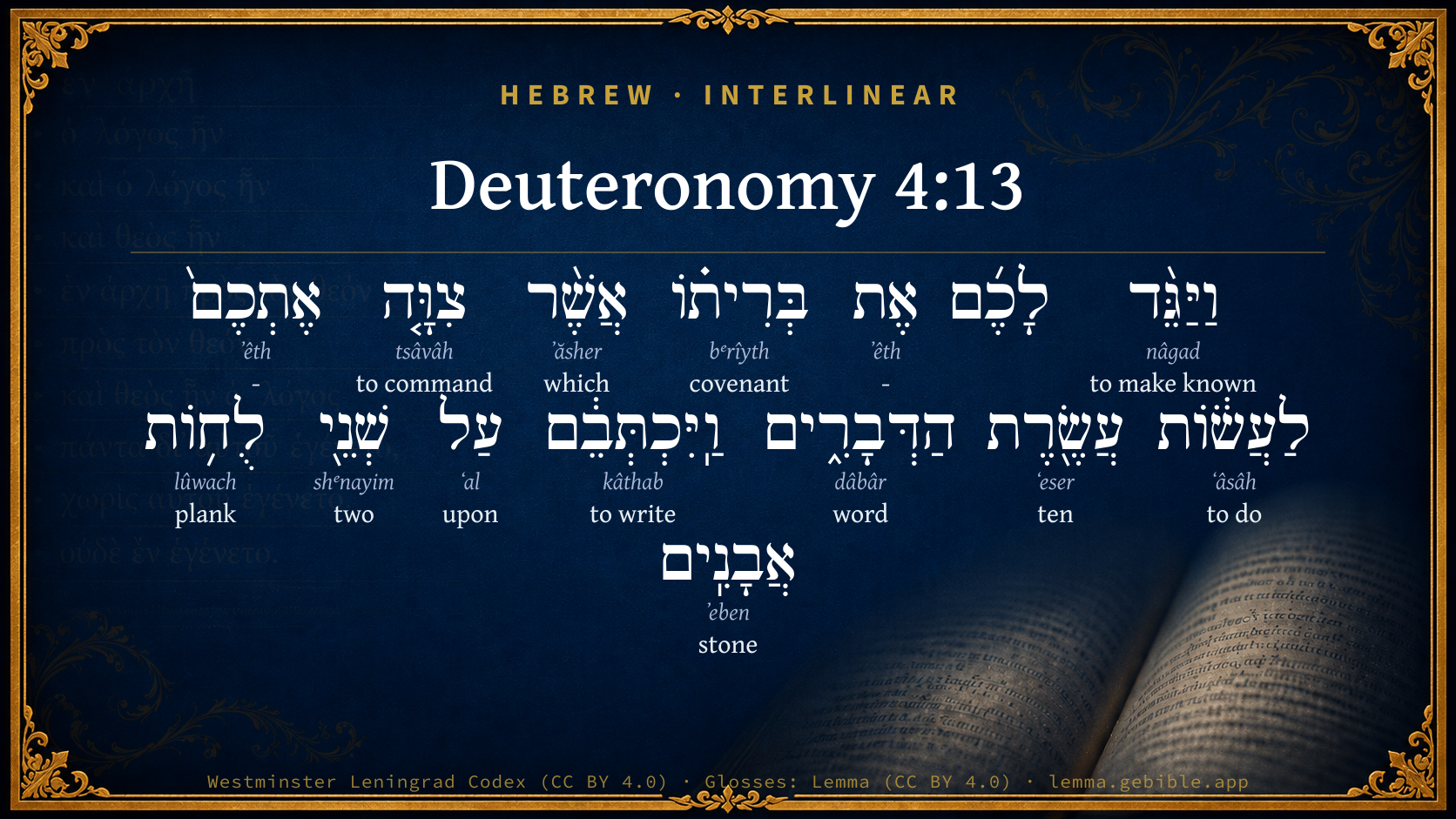
Hebrew (Westminster Leningrad Codex) Deuteronomy 4:13 appears in the Hebrew Old Testament. The text above is from the Westminster Leningrad Codex. Each word links to its Strong’s number, a concise gloss, and parsing drawn from the Open Scriptures Hebrew Bible morphology. Click any word for its full Brown-Driver-Briggs (BDB) entry.
Download image
Cite this verse

Deuteronomy 4:13 (World English Bible). Public Domain. Lemma interlinear Bible study tool, https://lemma.gebible.app/v/deuteronomy/4/13.

Show BibTeX & RIS
BibTeX
RIS
English Translation
He declared to you his covenant, which he commanded you to perform, even the ten commandments; and he wrote them on two tables of stone.
World English Bible · Public Domain
Download a study sheet

One document with this verse’s original text, its word-by-word gloss line, the meaning frame, cross-references with their text, attributed commentary, and full source and license credits — printable, and it pastes into notes with its structure intact.

This verse Autodidact and up

Study sheet (.html) Plain text (.txt)

A passage Seminary Student

Up to 50 verses in one chapter. A passage sheet keeps up to 6 commentary sources and 12 cross-references per verse, in the order this page ranks them, and says so on the sheet whenever that leaves anything out. Ask for a single verse and you get the Autodidact verse sheet above.

Everything on this page stays free to read, with no account — the sheet is a download of what is already on screen, not access to it.

Want to remove ads? Support Godless Engineer
Compare translations 3

The same verse in 3 English versions, stacked beneath the original-language interlinear above. Click any original word for its lexicon entry.

Each is an independent rendering of the whole verse — the interlinear is not word-aligned to these translations.

Highlighted words mark where these versions differ — a whole-verse word diff, not a word-by-word alignment.

  • World English Bible Public Domain
    He declared to you his covenant, which he commanded you to perform, even the ten commandments; and he wrote them on two tables of stone.
  • King James Version Public Domain
    And he declared unto you his covenant, which he commanded you to perform, even ten commandments; and he wrote them upon two tables of stone.
  • unfoldingWord Literal Text CC BY-SA 4.0
    And he declared to you his covenant that he commanded you to do, the Ten Words. And he wrote them on two tablets of stone.

unfoldingWord Literal Text — © unfoldingWord, licensed CC BY-SA 4.0. Word-aligned USFM3 via Door43 (git.door43.org/unfoldingWord/en_ult).

Versions to compare (up to 4)

3 of 4 selected

Show all 18 translations

Every available English version of this verse, each an independent rendering of the whole verse.

  • World English Bible Public Domain
    He declared to you his covenant, which he commanded you to perform, even the ten commandments; and he wrote them on two tables of stone.
  • Berean Standard Bible Public Domain
    He declared to you His covenant, which He commanded you to follow—the Ten Commandments that He wrote on two tablets of stone.
  • Majority Standard Bible Public Domain
    He declared to you His covenant, which He commanded you to follow—the Ten Commandments that He wrote on two tablets of stone.
  • King James Version Public Domain
    And he declared unto you his covenant, which he commanded you to perform, even ten commandments; and he wrote them upon two tables of stone.
  • American Standard Version (1901) Public Domain
    And he declared unto you his covenant, which he commanded you to perform, even the ten commandments; and he wrote them upon two tables of stone.
  • Revised Version (1885) Public Domain
    And he declared unto you his covenant, which he commanded you to perform, even the ten commandments; and he wrote them upon two tables of stone.
  • Geneva Bible (1599) Public Domain
    Then hee declared vnto you his couenant which he commanded you to doe, euen the ten commandements, and wrote them vpon two tables of stone.
  • Douay-Rheims (1899) Public Domain
    And he shewed you his covenant, which he commanded you to do, and the ten words that he wrote in two tables of stone.
  • Young's Literal Translation Public Domain
    and He declareth to you His covenant, which He hath commanded you to do, the Ten Matters, and He writeth them upon two tables of stone.
  • Literal Standard Version CC BY-SA 4.0
    and He declares His covenant to you, which He has commanded you to do, the Ten Commandments, and He writes them on two tablets of stone.
  • Unlocked Literal Bible CC BY-SA 4.0
    He declared to you his covenant that he commanded you to perform, the Ten Commandments. He wrote them on two tablets of stone.
  • unfoldingWord Literal Text CC BY-SA 4.0
    And he declared to you his covenant that he commanded you to do, the Ten Words. And he wrote them on two tablets of stone.
  • Darby Bible Public Domain
    And he declared to you his covenant, which he commanded you to do, the ten words; and he wrote them on two tables of stone.
  • World Messianic Bible Public Domain
    He declared to you his covenant, which he commanded you to perform, even the ten commandments. He wrote them on two stone tablets.
  • Webster's Bible Public Domain
    And he declared to you his covenant, which he commanded you to perform, even ten commandments; and he wrote them upon two tables of stone.
  • Free Bible Version CC BY-SA 4.0
    He explained to you his agreement, the Ten Commandments, which he ordered you to follow. He wrote them down on two tablets of stone.
  • Bible in Basic English Public Domain
    And he gave you his agreement with you, the ten rules which you were to keep, which he put in writing on the two stones of the law.
  • JPS Tanakh (1917) Public Domain
    And He declared unto you His covenant, which He commanded you to perform, even the ten words; and He wrote them upon two tables of stone.

Literal Standard Version (2020), Covenant Press — licensed CC BY-SA 4.0. Text via the HelloAO Bible API (eBible.org). Unlocked Literal Bible (unfoldingWord) — licensed CC BY-SA 4.0. Text via the HelloAO Bible API (eBible.org). unfoldingWord Literal Text — © unfoldingWord, licensed CC BY-SA 4.0. Word-aligned USFM3 via Door43 (git.door43.org/unfoldingWord/en_ult). Free Bible Version, Dr. Jonathan Gallagher — licensed CC BY-SA 4.0. Text via the HelloAO Bible API (eBible.org).

Word by word

More ways to search: Search by grammar → Find every occurrence → Compare this word →

Practice this passage: Drill this verse → Learn its vocabulary →

לֻח֥וֹת
lûwach
H3871
“planks of”
Noun, Common, Masculine, Plural, Construct
Part of Speech
Noun
Type
Common
Gender
Masculine
Number
Plural
State
Construct
Full BDB Definition

Origin: from a primitive root

TWOT: 1091a

board, slab, tablet, plank - tablets (of stone) - boards (of wood) - plate (of metal)
  1. וַיַּגֵּ֨ד nâgad H5046 “and · to make known” Conjunction + Verb, Hiphil, Sequential Imperfect, 3rd Person, Masculine, Singular
  2. אֶת ʼêth H853 “-” Particle, Direct Object
  3. בְּרִית֗וֹ bᵉrîyth H1285 “covenant · his” Noun, Common, Feminine, Singular, Construct + Suffix, Personal, 3rd Person, Masculine, Singular
  4. אֲשֶׁ֨ר ʼăsher H834 “which” Particle, Relative
  5. צִוָּ֤ה tsâvâh H6680 “to command” Verb, Piel, Perfect, 3rd Person, Masculine, Singular
  6. אֶתְכֶם֙ ʼêth H853 “- · you” Particle, Direct Object + Suffix, Personal, 2nd Person, Masculine, Plural
  7. לַעֲשׂ֔וֹת ʻâsâh H6213 “to do” Preposition + Verb, Qal, Infinitive Construct
  8. עֲשֶׂ֖רֶת ʻeser H6235 “ten” Adjective, Cardinal number, Masculine, Singular, Construct
  9. הַדְּבָרִ֑ים dâbâr H1697 “the · words” Particle, Definite Article + Noun, Common, Masculine, Plural, Absolute
  10. וַֽיִּכְתְּבֵ֔ם kâthab H3789 “and · to write · them” Conjunction + Verb, Qal, Sequential Imperfect, 3rd Person, Masculine, Singular + Suffix, Personal, 3rd Person, Masculine, Plural
  11. עַל ʻal H5921 “upon” Preposition
  12. שְׁנֵ֖י shᵉnayim H8147 “two” Adjective, Cardinal number, Masculine, Dual, Construct
  13. אֲבָנִֽים ʼeben H68 “stones” Noun, Common, Feminine, Plural, Absolute

About this verse

These counts appear in no published source. They are computed here, from the morphology-tagged text and Lemma’s own curated glosses. What Lemma adds →

15
words
13
distinct lemmas
Pentateuch
section

Shared distinctive vocabulary

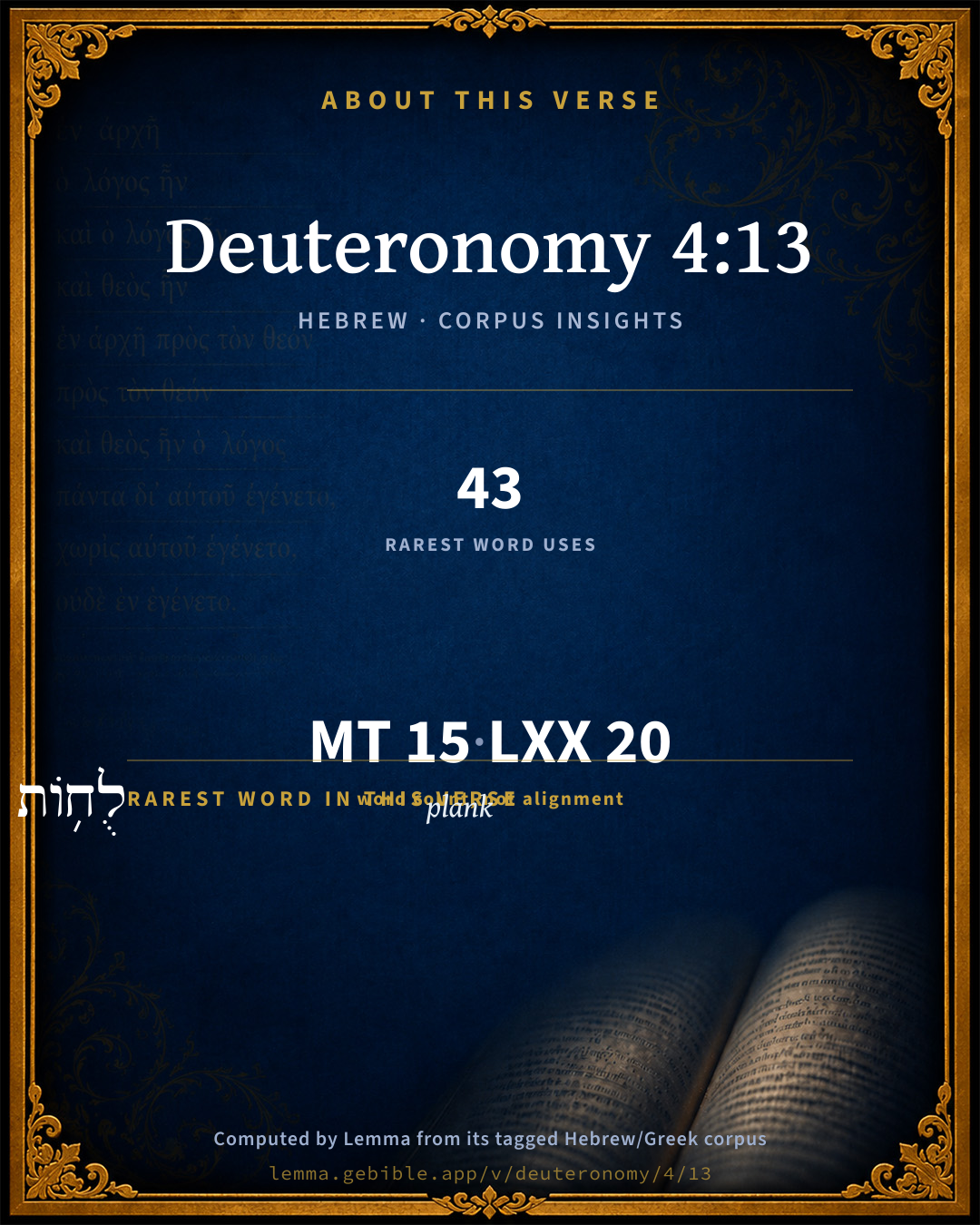
לֻח֥וֹת plank H3871 occurs in 33 verses of the Hebrew Bible. Also found in:

Grammatical profile

  • 4 verbs
  • 4 nouns
  • 2 adjectives
  • 2 prepositions
  • 3 particles

Verb forms

  • וַיַּגֵּ֨ד Hiphil · Sequential Imperfect
  • צִוָּ֤ה Piel · Perfect
  • לַעֲשׂ֔וֹת Qal · Infinitive Construct
  • וַֽיִּכְתְּבֵ֔ם Qal · Sequential Imperfect

Hebrew & Septuagint length

In English translation the verse runs 25 words from the Hebrew and 26 from the Septuagint (LXX English) — closely comparable.

A rough comparison of the two English renderings, which tokenize alike — not a word-level alignment.

Word counts can differ between the Hebrew and the Greek without any difference in meaning — e.g. the Hebrew direct-object marker אֵת has no separate Greek word, and Greek often adds the article ὁ.

In the original languages it is 15 Hebrew tokens and 20 Greek tokens — but the two are counted differently (Hebrew bundles its prefixes and suffixes into one token; the Greek is in lemma form), so that isn’t a like-for-like length.

Cross-references

11

Topical passages linked to Deuteronomy 4:13 in the Treasury of Scripture Knowledge — connected by theme and wording, ordered by reader-vote popularity; previews shown in the World English Bible.

  • Exodus 34:28 He was there with Yahweh forty days and forty nights; he neither ate bread, nor drank water. He wrote on the tablets the words of the covenant, the ten commandments.
  • Exodus 31:18 He gave to Moses, when he finished speaking with him on Mount Sinai, the two tablets of the testimony, stone tablets, written with God's finger.
  • Exodus 24:12 Yahweh said to Moses, "Come up to me on the mountain, and stay here, and I will give you the tables of stone with the law and the commands that I have written, that you may teach them."
  • Deuteronomy 9:9–11 When I was gone up onto the mountain to receive the tables of stone, even the tables of the covenant which Yahweh made with you, then I stayed on the mountain forty days and forty nights; I did neither eat bread nor drink water.
  • Exodus 19:5 Now therefore, if you will indeed obey my voice, and keep my covenant, then you shall be my own possession from among all peoples; for all the earth is mine;
  • Deuteronomy 10:1–5 At that time Yahweh said to me, Hew you two tables of stone like the first, and come up to me onto the mountain, and make an ark of wood.
  • Exodus 24:17–18 The appearance of the glory of Yahweh was like devouring fire on the top of the mountain in the eyes of the children of Israel.
  • Deuteronomy 5:1–21 Moses called to all Israel, and said to them, Hear, Israel, the statutes and the ordinances which I speak in your ears this day, that you may learn them, and observe to do them.
  • Hebrews 9:19–20 For when every commandment had been spoken by Moses to all the people according to the law, he took the blood of the calves and the goats, with water and scarlet wool and hyssop, and sprinkled both the book itself and all the people,
  • 2 Corinthians 3:7 But if the service of death, written engraved on stones, came with glory, so that the children of Israel could not look steadfastly on the face of Moses for the glory of his face; which was passing away:
  • Hebrews 9:4 having a golden altar of incense, and the ark of the covenant overlaid on all sides with gold, in which was a golden pot holding the manna, Aaron's rod that budded, and the tables of the covenant;

Cross-references courtesy of OpenBible.info (CC BY 4.0).

Hebrew and Greek witnesses Masoretic Hebrew ↔ Greek Septuagint

The same verse in the two great witnesses to the Old Testament, shown verse-for-verse.

These are two independent witnesses, not word-aligned to each other, and the Septuagint is shown in lemma (dictionary) form.

Hebrew Deuteronomy 4:13 Masoretic · Westminster Leningrad Codex

וַיַּגֵּ֨ד לָכֶ֜ם אֶת בְּרִית֗וֹ אֲשֶׁ֨ר צִוָּ֤ה אֶתְכֶם֙ לַעֲשׂ֔וֹת עֲשֶׂ֖רֶת הַדְּבָרִ֑ים וַֽיִּכְתְּבֵ֔ם עַל שְׁנֵ֖י לֻח֥וֹת אֲבָנִֽים

He declared to you his covenant, which he commanded you to perform, even the ten commandments; and he wrote them on two tables of stone.

World English Bible · Public Domain

Greek LXX Deuteronomy 4:13 Septuagint · lemma form

καί ἀναἀγγέλλω σύ ὁ διαθήκη αὐτός ὅς ἐντέλλομαι σύ ποιέω ὁ δέκα ῥῆμα καί γράφω αὐτός ἐπί δύο πλάξ λίθινος

And he announced to you his covenant, which he commanded you to keep, even the ten commandments; and he wrote them on two tables of stone.

LXX2012 (modern English Septuagint) · Public Domain

Hebrew: Westminster Leningrad Codex (CC BY 4.0). Greek: Septuagint (public domain); English from LXX2012 (modern English Septuagint) (Public Domain). How the Septuagint differs from the Hebrew →

Targum (Aramaic paraphrase)

2

The Targum is the ancient Jewish Aramaic paraphrase of the Hebrew Scriptures — an interpretive translation, not the Hebrew text itself. Onkelos (literal) and Pseudo-Jonathan (expansive) render the Torah, and Jonathan the Prophets. Coverage is partial: where no permissively-licensed English translation exists for a verse, only the Aramaic is shown. This is verse-level text, not a word-by-word alignment to the Hebrew.

  1. Targum Onkelos Torah (Genesis–Deuteronomy)
    וְחַוִי לְכוֹן יָת קְיָמֵהּ דִי פַקִיד יָתְכוֹן לְמֶעְבַּד עַשְׂרָא פִּתְגָמִין וּכְתָבִנוּן עַל תְּרֵין לוּחֵי אַבְנַיָא

    (no public-domain English translation for this verse)

    Targum Onkelos — Aramaic: “Onkelos Genesis” (public domain); “Onkelos Exodus” (public domain); “Onkelos Leviticus” (public domain); “Onkelos Numbers” (public domain); “Onkelos Deuteronomy” (public domain). English: “Sefaria Community Translation” (CC0 1.0 (public-domain dedication)); “J.W. Etheridge. The Targums of Onkelos and Jonathan Ben Uzziel on the Pentateuch. London: Longmans, Green, 1862” (public domain). Text via Sefaria.

  2. Targum Pseudo-Jonathan Torah (Genesis–Deuteronomy)
    וּתְנֵי לְכוֹן יַת קְיָמֵיהּ דְּפַקֵּיד יַתְכוֹן לְמֶעֱבַד עִישַרְתֵּי דִבּוּרַיָא וְכַתְבִינוּן עַל לוּחֵי סַמְפִּירִינוּן

    And He proclaimed to you His covenant which He commanded you to per- form; Ten Words {dibbura} which He wrote upon sapphire tablets.

    Targum Pseudo-Jonathan — Aramaic: “Targum Jonathan on Genesis” (public domain); “Targum Jonathan on Exodus” (public domain); “Targum Jonathan on Leviticus” (public domain); “Targum Jonathan on Numbers” (public domain); “Targum Jonathan on Deuteronomy” (public domain). English: “The Targum of Jonathan ben Uzziel, trans. J. W. Etheridge, London, 1862” (public domain). Text via Sefaria.

Commentary

Notes on Deuteronomy 4:13 from classic Christian and Jewish commentators (each source and its license shown beneath its notes). The classic Christian expositions comment on the surrounding passage and are grouped to its opening verse, so a note may address several verses; the Jewish commentaries on the Tanakh (Rashi and others) are per-verse, so they appear only where the commentator wrote on this verse.

Lemma curates 59 commentaries, every one of them public domain or Creative Commons licensed, each selected and text-cleaned for this edition rather than reprinted as found. About our sources →

The Cambridge Bible for Schools and Colleges

gen. ed. J. J. S. Perowne

13. his covenant, which he commanded you] Heb. berîth (prob. from a root = to bind) meant any compact, contract or bargain: between friends, 1Sa_18:3; man and wife, Pro_2:17; master and servant, Job_41:4; king and people, 2Sa_5:3; former foes, whether individuals, id. Deu_3:12 f., or peoples, J, Exo_23:32; Deu_7:2 (the only instance in D of its non-religious use); conqueror and conquered, 1Sa_11:1. Berîth might apply either to the transaction or to the binding conditions on which it was based; the covenant or the terms of the covenant, i.e. ordinance or constitution. When the parties were of unequal power the terms were imposed by the stronger. So between God and Israel; His covenant which He commanded, here and Deu_29:1. Used first in a religious sense by JE, Gen_15:18, etc. of God’s covenant with the patriarchs; Exo_19:5; Exo_24:7 ff. etc. with Israel at Ḥoreb; less used by the prophets, e.g. Hos_6:7; Hos_8:1; Jer_11:10; Jer_31:32; but very frequent in Deu_4:31; Deu_7:12; Deu_8:18, etc., with patriarchs (cp. Deu_6:18, Deu_9:5, Deu_11:9, etc.); Deu_4:13; Deu_4:23, Deu_5:2, Deu_9:9; Deu_9:11; Deu_9:15, at Ḥoreb; Deu_17:2 (?), Deu_29:1; Deu_29:9; Deu_29:12; Deu_29:14; Deu_29:21; Deu_29:25 renewed in Mo‘ab. The terms commanded by God were the words of the covenant, J, Exo_34:28, or the covenant alone as here, i.e. the Decalogue, but in Deu_29:1 the whole Deuteronomic Code; book of the covenant, E, Exo_24:7, the Ḥoreb legislation, but in 2Ki_23:2 f., 21, cp. Deu_29:21, the Deuteronomic Code. The tables of the Decalogue were the tables of the covenant, Deu_9:9; Deu_9:11; Deu_9:15; hence D’s characteristic name for the Ark, the Ark of the Covenant, Deu_10:8, Deu_31:9; Deu_31:25 and in Josh. A covenant was solemnised by a sacrificial feast, Gen_21:28 ff; Gen_31:46; Gen_31:54. Hence probably the phrase to cut or strike a covenant (karath berîth), cp. ὅρκια τέμνειν. Beyond the frequent use of this phrase, e.g. Deu_4:23, D nowhere associates the covenant with sacrifice. God makes (karath) it and it is His; swears to it; forgets it not, keeps, fulfils and establishes it, Deu_4:31, Deu_7:12, Deu_8:18, etc.; keeping covenant and true love, Deu_7:9; Deu_7:12. Israel enters into it, Deu_29:12, and is bound to keep and to do it, passim.

the ten commandments] Words. So also Deu_10:4. E, Exo_20:1, all these words. A gloss in Exo_34:28 has the ten words. See Driver’s note on both passages; and below on Deu_5:5, ‘The Ten Words.’

he wrote them upon two tables of stone] See below on Deu_5:22. On the ‘covenants’ mentioned in the Pentateuch see Driver, Exod. p. 175.

The Cambridge Bible for Schools and Colleges (gen. ed. J. J. S. Perowne; Cambridge University Press, 1878–1918) — public domain. Text from a community e-Sword module.

Tyndale Open Study Notes

Tyndale Open Resources

4:13 The covenant is the key theological idea of Deuteronomy and perhaps of the entire Old Testament. A covenant was a legal arrangement involving two or more parties who entered into agreements with mutually binding obligations. The covenant at Sinai (Exod 20–23) codified this relationship between the Lord and Israel; in Deuteronomy, Moses interpreted and expanded the covenant for the new generation that was about to conquer and occupy the Promised Land. • The Ten Commandments (literally the ten words, “decalogue”) are so much at the heart of the covenant text and its requirements as to be equated with the covenant. The first four words regulate relationship with God, while the last six regulate human relationships. • two stone tablets: All legal documents, including covenant texts, were copied for the benefit of all involved parties. God had his copy (the stone tablets) laid inside the Ark of the Covenant in the sanctuary (see Exod 25:16, 21; 31:18; 40:20; cp. Deut 31:26); Israel’s copy was written in the books of Exodus (Exod 20:1-17) and Deuteronomy (Deut 5:6-21).

Tyndale Open Study Notes — © Tyndale Open Resources, licensed CC BY-SA 4.0. Text via the HelloAO Bible API.

Geneva Bible (1599)

Geneva Bible translators

God joineth this condition to his covenant.

Or, words.

Geneva Bible (1599) marginal notes — public domain. Text via Bolls.life.

Ellicott's Commentary for English Readers

(13) His covenant . . . ten commandments.—See on Deuteronomy 5.

He wrote them.—See on Deu_10:2.

A Bible Commentary for English Readers, edited by Charles John Ellicott (1878–1897) — public domain. Text from a community e-Sword module.

John Gill's Exposition

And he declared unto you his covenant,.... So the law was called, because it contained, on the part of God, things which he would have done or avoided, to which were annexed promises of long life and happiness in the land he gave them; and they, on their part, agreed to hearken to it, and obey it, Exo 24:3,

which he commanded you to perform, even ten commandments; which see at large in Exo 20:1, and in this book afterwards repeated, Deu 5:6,

and he wrote them upon two tables of stone; to denote the durableness of them; the Targum of Jonathan says on tables of sapphire; but it is most likely that they were written on tables of marble, since there were great quantities of it in Mount Sinai; See Gill on Exo 31:18.

John Gill's Exposition of the Whole Bible (1746–1763) — public domain (CC PDM 1.0). Text via the HelloAO Bible API.

Haydock's Catholic Bible Commentary

Stone. Josephus (Antiquities iii. 4, 6,) says, that each table contained five precepts, two and a half being inscribed on one side. The Jews now suppose that four appeared on one table, and six on the other. But each table probably contained an entire copy of the law. (Calmet) --- It hence appears, that there are just ten precepts. (Worthington) --- But the manner of dividing them is rather uncertain. St. Augustine and Catholics in general place the three commandments, which regard God, by themselves. See Exodus xx. 1. Their greater importance and length would require as much space as the other seven, which ascertain the mutual duties of people to each other. (Haydock)

George Leo Haydock (1774–1849), Haydock's Catholic Family Bible and Commentary, 1859 edition — public domain. Excludes Psalms (Douay-Rheims chapter numbering differs from Protestant) and Deuterocanonical books (Catholic canon only).

Whedon's Commentary on the Bible

Daniel D. Whedon

13. Ten commandments — Literally, ten words. Comp. Exo_20:1-17.

Upon two tables of stone — Comp. Exo_31:18; Exo_34:1.

Daniel D. Whedon (gen. ed.), Commentary on the Old and New Testaments (1874–1909) — public domain. Text from a community e-Sword module.

The Pulpit Commentary

His covenant; God"s gracious engagement with Israel for their good, and by which they were bound to observe all his commandments. God declared this at Sinai when he uttered the ten commandments (words, "the words of the covenant, the ten words", (Exo_34:28) which he afterwards gave to Moses on two tables of stone, written with the finger of God. (Exo_24:12 Exo_31:18) Besides these, there were other statutes and ordinances which Moses was commanded to teach the people, and which, with them, comprised the Law given at Sinai (see Exodus 21. and following chapters).

The Pulpit Commentary (1880–1919), ed. H.D.M. Spence-Jones & Joseph S. Exell — public domain. Text from a community e-Sword module.

unfoldingWord translationNotes

Door43 World Missions Community

General Information:

Moses continues to speak to the people of Israel.

He declared

"Yahweh declared"

to you

Here "you" refers to the Israelites who were at Mount Horeb.

in the land that you are crossing over to take possession of

"after you have crossed over the Jordan River and taken possession of the land"

translationWords

declare

covenant

command

Ten Commandments

Yahweh

statute

ordinance

possess

unfoldingWord translationNotes — © Distant Shores Media and the Door43 World Missions Community, licensed CC BY-SA 4.0. Source: git.door43.org/Door43/en_tn.

Lesson kit

Teaching starters — assembled from the data on this page, not authored interpretation. Every prompt links to the verse data it draws on. Edit before teaching.

Deuteronomy, in the Pentateuch, opens this verse with 15 words (13 distinct Hebrew lemmas). Its most distinctive word is lûwach (“plank”). A historical commentator’s framing appears above. Read the whole chapter for the surrounding context.

Discussion questions

  1. The word lûwach carries the sense “plank.” How does it shape the verse?
  2. How does Exodus 24:12, which shares the word «plank», read alongside this verse?
  3. These translations render this verse differently. What is at stake in choosing one wording over another?
  4. «וַיַּגֵּ֨ד» is a Hiphil Sequential Imperfect verb. How does that grammatical form shape the action described?
  5. Compare how The Cambridge Bible for Schools and Colleges and Tyndale Open Study Notes read this verse. Where do they agree or differ?

Things to notice

Reading settings

Reading text

Shown beneath each verse's original-language words.

Old Testament
Old Testament edition

Read the OT as the Masoretic Hebrew (MT) or the Greek Septuagint (LXX).

English shown for the Greek Septuagint (in the Hebrew ↔ Greek comparison).

Comparing translations? Open the Compare panel on any verse page to stack up to four side by side.