Deuteronomy 17:3

Hebrew (Westminster Leningrad Codex) Deuteronomy 17:3 appears in the Hebrew Old Testament. The text above is from the Westminster Leningrad Codex. Each word links to its Strong’s number, a concise gloss, and parsing drawn from the Open Scriptures Hebrew Bible morphology. Click any word for its full Brown-Driver-Briggs (BDB) entry.
Download image
Cite this verse

Deuteronomy 17:3 (World English Bible). Public Domain. Lemma interlinear Bible study tool, https://lemma.gebible.app/v/deuteronomy/17/3.

Show BibTeX & RIS
BibTeX
RIS
English Translation
and has gone and served other gods, and worshiped them, or the sun, or the moon, or any of the host of the sky, which I have not commanded;
World English Bible · Public Domain
Download a study sheet

One document with this verse’s original text, its word-by-word gloss line, the meaning frame, cross-references with their text, attributed commentary, and full source and license credits — printable, and it pastes into notes with its structure intact.

This verse Autodidact and up

Study sheet (.html) Plain text (.txt)

A passage Seminary Student

Up to 50 verses in one chapter. A passage sheet keeps up to 6 commentary sources and 12 cross-references per verse, in the order this page ranks them, and says so on the sheet whenever that leaves anything out. Ask for a single verse and you get the Autodidact verse sheet above.

Everything on this page stays free to read, with no account — the sheet is a download of what is already on screen, not access to it.

Want to remove ads? Support Godless Engineer
Compare translations 3

The same verse in 3 English versions, stacked beneath the original-language interlinear above. Click any original word for its lexicon entry.

Each is an independent rendering of the whole verse — the interlinear is not word-aligned to these translations.

Highlighted words mark where these versions differ — a whole-verse word diff, not a word-by-word alignment.

  • World English Bible Public Domain
    and has gone and served other gods, and worshiped them, or the sun, or the moon, or any of the host of the sky, which I have not commanded;
  • King James Version Public Domain
    And hath gone and served other gods, and worshipped them, either the sun, or moon, or any of the host of heaven, which I have not commanded;
  • unfoldingWord Literal Text CC BY-SA 4.0
    and he followed and served other gods and bowed down to them and to the sun or to the moon or to any of the multitude of the heavens, which I have not commanded,

unfoldingWord Literal Text — © unfoldingWord, licensed CC BY-SA 4.0. Word-aligned USFM3 via Door43 (git.door43.org/unfoldingWord/en_ult).

Versions to compare (up to 4)

3 of 4 selected

Show all 18 translations

Every available English version of this verse, each an independent rendering of the whole verse.

  • World English Bible Public Domain
    and has gone and served other gods, and worshiped them, or the sun, or the moon, or any of the host of the sky, which I have not commanded;
  • Berean Standard Bible Public Domain
    and going to worship other gods, bowing down to them or to the sun or moon or any of the host of heaven—which I have forbidden—
  • Majority Standard Bible Public Domain
    and going to worship other gods, bowing down to them or to the sun or moon or any of the host of heaven—which I have forbidden—
  • King James Version Public Domain
    And hath gone and served other gods, and worshipped them, either the sun, or moon, or any of the host of heaven, which I have not commanded;
  • American Standard Version (1901) Public Domain
    and hath gone and served other gods, and worshipped them, or the sun, or the moon, or any of the host of heaven, which I have not commanded;
  • Revised Version (1885) Public Domain
    and hath gone and served other gods, and worshipped them, or the sun, or the moon, or any of the host of heaven, which I have not commanded;
  • Geneva Bible (1599) Public Domain
    And hath gone and serued other gods, and worshipped them: as the sunne, or the moone, or any of the hoste of heauen, which I haue not commanded,
  • Douay-Rheims (1899) Public Domain
    So as to go and serve strange gods, and adore them, the sun and the moon. and all the host of heaven, which I have not commanded:
  • Young's Literal Translation Public Domain
    and he doth go and serve other gods, and doth bow himself to them, and to the sun, or to the moon, or to any of the host of the heavens, which I have not commanded --
  • Literal Standard Version CC BY-SA 4.0
    and he goes and serves other gods, and bows himself to them, and to the sun, or to the moon, or to any of the host of the heavens, which I have not commanded,
  • Unlocked Literal Bible CC BY-SA 4.0
    anyone who has gone and worshiped other gods and bowed down to them, either the sun, the moon, or any of the host of heaven—nothing that I have commanded—
  • unfoldingWord Literal Text CC BY-SA 4.0
    and he followed and served other gods and bowed down to them and to the sun or to the moon or to any of the multitude of the heavens, which I have not commanded,
  • Darby Bible Public Domain
    and goeth and serveth other gods, and boweth down to them, either to the sun or to the moon, or to the whole host of heaven, which I have not commanded;
  • World Messianic Bible Public Domain
    and has gone and served other gods and worshiped them, or the sun, or the moon, or any of the stars of the sky, which I have not commanded,
  • Webster's Bible Public Domain
    And hath gone and served other gods, and worshiped them, either the sun, or moon, or any of the host of heaven, which I have not commanded;
  • Free Bible Version CC BY-SA 4.0
    This person has done this by going to worship other gods, bowing down to them—or to the sun, moon, or any of the stars of heaven—which I have ordered you not to do.
  • Bible in Basic English Public Domain
    By becoming a servant of other gods and worshipping them or the sun or the moon or all the stars of heaven, against my orders;
  • JPS Tanakh (1917) Public Domain
    and hath gone and served other gods, and worshipped them, or the sun, or the moon, or any of the host of heaven, which I have commanded not;

Literal Standard Version (2020), Covenant Press — licensed CC BY-SA 4.0. Text via the HelloAO Bible API (eBible.org). Unlocked Literal Bible (unfoldingWord) — licensed CC BY-SA 4.0. Text via the HelloAO Bible API (eBible.org). unfoldingWord Literal Text — © unfoldingWord, licensed CC BY-SA 4.0. Word-aligned USFM3 via Door43 (git.door43.org/unfoldingWord/en_ult). Free Bible Version, Dr. Jonathan Gallagher — licensed CC BY-SA 4.0. Text via the HelloAO Bible API (eBible.org).

Word by word

More ways to search: Search by grammar → Find every occurrence → Compare this word →

Practice this passage: Drill this verse → Learn its vocabulary →

לַיָּרֵ֗חַ
yârêach
H3394
“to/for the · moon”
Preposition, Determined + Noun, Common, Masculine, Singular, Absolute
Part of Speech
Preposition + Noun
Type
Common
Gender
Masculine
Number
Singular
State
Absolute
Full BDB Definition

Origin: from the same as H3391

TWOT: 913a

moon
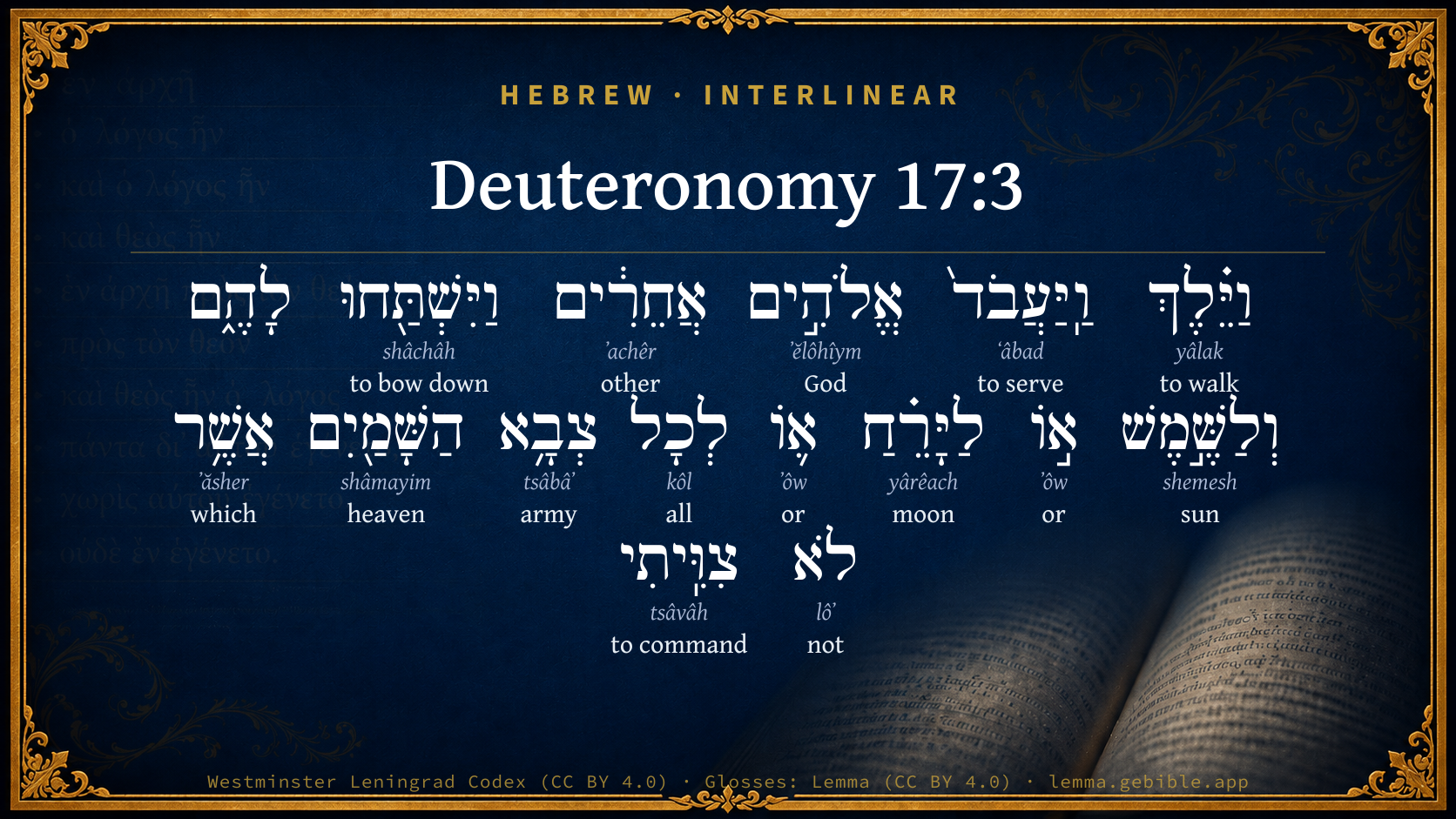
  1. וַיֵּ֗לֶךְ yâlak H3212 “and · to walk” Conjunction + Verb, Qal, Sequential Imperfect, 3rd Person, Masculine, Singular
  2. וַֽיַּעֲבֹד֙ ʻâbad H5647 “and · to serve” Conjunction + Verb, Qal, Sequential Imperfect, 3rd Person, Masculine, Singular
  3. אֱלֹהִ֣ים ʼĕlôhîym H430 “God(s)” Noun, Common, Masculine, Plural, Absolute
  4. אֲחֵרִ֔ים ʼachêr H312 “other” Adjective, Adjective, Masculine, Plural, Absolute
  5. וַיִּשְׁתַּ֖חוּ shâchâh H7812 “and · to bow down” Conjunction + Verb, Hithpael, Sequential Imperfect, 3rd Person, Masculine, Singular
  6. וְלַשֶּׁ֣מֶשׁ shemesh H8121 “and · to/for the · sun” Conjunction + Preposition, Determined + Noun, Common, Both, Singular, Absolute
  7. א֣וֹ ʼôw H176 “or” Conjunction
  8. א֛וֹ ʼôw H176 “or” Conjunction
  9. לְכָל kôl H3605 “to/for · all of” Preposition + Noun, Common, Masculine, Singular, Construct
  10. צְבָ֥א tsâbâʼ H6635 “army of” Noun, Common, Both, Singular, Construct
  11. הַשָּׁמַ֖יִם shâmayim H8064 “the · heaven(s)” Particle, Definite Article + Noun, Common, Masculine, Plural, Absolute
  12. אֲשֶׁ֥ר ʼăsher H834 “which” Particle, Relative
  13. לֹא lôʼ H3808 “not” Particle, Negative
  14. צִוִּֽיתִי tsâvâh H6680 “to command” Verb, Piel, Perfect, 1st Person, Common, Singular

About this verse

These counts appear in no published source. They are computed here, from the morphology-tagged text and Lemma’s own curated glosses. What Lemma adds →

16
words
14
distinct lemmas
Pentateuch
section

Shared distinctive vocabulary

לַיָּרֵ֗חַ moon H3394 occurs in 26 verses of the Hebrew Bible. Also found in:

Grammatical profile

  • 4 verbs
  • 6 nouns
  • 1 adjective
  • 1 preposition
  • 2 conjunctions
  • 2 particles

Verb forms

  • וַיֵּ֗לֶךְ Qal · Sequential Imperfect
  • וַֽיַּעֲבֹד֙ Qal · Sequential Imperfect
  • וַיִּשְׁתַּ֖חוּ Hithpael · Sequential Imperfect
  • צִוִּֽיתִי Piel · Perfect

Repetition

A word recurs within this verse — often emphatic in Hebrew:

  • א֣וֹ or H176 ×2

Hebrew & Septuagint length

In English translation the verse runs 29 words from the Hebrew and 30 from the Septuagint (LXX English) — closely comparable.

A rough comparison of the two English renderings, which tokenize alike — not a word-level alignment.

Word counts can differ between the Hebrew and the Greek without any difference in meaning — e.g. the Hebrew direct-object marker אֵת has no separate Greek word, and Greek often adds the article ὁ.

In the original languages it is 16 Hebrew tokens and 24 Greek tokens — but the two are counted differently (Hebrew bundles its prefixes and suffixes into one token; the Greek is in lemma form), so that isn’t a like-for-like length.

Cross-references

9

Topical passages linked to Deuteronomy 17:3 in the Treasury of Scripture Knowledge — connected by theme and wording, ordered by reader-vote popularity; previews shown in the World English Bible.

  • Jeremiah 7:31 They have built the high places of Topheth, which is in the valley of the son of Hinnom, to burn their sons and their daughters in the fire; which I didn't command, neither came it into my mind.
  • Deuteronomy 4:19 and lest you lift up your eyes to the sky, and when you see the sun and the moon and the stars, even all the host of the sky, you are drawn away and worship them, and serve them, which Yahweh your God has allotted to all the peoples under the whole sky.
  • Job 31:26–27 If I have seen the sun when it shined, Or the moon moving in splendor,
  • Jeremiah 7:22–23 For I didn't speak to your fathers, nor command them in the day that I brought them out of the land of Egypt, concerning burnt offerings or sacrifices:
  • Jeremiah 19:5 and have built the high places of Baal, to burn their sons in the fire for burnt offerings to Baal; which I didn't command, nor spoke it, neither came it into my mind:
  • Jeremiah 32:35 They built the high places of Baal, which are in the valley of the son of Hinnom, to cause their sons and their daughters to pass through [the fire] to Molech; which I didn't command them, neither did it come into my mind, that they should do this abomination, to cause Judah to sin.
  • 2 Kings 21:3 For he built again the high places which Hezekiah his father had destroyed; and he reared up altars for Baal, and made an Asherah, as did Ahab king of Israel, and worshiped all the host of the sky, and served them.
  • Jeremiah 8:2 and they shall spread them before the sun, and the moon, and all the host of the sky, which they have loved, and which they have served, and after which they have walked, and which they have sought, and which they have worshiped: they shall not be gathered, nor be buried, they shall be for dung on the surface of the earth.
  • Ezekiel 8:16 He brought me into the inner court of Yahweh's house; and see, at the door of the temple of Yahweh, between the porch and the altar, were about twenty-five men, with their backs toward the temple of Yahweh, and their faces toward the east; and they were worshipping the sun toward the east.

Cross-references courtesy of OpenBible.info (CC BY 4.0).

Hebrew and Greek witnesses Masoretic Hebrew ↔ Greek Septuagint

The same verse in the two great witnesses to the Old Testament, shown verse-for-verse.

These are two independent witnesses, not word-aligned to each other, and the Septuagint is shown in lemma (dictionary) form.

Hebrew Deuteronomy 17:3 Masoretic · Westminster Leningrad Codex

וַיֵּ֗לֶךְ וַֽיַּעֲבֹד֙ אֱלֹהִ֣ים אֲחֵרִ֔ים וַיִּשְׁתַּ֖חוּ לָהֶ֑ם וְלַשֶּׁ֣מֶשׁ א֣וֹ לַיָּרֵ֗חַ א֛וֹ לְכָל צְבָ֥א הַשָּׁמַ֖יִם אֲשֶׁ֥ר לֹא צִוִּֽיתִי

and has gone and served other gods, and worshiped them, or the sun, or the moon, or any of the host of the sky, which I have not commanded;

World English Bible · Public Domain

Greek LXX Deuteronomy 17:3 Septuagint · lemma form

καί ἔρχομαι λατρεύω θεός ἕτερος καί προςκυνέω αὐτός ὁ ἥλιος ἤ ὁ σελήνη ἤ πᾶς ὁ ἐκ ὁ κόσμος ὁ οὐρανός ὅς οὐ προςτάσσω

and they should go and serve other gods, and worship them, the sun, or the moon, or any of the host of heaven, which he commanded you not to do,

LXX2012 (modern English Septuagint) · Public Domain

Hebrew: Westminster Leningrad Codex (CC BY 4.0). Greek: Septuagint (public domain); English from LXX2012 (modern English Septuagint) (Public Domain). How the Septuagint differs from the Hebrew →

Targum (Aramaic paraphrase)

2

The Targum is the ancient Jewish Aramaic paraphrase of the Hebrew Scriptures — an interpretive translation, not the Hebrew text itself. Onkelos (literal) and Pseudo-Jonathan (expansive) render the Torah, and Jonathan the Prophets. Coverage is partial: where no permissively-licensed English translation exists for a verse, only the Aramaic is shown. This is verse-level text, not a word-by-word alignment to the Hebrew.

  1. Targum Onkelos Torah (Genesis–Deuteronomy)
    וַאֲזַל וּפְלַח לְטַעֲוַת עַמְמַיָא וּסְגִיד לְהוֹן וּלְשִׁמְשָׁא אוֹ לְסִיהֲרָא אוֹ לְכָל חֵילֵי שְׁמַיָא דִי לָא פַקֵדִית

    (no public-domain English translation for this verse)

    Targum Onkelos — Aramaic: “Onkelos Genesis” (public domain); “Onkelos Exodus” (public domain); “Onkelos Leviticus” (public domain); “Onkelos Numbers” (public domain); “Onkelos Deuteronomy” (public domain). English: “Sefaria Community Translation” (CC0 1.0 (public-domain dedication)); “J.W. Etheridge. The Targums of Onkelos and Jonathan Ben Uzziel on the Pentateuch. London: Longmans, Green, 1862” (public domain). Text via Sefaria.

  2. Targum Pseudo-Jonathan Torah (Genesis–Deuteronomy)
    וַאֲזַל בָּתַר יִצְרָא בִּישָׁא וּפְלַח לְטַעֲוַות עַמְמַיָא וּסְגִיד לְהוֹן וּלְשִׁמְשָׁא אוֹ לְסִיהֲרָא אוֹ לְכָל חֵילָא שְׁמַיָא דְלָא פַקֵּידִית

    and, following after evil desire, shall serve the idols of the Gentiles, and worship them, or the sun, or the moon, or all the host of the heavens, which I have not commanded;

    Targum Pseudo-Jonathan — Aramaic: “Targum Jonathan on Genesis” (public domain); “Targum Jonathan on Exodus” (public domain); “Targum Jonathan on Leviticus” (public domain); “Targum Jonathan on Numbers” (public domain); “Targum Jonathan on Deuteronomy” (public domain). English: “The Targum of Jonathan ben Uzziel, trans. J. W. Etheridge, London, 1862” (public domain). Text via Sefaria.

Commentary

Notes on Deuteronomy 17:3 from classic Christian and Jewish commentators (each source and its license shown beneath its notes). The classic Christian expositions comment on the surrounding passage and are grouped to its opening verse, so a note may address several verses; the Jewish commentaries on the Tanakh (Rashi and others) are per-verse, so they appear only where the commentator wrote on this verse.

Lemma curates 59 commentaries, every one of them public domain or Creative Commons licensed, each selected and text-cleaned for this edition rather than reprinted as found. About our sources →

Joseph Benson's Commentary

Deu 17:3. The host of heaven — Those glorious creatures, which are to be admired as the wonderful works of God, but not to be set up in God’s stead. By condemning the most specious of all idolatries, he intimates how absurd a thing it is to worship stocks and stones, the works of men’s hands. I have not commanded — That is, I have forbidden. Such negative expressions are emphatical.

Joseph Benson's Commentary on the Old and New Testaments (1811–1818) — public domain. Text from a community e-Sword module.

Tyndale Open Study Notes

Tyndale Open Resources

17:3 The forces of heaven are visible objects such as the sun, moon, and stars, as well as invisible beings such as angels. Worship of anyone or anything created by God is a clear violation of the second commandment (see 5:9).

Tyndale Open Study Notes — © Tyndale Open Resources, licensed CC BY-SA 4.0. Text via the HelloAO Bible API.

Geneva Bible (1599)

Geneva Bible translators

Whereby he condemneth all religion and serving of God which God hath not commanded.

Geneva Bible (1599) marginal notes — public domain. Text via Bolls.life.

The Cambridge Bible for Schools and Colleges

gen. ed. J. J. S. Perowne

3. gone and served other gods] So Deu_13:6; Deu_13:13 (7, 14); and 2 (3) with slight variation.

sun, moon, etc.] See on Deu_4:19.

which I have not commanded] Cp. Deu_4:19 : which thy God hath assigned unto the peoples. The use of the first person here is remarkable; God Himself takes up the speech, as in Deu_7:4 and frequently in the prophets: e.g. Jer_7:31; Jer_19:5; Jer_32:35.

The Cambridge Bible for Schools and Colleges (gen. ed. J. J. S. Perowne; Cambridge University Press, 1878–1918) — public domain. Text from a community e-Sword module.

John Gill's Exposition

And hath gone,.... The Targum of Jonathan adds, after the evil imagination or concupiscence, lusting after other lovers, and forsaking the true God, and departing from his worship:

and served other gods; strange gods, the idols of the people, other gods besides the true God; the creature besides the Creator:

and worshipped them; by bowing down before them, praying to them, or ascribing their mercies and blessings to them, and giving them the glory of them:

either the sun, or moon, or any of the host of heaven: the two great luminaries, and the planets, constellations, and stars, any of them; which kind of idolatry very early obtained, and was in use at this time among the Heathens, and was an iniquity to be punished by the judge, Job 31:26, which sin, though so strictly forbidden, the people of Israel sometimes fell into, Kg2 21:3.

which I have not commanded: and which is a sufficient reason, in matters of worship, to avoid and abstain from anything, that God has not commanded it; for in things of that nature nothing should be done but what he has ordered, who is a jealous God, and will not suffer any to take upon them to direct what should be done as a religious service and duty; and if any are so presumptuous, they must expect it will be resented; see Isa 1:12 and especially with respect to the object of worship, as here, and which relate to things if not forbid expressly, yet tacitly, to do which was an abomination to the Lord.

John Gill's Exposition of the Whole Bible (1746–1763) — public domain (CC PDM 1.0). Text via the HelloAO Bible API.

Haydock's Catholic Bible Commentary

The host of heaven. That is, the stars. (Challoner) --- This species of idolatry was the most ancient and common in the East. Job (xxxi. 26, 28) takes notice of the adoration of the sun and of the moon, and calls it a very great iniquity, and a denial against the most high God. He lived in Arabia, and probably not far from the place where Moses was addressing the Israelites. (Haydock) --- The pagans looked upon the sun and moon as the king and queen of heaven, and the stars as their guards. Plato says (in Phædro) that "the sun marches at the head of the gods, in a winged chariot, and the eleven other gods lead on their bands of demons," or the stars, &c.

George Leo Haydock (1774–1849), Haydock's Catholic Family Bible and Commentary, 1859 edition — public domain. Excludes Psalms (Douay-Rheims chapter numbering differs from Protestant) and Deuterocanonical books (Catholic canon only).

Matthew Poole's English Annotations

Those glorious creatures, which are to be admired as the wonderful works of God, but not to be set up in God’s stead, nor worshipped as gods: see Job 31:26. By condemning the most specious and reasonable of all idolaters, he intimates how absurd a thing it is to worship stocks and stones, the works of men’s hands.

Which I have not commanded, i.e. I have forbidden, to wit, Exo 20. Such negative expressions are oft emphatical, and imply the contrary, as Pro 10:2; 17:21; 24:23.

Matthew Poole's English Annotations on the Holy Bible (1683–1685) — public domain. Text from a community e-Sword/MySword module.

The Pulpit Commentary

cf. Deu_4:19 Which I have not commanded; i.e. have forbidden, a meiosis, as in Jer_7:31.

The Pulpit Commentary (1880–1919), ed. H.D.M. Spence-Jones & Joseph S. Exell — public domain. Text from a community e-Sword module.

John Wesley's Explanatory Notes

The host of heaven - Those glorious creatures, which are to be admired as the wonderful works of God, but not to be set up in God's stead. By condemning the most specious of all idolaters, he intimates, how absurd a thing it is to worship stocks and stones, the works of men's hands. I have not commanded - That is, I have forbidden. Such negative expressions are emphatical.

John Wesley, Explanatory Notes Upon the Whole Bible (1754–1765) — public domain. Text via the GEBible commentary corpus.

Rashi

Rabbi Shlomo Yitzchaki (Rashi)

אשר לא צויתי [AND HATH GONE AND SERVED OTHER GODS … EITHER THE SUN, OR MOON, OR ANY OF THE HOST OF HEAVEN] WHICH I HAVE NOT COMMANDED to worship them (Megillah 9b).

Rashi on the Tanakh — English translations: “The Judaica Press complete Tanach with Rashi, translated by A. J. Rosenberg” (CC BY 4.0); “Pentateuch with Rashi's commentary by M. Rosenbaum and A.M. Silbermann, 1929-1934” (public domain); “The Metsudah Tanach series, Lakewood, N.J” (CC BY 4.0); and “The Book of Joshua, Metsudah Publications, 1997” (CC BY 4.0). Text via Sefaria.

Lesson kit

Teaching starters — assembled from the data on this page, not authored interpretation. Every prompt links to the verse data it draws on. Edit before teaching.

Deuteronomy, in the Pentateuch, opens this verse with 16 words (14 distinct Hebrew lemmas). Its most distinctive word is yârêach (“moon”). A historical commentator’s framing appears above. Read the whole chapter for the surrounding context.

Discussion questions

  1. How does “moon” (yârêach) shape what this verse is saying?
  2. Genesis 37:9 shares the word «moon» with this verse. How do the two illuminate each other?
  3. “or” occurs 2× in this one verse. What is the effect of the repetition?
  4. These translations render this verse differently. What is at stake in choosing one wording over another?
  5. The verb «וַיֵּ֗לֶךְ» is Qal Sequential Imperfect. How does its form color the action?
  6. Reading how Joseph Benson's Commentary and Tyndale Open Study Notes read this verse, where do the two commentators agree and where do they part?

Things to notice

Reading settings

Reading text

Shown beneath each verse's original-language words.

Old Testament
Old Testament edition

Read the OT as the Masoretic Hebrew (MT) or the Greek Septuagint (LXX).

English shown for the Greek Septuagint (in the Hebrew ↔ Greek comparison).

Comparing translations? Open the Compare panel on any verse page to stack up to four side by side.