
1 Samuel 20:29

Hebrew (Westminster Leningrad Codex) 1 Samuel 20:29 appears in the Hebrew Old Testament. The text above is from the Westminster Leningrad Codex. Each word links to its Strong’s number, a concise gloss, and parsing drawn from the Open Scriptures Hebrew Bible morphology. Click any word for its full Brown-Driver-Briggs (BDB) entry.
Download image
Cite this verse

1 Samuel 20:29 (World English Bible). Public Domain. Lemma interlinear Bible study tool, https://lemma.gebible.app/v/1-samuel/20/29.

Show BibTeX & RIS
BibTeX
RIS
English Translation
and he said, Please let me go, for our family has a sacrifice in the city; and my brother, he has commanded me [to be there]: and now, if I have found favor in your eyes, let me get away, I pray you, and see my brothers. Therefore he is not come to the king's table.
World English Bible · Public Domain
Download a study sheet

One document with this verse’s original text, its word-by-word gloss line, the meaning frame, cross-references with their text, attributed commentary, and full source and license credits — printable, and it pastes into notes with its structure intact.

This verse Autodidact and up

Study sheet (.html) Plain text (.txt)

A passage Seminary Student

Up to 50 verses in one chapter. A passage sheet keeps up to 6 commentary sources and 12 cross-references per verse, in the order this page ranks them, and says so on the sheet whenever that leaves anything out. Ask for a single verse and you get the Autodidact verse sheet above.

Everything on this page stays free to read, with no account — the sheet is a download of what is already on screen, not access to it.

Want to remove ads? Support Godless Engineer
Compare translations 3

The same verse in 3 English versions, stacked beneath the original-language interlinear above. Click any original word for its lexicon entry.

Each is an independent rendering of the whole verse — the interlinear is not word-aligned to these translations.

Highlighted words mark where these versions differ — a whole-verse word diff, not a word-by-word alignment.

  • World English Bible Public Domain
    and he said, Please let me go, for our family has a sacrifice in the city; and my brother, he has commanded me [to be there]: and now, if I have found favor in your eyes, let me get away, I pray you, and see my brothers. Therefore he is not come to the king's table.
  • King James Version Public Domain
    And he said, Let me go, I pray thee; for our family hath a sacrifice in the city; and my brother, he hath commanded me to be there: and now, if I have found favor in thine eyes, let me get away, I pray thee, and see my brethren. Therefore he cometh not unto the king's table.
  • unfoldingWord Literal Text CC BY-SA 4.0
    And he said, ‘Please let me go. For the sacrifice of our clan in the city, and my brother himself has commanded me. And now, if I have found favor in your eyes, may I please go away, and may I see my brothers.’ Therefore he has not come to the table of the king.”

unfoldingWord Literal Text — © unfoldingWord, licensed CC BY-SA 4.0. Word-aligned USFM3 via Door43 (git.door43.org/unfoldingWord/en_ult).

Versions to compare (up to 4)

3 of 4 selected

Show all 18 translations

Every available English version of this verse, each an independent rendering of the whole verse.

  • World English Bible Public Domain
    and he said, Please let me go, for our family has a sacrifice in the city; and my brother, he has commanded me [to be there]: and now, if I have found favor in your eyes, let me get away, I pray you, and see my brothers. Therefore he is not come to the king's table.
  • Berean Standard Bible Public Domain
    saying, ‘Please let me go, because our clan is holding a sacrifice in the city, and my brother has told me to be there. So now, if I have found favor in your eyes, please let me go and see my brothers.’ That is why he did not come to the king’s table.”
  • Majority Standard Bible Public Domain
    saying, ‘Please let me go, because our clan is holding a sacrifice in the city, and my brother has told me to be there. So now, if I have found favor in your eyes, please let me go and see my brothers.’ That is why he has not come to the king’s table.”
  • King James Version Public Domain
    And he said, Let me go, I pray thee; for our family hath a sacrifice in the city; and my brother, he hath commanded me to be there: and now, if I have found favor in thine eyes, let me get away, I pray thee, and see my brethren. Therefore he cometh not unto the king's table.
  • American Standard Version (1901) Public Domain
    and he said, Let me go, I pray thee; for our family hath a sacrifice in the city; and my brother, he hath commanded me `to be there': and now, if I have found favor in thine eyes, let me get away, I pray thee, and see my brethren. Therefore he is not come unto the king's table.
  • Revised Version (1885) Public Domain
    and he said, Let me go, I pray thee; for our family hath a sacrifice in the city; and my brother, he hath commanded me to be there: and now, if I have found favour in thine eyes, let me get away, I pray thee, and see my brethren. Therefore he is not come unto the king’s table.
  • Geneva Bible (1599) Public Domain
    For he sayde, Let me goe, I pray thee: for our familie offreth a sacrifice in the citie, and my brother hath sent for me: therfore now if I haue found fauour in thine eyes, let me goe, I pray thee, and see my brethren: this is the cause that he commeth not vnto the Kings table.
  • Douay-Rheims (1899) Public Domain
    And he said: Let me go, for there is a solemn sacrifice in the city, one of my brethren hath sent for me: and now if I have found favour in thy eyes, I will go quickly, and see my brethren. For this cause he came not to the king's table.
  • Young's Literal Translation Public Domain
    and he saith, Send me away, I pray thee, for a family sacrifice we have in the city, and my brother himself hath given command to me, and now, if I have found grace in thine eyes, let me go away, I pray thee, and see my brethren; therefore he hath not come unto the table of the king.'
  • Literal Standard Version CC BY-SA 4.0
    and he says, Please send me away, for we have a family sacrifice in the city, and my brother has given command to me himself, and now, if I have found grace in your eyes, please let me go away and see my brothers; therefore he has not come to the table of the king.”
  • Unlocked Literal Bible CC BY-SA 4.0
    He said, 'Please let me go. For our family has a sacrifice in the city, and my brother has ordered me to be there. Now, if I have found favor in your eyes, please let me go and see my brothers.' For this reason he has not come to the king's table.”
  • unfoldingWord Literal Text CC BY-SA 4.0
    And he said, ‘Please let me go. For the sacrifice of our clan in the city, and my brother himself has commanded me. And now, if I have found favor in your eyes, may I please go away, and may I see my brothers.’ Therefore he has not come to the table of the king.”
  • Darby Bible Public Domain
    and said, Let me go, I pray thee; for we have a family sacrifice in the city; and my brother himself has commanded me [to be there]; and now, if I have found favour in thy sight, let me go away, I pray thee, and see my brethren. He has therefore not come to the king's table.
  • World Messianic Bible Public Domain
    He said, ‘Please let me go, for our family has a sacrifice in the city. My brother has commanded me to be there. Now, if I have found favor in your eyes, please let me go away and see my brothers.’ Therefore he has not come to the king’s table.”
  • Webster's Bible Public Domain
    And he said, Let me go, I pray thee; for our family hath a sacrifice in the city; and my brother he hath commanded me to be there: and now if I have found favor in thy eyes, let me get away, I pray thee, and see my brethren. Therefore he cometh not to the king's table.
  • Free Bible Version CC BY-SA 4.0
    He told me, ‘Please let me go, because our family is having a sacrifice in the town and my brother told me I had to be there. If you think well of me, please let me go and see my brothers.’ That's why he's absent from the king's table.”
  • Bible in Basic English Public Domain
    Saying, Our family is making an offering in the town, and my brothers have given me orders to be there: so now, if I have grace in your eyes, let me go away and see my brothers. This is why he has not come to the king's table.
  • JPS Tanakh (1917) Public Domain
    and he said: Let me go, I pray thee; for our family hath a sacrifice in the city; and my brother, he hath commanded me; and now, if I have found favour in thine eyes, let me get away, I pray thee, and see my brethren. Therefore he is not come unto the king's table.'

Literal Standard Version (2020), Covenant Press — licensed CC BY-SA 4.0. Text via the HelloAO Bible API (eBible.org). Unlocked Literal Bible (unfoldingWord) — licensed CC BY-SA 4.0. Text via the HelloAO Bible API (eBible.org). unfoldingWord Literal Text — © unfoldingWord, licensed CC BY-SA 4.0. Word-aligned USFM3 via Door43 (git.door43.org/unfoldingWord/en_ult). Free Bible Version, Dr. Jonathan Gallagher — licensed CC BY-SA 4.0. Text via the HelloAO Bible API (eBible.org).

Word by word

More ways to search: Search by grammar → Find every occurrence → Compare this word →

Practice this passage: Drill this verse → Learn its vocabulary →

חֵן֙
chên
H2580
“grace”
Noun, Common, Masculine, Singular, Absolute
Part of Speech
Noun
Type
Common
Gender
Masculine
Number
Singular
State
Absolute
Full BDB Definition

Origin: from H2603

TWOT: TWOT- 694a

favour, grace, charm - favour, grace, elegance - favour, acceptance
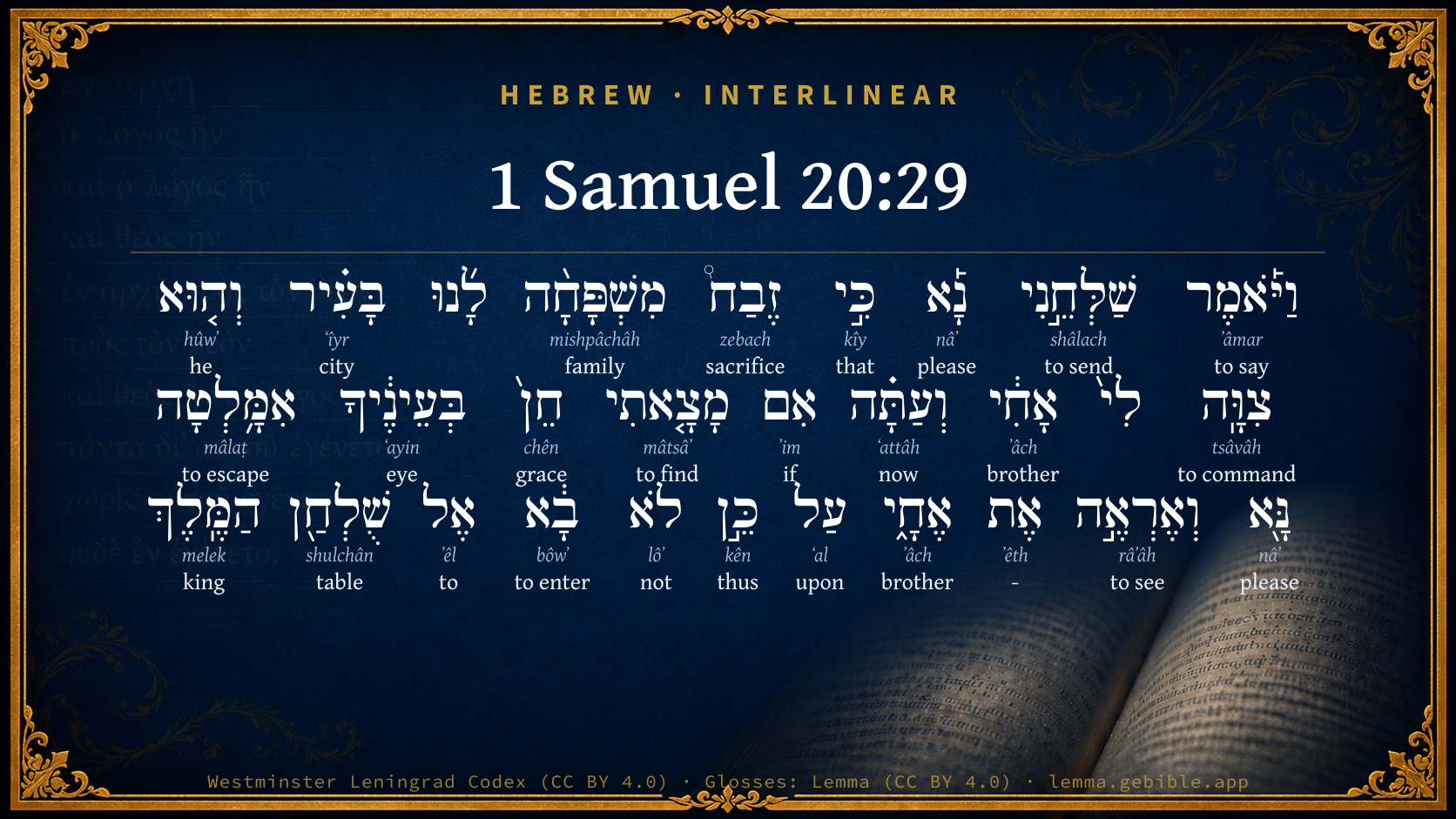
  1. וַיֹּ֡אמֶר ʼâmar H559 “and · to say” Conjunction + Verb, Qal, Sequential Imperfect, 3rd Person, Masculine, Singular
  2. שַׁלְּחֵ֣נִי shâlach H7971 “send · me” Verb, Piel, Imperative, 2nd Person, Masculine, Singular + Suffix, Personal, 1st Person, Common, Singular
  3. נָ֡א nâʼ H4994 “please” Particle, Exhortation
  4. כִּ֣י kîy H3588 “that” Conjunction
  5. זֶבַח֩ zebach H2077 “sacrifice of” Noun, Common, Masculine, Singular, Construct
  6. מִשְׁפָּחָ֨ה mishpâchâh H4940 “family” Noun, Common, Feminine, Singular, Absolute
  7. בָּעִ֗יר ʻîyr H5892 “in/at the · city” Preposition, Determined + Noun, Common, Feminine, Singular, Absolute
  8. וְה֤וּא hûwʼ H1931 “and · he” Conjunction + Pronoun, Personal, 3rd Person, Masculine, Singular
  9. צִוָּֽה tsâvâh H6680 “to command” Verb, Piel, Perfect, 3rd Person, Masculine, Singular
  10. אָחִ֔י ʼâch H251 “brother · my” Noun, Common, Masculine, Singular, Construct + Suffix, Personal, 1st Person, Common, Singular
  11. וְעַתָּ֗ה ʻattâh H6258 “and · now” Conjunction + Adverb
  12. אִם ʼim H518 “if” Conjunction
  13. מָצָ֤אתִי mâtsâʼ H4672 “to find” Verb, Qal, Perfect, 1st Person, Common, Singular
  14. בְּעֵינֶ֔יךָ ʻayin H5869 “in/at · eyes · your” Preposition + Noun, Common, Both, Dual, Construct + Suffix, Personal, 2nd Person, Masculine, Singular
  15. אִמָּ֥לְטָה mâlaṭ H4422 “to escape” Verb, Niphal, Cohortative, 1st Person, Common, Singular
  16. נָּ֖א nâʼ H4994 “please” Particle, Interjection
  17. וְאֶרְאֶ֣ה râʼâh H7200 “and · to see” Conjunction + Verb, Qal, Cohortative, 1st Person, Common, Singular
  18. אֶת ʼêth H853 “-” Particle, Direct Object
  19. אֶחָ֑י ʼâch H251 “brothers · my” Noun, Common, Masculine, Plural, Construct + Suffix, Personal, 1st Person, Common, Singular
  20. עַל ʻal H5921 “upon” Preposition
  21. כֵּ֣ן kên H3651 “thus” Particle, Demonstrative
  22. לֹא lôʼ H3808 “not” Particle, Negative
  23. בָ֔א bôwʼ H935 “to enter” Verb, Qal, Perfect, 3rd Person, Masculine, Singular
  24. אֶל ʼêl H413 “to” Preposition
  25. שֻׁלְחַ֖ן shulchân H7979 “table of” Noun, Common, Masculine, Singular, Construct
  26. הַמֶּֽלֶךְ melek H4428 “the · king” Particle, Definite Article + Noun, Common, Masculine, Singular, Absolute

About this verse

These counts appear in no published source. They are computed here, from the morphology-tagged text and Lemma’s own curated glosses. What Lemma adds →

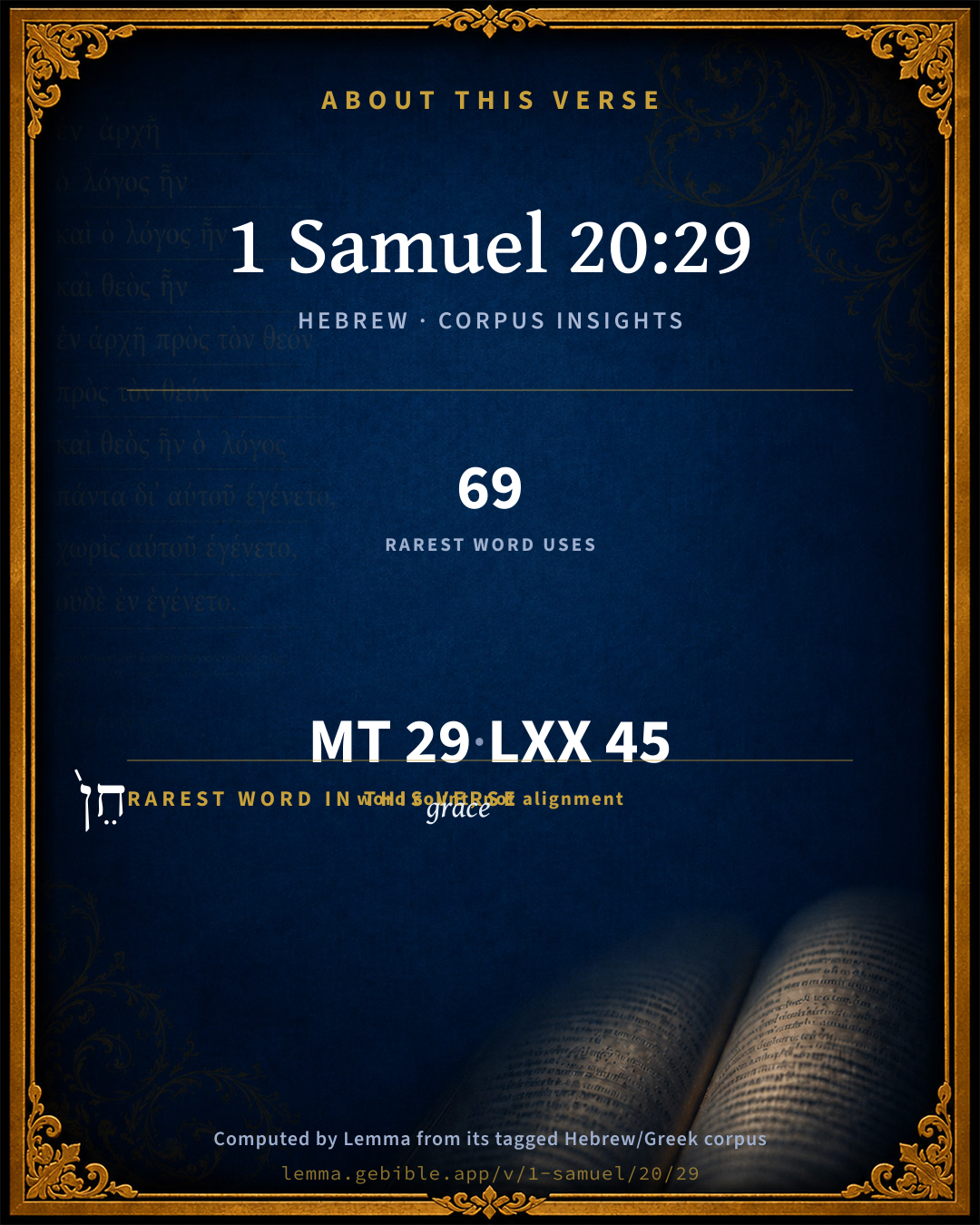
29
words
25
distinct lemmas
Historical
section

Grammatical profile

  • 7 verbs
  • 9 nouns
  • 1 pronoun
  • 4 prepositions
  • 2 conjunctions
  • 1 adverb
  • 5 particles

Verb forms

  • וַיֹּ֡אמֶר Qal · Sequential Imperfect
  • שַׁלְּחֵ֣נִי Piel · Imperative
  • צִוָּֽה Piel · Perfect
  • מָצָ֤אתִי Qal · Perfect
  • אִמָּ֥לְטָה Niphal · Cohortative
  • וְאֶרְאֶ֣ה Qal · Cohortative
  • בָ֔א Qal · Perfect

Repetition

Words recur within this verse — often emphatic in Hebrew:

  • נָ֡א please H4994 ×2
  • אָחִ֔י brother H251 ×2

Hebrew & Septuagint length

In English translation the verse runs 56 words from the Hebrew and 55 from the Septuagint (LXX English) — closely comparable.

A rough comparison of the two English renderings, which tokenize alike — not a word-level alignment.

Word counts can differ between the Hebrew and the Greek without any difference in meaning — e.g. the Hebrew direct-object marker אֵת has no separate Greek word, and Greek often adds the article ὁ.

In the original languages it is 29 Hebrew tokens and 45 Greek tokens — but the two are counted differently (Hebrew bundles its prefixes and suffixes into one token; the Greek is in lemma form), so that isn’t a like-for-like length.

Cross-references

1

Topical passages linked to 1 Samuel 20:29 in the Treasury of Scripture Knowledge — connected by theme and wording, ordered by reader-vote popularity; previews shown in the World English Bible.

  • 1 Samuel 17:28 Eliab his eldest brother heard when he spoke to the men; and Eliab's anger was kindled against David, and he said, Why are you come down? and with whom have you left those few sheep in the wilderness? I know your pride, and the naughtiness of your heart; for you have come down that you might see the battle.

Cross-references courtesy of OpenBible.info (CC BY 4.0).

Hebrew and Greek witnesses Masoretic Hebrew ↔ Greek Septuagint

The same verse in the two great witnesses to the Old Testament, shown verse-for-verse.

These are two independent witnesses, not word-aligned to each other, and the Septuagint is shown in lemma (dictionary) form.

Hebrew 1 Samuel 20:29 Masoretic · Westminster Leningrad Codex

וַיֹּ֡אמֶר שַׁלְּחֵ֣נִי נָ֡א כִּ֣י זֶבַח֩ מִשְׁפָּחָ֨ה לָ֜נוּ בָּעִ֗יר וְה֤וּא צִוָּֽה לִי֙ אָחִ֔י וְעַתָּ֗ה אִם מָצָ֤אתִי חֵן֙ בְּעֵינֶ֔יךָ אִמָּ֥לְטָה נָּ֖א וְאֶרְאֶ֣ה אֶת אֶחָ֑י עַל כֵּ֣ן לֹא בָ֔א אֶל שֻׁלְחַ֖ן הַמֶּֽלֶךְ

and he said, Please let me go, for our family has a sacrifice in the city; and my brother, he has commanded me [to be there]: and now, if I have found favor in your eyes, let me get away, I pray you, and see my brothers. Therefore he is not come to the king's table.

World English Bible · Public Domain

Greek LXX 1 Samuel 20:29 Septuagint · lemma form

καί εἶπον ἐκ ἀποστέλλω δή ἐγώ ὅτι θυσία ὁ φυλή ἐγώ ἐν ὁ πόλις καί ἐντέλλομαι πρός ἐγώ ὁ ἀδελφός ἐγώ καί νῦν εἰ εὑρίσκω χάρις ἐν ὀφθαλμός σύ διασώζω δή καί ὁράω ὁ ἀδελφός ἐγώ διά οὗτος οὐ παραγίγνομαι ἐπί ὁ τράπεζα ὁ βασιλεύς

and he said, Let me go, I pray you, for we have a family sacrifice in the city, and my brethren have sent for me; and now, if I have found grace in your eyes, I will even go over and see my brethren: therefore he is not present at the table of the king.

LXX2012 (modern English Septuagint) · Public Domain

On this verse, Ellicott's Commentary for English Readers discusses the Septuagint’s reading. Read the note in Commentary ↓

Hebrew: Westminster Leningrad Codex (CC BY 4.0). Greek: Septuagint (public domain); English from LXX2012 (modern English Septuagint) (Public Domain). How the Septuagint differs from the Hebrew →

Targum (Aramaic paraphrase)

1

The Targum is the ancient Jewish Aramaic paraphrase of the Hebrew Scriptures — an interpretive translation, not the Hebrew text itself. Onkelos (literal) and Pseudo-Jonathan (expansive) render the Torah, and Jonathan the Prophets. Coverage is partial: where no permissively-licensed English translation exists for a verse, only the Aramaic is shown. This is verse-level text, not a word-by-word alignment to the Hebrew.

  1. Targum Jonathan Prophets (Joshua–Malachi)
    וַאֲמַר שַׁלְחֵנִי כְּעַן אֲרֵי שֵׁירוּ נִכְסַת קוּדְשַׁיָא לְכָל זַרְעִיתָא לָנָא בְקַרְתָּא וְהוּא פַקֵיד לִי אֲחִי וּכְעַן אִם אַשְׁכְּחֵית רַחֲמִין בְּעֵינָךְ אִשְׁתֵּיזֵיב כְּעַן וְאֶחֱזֵי יַת אֲחַי עַל כֵּן לָא אֲתָא לְפָתוֹרָא דְמַלְכָּא:

    (no public-domain English translation for this verse)

    Targum Jonathan — Aramaic: “Mikraot Gedolot” (public domain). English: “Sefaria Community Translation” (CC0 1.0 (public-domain dedication)); “London "Chaldee Paraphrase," 1871” (public domain). Text via Sefaria.

Commentary

Notes on 1 Samuel 20:29 from classic Christian and Jewish commentators (each source and its license shown beneath its notes). The classic Christian expositions comment on the surrounding passage and are grouped to its opening verse, so a note may address several verses; the Jewish commentaries on the Tanakh (Rashi and others) are per-verse, so they appear only where the commentator wrote on this verse.

Lemma curates 59 commentaries, every one of them public domain or Creative Commons licensed, each selected and text-cleaned for this edition rather than reprinted as found. About our sources →

Trapp's Complete Commentary

John Trapp

1Sa 20:29 And he said, Let me go, I pray thee; for our family hath a sacrifice in the city; and my brother, he hath commanded me [to be there]: and now, if I have found favour in thine eyes, let me get away, I pray thee, and see my brethren. Therefore he cometh not unto the king’s table.

Ver. 29. And my brother, he hath commanded me to be there.] This, some think, Jonathan added of his own; and Josephus addeth, that Jonathan said he was also invited. It is ordinary with some people, in relating a business, to add here and there something, the better to set off the tale, and to make it run the more roundly.

John Trapp, A Commentary or Exposition upon All the Books of the Old and New Testament (1647–1656) — public domain. Text from a community e-Sword module.

Joseph Benson's Commentary

1Sa 20:29-30. My brother, he hath commanded me to be there — The eldest brother, it seems, was wont to let all the rest know that their company was expected. Thou son of the perverse, rebellious woman — Or rather, according to the Hebrew, Thou son of perverse rebellion; that is, a very perverse rebel. Thou hast chosen the son of Jesse to thine own confusion — Made him thy friend to thy utter undoing and disgrace. For men will conclude that thou hast no royal blood in thy veins, that thou canst so tamely give up thy crown to so contemptible a person. The confusion of thy mother’s nakedness — To the reproach of her having children, as if she were an adulteress, and thou and the rest base-born, and none of you worthy to inherit the kingdom: or rather, he thus asperses Jonathan’s very birth, as if so degenerate a son could not be his, but must be the offspring of his mother’s guilt, the issue of a criminal commerce with some other man.

Joseph Benson's Commentary on the Old and New Testaments (1811–1818) — public domain. Text from a community e-Sword module.

Tyndale Open Study Notes

Tyndale Open Resources

20:29 get away: This verb also describes David’s earlier escape from Saul (19:10-12, 17-18).

Tyndale Open Study Notes — © Tyndale Open Resources, licensed CC BY-SA 4.0. Text via the HelloAO Bible API.

Geneva Bible (1599)

Geneva Bible translators

Meaning, all his kinsfolk.

That is, a peace offering.

Geneva Bible (1599) marginal notes — public domain. Text via Bolls.life.

Adam Clarke's Commentary

Verse 29. Our family hath a sacrifice] Such sacrifices were undoubtedly festal ones; the beasts slain for the occasion were first offered to God, and their blood poured out before him; afterwards all that were bidden to the feast ate of the flesh. This was a family entertainment, at the commencement of which God was peculiarly honoured.

Adam Clarke's Commentary on the Bible (1810–1826) — public domain. Text from a community e-Sword/MySword module.

Ellicott's Commentary for English Readers

(29) Our family hath a sacrifice in the city; and my brother, he hath commanded me.—Jonathan answers the king’s question in the way previously agreed upon between him and David. He quotes the excuse in David’s own words.

The LXX., instead of “my brother,” has “my brothers.” It thus alters the original, not understanding the singular “brother,” Jesse, their father, being still alive. The brothers collectively might, the LXX. seemed to think, have bidden David to the family sacrificial feast. Dean Payne Smith suggests that as the ceremony was not a private family gathering, but one shared in by the district, the “brother” (probably the eldest), likely enough, was the convener of the absent member of the house of Jesse.

A Bible Commentary for English Readers, edited by Charles John Ellicott (1878–1897) — public domain. Text from a community e-Sword module.

The Cambridge Bible for Schools and Colleges

gen. ed. J. J. S. Perowne

29. my brother] The eldest brother probably made the arrangements in Jesse’s old age. The Sept. reads “my brothers.”

The Cambridge Bible for Schools and Colleges (gen. ed. J. J. S. Perowne; Cambridge University Press, 1878–1918) — public domain. Text from a community e-Sword module.

John Gill's Exposition

And he said, let me go, I pray thee, for our family hath a sacrifice in the city,.... In the city of Bethlehem where they lived, a peace offering on account of the new moon, and as an anniversary thanksgiving for the mercies of the year, Sa1 20:6; and seeing, though he was not at the feast in one place, he observed it in another, his absence at court was the more excusable; and the rather, since it was kept by him with his own family, in his own city: besides, it is added:

and my brother he hath commanded me to be there; his elder brother Eliab, whose commands, as a younger brother, he judged he ought to obey; it is probable his father was now dead, since no mention is made of him, and his elder brother took upon him the command of the family:

and now, if I have found favour in thine eyes, let me get away, I pray thee, see my brethren: he should take it as a favour to have leave to depart, and be free for the present from waiting upon the king at court, and so have an opportunity of seeing his brethren, for which he had a great desire; having not seen them a long time, not even since he saw them in the camp, when he slew Goliath:

therefore he cometh not to the king's table: this was the reason of it, at least one reason of it, and Jonathan was not obliged to tell the whole.

John Gill's Exposition of the Whole Bible (1746–1763) — public domain (CC PDM 1.0). Text via the HelloAO Bible API.

Haydock's Catholic Bible Commentary

Sacrifice. Hebrew, "my family hath a sacrifice," &c., ver. 5. (Haydock)

George Leo Haydock (1774–1849), Haydock's Catholic Family Bible and Commentary, 1859 edition — public domain. Excludes Psalms (Douay-Rheims chapter numbering differs from Protestant) and Deuterocanonical books (Catholic canon only).

Matthew Poole's English Annotations

He hath commanded me to be there; either in his father’s name, or in the right of the first-born; one branch of which was authority over his brethren in all the concerns of the family; whereof this was one.

Matthew Poole's English Annotations on the Holy Bible (1683–1685) — public domain. Text from a community e-Sword/MySword module.

Rashi

Rabbi Shlomo Yitzchaki (Rashi)

And he, my brother, summoned me. The eldest of the household, summoned me that I be here; and he is my brother Eliav.

Let me hurry away. Esmucier in O.F. I shall go away for a day and come [back].

Rashi on the Tanakh — English translations: “The Judaica Press complete Tanach with Rashi, translated by A. J. Rosenberg” (CC BY 4.0); “Pentateuch with Rashi's commentary by M. Rosenbaum and A.M. Silbermann, 1929-1934” (public domain); “The Metsudah Tanach series, Lakewood, N.J” (CC BY 4.0); and “The Book of Joshua, Metsudah Publications, 1997” (CC BY 4.0). Text via Sefaria.

Lesson kit

Teaching starters — assembled from the data on this page, not authored interpretation. Every prompt links to the verse data it draws on. Edit before teaching.

1 Samuel, in the Historical, opens this verse with 29 words (25 distinct Hebrew lemmas). Its most distinctive word is chên (“grace”). A historical commentator’s framing appears above. Read the whole chapter for the surrounding context.

Discussion questions

  1. What does “grace” (chên) contribute to the verse as a whole?
  2. How does 1 Samuel 17:28, which shares this passage’s theme, read alongside this verse?
  3. What does the repetition of “please” (2× in this one verse) do in this verse?
  4. These translations render this verse differently. What is at stake in choosing one wording over another?
  5. «וַיֹּ֡אמֶר» is a Qal Sequential Imperfect verb. How does that grammatical form shape the action described?
  6. Compare how Trapp's Complete Commentary and Joseph Benson's Commentary read this verse. Where do they agree or differ?

Things to notice

Reading settings

Reading text

Shown beneath each verse's original-language words.

Old Testament
Old Testament edition

Read the OT as the Masoretic Hebrew (MT) or the Greek Septuagint (LXX).

English shown for the Greek Septuagint (in the Hebrew ↔ Greek comparison).

Comparing translations? Open the Compare panel on any verse page to stack up to four side by side.