
Joshua 21:2

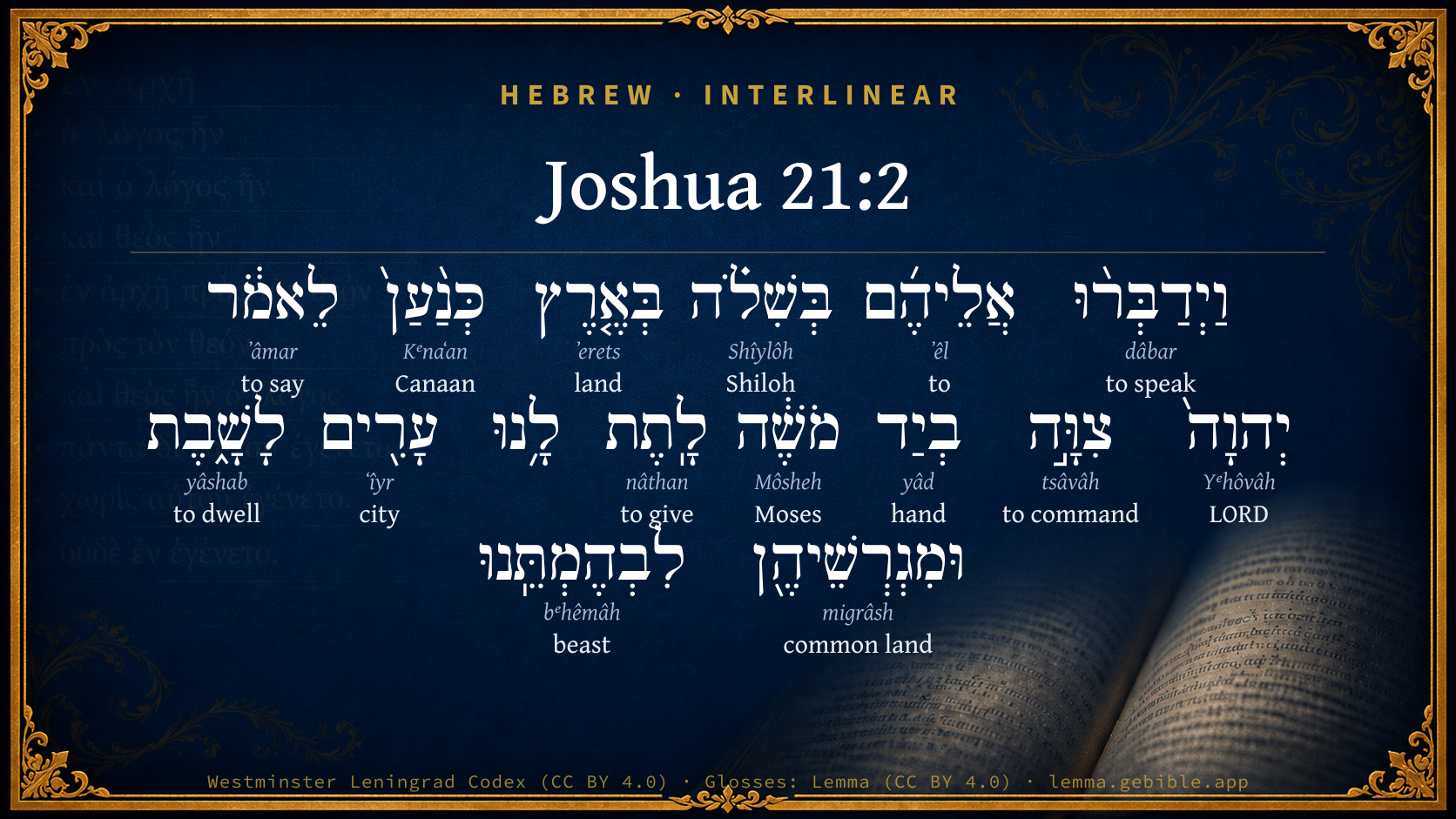
Hebrew (Westminster Leningrad Codex) Joshua 21:2 appears in the Hebrew Old Testament. The text above is from the Westminster Leningrad Codex. Each word links to its Strong’s number, a concise gloss, and parsing drawn from the Open Scriptures Hebrew Bible morphology. Click any word for its full Brown-Driver-Briggs (BDB) entry.
Download image
Cite this verse

Joshua 21:2 (World English Bible). Public Domain. Lemma interlinear Bible study tool, https://lemma.gebible.app/v/joshua/21/2.

Show BibTeX & RIS
BibTeX
RIS
English Translation
and they spoke to them at Shiloh in the land of Canaan, saying, Yahweh commanded Moses to give us cities to dwell in, with the suburbs of it for our cattle.
World English Bible · Public Domain
Download a study sheet

One document with this verse’s original text, its word-by-word gloss line, the meaning frame, cross-references with their text, attributed commentary, and full source and license credits — printable, and it pastes into notes with its structure intact.

This verse Autodidact and up

Study sheet (.html) Plain text (.txt)

A passage Seminary Student

Up to 50 verses in one chapter. A passage sheet keeps up to 6 commentary sources and 12 cross-references per verse, in the order this page ranks them, and says so on the sheet whenever that leaves anything out. Ask for a single verse and you get the Autodidact verse sheet above.

Everything on this page stays free to read, with no account — the sheet is a download of what is already on screen, not access to it.

Want to remove ads? Support Godless Engineer
Compare translations 3

The same verse in 3 English versions, stacked beneath the original-language interlinear above. Click any original word for its lexicon entry.

Each is an independent rendering of the whole verse — the interlinear is not word-aligned to these translations.

Highlighted words mark where these versions differ — a whole-verse word diff, not a word-by-word alignment.

  • World English Bible Public Domain
    and they spoke to them at Shiloh in the land of Canaan, saying, Yahweh commanded Moses to give us cities to dwell in, with the suburbs of it for our cattle.
  • King James Version Public Domain
    And they spake unto them at Shiloh in the land of Canaan, saying, The LORD commanded by the hand of Moses to give us cities to dwell in, with the suburbs thereof for our cattle.
  • unfoldingWord Literal Text CC BY-SA 4.0
    And they spoke to them in Shiloh in the land of Canaan, saying, “Yahweh commanded by the hand of Moses to give to us cities to dwell in, with their pasturelands for our livestock.”

unfoldingWord Literal Text — © unfoldingWord, licensed CC BY-SA 4.0. Word-aligned USFM3 via Door43 (git.door43.org/unfoldingWord/en_ult).

Versions to compare (up to 4)

3 of 4 selected

Show all 18 translations

Every available English version of this verse, each an independent rendering of the whole verse.

  • World English Bible Public Domain
    and they spoke to them at Shiloh in the land of Canaan, saying, Yahweh commanded Moses to give us cities to dwell in, with the suburbs of it for our cattle.
  • Berean Standard Bible Public Domain
    at Shiloh in the land of Canaan and said to them, “The LORD commanded through Moses that we be given cities in which to live, together with pasturelands for our livestock.”
  • Majority Standard Bible Public Domain
    at Shiloh in the land of Canaan and said to them, “The LORD commanded through Moses that we be given cities in which to live, together with pasturelands for our livestock.”
  • King James Version Public Domain
    And they spake unto them at Shiloh in the land of Canaan, saying, The LORD commanded by the hand of Moses to give us cities to dwell in, with the suburbs thereof for our cattle.
  • American Standard Version (1901) Public Domain
    and they spake unto them at Shiloh in the land of Canaan, saying, Jehovah commanded Moses to give us cities to dwell in, with the suburbs thereof for our cattle.
  • Revised Version (1885) Public Domain
    and they spake unto them at Shiloh in the land of Canaan, saying, The LORD commanded by the hand of Moses to give us cities to dwell in, with the suburbs thereof for our cattle.
  • Geneva Bible (1599) Public Domain
    And spake vnto them at Shiloh in the land of Canaan, saying, The Lord commanded by the hande of Moses, to giue vs cities to dwell in, with the suburbes thereof for our cattell.
  • Douay-Rheims (1899) Public Domain
    And they spoke to them in Silo in the land of Chanaan, and said: The Lord commanded by the hand of Moses, that cities should be given us to dwell in, and their suburbs to feed our cattle.
  • Young's Literal Translation Public Domain
    and they speak unto them in Shiloh, in the land of Canaan, saying, `Jehovah commanded by the hand of Moses to give to us cities to dwell in, and their suburbs for our cattle.'
  • Literal Standard Version CC BY-SA 4.0
    and they speak to them in Shiloh, in the land of Canaan, saying, “YHWH commanded by the hand of Moses to give to us cities to dwell in, and their outskirts for our livestock.”
  • Unlocked Literal Bible CC BY-SA 4.0
    They said to them at Shiloh in the land of Canaan, “Yahweh commanded you by the hand of Moses to give to us cities to live in, with the pasturelands for our livestock.”
  • unfoldingWord Literal Text CC BY-SA 4.0
    And they spoke to them in Shiloh in the land of Canaan, saying, “Yahweh commanded by the hand of Moses to give to us cities to dwell in, with their pasturelands for our livestock.”
  • Darby Bible Public Domain
    and they spoke to them at Shiloh in the land of Canaan, saying, Jehovah commanded through Moses to give us cities to dwell in, and their suburbs for our cattle.
  • World Messianic Bible Public Domain
    They spoke to them at Shiloh in the land of Canaan, saying, “The LORD commanded through Moses to give us cities to dwell in, with their pasture lands for our livestock.”
  • Webster's Bible Public Domain
    And they spoke to them at Shiloh in the land of Canaan, saying, the LORD commanded by the hand of Moses to give us cities to dwell in, with their suburbs for our cattle.
  • Free Bible Version CC BY-SA 4.0
    They spoke to them at Shiloh in Canaan, saying, “The Lord gave instructions through Moses to give us towns to live in, and pastures for our flocks.”
  • Bible in Basic English Public Domain
    And said to them in Shiloh in the land of Canaan, The Lord gave orders by Moses that we were to have towns for living in, with their grass-lands for our cattle.
  • JPS Tanakh (1917) Public Domain
    and they spoke unto them at Shiloh in the land of Canaan, saying: 'The LORD commanded by the hand of Moses to give us cities to dwell in, with the open land thereabout for our cattle.'

Literal Standard Version (2020), Covenant Press — licensed CC BY-SA 4.0. Text via the HelloAO Bible API (eBible.org). Unlocked Literal Bible (unfoldingWord) — licensed CC BY-SA 4.0. Text via the HelloAO Bible API (eBible.org). unfoldingWord Literal Text — © unfoldingWord, licensed CC BY-SA 4.0. Word-aligned USFM3 via Door43 (git.door43.org/unfoldingWord/en_ult). Free Bible Version, Dr. Jonathan Gallagher — licensed CC BY-SA 4.0. Text via the HelloAO Bible API (eBible.org).

Word by word

More ways to search: Search by grammar → Find every occurrence → Compare this word →

Practice this passage: Drill this verse → Learn its vocabulary →

בְּשִׁלֹ֗ה
Shîylôh
H7887
“in/at · Shiloh”
Preposition + Noun, Proper
Part of Speech
Preposition + Noun
Type
Proper
Full BDB Definition

Origin: from the same as H7886

TWOT: 2376

Shiloh = "place of rest" - a city in Ephraim and temporary home of the Ark of the Covenant and the Tabernacle, the place where Samuel grew up
  1. וַיְדַבְּר֨וּ dâbar H1696 “and · to speak” Conjunction + Verb, Piel, Sequential Imperfect, 3rd Person, Masculine, Plural
  2. אֲלֵיהֶ֜ם ʼêl H413 “to · them” Preposition + Suffix, Personal, 3rd Person, Masculine, Plural
  3. בְּאֶ֤רֶץ ʼerets H776 “in/at · land of” Preposition + Noun, Common, Both, Singular, Construct
  4. כְּנַ֨עַן֙ Kᵉnaʻan H3667 “Canaan” Noun, Proper
  5. לֵאמֹ֔ר ʼâmar H559 “to say” Preposition + Verb, Qal, Infinitive Construct
  6. יְהוָה֙ Yᵉhôvâh H3068 “LORD” Noun, Proper
  7. צִוָּ֣ה tsâvâh H6680 “to command” Verb, Piel, Perfect, 3rd Person, Masculine, Singular
  8. בְיַד yâd H3027 “in/at · hand of” Preposition + Noun, Common, Both, Singular, Construct
  9. מֹשֶׁ֔ה Môsheh H4872 “Moses” Noun, Proper
  10. לָֽתֶת nâthan H5414 “to give” Preposition + Verb, Qal, Infinitive Construct
  11. עָרִ֖ים ʻîyr H5892 “cities” Noun, Common, Feminine, Plural, Absolute
  12. לָשָׁ֑בֶת yâshab H3427 “to dwell” Preposition + Verb, Qal, Infinitive Construct
  13. וּמִגְרְשֵׁיהֶ֖ן migrâsh H4054 “and · common lands · their” Conjunction + Noun, Common, Masculine, Plural, Construct + Suffix, Personal, 3rd Person, Feminine, Plural
  14. לִבְהֶמְתֵּֽנוּ bᵉhêmâh H929 “to/for · beast · our” Preposition + Noun, Common, Feminine, Singular, Construct + Suffix, Personal, 1st Person, Common, Plural

About this verse

These counts appear in no published source. They are computed here, from the morphology-tagged text and Lemma’s own curated glosses. What Lemma adds →

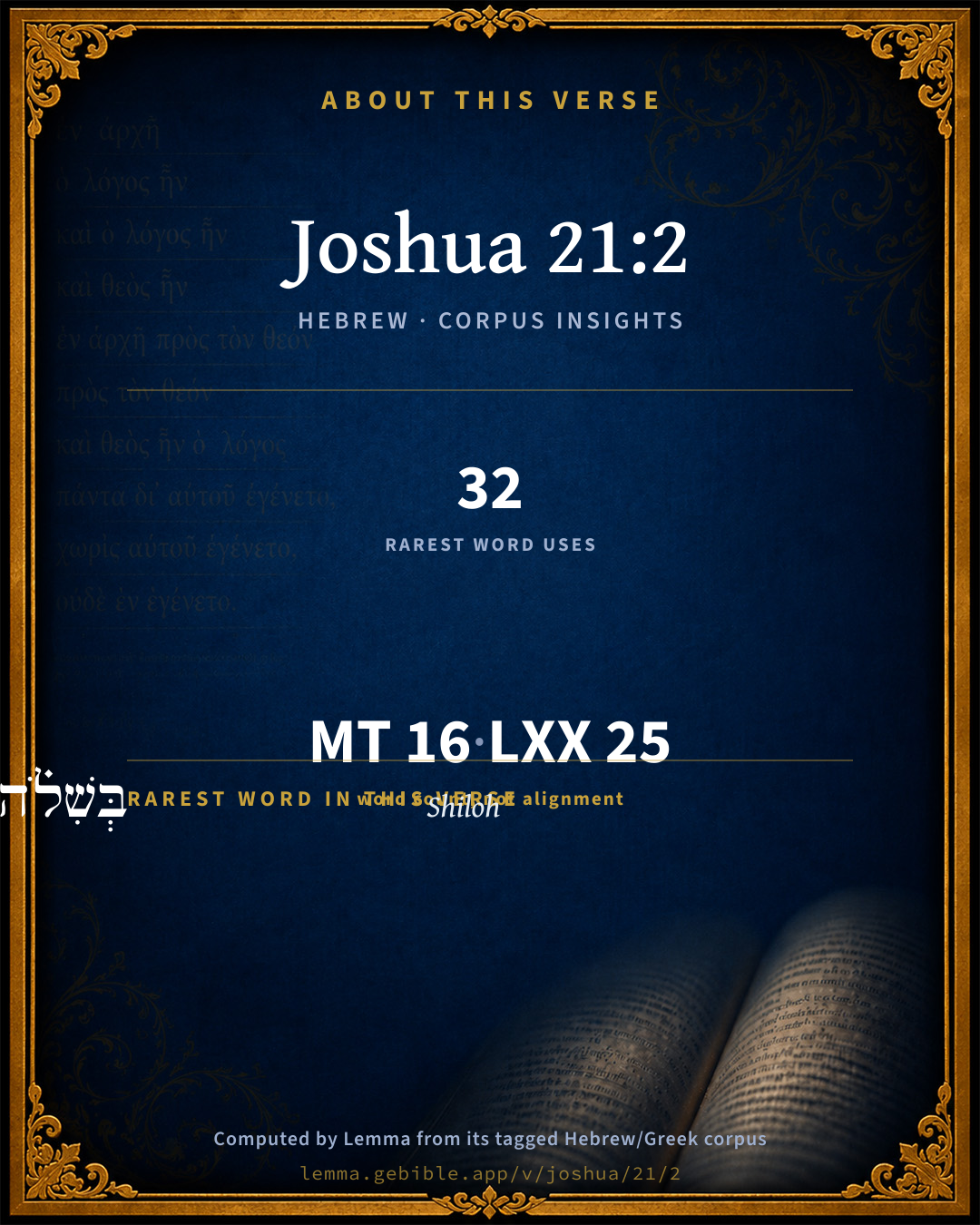
16
words
15
distinct lemmas
Historical
section

Shared distinctive vocabulary

בְּשִׁלֹ֗ה Shiloh H7887 occurs in 30 verses of the Hebrew Bible. Also found in:

Grammatical profile

  • 5 verbs
  • 9 nouns
  • 2 prepositions

Verb forms

  • וַיְדַבְּר֨וּ Piel · Sequential Imperfect
  • לֵאמֹ֔ר Qal · Infinitive Construct
  • צִוָּ֣ה Piel · Perfect
  • לָֽתֶת Qal · Infinitive Construct
  • לָשָׁ֑בֶת Qal · Infinitive Construct

Hebrew & Septuagint length

In English translation the verse runs 31 words from the Hebrew and 34 from the Septuagint (LXX English) — closely comparable.

A rough comparison of the two English renderings, which tokenize alike — not a word-level alignment.

Word counts can differ between the Hebrew and the Greek without any difference in meaning — e.g. the Hebrew direct-object marker אֵת has no separate Greek word, and Greek often adds the article ὁ.

In the original languages it is 16 Hebrew tokens and 25 Greek tokens — but the two are counted differently (Hebrew bundles its prefixes and suffixes into one token; the Greek is in lemma form), so that isn’t a like-for-like length.

Cross-references

6

Topical passages linked to Joshua 21:2 in the Treasury of Scripture Knowledge — connected by theme and wording, ordered by reader-vote popularity; previews shown in the World English Bible.

  • Joshua 18:1 The whole congregation of the children of Israel assembled themselves together at Shiloh, and set up the tent of meeting there: and the land was subdued before them.
  • Numbers 35:2–8 Command the children of Israel that they give to the Levites of the inheritance of their possession cities to dwell in; and suburbs for the cities round about them shall you give to the Levites.
  • Ezekiel 48:9–18 The offering that you shall offer to Yahweh shall be twenty-five thousand [reeds] in length, and ten thousand in breadth.
  • Matthew 10:10 Take no bag for your journey, neither two coats, nor shoes, nor staff: for the laborer is worthy of his food.
  • Galatians 6:6 But let him who is taught in the word share all good things with him who teaches.
  • 1 Timothy 5:17–18 Let the elders who rule well be counted worthy of double honor, especially those who labor in the word and in teaching.

Cross-references courtesy of OpenBible.info (CC BY 4.0).

Hebrew and Greek witnesses Masoretic Hebrew ↔ Greek Septuagint

The same verse in the two great witnesses to the Old Testament, shown verse-for-verse.

These are two independent witnesses, not word-aligned to each other, and the Septuagint is shown in lemma (dictionary) form.

Hebrew Joshua 21:2 Masoretic · Westminster Leningrad Codex

וַיְדַבְּר֨וּ אֲלֵיהֶ֜ם בְּשִׁלֹ֗ה בְּאֶ֤רֶץ כְּנַ֨עַן֙ לֵאמֹ֔ר יְהוָה֙ צִוָּ֣ה בְיַד מֹשֶׁ֔ה לָֽתֶת לָ֥נוּ עָרִ֖ים לָשָׁ֑בֶת וּמִגְרְשֵׁיהֶ֖ן לִבְהֶמְתֵּֽנוּ

and they spoke to them at Shiloh in the land of Canaan, saying, Yahweh commanded Moses to give us cities to dwell in, with the suburbs of it for our cattle.

World English Bible · Public Domain

Greek LXX Joshua 21:2 Septuagint · lemma form

καί εἶπον πρός αὐτός ἐν σηλω ἐν γῆ χανααν λέγω ἐντέλλομαι κύριος ἐν χείρ μωυσῆς δίδωμι ἐγώ πόλις καταοἰκέω καί ὁ περισπόριον ὁ κτῆνος ἐγώ

And they spoke to them in Selo in the land of Chanaan, saying, The Lord gave commandment by Moses to give us cities to dwell in, and the country round about for our cattle.

LXX2012 (modern English Septuagint) · Public Domain

Hebrew: Westminster Leningrad Codex (CC BY 4.0). Greek: Septuagint (public domain); English from LXX2012 (modern English Septuagint) (Public Domain). How the Septuagint differs from the Hebrew →

Targum (Aramaic paraphrase)

1

The Targum is the ancient Jewish Aramaic paraphrase of the Hebrew Scriptures — an interpretive translation, not the Hebrew text itself. Onkelos (literal) and Pseudo-Jonathan (expansive) render the Torah, and Jonathan the Prophets. Coverage is partial: where no permissively-licensed English translation exists for a verse, only the Aramaic is shown. This is verse-level text, not a word-by-word alignment to the Hebrew.

  1. Targum Jonathan Prophets (Joshua–Malachi)
    וּמַלִילוּ עִמְהוֹן בְּשִׁלֹה בְּאַרְעָא דִכְנָעַן לְמֵימַר יְיָ פַּקֵיד בְּיַד מֹשֶׁה לְמִתַּן לָנָא קִרְוִין לְמִתַּב וּרְוָחֵיהֶן לִבְעִירָנָא:

    (no public-domain English translation for this verse)

    Targum Jonathan — Aramaic: “Mikraot Gedolot” (public domain). English: “Sefaria Community Translation” (CC0 1.0 (public-domain dedication)); “London "Chaldee Paraphrase," 1871” (public domain). Text via Sefaria.

Commentary

Notes on Joshua 21:2 from classic Christian and Jewish commentators (each source and its license shown beneath its notes). The classic Christian expositions comment on the surrounding passage and are grouped to its opening verse, so a note may address several verses; the Jewish commentaries on the Tanakh (Rashi and others) are per-verse, so they appear only where the commentator wrote on this verse.

Lemma curates 59 commentaries, every one of them public domain or Creative Commons licensed, each selected and text-cleaned for this edition rather than reprinted as found. About our sources →

Trapp's Complete Commentary

John Trapp

Jos 21:2 And they spake unto them at Shiloh in the land of Canaan, saying, The LORD commanded by the hand of Moses to give us cities to dwell in, with the suburbs thereof for our cattle.

Ver 2. The Lord commanded.] He left not his Levites to the will and devotion of the people: for then they should have had Micah’s allowance, {Jdg 17:10} prisoners’ pittances, such as will neither keep them alive, nor suffer them to die. Spoliantur parochiae et scholae, non aliter ac si tame necare nos velint, is Luther’s complain: they keep us so poor as if they meant to famish us all. Therefore the Lord commanded, as here; lest men should deal by his Levites, as Louis XI of France did by his chaplains, to whom he allowed twenty shillings a month, whereas to his barber, John Cottier, he allowed ten thousand crowns a month.

John Trapp, A Commentary or Exposition upon All the Books of the Old and New Testament (1647–1656) — public domain. Text from a community e-Sword module.

Joseph Benson's Commentary

Jos 21:2. The Lord commanded — Observe: the maintenance of ministers is not an arbitrary thing, left purely to the good-will of the people. No: as the God of Israel commanded that the Levites should be provided for, so hath the Lord Jesus ordained (and a perpetual ordinance it is) “that they who preach the gospel should live of the gospel.”

Joseph Benson's Commentary on the Old and New Testaments (1811–1818) — public domain. Text from a community e-Sword module.

Tyndale Open Study Notes

Tyndale Open Resources

21:2-3 The Lord commanded Moses: See Num 35:1-7. One of the priestly duties was to teach God’s torah (see study note on 1:8) to Israel. The Levites could accomplish this better by living throughout the tribal territories.

Tyndale Open Study Notes — © Tyndale Open Resources, licensed CC BY-SA 4.0. Text via the HelloAO Bible API.

Geneva Bible (1599)

Geneva Bible translators

By Moses, by whose ministry God showed his power.

Geneva Bible (1599) marginal notes — public domain. Text via Bolls.life.

The Cambridge Bible for Schools and Colleges

gen. ed. J. J. S. Perowne

2. The Lord commanded] They reminded them of the command of Jehovah respecting themselves, which is found in Numbers 35, and where directions had been given that 48 cities (Num_35:6-7), with outlying suburbs of meadow-land for the pasturage of their flocks and herds, should be assigned them.

The Cambridge Bible for Schools and Colleges (gen. ed. J. J. S. Perowne; Cambridge University Press, 1878–1918) — public domain. Text from a community e-Sword module.

John Gill's Exposition

And they spake unto them at Shiloh in the land of Canaan,.... Where the tabernacle was fixed, at or near which the above persons met to cast lots for the division of the land to the seven tribes that had not received their inheritance:

saying, the Lord commanded by the hand of Moses to give us cities to dwell in, with the suburbs thereof for our cattle; this command is extant in Num 35:2.

John Gill's Exposition of the Whole Bible (1746–1763) — public domain (CC PDM 1.0). Text via the HelloAO Bible API.

Whedon's Commentary on the Bible

Daniel D. Whedon

2. With the suburbs thereof — The area of these suburbs is laid down in Num_35:4-5, but so obscurely that great diversity of computation has arisen among expositors. The suburbs were to reach a thousand cubits from the wall of the city on each of the four sides, and yet the measure on each side of the city was to be two thousand cubits. This Keil explains, as in the following diagram by picturing the city and its suburbs in squares, with the city in the midst, and understanding the two thousand cubits as the length of each outer side of the suburbs, apart from the walls of the cities, which latter, of course, might vary in size. Or we may understand with Maimonides that the two thousand cubits were added to the one thousand as “fields of the suburbs,” (Lev_25:34,) and lay outside the suburbs proper.

Daniel D. Whedon (gen. ed.), Commentary on the Old and New Testaments (1874–1909) — public domain. Text from a community e-Sword module.

The Pulpit Commentary

At Shiloh. Another instance of exact accuracy. Shiloh was now the place of assembly in Israel. (see Jos_18:1) The Lord commanded. The command is given in Numbers 35. We have here, therefore, another quotation from the books of Moses. If we refer to it we find how exactly the precepts were carried out. First, the six cities of refuge were to be appointed, and then forty-two more were to be added to them. Calvin, not noticing this, has complained that this narrative is not in its proper place, and that it should have been inserted before the details in Jos 20. The very reverse is the fact. These cities of refuge are included, in what follows, among the number of forty-eight cities in all, assigned to the Levites. Suburbs. See Jos_14:4. And so throughout the chapter.

The Pulpit Commentary (1880–1919), ed. H.D.M. Spence-Jones & Joseph S. Exell — public domain. Text from a community e-Sword module.

John Wesley's Explanatory Notes

The Lord commanded - Observe: the maintenance of ministers is not an arbitrary thing, left purely to the good will of the people. No: as the God of Israel commanded, that the Levites should be provided for, so hath the Lord Jesus ordained, (and a perpetual ordinance it is) that they who preach the gospel should live of the gospel.

John Wesley, Explanatory Notes Upon the Whole Bible (1754–1765) — public domain. Text via the GEBible commentary corpus.

Lesson kit

Teaching starters — assembled from the data on this page, not authored interpretation. Every prompt links to the verse data it draws on. Edit before teaching.

Joshua, in the Historical, opens this verse with 16 words (15 distinct Hebrew lemmas). Its most distinctive word is Shîylôh (“Shiloh”). A historical commentator’s framing appears above. Read the whole chapter for the surrounding context.

Discussion questions

  1. What does “Shiloh” (Shîylôh) contribute to the verse as a whole?
  2. How does Joshua 18:1, which shares the word «Shiloh», read alongside this verse?
  3. The translations on this page render this verse differently — a whole-verse word diff, not a word-by-word alignment. What might account for the different wordings?
  4. «וַיְדַבְּר֨וּ» is a Piel Sequential Imperfect verb. How does that grammatical form shape the action described?
  5. Compare how Trapp's Complete Commentary and Joseph Benson's Commentary read this verse. Where do they agree or differ?

Things to notice

Reading settings

Reading text

Shown beneath each verse's original-language words.

Old Testament
Old Testament edition

Read the OT as the Masoretic Hebrew (MT) or the Greek Septuagint (LXX).

English shown for the Greek Septuagint (in the Hebrew ↔ Greek comparison).

Comparing translations? Open the Compare panel on any verse page to stack up to four side by side.