
2 Kings 21:8

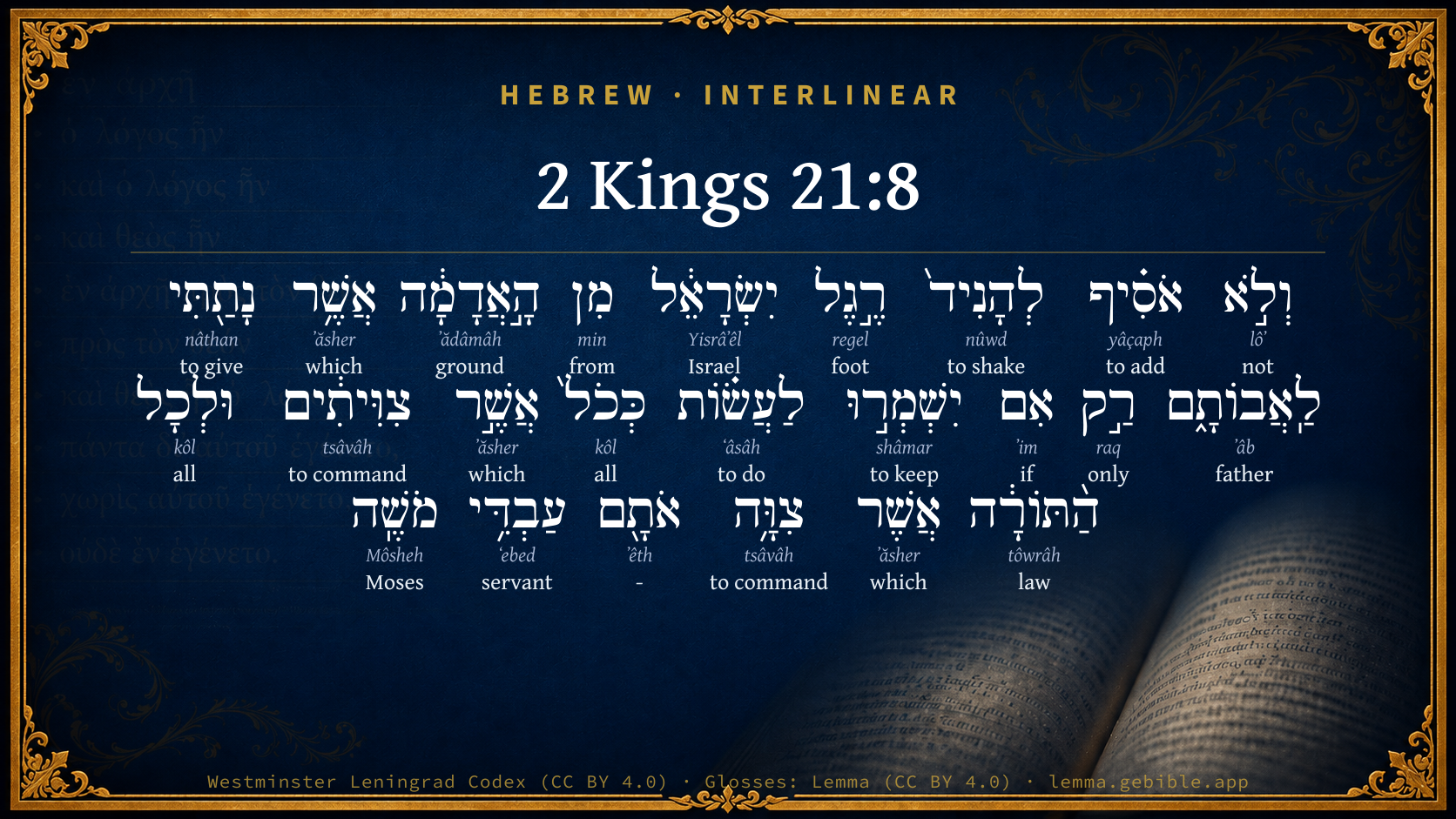
Hebrew (Westminster Leningrad Codex) 2 Kings 21:8 appears in the Hebrew Old Testament. The text above is from the Westminster Leningrad Codex. Each word links to its Strong’s number, a concise gloss, and parsing drawn from the Open Scriptures Hebrew Bible morphology. Click any word for its full Brown-Driver-Briggs (BDB) entry.
Download image
Cite this verse

2 Kings 21:8 (World English Bible). Public Domain. Lemma interlinear Bible study tool, https://lemma.gebible.app/v/2-kings/21/8.

Show BibTeX & RIS
BibTeX
RIS
English Translation
neither will I cause the feet of Israel to wander any more out of the land which I gave their fathers, if only they will observe to do according to all that I have commanded them, and according to all the law that my servant Moses commanded them.
World English Bible · Public Domain
Download a study sheet

One document with this verse’s original text, its word-by-word gloss line, the meaning frame, cross-references with their text, attributed commentary, and full source and license credits — printable, and it pastes into notes with its structure intact.

This verse Autodidact and up

Study sheet (.html) Plain text (.txt)

A passage Seminary Student

Up to 50 verses in one chapter. A passage sheet keeps up to 6 commentary sources and 12 cross-references per verse, in the order this page ranks them, and says so on the sheet whenever that leaves anything out. Ask for a single verse and you get the Autodidact verse sheet above.

Everything on this page stays free to read, with no account — the sheet is a download of what is already on screen, not access to it.

Want to remove ads? Support Godless Engineer
Compare translations 3

The same verse in 3 English versions, stacked beneath the original-language interlinear above. Click any original word for its lexicon entry.

Each is an independent rendering of the whole verse — the interlinear is not word-aligned to these translations.

Highlighted words mark where these versions differ — a whole-verse word diff, not a word-by-word alignment.

  • World English Bible Public Domain
    neither will I cause the feet of Israel to wander any more out of the land which I gave their fathers, if only they will observe to do according to all that I have commanded them, and according to all the law that my servant Moses commanded them.
  • King James Version Public Domain
    Neither will I make the feet of Israel move any more out of the land which I gave their fathers; only if they will observe to do according to all that I have commanded them, and according to all the law that my servant Moses commanded them.
  • unfoldingWord Literal Text CC BY-SA 4.0
    And I will not add to make the foot of Israel wander from the ground that I gave to their fathers if only they will take care to act according to all that I have commanded them and to all of the law that my servant Moses commanded them.”

unfoldingWord Literal Text — © unfoldingWord, licensed CC BY-SA 4.0. Word-aligned USFM3 via Door43 (git.door43.org/unfoldingWord/en_ult).

Versions to compare (up to 4)

3 of 4 selected

Show all 18 translations

Every available English version of this verse, each an independent rendering of the whole verse.

  • World English Bible Public Domain
    neither will I cause the feet of Israel to wander any more out of the land which I gave their fathers, if only they will observe to do according to all that I have commanded them, and according to all the law that my servant Moses commanded them.
  • Berean Standard Bible Public Domain
    I will never again cause the feet of the Israelites to wander from the land that I gave to their fathers, if only they are careful to do all I have commanded them—the whole Law that My servant Moses commanded them.”
  • Majority Standard Bible Public Domain
    I will never again cause the feet of the Israelites to wander from the land that I gave to their fathers, if only they are careful to do all I have commanded them—the whole Law that My servant Moses commanded them.”
  • King James Version Public Domain
    Neither will I make the feet of Israel move any more out of the land which I gave their fathers; only if they will observe to do according to all that I have commanded them, and according to all the law that my servant Moses commanded them.
  • American Standard Version (1901) Public Domain
    neither will I cause the feet of Israel to wander any more out of the land which I gave their fathers, if only they will observe to do according to all that I have commanded them, and according to all the law that my servant Moses commanded them.
  • Revised Version (1885) Public Domain
    neither will I cause the feet of Israel to wander any more out of the land which I gave their fathers; if only they will observe to do according to all that I have commanded them, and according to all the law that my servant Moses commanded them.
  • Geneva Bible (1599) Public Domain
    Neither will I make the feete of Israel, mooue any more out of the lande, which I gaue their fathers: so that they will obserue and doe all that I haue commanded them, and according to all the Lawe that my seruant Moses commanded them.
  • Douay-Rheims (1899) Public Domain
    And I will no more make the feet of Israel to be moved out of the land, which I gave to their fathers: only if they will observe to do all that I have commanded them according to the law which my servant Moses commanded them.
  • Young's Literal Translation Public Domain
    and I do not add to cause the foot of Israel to move from the ground that I gave to their fathers, only, if they observe to do according to all that I commanded them, and to all the law that My servant Moses commanded them.'
  • Literal Standard Version CC BY-SA 4.0
    and I do not add to cause the foot of Israel to move from the ground that I gave to their fathers, only, if they observe to do according to all that I commanded them, and to all the Law that My servant Moses commanded them.”
  • Unlocked Literal Bible CC BY-SA 4.0
    I will not cause the feet of Israel to wander any more out of the land that I gave to their ancestors, if they will only be careful to obey all that I have commanded them, and to follow all the law that my servant Moses commanded them.”
  • unfoldingWord Literal Text CC BY-SA 4.0
    And I will not add to make the foot of Israel wander from the ground that I gave to their fathers if only they will take care to act according to all that I have commanded them and to all of the law that my servant Moses commanded them.”
  • Darby Bible Public Domain
    neither will I any more cause the foot of Israel to wander away from the land that I gave their fathers; if they will only take heed to do according to all that I have commanded them, and according to all the law that my servant Moses commanded them.
  • World Messianic Bible Public Domain
    I will not cause the feet of Israel to wander any more out of the land which I gave their fathers, if only they will observe to do according to all that I have commanded them, and according to all the law that my servant Moses commanded them.”
  • Webster's Bible Public Domain
    Neither will I make the feet of Israel move any more out of the land which I gave their fathers; only if they will observe to do according to all that I have commanded them, and according to all the law that my servant Moses commanded them.
  • Free Bible Version CC BY-SA 4.0
    I will never again make the Israelites wander from the land I gave their forefathers if they are careful to follow everything I have ordered them to do—the whole law that my servant Moses gave them.”
  • Bible in Basic English Public Domain
    And never again will I send the feet of Israel wandering from the land which I gave to their fathers; if only they will take care to do all my orders, and keep all the law which my servant Moses gave them.
  • JPS Tanakh (1917) Public Domain
    neither will I cause the feet of Israel to wander any more out of the land which I gave their fathers; if only they will observe to do according to all that I have commanded them, and according to all the law that My servant Moses commanded them.'

Literal Standard Version (2020), Covenant Press — licensed CC BY-SA 4.0. Text via the HelloAO Bible API (eBible.org). Unlocked Literal Bible (unfoldingWord) — licensed CC BY-SA 4.0. Text via the HelloAO Bible API (eBible.org). unfoldingWord Literal Text — © unfoldingWord, licensed CC BY-SA 4.0. Word-aligned USFM3 via Door43 (git.door43.org/unfoldingWord/en_ult). Free Bible Version, Dr. Jonathan Gallagher — licensed CC BY-SA 4.0. Text via the HelloAO Bible API (eBible.org).

Word by word

More ways to search: Search by grammar → Find every occurrence → Compare this word →

Practice this passage: Drill this verse → Learn its vocabulary →

לְהָנִיד֙
nûwd
H5110
“to shake”
Preposition + Verb, Hiphil, Infinitive Construct
Part of Speech
Preposition + Verb
Stem
Hiphil
Form
Infinitive Construct
Full BDB Definition

Origin: a primitive root

TWOT: 1319

to shake, waver, wander, move to and fro, flutter, show grief, have compassion on - (Qal) - to move to and fro, wander (aimlessly), take flight - to flutter - to waver, wave, shake - to show grief - to lament, condole, show sympathy - (Hiphil) - to cause to wander (aimlessly) - to make a wagging, wag (with the head) - (Hithpolel) - to move oneself to and fro, sway, totter - to shake oneself - to bemoan oneself
  1. וְלֹ֣א lôʼ H3808 “and · not” Conjunction + Particle, Negative
  2. אֹסִ֗יף yâçaph H3254 “to add” Verb, Hiphil, Imperfect, 1st Person, Common, Singular
  3. רֶ֣גֶל regel H7272 “foot of” Noun, Common, Feminine, Singular, Construct
  4. יִשְׂרָאֵ֔ל Yisrâʼêl H3478 “Israel” Noun, Proper
  5. מִן min H4480 “from” Preposition
  6. הָ֣אֲדָמָ֔ה ʼădâmâh H127 “the · ground” Particle, Definite Article + Noun, Common, Feminine, Singular, Absolute
  7. אֲשֶׁ֥ר ʼăsher H834 “which” Particle, Relative
  8. נָתַ֖תִּי nâthan H5414 “to give” Verb, Qal, Perfect, 1st Person, Common, Singular
  9. לַֽאֲבוֹתָ֑ם ʼâb H1 “to/for · fathers · their” Preposition + Noun, Common, Masculine, Plural, Construct + Suffix, Personal, 3rd Person, Masculine, Plural
  10. רַ֣ק raq H7535 “only” Particle, Accusative
  11. אִם ʼim H518 “if” Conjunction
  12. יִשְׁמְר֣וּ shâmar H8104 “to keep” Verb, Qal, Imperfect, 3rd Person, Masculine, Plural
  13. לַעֲשׂ֗וֹת ʻâsâh H6213 “to do” Preposition + Verb, Qal, Infinitive Construct
  14. כְּכֹל֙ kôl H3605 “like/as · all” Preposition + Noun, Common, Masculine, Singular, Absolute
  15. אֲשֶׁ֣ר ʼăsher H834 “which” Particle, Relative
  16. צִוִּיתִ֔ים tsâvâh H6680 “to command · them” Verb, Piel, Perfect, 1st Person, Common, Singular + Suffix, Personal, 3rd Person, Masculine, Plural
  17. וּלְכָל kôl H3605 “and · to/for · all of” Conjunction + Preposition + Noun, Common, Masculine, Singular, Construct
  18. הַ֨תּוֹרָ֔ה tôwrâh H8451 “the · law” Particle, Definite Article + Noun, Common, Feminine, Singular, Absolute
  19. אֲשֶׁר ʼăsher H834 “which” Particle, Relative
  20. צִוָּ֥ה tsâvâh H6680 “to command” Verb, Piel, Perfect, 3rd Person, Masculine, Singular
  21. אֹתָ֖ם ʼêth H853 “- · them” Particle, Direct Object + Suffix, Personal, 3rd Person, Masculine, Plural
  22. עַבְדִּ֥י ʻebed H5650 “servant · my” Noun, Common, Masculine, Singular, Construct + Suffix, Personal, 1st Person, Common, Singular
  23. מֹשֶֽׁה Môsheh H4872 “Moses” Noun, Proper

About this verse

These counts appear in no published source. They are computed here, from the morphology-tagged text and Lemma’s own curated glosses. What Lemma adds →

24
words
20
distinct lemmas
Historical
section

Notable vocabulary

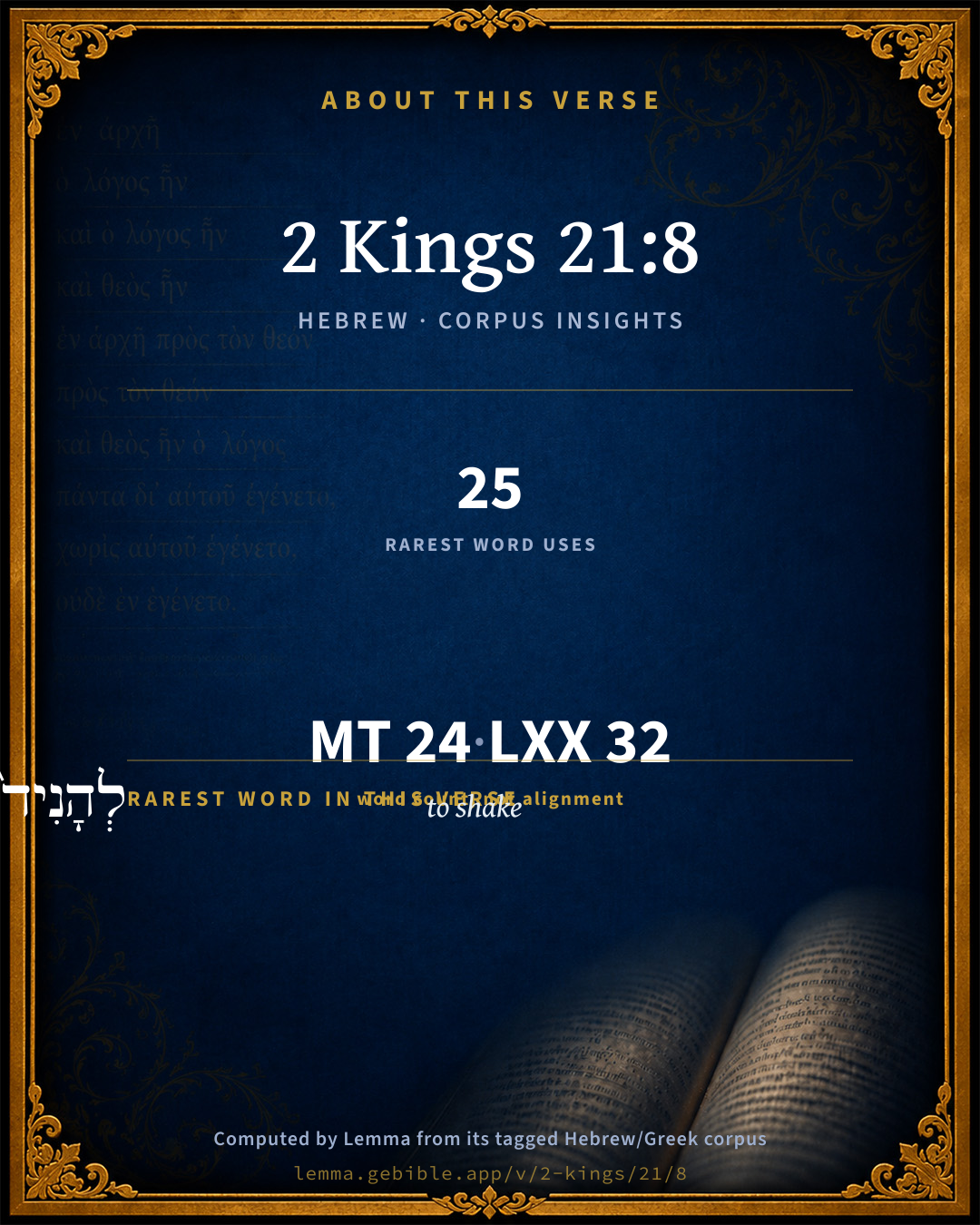
The rarest word here is לְהָנִיד֙ to shake H5110 — appearing just 25 times in the whole Hebrew Bible.

Shared distinctive vocabulary

לְהָנִיד֙ to shake H5110 occurs in 24 verses of the Hebrew Bible. Also found in:

Grammatical profile

  • 7 verbs
  • 9 nouns
  • 1 preposition
  • 1 conjunction
  • 6 particles

Verb forms

  • אֹסִ֗יף Hiphil · Imperfect
  • לְהָנִיד֙ Hiphil · Infinitive Construct
  • נָתַ֖תִּי Qal · Perfect
  • יִשְׁמְר֣וּ Qal · Imperfect
  • לַעֲשׂ֗וֹת Qal · Infinitive Construct
  • צִוִּיתִ֔ים Piel · Perfect
  • צִוָּ֥ה Piel · Perfect

Repetition

Words recur within this verse — often emphatic in Hebrew:

  • כְּכֹל֙ all H3605 ×2
  • צִוִּיתִ֔ים to command H6680 ×2
  • אֲשֶׁ֥ר which H834 ×3

Hebrew & Septuagint length

In English translation the verse runs 48 words from the Hebrew and 40 from the Septuagint (LXX English) — closely comparable.

A rough comparison of the two English renderings, which tokenize alike — not a word-level alignment.

Word counts can differ between the Hebrew and the Greek without any difference in meaning — e.g. the Hebrew direct-object marker אֵת has no separate Greek word, and Greek often adds the article ὁ.

In the original languages it is 24 Hebrew tokens and 32 Greek tokens — but the two are counted differently (Hebrew bundles its prefixes and suffixes into one token; the Greek is in lemma form), so that isn’t a like-for-like length.

Cross-references

16

Topical passages linked to 2 Kings 21:8 in the Treasury of Scripture Knowledge — connected by theme and wording, ordered by reader-vote popularity; previews shown in the World English Bible.

  • 2 Samuel 7:10 I will appoint a place for my people Israel, and will plant them, that they may dwell in their own place, and be moved no more; neither shall the children of wickedness afflict them any more, as at the first,
  • Leviticus 26:3–13 "'If you walk in my statutes, and keep my commandments, and do them;
  • Deuteronomy 5:28–29 Yahweh heard the voice of your words, when you spoke to me; and Yahweh said to me, I have heard the voice of the words of this people, which they have spoken to you: they have well said all that they have spoken.
  • Deuteronomy 28:1–14 It shall happen, if you shall listen diligently to the voice of Yahweh your God, to observe to do all his commandments which I command you this day, who Yahweh your God will set you on high above all the nations of the earth:
  • Joshua 23:11–13 Take good heed therefore to yourselves, that you love Yahweh your God.
  • 2 Kings 18:11–12 The king of Assyria carried Israel away to Assyria, and put them in Halah, and on the Habor, the river of Gozan, and in the cities of the Medes,
  • 1 Chronicles 17:9 I will appoint a place for my people Israel, and will plant them, that they may dwell in their own place, and be moved no more; neither shall the children of wickedness waste them any more, as at the first,
  • 2 Chronicles 33:8 neither will I any more remove the foot of Israel from off the land which I have appointed for your fathers, if only they will observe to do all that I have commanded them, even all the law and the statutes and the ordinances [given] by Moses.
  • Psalms 37:3 Trust in Yahweh, and do good. Dwell in the land, and enjoy safe pasture.
  • Psalms 81:11–16 But my people didn't listen to my voice. Israel desired none of me.
  • Isaiah 1:19 If you are willing and obedient, You shall eat the good of the land;
  • Jeremiah 7:3–7 Thus says Yahweh of Hosts, the God of Israel, Amend your ways and your doings, and I will cause you to dwell in this place.
  • Jeremiah 7:23 but this thing I commanded them, saying, Listen to my voice, and I will be your God, and you shall be my people; and walk you in all the way that I command you, that it may be well with you.
  • Jeremiah 17:20–27 and tell them, Hear you the word of Yahweh, you kings of Judah, and all Judah, and all the inhabitants of Jerusalem, that enter in by these gates:
  • Ezekiel 22:2–16 You, son of man, will you judge, will you judge the bloody city? then cause her to know all her abominations.
  • Ezekiel 33:25–29 Therefore tell them, Thus says the Lord Yahweh: You eat with the blood, and lift up your eyes to your idols, and shed blood: and shall you possess the land?

Cross-references courtesy of OpenBible.info (CC BY 4.0).

Hebrew and Greek witnesses Masoretic Hebrew ↔ Greek Septuagint

The same verse in the two great witnesses to the Old Testament, shown verse-for-verse.

These are two independent witnesses, not word-aligned to each other, and the Septuagint is shown in lemma (dictionary) form.

Hebrew 2 Kings 21:8 Masoretic · Westminster Leningrad Codex

וְלֹ֣א אֹסִ֗יף לְהָנִיד֙ רֶ֣גֶל יִשְׂרָאֵ֔ל מִן הָ֣אֲדָמָ֔ה אֲשֶׁ֥ר נָתַ֖תִּי לַֽאֲבוֹתָ֑ם רַ֣ק אִם יִשְׁמְר֣וּ לַעֲשׂ֗וֹת כְּכֹל֙ אֲשֶׁ֣ר צִוִּיתִ֔ים וּלְכָל הַ֨תּוֹרָ֔ה אֲשֶׁר צִוָּ֥ה אֹתָ֖ם עַבְדִּ֥י מֹשֶֽׁה

neither will I cause the feet of Israel to wander any more out of the land which I gave their fathers, if only they will observe to do according to all that I have commanded them, and according to all the law that my servant Moses commanded them.

World English Bible · Public Domain

Greek LXX 2 Kings 21:8 Septuagint · lemma form

καί οὐ προςτίθημι ὁ σαλεύω ὁ πούς ἰσραήλ ἀπό ὁ γῆ ὅς δίδωμι ὁ πατήρ αὐτός ὅστις φυλάσσω πᾶς ὅσος ἐντέλλομαι κατά πᾶς ὁ ἐντολή ὅς ἐντέλλομαι αὐτός ὁ δοῦλος ἐγώ μωυσῆς

And I will not again remove the foot of Israel from the land which I gave to their fathers, even of those who shall keep all that I commanded, according to all the commandments which my servant Moses commanded them.

LXX2012 (modern English Septuagint) · Public Domain

On this verse, Ellicott's Commentary for English Readers discusses the Septuagint’s reading. Read the note in Commentary ↓

Hebrew: Westminster Leningrad Codex (CC BY 4.0). Greek: Septuagint (public domain); English from LXX2012 (modern English Septuagint) (Public Domain). How the Septuagint differs from the Hebrew →

Targum (Aramaic paraphrase)

1

The Targum is the ancient Jewish Aramaic paraphrase of the Hebrew Scriptures — an interpretive translation, not the Hebrew text itself. Onkelos (literal) and Pseudo-Jonathan (expansive) render the Torah, and Jonathan the Prophets. Coverage is partial: where no permissively-licensed English translation exists for a verse, only the Aramaic is shown. This is verse-level text, not a word-by-word alignment to the Hebrew.

  1. Targum Jonathan Prophets (Joshua–Malachi)
    וְלָא אוֹסִיף לְטַלְטָלָא יַת יִשְׂרָאֵל מִן אַרְעָא דִיְהָבֵית לַאֲבָהַתְהוֹן לְחוֹד אִם יִטְרוּן לְמֶעְבַּד כְּכָל תַּפְקֵידְתָּא דְפַקֵידְתִּינוּן וּלְכָל אוֹרַיְתָא דְפַקֵיד יַתְהוֹן עַבְדִי מֹשֶׁה:

    (no public-domain English translation for this verse)

    Targum Jonathan — Aramaic: “Mikraot Gedolot” (public domain). English: “Sefaria Community Translation” (CC0 1.0 (public-domain dedication)); “London "Chaldee Paraphrase," 1871” (public domain). Text via Sefaria.

Commentary

Notes on 2 Kings 21:8 from classic Christian and Jewish commentators (each source and its license shown beneath its notes). The classic Christian expositions comment on the surrounding passage and are grouped to its opening verse, so a note may address several verses; the Jewish commentaries on the Tanakh (Rashi and others) are per-verse, so they appear only where the commentator wrote on this verse.

Lemma curates 59 commentaries, every one of them public domain or Creative Commons licensed, each selected and text-cleaned for this edition rather than reprinted as found. About our sources →

Trapp's Complete Commentary

John Trapp

2Ki 21:8 Neither will I make the feet of Israel move any more out of the land which I gave their fathers; only if they will observe to do according to all that I have commanded them, and according to all the law that my servant Moses commanded them.

Ver. 8. According to all that I have commanded them,] viz., In the moral law: of which God might say, as once Joseph did to his brethren in another case, "Behold, your eyes see that it is my mouth that speaketh unto you," {Gen 45:12} and as Paul to Philemon, {Phm 1:19} "I," the Lord, "have written it with mine own hand."

And according to all the law that my servant Moses commanded.] The ceremonial and judicial laws.

John Trapp, A Commentary or Exposition upon All the Books of the Old and New Testament (1647–1656) — public domain. Text from a community e-Sword module.

Geneva Bible (1599)

Geneva Bible translators

Therefore seeing they obeyed not the commandment of God, they were justly cast forth of that land, which they had but on condition.

Geneva Bible (1599) marginal notes — public domain. Text via Bolls.life.

Jamieson, Fausset & Brown

Robert Jamieson, A. R. Fausset & David Brown

Neither will I make the feet of Israel move . . . out of the land which I gave their fathers--alluding to the promise (Sa2 7:10).

only if they will observe, &c.--This condition was expressed from the first plantation of Israel in Canaan. But that people not only did not keep it, but through the pernicious influence of Manasseh, were seduced into greater excesses of idolatrous corruption than even the original Canaanites.

Jamieson, Fausset & Brown — Commentary Critical and Explanatory on the Whole Bible (1871) — public domain (CC PDM 1.0). Text via the HelloAO Bible API.

Adam Clarke's Commentary

Verse 8. Neither will I make the feet of Israel] Had they been faithful to God's testimonies they never had gone into captivity, and should even at this day have been in possession of the promised land.

Adam Clarke's Commentary on the Bible (1810–1826) — public domain. Text from a community e-Sword/MySword module.

Ellicott's Commentary for English Readers

(8) Neither will I make the feet (foot) of Israel move (wander) . . .—Comp. the promise in 2Sa_7:10. The reference is to the migration to Egypt; and the thought is that the permanent possession of the Promised Land depends on the permanent adherence of the nation to Jehovah only.

Only if.—If only.

According to all.—Chronicles rightly has simply (to do) all; and so LXX., Syriac, Vulg., Arabic here.

And according to all the law.—Omit and, with Chronicles and the Vatican LXX.

A Bible Commentary for English Readers, edited by Charles John Ellicott (1878–1897) — public domain. Text from a community e-Sword module.

The Cambridge Bible for Schools and Colleges

gen. ed. J. J. S. Perowne

8. neither will I make [R.V. cause] the feet of Israel move] R.V. to wander. The verb has the notion of a restless unsettled state. It is used (Gen_4:12; Gen_4:14) of Cain as a ‘vagabond’.

only if] R.V. if only. At the end of this clause there are not two sets of commands spoken of. ‘That which I have commanded them’ is only explained by ‘the law that my servant Moses commanded them’.

The Cambridge Bible for Schools and Colleges (gen. ed. J. J. S. Perowne; Cambridge University Press, 1878–1918) — public domain. Text from a community e-Sword module.

John Gill's Exposition

Neither will I make the feet of Israel move any more out of the land which I gave their fathers,.... Or suffer them to be carried captive into another land, as in the times of the judges; that is, on the following condition:

only if they will observe to do according to all the law that my servant Moses commanded them by obedience to which they had the tenure of the land of Canaan, Isa 1:19.

John Gill's Exposition of the Whole Bible (1746–1763) — public domain (CC PDM 1.0). Text via the HelloAO Bible API.

Matthew Poole's English Annotations

Move any more out of the land; they shall no more be carried captives into a strange land, as it had happened before.

Matthew Poole's English Annotations on the Holy Bible (1683–1685) — public domain. Text from a community e-Sword/MySword module.

The Pulpit Commentary

Neither will I make the feet of Israel move any more out of the land which I gave their fathers. The writer"s argument is that Manasseh, by these impieties, annulled God"s promises, brought about the destruction of the temple and of Jerusalem, and caused the entire people to be carried off into captivity. The promises of permanence to the city and temple, and of the continued possession of the laud by the people, were, he notes, conditional; and Manasseh, by breaking through the conditions, forfeited them. (comp. 2Ki_24:3) Only if they will observe to do according to all that I have commanded them, and according to all that my servant Moses commanded them. The words are not taken from any single passage, but express the general sense of numerous passages, as for example of Deu_4:25-27 Deu_30:15-19; Psa_89:28-32; 1Ki_9:4-9, etc.

The Pulpit Commentary (1880–1919), ed. H.D.M. Spence-Jones & Joseph S. Exell — public domain. Text from a community e-Sword module.

Lesson kit

Teaching starters — assembled from the data on this page, not authored interpretation. Every prompt links to the verse data it draws on. Edit before teaching.

2 Kings, in the Historical, opens this verse with 24 words (20 distinct Hebrew lemmas). Its most distinctive word is nûwd (“to shake”). A historical commentator’s framing appears above. Read the whole chapter for the surrounding context.

Discussion questions

  1. What does “to shake” (nûwd) contribute to the verse as a whole?
  2. How does Genesis 4:12, which shares the word «to shake», read alongside this verse?
  3. What does the repetition of “all” (2× in this one verse) do in this verse?
  4. These translations render this verse differently. What is at stake in choosing one wording over another?
  5. «אֹסִ֗יף» is a Hiphil Imperfect verb. How does that grammatical form shape the action described?
  6. Compare how Trapp's Complete Commentary and Geneva Bible (1599) read this verse. Where do they agree or differ?

Things to notice

Reading settings

Reading text

Shown beneath each verse's original-language words.

Old Testament
Old Testament edition

Read the OT as the Masoretic Hebrew (MT) or the Greek Septuagint (LXX).

English shown for the Greek Septuagint (in the Hebrew ↔ Greek comparison).

Comparing translations? Open the Compare panel on any verse page to stack up to four side by side.