
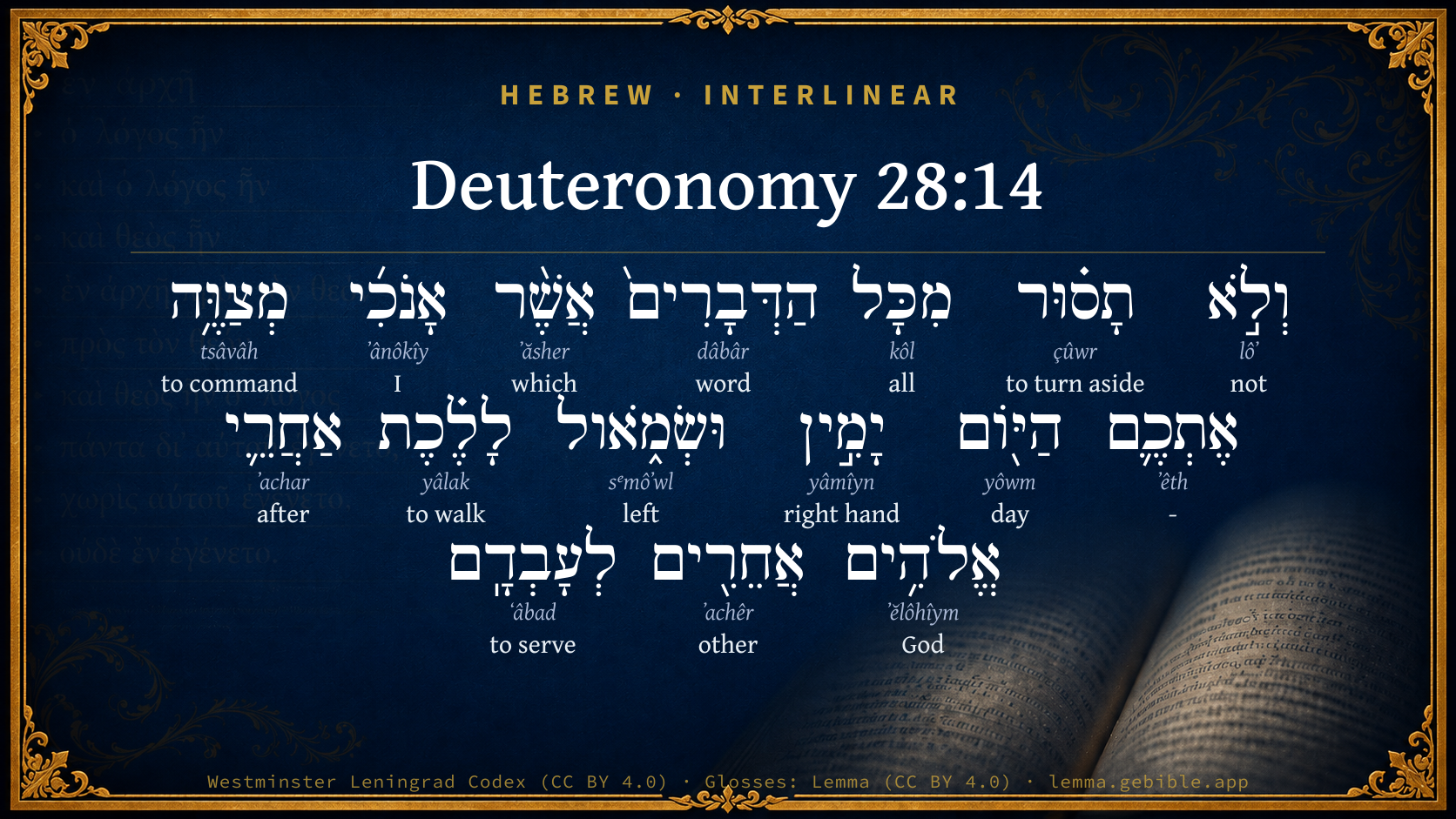
Deuteronomy 28:14

Hebrew (Westminster Leningrad Codex) Deuteronomy 28:14 appears in the Hebrew Old Testament. The text above is from the Westminster Leningrad Codex. Each word links to its Strong’s number, a concise gloss, and parsing drawn from the Open Scriptures Hebrew Bible morphology. Click any word for its full Brown-Driver-Briggs (BDB) entry.
Download image
Cite this verse

Deuteronomy 28:14 (World English Bible). Public Domain. Lemma interlinear Bible study tool, https://lemma.gebible.app/v/deuteronomy/28/14.

Show BibTeX & RIS
BibTeX
RIS
English Translation
and shall not turn aside from any of the words which I command you this day, to the right hand, or to the left, to go after other gods to serve them.
World English Bible · Public Domain
Download a study sheet

One document with this verse’s original text, its word-by-word gloss line, the meaning frame, cross-references with their text, attributed commentary, and full source and license credits — printable, and it pastes into notes with its structure intact.

This verse Autodidact and up

Study sheet (.html) Plain text (.txt)

A passage Seminary Student

Up to 50 verses in one chapter. A passage sheet keeps up to 6 commentary sources and 12 cross-references per verse, in the order this page ranks them, and says so on the sheet whenever that leaves anything out. Ask for a single verse and you get the Autodidact verse sheet above.

Everything on this page stays free to read, with no account — the sheet is a download of what is already on screen, not access to it.

Want to remove ads? Support Godless Engineer
Compare translations 3

The same verse in 3 English versions, stacked beneath the original-language interlinear above. Click any original word for its lexicon entry.

Each is an independent rendering of the whole verse — the interlinear is not word-aligned to these translations.

Highlighted words mark where these versions differ — a whole-verse word diff, not a word-by-word alignment.

  • World English Bible Public Domain
    and shall not turn aside from any of the words which I command you this day, to the right hand, or to the left, to go after other gods to serve them.
  • King James Version Public Domain
    And thou shalt not go aside from any of the words which I command thee this day, to the right hand, or to the left, to go after other gods to serve them.
  • unfoldingWord Literal Text CC BY-SA 4.0
    and you do not turn away from any of the words that I am commanding you today, right or left, going after other gods to serve them.

unfoldingWord Literal Text — © unfoldingWord, licensed CC BY-SA 4.0. Word-aligned USFM3 via Door43 (git.door43.org/unfoldingWord/en_ult).

Versions to compare (up to 4)

3 of 4 selected

Show all 18 translations

Every available English version of this verse, each an independent rendering of the whole verse.

  • World English Bible Public Domain
    and shall not turn aside from any of the words which I command you this day, to the right hand, or to the left, to go after other gods to serve them.
  • Berean Standard Bible Public Domain
    Do not turn aside to the right or to the left from any of the words I command you today, and do not go after other gods to serve them.
  • Majority Standard Bible Public Domain
    Do not turn aside to the right or to the left from any of the words I command you today, and do not go after other gods to serve them.
  • King James Version Public Domain
    And thou shalt not go aside from any of the words which I command thee this day, to the right hand, or to the left, to go after other gods to serve them.
  • American Standard Version (1901) Public Domain
    and shalt not turn aside from any of the words which I command you this day, to the right hand, or to the left, to go after other gods to serve them.
  • Revised Version (1885) Public Domain
    and shalt not turn aside from any of the words which I command you this day, to the right hand, or to the left, to go after other gods to serve them.
  • Geneva Bible (1599) Public Domain
    But thou shalt not decline from any of the wordes, which I command you this day, either to the right hand or to the left, to goe after other gods to serue them.
  • Douay-Rheims (1899) Public Domain
    And turn not away from them neither to the right hand, nor to the left, nor follow strange gods, nor worship them.
  • Young's Literal Translation Public Domain
    and thou dost not turn aside from all the words which I am commanding you to-day -- right or left -- to go after other gods, to serve them.
  • Literal Standard Version CC BY-SA 4.0
    and you do not turn aside from all the words which I am commanding you today [to] the right or left, to go after other gods, to serve them.
  • Unlocked Literal Bible CC BY-SA 4.0
    and if you do not turn away from any of the words that I am commanding you today, to the right hand or to the left, so as to go after other gods to serve them.
  • unfoldingWord Literal Text CC BY-SA 4.0
    and you do not turn away from any of the words that I am commanding you today, right or left, going after other gods to serve them.
  • Darby Bible Public Domain
    and if thou turn not aside from any of the words that I command thee this day, to the right hand or to the left, to go after other gods to serve them.
  • World Messianic Bible Public Domain
    and shall not turn away from any of the words which I command you today, to the right hand or to the left, to go after other gods to serve them.
  • Webster's Bible Public Domain
    And thou shalt not go aside from any of the words which I command thee this day, to the right hand or to the left, to go after other gods to serve them.
  • Free Bible Version CC BY-SA 4.0
    Don't deviate from any of my instructions today. Don't go and worship other gods.
  • Bible in Basic English Public Domain
    Not turning away from any of the orders which I give you today, to the right hand or to the left, or going after any other gods to give them worship.
  • JPS Tanakh (1917) Public Domain
    and shalt not turn aside from any of the words which I command you this day, to the right hand, or to the left, to go after other gods to serve them.

Literal Standard Version (2020), Covenant Press — licensed CC BY-SA 4.0. Text via the HelloAO Bible API (eBible.org). Unlocked Literal Bible (unfoldingWord) — licensed CC BY-SA 4.0. Text via the HelloAO Bible API (eBible.org). unfoldingWord Literal Text — © unfoldingWord, licensed CC BY-SA 4.0. Word-aligned USFM3 via Door43 (git.door43.org/unfoldingWord/en_ult). Free Bible Version, Dr. Jonathan Gallagher — licensed CC BY-SA 4.0. Text via the HelloAO Bible API (eBible.org).

Word by word

More ways to search: Search by grammar → Find every occurrence → Compare this word →

Practice this passage: Drill this verse → Learn its vocabulary →

וּשְׂמֹ֑אול
sᵉmôʼwl
H8040
“and · left”
Conjunction + Noun, Common, Masculine, Singular, Absolute
Part of Speech
Conjunction + Noun
Type
Common
Gender
Masculine
Number
Singular
State
Absolute
Full BDB Definition

Origin: a primitive word [rather perhaps from the same as H8071 (by insertion of the aleph) through the idea of wrapping up]

TWOT: 2267a

the left, the left hand, the left side - left - left hand - north (as one faces east)
  1. וְלֹ֣א lôʼ H3808 “and · not” Conjunction + Particle, Negative
  2. תָס֗וּר çûwr H5493 “to turn aside” Verb, Qal, Imperfect, 2nd Person, Masculine, Singular
  3. מִכָּל kôl H3605 “from · all of” Preposition + Noun, Common, Masculine, Singular, Construct
  4. הַדְּבָרִים֙ dâbâr H1697 “the · words” Particle, Definite Article + Noun, Common, Masculine, Plural, Absolute
  5. אֲשֶׁ֨ר ʼăsher H834 “which” Particle, Relative
  6. אָנֹכִ֜י ʼânôkîy H595 “I” Pronoun, Personal, 1st Person, Common, Singular
  7. מְצַוֶּ֥ה tsâvâh H6680 “commanding” Verb, Piel, Participle Active, Masculine, Singular, Absolute
  8. אֶתְכֶ֛ם ʼêth H853 “- · you” Particle, Direct Object + Suffix, Personal, 2nd Person, Masculine, Plural
  9. הַיּ֖וֹם yôwm H3117 “the · day” Particle, Definite Article + Noun, Common, Masculine, Singular, Absolute
  10. יָמִ֣ין yâmîyn H3225 “right hand” Noun, Common, Feminine, Singular, Absolute
  11. לָלֶ֗כֶת yâlak H3212 “to walk” Preposition + Verb, Qal, Infinitive Construct
  12. אַחֲרֵ֛י ʼachar H310 “after” Preposition
  13. אֱלֹהִ֥ים ʼĕlôhîym H430 “God(s)” Noun, Common, Masculine, Plural, Absolute
  14. אֲחֵרִ֖ים ʼachêr H312 “other” Adjective, Adjective, Masculine, Plural, Absolute
  15. לְעָבְדָֽם ʻâbad H5647 “to serve · them” Preposition + Verb, Qal, Infinitive Construct + Suffix, Personal, 3rd Person, Masculine, Plural

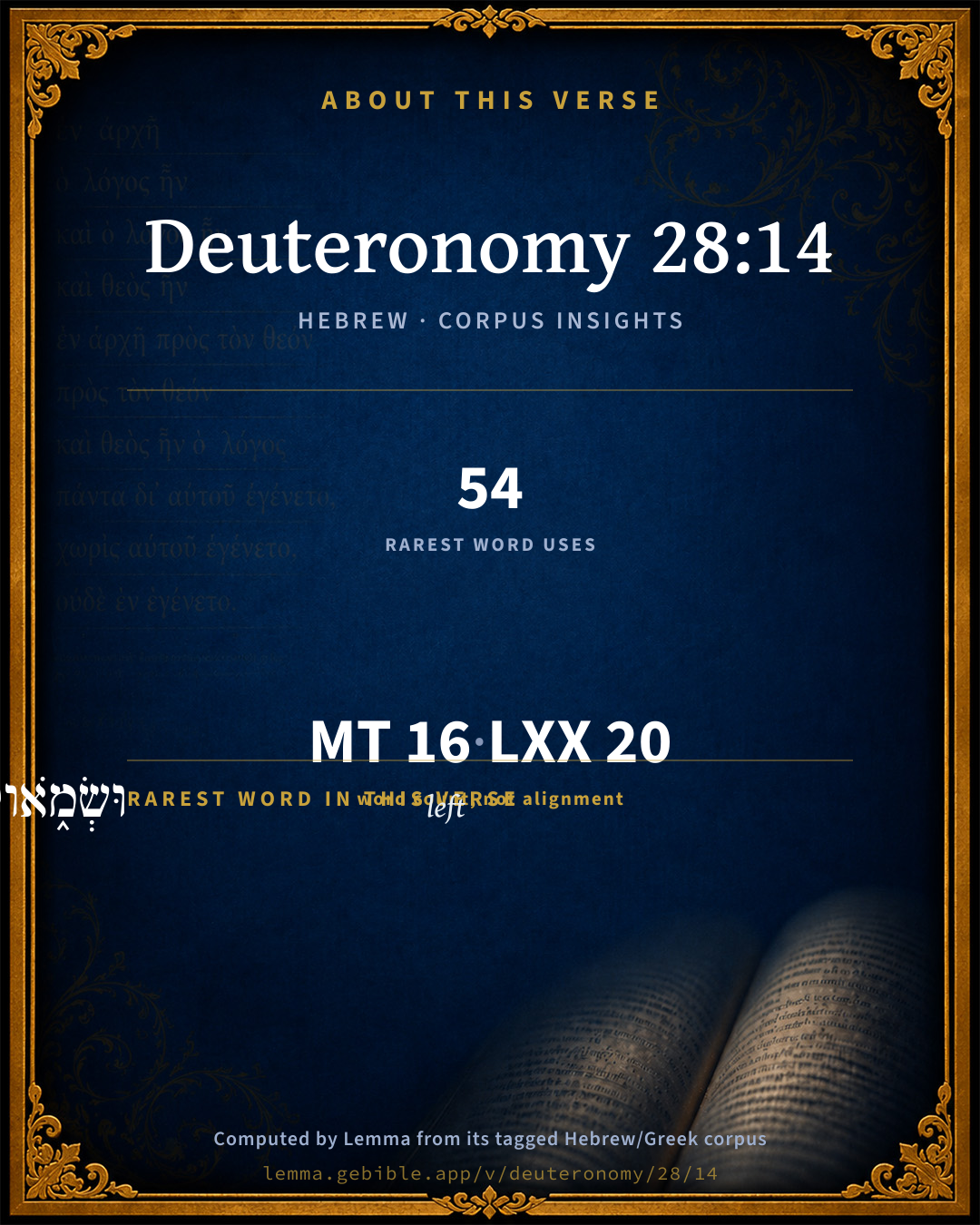
About this verse

These counts appear in no published source. They are computed here, from the morphology-tagged text and Lemma’s own curated glosses. What Lemma adds →

16
words
16
distinct lemmas
Pentateuch
section

Shared distinctive vocabulary

וּשְׂמֹ֑אול left H8040 occurs in 53 verses of the Hebrew Bible. Also found in:

Grammatical profile

  • 4 verbs
  • 6 nouns
  • 1 adjective
  • 1 pronoun
  • 1 preposition
  • 3 particles

Verb forms

  • תָס֗וּר Qal · Imperfect
  • מְצַוֶּ֥ה Piel · Participle Active
  • לָלֶ֗כֶת Qal · Infinitive Construct
  • לְעָבְדָֽם Qal · Infinitive Construct

Hebrew & Septuagint length

In English translation the verse runs 32 words from the Hebrew and 32 from the Septuagint (LXX English) — the same length.

A rough comparison of the two English renderings, which tokenize alike — not a word-level alignment.

Word counts can differ between the Hebrew and the Greek without any difference in meaning — e.g. the Hebrew direct-object marker אֵת has no separate Greek word, and Greek often adds the article ὁ.

In the original languages it is 16 Hebrew tokens and 20 Greek tokens — but the two are counted differently (Hebrew bundles its prefixes and suffixes into one token; the Greek is in lemma form), so that isn’t a like-for-like length.

Cross-references

7

Topical passages linked to Deuteronomy 28:14 in the Treasury of Scripture Knowledge — connected by theme and wording, ordered by reader-vote popularity; previews shown in the World English Bible.

  • Isaiah 30:21 and your ears shall hear a word behind you, saying, This is the way, walk you in it; when you turn to the right hand, and when you turn to the left.
  • Deuteronomy 5:32 You shall observe to do therefore as Yahweh your God has commanded you: you shall not turn aside to the right hand or to the left.
  • Deuteronomy 11:16 Take heed to yourselves, lest your heart be deceived, and you turn aside, and serve other gods, and worship them;
  • Proverbs 4:26–27 Make the path of your feet level. Let all of your ways be established.
  • Deuteronomy 11:26–28 Behold, I set before you this day a blessing and a curse:
  • 2 Kings 22:2 He did that which was right in the eyes of Yahweh, and walked in all the way of David his father, and didn't turn aside to the right hand or to the left.
  • Joshua 23:6 Therefore be you very courageous to keep and to do all that is written in the book of the law of Moses, that you not turn aside from it to the right hand or to the left;

Cross-references courtesy of OpenBible.info (CC BY 4.0).

Hebrew and Greek witnesses Masoretic Hebrew ↔ Greek Septuagint

The same verse in the two great witnesses to the Old Testament, shown verse-for-verse.

These are two independent witnesses, not word-aligned to each other, and the Septuagint is shown in lemma (dictionary) form.

Hebrew Deuteronomy 28:14 Masoretic · Westminster Leningrad Codex

וְלֹ֣א תָס֗וּר מִכָּל הַדְּבָרִים֙ אֲשֶׁ֨ר אָנֹכִ֜י מְצַוֶּ֥ה אֶתְכֶ֛ם הַיּ֖וֹם יָמִ֣ין וּשְׂמֹ֑אול לָלֶ֗כֶת אַחֲרֵ֛י אֱלֹהִ֥ים אֲחֵרִ֖ים לְעָבְדָֽם

and shall not turn aside from any of the words which I command you this day, to the right hand, or to the left, to go after other gods to serve them.

World English Bible · Public Domain

Greek LXX Deuteronomy 28:14 Septuagint · lemma form

οὐ παραβαίνω ἀπό πᾶς ὁ λόγος ὅς ἐγώ ἐντέλλομαι σύ σήμερον δεξιός οὐδέ ἀριστερός πορεύομαι ὀπίσω θεός ἕτερος λατρεύω αὐτός

You shall not turn aside from any of the commandments, which I charge you this day, to the right hand or to the left, to go after other gods to serve them.

LXX2012 (modern English Septuagint) · Public Domain

On this verse, Ellicott's Commentary for English Readers discusses the Septuagint’s reading. Read the note in Commentary ↓

Hebrew: Westminster Leningrad Codex (CC BY 4.0). Greek: Septuagint (public domain); English from LXX2012 (modern English Septuagint) (Public Domain). How the Septuagint differs from the Hebrew →

Targum (Aramaic paraphrase)

2

The Targum is the ancient Jewish Aramaic paraphrase of the Hebrew Scriptures — an interpretive translation, not the Hebrew text itself. Onkelos (literal) and Pseudo-Jonathan (expansive) render the Torah, and Jonathan the Prophets. Coverage is partial: where no permissively-licensed English translation exists for a verse, only the Aramaic is shown. This is verse-level text, not a word-by-word alignment to the Hebrew.

  1. Targum Onkelos Torah (Genesis–Deuteronomy)
    וְלָא תִסְטוּן מִכָּל פִּתְגָמַיָא דִי אֲנָא מְפַקֵד יָתְכוֹן יוֹמָא דֵין יַמִינָא וּשְׂמָאלָא לִמְהַךְ בָּתַר טַעֲוַת עַמְמַיָא לְמִפְלְחִנוּן

    (no public-domain English translation for this verse)

    Targum Onkelos — Aramaic: “Onkelos Genesis” (public domain); “Onkelos Exodus” (public domain); “Onkelos Leviticus” (public domain); “Onkelos Numbers” (public domain); “Onkelos Deuteronomy” (public domain). English: “Sefaria Community Translation” (CC0 1.0 (public-domain dedication)); “J.W. Etheridge. The Targums of Onkelos and Jonathan Ben Uzziel on the Pentateuch. London: Longmans, Green, 1862” (public domain). Text via Sefaria.

  2. Targum Pseudo-Jonathan Torah (Genesis–Deuteronomy)
    וְלָא תִסְטוּן מִן כָּל פִּתְגָמַיָא דַאֲנָא מְפַקֵיד לְכוֹן יוֹמָנָא לְיַמִינָא וְלִשְמָאלָא לִמְהַךְ בָּתַר טַעֲוַות עַמְמַיָא לְמִפְלַחְהוֹן

    Decline not from any of these words that I teach you today either to the right or the left, in walking after the idols of the Gentiles to serve them.

    Targum Pseudo-Jonathan — Aramaic: “Targum Jonathan on Genesis” (public domain); “Targum Jonathan on Exodus” (public domain); “Targum Jonathan on Leviticus” (public domain); “Targum Jonathan on Numbers” (public domain); “Targum Jonathan on Deuteronomy” (public domain). English: “The Targum of Jonathan ben Uzziel, trans. J. W. Etheridge, London, 1862” (public domain). Text via Sefaria.

Commentary

Notes on Deuteronomy 28:14 from classic Christian and Jewish commentators (each source and its license shown beneath its notes). The classic Christian expositions comment on the surrounding passage and are grouped to its opening verse, so a note may address several verses; the Jewish commentaries on the Tanakh (Rashi and others) are per-verse, so they appear only where the commentator wrote on this verse.

Lemma curates 59 commentaries, every one of them public domain or Creative Commons licensed, each selected and text-cleaned for this edition rather than reprinted as found. About our sources →

Trapp's Complete Commentary

John Trapp

Deu 28:14 And thou shalt not go aside from any of the words which I command thee this day, [to] the right hand, or [to] the left, to go after other gods to serve them.

Ver. 14. And thou shalt not go aside.] But keep my commandments curiously, even "as the apple of thine eye," {Pro 7:2} with all chariness and circumspection, since the least deviation is dangerous, yea, destructive.

John Trapp, A Commentary or Exposition upon All the Books of the Old and New Testament (1647–1656) — public domain. Text from a community e-Sword module.

Adam Clarke's Commentary

Verse 14. Thou shalt not go aside - to the right hand or to the left] The way of obedience is a straight way; it goes right forward; he who declines either to right or left from this path goes astray and misses heaven.

Adam Clarke's Commentary on the Bible (1810–1826) — public domain. Text from a community e-Sword/MySword module.

Ellicott's Commentary for English Readers

(14) And thou shalt not go aside.—It is possible, of course, to connect this sentence with the “if” in Deu_28:13, “If that thou hearken and do not go aside.” But the LXX., and apparently the Targums also, begin a fresh sentence with this verse. The idea that obedience begets obedience is by no means foreign to the Jewish mind. There are many passages in their literature which contain the thought expressed so forcibly in Rev_22:11, “He that is unjust, let him be unjust still . . . and he that is holy, let him be holy still.”

A Bible Commentary for English Readers, edited by Charles John Ellicott (1878–1897) — public domain. Text from a community e-Sword module.

The Cambridge Bible for Schools and Colleges

gen. ed. J. J. S. Perowne

14. turn aside, etc.] Deu_5:32. For you read thee. Sam., Gk., Syr. go after other gods] Deu_6:14, Deu_8:19, Deu_13:2 (3).

The Cambridge Bible for Schools and Colleges (gen. ed. J. J. S. Perowne; Cambridge University Press, 1878–1918) — public domain. Text from a community e-Sword module.

John Gill's Exposition

But it shall come to pass, if thou wilt not hearken to the voice of the Lord thy God,.... As directed, exhorted, and encouraged to, Deu 28:1, &c.

to observe to do all his commandments and his statutes, which I command thee this day; both moral and ceremonial:

that all these curses shall come upon thee; from the hand of God, certainly, suddenly, and unawares:

and overtake thee; pursuing after thee, will come up to thee, and seize upon thee, though they may seem to move slowly; see Zac 5:3; namely, the curses which follow. Manasseh Ben Israel (f) divides them into two parts, the first from hence to Deu 28:45; which respects the destruction of the first temple, and the things that went before or related to that; and the second from thence to the end of the chapter, which he thinks refers to the destruction of the second temple, and their present case and circumstances; and it must be owned that for the most part the distinction may seem to hold good; what is prophesied of that should befall the Jews for their disobedience being more remarkably and distinctly fulfilled in the one than in the other; yet there are things in the whole which respect both, or that were fulfilled, some under one dispensation, and some under another, and some that were fulfilled in both; but chiefly and more manifestly at and since their dispersion by the Romans.

(f) De Termino Vitae, l. 3. sect. 3. p. 126.

John Gill's Exposition of the Whole Bible (1746–1763) — public domain (CC PDM 1.0). Text via the HelloAO Bible API.

The Pulpit Commentary

cf. Deu_5:29 Deu_11:28. Moses ends as he began, by reminding them that the condition of enjoying the blessing was obedience to the Divine Law, and steadfast adherence to the course in which they were called to walk.

The Pulpit Commentary (1880–1919), ed. H.D.M. Spence-Jones & Joseph S. Exell — public domain. Text from a community e-Sword module.

Ramban (Nachmanides)

Rabbi Moshe ben Nachman (Ramban / Nachmanides)

AND THOU SHALT NOT TURN ASIDE FROM ANY OF THE WORDS WHICH I COMMAND YOU THIS DAY. This is connected with the expression [in the preceding Verse 13] if thou shalt hearken, meaning that all these blessings will come upon you when you will hearken to His commandments, and when you will not turn aside to the right, or to the left from any of the words which I command you concerning idolatry. For, if you will go after other gods to serve them you will already have turned aside from all His commandments, is thus not an independent negative commandment, as the author of the “Hilchoth Gedoloth” would have it, but is rather to be understood in connection with the concluding part of that verse, to go after other gods to serve them, meaning to say: if you will go after other gods to serve them, you will already have turned aside from any of the words which, command you this day. and He shall have no desire whatever for any of the commandments you may observe. The sense of the verse is thus unlike the words of the “Hilchoth Gedoloth” contained in the Torah. The listing is in the preface to his work “Hilchoth Gedoloth”. His concept was utilized by the Paitanim, the writers of liturgical poetry who wrote various Azharoth (Exhortations), liturgical poems containing the Divine Commandments. — It should be noted that while the “Hilchoth Gedoloth” contains the first historical record in our possession of an attempt at enumerating the individual commandments, there is no doubt that the author drew upon older sources of such lists, and as Rabbeinu Saadia Gaon writes here, such “a list of the commandments” was written upon the stones by Moses. who counted this verse as a negative commandment.

Ramban (Nachmanides) on the Tanakh — English translation: “Commentary on the Torah by Ramban (Nachmanides). Translated and annotated by Charles B. Chavel. New York, Shilo Pub. House, 1971-1976” (CC BY 4.0). Text via Sefaria.

Lesson kit

Teaching starters — assembled from the data on this page, not authored interpretation. Every prompt links to the verse data it draws on. Edit before teaching.

Deuteronomy, in the Pentateuch, opens this verse with 16 words (16 distinct Hebrew lemmas). Its most distinctive word is sᵉmôʼwl (“left”). A historical commentator’s framing appears above. Read the whole chapter for the surrounding context.

Discussion questions

  1. How does “left” (sᵉmôʼwl) shape what this verse is saying?
  2. Genesis 13:9 shares the word «left» with this verse. How do the two illuminate each other?
  3. These translations render this verse differently; the difference is in the English rendering, not the original. What questions does that raise?
  4. The verb «תָס֗וּר» is Qal Imperfect. How does its form color the action?
  5. Reading how Trapp's Complete Commentary and Adam Clarke's Commentary read this verse, where do the two commentators agree and where do they part?

Things to notice

Reading settings

Reading text

Shown beneath each verse's original-language words.

Old Testament
Old Testament edition

Read the OT as the Masoretic Hebrew (MT) or the Greek Septuagint (LXX).

English shown for the Greek Septuagint (in the Hebrew ↔ Greek comparison).

Comparing translations? Open the Compare panel on any verse page to stack up to four side by side.