
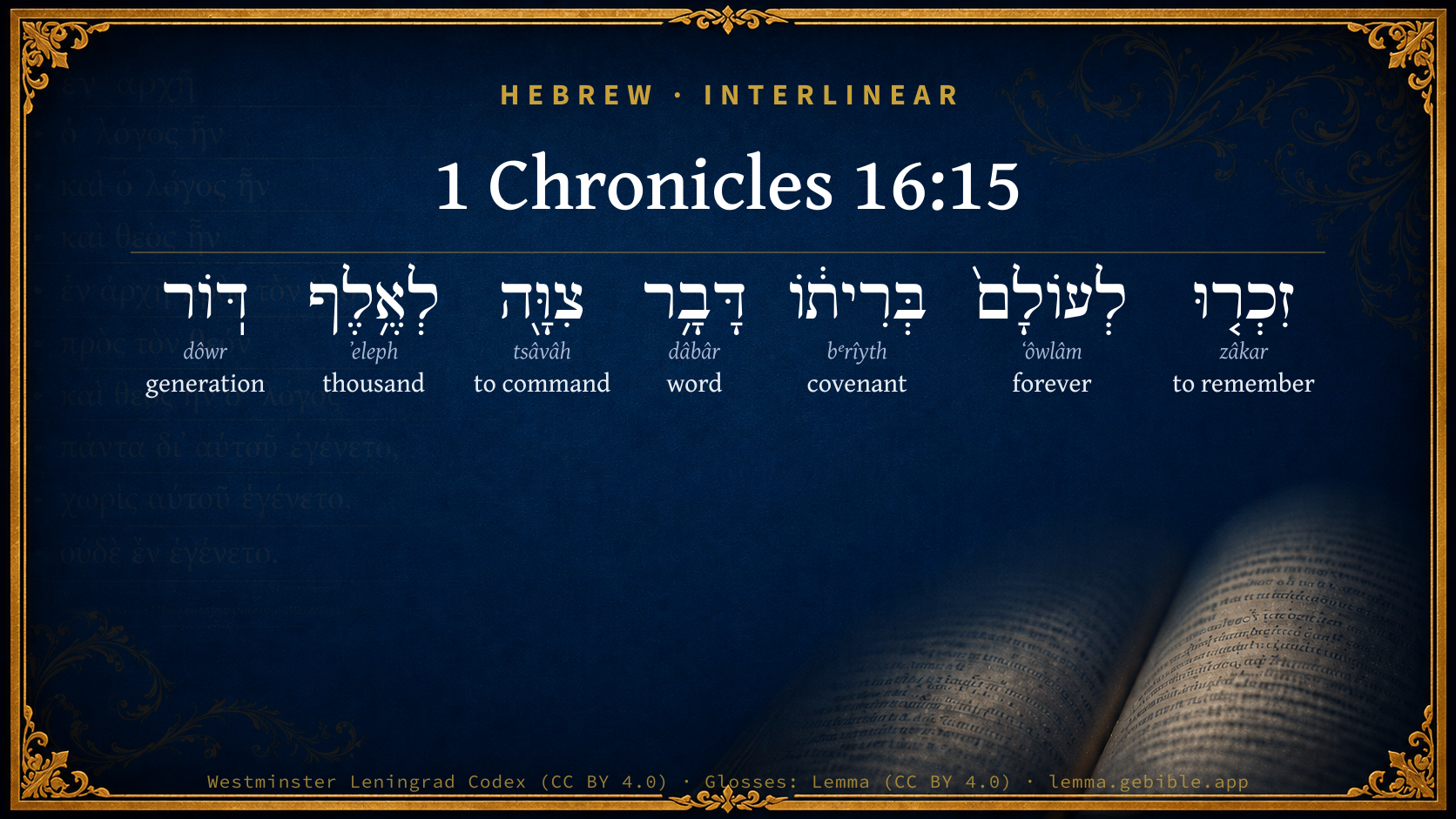
1 Chronicles 16:15

Hebrew (Westminster Leningrad Codex) 1 Chronicles 16:15 appears in the Hebrew Old Testament. The text above is from the Westminster Leningrad Codex. Each word links to its Strong’s number, a concise gloss, and parsing drawn from the Open Scriptures Hebrew Bible morphology. Click any word for its full Brown-Driver-Briggs (BDB) entry.
Download image
Cite this verse

1 Chronicles 16:15 (World English Bible). Public Domain. Lemma interlinear Bible study tool, https://lemma.gebible.app/v/1-chronicles/16/15.

Show BibTeX & RIS
BibTeX
RIS
English Translation
Remember his covenant forever, The word which he commanded to a thousand generations,
World English Bible · Public Domain
Download a study sheet

One document with this verse’s original text, its word-by-word gloss line, the meaning frame, cross-references with their text, attributed commentary, and full source and license credits — printable, and it pastes into notes with its structure intact.

This verse Autodidact and up

Study sheet (.html) Plain text (.txt)

A passage Seminary Student

Up to 50 verses in one chapter. A passage sheet keeps up to 6 commentary sources and 12 cross-references per verse, in the order this page ranks them, and says so on the sheet whenever that leaves anything out. Ask for a single verse and you get the Autodidact verse sheet above.

Everything on this page stays free to read, with no account — the sheet is a download of what is already on screen, not access to it.

Want to remove ads? Support Godless Engineer
Compare translations 3

The same verse in 3 English versions, stacked beneath the original-language interlinear above. Click any original word for its lexicon entry.

Each is an independent rendering of the whole verse — the interlinear is not word-aligned to these translations.

Highlighted words mark where these versions differ — a whole-verse word diff, not a word-by-word alignment.

  • World English Bible Public Domain
    Remember his covenant forever, The word which he commanded to a thousand generations,
  • King James Version Public Domain
    Be ye mindful always of his covenant; the word which he commanded to a thousand generations;
  • unfoldingWord Literal Text CC BY-SA 4.0
    Remember his covenant forever, the word he commanded, for a thousand generations,

unfoldingWord Literal Text — © unfoldingWord, licensed CC BY-SA 4.0. Word-aligned USFM3 via Door43 (git.door43.org/unfoldingWord/en_ult).

Versions to compare (up to 4)

3 of 4 selected

Show all 18 translations

Every available English version of this verse, each an independent rendering of the whole verse.

  • World English Bible Public Domain
    Remember his covenant forever, The word which he commanded to a thousand generations,
  • Berean Standard Bible Public Domain
    Remember His covenant forever, the word He ordained for a thousand generations—
  • Majority Standard Bible Public Domain
    Remember His covenant forever, the word He ordained for a thousand generations—
  • King James Version Public Domain
    Be ye mindful always of his covenant; the word which he commanded to a thousand generations;
  • American Standard Version (1901) Public Domain
    Remember his covenant for ever, The word which he commanded to a thousand generations,
  • Revised Version (1885) Public Domain
    Remember his covenant for ever, the word which he commanded to a thousand generations;
  • Geneva Bible (1599) Public Domain
    Remember his couenant for euer, and the worde, which hee commanded to a thousand generations:
  • Douay-Rheims (1899) Public Domain
    Remember for ever his covenant: the word, which he commanded to a thousand generations.
  • Young's Literal Translation Public Domain
    Remember ye to the age His covenant, The word He commanded -- To a thousand generations,
  • Literal Standard Version CC BY-SA 4.0
    Remember His covenant for all time, || The word He commanded—To one thousand generations,
  • Unlocked Literal Bible CC BY-SA 4.0
    Keep his covenant in mind forever, the word that he commanded for a thousand generations.
  • unfoldingWord Literal Text CC BY-SA 4.0
    Remember his covenant forever, the word he commanded, for a thousand generations,
  • Darby Bible Public Domain
    Be ye ever mindful of his covenant, The word which he commanded to a thousand generations, --
  • World Messianic Bible Public Domain
    Remember his covenant forever, the word which he commanded to a thousand generations,
  • Webster's Bible Public Domain
    Be ye mindful always of his covenant; the word which he commanded to a thousand generations;
  • Free Bible Version CC BY-SA 4.0
    He remembers his agreement forever, the promise he made lasts for a thousand generations;
  • Bible in Basic English Public Domain
    He has kept his agreement in mind for ever, the word which he gave for a thousand generations;
  • JPS Tanakh (1917) Public Domain
    Remember His covenant for ever, the word which He commanded to a thousand generations;

Literal Standard Version (2020), Covenant Press — licensed CC BY-SA 4.0. Text via the HelloAO Bible API (eBible.org). Unlocked Literal Bible (unfoldingWord) — licensed CC BY-SA 4.0. Text via the HelloAO Bible API (eBible.org). unfoldingWord Literal Text — © unfoldingWord, licensed CC BY-SA 4.0. Word-aligned USFM3 via Door43 (git.door43.org/unfoldingWord/en_ult). Free Bible Version, Dr. Jonathan Gallagher — licensed CC BY-SA 4.0. Text via the HelloAO Bible API (eBible.org).

Word by word

More ways to search: Search by grammar → Find every occurrence → Compare this word →

Practice this passage: Drill this verse → Learn its vocabulary →

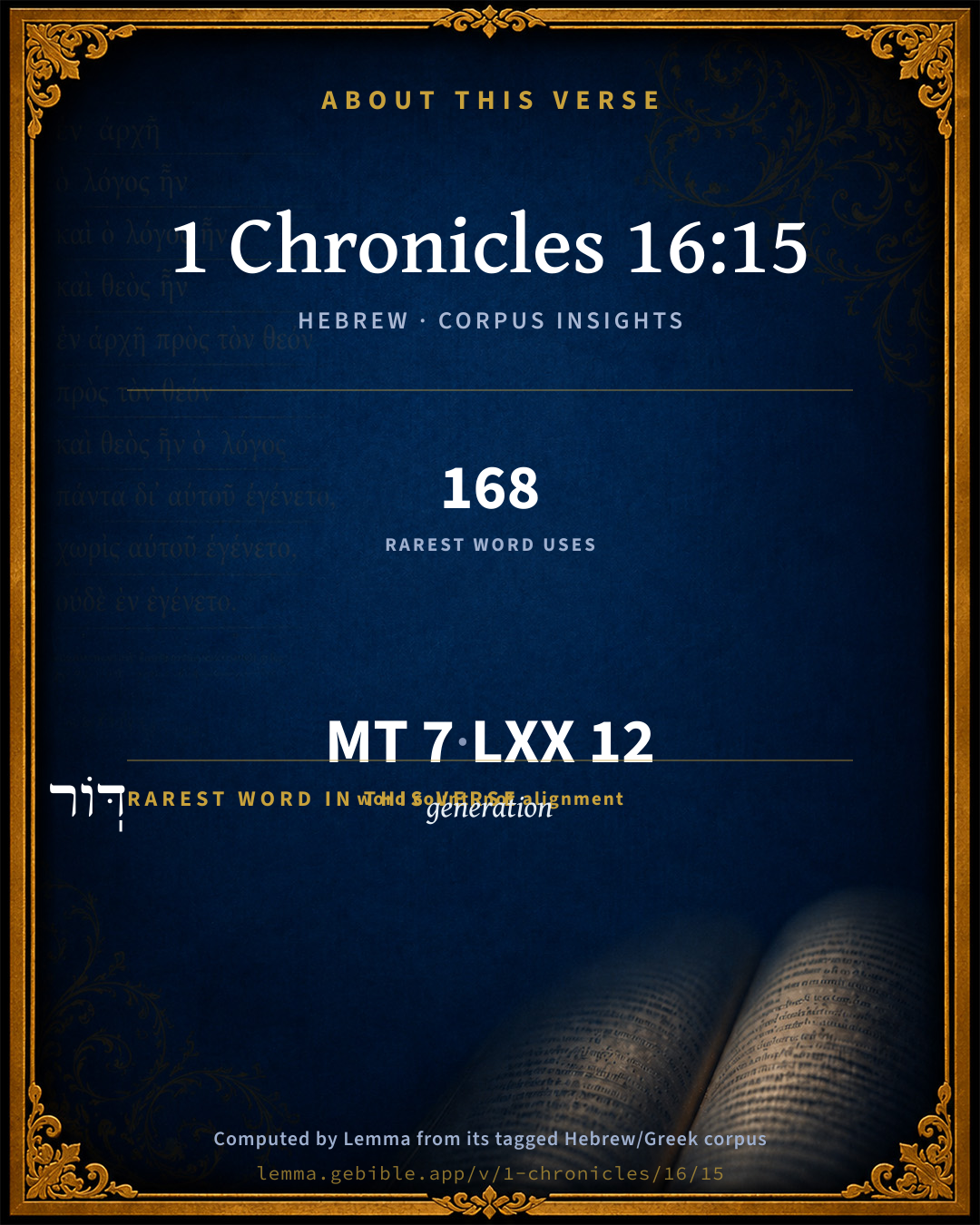
About this verse

These counts appear in no published source. They are computed here, from the morphology-tagged text and Lemma’s own curated glosses. What Lemma adds →

7
words
7
distinct lemmas
Historical
section

Grammatical profile

  • 2 verbs
  • 4 nouns
  • 1 adjective

Verb forms

  • זִכְר֤וּ Qal · Imperative
  • צִוָּ֖ה Piel · Perfect

Hebrew & Septuagint length

In English translation the verse runs 13 words from the Hebrew and 16 from the Septuagint (LXX English) — closely comparable.

A rough comparison of the two English renderings, which tokenize alike — not a word-level alignment.

Word counts can differ between the Hebrew and the Greek without any difference in meaning — e.g. the Hebrew direct-object marker אֵת has no separate Greek word, and Greek often adds the article ὁ.

In the original languages it is 7 Hebrew tokens and 12 Greek tokens — but the two are counted differently (Hebrew bundles its prefixes and suffixes into one token; the Greek is in lemma form), so that isn’t a like-for-like length.

Cross-references

5

Topical passages linked to 1 Chronicles 16:15 in the Treasury of Scripture Knowledge — connected by theme and wording, ordered by reader-vote popularity; previews shown in the World English Bible.

  • Psalms 105:8 He has remembered his covenant forever, The word which he commanded to a thousand generations,
  • Deuteronomy 7:9 Know therefore that Yahweh your God, he is God, the faithful God, who keeps covenant and loving kindness with them who love him and keep his commandments to a thousand generations,
  • Psalms 25:10 All the paths of Yahweh are loving kindness and truth To such as keep his covenant and his testimonies.
  • Malachi 4:4 "Remember the law of Moses my servant, which I commanded to him in Horeb for all Israel, even statutes and ordinances.
  • Psalms 44:17 All this has come on us, Yet have we not forgotten you, Neither have we been false to your covenant.

Cross-references courtesy of OpenBible.info (CC BY 4.0).

Hebrew and Greek witnesses Masoretic Hebrew ↔ Greek Septuagint

The same verse in the two great witnesses to the Old Testament, shown verse-for-verse.

These are two independent witnesses, not word-aligned to each other, and the Septuagint is shown in lemma (dictionary) form.

Hebrew 1 Chronicles 16:15 Masoretic · Westminster Leningrad Codex

זִכְר֤וּ לְעוֹלָם֙ בְּרִית֔וֹ דָּבָ֥ר צִוָּ֖ה לְאֶ֥לֶף דּֽוֹר

Remember his covenant forever, The word which he commanded to a thousand generations,

World English Bible · Public Domain

Greek LXX 1 Chronicles 16:15 Septuagint · lemma form

μνημονεύω εἰς αἰών διαθήκη αὐτός λόγος αὐτός ὅς ἐντέλλομαι εἰς χίλιοι γενεά

Let us remember his covenant for ever, his word which he commanded to a thousand generations,

LXX2012 (modern English Septuagint) · Public Domain

Hebrew: Westminster Leningrad Codex (CC BY 4.0). Greek: Septuagint (public domain); English from LXX2012 (modern English Septuagint) (Public Domain). How the Septuagint differs from the Hebrew →

Commentary

Notes on 1 Chronicles 16:15 from classic Christian and Jewish commentators (each source and its license shown beneath its notes). The classic Christian expositions comment on the surrounding passage and are grouped to its opening verse, so a note may address several verses; the Jewish commentaries on the Tanakh (Rashi and others) are per-verse, so they appear only where the commentator wrote on this verse.

Lemma curates 59 commentaries, every one of them public domain or Creative Commons licensed, each selected and text-cleaned for this edition rather than reprinted as found. About our sources →

The Biblical Illustrator

Joseph S. Exell

1Ch_16:15-22

Be ye always mindful of His covenant

The national covenant

Learn:

I.

That Gods method of intercourse with men has ever been in the form of a covenant. Tayler Lewes says: There is no religion without this idea of covenant with a personal God, and therefore all such views as those of Comte, Mill, and Spencer are, for all moral and religious purposes, wholly atheistical.

II. That this covenant method of intercourse with men displays the sovereign will and free grace of God (Eph_1:5).

III. That this covenant method of intercourse puts man under deep obligation to God.

1. They are chosen to great favours.

2. They should render thanks for these favours.

IV. The obligations of men to God for his covenant mercies can never cease.

1. It is of Divine authority.

2. It is confirmed from time to time.

3. It is an everlasting covenant (1Ch_16:17), made with man as an immortal being, and in itself an evidence of his designed immortality. (J. Wolfendale.)

The Biblical Illustrator, edited by Joseph S. Exell (c. 1880s–1900s) — public domain. Text from a community e-Sword module.

Ellicott's Commentary for English Readers

(15) Be ye mindful.—Psa_105:8, third strophe, begins, “He hath remembered,” that is, “He will certainly remember” His ancient covenant; and the exile and oppression of His people can only be transitory (Comp. Psa_111:5.) The expression is modified here, to suit different circumstances, and perhaps in view of 1Ch_16:12.

The word which he commanded to . . . Rather, the promise which he established for . . .

A Bible Commentary for English Readers, edited by Charles John Ellicott (1878–1897) — public domain. Text from a community e-Sword module.

The Cambridge Bible for Schools and Colleges

gen. ed. J. J. S. Perowne

15. Be ye mindful] Read (with Psa_105:8) He hath remembered. Cp. Exo_24:3-8; Exo_34:10-27.

The Cambridge Bible for Schools and Colleges (gen. ed. J. J. S. Perowne; Cambridge University Press, 1878–1918) — public domain. Text from a community e-Sword module.

The Pulpit Commentary

Vers. 15-22.

Human mindfulness of Divine promises.

I THAT GOD HAS MADE DISTINCT PROMISES TO MANKIND. David speaks here of the "covenant which God made with Abraham, and his oath unto Isaac" (vers. 15, 16; see ver. 18 and. Gen_17:2, Gen_26:3, etc.) We know that he also promised David that he should sit on the throne, and his children after him. (1Ch_17:17) We think also of the primeval promise, looking far forward and embracing such large results. (Gen_3:15) God has made "exceeding great and precious promises" to us in Christ; he promises to those who are in him pardon, peace, joy, the indwelling Spirit, sanctity, eternal life,

II THAT OF THESE HIS PROMISES HE HAS GIVEN US ASSURING CONFIRMATION. He "confirmed the same to Jacob for a law, and to Israel for an everlasting covenant" (ver. 17); he did this in word (ver. 18) and in deed (vers. 19-22). All the promises which are made to us in Christ are confirmed both in word and deed.

1. In Divine Word. By repeated assurances not only from the lips of theLord himself, but also from the utterances of his inspired apostles. In Scripture we have the most abundant assurances that those who believe in Christ shall enjoy the favour of the eternal Father and possess everlasting life.

2. And also in Divine action; for we have the testimony of all succeedinggenerations of Christian men, who bear unvarying witness that "God is faithful, who hath called us to the fellowship of his Son" (l Corinthians 1:9). This is surely a confirmation of God"s working; for are not all these witnesses his workmanship? are they not his husbandry, his building? (Eph_2:10; 1Co_3:9)

III THAT IT BEHOVES US TO KEEP THEM IN CONTINUED AND LIVELY REMEMBRANCE. "Be ye mindful always of his covenant" (ver. 15). In the day of spiritual awakening, in the midst of earnest Christian work, in the time of trouble, in the hour of spiritual struggle and misgiving, in the valley of the shadow of death, we have especial need to be mindful of the promises of God. But they should never be far from us, they should be always within reach, like a sword at our side, like bread beneath the roof, that we may draw them at the approaching danger, that we may resort to them when our heart is a-hungered. We may add, though it is not in the text

IV THAT WE MUST NOT FAIL TO COMPLY WITH THE CONDITIONS ATTENDING THEM. God"s promises are never unconditional: there is always an "if" implied if not expressed (2Sa_7:12; 1Ki_2:4; Psa_132:11, Psa_132:12) His promises to us of eternal life are conditional on

(1) our acceptance of Jesus Christ, and

(2) our faithfulness unto death. C.

Vers. 23-36.

The broader aspect of Hebrew piety.

It cannot be denied that there was an aspect of exclusiveness in the religion of Jewry, as seen in the days of our Lord. But it is a question how far this was a lawful and how far an unlawful development of the teaching which had come from above. To some extent it was necessary that the people of God should be separated, in intercourse as well as in thought and sympathy, from the nations around them. We may, however, be assured that the narrow and bigoted ideas which were so firmly embedded in the Jewish mind were the product of their own misconstructions of the Divine Word. Our text, indeed, shows:

1. That the Jewish nation was taught to feel that God was their God in apeculiar sense. He was continually spoken of, in worship, as "the Lord God of Israel" (ver. 36). He had not dealt with any nation as with Israel: he had not made known his judgments to any people as he had to them. (Psa_147:20) He was their God, inasmuch as he had shown peculiar and distinguishing favour to them.

2. That they looked to God for deliverance and separation from othernations. "Save us and gather us together, and deliver us from the heathen" (ver. 35). They were led to regard surrounding peoples, with their idolatries and immoralities, as foes over whom they might religiously triumph, and from contact with whom they would wisely shrink. Yet, on the other hand, in distinction from this element of exclusiveness and this narrowness of view and ambition, we have certain elements of breadth. They were taught to regard

I THE ENTIRE EARTH AS GOD"S CREATION, AND THE WHOLE WORLD AS UNDER HIS RULE. They sang "of his marvellous works among all nations" (ver. 24). So far were they from imagining that the gods of other nations made those lands, while Jehovah brought themselves and their own land into being, that they sang continually, "All the gods of the people are idols, but the Lord made the heavens" (ver. 26); "The world also shall be stable, that it be not moved" (ver. 30). They undoubtedly believed that the God whom they worshipped had unbounded sovereignty over all lands and nations.

II THE HEATHEN AS THOSE WHO OUGHT TO WORSHIP GOD. They were invited, in their public worship, to express the sentiment that it was only "due to the Name of the Lord" that "all the earth" "should sing to him, and show forth his salvation from day to day;" that all "kindreds of the people" should ascribe "glory and strength" unto him (vers. 23, 28, 29). They expressed, before God, their desire that his glory might be declared among the heathen (ver. 24), that all the earth should fear him (ver. 30). They evidently felt that it was right and due that anthems of praise should be sung to Jehovah by every lip, that before him every knee should bow.

III THE HEATHEN AS THE FUTURE INHERITANCE OF GOD. In their higher moods and more exalted hours, they looked forward to the time when all the world should be subject to the Divine sway. How far this grand hope took possession of the popular mind we cannot tell, but it was not beyond the reach of those who thought the most and saw the furthest (vers. 31-35). All inanimate creation was invoked to rejoice, because the Lord was coming to judge the earth, because the good and merciful One (ver. 34) was to reign over all the nations (ver. 31). It is for us:

1. To rejoice that what was only dimly foreshadowed to them is clearlyrevealed to us. We have a clear vision of the blessed and glorious time when "Jesus shall reign where"er the sun," etc.

2. To rejoice that God"s gracious purpose is being fulfilled before our eyes.All nations are coming and worshipping, etc. (Psa_86:9)

3. To do our part in our generation towards the blissful consummation.God has committed unto us the word of reconciliation C. (2Co_5:19)

Abiding thoughts of the covenant.

Comparing the first clause of this verse with the answering clause in Psa_105:8, it would seem that it is rather a statement concerning God than a counsel given to man; and it may be rendered, "He hath remembered," or "He hath been mindful always of his covenant." But man may very properly be urged to keep God"s covenant ever in mind, on the very ground that God himself, in Divine faithfulness, keeps it ever before him. We may dwell on the moral influence exerted by cherishing thoughts of those covenant conditions under which God has been graciously pleased to set us. Explanations should be given of the Adalnic covenant, or covenant of creation; the patriarchal covenant, renewed again and again in Abraham, Isaac, and Jacob; the Mosaic covenant, solemnly accepted by God and the people at Sinai, and made the condition of the national prosperity; and the Christian covenant, pledged for all believers in the person of the Lord Jesus Christ. It should be shown how fully the Mosaic covenant became interwoven with Jewish thought; and how, by fresh and arousing incidents, the claims of the covenant were renewed; and also how, to the more devout Jewish mind, that covenant was glorified. The following points will be suggestive. It is morally helpful to keep before us

I THE HONOR OF BEING IN THE DIVINE COVENANT. All accesses to God are honourable. Compare our estimate of the honour of presentation to an earthly sovereign, and our sense of the yet higher honour of coming into direct relations of friendship and service with him. Illustrate by Abraham"s oppressed feeling at the honour of close communion with the Lord and permission to intercede for Sodom, or by the surprised feeling of St. Paul when he thinks of himself as being a coworker together with God. This "honour" exercises a moral influence on us especially in this, that it inspires us to be our best. It makes us feel, "What manner of persons ought we to be in all holy conversation and godliness?

II THE PRIVILEGE OF BEING IN THE DIVINE COVENANT. For we must be favoured above others; and if we are right-minded, all signs of special favour and regard bow us down in humility, as they did David, leading him to say, "What is man, that thou art mindful of him, or the son of man, that thou visitest him?" Seeing that there is "no respect of persons with God," it is necessary that we should keep from associating favouritism with his dealings. If he brings some a few under a special covenant, it is only for the service of the many, and with a view to the final blessing of the whole through them. So the sense of "privilege" should always be associated with the "humility" of the true servant; and we remember the covenant that we may be ever kept humble under God"s gracious hand.

III THE RESPONSIBILITY OF BEING IN THE DIVINE COVENANT. For it involves solemn pledges bearing relation to the

(1) maintenance of a high character;

(2) rendering of a pure witness; and

(3) doing an earnest work.

These may be set forth in both their Jewish and their Christian phases. The sense of responsibility has this moral influence it cultures earnestness and diligence, and it arouses the whole powers to the attainment of faithfulness.

IV THE REWARDS OF BEING IN THE DIVINE COVENANT. Those rewards come in the fulfilment of the promises attached to the covenant. In the Jewish case they concerned material good, national peace and prosperity. In the Christian ease they concern moral and spiritual blessings, with earthly good conditioned upon the Divine wisdom and will. Rewards have this moral influence they brighten, cheer, and encourage those who may be in the midst of toil and trouble.

In each of the above it may be shown how the sense of covenant-relations is corrective of the precise forms of worldly influence to which we are subject. And, in conclusion, we may dwell upon the holy rest of the thought that God himself is in pledged and holy covenant with us in Christ Jesus. R.T.

The Pulpit Commentary (1880–1919), ed. H.D.M. Spence-Jones & Joseph S. Exell — public domain. Text from a community e-Sword module.

unfoldingWord translationNotes

Door43 World Missions Community

Keep his covenant ... for a thousand generations

These two phrases share similar meanings and are used together for emphasis. Here "word" refers to the covenant. AT: "Keep his covenant in mind forever, the promise that he made for a thousand generations" (See: Parallelism and Metonymy)

Keep his covenant in mind

This means to remember and think about his covenant. AT: "Remember his covenant" (See: Idiom)

a thousand generations

"1,000 generations" (See: Numbers)

He calls to mind

The phrase "calls to mind" means to remember something. AT: "He remembers" (See: Idiom)

the covenant that he made with Abraham, and his oath to Isaac

Both "the covenant" and "the oath" refer to the same promise that Yahweh made to his people. (See: Parallelism)

his oath to Isaac

This refers to the oath that he had previously made to Issac. AT: "his oath that he made to Isaac" (See: Ellipsis)

as your share

"as your part"

translationWords

covenant

mind

eternity

command

generation

Abraham

oath

Isaac

confirm

statute

eternity

Canaan

inherit

unfoldingWord translationNotes — © Distant Shores Media and the Door43 World Missions Community, licensed CC BY-SA 4.0. Source: git.door43.org/Door43/en_tn.

Lesson kit

Teaching starters — assembled from the data on this page, not authored interpretation. Every prompt links to the verse data it draws on. Edit before teaching.

1 Chronicles, in the Historical, opens this verse with 7 words (7 distinct Hebrew lemmas). Its most distinctive word is dôwr (“generation”). A historical commentator’s framing appears above. Read the whole chapter for the surrounding context.

Discussion questions

  1. The word dôwr carries the sense “generation.” How does it shape the verse?
  2. Psalms 105:8 shares this passage’s theme. How do the two illuminate each other?
  3. The translations on this page render this verse differently — a whole-verse word diff, not a word-by-word alignment. What might account for the different wordings?
  4. The verb «זִכְר֤וּ» is Qal Imperative. How does its form color the action?
  5. Reading how The Biblical Illustrator and Ellicott's Commentary for English Readers read this verse, where do the two commentators agree and where do they part?

Things to notice

Reading settings

Reading text

Shown beneath each verse's original-language words.

Old Testament
Old Testament edition

Read the OT as the Masoretic Hebrew (MT) or the Greek Septuagint (LXX).

English shown for the Greek Septuagint (in the Hebrew ↔ Greek comparison).

Comparing translations? Open the Compare panel on any verse page to stack up to four side by side.