
Joshua 23:16

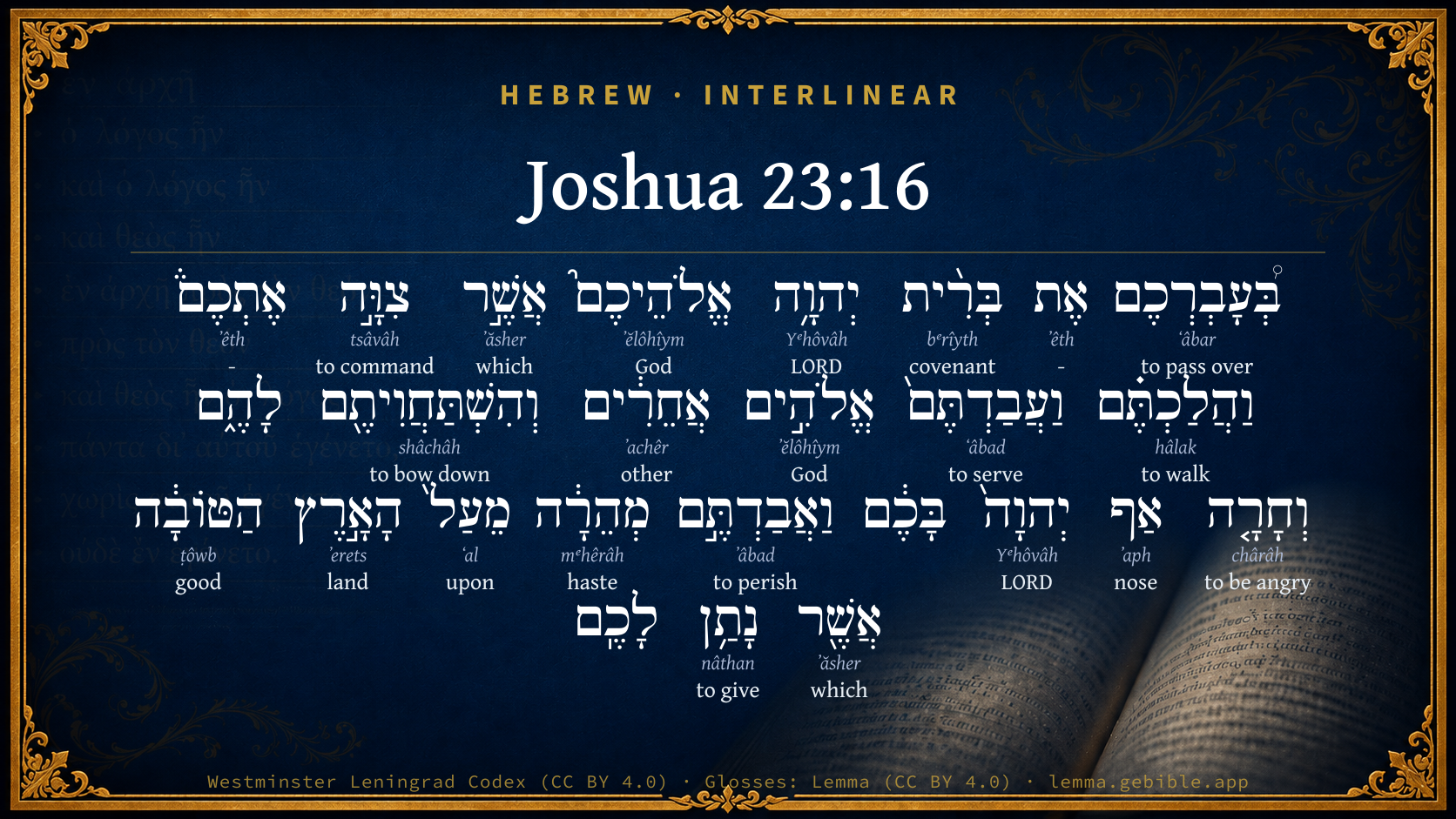
Hebrew (Westminster Leningrad Codex) Joshua 23:16 appears in the Hebrew Old Testament. The text above is from the Westminster Leningrad Codex. Each word links to its Strong’s number, a concise gloss, and parsing drawn from the Open Scriptures Hebrew Bible morphology. Click any word for its full Brown-Driver-Briggs (BDB) entry.
Download image
Cite this verse

Joshua 23:16 (World English Bible). Public Domain. Lemma interlinear Bible study tool, https://lemma.gebible.app/v/joshua/23/16.

Show BibTeX & RIS
BibTeX
RIS
English Translation
When you disobey the covenant of Yahweh your God, which he commanded you, and go and serve other gods, and bow down yourselves to them; then will the anger of Yahweh be kindled against you, and you shall perish quickly from off the good land which he has given to you.
World English Bible · Public Domain
Download a study sheet

One document with this verse’s original text, its word-by-word gloss line, the meaning frame, cross-references with their text, attributed commentary, and full source and license credits — printable, and it pastes into notes with its structure intact.

This verse Autodidact and up

Study sheet (.html) Plain text (.txt)

A passage Seminary Student

Up to 50 verses in one chapter. A passage sheet keeps up to 6 commentary sources and 12 cross-references per verse, in the order this page ranks them, and says so on the sheet whenever that leaves anything out. Ask for a single verse and you get the Autodidact verse sheet above.

Everything on this page stays free to read, with no account — the sheet is a download of what is already on screen, not access to it.

Want to remove ads? Support Godless Engineer
Compare translations 3

The same verse in 3 English versions, stacked beneath the original-language interlinear above. Click any original word for its lexicon entry.

Each is an independent rendering of the whole verse — the interlinear is not word-aligned to these translations.

Highlighted words mark where these versions differ — a whole-verse word diff, not a word-by-word alignment.

  • World English Bible Public Domain
    When you disobey the covenant of Yahweh your God, which he commanded you, and go and serve other gods, and bow down yourselves to them; then will the anger of Yahweh be kindled against you, and you shall perish quickly from off the good land which he has given to you.
  • King James Version Public Domain
    When ye have transgressed the covenant of the LORD your God, which he commanded you, and have gone and served other gods, and bowed yourselves to them; then shall the anger of the LORD be kindled against you, and ye shall perish quickly from off the good land which he hath given unto you.
  • unfoldingWord Literal Text CC BY-SA 4.0
    In your transgressing the covenant of Yahweh your God that he commanded you and you go and serve other gods and bow down to them, then the nose of Yahweh will burn against you, and you will quickly perish from upon the good land that he has given to you.”

unfoldingWord Literal Text — © unfoldingWord, licensed CC BY-SA 4.0. Word-aligned USFM3 via Door43 (git.door43.org/unfoldingWord/en_ult).

Versions to compare (up to 4)

3 of 4 selected

Show all 18 translations

Every available English version of this verse, each an independent rendering of the whole verse.

  • World English Bible Public Domain
    When you disobey the covenant of Yahweh your God, which he commanded you, and go and serve other gods, and bow down yourselves to them; then will the anger of Yahweh be kindled against you, and you shall perish quickly from off the good land which he has given to you.
  • Berean Standard Bible Public Domain
    If you transgress the covenant of the LORD your God, which He commanded you, and go and serve other gods and bow down to them, then the anger of the LORD will burn against you, and you will quickly perish from this good land He has given you.”
  • Majority Standard Bible Public Domain
    If you transgress the covenant of the LORD your God, which He commanded you, and go and serve other gods and bow down to them, then the anger of the LORD will burn against you, and you will quickly perish from this good land He has given you.”
  • King James Version Public Domain
    When ye have transgressed the covenant of the LORD your God, which he commanded you, and have gone and served other gods, and bowed yourselves to them; then shall the anger of the LORD be kindled against you, and ye shall perish quickly from off the good land which he hath given unto you.
  • American Standard Version (1901) Public Domain
    When ye transgress the covenant of Jehovah your God, which he commanded you, and go and serve other gods, and bow down yourselves to them; then will the anger of Jehovah be kindled against you, and ye shall perish quickly from off the good land which he hath given unto you.
  • Revised Version (1885) Public Domain
    When ye transgress the covenant of the LORD your God, which he commanded you, and go and serve other gods, and bow down yourselves to them; then shall the anger of the LORD be kindled against you, and ye shall perish quickly from off the good land which he hath given unto you.
  • Geneva Bible (1599) Public Domain
    When ye shall transgresse the couenant of the Lord your God, which he commanded you, and shall goe and serue other gods, and bowe your selues to them, then shall the wrath of the Lord waxe hote against you, and ye shall perish quickely out of the good lande which he hath giuen you.
  • Douay-Rheims (1899) Public Domain
    When you shall have transgressed the covenant of the Lord your God, which he hath made with you, and shall have served strange gods, and adored them: then shall the indignation of the Lord rise up quickly and speedily against you, and you shall be taken away from this excellent land, which he hath delivered to you.
  • Young's Literal Translation Public Domain
    in your transgressing the covenant of Jehovah your God which He commanded you, and ye have gone and served other gods, and bowed yourselves to them, then hath the anger of Jehovah burned against you, and ye have perished hastily from off the good land which He hath given to you.'
  • Literal Standard Version CC BY-SA 4.0
    in your transgressing the covenant of your God YHWH which He commanded you, and you have gone and served other gods, and bowed yourselves to them, then the anger of YHWH has burned against you, and you have perished quickly from off the good land which He has given to you.”
  • Unlocked Literal Bible CC BY-SA 4.0
    He will do this if you break the covenant of Yahweh your God, which he commanded you to keep. If you go and worship other gods and bow down to them, then the anger of Yahweh will be kindled against you, and you will quickly perish from the good land that he has given you.”
  • unfoldingWord Literal Text CC BY-SA 4.0
    In your transgressing the covenant of Yahweh your God that he commanded you and you go and serve other gods and bow down to them, then the nose of Yahweh will burn against you, and you will quickly perish from upon the good land that he has given to you.”
  • Darby Bible Public Domain
    when ye transgress the covenant of Jehovah your God which he commanded you, and go and serve other gods, and bow yourselves unto them, so that the anger of Jehovah shall be kindled against you, and ye shall perish quickly from off the good land which he hath given unto you.
  • World Messianic Bible Public Domain
    when you disobey the covenant of the LORD your God, which he commanded you, and go and serve other gods, and bow down yourselves to them. Then the LORD’s anger will be kindled against you, and you will perish quickly from off the good land which he has given to you.”
  • Webster's Bible Public Domain
    When ye have transgressed the covenant of the LORD your God, which he commanded you, and have gone and served other gods, and bowed yourselves to them; then shall the anger of the LORD be kindled against you, and ye shall perish quickly from off the good land which he hath given to you.
  • Free Bible Version CC BY-SA 4.0
    If you break the agreement the Lord your God made with you, and you go and worship other gods, bowing down before them, then the Lord will become angry with you, and you will be quickly wiped out from the good land he has given you.”
  • Bible in Basic English Public Domain
    If the agreement of the Lord your God, which was given to you by his orders, is broken, and you become the servants of other gods and give them worship, then the wrath of the Lord will be burning against you, and you will quickly be cut off from the good land which he has given you.
  • JPS Tanakh (1917) Public Domain
    When ye transgress the covenant of the LORD your God, which He commanded you, and go and serve other gods, and worship them; then shall the anger of the LORD be kindled against you, and ye shall perish quickly from off the good land which He hath given unto you.'

Literal Standard Version (2020), Covenant Press — licensed CC BY-SA 4.0. Text via the HelloAO Bible API (eBible.org). Unlocked Literal Bible (unfoldingWord) — licensed CC BY-SA 4.0. Text via the HelloAO Bible API (eBible.org). unfoldingWord Literal Text — © unfoldingWord, licensed CC BY-SA 4.0. Word-aligned USFM3 via Door43 (git.door43.org/unfoldingWord/en_ult). Free Bible Version, Dr. Jonathan Gallagher — licensed CC BY-SA 4.0. Text via the HelloAO Bible API (eBible.org).

Word by word

More ways to search: Search by grammar → Find every occurrence → Compare this word →

Practice this passage: Drill this verse → Learn its vocabulary →

מְהֵרָ֔ה
mᵉhêrâh
H4120
“haste”
Noun, Common, Feminine, Singular, Absolute
Part of Speech
Noun
Type
Common
Gender
Feminine
Number
Singular
State
Absolute
Full BDB Definition

Origin: from H4118

TWOT: 1152d

haste, speed - hastily, speedily (as adverb) - in haste (with preposition)
  1. בְּ֠עָבְרְכֶם ʻâbar H5674 “in/at · to pass over · you” Preposition + Verb, Qal, Infinitive Construct + Suffix, Personal, 2nd Person, Masculine, Plural
  2. אֶת ʼêth H853 “-” Particle, Direct Object
  3. בְּרִ֨ית bᵉrîyth H1285 “covenant of” Noun, Common, Feminine, Singular, Construct
  4. יְהוָ֥ה Yᵉhôvâh H3068 “LORD” Noun, Proper
  5. אֱלֹהֵיכֶם֮ ʼĕlôhîym H430 “God(s) · your” Noun, Common, Masculine, Plural, Construct + Suffix, Personal, 2nd Person, Masculine, Plural
  6. אֲשֶׁ֣ר ʼăsher H834 “which” Particle, Relative
  7. צִוָּ֣ה tsâvâh H6680 “to command” Verb, Piel, Perfect, 3rd Person, Masculine, Singular
  8. אֶתְכֶם֒ ʼêth H853 “- · you” Particle, Direct Object + Suffix, Personal, 2nd Person, Masculine, Plural
  9. וַהֲלַכְתֶּ֗ם hâlak H1980 “and · to walk” Conjunction + Verb, Qal, Sequential Perfect, 2nd Person, Masculine, Plural
  10. וַעֲבַדְתֶּם֙ ʻâbad H5647 “and · to serve” Conjunction + Verb, Qal, Sequential Perfect, 2nd Person, Masculine, Plural
  11. אֱלֹהִ֣ים ʼĕlôhîym H430 “God(s)” Noun, Common, Masculine, Plural, Absolute
  12. אֲחֵרִ֔ים ʼachêr H312 “other” Adjective, Adjective, Masculine, Plural, Absolute
  13. וְהִשְׁתַּחֲוִיתֶ֖ם shâchâh H7812 “and · to bow down” Conjunction + Verb, Hishtaphel, Sequential Perfect, 2nd Person, Masculine, Plural
  14. וְחָרָ֤ה chârâh H2734 “and · to be angry” Conjunction + Verb, Qal, Sequential Perfect, 3rd Person, Masculine, Singular
  15. אַף ʼaph H639 “nose” Particle, Accusative
  16. יְהוָה֙ Yᵉhôvâh H3068 “LORD” Noun, Proper
  17. וַאֲבַדְתֶּ֣ם ʼâbad H6 “and · to perish” Conjunction + Verb, Qal, Sequential Perfect, 2nd Person, Masculine, Plural
  18. מֵעַל֙ ʻal H5921 “from · upon” Preposition + Preposition
  19. הָאָ֣רֶץ ʼerets H776 “the · land” Particle, Definite Article + Noun, Common, Both, Singular, Absolute
  20. הַטּוֹבָ֔ה ṭôwb H2896 “the · good” Particle, Definite Article + Adjective, Adjective, Feminine, Singular, Absolute
  21. אֲשֶׁ֖ר ʼăsher H834 “which” Particle, Relative
  22. נָתַ֥ן nâthan H5414 “to give” Verb, Qal, Perfect, 3rd Person, Masculine, Singular

About this verse

These counts appear in no published source. They are computed here, from the morphology-tagged text and Lemma’s own curated glosses. What Lemma adds →

26
words
19
distinct lemmas
Historical
section

Notable vocabulary

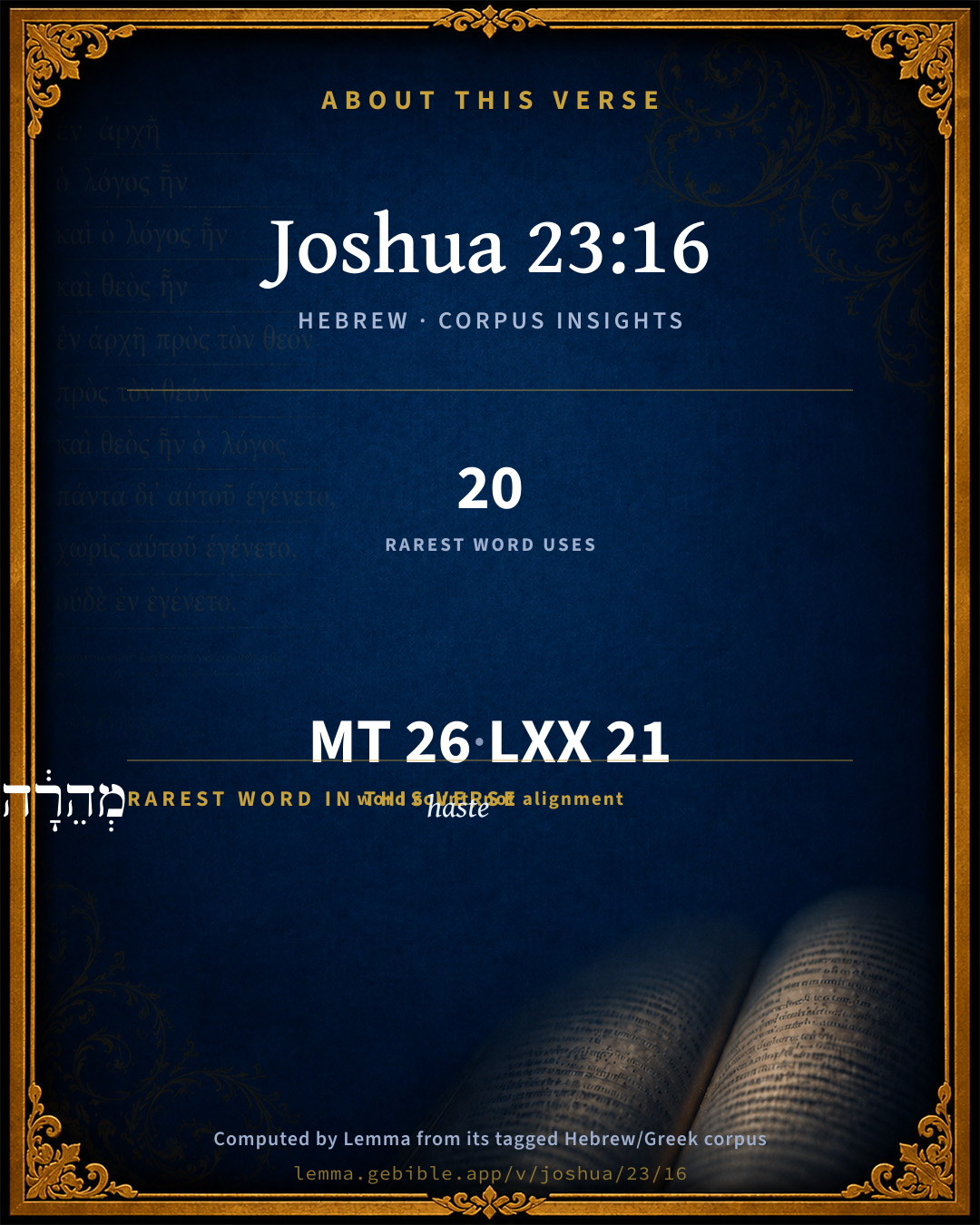
The rarest word here is מְהֵרָ֔ה haste H4120 — appearing just 20 times in the whole Hebrew Bible.

Shared distinctive vocabulary

מְהֵרָ֔ה haste H4120 occurs in 20 verses of the Hebrew Bible. Also found in:

Grammatical profile

  • 8 verbs
  • 7 nouns
  • 2 adjectives
  • 4 prepositions
  • 5 particles

Verb forms

  • בְּ֠עָבְרְכֶם Qal · Infinitive Construct
  • צִוָּ֣ה Piel · Perfect
  • וַהֲלַכְתֶּ֗ם Qal · Sequential Perfect
  • וַעֲבַדְתֶּם֙ Qal · Sequential Perfect
  • וְהִשְׁתַּחֲוִיתֶ֖ם Hishtaphel · Sequential Perfect
  • וְחָרָ֤ה Qal · Sequential Perfect
  • וַאֲבַדְתֶּ֣ם Qal · Sequential Perfect
  • נָתַ֥ן Qal · Perfect

Repetition

Words recur within this verse — often emphatic in Hebrew:

  • יְהוָ֥ה LORD H3068 ×2
  • אֱלֹהֵיכֶם֮ God H430 ×2
  • אֲשֶׁ֣ר which H834 ×2

Hebrew & Septuagint length

In English translation the verse runs 51 words from the Hebrew and 26 from the Septuagint (LXX English) — the Septuagint runs noticeably shorter here. See the side-by-side →

A rough comparison of the two English renderings, which tokenize alike — not a word-level alignment.

Word counts can differ between the Hebrew and the Greek without any difference in meaning — e.g. the Hebrew direct-object marker אֵת has no separate Greek word, and Greek often adds the article ὁ.

In the original languages it is 26 Hebrew tokens and 21 Greek tokens — but the two are counted differently (Hebrew bundles its prefixes and suffixes into one token; the Greek is in lemma form), so that isn’t a like-for-like length.

Cross-references

2

Topical passages linked to Joshua 23:16 in the Treasury of Scripture Knowledge — connected by theme and wording, ordered by reader-vote popularity; previews shown in the World English Bible.

  • Deuteronomy 4:25–26 When you shall father children, and children's children, and you shall have been long in the land, and shall corrupt yourselves, and make an engraved image in the form of anything, and shall do that which is evil in the sight of Yahweh your God, to provoke him to anger;
  • 2 Kings 24:20 For through the anger of Yahweh did it happen in Jerusalem and Judah, until he had cast them out from his presence. Zedekiah rebelled against the king of Babylon.

Cross-references courtesy of OpenBible.info (CC BY 4.0).

Hebrew and Greek witnesses Masoretic Hebrew ↔ Greek Septuagint

The same verse in the two great witnesses to the Old Testament, shown verse-for-verse.

Here the Septuagint runs noticeably shorter than the Hebrew — LXX2012 (modern English Septuagint) 26 words vs World English Bible 51. A rough length comparison of the two English translations, not a word-level alignment — read both below.

These are two independent witnesses, not word-aligned to each other, and the Septuagint is shown in lemma (dictionary) form.

Hebrew Joshua 23:16 Masoretic · Westminster Leningrad Codex

בְּ֠עָבְרְכֶם אֶת בְּרִ֨ית יְהוָ֥ה אֱלֹהֵיכֶם֮ אֲשֶׁ֣ר צִוָּ֣ה אֶתְכֶם֒ וַהֲלַכְתֶּ֗ם וַעֲבַדְתֶּם֙ אֱלֹהִ֣ים אֲחֵרִ֔ים וְהִשְׁתַּחֲוִיתֶ֖ם לָהֶ֑ם וְחָרָ֤ה אַף יְהוָה֙ בָּכֶ֔ם וַאֲבַדְתֶּ֣ם מְהֵרָ֔ה מֵעַל֙ הָאָ֣רֶץ הַטּוֹבָ֔ה אֲשֶׁ֖ר נָתַ֥ן לָכֶֽם

When you disobey the covenant of Yahweh your God, which he commanded you, and go and serve other gods, and bow down yourselves to them; then will the anger of Yahweh be kindled against you, and you shall perish quickly from off the good land which he has given to you.

World English Bible · Public Domain

Greek LXX Joshua 23:16 Septuagint · lemma form

ἐν ὁ παραβαίνω σύ ὁ διαθήκη κύριος ὁ θεός σύ ὅς ἐντέλλομαι σύ καί πορεύομαι λατρεύω θεός ἕτερος καί προςκυνέω αὐτός

when you⌃ transgress the covenant of the Lord our God, which he has charged us, and go and serve other gods, and bow down to them.

LXX2012 (modern English Septuagint) · Public Domain

Hebrew: Westminster Leningrad Codex (CC BY 4.0). Greek: Septuagint (public domain); English from LXX2012 (modern English Septuagint) (Public Domain). How the Septuagint differs from the Hebrew →

Targum (Aramaic paraphrase)

1

The Targum is the ancient Jewish Aramaic paraphrase of the Hebrew Scriptures — an interpretive translation, not the Hebrew text itself. Onkelos (literal) and Pseudo-Jonathan (expansive) render the Torah, and Jonathan the Prophets. Coverage is partial: where no permissively-licensed English translation exists for a verse, only the Aramaic is shown. This is verse-level text, not a word-by-word alignment to the Hebrew.

  1. Targum Jonathan Prophets (Joshua–Malachi)
    בְּמֶעְבַּרְכוֹן יַת קְיָמָא דַייָ אֱלָהָכוֹן דְפַקֵד יַתְכוֹן וְתַהֲכוּן וְתִפְלְחוּן לְטַעֲוַת עַמְמַיָא וְתִסְגְדוּן לְהוֹן וְיִתְקֵיף רוּגְזָא דַייָ בְּכוֹן וְתֵיבְדוּן בִּפְרִיעַ מֵעַל אַרְעָא טַבְתָא דִיהַב לְכוֹן:

    (no public-domain English translation for this verse)

    Targum Jonathan — Aramaic: “Mikraot Gedolot” (public domain). English: “Sefaria Community Translation” (CC0 1.0 (public-domain dedication)); “London "Chaldee Paraphrase," 1871” (public domain). Text via Sefaria.

Commentary

Notes on Joshua 23:16 from classic Christian and Jewish commentators (each source and its license shown beneath its notes). The classic Christian expositions comment on the surrounding passage and are grouped to its opening verse, so a note may address several verses; the Jewish commentaries on the Tanakh (Rashi and others) are per-verse, so they appear only where the commentator wrote on this verse.

Lemma curates 59 commentaries, every one of them public domain or Creative Commons licensed, each selected and text-cleaned for this edition rather than reprinted as found. About our sources →

Trapp's Complete Commentary

John Trapp

Jos 23:16 When ye have transgressed the covenant of the LORD your God, which he commanded you, and have gone and served other gods, and bowed yourselves to them; then shall the anger of the LORD be kindled against you, and ye shall perish quickly from off the good land which he hath given unto you.

Ver. 16. And ye shall perish quickly from off the good land.] This judgment Joshua inculcateth, {Jos 23:13-16} because he knew it would be very grievous to them to forego so goodly a land so lately gotten, and so little a while enjoyed. In the beginning of a speech τα ηθη milder affections suit best; but toward the end thereof τα παθη, saith the orator, passionate and piercing passages. This rule Joshua here observeth, being ex utroque Caesar, no less an orator than a warrior, as hath been already observed.

John Trapp, A Commentary or Exposition upon All the Books of the Old and New Testament (1647–1656) — public domain. Text from a community e-Sword module.

Joseph Benson's Commentary

Jos 23:16. Ye shall perish quickly from off the good land — It would aggravate their misery in their destruction, that the land from which they perished was a good land, and a land which God himself had given them: and which therefore he would have secured to them, if they had not thrown themselves out of it. “Thus the goodness of the heavenly Canaan,” says Mr. Henry, “and the free and sure grant God has made of it, will aggravate the misery of those who shall for ever be shut out and perish from it. Nothing will make them see how wretched they are, so much so as to see how happy they might have been.”

Joseph Benson's Commentary on the Old and New Testaments (1811–1818) — public domain. Text from a community e-Sword module.

Geneva Bible (1599)

Geneva Bible translators

He showeth that no evil can come unto man, except he offend God by disobedience.

Geneva Bible (1599) marginal notes — public domain. Text via Bolls.life.

Adam Clarke's Commentary

Verse 16. Ye shall perish quickly from off the good land] The following note from Mr. John Trapp is very judicious: "This judgment Joshua inculcates Jos 23:13; Jos 23:15, and here, because he knew it would be a very grievous thing to them to forego so goodly a land, so lately gotten, and so short a while enjoyed. In the beginning of a speech ταηθη, the milder affections, suit best; but towards the end ταπαθη, passionate and piercing passages; according to the orator. This rule Joshua observes, being Ex utroque Caesar; no less an orator than a warrior."

In all this exhortation we see how closely Joshua copies the example of his great master Moses. See Le 26:7-8; Le 26:14, c. De 28:7; De 32:30. He was tenderly concerned for the welfare of the people, and with a deeply affected heart he spoke to their hearts. No people ever were more fairly and fully warned, and no people profited less by it. The threatenings pronounced here were accomplished in the Babylonish captivity, but more fully in their general dispersion since the crucifixion of our Lord. And should not every Christian fear when he reads, If God spared not the natural branches, take heed that he spare not thee? Surely a worldly, carnal, and godless Christian has no more reason to expect indulgence from the justice of God than a profligate Jew. We have a goodly land, but the justice of God can decree a captivity from it, or a state of bondage in it. The privileges that are abused are thereby forfeited. And this is as applicable to the individual as to the whole system.

Adam Clarke's Commentary on the Bible (1810–1826) — public domain. Text from a community e-Sword/MySword module.

Ellicott's Commentary for English Readers

(16) The resemblance between this verse and an exhortation in Deuteronomy should be noticed, Jos_11:16-17, “Take heed to yourselves, lest . . . ye turn aside and serve other gods and worship them; and then the Lord’s wrath be kindled against you . . . and ye perish quickly from off the good land which the Lord giveth you.”

A Bible Commentary for English Readers, edited by Charles John Ellicott (1878–1897) — public domain. Text from a community e-Sword module.

The Cambridge Bible for Schools and Colleges

gen. ed. J. J. S. Perowne

16. ye shall perish] The latter part of this 16th verse occurs word for word in Deu_11:17.

The Cambridge Bible for Schools and Colleges (gen. ed. J. J. S. Perowne; Cambridge University Press, 1878–1918) — public domain. Text from a community e-Sword module.

John Gill's Exposition

When ye have transgressed the covenant of the Lord your God,

which he commanded you,.... The law, so called, and the several precepts of it, particularly those which relate to the faith and worship of the one only true God; see Exo 24:7;

and have gone and served other gods, and have bowed down yourselves unto them; been guilty of idolatry, of having and worshipping other gods, which are no gods, with or besides the God of Israel, see Jos 23:7,

then shall the anger of the Lord be kindled against you; nothing being more provoking to him than idolatry, he being a jealous God of his honour and worship:

and ye shall perish quickly from off the good land which he hath given unto you; as they did at the time of the Babylonish captivity, and at the last destruction of Jerusalem by the Romans.

Next: Joshua Chapter 24

John Gill's Exposition of the Whole Bible (1746–1763) — public domain (CC PDM 1.0). Text via the HelloAO Bible API.

Haydock's Catholic Bible Commentary

And speedily. This word is added to express the force of the Hebrew term. (Menochius) --- "Punishment is seldom lame in overtaking the wicked. (Haydock) --- This. He emphatically sets before them what labours they had sustained in making the acquisition, and what ingratitude they will be guilty of, if they ever forfeit so great a blessing. (Menochius) --- The treat or prediction was verified during the captivity, and still more after the destruction of Jerusalem. (Calmet)

George Leo Haydock (1774–1849), Haydock's Catholic Family Bible and Commentary, 1859 edition — public domain. Excludes Psalms (Douay-Rheims chapter numbering differs from Protestant) and Deuterocanonical books (Catholic canon only).

The Pulpit Commentary

Transgressed. The English is the precise equivalent of the Hebrew, which signifies to "pass over," with the idea of going beyond bounds which had previously been prescribed in the covenant between God and His people. Other gods. See ver. 7. Here again we have the usual repetition for the sake of emphasis. Ye shall perish quickly. A verbally accurate quotation of Deu_11:17. The original is even more emphaticwith haste.

The Pulpit Commentary (1880–1919), ed. H.D.M. Spence-Jones & Joseph S. Exell — public domain. Text from a community e-Sword module.

John Wesley's Explanatory Notes

It will aggravate their perdition, that the land from which they shall perish is a good land, and a land which God himself had given them: and which therefore he would have secured to them, if they had not thrown themselves out of it. "Thus the goodness of the heavenly Canaan, says Mr. Henry, and the free and sure grant God has made of it, will aggravate the misery of those that shall forever be shut out and perish from it. Nothing will make them see how wretched they are, so much as to see, how happy they might have been." Might have been! What on the supposition of absolute decrees? How happy might a person not elected have been? And if he was elected, how could he be wretched for ever? What art of man can reconcile these things? Again, shall any of the elect perish forever? or has God made to any others, a free and sure grant of the heavenly Canaan? If not, how can the misery of those that perish be aggravated, by a free and sure grant which they never had any share in?

John Wesley, Explanatory Notes Upon the Whole Bible (1754–1765) — public domain. Text via the GEBible commentary corpus.

unfoldingWord translationNotes

Door43 World Missions Community

He will do this

This refers to the punishment threatened in the previous verse.

worship other gods and bow down to them

These two phrases mean basically the same thing. The second describes how the people "worship other gods." (See: Parallelism)

the anger of Yahweh will be kindled against you

"Kindled" here is a metaphor for the beginning of Yahweh's anger, like a fire is "kindled" or started with "kindling" or very easy to start burning like dried grass or small twigs. AT: "Yahweh will begin to be angry with you" (See: Metaphor)

translationWords

covenant

worship

anger

unfoldingWord translationNotes — © Distant Shores Media and the Door43 World Missions Community, licensed CC BY-SA 4.0. Source: git.door43.org/Door43/en_tn.

Lesson kit

Teaching starters — assembled from the data on this page, not authored interpretation. Every prompt links to the verse data it draws on. Edit before teaching.

Joshua, in the Historical, opens this verse with 26 words (19 distinct Hebrew lemmas). Its most distinctive word is mᵉhêrâh (“haste”). The Greek Septuagint runs shorter here. A historical commentator’s framing appears above. Read the whole chapter for the surrounding context.

Discussion questions

  1. The word mᵉhêrâh carries the sense “haste.” How does it shape the verse?
  2. Numbers 16:46 shares the word «haste» with this verse. How do the two illuminate each other?
  3. “LORD” occurs 2× in this one verse. What is the effect of the repetition?
  4. Compared with the Hebrew, the Septuagint runs shorter here. What questions does that raise?
  5. The translations on this page render this verse differently — a whole-verse word diff, not a word-by-word alignment. What might account for the different wordings?
  6. The verb «בְּ֠עָבְרְכֶם» is Qal Infinitive Construct. How does its form color the action?
  7. Reading how Trapp's Complete Commentary and Joseph Benson's Commentary read this verse, where do the two commentators agree and where do they part?

Things to notice

Reading settings

Reading text

Shown beneath each verse's original-language words.

Old Testament
Old Testament edition

Read the OT as the Masoretic Hebrew (MT) or the Greek Septuagint (LXX).

English shown for the Greek Septuagint (in the Hebrew ↔ Greek comparison).

Comparing translations? Open the Compare panel on any verse page to stack up to four side by side.