
Ezra 9:11

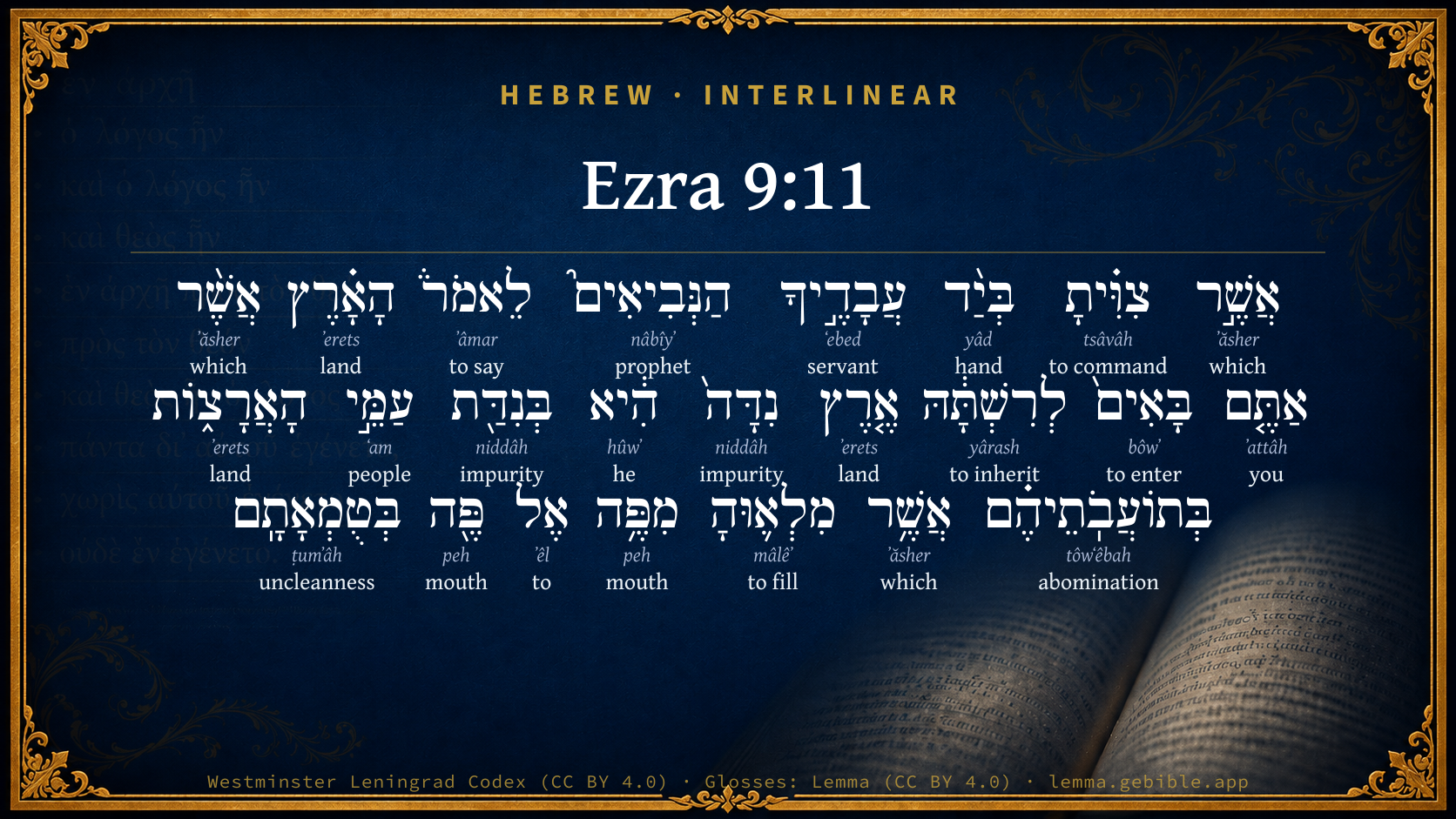
Hebrew (Westminster Leningrad Codex) Ezra 9:11 appears in the Hebrew Old Testament. The text above is from the Westminster Leningrad Codex. Each word links to its Strong’s number, a concise gloss, and parsing drawn from the Open Scriptures Hebrew Bible morphology. Click any word for its full Brown-Driver-Briggs (BDB) entry.
Download image
Cite this verse

Ezra 9:11 (World English Bible). Public Domain. Lemma interlinear Bible study tool, https://lemma.gebible.app/v/ezra/9/11.

Show BibTeX & RIS
BibTeX
RIS
English Translation
which you have commanded by your servants the prophets, saying, The land, to which you go to possess it, is an unclean land through the uncleanness of the peoples of the lands, through their abominations, which have filled it from one end to another with their filthiness:
World English Bible · Public Domain
Download a study sheet

One document with this verse’s original text, its word-by-word gloss line, the meaning frame, cross-references with their text, attributed commentary, and full source and license credits — printable, and it pastes into notes with its structure intact.

This verse Autodidact and up

Study sheet (.html) Plain text (.txt)

A passage Seminary Student

Up to 50 verses in one chapter. A passage sheet keeps up to 6 commentary sources and 12 cross-references per verse, in the order this page ranks them, and says so on the sheet whenever that leaves anything out. Ask for a single verse and you get the Autodidact verse sheet above.

Everything on this page stays free to read, with no account — the sheet is a download of what is already on screen, not access to it.

Want to remove ads? Support Godless Engineer
Compare translations 3

The same verse in 3 English versions, stacked beneath the original-language interlinear above. Click any original word for its lexicon entry.

Each is an independent rendering of the whole verse — the interlinear is not word-aligned to these translations.

Highlighted words mark where these versions differ — a whole-verse word diff, not a word-by-word alignment.

  • World English Bible Public Domain
    which you have commanded by your servants the prophets, saying, The land, to which you go to possess it, is an unclean land through the uncleanness of the peoples of the lands, through their abominations, which have filled it from one end to another with their filthiness:
  • King James Version Public Domain
    Which thou hast commanded by thy servants the prophets, saying, The land, unto which ye go to possess it, is an unclean land with the filthiness of the people of the lands, with their abominations, which have filled it from one end to another with their uncleanness.
  • unfoldingWord Literal Text CC BY-SA 4.0
    which you commanded by the hand of your servants, the prophets, saying, ‘The land that you are entering to possess is a land of impurity by the impurity of the peoples of the lands, by their abominations that have filled it from mouth to mouth with their uncleanness.

unfoldingWord Literal Text — © unfoldingWord, licensed CC BY-SA 4.0. Word-aligned USFM3 via Door43 (git.door43.org/unfoldingWord/en_ult).

Versions to compare (up to 4)

3 of 4 selected

Show all 18 translations

Every available English version of this verse, each an independent rendering of the whole verse.

  • World English Bible Public Domain
    which you have commanded by your servants the prophets, saying, The land, to which you go to possess it, is an unclean land through the uncleanness of the peoples of the lands, through their abominations, which have filled it from one end to another with their filthiness:
  • Berean Standard Bible Public Domain
    that You gave through Your servants the prophets, saying: ‘The land that you are entering to possess is a land polluted by the impurity of its peoples and the abominations with which they have filled it from end to end.
  • Majority Standard Bible Public Domain
    that You gave through Your servants the prophets, saying: ‘The land that you are entering to possess is a land polluted by the impurity of its peoples and the abominations with which they have filled it from end to end.
  • King James Version Public Domain
    Which thou hast commanded by thy servants the prophets, saying, The land, unto which ye go to possess it, is an unclean land with the filthiness of the people of the lands, with their abominations, which have filled it from one end to another with their uncleanness.
  • American Standard Version (1901) Public Domain
    which thou hast commanded by thy servants the prophets, saying, The land, unto which ye go to possess it, is an unclean land through the uncleanness of the peoples of the lands, through their abominations, which have filled it from one end to another with their filthiness:
  • Revised Version (1885) Public Domain
    which thou hast commanded by thy servants the prophets, saying, The land, unto which ye go to possess it, is an unclean land through the uncleanness of the peoples of the lands, through their abominations, which have filled it from one end to another with their filthiness.
  • Geneva Bible (1599) Public Domain
    Which thou hast commanded by thy seruants the Prophets, saying, The land whereunto ye go to possesse it, is an vncleane land, because of the filthines of the people of the lands, which by their abominations, and by their vncleannes haue filled it from corner to corner.
  • Douay-Rheims (1899) Public Domain
    Which thou hast commanded by the hand of thy servants the prophets, saying: The land which you go to possess, is an unclean land, according to the uncleanness of the people, and of other lands, with their abominations, who have filled it from mouth to mouth with their filth.
  • Young's Literal Translation Public Domain
    that Thou hast commanded by the hands of thy servants the prophets, saying, The land into which ye are going to possess it, `is' a land of impurity, by the impurity of the people of the lands, by their abominations with which they have filled it -- from mouth unto mouth -- by their uncleanness;
  • Literal Standard Version CC BY-SA 4.0
    that You have commanded by the hands of Your servants the prophets, saying, The land into which you are going to possess it, [is] a land of impurity, by the impurity of the people of the lands, by their abominations with which they have filled it—from mouth to mouth—by their uncleanness;
  • Unlocked Literal Bible CC BY-SA 4.0
    the commands that you gave to your servants the prophets, when you said, “This land that you are entering to possess is an unclean land. It is contaminated by the people of the lands with their abominations. They have filled it from one end to the other with their uncleanness.
  • unfoldingWord Literal Text CC BY-SA 4.0
    which you commanded by the hand of your servants, the prophets, saying, ‘The land that you are entering to possess is a land of impurity by the impurity of the peoples of the lands, by their abominations that have filled it from mouth to mouth with their uncleanness.
  • Darby Bible Public Domain
    which thou hast commanded by thy servants the prophets, saying, The land, unto which ye go to possess [it], is an unclean land through the filthiness of the peoples of the lands, through their abominations with which they have filled it from one end to another through their uncleanness.
  • World Messianic Bible Public Domain
    which you have commanded by your servants the prophets, saying, ‘The land to which you go to possess is an unclean land through the uncleanness of the peoples of the lands, through their abominations, which have filled it from one end to another with their filthiness.
  • Webster's Bible Public Domain
    Which thou hast commanded by thy servants the prophets, saying, The land, to which ye go to possess it, is an unclean land with the filthiness of the people of the lands, with their abominations, which have filled it from one end to another with their uncleanness.
  • Free Bible Version CC BY-SA 4.0
    that you gave through your servants the prophets, telling us, ‘The land you are entering to become its owners is contaminated by the sins of its peoples, the disgusting religious practices that they have filled it with, from one side to the other.
  • Bible in Basic English Public Domain
    Which you gave to your servants the prophets, saying, The land into which you are going, to take it for a heritage, is an unclean land, because of the evil lives of the peoples of the land and their disgusting ways, which have made the land unclean from end to end.
  • JPS Tanakh (1917) Public Domain
    which Thou hast commanded by Thy servants the prophets, saying: The land, unto which ye go to possess it, is an unclean land through the uncleanness of the peoples of the lands, through their abominations, wherewith they have filled it from one end to another with their filthiness.

Literal Standard Version (2020), Covenant Press — licensed CC BY-SA 4.0. Text via the HelloAO Bible API (eBible.org). Unlocked Literal Bible (unfoldingWord) — licensed CC BY-SA 4.0. Text via the HelloAO Bible API (eBible.org). unfoldingWord Literal Text — © unfoldingWord, licensed CC BY-SA 4.0. Word-aligned USFM3 via Door43 (git.door43.org/unfoldingWord/en_ult). Free Bible Version, Dr. Jonathan Gallagher — licensed CC BY-SA 4.0. Text via the HelloAO Bible API (eBible.org).

Word by word

More ways to search: Search by grammar → Find every occurrence → Compare this word →

Practice this passage: Drill this verse → Learn its vocabulary →

נִדָּה֙
niddâh
H5079
“impurity”
Noun, Common, Feminine, Singular, Absolute
Part of Speech
Noun
Type
Common
Gender
Feminine
Number
Singular
State
Absolute
Full BDB Definition

Origin: from H5074

TWOT: 1302a

impurity, filthiness, menstruous, set apart - impurity - of ceremonial impurity - of menstruation - impure thing (figuratively) - of idolatry, immorality
  1. אֲשֶׁ֣ר ʼăsher H834 “which” Particle, Relative
  2. צִוִּ֗יתָ tsâvâh H6680 “to command” Verb, Piel, Perfect, 2nd Person, Masculine, Singular
  3. בְּיַ֨ד yâd H3027 “in/at · hand of” Preposition + Noun, Common, Both, Singular, Construct
  4. עֲבָדֶ֣יךָ ʻebed H5650 “servants · your” Noun, Common, Masculine, Plural, Construct + Suffix, Personal, 2nd Person, Masculine, Singular
  5. הַנְּבִיאִים֮ nâbîyʼ H5030 “the · prophets” Particle, Definite Article + Noun, Common, Masculine, Plural, Absolute
  6. לֵאמֹר֒ ʼâmar H559 “to say” Preposition + Verb, Qal, Infinitive Construct
  7. הָאָ֗רֶץ ʼerets H776 “the · land” Particle, Definite Article + Noun, Common, Both, Singular, Absolute
  8. אֲשֶׁ֨ר ʼăsher H834 “which” Particle, Relative
  9. אַתֶּ֤ם ʼattâh H859 “you” Pronoun, Personal, 2nd Person, Masculine, Plural
  10. בָּאִים֙ bôwʼ H935 “entering” Verb, Qal, Participle Active, Masculine, Plural, Absolute
  11. לְרִשְׁתָּ֔הּ yârash H3423 “to inherit · her” Preposition + Verb, Qal, Infinitive Construct + Suffix, Personal, 3rd Person, Feminine, Singular
  12. אֶ֤רֶץ ʼerets H776 “land of” Noun, Common, Both, Singular, Construct
  13. הִ֔יא hûwʼ H1931 “he” Pronoun, Personal, 3rd Person, Feminine, Singular
  14. בְּנִדַּ֖ת niddâh H5079 “in/at · impurity of” Preposition + Noun, Common, Feminine, Singular, Construct
  15. עַמֵּ֣י ʻam H5971 “peoples of” Noun, Common, Masculine, Plural, Construct
  16. הָאֲרָצ֑וֹת ʼerets H776 “the · lands” Particle, Definite Article + Noun, Common, Both, Plural, Absolute
  17. בְּתוֹעֲבֹֽתֵיהֶ֗ם tôwʻêbah H8441 “in/at · abominations · their” Preposition + Noun, Common, Feminine, Plural, Construct + Suffix, Personal, 3rd Person, Masculine, Plural
  18. אֲשֶׁ֥ר ʼăsher H834 “which” Particle, Relative
  19. מִלְא֛וּהָ mâlêʼ H4390 “to fill · her” Verb, Piel, Perfect, 3rd Person, Common, Plural + Suffix, Personal, 3rd Person, Feminine, Singular
  20. מִפֶּ֥ה peh H6310 “from · mouth” Preposition + Noun, Common, Masculine, Singular, Absolute
  21. אֶל ʼêl H413 “to” Preposition
  22. פֶּ֖ה peh H6310 “mouth” Noun, Common, Masculine, Singular, Absolute
  23. בְּטֻמְאָתָֽם ṭumʼâh H2932 “in/at · uncleanness · their” Preposition + Noun, Common, Feminine, Singular, Construct + Suffix, Personal, 3rd Person, Masculine, Plural

About this verse

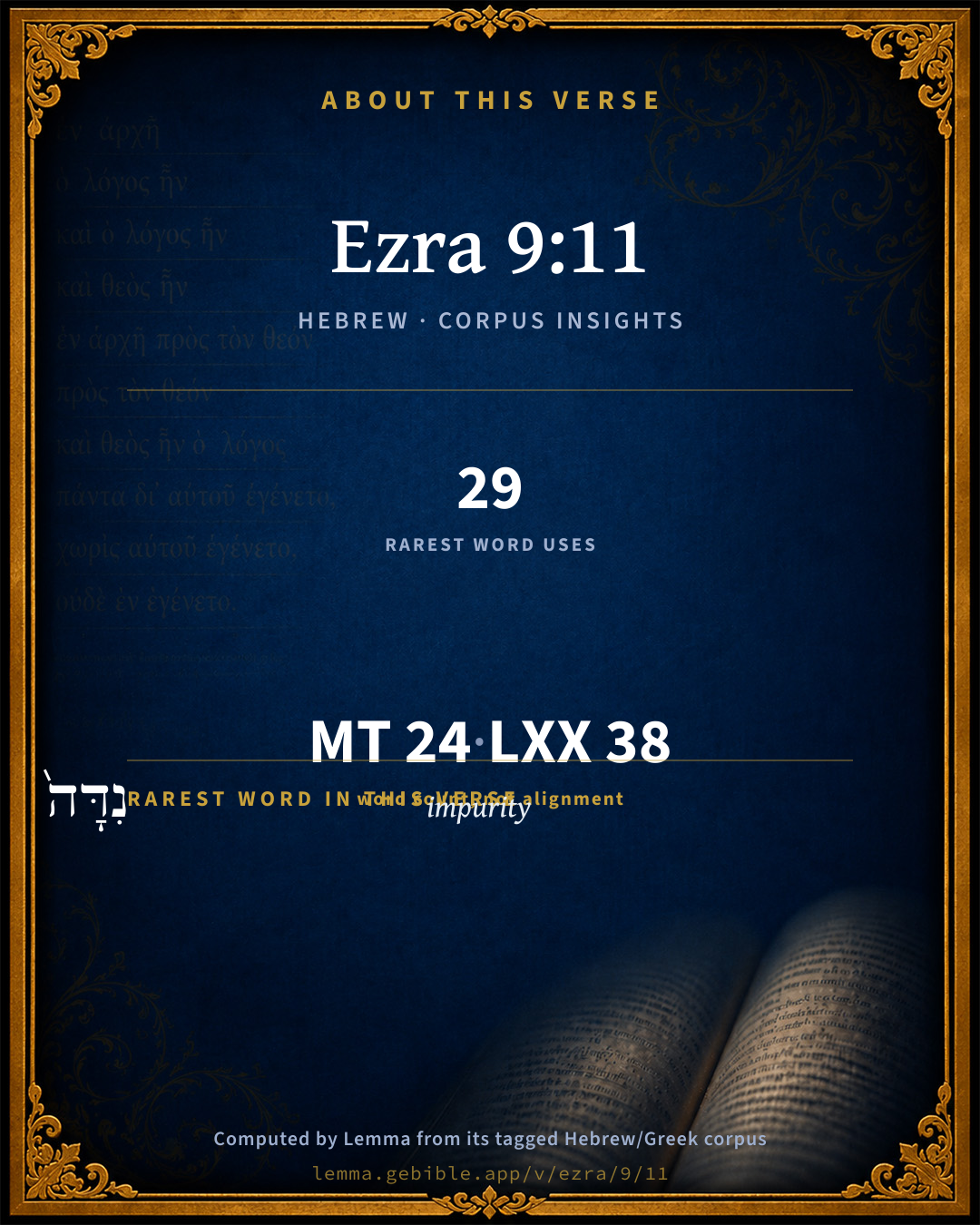
These counts appear in no published source. They are computed here, from the morphology-tagged text and Lemma’s own curated glosses. What Lemma adds →

24
words
18
distinct lemmas
Historical
section

Shared distinctive vocabulary

נִדָּה֙ impurity H5079 occurs in 24 verses of the Hebrew Bible. Also found in:

Grammatical profile

  • 5 verbs
  • 13 nouns
  • 2 pronouns
  • 1 preposition
  • 3 particles

Verb forms

  • צִוִּ֗יתָ Piel · Perfect
  • לֵאמֹר֒ Qal · Infinitive Construct
  • בָּאִים֙ Qal · Participle Active
  • לְרִשְׁתָּ֔הּ Qal · Infinitive Construct
  • מִלְא֛וּהָ Piel · Perfect

Repetition

Words recur within this verse — often emphatic in Hebrew:

  • הָאָ֗רֶץ land H776 ×3
  • נִדָּה֙ impurity H5079 ×2
  • מִפֶּ֥ה mouth H6310 ×2
  • אֲשֶׁ֣ר which H834 ×3

Hebrew & Septuagint length

In English translation the verse runs 47 words from the Hebrew and 55 from the Septuagint (LXX English) — closely comparable.

A rough comparison of the two English renderings, which tokenize alike — not a word-level alignment.

Word counts can differ between the Hebrew and the Greek without any difference in meaning — e.g. the Hebrew direct-object marker אֵת has no separate Greek word, and Greek often adds the article ὁ.

In the original languages it is 24 Hebrew tokens and 38 Greek tokens — but the two are counted differently (Hebrew bundles its prefixes and suffixes into one token; the Greek is in lemma form), so that isn’t a like-for-like length.

Cross-references

8

Topical passages linked to Ezra 9:11 in the Treasury of Scripture Knowledge — connected by theme and wording, ordered by reader-vote popularity; previews shown in the World English Bible.

  • Leviticus 18:24–30 "'Don't defile yourselves in any of these things: for in all these the nations which I am casting out before you were defiled.
  • Ezra 6:21 The children of Israel who had come again out of the captivity, and all such as had separated themselves to them from the filthiness of the nations of the land, to seek Yahweh, the God of Israel, ate,
  • Deuteronomy 12:31 You shall not do so to Yahweh your God: for every abomination to Yahweh, which he hates, have they done to their gods; for even their sons and their daughters do they burn in the fire to their gods.
  • Deuteronomy 18:12 For whoever does these things is an abomination to Yahweh: and because of these abominations Yahweh your God does drive them out from before you.
  • 2 Chronicles 33:2 He did that which was evil in the sight of Yahweh, after the abominations of the nations whom Yahweh cast out before the children of Israel.
  • Ezra 9:1 Now when these things were done, the princes drew near to me, saying, The people of Israel, and the priests and the Levites, have not separated themselves from the peoples of the lands, [doing] according to their abominations, even of the Canaanites, the Hittites, the Perizzites, the Jebusites, the Ammonites, the Moabites, the Egyptians, and the Amorites.
  • Ezekiel 36:25–27 I will sprinkle clean water on you, and you shall be clean: from all your filthiness, and from all your idols, will I cleanse you.
  • 2 Corinthians 7:1 Having therefore these promises, beloved, let us cleanse ourselves from all defilement of flesh and spirit, perfecting holiness in the fear of God.

Cross-references courtesy of OpenBible.info (CC BY 4.0).

Hebrew and Greek witnesses Masoretic Hebrew ↔ Greek Septuagint

The same verse in the two great witnesses to the Old Testament, shown verse-for-verse.

These are two independent witnesses, not word-aligned to each other, and the Septuagint is shown in lemma (dictionary) form.

Hebrew Ezra 9:11 Masoretic · Westminster Leningrad Codex

אֲשֶׁ֣ר צִוִּ֗יתָ בְּיַ֨ד עֲבָדֶ֣יךָ הַנְּבִיאִים֮ לֵאמֹר֒ הָאָ֗רֶץ אֲשֶׁ֨ר אַתֶּ֤ם בָּאִים֙ לְרִשְׁתָּ֔הּ אֶ֤רֶץ נִדָּה֙ הִ֔יא בְּנִדַּ֖ת עַמֵּ֣י הָאֲרָצ֑וֹת בְּתוֹעֲבֹֽתֵיהֶ֗ם אֲשֶׁ֥ר מִלְא֛וּהָ מִפֶּ֥ה אֶל פֶּ֖ה בְּטֻמְאָתָֽם

which you have commanded by your servants the prophets, saying, The land, to which you go to possess it, is an unclean land through the uncleanness of the peoples of the lands, through their abominations, which have filled it from one end to another with their filthiness:

World English Bible · Public Domain

Greek LXX Ezra 9:11 Septuagint · lemma form

ὅς δίδωμι ἐγώ ἐν χείρ δοῦλος σύ ὁ προφήτης λέγω ὁ γῆ εἰς ὅς εἰςπορεύομαι κληρονομέω αὐτός γῆ μετακινέω εἰμί ἐν μετακινέω λαός ὁ ἔθνος ἐν μάκρυμμα αὐτός ὅς πίμπλημι αὐτός ἀπό στόμα ἐπί στόμα ἐν ἀκαθαρσία αὐτός

which you have given us by the hand of your servants the prophets, saying, The land, into which you⌃ go to inherit it, is a land subject to disturbance by the removal of the people of the nations for their abominations, wherewith they have filled it from one end to the other by their uncleanness.

LXX2012 (modern English Septuagint) · Public Domain

In the Septuagint this is one book — Esdras B (2 Esdras): Ezra is chapters 1–10, Nehemiah 11–23.

Hebrew: Westminster Leningrad Codex (CC BY 4.0). Greek: Septuagint (public domain); English from LXX2012 (modern English Septuagint) (Public Domain). How the Septuagint differs from the Hebrew →

Commentary

Notes on Ezra 9:11 from classic Christian and Jewish commentators (each source and its license shown beneath its notes). The classic Christian expositions comment on the surrounding passage and are grouped to its opening verse, so a note may address several verses; the Jewish commentaries on the Tanakh (Rashi and others) are per-verse, so they appear only where the commentator wrote on this verse.

Lemma curates 59 commentaries, every one of them public domain or Creative Commons licensed, each selected and text-cleaned for this edition rather than reprinted as found. About our sources →

Trapp's Complete Commentary

John Trapp

Ezr 9:11 Which thou hast commanded by thy servants the prophets, saying, The land, unto which ye go to possess it, is an unclean land with the filthiness of the people of the lands, with their abominations, which have filled it from one end to another with their uncleanness.

Ver. 11. Which thou hast commanded by thy servants the prophets] Whose office it was to expound the law to us, and to apply it to our consciences. This, although they have done daily and duly, yet we have not been kept within the bounds of obedience, but have flown against the lights (as bats use to do), and sinned presumptuously. Thus he aggravateth their sin by every circumstance. And this is right confession, such as the schoolmen have set forth in this tetrastic.

Sit simplex, humilis confessio, pura, fidelis,

Atque frequens, nuda et discreta, lubens, verecunda,

Integra, cordata, et lachrymabilis, accelerata,

Fortis et accusans, et se punire parata.

Is an unclean land] Because inhabited by an unclean people, who are acted and agitated by an unclean spirit, and do miserably moil themselves in the filthiness of lewdness, which defileth a man worse than any leprosy, than any out-house, Mar 7:23. Mr Aseham (schoolmaster to Queen Elizabeth) did thank God that he was but nine days in Italy, wherein he saw, in that one city of Venice, more uncleanness and licentiousness than in London he ever heard of in nine years.

With the filthiness of the people of the lands] Those Canaanites were very Borborites, shameless sinners before the Lord; who therefore rooted them out, and caused their land, when it could bear them no longer, to spue them out. Sin is filthiness (ρυπαρια) in the abstract. St James calleth it the stinking filth of a pestilent ulcer, and the superfluity or garbage of naughtiness, Jas 1:21. It is no better than the devil’s excrement; it sets his limbs in us, and draws his picture upon us; for malice is the devil’s eye, oppression is his hand, hypocrisy is his cloven foot, &c. Great sins do greatly pollute.

Which have filled it from one end to another] Hath overspread it as a deluge, overrun it, as the Jerusalem artichoke doth the ground wherein it is planted; turned it into the same nature with itself, as copperas, which will turn milk into ink; or leaven, which turneth a very passover into pollution. See Mic 1:5, {See Trapp on "Mic 1:5"}

John Trapp, A Commentary or Exposition upon All the Books of the Old and New Testament (1647–1656) — public domain. Text from a community e-Sword module.

Joseph Benson's Commentary

Ezr 9:11-12. Is an unclean land with the filthiness of the people of the lands — Or, of these lands, which are round about it. This expresses the cause or matter of this uncleanness: the land was not unclean of itself, but only polluted by the filthiness of its inhabitants. Give not your daughters unto their sons, &c., that ye may be strong — Although you may fancy making leagues and marriages with them is the only way to establish you, yet, I assure you, it will weaken and ruin you, and the contrary course will make you strong.

Joseph Benson's Commentary on the Old and New Testaments (1811–1818) — public domain. Text from a community e-Sword module.

Tyndale Open Study Notes

Tyndale Open Resources

9:11-12 Your servants the prophets warned us: God had clearly revealed what he expected from his people (see Deut 7:3-4; Mal 2:10-12) and had promised great blessings if they followed his covenant stipulations (see Lev 26:1-13; Deut 28:1-14; Jer 32:36–33:18; Ezek 37:15-28; Hos 14:1-8).

Tyndale Open Study Notes — © Tyndale Open Resources, licensed CC BY-SA 4.0. Text via the HelloAO Bible API.

Adam Clarke's Commentary

Verse 11. Have filled it from one end to another] The abominations have been like a sweeping mighty torrent, that has increased till it filled the whole land, and carried every thing before it.

Adam Clarke's Commentary on the Bible (1810–1826) — public domain. Text from a community e-Sword/MySword module.

The Cambridge Bible for Schools and Colleges

gen. ed. J. J. S. Perowne

11. The Divine commands which Israel had violated had been conveyed to them expressly by the prophets. The people were without excuse.

commanded by thy servants the prophets] Lit. ‘by the hand of’. To command by ‘the hand of’ occurs often, as in the Heb. of Neh_8:14; Lev_8:36; Num_16:40; Num_36:13; Jdg_3:4, &c.: cf. ‘to speak by the hand of’, 2Ki_17:23; 2Ki_21:10; 2Ki_24:2.

saying] The prophetic word is contained in this and the following verse. There is no passage in the prophets resembling the words here given. It is generally supposed that Ezra is citing from Deu_7:1-3, and that the expression ‘thy servants the prophets’ alludes to Moses. But it must be remembered that ‘the law of Moses’ in these books is always directly referred to, e.g. Ezr_3:2; Ezr_6:18; Ezr_7:6; Neh_8:1; Neh_8:14; Neh_13:1; 2Ch_23:18; 2Ch_25:4; 2Ch_30:16; 2Ch_35:12. It is better then to regard the passage as a perfectly general statement by Ezra of prophetical teaching upon the subject of intermarriage with foreign nations. Such a statement would naturally reecho the Deuteronomic law, and even repeat words and phrases which, by oral as well as by written tradition, would be familiar. We are forcibly reminded how much of the teaching of the prophets has never come down to us. On the other hand it is no less instructive to observe that the prophetical teaching seems naturally to embody itself in a form, which recalls the language of the Deuteronomic legislation, e.g. ‘The land unto which ye go to possess it’, cf. Deu_7:1 ‘Then the Lord thy God shall bring thee into the land whither thou goest to possess it’.

The land … is an unclean land] This expression (lit. land of unclean ness) is not found in the Pentateuch with reference to the promised land.

with the filthiness of the people of the land] R.V. through the uncleanness of the peoples of the lands. The same word ‘uncleanness’ (niddah) is used here as in the phrase an ‘unclean land’. It occurs in 2Ch_29:5 ‘carry forth the filthiness out of the holy place’. Cf. Lam_1:17. It is a strong word to denote anything that would convey defilement.

with their abominations] R.V. through their abominations. Added by way of explanation. On the word see note on Ezr_9:1. The ‘abominations’ are described as acts of impurity because these were the accompaniment of the local worship. Cf. Lev_18:27 ‘All these abominations (Ezr_9:6-15) have the men of the land done … and the land is defiled’.

from one end to another] Lit. ‘from mouth to mouth’. Cf. almost the same expression in 2Ki_10:21; 2Ki_21:16. It means ‘from one extremity to another’; perhaps the metaphor has been taken from a drinking vessel.

with their uncleanness] R.V. with their filthiness. The same word in the Hebrew as that rendered ‘filthiness’ in chap. Ezr_6:21. It denotes ‘impurity’, ‘defilement’ generally. Cf. Zec_13:2 ‘I will cause the prophets and the unclean spirit to pass out of the land’. See, for the special application, the whole passage Lev_18:24-30.

The Cambridge Bible for Schools and Colleges (gen. ed. J. J. S. Perowne; Cambridge University Press, 1878–1918) — public domain. Text from a community e-Sword module.

John Gill's Exposition

Which thou hast commanded by thy servants the prophets,.... Moses, and Joshua, and others, see Deu 7:3

saying, the land, unto which ye go to possess it; meaning the land of Canaan:

is an unclean land with the filthiness of the people of the lands, with their abominations, which have filled it from one end to another with their uncleanness; which is to be understood not of their idolatries only, but of their incestuous marriages, and impure copulations, on which account the Lord spewed out the old inhabitants of it; for which reason the Jews ought to have been careful not to have defiled it again by similar practices; see Lev 18:1.

John Gill's Exposition of the Whole Bible (1746–1763) — public domain (CC PDM 1.0). Text via the HelloAO Bible API.

Albert Barnes' Notes on the Bible

Saying - The words which follow in this verse are not quoted from any previous book of Scripture, but merely give the general sense of numerous passages. Compare the marginal references.

Albert Barnes' Notes on the Bible (1834–1885) — public domain. Text from a community e-Sword/MySword module.

Haydock's Catholic Bible Commentary

Mouth, like a vessel brim-full. (Menochius) --- Protestants, "from one end ot the other." (Haydock)

George Leo Haydock (1774–1849), Haydock's Catholic Family Bible and Commentary, 1859 edition — public domain. Excludes Psalms (Douay-Rheims chapter numbering differs from Protestant) and Deuterocanonical books (Catholic canon only).

Matthew Poole's English Annotations

An unclean land with the filthiness of the people: this notes the cause or matter of this uncleanness. The land was not unclean in itself, but only polluted by the filthiness of its inhabitants.

Of the lands; or, of these lands which are round about it. This land is as corrupt as any of the rest of the heathen nations.

Matthew Poole's English Annotations on the Holy Bible (1683–1685) — public domain. Text from a community e-Sword/MySword module.

Whedon's Commentary on the Bible

Daniel D. Whedon

11. Commanded by thy servants the prophets — Especially by Moses, the great prophet (Deu_18:15) and lawgiver. Comp. with this and the next verse Exo_23:32; Exo_34:12-16; Deu_7:1-3.

Daniel D. Whedon (gen. ed.), Commentary on the Old and New Testaments (1874–1909) — public domain. Text from a community e-Sword module.

The Pulpit Commentary

The land, unto which ye go to possess it, is an unclean land, etc. These exact words do not occur elsewhere; but the "unclean" and corrupt character of the Canaanitish nations is constantly proclaimed in the Law, and was the sole reason why their land was taken from them and given to the Israelites. On the special character of their "filthiness" and "abominations" see Deu_12:2, Deu_12:3; Lev_18:6-27.

The Pulpit Commentary (1880–1919), ed. H.D.M. Spence-Jones & Joseph S. Exell — public domain. Text from a community e-Sword module.

John Wesley's Explanatory Notes

It is unclean - This land is as corrupt as any of the rest of the heathen nations.

John Wesley, Explanatory Notes Upon the Whole Bible (1754–1765) — public domain. Text via the GEBible commentary corpus.

Rashi

Rabbi Shlomo Yitzchaki (Rashi)

unclean Heb. נִדָה, unclean and repulsive.

Rashi on the Tanakh — English translations: “The Judaica Press complete Tanach with Rashi, translated by A. J. Rosenberg” (CC BY 4.0); “Pentateuch with Rashi's commentary by M. Rosenbaum and A.M. Silbermann, 1929-1934” (public domain); “The Metsudah Tanach series, Lakewood, N.J” (CC BY 4.0); and “The Book of Joshua, Metsudah Publications, 1997” (CC BY 4.0). Text via Sefaria.

Lesson kit

Teaching starters — assembled from the data on this page, not authored interpretation. Every prompt links to the verse data it draws on. Edit before teaching.

Ezra, in the Historical, opens this verse with 24 words (18 distinct Hebrew lemmas). Its most distinctive word is niddâh (“impurity”). A historical commentator’s framing appears above. Read the whole chapter for the surrounding context.

Discussion questions

  1. The word niddâh carries the sense “impurity.” How does it shape the verse?
  2. How does Leviticus 12:2, which shares the word «impurity», read alongside this verse?
  3. What does the repetition of “land” (3× in this one verse) do in this verse?
  4. These translations render this verse differently. What is at stake in choosing one wording over another?
  5. «צִוִּ֗יתָ» is a Piel Perfect verb. How does that grammatical form shape the action described?
  6. Compare how Trapp's Complete Commentary and Joseph Benson's Commentary read this verse. Where do they agree or differ?

Things to notice

Reading settings

Reading text

Shown beneath each verse's original-language words.

Old Testament
Old Testament edition

Read the OT as the Masoretic Hebrew (MT) or the Greek Septuagint (LXX).

English shown for the Greek Septuagint (in the Hebrew ↔ Greek comparison).

Comparing translations? Open the Compare panel on any verse page to stack up to four side by side.