
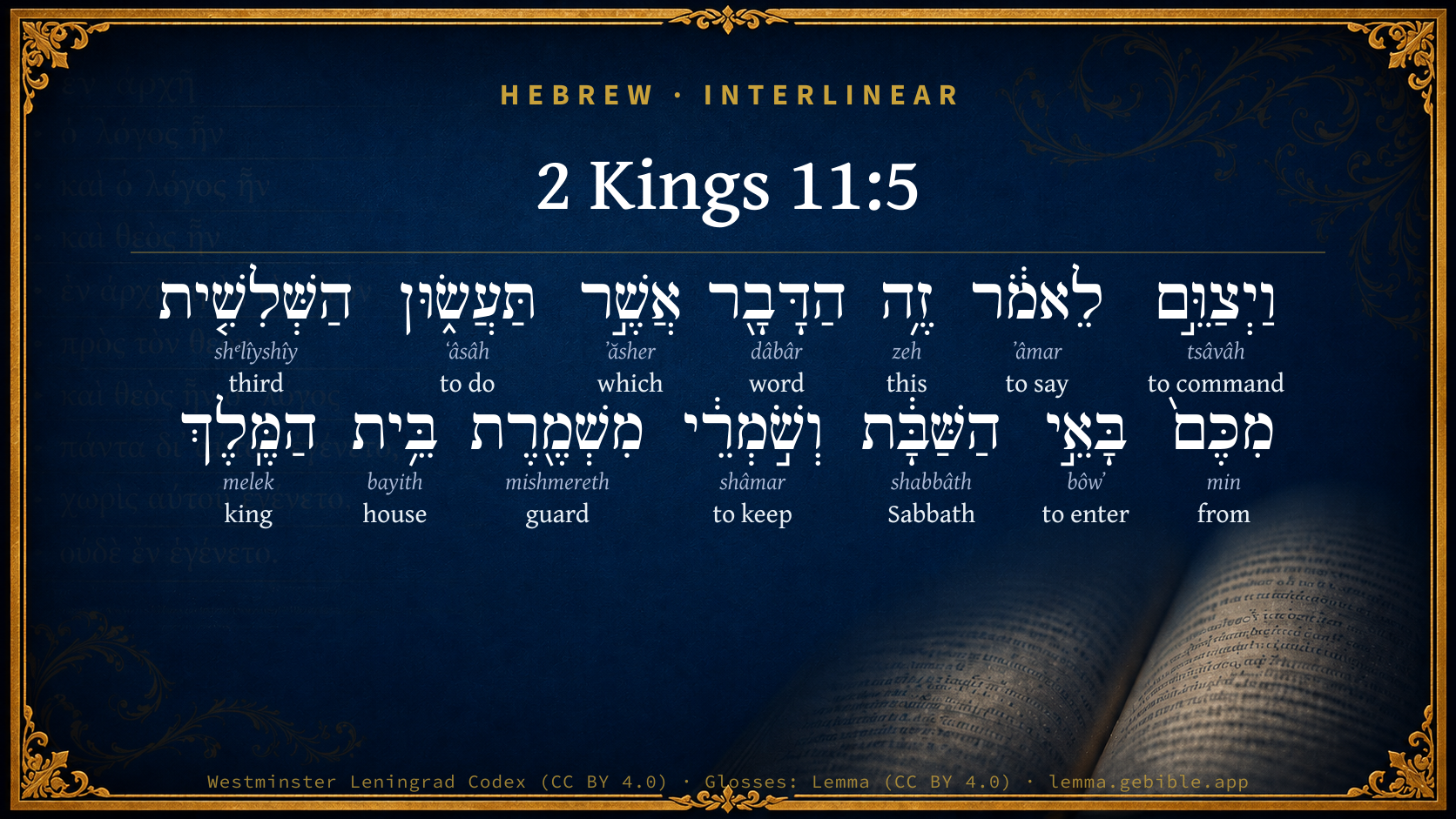
2 Kings 11:5

Hebrew (Westminster Leningrad Codex) 2 Kings 11:5 appears in the Hebrew Old Testament. The text above is from the Westminster Leningrad Codex. Each word links to its Strong’s number, a concise gloss, and parsing drawn from the Open Scriptures Hebrew Bible morphology. Click any word for its full Brown-Driver-Briggs (BDB) entry.
Download image
Cite this verse

2 Kings 11:5 (World English Bible). Public Domain. Lemma interlinear Bible study tool, https://lemma.gebible.app/v/2-kings/11/5.

Show BibTeX & RIS
BibTeX
RIS
English Translation
He commanded them, saying, This is the thing that you shall do: a third part of you, who come in on the Sabbath, shall be keepers of the watch of the king's house;
World English Bible · Public Domain
Download a study sheet

One document with this verse’s original text, its word-by-word gloss line, the meaning frame, cross-references with their text, attributed commentary, and full source and license credits — printable, and it pastes into notes with its structure intact.

This verse Autodidact and up

Study sheet (.html) Plain text (.txt)

A passage Seminary Student

Up to 50 verses in one chapter. A passage sheet keeps up to 6 commentary sources and 12 cross-references per verse, in the order this page ranks them, and says so on the sheet whenever that leaves anything out. Ask for a single verse and you get the Autodidact verse sheet above.

Everything on this page stays free to read, with no account — the sheet is a download of what is already on screen, not access to it.

Want to remove ads? Support Godless Engineer
Compare translations 3

The same verse in 3 English versions, stacked beneath the original-language interlinear above. Click any original word for its lexicon entry.

Each is an independent rendering of the whole verse — the interlinear is not word-aligned to these translations.

Highlighted words mark where these versions differ — a whole-verse word diff, not a word-by-word alignment.

  • World English Bible Public Domain
    He commanded them, saying, This is the thing that you shall do: a third part of you, who come in on the Sabbath, shall be keepers of the watch of the king's house;
  • King James Version Public Domain
    And he commanded them, saying, This is the thing that ye shall do; A third part of you that enter in on the sabbath shall even be keepers of the watch of the king's house;
  • unfoldingWord Literal Text CC BY-SA 4.0
    And he commanded them, saying, “This the thing that you shall do. A third of you coming in on the Sabbath indeed keepers of the keeping of the house of the king,

unfoldingWord Literal Text — © unfoldingWord, licensed CC BY-SA 4.0. Word-aligned USFM3 via Door43 (git.door43.org/unfoldingWord/en_ult).

Versions to compare (up to 4)

3 of 4 selected

Show all 18 translations

Every available English version of this verse, each an independent rendering of the whole verse.

  • World English Bible Public Domain
    He commanded them, saying, This is the thing that you shall do: a third part of you, who come in on the Sabbath, shall be keepers of the watch of the king's house;
  • Berean Standard Bible Public Domain
    and commanded them, “This is what you are to do: A third of you who come on duty on the Sabbath shall guard the royal palace,
  • Majority Standard Bible Public Domain
    and commanded them, “This is what you are to do: A third of you who come on duty on the Sabbath shall guard the royal palace,
  • King James Version Public Domain
    And he commanded them, saying, This is the thing that ye shall do; A third part of you that enter in on the sabbath shall even be keepers of the watch of the king's house;
  • American Standard Version (1901) Public Domain
    And he commanded them, saying, This is the thing that ye shall do: a third part of you, that come in on the sabbath, shall be keepers of the watch of the king's house;
  • Revised Version (1885) Public Domain
    And he commanded them, saying, This is the thing that ye shall do: a third part of you, that come in on the sabbath, shall be keepers of the watch of the king’s house;
  • Geneva Bible (1599) Public Domain
    And he commanded them, saying, This is it that ye must doe, The third part of you, that commeth on the Sabbath, shall warde towarde the Kings house:
  • Douay-Rheims (1899) Public Domain
    And he commanded them, saying: This is the thing that you must do:
  • Young's Literal Translation Public Domain
    and commandeth them, saying, `This `is' the thing that ye do; The third of you `are' going in on the sabbath, and keepers of the charge of the house of the king,
  • Literal Standard Version CC BY-SA 4.0
    and commands them, saying, “This [is] the thing that you do; the third of you [are] going in on the Sabbath, and keepers of the charge of the house of the king,
  • Unlocked Literal Bible CC BY-SA 4.0
    He commanded them, saying, “This is what you must do. A third of you who come on the Sabbath will keep watch over the king's house,
  • unfoldingWord Literal Text CC BY-SA 4.0
    And he commanded them, saying, “This the thing that you shall do. A third of you coming in on the Sabbath indeed keepers of the keeping of the house of the king,
  • Darby Bible Public Domain
    And he commanded them saying, This is the thing which ye shall do: a third part of you, that come in on the sabbath, shall be keepers of the watch of the king's house;
  • World Messianic Bible Public Domain
    He commanded them, saying, “This is what you must do: a third of you, who come in on the Sabbath, shall be keepers of the watch of the king’s house;
  • Webster's Bible Public Domain
    And he commanded them, saying, This is the thing that ye shall do; A third part of you that enter in on the sabbath shall even be keepers of the watch of the king's house;
  • Free Bible Version CC BY-SA 4.0
    and ordered them, “This is what you are going to do: One third of you who come on duty on the Sabbath will guard the royal palace.
  • Bible in Basic English Public Domain
    And he gave them orders, saying, This is what you are to do: the third part of you, who come in on the Sabbath and keep the watch of the king's house,
  • JPS Tanakh (1917) Public Domain
    And he commanded them, saying: 'This is the thing that ye shall do: a third part of you, that come in on the sabbath, and that keep the watch of the king's house —

Literal Standard Version (2020), Covenant Press — licensed CC BY-SA 4.0. Text via the HelloAO Bible API (eBible.org). Unlocked Literal Bible (unfoldingWord) — licensed CC BY-SA 4.0. Text via the HelloAO Bible API (eBible.org). unfoldingWord Literal Text — © unfoldingWord, licensed CC BY-SA 4.0. Word-aligned USFM3 via Door43 (git.door43.org/unfoldingWord/en_ult). Free Bible Version, Dr. Jonathan Gallagher — licensed CC BY-SA 4.0. Text via the HelloAO Bible API (eBible.org).

Word by word

More ways to search: Search by grammar → Find every occurrence → Compare this word →

Practice this passage: Drill this verse → Learn its vocabulary →

מִשְׁמֶ֖רֶת
mishmereth
H4931
“guard of”
Noun, Common, Feminine, Singular, Construct
Part of Speech
Noun
Type
Common
Gender
Feminine
Number
Singular
State
Construct
Full BDB Definition

Origin: from H4929

TWOT: 2414g

guard, charge, function, obligation, service, watch - guard, watch, house of detention or confinement - keeping, preserving - charge, injunction - office, function (ceremonial)
  1. וַיְצַוֵּ֣ם tsâvâh H6680 “and · to command · them” Conjunction + Verb, Piel, Sequential Imperfect, 3rd Person, Masculine, Singular + Suffix, Personal, 3rd Person, Masculine, Plural
  2. לֵאמֹ֔ר ʼâmar H559 “to say” Preposition + Verb, Qal, Infinitive Construct
  3. זֶ֥ה zeh H2088 “this” Pronoun, Demonstrative, Masculine, Singular
  4. הַדָּבָ֖ר dâbâr H1697 “the · word” Particle, Definite Article + Noun, Common, Masculine, Singular, Absolute
  5. אֲשֶׁ֣ר ʼăsher H834 “which” Particle, Relative
  6. תַּעֲשׂ֑וּן ʻâsâh H6213 “to do” Verb, Qal, Imperfect, 2nd Person, Masculine, Plural + Suffix, n
  7. הַשְּׁלִשִׁ֤ית shᵉlîyshîy H7992 “the · third” Particle, Definite Article + Noun, Common, Feminine, Singular, Absolute
  8. מִכֶּם֙ min H4480 “from · you” Preposition + Suffix, Personal, 2nd Person, Masculine, Plural
  9. בָּאֵ֣י bôwʼ H935 “entering” Verb, Qal, Participle Active, Masculine, Plural, Construct
  10. הַשַּׁבָּ֔ת shabbâth H7676 “the · Sabbath” Particle, Definite Article + Noun, Common, Both, Singular, Absolute
  11. וְשֹׁ֣מְרֵ֔י shâmar H8104 “and · keeping” Conjunction + Verb, Qal, Participle Active, Masculine, Plural, Construct
  12. בֵּ֥ית bayith H1004 “house of” Noun, Common, Masculine, Singular, Construct
  13. הַמֶּֽלֶךְ melek H4428 “the · king” Particle, Definite Article + Noun, Common, Masculine, Singular, Absolute

About this verse

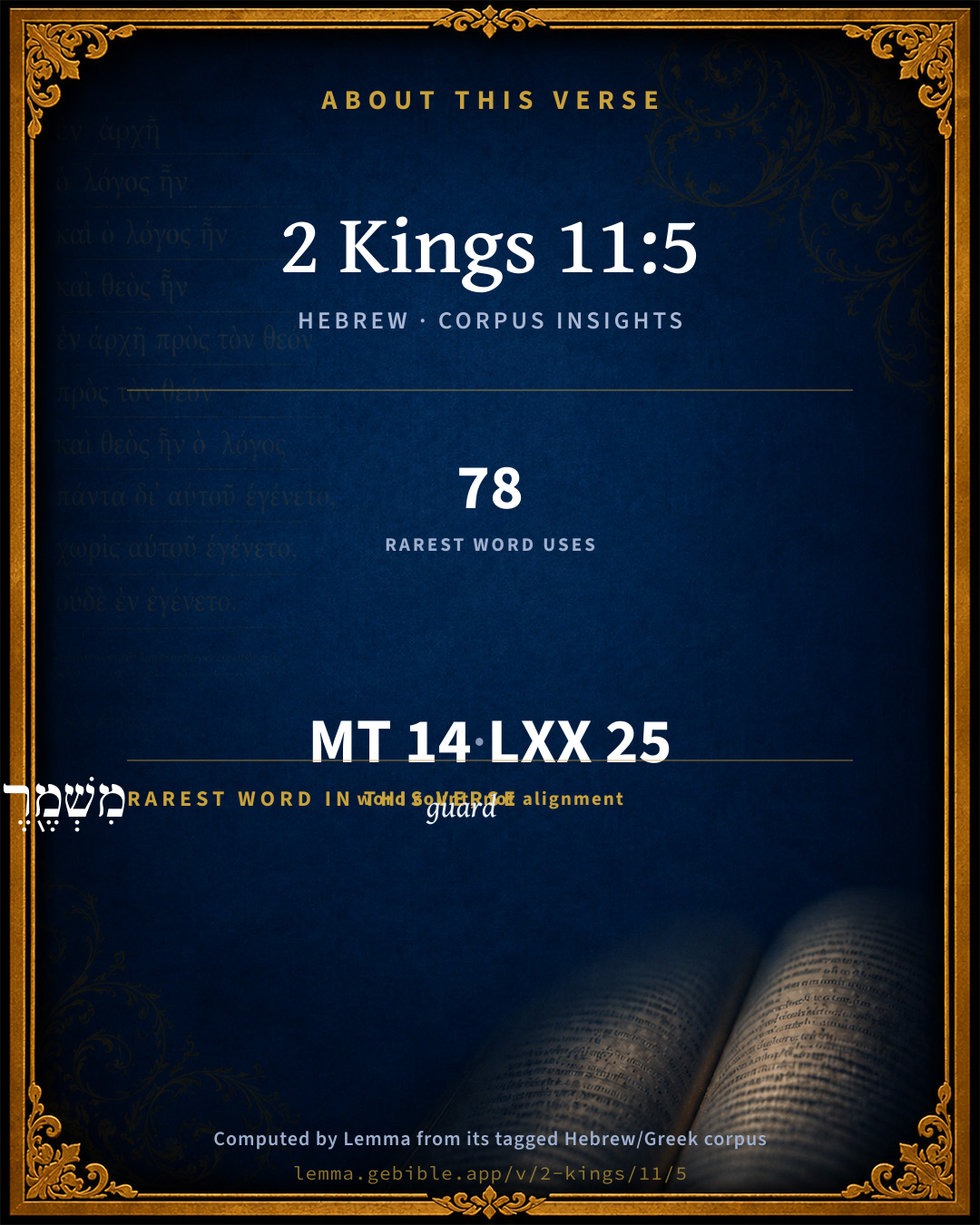
These counts appear in no published source. They are computed here, from the morphology-tagged text and Lemma’s own curated glosses. What Lemma adds →

14
words
14
distinct lemmas
Historical
section

Grammatical profile

  • 5 verbs
  • 6 nouns
  • 1 pronoun
  • 1 preposition
  • 1 particle

Verb forms

  • וַיְצַוֵּ֣ם Piel · Sequential Imperfect
  • לֵאמֹ֔ר Qal · Infinitive Construct
  • תַּעֲשׂ֑וּן Qal · Imperfect
  • בָּאֵ֣י Qal · Participle Active
  • וְשֹׁ֣מְרֵ֔י Qal · Participle Active

Hebrew & Septuagint length

In English translation the verse runs 33 words from the Hebrew and 12 from the Septuagint (LXX English) — the Septuagint runs noticeably shorter here. See the side-by-side →

A rough comparison of the two English renderings, which tokenize alike — not a word-level alignment.

Word counts can differ between the Hebrew and the Greek without any difference in meaning — e.g. the Hebrew direct-object marker אֵת has no separate Greek word, and Greek often adds the article ὁ.

In the original languages it is 14 Hebrew tokens and 25 Greek tokens — but the two are counted differently (Hebrew bundles its prefixes and suffixes into one token; the Greek is in lemma form), so that isn’t a like-for-like length.

Cross-references

11

Topical passages linked to 2 Kings 11:5 in the Treasury of Scripture Knowledge — connected by theme and wording, ordered by reader-vote popularity; previews shown in the World English Bible.

  • 1 Chronicles 9:25 Their brothers, in their villages, were to come in every seven days from time to time to be with them:
  • 1 Kings 10:5 and the food of his table, and the sitting of his servants, and the attendance of his ministers, and their clothing, and his cup bearers, and his ascent by which he went up to the house of Yahweh; there was no more spirit in her.
  • 2 Kings 11:19 He took the captains over hundreds, and the Carites, and the guard, and all the people of the land; and they brought down the king from the house of Yahweh, and came by the way of the gate of the guard to the king's house. He sat on the throne of the kings.
  • 2 Kings 16:18 The covered way for the Sabbath that they had built in the house, and the king's entry outside, turned he to the house of Yahweh, because of the king of Assyria.
  • 1 Chronicles 23:3–6 The Levites were numbered from thirty years old and upward: and their number by their polls, man by man, was thirty-eight thousand.
  • 1 Chronicles 23:32 and that they should keep the charge of the tent of meeting, and the charge of the holy place, and the charge of the sons of Aaron their brothers, for the service of the house of Yahweh.
  • 1 Chronicles 24:3–6 David with Zadok of the sons of Eleazar, and Ahimelech of the sons of Ithamar, divided them according to their ordering in their service.
  • Jeremiah 26:10 When the princes of Judah heard these things, they came up from the king's house to the house of Yahweh; and they sat in the entry of the new gate of Yahweh's [house].
  • Ezekiel 44:2–3 Yahweh said to me, This gate shall be shut; it shall not be opened, neither shall any man enter in by it; for Yahweh, the God of Israel, has entered in by it; therefore it shall be shut.
  • Ezekiel 46:2–3 The prince shall enter by the way of the porch of the gate outside, and shall stand by the post of the gate; and the priests shall prepare his burnt-offering and his peace-offerings, and he shall worship at the threshold of the gate: then he shall go forth; but the gate shall not be shut until the evening.
  • Luke 1:8–9 Now it happened, while he executed the priest's office before God in the order of his division,

Cross-references courtesy of OpenBible.info (CC BY 4.0).

Hebrew and Greek witnesses Masoretic Hebrew ↔ Greek Septuagint

The same verse in the two great witnesses to the Old Testament, shown verse-for-verse.

Here the Septuagint runs noticeably shorter than the Hebrew — LXX2012 (modern English Septuagint) 12 words vs World English Bible 33. A rough length comparison of the two English translations, not a word-level alignment — read both below.

These are two independent witnesses, not word-aligned to each other, and the Septuagint is shown in lemma (dictionary) form.

Hebrew 2 Kings 11:5 Masoretic · Westminster Leningrad Codex

וַיְצַוֵּ֣ם לֵאמֹ֔ר זֶ֥ה הַדָּבָ֖ר אֲשֶׁ֣ר תַּעֲשׂ֑וּן הַשְּׁלִשִׁ֤ית מִכֶּם֙ בָּאֵ֣י הַשַּׁבָּ֔ת וְשֹׁ֣מְרֵ֔י מִשְׁמֶ֖רֶת בֵּ֥ית הַמֶּֽלֶךְ

He commanded them, saying, This is the thing that you shall do: a third part of you, who come in on the Sabbath, shall be keepers of the watch of the king's house;

World English Bible · Public Domain

Greek LXX 2 Kings 11:5 Septuagint · lemma form

καί ἐντέλλομαι αὐτός λέγω οὗτος ὁ λόγος ὅς ποιέω ὁ τρίτος ἐκ σύ εἰςἔρχομαι ὁ σάββατον καί φυλάσσω φυλακή οἶκος ὁ βασιλεύς ἐν ὁ πυλών

And charged them, saying, This is the thing which you⌃ shall do.

LXX2012 (modern English Septuagint) · Public Domain

On this verse, Ellicott's Commentary for English Readers discusses the Septuagint’s reading. Read the note in Commentary ↓

Hebrew: Westminster Leningrad Codex (CC BY 4.0). Greek: Septuagint (public domain); English from LXX2012 (modern English Septuagint) (Public Domain). How the Septuagint differs from the Hebrew →

Targum (Aramaic paraphrase)

1

The Targum is the ancient Jewish Aramaic paraphrase of the Hebrew Scriptures — an interpretive translation, not the Hebrew text itself. Onkelos (literal) and Pseudo-Jonathan (expansive) render the Torah, and Jonathan the Prophets. Coverage is partial: where no permissively-licensed English translation exists for a verse, only the Aramaic is shown. This is verse-level text, not a word-by-word alignment to the Hebrew.

  1. Targum Jonathan Prophets (Joshua–Malachi)
    וּפַקְדִינוּן לְמֵימַר דֵין פִּתְגָמָא דְתַעְבְּדוּן תִּלְתָּא מִנְכוֹן עָלֵי שַׁבָּא וְנַטְרֵי מַטְרַת בֵּית מַלְכָּא:

    (no public-domain English translation for this verse)

    Targum Jonathan — Aramaic: “Mikraot Gedolot” (public domain). English: “Sefaria Community Translation” (CC0 1.0 (public-domain dedication)); “London "Chaldee Paraphrase," 1871” (public domain). Text via Sefaria.

Commentary

Notes on 2 Kings 11:5 from classic Christian and Jewish commentators (each source and its license shown beneath its notes). The classic Christian expositions comment on the surrounding passage and are grouped to its opening verse, so a note may address several verses; the Jewish commentaries on the Tanakh (Rashi and others) are per-verse, so they appear only where the commentator wrote on this verse.

Lemma curates 59 commentaries, every one of them public domain or Creative Commons licensed, each selected and text-cleaned for this edition rather than reprinted as found. About our sources →

Trapp's Complete Commentary

John Trapp

2Ki 11:5 And he commanded them, saying, This [is] the thing that ye shall do; A third part of you that enter in on the sabbath shall even be keepers of the watch of the king’s house;

Ver. 5. And he commanded them.] For he was protector of the young king, and προβολον της αληθειας - as Theodoret styleth Athanasius - the Bulwark of Truth.

That enter in on the Sabbath.] So that the deposing Of Athaliah and her idolatry, the setting up of Joash, and with him, of true religion, was a Sabbath day’s work, and well it might be: Jehoiada - for the purpose - taking in the new company of Levites that came in their course, and not dismissing the old till this great work was over.

Of the king’s house.] Which was very near the temple; however it was with Athaliah, and the recently revolted princes of Judah, according to the common word, The nearer to the church, the farther from God.

John Trapp, A Commentary or Exposition upon All the Books of the Old and New Testament (1647–1656) — public domain. Text from a community e-Sword module.

Joseph Benson's Commentary

2Ki 11:5-6. A third part of you — Of the Levites, who were distributed into twenty-four courses, to minister in turns, each course consisting of about a thousand men for a week. That enter in, &c. — That come into the temple to attend your ministry. Shall be keepers of the king’s house — Of that part which led to the king’s palace, which Athaliah now possessed. A third part shall be at the gate of Sur — The chief gate of the temple, called the high gate, 2Ki 15:35; the foundation gate, 2Ch 23:5; the east gate, Jer 19:2; the middle gate, Jer 39:3; and the gate of entrance, Eze 40:15. A third part at the gate behind the guard — Either, 1st, The king’s guard: or, 2d, The guard of the temple; this gate was in the south side. So shall ye keep, &c. — So you shall guard all the gates or entrances into the temple, that neither Athaliah nor any of her soldiers may break in.

Joseph Benson's Commentary on the Old and New Testaments (1811–1818) — public domain. Text from a community e-Sword module.

Whedon's Commentary on the Bible

Daniel D. Whedon

5. This is the thing that ye shall do — This description (2Ki_11:5-14) of the arrangement of the Levite guards is obscure, and some parts of it difficult to harmonize with the parallel and fuller account in 2Ch_23:4-13. The difficulty comes from our ignorance of some of the terms employed. The gate of Sur and the gate behind the guard are matters of conjecture, on which it is needless to posit a decided opinion. But so long as these gates are unknown, there must rest an obscurity upon the whole passage. We attempt merely to point out what seems to be the most natural and plausible meaning of the words.

You that enter in on the sabbath — Those Levites whose turn to enter upon their week of service in the temple came on the particular Sabbath here indicated. The different kinds of service in which they were employed are described in 1Ch_9:17-33, from which passage it appears that a large body of the Levites were constantly required in the temple, and that they relieved each other by turns, one company entering in on the Sabbath when another company, having filled their week, went forth. 2Ki_11:7. “By choosing the Sabbath day,” says Wordsworth, “and by retaining those of the Levitical course whose turn it was to retire from its allotted service, Jehoiada doubled the number of the official forces of the temple without exciting suspicion.”

Shall even be keepers of the watch of the king’s house — The king’s house must certainly mean the royal palace, from which there was a magnificent passageway leading up to the house of the Lord. 1Ki_10:5, note. A third part of the Levites here specified, instead of entering the temple as usual, were to stay outside, and guard this way to the royal residence, lest some satellite of Athaliah should discover or interrupt the plot. They are the ones who in 2Ch_23:5 are to be at the king’s house.

Daniel D. Whedon (gen. ed.), Commentary on the Old and New Testaments (1874–1909) — public domain. Text from a community e-Sword module.

Tyndale Open Study Notes

Tyndale Open Resources

11:5-8 Jehoiada divided the royal guard into distinctive units: some to guard the young king; others to take up posts at the palace, the Sur Gate (or Foundation Gate, 2 Chr 23:5), and positions behind the palace guard; and still others to stand guard . . . at the Lord’s Temple. All care was taken to secure the king and the site for his anointing.

Tyndale Open Study Notes — © Tyndale Open Resources, licensed CC BY-SA 4.0. Text via the HelloAO Bible API.

Geneva Bible (1599)

Geneva Bible translators

That none should come upon them, while they were crowning the king.

Of the Levites, which had charge of the keeping of the Temple, and kept watch by course.

Geneva Bible (1599) marginal notes — public domain. Text via Bolls.life.

Adam Clarke's Commentary

Verse 5. That enter in on the Sabbath] It appears that Jehoiada chose the Sabbath day to proclaim the young king, because as that was a day of public concourse, the gathering together of the people who were in this secret would not be noticed; and it is likely that they all came unarmed, and were supplied by Jehoiada with the spears and shields which David had laid up in the temple, 2Kg 11:10.

The priests and Levites were divided into twenty-four classes by David, and each served a week by turns in the temple, and it was on the Sabbath that they began the weekly service, all this favoured Jehoiada's design.

Adam Clarke's Commentary on the Bible (1810–1826) — public domain. Text from a community e-Sword/MySword module.

Ellicott's Commentary for English Readers

(5) A third part of you . . . king’s house.—Rather, the third of you who come in on the Sabbath shall keep the ward of the king’s house. (Reading w‘shâm‘rû, as in 2Ki_11:7.) The troops of the royal guard regularly succeeded each other on duty just as they do in modern European capitals. That the Sabbath was the day on which they relieved each other is known only from this passage; but the priestly and Levitical guilds did the same, and their organisation in many ways resembled that of an army.

The watch of the king’s house.—There were two places to be occupied for the success of the present movement—viz., the royal palace and the Temple, “the king’s house” and “the house of the Lord.” In the former was Athaliah, the usurping queen, whose movements must be closely watched, and whose adherents must be prevented from occupying and defending the palace; in the latter, the young heir to the throne, who must be protected from attack. That “the king’s house” here means the palace proper is evident from 2Ki_11:16; 2Ki_11:19, and, indeed, from the whole narrative. The LXX. adds, “at the entry” (ἐν τῷ πυλῶνι)—i.e., the grand entrance to the palace itself. This is at least a correct gloss, and may be part of the original text.

(5, 6) Three companies of the guards to be stationed at the three approaches to the palace.

A Bible Commentary for English Readers, edited by Charles John Ellicott (1878–1897) — public domain. Text from a community e-Sword module.

The Cambridge Bible for Schools and Colleges

gen. ed. J. J. S. Perowne

5. And he commanded them] The two things to be provided for were the safety of the young king’s person when it should be known to Athaliah and her party that he was alive, and the guarding of the royal palace, so that no personal troop of Athaliah’s might make an attack on the king’s party, and at the proper moment the palace might be seized and the king brought to it and set on the throne. These duties Jehoiada deputed to the five captains whom he had taken into his confidence. Three bodies of men, presumably each under a captain, are to watch the palace at different points, while two other bodies are to be in charge of the house of the Lord about the king. It is not without interest to observe that this fivefold division of the guards corresponds to the number of the captains selected, though they and their number are only mentioned in the narrative of 2 Chronicles. We see from this, that although we may not, at this distance of time, be able to make clear every detail of the two stories, they fit here very remarkably into each other.

a third part of you that enter [R.V. come] in on the sabbath] Those who are to take part in the work that is planned are to be the guards who enter on their duty on the Sabbath, and those who are going off duty. As the words are addressed to the captains over hundreds the ‘of you’ must apply to the soldiers under their command. But it is perfectly intelligible that a somewhat similar arrangement of the Levites might also be made, and that they should take their part in work of restoring the king. From the narrative in 2 Chronicles we see that the priests and Levites were arranged in 3 divisions, one of which was to have the duty of porters, as it seems, at the doors of the temple, another to be at the king’s house, and the third at the gate of the foundation. On this last position see below. Thus, as in the case of the purely military arrangement, the larger number of the priestly and Levitical body was to serve near the royal palace. We note also from Chronicles that the occasion of some feast was arranged as the time for carrying out the plan. For it is said that ‘all the people shall be in the courts of the house of the Lord’.

shall even be keepers of the watch of the king’s house] R.V. omits ‘even’. The LXX. adds ‘at the doorway’ in the end of this clause. No doubt they would be stationed so as to prevent any one from the palace coming forth, without their consent, to interfere with the proceedings at the temple.

The Cambridge Bible for Schools and Colleges (gen. ed. J. J. S. Perowne; Cambridge University Press, 1878–1918) — public domain. Text from a community e-Sword module.

John Gill's Exposition

And he commanded them, saying, this is the thing that ye shall do,.... These were the rulers over hundreds among the priests and Levites, and which he, as high priest, could command, and whom he could convene without suspicion, being such as he had a connection with, and were unarmed men: and for the better understanding of what follows, it should be observed, that the priests, in the times of David, were divided into twenty four courses, which were by turns to serve a week in the temple; the course that came in entered when the sabbath began, and that which went out went out when it ended, and each course consisted of a thousand men: now with respect to both these courses, both that which went in and that which went out, Jehoiada gave them the following charge:

a third part of you that enter in on the sabbath; on the beginning of it, to do duty in the temple the week following:

shall even be keepers of the watch of the king's house, which, according to some, was that part of the temple where the king was hid and brought up, supposed to be the north part of it: or rather these were set at the north gate of the temple, which led to the royal palace, lest any should rush out of that, and kill the king.

John Gill's Exposition of the Whole Bible (1746–1763) — public domain (CC PDM 1.0). Text via the HelloAO Bible API.

Albert Barnes' Notes on the Bible

Five divisions of the guard under their five captains are distinguished here. Three of the five divisions “enter in” on the Sabbath; the other two “go forth” on the Sabbath 2Ki 11:7. By the former phrase seems to be meant the mounting guard at the royal palace (the “king’s house,” where Athaliah then was); by the latter the serving of escort to the sovereign beyond the palace bounds. Jehoiada orders that of those whose business it would be to guard the palace on the ensuing Sabbath, one company or cohort should perform that task in the ordinary way, while another should watch the gate of Sur - or better, “the gate of the foundation” 2Ch 23:5 - that by which the palace was usually quitted for the temple, and a third should watch another of the palace gates, called “the gate of the guard” (see 2Ki 11:19). The two companies whose proper business it would be to serve as the royal escort beyond the palace walls, he orders to enter the temple, and surround the person of the young king.

2Ki 11:6

That it be not broken down - The one word in the original text of which this is a translation occurs nowhere else; and its meaning is very doubtful.

2Ki 11:8

Within the ranges - Rather, “within the ranks.” If anyone tried to break through the soldiers’ ranks to the king, or even to disturb their order, he was to be immediately slain.

Albert Barnes' Notes on the Bible (1834–1885) — public domain. Text from a community e-Sword/MySword module.

Matthew Poole's English Annotations

A third part of you; either,

1. A third part of you, (i.e. of the whole number, including those

that come in and those

that go out on the sabbath,) even

they that enter in on the sabbath;

and so the two other third parts were to consist of those that went out on the sabbath, as some gather from 2Ki 11:6,7. Or rather,

2. A third part only of those that enter in on the sabbath, who seem to be plainly divided into three thirds here, and 2Ki 11:6, as those that went forth on the sabbath are expressly distributed into two parts, 2Ki 11:7. That enter in on the sabbath, i.e. that come into the temple on the sabbath day. For the understanding of this matter, you must know that the Levites were, in and from David’s time, distributed into twenty-four courses, which were to do the work of the temple successively, and by turns; each course consisting of about a thousand men for his week; of which see 1Ch 23; 1Ch 24.

The watch of the king’s house; either,

1. Of that bed-chamber where the king now was. But it is unlikely, and without example, either that one bed-chamber, or the temple, or any part of it, should be called the king’s house. And besides, the king’s person is secured by other persons, 2Ki 11:7. Or rather,

2. Of that part which leadeth to the king’s palace, which Athaliah now possessed, and whence they might expect opposition.

Matthew Poole's English Annotations on the Holy Bible (1683–1685) — public domain. Text from a community e-Sword/MySword module.

The Pulpit Commentary

And he commanded them, saying, This is the thing that ye shall do. It is evident, from 2 Chronicles and from Josephus, that a considerable interval of time separates the events of ver. 5 from those of ver. 4. The immediate arrangement made between Jehoiada and the centurions was that they should "go throughout the whole land" (Josephus, "Ant. Jud:," 9:7. visit "all the cities of Judah", (2Ch_23:2) and gather out of them a strong force of Levites and priests (Josephus), together with a certain number of other representative Israelites, which force they should bring with them to Jerusalem, and place at his disposal. To accomplish this must have taken some weeks. When the force had arrived, Jehoiada summoned it to meet him in the courts of the temple, and swore it to a similar covenant to that which he had made with the centurions. He then bided his time, completed his arrangements, utilized the store of arms laid up in the temple armory (ver. 10), and finally gave two charges one to the centurions, which is given here (vers. 5-8), and the other to the force collected from the cities of Judah, which is given in Chronicles. (2Ch_23:4-7) The orders given to the two forces were very similar, but not identical. A third part of you that enter in on the sabbath. The royal body-guard consisted of five divisions, each probably of a hundred men, and each commanded by its own captain. (2Ch_23:1) It was usual on the sabbath for three divisions out of the five to mount guard at the royal palace, while two were engaged outside, keeping order in the city, and especially at the temple. We do not know the ordinary disposition of the guard, either inside or outside the palace. On this occasion Jehoiada commanded that the palace-guard should be disposed as follows: one division at the palace proper, in the courts and halls and antechambers; a second at one of the issues from the palace, known as "the gate of Sur;" and a third at an issue called "the gate of the guard," which was certainly towards the east, where the palace fronted the temple. The object was to secure the palace, but not to prevent the queen from leaving it. Shall even be keepers of the watch of the king"s house; i.e. of the royal palace.

The Pulpit Commentary (1880–1919), ed. H.D.M. Spence-Jones & Joseph S. Exell — public domain. Text from a community e-Sword module.

John Wesley's Explanatory Notes

Of you - Levites, who were distributed into twenty four courses, to minister in turns, each course consisting of about a thousand men for a week. Enter in - That come into the temple to attend your ministry. King's house - Of that part which lead to the king's palace, which Athaliah now possessed.

John Wesley, Explanatory Notes Upon the Whole Bible (1754–1765) — public domain. Text via the GEBible commentary corpus.

Rashi

Rabbi Shlomo Yitzchaki (Rashi)

One third of you of those who come on Shabbos. The watches would be renewed on Shabbos, and Leviyim that served in rotation in the Beis Hamikdosh. They changed places on Shabbos. the watches of the kohanim and Leviyim. one would enter and one would leave. He ordered the watch that was entering, to divide into three parts, one third in the king’s palace, to guard that no one rise up against the king to assassinate him.

Rashi on the Tanakh — English translations: “The Judaica Press complete Tanach with Rashi, translated by A. J. Rosenberg” (CC BY 4.0); “Pentateuch with Rashi's commentary by M. Rosenbaum and A.M. Silbermann, 1929-1934” (public domain); “The Metsudah Tanach series, Lakewood, N.J” (CC BY 4.0); and “The Book of Joshua, Metsudah Publications, 1997” (CC BY 4.0). Text via Sefaria.

Lesson kit

Teaching starters — assembled from the data on this page, not authored interpretation. Every prompt links to the verse data it draws on. Edit before teaching.

2 Kings, in the Historical, opens this verse with 14 words (14 distinct Hebrew lemmas). Its most distinctive word is mishmereth (“guard”). The Greek Septuagint runs shorter here. A historical commentator’s framing appears above. Read the whole chapter for the surrounding context.

Discussion questions

  1. How does “guard” (mishmereth) shape what this verse is saying?
  2. How does 1 Chronicles 9:25, which shares this passage’s theme, read alongside this verse?
  3. The Septuagint runs shorter here than the Hebrew. What might account for the difference?
  4. The translations on this page render this verse differently — a whole-verse word diff, not a word-by-word alignment. What might account for the different wordings?
  5. «וַיְצַוֵּ֣ם» is a Piel Sequential Imperfect verb. How does that grammatical form shape the action described?
  6. Compare how Trapp's Complete Commentary and Joseph Benson's Commentary read this verse. Where do they agree or differ?

Things to notice

Reading settings

Reading text

Shown beneath each verse's original-language words.

Old Testament
Old Testament edition

Read the OT as the Masoretic Hebrew (MT) or the Greek Septuagint (LXX).

English shown for the Greek Septuagint (in the Hebrew ↔ Greek comparison).

Comparing translations? Open the Compare panel on any verse page to stack up to four side by side.