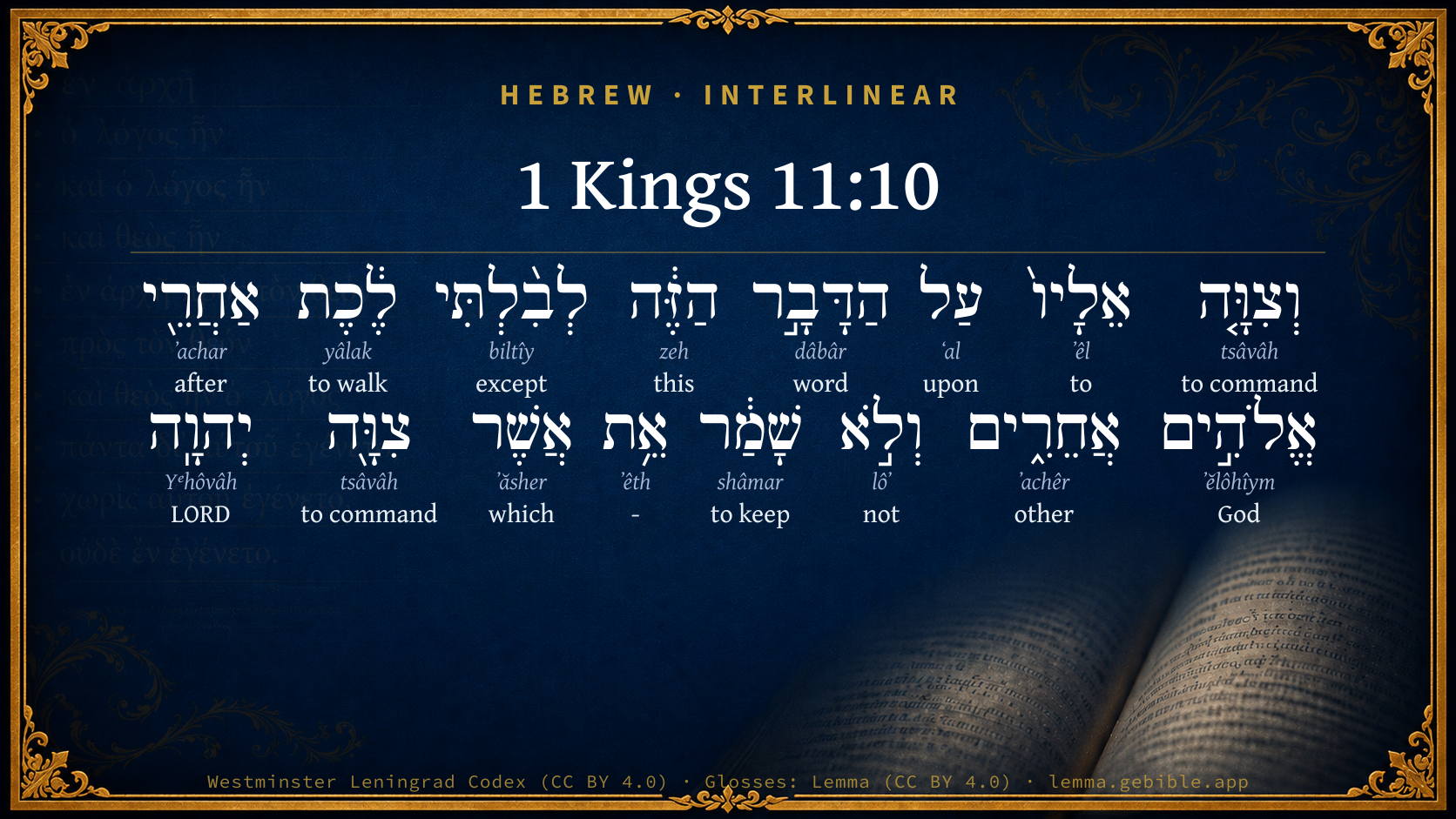
1 Kings 11:10

Hebrew (Westminster Leningrad Codex) 1 Kings 11:10 appears in the Hebrew Old Testament. The text above is from the Westminster Leningrad Codex. Each word links to its Strong’s number, a concise gloss, and parsing drawn from the Open Scriptures Hebrew Bible morphology. Click any word for its full Brown-Driver-Briggs (BDB) entry.
Download image
Cite this verse

1 Kings 11:10 (World English Bible). Public Domain. Lemma interlinear Bible study tool, https://lemma.gebible.app/v/1-kings/11/10.

Show BibTeX & RIS
BibTeX
RIS
English Translation
and had commanded him concerning this thing, that he should not go after other gods: but he didn't keep that which Yahweh commanded.
World English Bible · Public Domain
Download a study sheet

One document with this verse’s original text, its word-by-word gloss line, the meaning frame, cross-references with their text, attributed commentary, and full source and license credits — printable, and it pastes into notes with its structure intact.

This verse Autodidact and up

Study sheet (.html) Plain text (.txt)

A passage Seminary Student

Up to 50 verses in one chapter. A passage sheet keeps up to 6 commentary sources and 12 cross-references per verse, in the order this page ranks them, and says so on the sheet whenever that leaves anything out. Ask for a single verse and you get the Autodidact verse sheet above.

Everything on this page stays free to read, with no account — the sheet is a download of what is already on screen, not access to it.

Want to remove ads? Support Godless Engineer
Compare translations 3

The same verse in 3 English versions, stacked beneath the original-language interlinear above. Click any original word for its lexicon entry.

Each is an independent rendering of the whole verse — the interlinear is not word-aligned to these translations.

Highlighted words mark where these versions differ — a whole-verse word diff, not a word-by-word alignment.

  • World English Bible Public Domain
    and had commanded him concerning this thing, that he should not go after other gods: but he didn't keep that which Yahweh commanded.
  • King James Version Public Domain
    And had commanded him concerning this thing, that he should not go after other gods: but he kept not that which the LORD commanded.
  • unfoldingWord Literal Text CC BY-SA 4.0
    and he had commanded to him about this thing, not to go after other gods. But he did not keep what Yahweh had commanded.

unfoldingWord Literal Text — © unfoldingWord, licensed CC BY-SA 4.0. Word-aligned USFM3 via Door43 (git.door43.org/unfoldingWord/en_ult).

Versions to compare (up to 4)

3 of 4 selected

Show all 18 translations

Every available English version of this verse, each an independent rendering of the whole verse.

  • World English Bible Public Domain
    and had commanded him concerning this thing, that he should not go after other gods: but he didn't keep that which Yahweh commanded.
  • Berean Standard Bible Public Domain
    Although He had warned Solomon explicitly not to follow other gods, Solomon did not keep the LORD’s command.
  • Majority Standard Bible Public Domain
    Although He had warned Solomon explicitly not to follow other gods, Solomon did not keep the LORD’s command.
  • King James Version Public Domain
    And had commanded him concerning this thing, that he should not go after other gods: but he kept not that which the LORD commanded.
  • American Standard Version (1901) Public Domain
    and had commanded him concerning this thing, that he should not go after other gods: but he kept not that which Jehovah commanded.
  • Revised Version (1885) Public Domain
    and had commanded him concerning this thing, that he should not go after other gods: but he kept not that which the LORD commanded.
  • Geneva Bible (1599) Public Domain
    And had giuen him a charge concerning this thing, that he should not follow other gods: but he kept not that, which the Lord had commanded him.
  • Douay-Rheims (1899) Public Domain
    And had commanded him concerning this thing, that he should not follow strange gods: but he kept not the things which the Lord commanded him.
  • Young's Literal Translation Public Domain
    and given a charge unto him concerning this thing, not to go after other gods; and he hath not kept that which Jehovah commanded,
  • Literal Standard Version CC BY-SA 4.0
    and given a charge to him concerning this thing, not to go after other gods; and he has not kept that which YHWH commanded,
  • Unlocked Literal Bible CC BY-SA 4.0
    and commanded him about this very thing, that he should not go after other gods. But Solomon did not obey what Yahweh commanded.
  • unfoldingWord Literal Text CC BY-SA 4.0
    and he had commanded to him about this thing, not to go after other gods. But he did not keep what Yahweh had commanded.
  • Darby Bible Public Domain
    and had commanded him concerning this thing, not to go after other gods; but he kept not what Jehovah had commanded.
  • World Messianic Bible Public Domain
    and had commanded him concerning this thing, that he should not go after other gods; but he didn’t keep that which the LORD commanded.
  • Webster's Bible Public Domain
    And had commanded him concerning this thing, that he should not go after other gods: but he kept not that which the LORD commanded.
  • Free Bible Version CC BY-SA 4.0
    The Lord had warned Solomon about this—that he should not worship other gods. But Solomon did not listen to the Lord's warning.
  • Bible in Basic English Public Domain
    And had given him orders about this very thing, that he was not to go after other gods; but he did not keep the orders of the Lord.
  • JPS Tanakh (1917) Public Domain
    and had commanded him concerning this thing, that he should not go after other gods; but he kept not that which the LORD commanded.

Literal Standard Version (2020), Covenant Press — licensed CC BY-SA 4.0. Text via the HelloAO Bible API (eBible.org). Unlocked Literal Bible (unfoldingWord) — licensed CC BY-SA 4.0. Text via the HelloAO Bible API (eBible.org). unfoldingWord Literal Text — © unfoldingWord, licensed CC BY-SA 4.0. Word-aligned USFM3 via Door43 (git.door43.org/unfoldingWord/en_ult). Free Bible Version, Dr. Jonathan Gallagher — licensed CC BY-SA 4.0. Text via the HelloAO Bible API (eBible.org).

Word by word

More ways to search: Search by grammar → Find every occurrence → Compare this word →

Practice this passage: Drill this verse → Learn its vocabulary →

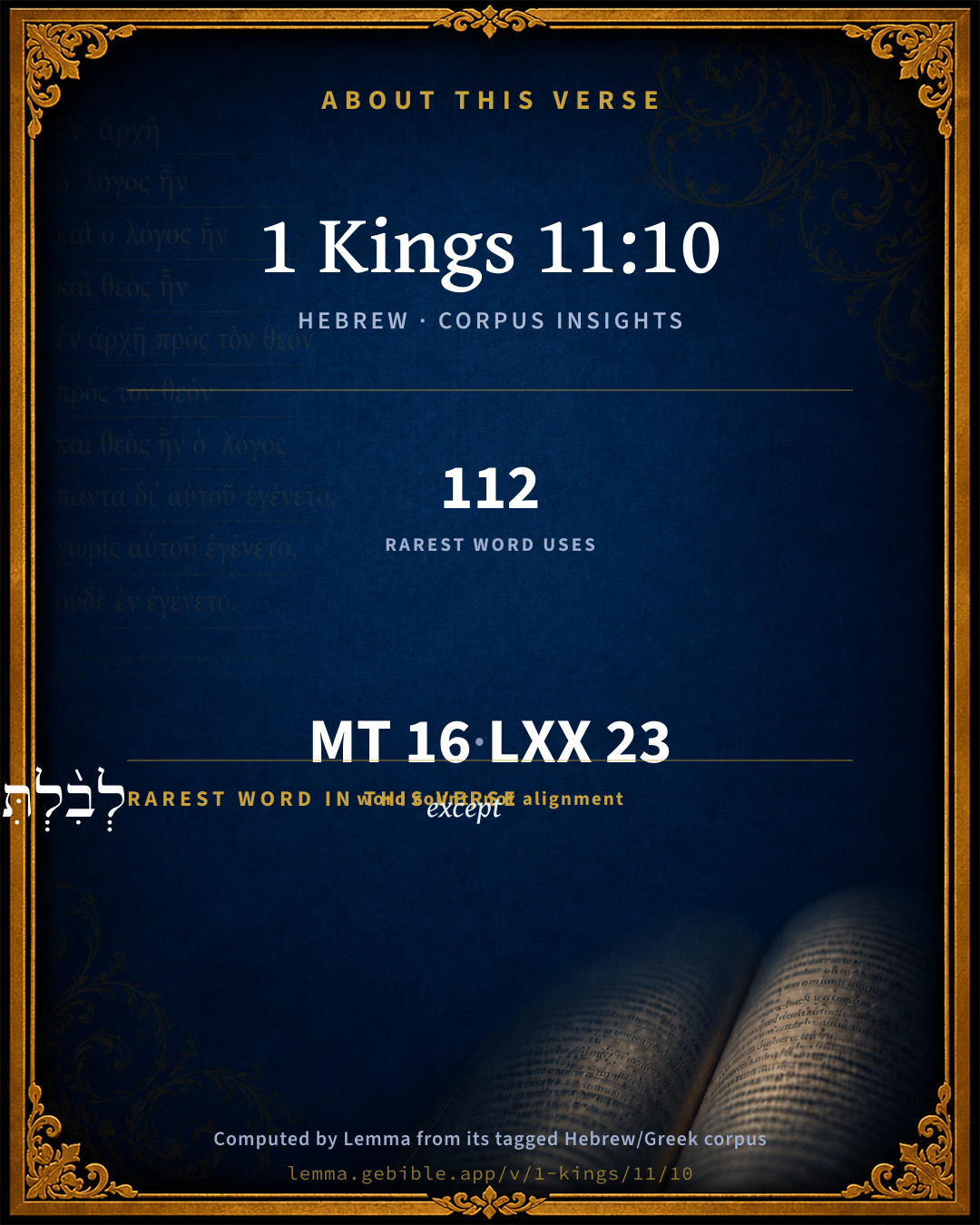
לְבִ֨לְתִּי
biltîy
H1115
“to/for · except”
Preposition + Conjunction
Part of Speech
Preposition + Conjunction
Full BDB Definition

Origin: constructive fem. of H1086 (equivalent to H1097 )

TWOT: 246i

not, except (substantive) - not (adverb) - except (after preceding negation) (adverb) - except (after an implied or expressed negation) (conjunction) - so as not, in order not (with preposition) - an account of not, because...not (with preposition) - until not (with preposition)
  1. וְצִוָּ֤ה tsâvâh H6680 “and · to command” Conjunction + Verb, Piel, Perfect, 3rd Person, Masculine, Singular
  2. אֵלָיו֙ ʼêl H413 “to · him” Preposition + Suffix, Personal, 3rd Person, Masculine, Singular
  3. עַל ʻal H5921 “upon” Preposition
  4. הַדָּבָ֣ר dâbâr H1697 “the · word” Particle, Definite Article + Noun, Common, Masculine, Singular, Absolute
  5. הַזֶּ֔ה zeh H2088 “the · this” Particle, Definite Article + Pronoun, Demonstrative, Masculine, Singular
  6. לֶ֔כֶת yâlak H3212 “to walk” Verb, Qal, Infinitive Construct
  7. אַחֲרֵ֖י ʼachar H310 “after” Preposition
  8. אֱלֹהִ֣ים ʼĕlôhîym H430 “God(s)” Noun, Common, Masculine, Plural, Absolute
  9. אֲחֵרִ֑ים ʼachêr H312 “other” Adjective, Adjective, Masculine, Plural, Absolute
  10. וְלֹ֣א lôʼ H3808 “and · not” Conjunction + Particle, Negative
  11. שָׁמַ֔ר shâmar H8104 “to keep” Verb, Qal, Perfect, 3rd Person, Masculine, Singular
  12. אֵ֥ת ʼêth H853 “-” Particle, Direct Object
  13. אֲשֶׁר ʼăsher H834 “which” Particle, Relative
  14. צִוָּ֖ה tsâvâh H6680 “to command” Verb, Piel, Perfect, 3rd Person, Masculine, Singular
  15. יְהוָֽה Yᵉhôvâh H3068 “LORD” Noun, Proper

About this verse

These counts appear in no published source. They are computed here, from the morphology-tagged text and Lemma’s own curated glosses. What Lemma adds →

16
words
15
distinct lemmas
Historical
section

Grammatical profile

  • 4 verbs
  • 3 nouns
  • 1 adjective
  • 1 pronoun
  • 3 prepositions
  • 1 conjunction
  • 3 particles

Verb forms

  • וְצִוָּ֤ה Piel · Perfect
  • לֶ֔כֶת Qal · Infinitive Construct
  • שָׁמַ֔ר Qal · Perfect
  • צִוָּ֖ה Piel · Perfect

Repetition

A word recurs within this verse — often emphatic in Hebrew:

  • וְצִוָּ֤ה to command H6680 ×2

Hebrew & Septuagint length

In English translation the verse runs 23 words from the Hebrew and 42 from the Septuagint (LXX English) — the Septuagint runs noticeably longer here. See the side-by-side →

A rough comparison of the two English renderings, which tokenize alike — not a word-level alignment.

Word counts can differ between the Hebrew and the Greek without any difference in meaning — e.g. the Hebrew direct-object marker אֵת has no separate Greek word, and Greek often adds the article ὁ.

In the original languages it is 16 Hebrew tokens and 23 Greek tokens — but the two are counted differently (Hebrew bundles its prefixes and suffixes into one token; the Greek is in lemma form), so that isn’t a like-for-like length.

Cross-references

3

Topical passages linked to 1 Kings 11:10 in the Treasury of Scripture Knowledge — connected by theme and wording, ordered by reader-vote popularity; previews shown in the World English Bible.

  • 1 Kings 6:12–13 Concerning this house which you are building, if you will walk in my statutes, and execute my ordinances, and keep all my commandments to walk in them; then will I establish my word with you, which I spoke to David your father.
  • 1 Kings 9:4–7 As for you, if you will walk before me, as David your father walked, in integrity of heart, and in uprightness, to do according to all that I have commanded you, and will keep my statutes and my ordinances;
  • 2 Chronicles 7:17–22 As for you, if you will walk before me as David your father walked, and do according to all that I have commanded you, and will keep my statutes and my ordinances;

Cross-references courtesy of OpenBible.info (CC BY 4.0).

Hebrew and Greek witnesses Masoretic Hebrew ↔ Greek Septuagint

The same verse in the two great witnesses to the Old Testament, shown verse-for-verse.

Here the Septuagint runs noticeably longer than the Hebrew — LXX2012 (modern English Septuagint) 42 words vs World English Bible 23. A rough length comparison of the two English translations, not a word-level alignment — read both below.

These are two independent witnesses, not word-aligned to each other, and the Septuagint is shown in lemma (dictionary) form.

Hebrew 1 Kings 11:10 Masoretic · Westminster Leningrad Codex

וְצִוָּ֤ה אֵלָיו֙ עַל הַדָּבָ֣ר הַזֶּ֔ה לְבִ֨לְתִּי לֶ֔כֶת אַחֲרֵ֖י אֱלֹהִ֣ים אֲחֵרִ֑ים וְלֹ֣א שָׁמַ֔ר אֵ֥ת אֲשֶׁר צִוָּ֖ה יְהוָֽה

and had commanded him concerning this thing, that he should not go after other gods: but he didn't keep that which Yahweh commanded.

World English Bible · Public Domain

Greek LXX 1 Kings 11:10 Septuagint · lemma form

καί ἐντέλλομαι αὐτός ὑπέρ ὁ λόγος οὗτος ὁ παράπαν μή πορεύομαι ὀπίσω θεός ἕτερος καί φυλάσσω ποιέω ὅς ἐντέλλομαι αὐτός κύριος ὁ θεός

and charged him concerning this matter, by no means to go after other gods, but to take heed to do what the Lord God commanded him; neither was his heart perfect with the Lord, according to the heart of David his father.

LXX2012 (modern English Septuagint) · Public Domain

On this verse, The Cambridge Bible for Schools and Colleges discusses the Septuagint’s reading. Read the note in Commentary ↓

Hebrew: Westminster Leningrad Codex (CC BY 4.0). Greek: Septuagint (public domain); English from LXX2012 (modern English Septuagint) (Public Domain). How the Septuagint differs from the Hebrew →

Targum (Aramaic paraphrase)

1

The Targum is the ancient Jewish Aramaic paraphrase of the Hebrew Scriptures — an interpretive translation, not the Hebrew text itself. Onkelos (literal) and Pseudo-Jonathan (expansive) render the Torah, and Jonathan the Prophets. Coverage is partial: where no permissively-licensed English translation exists for a verse, only the Aramaic is shown. This is verse-level text, not a word-by-word alignment to the Hebrew.

  1. Targum Jonathan Prophets (Joshua–Malachi)
    וּפַקֵיד עֲלוֹהִי עַל פִּתְגָמָא הָדֵין בְּדִיל דְלָא לִמְהַךְ בָּתַר טַעֲוַת עַמְמַיָא וְלָא נְטַר יַת דְפַקֵיד יְיָ:

    (no public-domain English translation for this verse)

    Targum Jonathan — Aramaic: “Mikraot Gedolot” (public domain). English: “Sefaria Community Translation” (CC0 1.0 (public-domain dedication)); “London "Chaldee Paraphrase," 1871” (public domain). Text via Sefaria.

Commentary

Notes on 1 Kings 11:10 from classic Christian and Jewish commentators (each source and its license shown beneath its notes). The classic Christian expositions comment on the surrounding passage and are grouped to its opening verse, so a note may address several verses; the Jewish commentaries on the Tanakh (Rashi and others) are per-verse, so they appear only where the commentator wrote on this verse.

Lemma curates 59 commentaries, every one of them public domain or Creative Commons licensed, each selected and text-cleaned for this edition rather than reprinted as found. About our sources →

Trapp's Complete Commentary

John Trapp

1Ki 11:10 And had commanded him concerning this thing, that he should not go after other gods: but he kept not that which the LORD commanded.

Ver. 10. And had commanded him.] To despise God’s express command, is a foul offence. {2Sa 12:9} {See Trapp on "2Sa 12:9"} "Rebellion is" as bad "as witchcraft." {1Sa 15:23}

John Trapp, A Commentary or Exposition upon All the Books of the Old and New Testament (1647–1656) — public domain. Text from a community e-Sword module.

The Cambridge Bible for Schools and Colleges

gen. ed. J. J. S. Perowne

10. and had commanded him concerning this thing] The command is recorded in substance in 1Ki_6:12 and 1Ki_9:6. No allusion is made in either place to the sort of temptation which led Solomon into this sin.

but he kept not that which the Lord commanded] Instead of these words the LXX. gives ‘and his heart was not perfect with the Lord, as the heart of David his father’: a repetition of a part of 1Ki_11:4.

The Cambridge Bible for Schools and Colleges (gen. ed. J. J. S. Perowne; Cambridge University Press, 1878–1918) — public domain. Text from a community e-Sword module.

John Gill's Exposition

Wherefore the Lord said unto Solomon,.... Not in a vision, as before, but by a prophet; the Jews say (n), Ahijah the Shilonite, which is probable, see Kg1 11:29.

forasmuch as this is done of thee, that thou hast not kept my covenant and my statutes which I have commanded thee; but broke them by his idolatry:

I will surely rend the kingdom from thee, and I will give it to thy servant; meaning Jeroboam, who was not only a subject, but in office under him, Kg1 11:26.

(n) Seder Olam Rabba, c. 20. p. 53. Kimchi in loc.

John Gill's Exposition of the Whole Bible (1746–1763) — public domain (CC PDM 1.0). Text via the HelloAO Bible API.

The Pulpit Commentary

And had commanded him concerning this thing (1Ki_9:6) that he should not go after other gods: but he kept not that which the Lord commanded.

The Pulpit Commentary (1880–1919), ed. H.D.M. Spence-Jones & Joseph S. Exell — public domain. Text from a community e-Sword module.

Lesson kit

Teaching starters — assembled from the data on this page, not authored interpretation. Every prompt links to the verse data it draws on. Edit before teaching.

1 Kings, in the Historical, opens this verse with 16 words (15 distinct Hebrew lemmas). Its most distinctive word is biltîy (“except”). The Greek Septuagint runs longer here. A historical commentator’s framing appears above. Read the whole chapter for the surrounding context.

Discussion questions

  1. How does “except” (biltîy) shape what this verse is saying?
  2. 1 Kings 6:12–13 shares this passage’s theme. How do the two illuminate each other?
  3. “to command” occurs 2× in this one verse. What is the effect of the repetition?
  4. Compared with the Hebrew, the Septuagint runs longer here. What questions does that raise?
  5. These translations render this verse differently. What is at stake in choosing one wording over another?
  6. The verb «וְצִוָּ֤ה» is Piel Perfect. How does its form color the action?
  7. Reading how Trapp's Complete Commentary and The Cambridge Bible for Schools and Colleges read this verse, where do the two commentators agree and where do they part?

Things to notice

Reading settings

Reading text

Shown beneath each verse's original-language words.

Old Testament
Old Testament edition

Read the OT as the Masoretic Hebrew (MT) or the Greek Septuagint (LXX).

English shown for the Greek Septuagint (in the Hebrew ↔ Greek comparison).

Comparing translations? Open the Compare panel on any verse page to stack up to four side by side.