

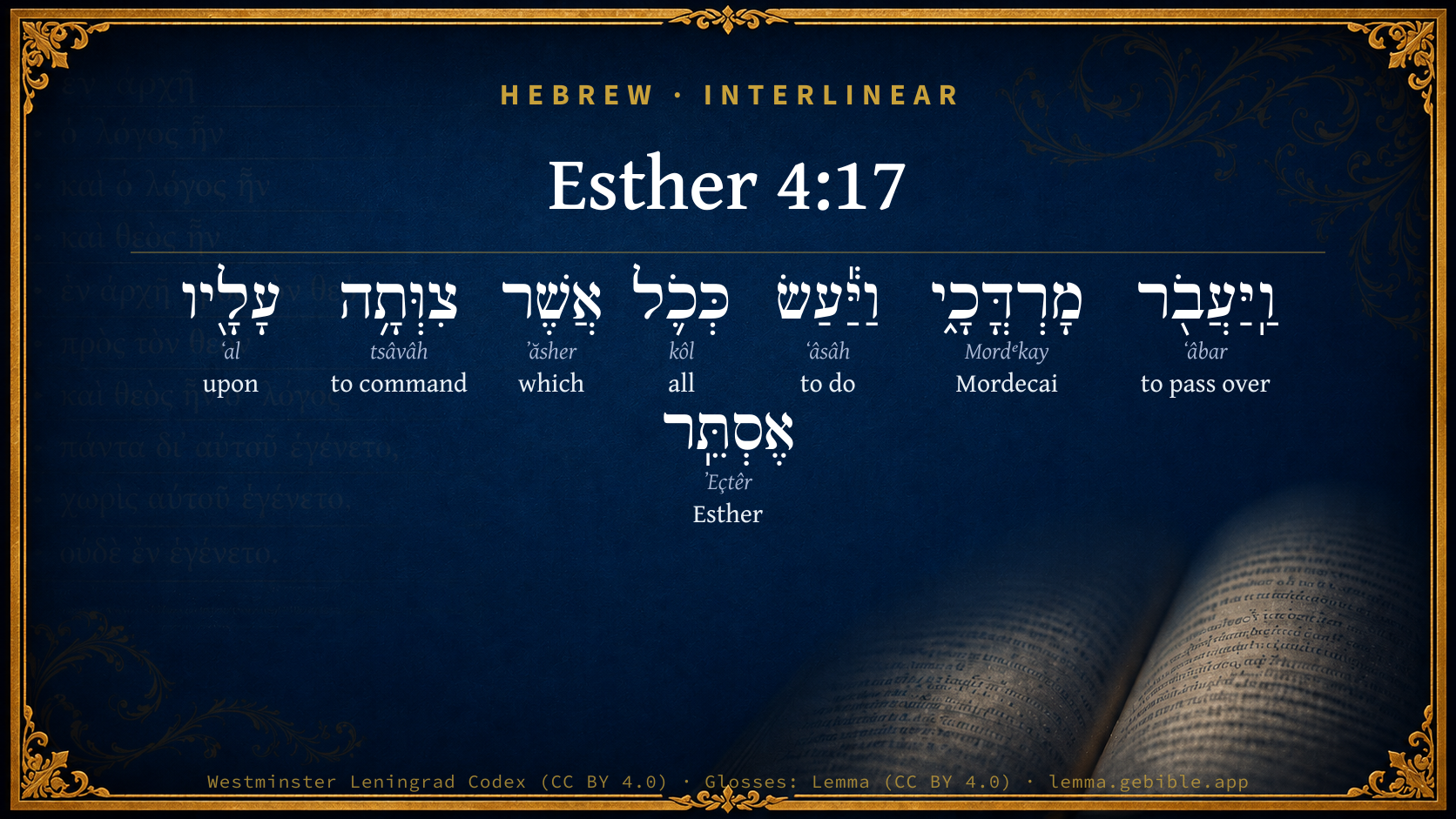
וַֽיַּעֲבֹ֖ר מָרְדֳּכָ֑י וַיַּ֕עַשׂ כְּכֹ֛ל אֲשֶׁר צִוְּתָ֥ה עָלָ֖יו אֶסְתֵּֽר
So Mordecai went his way, and did according to all that Esther had commanded him.
World English Bible · Public Domain
So Mordecai went his way, and did according to all that Esther had commanded him.
One document with this verse’s original text, its word-by-word gloss line, the meaning frame, cross-references with their text, attributed commentary, and full source and license credits — printable, and it pastes into notes with its structure intact.
This verse Autodidact and up
A passage Seminary Student
Up to 50 verses in one chapter. A passage sheet keeps up to 6 commentary sources and 12 cross-references per verse, in the order this page ranks them, and says so on the sheet whenever that leaves anything out. Ask for a single verse and you get the Autodidact verse sheet above.
Everything on this page stays free to read, with no account — the sheet is a download of what is already on screen, not access to it.
The same verse in 3 English versions, stacked beneath the original-language interlinear above. Click any original word for its lexicon entry.
Each is an independent rendering of the whole verse — the interlinear is not word-aligned to these translations.
Highlighted words mark where these versions differ — a whole-verse word diff, not a word-by-word alignment.
So Mordecai went his way, and did according to all that Esther had commanded him.
So Mordecai went his way, and did according to all that Esther had commanded him.
And Mordecai went and did according to the whole charge that Esther had laid upon him.
unfoldingWord Literal Text — © unfoldingWord, licensed CC BY-SA 4.0. Word-aligned USFM3 via Door43 (git.door43.org/unfoldingWord/en_ult).
Every available English version of this verse, each an independent rendering of the whole verse.
So Mordecai went his way, and did according to all that Esther had commanded him.
So Mordecai went and did all that Esther had instructed him.
So Mordecai went and did all that Esther had instructed him.
So Mordecai went his way, and did according to all that Esther had commanded him.
So Mordecai went his way, and did according to all that Esther had commanded him.
So Mordecai went his way, and did according to all that Esther had commanded him.
So Mordecai went his way, and did according to all that Ester had commanded him.
So Mardochai went, and did all that Esther had commanded him.
And Mordecai passeth on, and doth according to all that Esther hath charged upon him.
And Mordecai passes on, and does according to all that Esther has charged on him.
Mordecai went and did all that Esther told him to do.
And Mordecai went and did according to the whole charge that Esther had laid upon him.
And Mordecai went his way, and did according to all that Esther had commanded him.
So Mordecai went his way, and did according to all that Esther had commanded him.
So Mordecai went his way, and did according to all that Esther had commanded him.
Mordecai went and did everything Esther had told him to do.
So Mordecai went away and did everything as Esther had said.
So Mordecai went his way, and did according to all that Esther had commanded him.
Literal Standard Version (2020), Covenant Press — licensed CC BY-SA 4.0. Text via the HelloAO Bible API (eBible.org). Unlocked Literal Bible (unfoldingWord) — licensed CC BY-SA 4.0. Text via the HelloAO Bible API (eBible.org). unfoldingWord Literal Text — © unfoldingWord, licensed CC BY-SA 4.0. Word-aligned USFM3 via Door43 (git.door43.org/unfoldingWord/en_ult). Free Bible Version, Dr. Jonathan Gallagher — licensed CC BY-SA 4.0. Text via the HelloAO Bible API (eBible.org).
More ways to search: Search by grammar → Find every occurrence → Compare this word →
Practice this passage: Drill this verse → Learn its vocabulary →
These counts appear in no published source. They are computed here, from the morphology-tagged text and Lemma’s own curated glosses. What Lemma adds →
Shared distinctive vocabulary
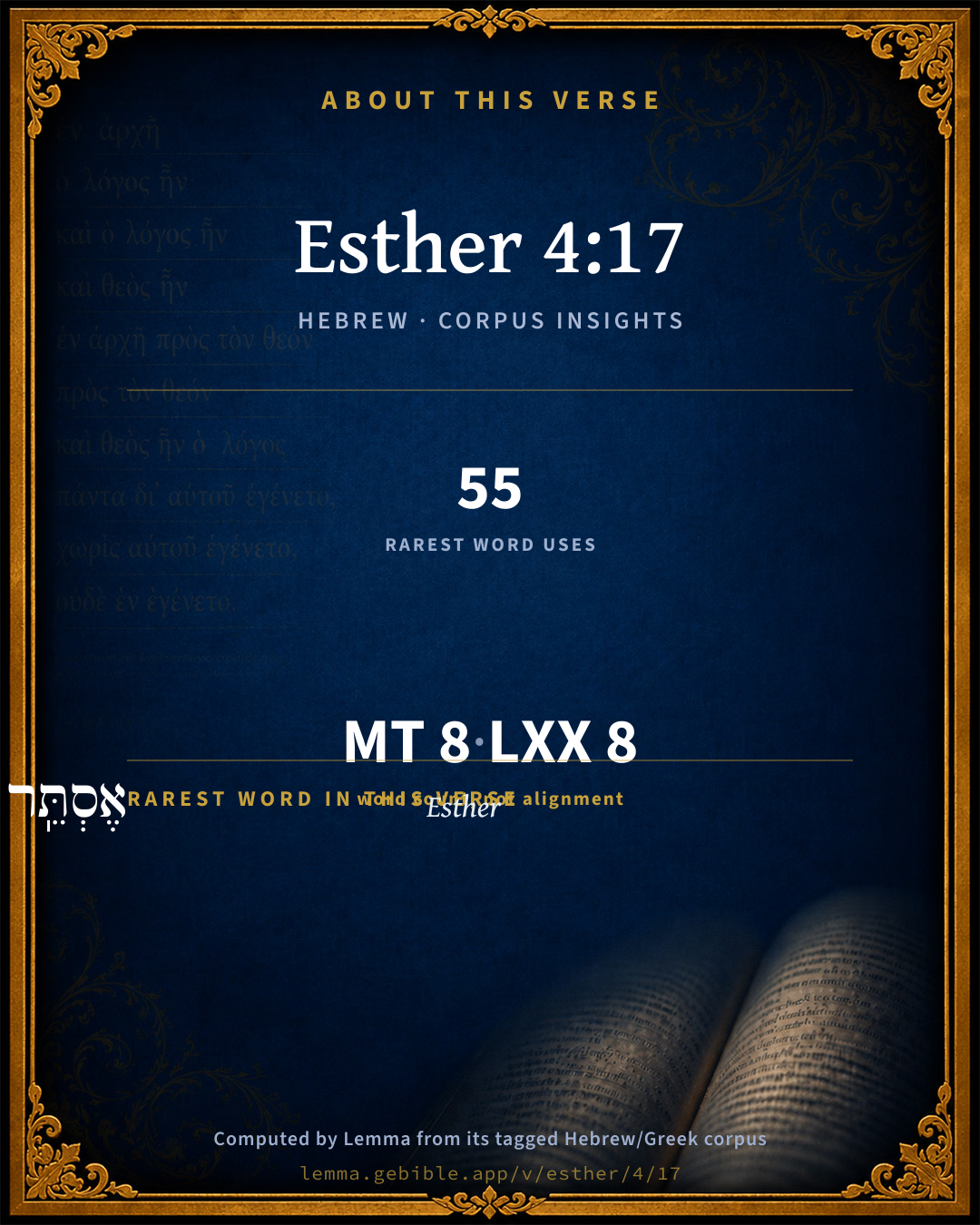
אֶסְתֵּֽר Esther H635 occurs in 45 verses of the Hebrew Bible. Also found in:
Grammatical profile
Verb forms
Hebrew & Septuagint length
In English translation the verse runs 15 words from the Hebrew and 807 from the Septuagint (LXX English) — the Septuagint runs noticeably longer here. See the side-by-side →
A rough comparison of the two English renderings, which tokenize alike — not a word-level alignment.
Word counts can differ between the Hebrew and the Greek without any difference in meaning — e.g. the Hebrew direct-object marker אֵת has no separate Greek word, and Greek often adds the article ὁ.
In the original languages it is 8 Hebrew tokens and 8 Greek tokens — but the two are counted differently (Hebrew bundles its prefixes and suffixes into one token; the Greek is in lemma form), so that isn’t a like-for-like length.
The same verse in the two great witnesses to the Old Testament, shown verse-for-verse.
Here the Septuagint runs noticeably longer than the Hebrew — LXX2012 (modern English Septuagint) 807 words vs World English Bible 15. A rough length comparison of the two English translations, not a word-level alignment — read both below.
These are two independent witnesses, not word-aligned to each other, and the Septuagint is shown in lemma (dictionary) form.
וַֽיַּעֲבֹ֖ר מָרְדֳּכָ֑י וַיַּ֕עַשׂ כְּכֹ֛ל אֲשֶׁר צִוְּתָ֥ה עָלָ֖יו אֶסְתֵּֽר
So Mordecai went his way, and did according to all that Esther had commanded him.
World English Bible · Public Domain
καί βαδίζω μαρδοχαῖος ποιέω ὅσος ἐντέλλω αὐτός εσθηρ
So Mardochaeus went and did all that Esther commanded him. [And he implored the Lord, making mention of all the works of the Lord; and he said, Lord God, king ruling over all, for all things are in your power, and there is no one that shall oppose you, in your purpose to save Israel. - For you have made the heaven and the earth and every wonderful thing in the world under heaven. And you are Lord of all, and there is no one who shall resist you Lord. You know all things: you know, Lord, that it is not in insolence, nor haughtiness, nor love of glory, that I have done this, to refuse obeisance to the haughty Aman. For I would gladly have kissed the soles of his feet for the safety of Israel. But I have done this, that I might not set the glory of man above the glory of God: and I will not worship any one except you, my Lord, and I will not do these things in haughtiness. And now, O Lord God, the King, the God of Abraam, spare your people, for our enemies are looking upon us to our destruction, and they have desired to destroy your ancient inheritance. Do not overlook your peculiar people, whom you have redeemed for yourself out of the land of Egypt. Listen to my prayer, and be propitious to your inheritance, and turn our mourning into gladness, that we may live and sing praise to your name, O Lord; and do not utterly destroy the mouth of them that praise you, O Lord. And all Israel cried with all their might, for death was before their eyes. And queen Esther betook herself for refuge to the Lord, being taken as it were in the agony of death. And having taken off her glorious apparel, she put on garments of distress and mourning; and instead of grand perfumes she filled her head with ashes and dung, and she greatly brought down her body, and she filled every place of her glad adorning with the torn curls of her hair. And she implored the Lord God of Israel, and said, O my Lord, you alone are our king: help me who am destitute, and have no helper but you, for my danger is near at hand. I have heard from my birth, in the tribe of my kindred that you, Lord, took Israel out of all the nations, and our fathers out of all their kindred for a perpetual inheritance, and have wrought for them all that you have said. And now we have sinned before you, and you have delivered us into the hands of our enemies, because we honored their gods: you are righteous, O Lord. But now they have not been contented with the bitterness of our slavery, but have laid their hands on the hands of their idols, in order to abolish the decree of your mouth, and utterly to destroy your inheritances, and to stop the mouth of them that praise you, and to extinguish the glory of your house and your altar, and to open the mouth of the Gentiles to speak the praises of vanities, and in order that a mortal king should be admired for ever. O Lord, do not resign your sceptre to them that are not, and let them not laugh at our fall, but turn their counsel against themselves, and make an example of him who has begun to injure us. Remember us, O Lord, manifest yourself in the time of our affliction, and encourage me, O King of gods, and ruler of all dominion. Put harmonious speech into my mouth before the lion, and turn his heart to hate him that fights against us, to the utter destruction of him that consent with him. But deliver us by your hand, and help me who am destitute, and have none but the, O Lord. You know all things, and know that I hate the glory of transgressors, and that I abhor the couch of the uncircumcised, and of every stranger. You know my necessity, for I abhor the symbol of my proud station, which is upon my head in the days of my splendor: I abhor it as a menstruous cloth, and I wear it not in the days of my tranquility. And your handmaid has not eaten at the table of Aman, and I have not honored the banquet of the king, neither have I drunk wine of libations. Neither has your handmaid rejoiced since the day of my promotion until now, except in you, O Lord God of Abraam. O god, who has power over all, listen to the voice of the desperate, and deliver us from the hand of them that devise mischief; and deliver me from my fear.]
LXX2012 (modern English Septuagint) · Public Domain
Hebrew: Westminster Leningrad Codex (CC BY 4.0). Greek: Septuagint (public domain); English from LXX2012 (modern English Septuagint) (Public Domain). How the Septuagint differs from the Hebrew →
Teaching starters — assembled from the data on this page, not authored interpretation. Every prompt links to the verse data it draws on. Edit before teaching.
Esther, in the Historical, opens this verse with 8 words (8 distinct Hebrew lemmas). Its most distinctive word is ʼEçtêr (“Esther”). The Greek Septuagint runs longer here. A historical commentator’s framing appears above. Read the whole chapter for the surrounding context.
Commentary
Notes on Esther 4:17 from classic Christian and Jewish commentators (each source and its license shown beneath its notes). The classic Christian expositions comment on the surrounding passage and are grouped to its opening verse, so a note may address several verses; the Jewish commentaries on the Tanakh (Rashi and others) are per-verse, so they appear only where the commentator wrote on this verse.
Lemma curates 59 commentaries, every one of them public domain or Creative Commons licensed, each selected and text-cleaned for this edition rather than reprinted as found. About our sources →
Trapp's Complete Commentary
John Trapp
John Trapp, A Commentary or Exposition upon All the Books of the Old and New Testament (1647–1656) — public domain. Text from a community e-Sword module.
The Preacher's Complete Homiletical Commentary
Joseph S. Exell (gen. ed.)
The Preacher's Complete Homiletical Commentary (gen. ed. Joseph S. Exell; Funk & Wagnalls, c. 1892) — public domain (pre-1929). A full-Bible homiletical/sermon-outline anthology covering 65 of 66 books (2 John is absent from the source module). Text from a community e-Sword module.
The Cambridge Bible for Schools and Colleges
gen. ed. J. J. S. Perowne
The Cambridge Bible for Schools and Colleges (gen. ed. J. J. S. Perowne; Cambridge University Press, 1878–1918) — public domain. Text from a community e-Sword module.
The Pulpit Commentary
The Pulpit Commentary (1880–1919), ed. H.D.M. Spence-Jones & Joseph S. Exell — public domain. Text from a community e-Sword module.
Keil & Delitzsch
C. F. Keil & F. Delitzsch
Keil & Delitzsch — Biblical Commentary on the Old Testament (1861–1891) — public domain (CC PDM 1.0). Text via the HelloAO Bible API. (Old Testament only.)
Rashi
Rabbi Shlomo Yitzchaki (Rashi)
Rashi on the Tanakh — English translations: “The Judaica Press complete Tanach with Rashi, translated by A. J. Rosenberg” (CC BY 4.0); “Pentateuch with Rashi's commentary by M. Rosenbaum and A.M. Silbermann, 1929-1934” (public domain); “The Metsudah Tanach series, Lakewood, N.J” (CC BY 4.0); and “The Book of Joshua, Metsudah Publications, 1997” (CC BY 4.0). Text via Sefaria.