Exodus 18:23

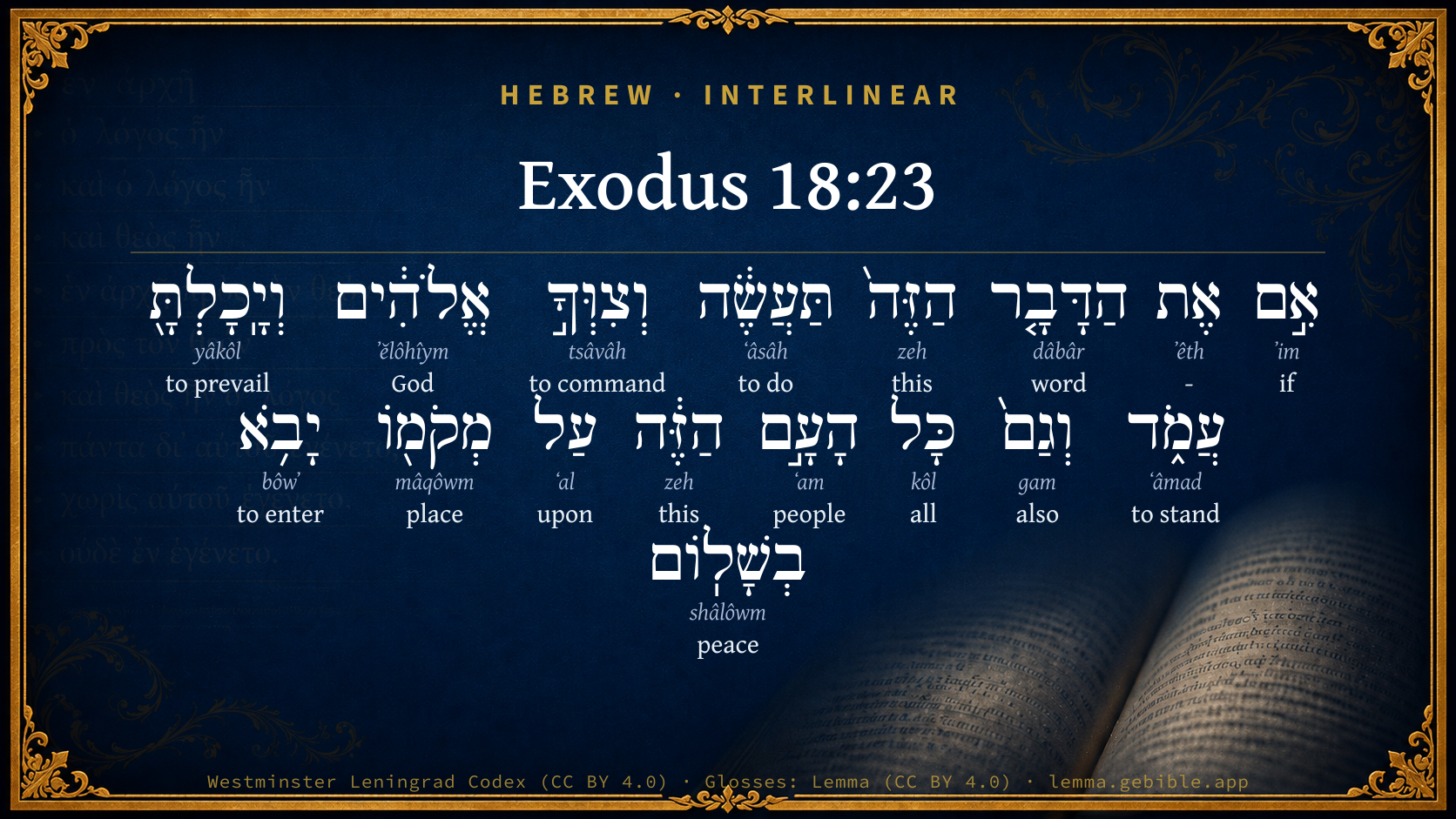
Hebrew (Westminster Leningrad Codex) Exodus 18:23 appears in the Hebrew Old Testament. The text above is from the Westminster Leningrad Codex. Each word links to its Strong’s number, a concise gloss, and parsing drawn from the Open Scriptures Hebrew Bible morphology. Click any word for its full Brown-Driver-Briggs (BDB) entry.
Download image
Cite this verse

Exodus 18:23 (World English Bible). Public Domain. Lemma interlinear Bible study tool, https://lemma.gebible.app/v/exodus/18/23.

Show BibTeX & RIS
BibTeX
RIS
English Translation
If you will do this thing, and God commands you so, then you will be able to endure, and all of these people also will go to their place in peace."
World English Bible · Public Domain
Download a study sheet

One document with this verse’s original text, its word-by-word gloss line, the meaning frame, cross-references with their text, attributed commentary, and full source and license credits — printable, and it pastes into notes with its structure intact.

This verse Autodidact and up

Study sheet (.html) Plain text (.txt)

A passage Seminary Student

Up to 50 verses in one chapter. A passage sheet keeps up to 6 commentary sources and 12 cross-references per verse, in the order this page ranks them, and says so on the sheet whenever that leaves anything out. Ask for a single verse and you get the Autodidact verse sheet above.

Everything on this page stays free to read, with no account — the sheet is a download of what is already on screen, not access to it.

Want to remove ads? Support Godless Engineer
Compare translations 3

The same verse in 3 English versions, stacked beneath the original-language interlinear above. Click any original word for its lexicon entry.

Each is an independent rendering of the whole verse — the interlinear is not word-aligned to these translations.

Highlighted words mark where these versions differ — a whole-verse word diff, not a word-by-word alignment.

  • World English Bible Public Domain
    If you will do this thing, and God commands you so, then you will be able to endure, and all of these people also will go to their place in peace."
  • King James Version Public Domain
    If thou shalt do this thing, and God command thee so, then thou shalt be able to endure, and all this people shall also go to their place in peace.
  • unfoldingWord Literal Text CC BY-SA 4.0
    If you do this thing, and God instructs you, then you will be able to endure, and furthermore, all of this people will go to its place in peace.”

unfoldingWord Literal Text — © unfoldingWord, licensed CC BY-SA 4.0. Word-aligned USFM3 via Door43 (git.door43.org/unfoldingWord/en_ult).

Versions to compare (up to 4)

3 of 4 selected

Show all 18 translations

Every available English version of this verse, each an independent rendering of the whole verse.

  • World English Bible Public Domain
    If you will do this thing, and God commands you so, then you will be able to endure, and all of these people also will go to their place in peace."
  • Berean Standard Bible Public Domain
    If you follow this advice and God so directs you, then you will be able to endure, and all these people can go home in peace.”
  • Majority Standard Bible Public Domain
    If you follow this advice and God so directs you, then you will be able to endure, and all these people can go home in peace.”
  • King James Version Public Domain
    If thou shalt do this thing, and God command thee so, then thou shalt be able to endure, and all this people shall also go to their place in peace.
  • American Standard Version (1901) Public Domain
    If thou shalt do this thing, and God command thee so, then thou shalt be able to endure, and all this people also shall go to their place in peace.
  • Revised Version (1885) Public Domain
    If thou shalt do this thing, and God command thee so, then thou shalt be able to endure, and all this people also shall go to their place in peace.
  • Geneva Bible (1599) Public Domain
    If thou do this thing, (and God so command thee) both thou shalt be able to endure, and all this people shall also go quietly to their place.
  • Douay-Rheims (1899) Public Domain
    If thou dost this, thou shalt fulfil the commandment of God, and shalt be able to bear his precepts: and all this people shall return to their places with peace.
  • Young's Literal Translation Public Domain
    If thou dost this thing, and God hath commanded thee, then thou hast been able to stand, and all this people also goeth in unto its place in peace.'
  • Literal Standard Version CC BY-SA 4.0
    If you do this thing, and God has commanded you, then you have been able to stand, and all this people also goes to its place in peace.”
  • Unlocked Literal Bible CC BY-SA 4.0
    If you do this, and if God commands you to do so, then you will be able to endure, and the entire people will be able to go home satisfied.”
  • unfoldingWord Literal Text CC BY-SA 4.0
    If you do this thing, and God instructs you, then you will be able to endure, and furthermore, all of this people will go to its place in peace.”
  • Darby Bible Public Domain
    If thou do this thing, and God command thee [so], thou wilt be able to endure, and all this people shall also go to their place in peace.
  • World Messianic Bible Public Domain
    If you will do this thing, and God commands you so, then you will be able to endure, and all these people also will go to their place in peace.”
  • Webster's Bible Public Domain
    If thou shalt do this thing, and God command thee so, then thou shalt be able to endure, and all this people shall also go to their place in peace.
  • Free Bible Version CC BY-SA 4.0
    If you follow my advice, and if it's what God tells you to do, then you will be able to survive, and all these people can go home satisfied that their cases have been heard.”
  • Bible in Basic English Public Domain
    If you do this, and God gives approval, then you will be able to go on without weariness, and all this people will go to their tents in peace.
  • JPS Tanakh (1917) Public Domain
    If thou shalt do this thing, and God command thee so, then thou shalt be able to endure, and all this people also shall go to their place in peace.'

Literal Standard Version (2020), Covenant Press — licensed CC BY-SA 4.0. Text via the HelloAO Bible API (eBible.org). Unlocked Literal Bible (unfoldingWord) — licensed CC BY-SA 4.0. Text via the HelloAO Bible API (eBible.org). unfoldingWord Literal Text — © unfoldingWord, licensed CC BY-SA 4.0. Word-aligned USFM3 via Door43 (git.door43.org/unfoldingWord/en_ult). Free Bible Version, Dr. Jonathan Gallagher — licensed CC BY-SA 4.0. Text via the HelloAO Bible API (eBible.org).

Word by word

More ways to search: Search by grammar → Find every occurrence → Compare this word →

Practice this passage: Drill this verse → Learn its vocabulary →

וְיָֽכָלְתָּ֖
yâkôl
H3201
“and · to prevail”
Conjunction + Verb, Qal, Sequential Perfect, 2nd Person, Masculine, Singular
Part of Speech
Conjunction + Verb
Stem
Qal
Form
Sequential Perfect
Person
2nd Person
Gender
Masculine
Number
Singular
Full BDB Definition

Origin: a primitive root

TWOT: 866

to prevail, overcome, endure, have power, be able - (Qal) - to be able, be able to gain or accomplish, be able to endure, be able to reach - to prevail, prevail over or against, overcome, be victor - to have ability, have strength
  1. אִ֣ם ʼim H518 “if” Conjunction
  2. אֶת ʼêth H853 “-” Particle, Direct Object
  3. הַדָּבָ֤ר dâbâr H1697 “the · word” Particle, Definite Article + Noun, Common, Masculine, Singular, Absolute
  4. הַזֶּה֙ zeh H2088 “the · this” Particle, Definite Article + Pronoun, Demonstrative, Masculine, Singular
  5. תַּעֲשֶׂ֔ה ʻâsâh H6213 “to do” Verb, Qal, Imperfect, 2nd Person, Masculine, Singular
  6. וְצִוְּךָ֣ tsâvâh H6680 “and · to command · you” Conjunction + Verb, Piel, Sequential Perfect, 3rd Person, Masculine, Singular + Suffix, Personal, 2nd Person, Masculine, Singular
  7. אֱלֹהִ֔ים ʼĕlôhîym H430 “God(s)” Noun, Common, Masculine, Plural, Absolute
  8. עֲמֹ֑ד ʻâmad H5975 “to stand” Verb, Qal, Infinitive Construct
  9. וְגַם֙ gam H1571 “and · also” Conjunction + Particle, Accusative
  10. כָּל kôl H3605 “all of” Noun, Common, Masculine, Singular, Construct
  11. הָעָ֣ם ʻam H5971 “the · people” Particle, Definite Article + Noun, Common, Masculine, Singular, Absolute
  12. הַזֶּ֔ה zeh H2088 “the · this” Particle, Definite Article + Pronoun, Demonstrative, Masculine, Singular
  13. עַל ʻal H5921 “upon” Preposition
  14. מְקֹמ֖וֹ mâqôwm H4725 “place · his” Noun, Common, Masculine, Singular, Construct + Suffix, Personal, 3rd Person, Masculine, Singular
  15. יָבֹ֥א bôwʼ H935 “to enter” Verb, Qal, Imperfect, 3rd Person, Masculine, Singular
  16. בְשָׁלֽוֹם shâlôwm H7965 “in/at · peace” Preposition + Noun, Common, Masculine, Singular, Absolute

About this verse

These counts appear in no published source. They are computed here, from the morphology-tagged text and Lemma’s own curated glosses. What Lemma adds →

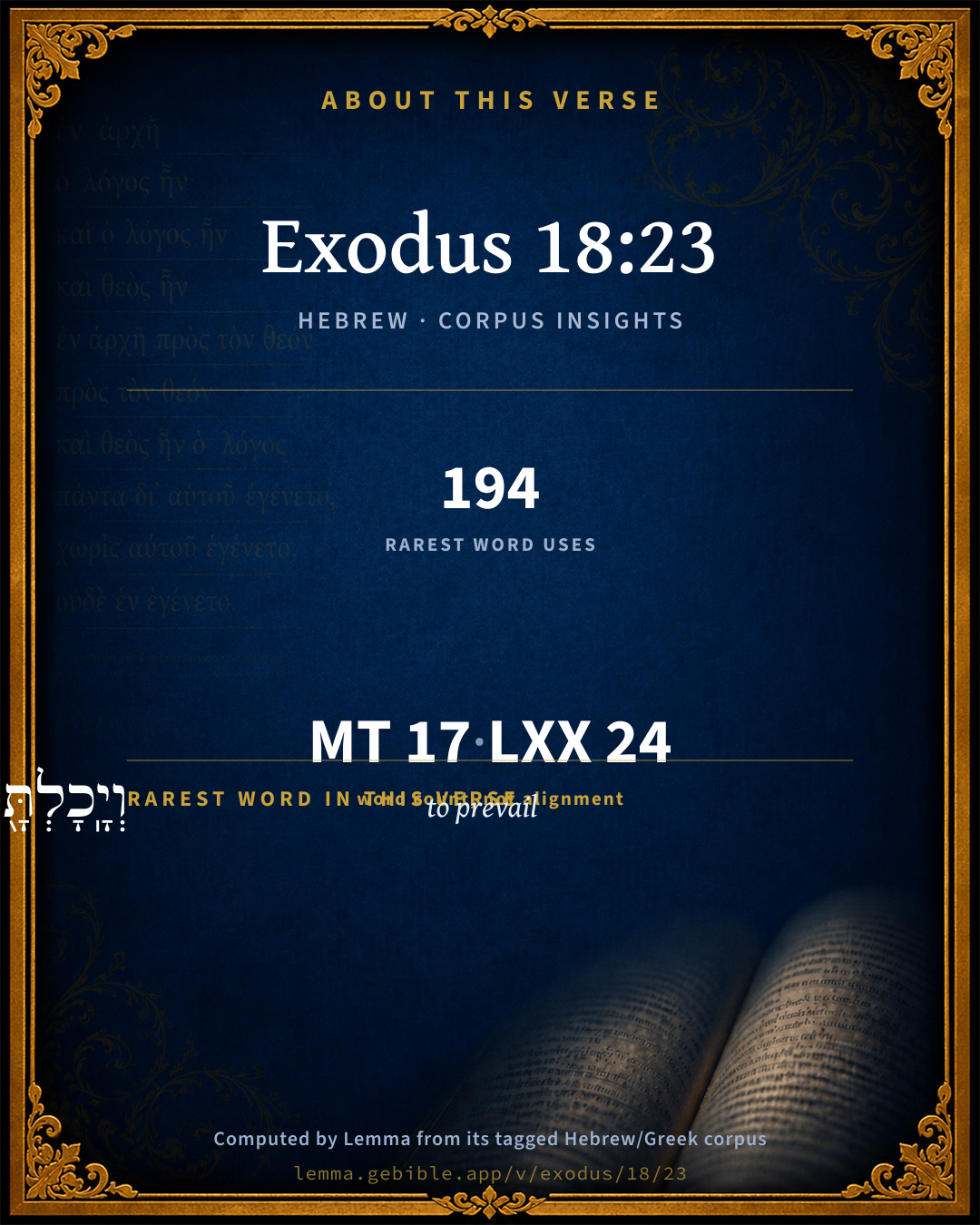
17
words
16
distinct lemmas
Pentateuch
section

Grammatical profile

  • 5 verbs
  • 6 nouns
  • 2 pronouns
  • 1 preposition
  • 1 conjunction
  • 2 particles

Verb forms

  • תַּעֲשֶׂ֔ה Qal · Imperfect
  • וְצִוְּךָ֣ Piel · Sequential Perfect
  • וְיָֽכָלְתָּ֖ Qal · Sequential Perfect
  • עֲמֹ֑ד Qal · Infinitive Construct
  • יָבֹ֥א Qal · Imperfect

Repetition

A word recurs within this verse — often emphatic in Hebrew:

  • הַזֶּה֙ this H2088 ×2

Hebrew & Septuagint length

In English translation the verse runs 31 words from the Hebrew and 29 from the Septuagint (LXX English) — closely comparable.

A rough comparison of the two English renderings, which tokenize alike — not a word-level alignment.

Word counts can differ between the Hebrew and the Greek without any difference in meaning — e.g. the Hebrew direct-object marker אֵת has no separate Greek word, and Greek often adds the article ὁ.

In the original languages it is 17 Hebrew tokens and 24 Greek tokens — but the two are counted differently (Hebrew bundles its prefixes and suffixes into one token; the Greek is in lemma form), so that isn’t a like-for-like length.

Cross-references

6

Topical passages linked to Exodus 18:23 in the Treasury of Scripture Knowledge — connected by theme and wording, ordered by reader-vote popularity; previews shown in the World English Bible.

  • Exodus 18:18 You will surely wear away, both you, and this people that is with you; for the thing is too heavy for you. You are not able to perform it yourself alone.
  • 1 Samuel 8:6–7 But the thing displeased Samuel, when they said, Give us a king to judge us. Samuel prayed to Yahweh.
  • 1 Samuel 8:22 Yahweh said to Samuel, Listen to their voice, and make them a king. Samuel said to the men of Israel, Go you every man to his city.
  • Genesis 18:33 Yahweh went his way, as soon as he had finished communing with Abraham, and Abraham returned to his place.
  • Genesis 21:10–12 Therefore she said to Abraham, "Cast out this handmaid and her son! For the son of this handmaid will not be heir with my son, even with Isaac."
  • 2 Samuel 18:3 But the people said, You shall not go forth: for if we flee away, they will not care for us; neither if half of us die, will they care for us: but you are worth ten thousand of us; therefore now it is better that you are ready to help us out of the city.

Cross-references courtesy of OpenBible.info (CC BY 4.0).

Hebrew and Greek witnesses Masoretic Hebrew ↔ Greek Septuagint

The same verse in the two great witnesses to the Old Testament, shown verse-for-verse.

These are two independent witnesses, not word-aligned to each other, and the Septuagint is shown in lemma (dictionary) form.

Hebrew Exodus 18:23 Masoretic · Westminster Leningrad Codex

אִ֣ם אֶת הַדָּבָ֤ר הַזֶּה֙ תַּעֲשֶׂ֔ה וְצִוְּךָ֣ אֱלֹהִ֔ים וְיָֽכָלְתָּ֖ עֲמֹ֑ד וְגַם֙ כָּל הָעָ֣ם הַזֶּ֔ה עַל מְקֹמ֖וֹ יָבֹ֥א בְשָׁלֽוֹם

If you will do this thing, and God commands you so, then you will be able to endure, and all of these people also will go to their place in peace."

World English Bible · Public Domain

Greek LXX Exodus 18:23 Septuagint · lemma form

ἐάν ὁ ῥῆμα οὗτος ποιέω καταισχύω σύ ὁ θεός καί δύναμαι παραἵστημι καί πᾶς ὁ λαός οὗτος εἰς ὁ ἑαυτοῦ τόπος μετά εἰρήνη ἥκω

If you will do this thing, God shall strengthen you, and you shall be able to attend, and all this people shall come with peace into their own place.

LXX2012 (modern English Septuagint) · Public Domain

Hebrew: Westminster Leningrad Codex (CC BY 4.0). Greek: Septuagint (public domain); English from LXX2012 (modern English Septuagint) (Public Domain). How the Septuagint differs from the Hebrew →

Targum (Aramaic paraphrase)

2

The Targum is the ancient Jewish Aramaic paraphrase of the Hebrew Scriptures — an interpretive translation, not the Hebrew text itself. Onkelos (literal) and Pseudo-Jonathan (expansive) render the Torah, and Jonathan the Prophets. Coverage is partial: where no permissively-licensed English translation exists for a verse, only the Aramaic is shown. This is verse-level text, not a word-by-word alignment to the Hebrew.

  1. Targum Onkelos Torah (Genesis–Deuteronomy)
    אִם יָת פִּתְגָמָא הָדֵין תַּעְבֵּד וִיפַקְדִנָךְ יְיָ וְתִכּוֹל לְמֵיקָם וְאַף כָּל עַמָא הָדֵין עַל אַתְרֵהּ יְהַךְ בִּשְׁלָם:

    (no public-domain English translation for this verse)

    Targum Onkelos — Aramaic: “Onkelos Genesis” (public domain); “Onkelos Exodus” (public domain); “Onkelos Leviticus” (public domain); “Onkelos Numbers” (public domain); “Onkelos Deuteronomy” (public domain). English: “Sefaria Community Translation” (CC0 1.0 (public-domain dedication)); “J.W. Etheridge. The Targums of Onkelos and Jonathan Ben Uzziel on the Pentateuch. London: Longmans, Green, 1862” (public domain). Text via Sefaria.

  2. Targum Pseudo-Jonathan Torah (Genesis–Deuteronomy)
    אִין יַת פִּתְגָמָא הָדֵין תַּעֲבֵיד דְּתֵיהֵי פָנֵי מִן דִּינָא וְיַפְקְדִינָךְ יְיָ פְּקוּדַיָא וְתֵיכוּל לְמֵיקָם לְמִשְׁמָעֵהוֹן וְאוּף אַהֲרן וּבְנוֹי וְכָל סָבַיָא דְעַמָא הָדֵין עַל אֲתַר בֵּי דִינְהוֹן יֵיתוּן בִּשְׁלָם

    If thou wilt do this, and exempt thyself from judging (every case) as the Lord shall give thee instruction, thou wilt be able to continue to hear them; and Aharon also and his sons, and all the elders of this people, will resort to the place of Judgment in peace.

    Targum Pseudo-Jonathan — Aramaic: “Targum Jonathan on Genesis” (public domain); “Targum Jonathan on Exodus” (public domain); “Targum Jonathan on Leviticus” (public domain); “Targum Jonathan on Numbers” (public domain); “Targum Jonathan on Deuteronomy” (public domain). English: “The Targum of Jonathan ben Uzziel, trans. J. W. Etheridge, London, 1862” (public domain). Text via Sefaria.

Commentary

Notes on Exodus 18:23 from classic Christian and Jewish commentators (each source and its license shown beneath its notes). The classic Christian expositions comment on the surrounding passage and are grouped to its opening verse, so a note may address several verses; the Jewish commentaries on the Tanakh (Rashi and others) are per-verse, so they appear only where the commentator wrote on this verse.

Lemma curates 59 commentaries, every one of them public domain or Creative Commons licensed, each selected and text-cleaned for this edition rather than reprinted as found. About our sources →

Trapp's Complete Commentary

John Trapp

Exo 18:23 If thou shalt do this thing, and God command thee [so], then thou shalt be able to endure, and all this people shall also go to their place in peace.

Ver. 23. To their place.] To the Promised Land, or to their own homes, well apaid, and with good content.

John Trapp, A Commentary or Exposition upon All the Books of the Old and New Testament (1647–1656) — public domain. Text from a community e-Sword module.

Jamieson, Fausset & Brown

Robert Jamieson, A. R. Fausset & David Brown

If thou shalt do this thing, &c.--Jethro's counsel was given merely in the form of a suggestion; it was not to be adopted without the express sanction and approval of a better and higher Counsellor; and although we are not informed of it, there can be no doubt that Moses, before appointing subordinate magistrates, would ask the mind of God, as it is the duty and privilege of every Christian in like manner to supplicate the divine direction in all his ways.

Next: Exodus Chapter 19

Jamieson, Fausset & Brown — Commentary Critical and Explanatory on the Whole Bible (1871) — public domain (CC PDM 1.0). Text via the HelloAO Bible API.

Adam Clarke's Commentary

Verse 23. If thou shalt do this thing, and God command thee] Though the measure was obviously of the utmost importance, and plainly recommended itself by its expediency and necessity; yet Jethro very modestly leaves it to the wisdom of Moses to choose or reject it; and, knowing that in all things his relative was now acting under the immediate direction of God, intimates that no measure can be safely adopted without a positive injunction from God himself. As the counsel was doubtless inspired by the Divine Spirit, we find that it was sanctioned by the same, for Moses acted in every respect according to the advice he had received.

Adam Clarke's Commentary on the Bible (1810–1826) — public domain. Text from a community e-Sword/MySword module.

Ellicott's Commentary for English Readers

(23) If thou shalt do this thing, and God command thee so.—A reference of the entire matter to God, before any final decision was made, is plainly indicated. Moses must have already had some mode of consulting God on any point which required to be settled, and obtaining an answer. Was it by the “Urim and Thummim”?

Thou shalt be able to endure.—Comp. Exo_18:18, where the inability of Moses to endure, unless he made some change, was strongly asserted.

And all this people shall also go to their place in peace.—The people, i.e., will go on their way to Canaan peacefully and contentedly, without suffering the inconvenience to which they are now subject.

A Bible Commentary for English Readers, edited by Charles John Ellicott (1878–1897) — public domain. Text from a community e-Sword module.

The Cambridge Bible for Schools and Colleges

gen. ed. J. J. S. Perowne

23. this thing] Their position in the Heb. shews that these words are emphatic.

command thee so] i.e. approve and sanction thy doing this.

go to their place in peace] return quickly to their houses satisfied, without having to stand all the day before Moses (v. 14).

The Cambridge Bible for Schools and Colleges (gen. ed. J. J. S. Perowne; Cambridge University Press, 1878–1918) — public domain. Text from a community e-Sword module.

John Gill's Exposition

So Moses hearkened to the voice of his father in law,.... Considered what he said, weighed it well in his mind, and judged it good advice, and determined to follow it:

and did all that he had said; by choosing such men as he directed to, and committing the judgment of the people to them, as follows:

John Gill's Exposition of the Whole Bible (1746–1763) — public domain (CC PDM 1.0). Text via the HelloAO Bible API.

Albert Barnes' Notes on the Bible

To their place - i. e. to Canaan, which is thus recognized by Jethro as the appointed and true home of Israel. Compare Num 10:29-30.

Albert Barnes' Notes on the Bible (1834–1885) — public domain. Text from a community e-Sword/MySword module.

Haydock's Catholic Bible Commentary

Thou shalt. Hebrew, "and God shall order thee." Jethro does not wish his advice should be followed, till God had been consulted. (Calmet) --- By his plan, he thought Moses would have time to confer more with God, and promote his own welfare, and the convenient dispatch of business. (Menochius)

George Leo Haydock (1774–1849), Haydock's Catholic Family Bible and Commentary, 1859 edition — public domain. Excludes Psalms (Douay-Rheims chapter numbering differs from Protestant) and Deuterocanonical books (Catholic canon only).

Matthew Poole's English Annotations

If God approve of the course which I suggest, to whose wisdom I submit my opinion. For Jethro might well think that Moses neither would nor might make so great an alteration in the government without consulting God about it, and expecting his answer. Others render the place thus, both God will give thee his commands, i.e. thou wilt have leisure to ask and take his counsel in all emergencies, which now thou hast not,

and thou wilt be able to endure.

To their place; to their several habitations, which are called men’s places, Jdg 7:7; 9:55; 19:28,29; where their calling and business lies, from which they are now diverted and detained by fruitless and wearisome attendances.

In peace, orderly and quietly, having their minds much eased by this course, and their contentions soon ended.

Matthew Poole's English Annotations on the Holy Bible (1683–1685) — public domain. Text from a community e-Sword/MySword module.

Whedon's Commentary on the Bible

Daniel D. Whedon

23. To their place — Some think that Jethro here refers to Canaan as the promised home or place of Israel. But the more simple reference is to the common place of abode, the tent or home, to which the people, having had their matters of controversy adjusted, could speedily return.

Daniel D. Whedon (gen. ed.), Commentary on the Old and New Testaments (1874–1909) — public domain. Text from a community e-Sword module.

The Pulpit Commentary

And God command thee so. Jethro does not suppose that Moses will take his advice without further consultation. He assumes that the matter will be laid by Moses before God, and God"s will learnt concerning it. The entire narrative supposes that there was some established means by which the Israelite leader could refer a matter to Jehovah and obtain a decision upon it. This can scarcely have been as yet the Urim and Thummim. Probably Moses held frequent communication with Jehovah by means of waking visions. Thou shalt be able to endurei.e., "the work will not be too much for thee thou wilt be able to bear it." This people shall also go to their place in peace. The "place" intended would seem to be Palestine. Keil supposes that the word "peace" is to be taken literally, and concludes from it that breaches of the peace had previously been frequent, the people having "often taken the law into their own hands on account of the delay in the judicial decision;" but this is to extract from the words more than they naturally signify. "In peace" means "cheerfully, contentedly." If the changes which he recommends are carried out, Jethro thinks that the people will make the rest of the journey to Canaan quietly and contentedly, without complaint or dissatisfaction.

The Pulpit Commentary (1880–1919), ed. H.D.M. Spence-Jones & Joseph S. Exell — public domain. Text from a community e-Sword module.

Rashi

Rabbi Shlomo Yitzchaki (Rashi)

וצוך אלהים ויכלת עמד This implies: Consult the Almighty; if He commands thee to do this, thou wilt be able to stand, and if He prevents thee thou wilt be unable to stand (Mekhilta).

וגם כל העם הזה AND ALL THIS PEOPLE ALSO — Aaron, Nadab and Abihu and the seventy elders who are now associated with you (Mekhilta).

Rashi on the Tanakh — English translations: “The Judaica Press complete Tanach with Rashi, translated by A. J. Rosenberg” (CC BY 4.0); “Pentateuch with Rashi's commentary by M. Rosenbaum and A.M. Silbermann, 1929-1934” (public domain); “The Metsudah Tanach series, Lakewood, N.J” (CC BY 4.0); and “The Book of Joshua, Metsudah Publications, 1997” (CC BY 4.0). Text via Sefaria.

Lesson kit

Teaching starters — assembled from the data on this page, not authored interpretation. Every prompt links to the verse data it draws on. Edit before teaching.

Exodus, in the Pentateuch, opens this verse with 17 words (16 distinct Hebrew lemmas). Its most distinctive word is yâkôl (“to prevail”). A historical commentator’s framing appears above. Read the whole chapter for the surrounding context.

Discussion questions

  1. How does “to prevail” (yâkôl) shape what this verse is saying?
  2. Exodus 18:18 shares this passage’s theme. How do the two illuminate each other?
  3. “this” occurs 2× in this one verse. What is the effect of the repetition?
  4. The translations on this page render this verse differently — a whole-verse word diff, not a word-by-word alignment. What might account for the different wordings?
  5. The verb «תַּעֲשֶׂ֔ה» is Qal Imperfect. How does its form color the action?
  6. Reading how Trapp's Complete Commentary and Jamieson, Fausset & Brown read this verse, where do the two commentators agree and where do they part?

Things to notice

Reading settings

Reading text

Shown beneath each verse's original-language words.

Old Testament
Old Testament edition

Read the OT as the Masoretic Hebrew (MT) or the Greek Septuagint (LXX).

English shown for the Greek Septuagint (in the Hebrew ↔ Greek comparison).

Comparing translations? Open the Compare panel on any verse page to stack up to four side by side.