Nehemiah 1:8

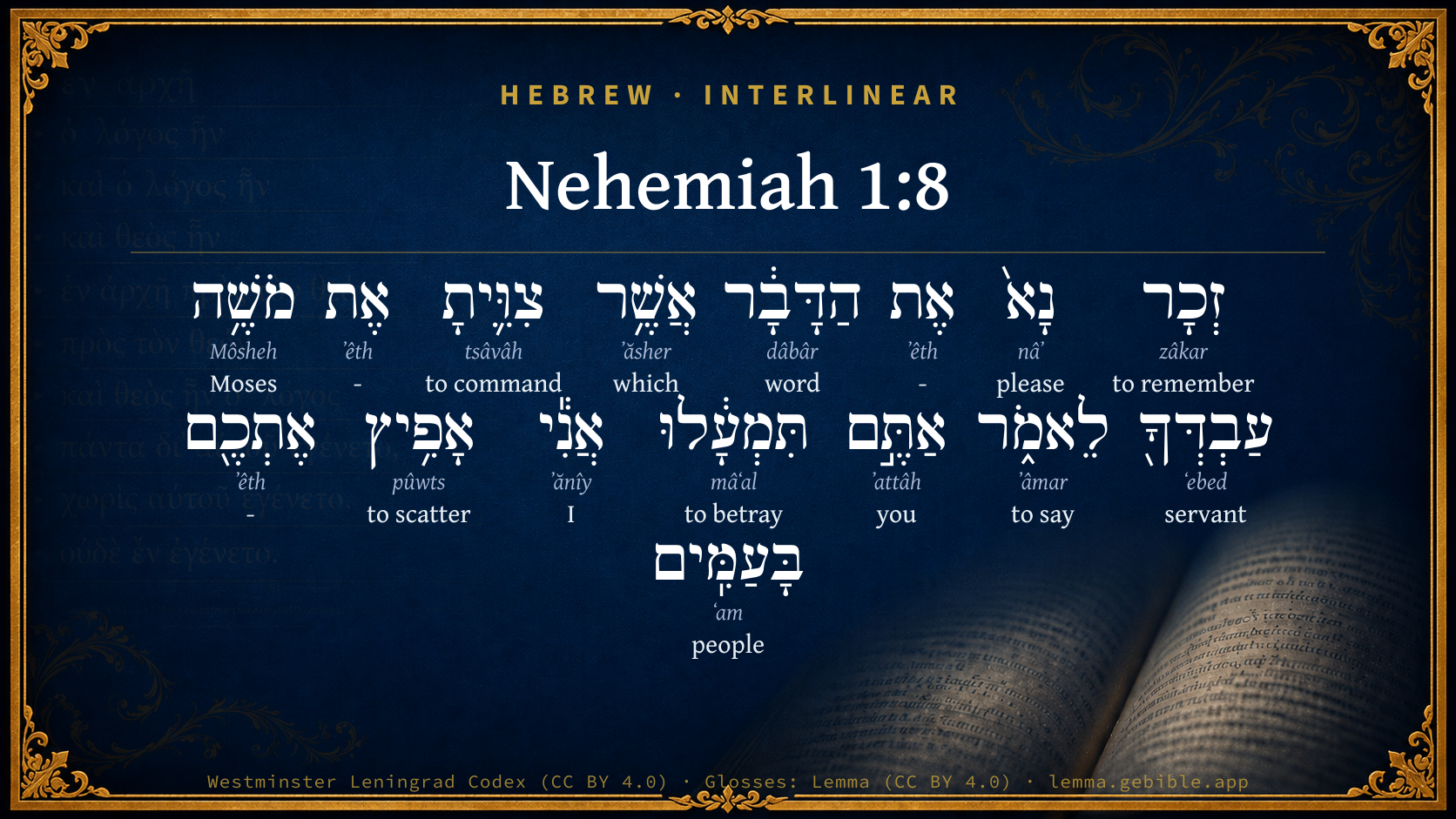
Hebrew (Westminster Leningrad Codex) Nehemiah 1:8 appears in the Hebrew Old Testament. The text above is from the Westminster Leningrad Codex. Each word links to its Strong’s number, a concise gloss, and parsing drawn from the Open Scriptures Hebrew Bible morphology. Click any word for its full Brown-Driver-Briggs (BDB) entry.
Download image
Cite this verse

Nehemiah 1:8 (World English Bible). Public Domain. Lemma interlinear Bible study tool, https://lemma.gebible.app/v/nehemiah/1/8.

Show BibTeX & RIS
BibTeX
RIS
English Translation
Remember, I beg you, the word that you commanded your servant Moses, saying, If you trespass, I will scatter you abroad among the peoples:
World English Bible · Public Domain
Download a study sheet

One document with this verse’s original text, its word-by-word gloss line, the meaning frame, cross-references with their text, attributed commentary, and full source and license credits — printable, and it pastes into notes with its structure intact.

This verse Autodidact and up

Study sheet (.html) Plain text (.txt)

A passage Seminary Student

Up to 50 verses in one chapter. A passage sheet keeps up to 6 commentary sources and 12 cross-references per verse, in the order this page ranks them, and says so on the sheet whenever that leaves anything out. Ask for a single verse and you get the Autodidact verse sheet above.

Everything on this page stays free to read, with no account — the sheet is a download of what is already on screen, not access to it.

Want to remove ads? Support Godless Engineer
Compare translations 3

The same verse in 3 English versions, stacked beneath the original-language interlinear above. Click any original word for its lexicon entry.

Each is an independent rendering of the whole verse — the interlinear is not word-aligned to these translations.

Highlighted words mark where these versions differ — a whole-verse word diff, not a word-by-word alignment.

  • World English Bible Public Domain
    Remember, I beg you, the word that you commanded your servant Moses, saying, If you trespass, I will scatter you abroad among the peoples:
  • King James Version Public Domain
    Remember, I beseech thee, the word that thou commandedst thy servant Moses, saying, If ye transgress, I will scatter you abroad among the nations:
  • unfoldingWord Literal Text CC BY-SA 4.0
    Please remember the word that you commanded Moses your servant, saying, ‘If you yourselves act unfaithfully, I myself will scatter you among the peoples.

unfoldingWord Literal Text — © unfoldingWord, licensed CC BY-SA 4.0. Word-aligned USFM3 via Door43 (git.door43.org/unfoldingWord/en_ult).

Versions to compare (up to 4)

3 of 4 selected

Show all 18 translations

Every available English version of this verse, each an independent rendering of the whole verse.

  • World English Bible Public Domain
    Remember, I beg you, the word that you commanded your servant Moses, saying, If you trespass, I will scatter you abroad among the peoples:
  • Berean Standard Bible Public Domain
    Remember, I pray, the word that You commanded Your servant Moses when You said, ‘If you are unfaithful, I will scatter you among the nations,
  • Majority Standard Bible Public Domain
    Remember, I pray, the word that You commanded Your servant Moses when You said, ‘If you are unfaithful, I will scatter you among the nations,
  • King James Version Public Domain
    Remember, I beseech thee, the word that thou commandedst thy servant Moses, saying, If ye transgress, I will scatter you abroad among the nations:
  • American Standard Version (1901) Public Domain
    Remember, I beseech thee, the word that thou commandedst thy servant Moses, saying, If ye trespass, I will scatter you abroad among the peoples:
  • Revised Version (1885) Public Domain
    Remember, I beseech thee, the word that thou commandedst thy servant Moses, saying, If ye trespass, I will scatter you abroad among the peoples:
  • Geneva Bible (1599) Public Domain
    I beseeche thee, remember the worde that thou commandedst thy seruant Moses, saying, Ye wil transgresse, and I will scatter you abroade among the people.
  • Douay-Rheims (1899) Public Domain
    Remember the word that thou commandedst to Moses thy servant, saying: If you shall transgress, I will scatter you abroad among the nations:
  • Young's Literal Translation Public Domain
    `Remember, I pray Thee, the word that Thou didst command Moses Thy servant, saying, Ye -- ye trespass -- I scatter you among peoples;
  • Literal Standard Version CC BY-SA 4.0
    Please remember the word that You commanded Your servant Moses, saying, You trespass—I scatter you among peoples;
  • Unlocked Literal Bible CC BY-SA 4.0
    Please call to mind the word you commanded your servant Moses, 'If you act unfaithfully, I will scatter you among the nations,
  • unfoldingWord Literal Text CC BY-SA 4.0
    Please remember the word that you commanded Moses your servant, saying, ‘If you yourselves act unfaithfully, I myself will scatter you among the peoples.
  • Darby Bible Public Domain
    Remember, I beseech thee, the word that thou commandedst thy servant Moses, saying, If ye act unfaithfully, I will scatter you among the peoples;
  • World Messianic Bible Public Domain
    “Remember, I beg you, the word that you commanded your servant Moses, saying, ‘If you trespass, I will scatter you among the peoples;
  • Webster's Bible Public Domain
    Remember, I beseech thee, the word that thou commandedst thy servant Moses, saying, If ye transgress, I will scatter you abroad among the nations:
  • Free Bible Version CC BY-SA 4.0
    Please remember what you told Moses when you said, ‘If you are unfaithful, I will scatter you among the nations,
  • Bible in Basic English Public Domain
    Keep in mind, O Lord, the order you gave your servant Moses, saying, If you do wrong I will send you wandering among the peoples:
  • JPS Tanakh (1917) Public Domain
    Remember, I beseech Thee, the word that Thou didst command Thy servant Moses, saying: If ye deal treacherously, I will scatter you abroad among the peoples;

Literal Standard Version (2020), Covenant Press — licensed CC BY-SA 4.0. Text via the HelloAO Bible API (eBible.org). Unlocked Literal Bible (unfoldingWord) — licensed CC BY-SA 4.0. Text via the HelloAO Bible API (eBible.org). unfoldingWord Literal Text — © unfoldingWord, licensed CC BY-SA 4.0. Word-aligned USFM3 via Door43 (git.door43.org/unfoldingWord/en_ult). Free Bible Version, Dr. Jonathan Gallagher — licensed CC BY-SA 4.0. Text via the HelloAO Bible API (eBible.org).

Word by word

More ways to search: Search by grammar → Find every occurrence → Compare this word →

Practice this passage: Drill this verse → Learn its vocabulary →

תִּמְעָ֔לוּ
mâʻal
H4603
“to betray”
Verb, Qal, Imperfect, 2nd Person, Masculine, Plural
Part of Speech
Verb
Stem
Qal
Form
Imperfect
Person
2nd Person
Gender
Masculine
Number
Plural
Full BDB Definition

Origin: a primitive root

TWOT: 1230

to act unfaithfully, act treacherously, transgress, commit a trespass - (Qal) to act unfaithfully or treacherously - against man - against God - against devoted thing - against husband
  1. זְכָר zâkar H2142 “remember” Verb, Qal, Imperative, 2nd Person, Masculine, Singular
  2. נָא֙ nâʼ H4994 “please” Particle, Exhortation
  3. אֶת ʼêth H853 “-” Particle, Direct Object
  4. הַדָּבָ֔ר dâbâr H1697 “the · word” Particle, Definite Article + Noun, Common, Masculine, Singular, Absolute
  5. אֲשֶׁ֥ר ʼăsher H834 “which” Particle, Relative
  6. צִוִּ֛יתָ tsâvâh H6680 “to command” Verb, Piel, Perfect, 2nd Person, Masculine, Singular
  7. אֶת ʼêth H853 “-” Particle, Direct Object
  8. מֹשֶׁ֥ה Môsheh H4872 “Moses” Noun, Proper
  9. עַבְדְּךָ֖ ʻebed H5650 “servant · your” Noun, Common, Masculine, Singular, Construct + Suffix, Personal, 2nd Person, Masculine, Singular
  10. לֵאמֹ֑ר ʼâmar H559 “to say” Preposition + Verb, Qal, Infinitive Construct
  11. אַתֶּ֣ם ʼattâh H859 “you” Pronoun, Personal, 2nd Person, Masculine, Plural
  12. אֲנִ֕י ʼănîy H589 “I” Pronoun, Personal, 1st Person, Common, Singular
  13. אָפִ֥יץ pûwts H6327 “to scatter” Verb, Hiphil, Imperfect, 1st Person, Common, Singular
  14. אֶתְכֶ֖ם ʼêth H853 “- · you” Particle, Direct Object + Suffix, Personal, 2nd Person, Masculine, Plural
  15. בָּעַמִּֽים ʻam H5971 “in/at the · peoples” Preposition, Determined + Noun, Common, Masculine, Plural, Absolute

About this verse

These counts appear in no published source. They are computed here, from the morphology-tagged text and Lemma’s own curated glosses. What Lemma adds →

16
words
14
distinct lemmas
Historical
section

Shared distinctive vocabulary

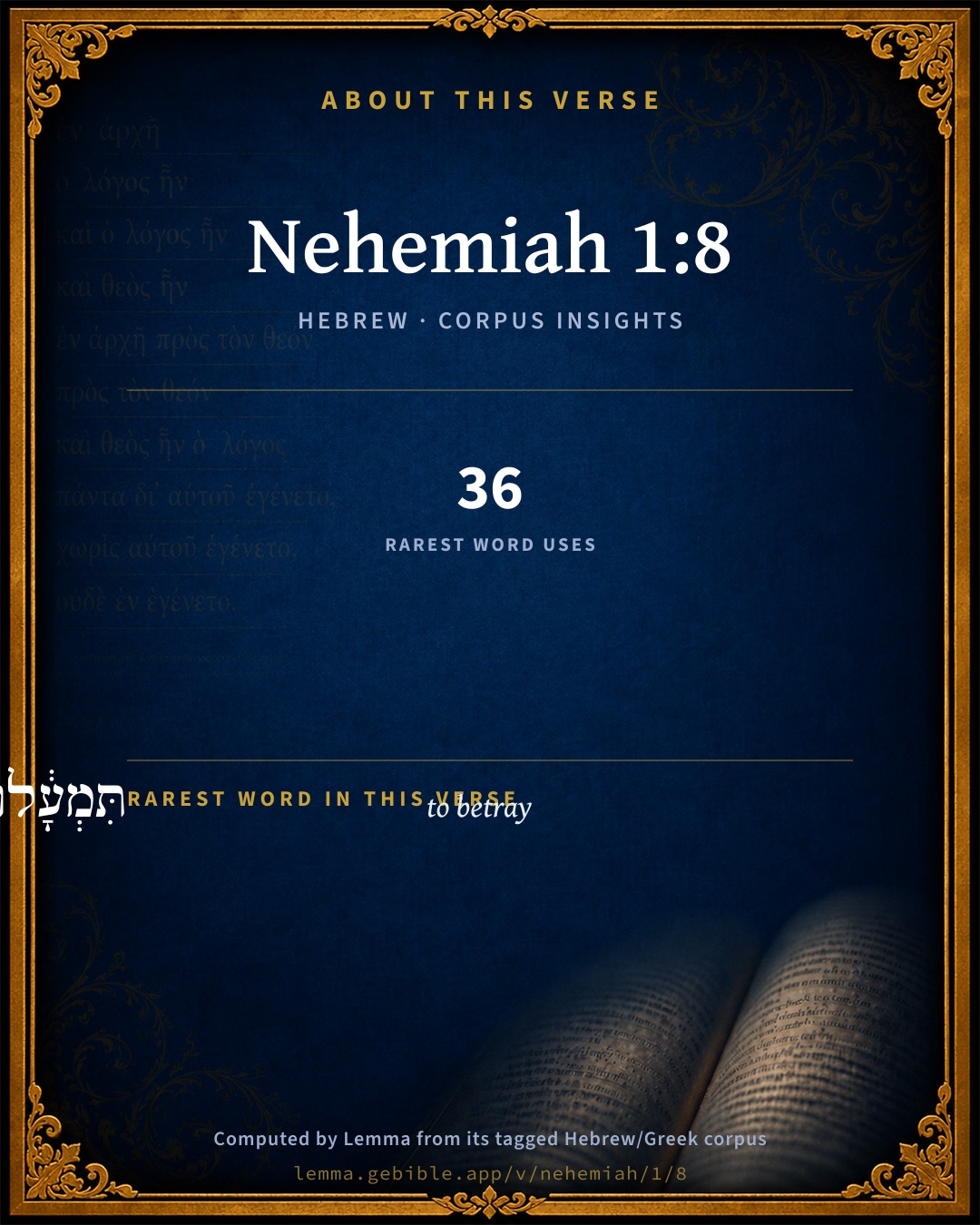
תִּמְעָ֔לוּ to betray H4603 occurs in 35 verses of the Hebrew Bible. Also found in:

Grammatical profile

  • 5 verbs
  • 4 nouns
  • 2 pronouns
  • 5 particles

Verb forms

  • זְכָר Qal · Imperative
  • צִוִּ֛יתָ Piel · Perfect
  • לֵאמֹ֑ר Qal · Infinitive Construct
  • תִּמְעָ֔לוּ Qal · Imperfect
  • אָפִ֥יץ Hiphil · Imperfect

Cross-references

7

Topical passages linked to Nehemiah 1:8 in the Treasury of Scripture Knowledge — connected by theme and wording, ordered by reader-vote popularity; previews shown in the World English Bible.

  • Deuteronomy 28:64 Yahweh will scatter you among all peoples, from the one end of the earth even to the other end of the earth; and there you shall serve other gods, which you have not known, you nor your fathers, even wood and stone.
  • Deuteronomy 4:25–27 When you shall father children, and children's children, and you shall have been long in the land, and shall corrupt yourselves, and make an engraved image in the form of anything, and shall do that which is evil in the sight of Yahweh your God, to provoke him to anger;
  • Leviticus 26:33–46 I will scatter you among the nations, and I will draw out the sword after you: and your land will be a desolation, and your cities shall be a waste.
  • 1 Kings 9:6–7 But if you shall turn away from following me, you or your children, and not keep my commandments and my statutes which I have set before you, but shall go and serve other gods, and worship them;
  • Deuteronomy 32:26–28 I said, I would scatter them afar, I would make the memory of them to cease from among men;
  • Luke 1:72 To show mercy towards our fathers, To remember his holy covenant,
  • Psalms 119:49 Remember your word to your servant, Because you gave me hope.

Cross-references courtesy of OpenBible.info (CC BY 4.0).

Hebrew and Greek witnesses Masoretic Hebrew ↔ Greek Septuagint

The same verse in the two great witnesses to the Old Testament, shown verse-for-verse.

These are two independent witnesses, not word-aligned to each other, and the Septuagint is shown in lemma (dictionary) form.

Hebrew Nehemiah 1:8 Masoretic · Westminster Leningrad Codex

זְכָר נָא֙ אֶת הַדָּבָ֔ר אֲשֶׁ֥ר צִוִּ֛יתָ אֶת מֹשֶׁ֥ה עַבְדְּךָ֖ לֵאמֹ֑ר אַתֶּ֣ם תִּמְעָ֔לוּ אֲנִ֕י אָפִ֥יץ אֶתְכֶ֖ם בָּעַמִּֽים

Remember, I beg you, the word that you commanded your servant Moses, saying, If you trespass, I will scatter you abroad among the peoples:

World English Bible · Public Domain

Greek LXX Structure differs

The Septuagint has no separate book of Nehemiah. Its Greek text is the second half of Esdras B (2 Esdras), chapters 11–23; Ezra is the first half (1–10).

A verse-for-verse comparison isn’t shown here because the chapters and verses don’t line up. Switch to the LXX edition with the MT / LXX toggle above to read the Greek directly.

Hebrew: Westminster Leningrad Codex (CC BY 4.0). Greek: Septuagint (public domain); English from a public-domain English Septuagint. How the Septuagint differs from the Hebrew →

Commentary

Notes on Nehemiah 1:8 from classic Christian and Jewish commentators (each source and its license shown beneath its notes). The classic Christian expositions comment on the surrounding passage and are grouped to its opening verse, so a note may address several verses; the Jewish commentaries on the Tanakh (Rashi and others) are per-verse, so they appear only where the commentator wrote on this verse.

Lemma curates 59 commentaries, every one of them public domain or Creative Commons licensed, each selected and text-cleaned for this edition rather than reprinted as found. About our sources →

Trapp's Complete Commentary

John Trapp

Neh 1:8 Remember, I beseech thee, the word that thou commandedst thy servant Moses, saying, [If] ye transgress, I will scatter you abroad among the nations:

Ver. 8. Remember, I beseech thee, the word] It befalleth not the Lord to forget or remember (to speak properly), for all things are present with him. Nevertheless metaphorically God is said to do both; as when, being provoked by the horrid sins of the Jews, he so punished them as if he had forgotten that they were his people, or that he had ever made them any promises. And in this case God gives his prophets and praying people leave to be his remembrancers, Isa 62:6-7. Ye that are the Lord’s remembrancers, keep not silence, and give him no rest till he establish, and till he make Jerusalem a praise in the earth. This Nehemiah doth here most vigorously, and sped accordingly; let us do likewise. Cast the labouring Church into God’s everlasting arms, and remind him of his promises burden him with them, as that martyr said; put them into suit, they are nigh the Lord day and night, 1Ki 8:59. Say, remember thy word unto thy servant, whereupon thou hast caused me to trust, Psa 119:49. And in the want of other rhetoric urge this, with repetition, Lord, thou hast promised, thou hast promised, &c. He loves to be urged with his word, to be used upon his bond, &c.

The word that thou commandest, &c.] The threatening is also to be acknowledged God’s word, as well as the promise; and the uprightness of our hearts is, to be approving by believing the one as well as the other. Sour and sweet make the best sauce; promises and menaces mingled serve to keep the heart in the best temper, as Nehemiah’s was.

John Trapp, A Commentary or Exposition upon All the Books of the Old and New Testament (1647–1656) — public domain. Text from a community e-Sword module.

Tyndale Open Study Notes

Tyndale Open Resources

1:8-9 Nehemiah recalls God’s curse on sin and his promise of restoration (Deut 4:25-31; 30:1-5). • The place . . . for my name to be honored was Jerusalem.

Tyndale Open Study Notes — © Tyndale Open Resources, licensed CC BY-SA 4.0. Text via the HelloAO Bible API.

Adam Clarke's Commentary

Verse 8. Thy servant Moses] See the parallel places in the margin, and the notes there Le 26:33 (note), De 4:25-27 (note), De 28:64 (note). Though in an enemy's country, and far from the ordinances of God, Nehemiah did not forget the law: he read his Bible well, and quotes correctly.

Adam Clarke's Commentary on the Bible (1810–1826) — public domain. Text from a community e-Sword/MySword module.

The Cambridge Bible for Schools and Colleges

gen. ed. J. J. S. Perowne

8. Remember … the word … saying] The reference here made is in general terms. No passage in the Pentateuch exactly agrees with it (cf. Neh_10:34). This may be shown by the words used in the first sentence. The Hebrew word for ‘I will scatter’ is only found in Deuteronomy in the Pentateuch: the Hebrew word for ‘transgress’ only occurs once in Deuteronomy (Deu_32:51), but in quite a different context from the threat of dispersion.

The threat of dispersion is found in the Pentateuch in Lev_26:33; Deu_4:27; Deu_28:64; Deu_30:3. The promise of restoration is given in Deu_4:29 and in Deu_30:4-5 (Lev_26:40-42). The passage most resembling the words here given is Deu_30:1-5. On ‘transgress,’ see note on Ezr_9:4.

scatter … abroad among the nations] Cf. Jer_9:16; Eze_11:16; Eze_12:15; Eze_20:23; Eze_22:15; Eze_36:19.

In the original the position of the personal pronouns is very emphatic, Ye transgress, I scatter.

For the appeal to the Lord to ‘remember,’ cf. Psa_106:4.

The Cambridge Bible for Schools and Colleges (gen. ed. J. J. S. Perowne; Cambridge University Press, 1878–1918) — public domain. Text from a community e-Sword module.

John Gill's Exposition

Remember, I beseech thee, the word that thou commandedst thy servant Moses,.... To publish and declare to the children of Israel, Deu 28:64,

saying, if ye transgress; the law of God:

I will scatter you abroad among the nations; as now they had been among the Assyrians, Chaldeans, Medes, and Persians.

John Gill's Exposition of the Whole Bible (1746–1763) — public domain (CC PDM 1.0). Text via the HelloAO Bible API.

The Pulpit Commentary

If ye transgress, etc. This is not a quotation, but a reference to the general sense of various passages, as, for instance, Lev_26:27-45 Deu_30:1-5, etc. The sacred historians habitually refer to the older Scriptures in this way, quoting them in the spirit rather than in the letter.

The Pulpit Commentary (1880–1919), ed. H.D.M. Spence-Jones & Joseph S. Exell — public domain. Text from a community e-Sword module.

unfoldingWord translationNotes

Door43 World Missions Community

Connecting Statement:

Nehemiah continues praying to God.

Please call to mind

To "call to mind" is an idiom that means to remember. AT: "Please remember" (See: Idiom)

the word you commanded your servant Moses

The pronouns "you" and "your" refer to God.

If you act unfaithfully ... scatter you ... if you return ... your people

The pronouns "you" and "your" are plural and refer to the Israelite people.

I will scatter you among the nations

Yahweh speaks of causing the Israelite people to live in other nations as if he scattered them like one would scatter seeds. AT: "I will cause you to live among the nations" (See: Metaphor)

though your people were scattered

This can be stated in active form. AT: "though I scattered your people" (See: Active or Passive)

under the farthest skies

Yahweh speaks of places on the earth that are very far away as being "under the farthest skies." AT: "to places very far away" (See: Idiom)

to that place where I have chosen ... remain

This phrase refers to Jerusalem, where the temple was located. AT: "to Jerusalem, where I have chosen ... remain" (See: Assumed Knowledge and Implicit Information)

where I have chosen to make my name remain

Here the word "name" represents Yahweh himself. AT: "where I have chosen to dwell" (See: Metonymy)

translationWords

call

mind

word

command

servant

Moses

faithful

nation

heaven

name

unfoldingWord translationNotes — © Distant Shores Media and the Door43 World Missions Community, licensed CC BY-SA 4.0. Source: git.door43.org/Door43/en_tn.

Lesson kit

Teaching starters — assembled from the data on this page, not authored interpretation. Every prompt links to the verse data it draws on. Edit before teaching.

Nehemiah, in the Historical, opens this verse with 16 words (14 distinct Hebrew lemmas). Its most distinctive word is mâʻal (“to betray”). A historical commentator’s framing appears above. Read the whole chapter for the surrounding context.

Discussion questions

  1. How does “to betray” (mâʻal) shape what this verse is saying?
  2. Leviticus 5:15 shares the word «to betray» with this verse. How do the two illuminate each other?
  3. These translations render this verse differently; the difference is in the English rendering, not the original. What questions does that raise?
  4. The verb «זְכָר» is Qal Imperative. How does its form color the action?
  5. Reading how Trapp's Complete Commentary and Tyndale Open Study Notes read this verse, where do the two commentators agree and where do they part?

Things to notice

Reading settings

Reading text

Shown beneath each verse's original-language words.

Old Testament
Old Testament edition

Read the OT as the Masoretic Hebrew (MT) or the Greek Septuagint (LXX).

English shown for the Greek Septuagint (in the Hebrew ↔ Greek comparison).

Comparing translations? Open the Compare panel on any verse page to stack up to four side by side.