
Exodus 6:13

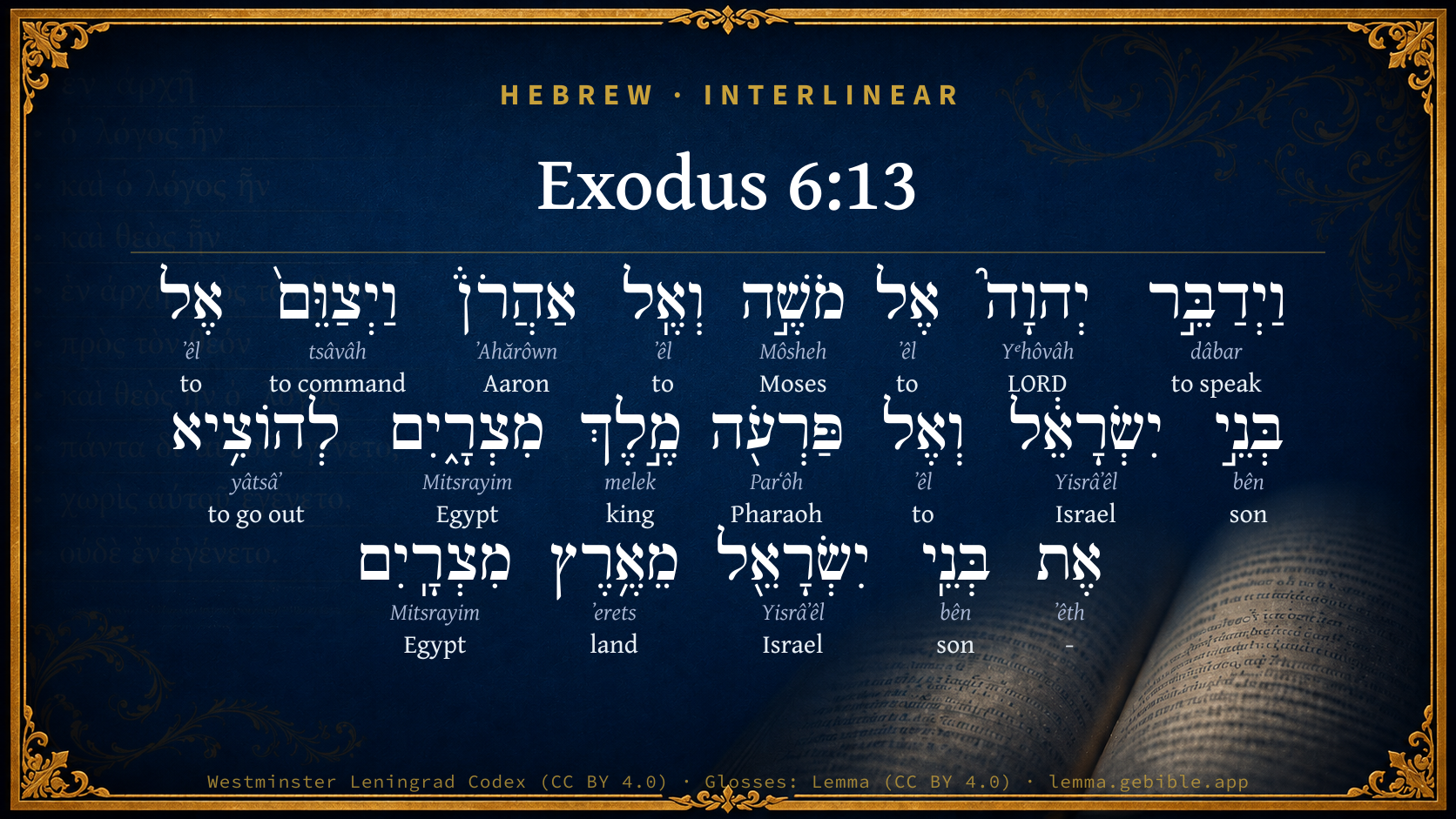
Hebrew (Westminster Leningrad Codex) Exodus 6:13 appears in the Hebrew Old Testament. The text above is from the Westminster Leningrad Codex. Each word links to its Strong’s number, a concise gloss, and parsing drawn from the Open Scriptures Hebrew Bible morphology. Click any word for its full Brown-Driver-Briggs (BDB) entry.
Download image
Cite this verse

Exodus 6:13 (World English Bible). Public Domain. Lemma interlinear Bible study tool, https://lemma.gebible.app/v/exodus/6/13.

Show BibTeX & RIS
BibTeX
RIS
English Translation
Yahweh spoke to Moses and to Aaron, and gave them a charge to the children of Israel, and to Pharaoh king of Egypt, to bring the children of Israel out of the land of Egypt.
World English Bible · Public Domain
Download a study sheet

One document with this verse’s original text, its word-by-word gloss line, the meaning frame, cross-references with their text, attributed commentary, and full source and license credits — printable, and it pastes into notes with its structure intact.

This verse Autodidact and up

Study sheet (.html) Plain text (.txt)

A passage Seminary Student

Up to 50 verses in one chapter. A passage sheet keeps up to 6 commentary sources and 12 cross-references per verse, in the order this page ranks them, and says so on the sheet whenever that leaves anything out. Ask for a single verse and you get the Autodidact verse sheet above.

Everything on this page stays free to read, with no account — the sheet is a download of what is already on screen, not access to it.

Want to remove ads? Support Godless Engineer
Compare translations 3

The same verse in 3 English versions, stacked beneath the original-language interlinear above. Click any original word for its lexicon entry.

Each is an independent rendering of the whole verse — the interlinear is not word-aligned to these translations.

Highlighted words mark where these versions differ — a whole-verse word diff, not a word-by-word alignment.

  • World English Bible Public Domain
    Yahweh spoke to Moses and to Aaron, and gave them a charge to the children of Israel, and to Pharaoh king of Egypt, to bring the children of Israel out of the land of Egypt.
  • King James Version Public Domain
    And the LORD spake unto Moses and unto Aaron, and gave them a charge unto the children of Israel, and unto Pharaoh king of Egypt, to bring the children of Israel out of the land of Egypt.
  • unfoldingWord Literal Text CC BY-SA 4.0
    And Yahweh spoke to Moses and to Aaron, and he gave them a command to the sons of Israel and to Pharaoh, king of Egypt: to bring the sons of Israel out from the land of Egypt.

unfoldingWord Literal Text — © unfoldingWord, licensed CC BY-SA 4.0. Word-aligned USFM3 via Door43 (git.door43.org/unfoldingWord/en_ult).

Versions to compare (up to 4)

3 of 4 selected

Show all 18 translations

Every available English version of this verse, each an independent rendering of the whole verse.

  • World English Bible Public Domain
    Yahweh spoke to Moses and to Aaron, and gave them a charge to the children of Israel, and to Pharaoh king of Egypt, to bring the children of Israel out of the land of Egypt.
  • Berean Standard Bible Public Domain
    Then the LORD spoke to Moses and Aaron and gave them a charge concerning both the Israelites and Pharaoh king of Egypt, to bring the Israelites out of the land of Egypt.
  • Majority Standard Bible Public Domain
    Then the LORD spoke to Moses and Aaron and gave them a charge concerning both the Israelites and Pharaoh king of Egypt, to bring the Israelites out of the land of Egypt.
  • King James Version Public Domain
    And the LORD spake unto Moses and unto Aaron, and gave them a charge unto the children of Israel, and unto Pharaoh king of Egypt, to bring the children of Israel out of the land of Egypt.
  • American Standard Version (1901) Public Domain
    And Jehovah spake unto Moses and unto Aaron, and gave them a charge unto the children of Israel, and unto Pharaoh king of Egypt, to bring the children of Israel out of the land of Egypt.
  • Revised Version (1885) Public Domain
    And the LORD spake unto Moses and unto Aaron, and gave them a charge unto the children of Israel, and unto Pharaoh king of Egypt, to bring the children of Israel out of the land of Egypt.
  • Geneva Bible (1599) Public Domain
    Then the Lord spake vnto Moses and vnto Aaron, and charged them to goe to the children of Israel and to Pharaoh King of Egypt, to bring the children of Israel out of the lande of Egypt.
  • Douay-Rheims (1899) Public Domain
    And the Lord spoke to Moses and Aaron, and he gave them a charge unto the children of Israel, and unto Pharao the king of Egypt, that they should bring forth the children of Israel out of the land of Egypt.
  • Young's Literal Translation Public Domain
    And Jehovah speaketh unto Moses, and unto Aaron, and chargeth them for the sons of Israel, and for Pharaoh king of Egypt, to bring out the sons of Israel from the land of Egypt.
  • Literal Standard Version CC BY-SA 4.0
    And YHWH speaks to Moses and to Aaron, and charges them for the sons of Israel, and for Pharaoh king of Egypt, to bring out the sons of Israel from the land of Egypt.
  • Unlocked Literal Bible CC BY-SA 4.0
    Yahweh spoke to Moses and to Aaron. He gave them a command for the Israelites and for Pharaoh, king of Egypt, to bring the Israelites out of the land of Egypt.
  • unfoldingWord Literal Text CC BY-SA 4.0
    And Yahweh spoke to Moses and to Aaron, and he gave them a command to the sons of Israel and to Pharaoh, king of Egypt: to bring the sons of Israel out from the land of Egypt.
  • Darby Bible Public Domain
    And Jehovah spoke to Moses and to Aaron, and gave them a commandment to the children of Israel, and to Pharaoh king of Egypt, to bring the children of Israel out of the land of Egypt.
  • World Messianic Bible Public Domain
    The LORD spoke to Moses and to Aaron, and gave them a command to the children of Israel, and to Pharaoh king of Egypt, to bring the children of Israel out of the land of Egypt.
  • Webster's Bible Public Domain
    And the LORD spoke to Moses, and to Aaron, and gave them a charge to the children of Israel, and to Pharaoh, king of Egypt, to bring the children of Israel out of the land of Egypt.
  • Free Bible Version CC BY-SA 4.0
    But the Lord spoke to Moses and Aaron, and told them what to do regarding the people of Israel and Pharaoh, king of Egypt, in order to bring the Israelites out of Egypt.
  • Bible in Basic English Public Domain
    And the word of the Lord came to Moses and Aaron, with orders for the children of Israel and for Pharaoh, king of Egypt, to take the children of Israel out of the land of Egypt.
  • JPS Tanakh (1917) Public Domain
    And the LORD spoke unto Moses and unto Aaron, and gave them a charge unto the children of Israel, and unto Pharaoh king of Egypt, to bring the children of Israel out of the land of Egypt.

Literal Standard Version (2020), Covenant Press — licensed CC BY-SA 4.0. Text via the HelloAO Bible API (eBible.org). Unlocked Literal Bible (unfoldingWord) — licensed CC BY-SA 4.0. Text via the HelloAO Bible API (eBible.org). unfoldingWord Literal Text — © unfoldingWord, licensed CC BY-SA 4.0. Word-aligned USFM3 via Door43 (git.door43.org/unfoldingWord/en_ult). Free Bible Version, Dr. Jonathan Gallagher — licensed CC BY-SA 4.0. Text via the HelloAO Bible API (eBible.org).

Word by word

More ways to search: Search by grammar → Find every occurrence → Compare this word →

Practice this passage: Drill this verse → Learn its vocabulary →

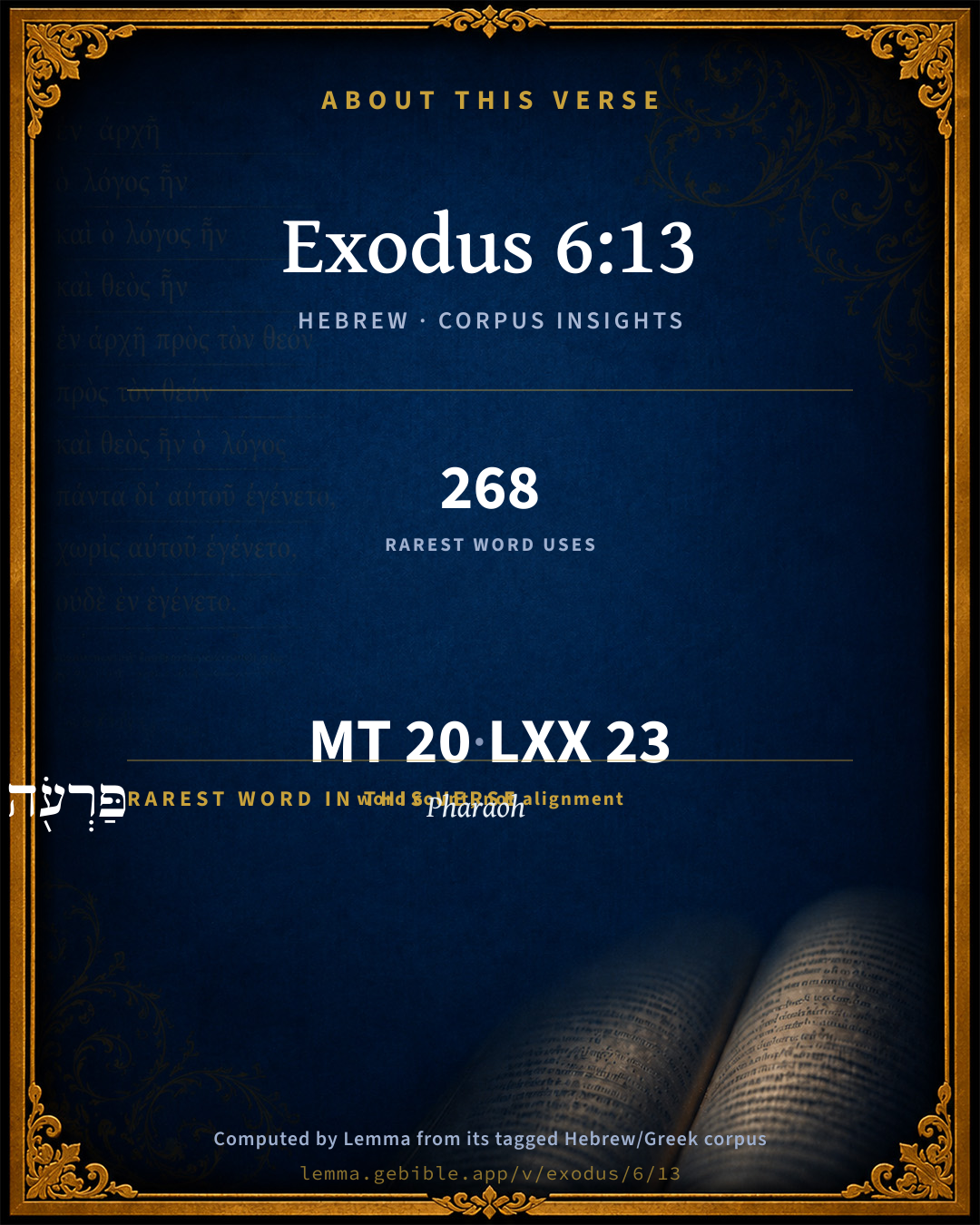
פַּרְעֹ֖ה
Parʻôh
H6547
“Pharaoh”
Noun, Proper
Part of Speech
Noun
Type
Proper
Full BDB Definition

Origin: of Egyptian derivation

TWOT: 1825

Pharaoh = "great house" - the common title of the king of Egypt
  1. וַיְדַבֵּ֣ר dâbar H1696 “and · to speak” Conjunction + Verb, Piel, Sequential Imperfect, 3rd Person, Masculine, Singular
  2. יְהוָה֮ Yᵉhôvâh H3068 “LORD” Noun, Proper
  3. אֶל ʼêl H413 “to” Preposition
  4. מֹשֶׁ֣ה Môsheh H4872 “Moses” Noun, Proper
  5. וְאֶֽל ʼêl H413 “and · to” Conjunction + Preposition
  6. אַהֲרֹן֒ ʼAhărôwn H175 “Aaron” Noun, Proper
  7. וַיְצַוֵּם֙ tsâvâh H6680 “and · to command · them” Conjunction + Verb, Piel, Sequential Imperfect, 3rd Person, Masculine, Singular + Suffix, Personal, 3rd Person, Masculine, Plural
  8. אֶל ʼêl H413 “to” Preposition
  9. בְּנֵ֣י bên H1121 “sons of” Noun, Common, Masculine, Plural, Construct
  10. יִשְׂרָאֵ֔ל Yisrâʼêl H3478 “Israel” Noun, Proper
  11. וְאֶל ʼêl H413 “and · to” Conjunction + Preposition
  12. מֶ֣לֶךְ melek H4428 “king of” Noun, Common, Masculine, Singular, Construct
  13. מִצְרָ֑יִם Mitsrayim H4714 “Egypt” Noun, Proper
  14. לְהוֹצִ֥יא yâtsâʼ H3318 “to go out” Preposition + Verb, Hiphil, Infinitive Construct
  15. אֶת ʼêth H853 “-” Particle, Direct Object
  16. בְּנֵֽי bên H1121 “sons of” Noun, Common, Masculine, Plural, Construct
  17. יִשְׂרָאֵ֖ל Yisrâʼêl H3478 “Israel” Noun, Proper
  18. מֵאֶ֥רֶץ ʼerets H776 “from · land of” Preposition + Noun, Common, Both, Singular, Construct
  19. מִצְרָֽיִם Mitsrayim H4714 “Egypt” Noun, Proper

About this verse

These counts appear in no published source. They are computed here, from the morphology-tagged text and Lemma’s own curated glosses. What Lemma adds →

20
words
14
distinct lemmas
Pentateuch
section

Grammatical profile

  • 3 verbs
  • 12 nouns
  • 4 prepositions
  • 1 particle

Verb forms

  • וַיְדַבֵּ֣ר Piel · Sequential Imperfect
  • וַיְצַוֵּם֙ Piel · Sequential Imperfect
  • לְהוֹצִ֥יא Hiphil · Infinitive Construct

Repetition

Words recur within this verse — often emphatic in Hebrew:

  • בְּנֵ֣י son H1121 ×2
  • יִשְׂרָאֵ֔ל Israel H3478 ×2
  • מִצְרָ֑יִם Egypt H4714 ×2
  • אֶל to H413 ×4

Hebrew & Septuagint length

In English translation the verse runs 35 words from the Hebrew and 33 from the Septuagint (LXX English) — closely comparable.

A rough comparison of the two English renderings, which tokenize alike — not a word-level alignment.

Word counts can differ between the Hebrew and the Greek without any difference in meaning — e.g. the Hebrew direct-object marker אֵת has no separate Greek word, and Greek often adds the article ὁ.

In the original languages it is 20 Hebrew tokens and 23 Greek tokens — but the two are counted differently (Hebrew bundles its prefixes and suffixes into one token; the Greek is in lemma form), so that isn’t a like-for-like length.

Cross-references

11

Topical passages linked to Exodus 6:13 in the Treasury of Scripture Knowledge — connected by theme and wording, ordered by reader-vote popularity; previews shown in the World English Bible.

  • Numbers 27:23 and he laid his hands on him, and gave him a charge, as Yahweh spoke by Moses.
  • Deuteronomy 31:14 Yahweh said to Moses, Behold, your days approach that you must die: call Joshua, and present yourselves in the tent of meeting, that I may give him a charge. Moses and Joshua went, and presented themselves in the tent of meeting.
  • Psalms 91:11 For he will give his angels charge over you, To guard you in all your ways.
  • 1 Timothy 1:18 This charge I commit to you, my child Timothy, according to the prophecies which led the way to you, that by them you may wage the good warfare;
  • 1 Timothy 5:21 I charge you in the sight of God, and Christ Jesus, and the chosen angels, that you observe these things without prejudice, doing nothing by partiality.
  • 1 Timothy 6:13 I charge you before God, who gives life to all things, and before Christ Jesus, who before Pontius Pilate testified the good confession,
  • 2 Timothy 4:1 I charge you therefore before God and the Lord Jesus Christ, who will judge the living and the dead at his appearing and his Kingdom:
  • Numbers 27:19 and set him before Eleazar the priest, and before all the congregation; and give him a charge in their sight.
  • Matthew 4:6 and said to him, "If you are the Son of God, throw yourself down, for it is written, 'He will give his angels charge concerning you.' and, 'On their hands they will bear you up, So that you don't dash your foot against a stone.'"
  • 1 Timothy 6:17 Charge those who are rich in this present world that they not be haughty, nor have their hope set on the uncertainty of riches, but on the living God, who richly provides us with everything to enjoy;
  • 2 Timothy 2:4 No soldier on service entangles himself in the affairs of life, that he may please him who enrolled him as a soldier.

Cross-references courtesy of OpenBible.info (CC BY 4.0).

Hebrew and Greek witnesses Masoretic Hebrew ↔ Greek Septuagint

The same verse in the two great witnesses to the Old Testament, shown verse-for-verse.

These are two independent witnesses, not word-aligned to each other, and the Septuagint is shown in lemma (dictionary) form.

Hebrew Exodus 6:13 Masoretic · Westminster Leningrad Codex

וַיְדַבֵּ֣ר יְהוָה֮ אֶל מֹשֶׁ֣ה וְאֶֽל אַהֲרֹן֒ וַיְצַוֵּם֙ אֶל בְּנֵ֣י יִשְׂרָאֵ֔ל וְאֶל פַּרְעֹ֖ה מֶ֣לֶךְ מִצְרָ֑יִם לְהוֹצִ֥יא אֶת בְּנֵֽי יִשְׂרָאֵ֖ל מֵאֶ֥רֶץ מִצְרָֽיִם

Yahweh spoke to Moses and to Aaron, and gave them a charge to the children of Israel, and to Pharaoh king of Egypt, to bring the children of Israel out of the land of Egypt.

World English Bible · Public Domain

Greek LXX Exodus 6:13 Septuagint · lemma form

εἶπον δέ κύριος πρός μωυσῆς καί ααρων καί συντάσσω αὐτός πρός φαραώ βασιλεύς αἴγυπτος ὥστε ἐκ ἀποστέλλω ὁ υἱός ἰσραήλ ἐκ γῆ αἴγυπτος

And the Lord spoke to Moses and Aaron, and gave them a charge to Pharao king of Egypt, that he should send forth the children of Israel out of the land of Egypt.

LXX2012 (modern English Septuagint) · Public Domain

Hebrew: Westminster Leningrad Codex (CC BY 4.0). Greek: Septuagint (public domain); English from LXX2012 (modern English Septuagint) (Public Domain). How the Septuagint differs from the Hebrew →

Targum (Aramaic paraphrase)

2

The Targum is the ancient Jewish Aramaic paraphrase of the Hebrew Scriptures — an interpretive translation, not the Hebrew text itself. Onkelos (literal) and Pseudo-Jonathan (expansive) render the Torah, and Jonathan the Prophets. Coverage is partial: where no permissively-licensed English translation exists for a verse, only the Aramaic is shown. This is verse-level text, not a word-by-word alignment to the Hebrew.

  1. Targum Onkelos Torah (Genesis–Deuteronomy)
    וּמַלִיל יְיָ עִם משֶׁה וְעִם אַהֲרֹן וּפַקֵדִנוּן לְוָת בְּנֵי יִשְׂרָאֵל וּלְוָת פַּרְעֹה מַלְכָּא דְמִצְרָיִם לְאַפָּקָא יָת בְּנֵי יִשְׂרָאֵל מֵאַרְעָא דְמִצְרָיִם:

    (no public-domain English translation for this verse)

    Targum Onkelos — Aramaic: “Onkelos Genesis” (public domain); “Onkelos Exodus” (public domain); “Onkelos Leviticus” (public domain); “Onkelos Numbers” (public domain); “Onkelos Deuteronomy” (public domain). English: “Sefaria Community Translation” (CC0 1.0 (public-domain dedication)); “J.W. Etheridge. The Targums of Onkelos and Jonathan Ben Uzziel on the Pentateuch. London: Longmans, Green, 1862” (public domain). Text via Sefaria.

  2. Targum Pseudo-Jonathan Torah (Genesis–Deuteronomy)
    וּמַלֵיל יְיָ עִם משֶׁה וְעִם אַהֲרן וְאַזְהַרִינוּן עַל בְּנֵי יִשְרָאֵל וְשַׁלְחִינוּן לְוַת פַּרְעה מַלְכָּא דְמִצְרַיִם לְאַפָּקָא יַת בְּנֵי יִשְרָאֵל מֵאַרְעָא דְמִצְרַיִם

    And the Lord spake with Mosheh and with Aharon, and gave them admonition for the sons of Israel, and sent them to Pharoh, king of Mizraim, to send forth the children of Israel from the land of Mizraim.

    Targum Pseudo-Jonathan — Aramaic: “Targum Jonathan on Genesis” (public domain); “Targum Jonathan on Exodus” (public domain); “Targum Jonathan on Leviticus” (public domain); “Targum Jonathan on Numbers” (public domain); “Targum Jonathan on Deuteronomy” (public domain). English: “The Targum of Jonathan ben Uzziel, trans. J. W. Etheridge, London, 1862” (public domain). Text via Sefaria.

Commentary

Notes on Exodus 6:13 from classic Christian and Jewish commentators (each source and its license shown beneath its notes). The classic Christian expositions comment on the surrounding passage and are grouped to its opening verse, so a note may address several verses; the Jewish commentaries on the Tanakh (Rashi and others) are per-verse, so they appear only where the commentator wrote on this verse.

Lemma curates 59 commentaries, every one of them public domain or Creative Commons licensed, each selected and text-cleaned for this edition rather than reprinted as found. About our sources →

Trapp's Complete Commentary

John Trapp

Exo 6:13 And the LORD spake unto Moses and unto Aaron, and gave them a charge unto the children of Israel, and unto Pharaoh king of Egypt, to bring the children of Israel out of the land of Egypt.

Ver. 13. And the Lord spake unto Moses.] Notwithstanding his former equivocation, and the people’s peevishness. Men’s wickedness cannot interrupt the course of God’s goodness.

John Trapp, A Commentary or Exposition upon All the Books of the Old and New Testament (1647–1656) — public domain. Text from a community e-Sword module.

Keil & Delitzsch

C. F. Keil & F. Delitzsch

Exo 6:13 forms a concluding summary, and prepares the way for the genealogy that follows, the heading of which is given in Exo 6:14.

(Note: The organic connection of this genealogy with the entire narrative has been so conclusively demonstrated by Ranke, in his Unterss. ub. d. Pent. i. p. 68ff. and ii. 19ff., that even Knobel has admitted it, and thrown away the fragmentary hypothesis.)

Keil & Delitzsch — Biblical Commentary on the Old Testament (1861–1891) — public domain (CC PDM 1.0). Text via the HelloAO Bible API. (Old Testament only.)

Ellicott's Commentary for English Readers

(13) The Lord . . . gave them a charge.—The reluctance and opposition of Moses led to an express “charge” being laid upon himself and Aaron, the details of which are given in Exo_7:1-9. Exo_6:1 of Exodus 7 probably followed originally on Exo_6:12 of this chapter. When the genealogy was inserted at this point, the present verse, which summarises Exo_7:1-9, was added, as also Exo_6:28-30 at the end of the chapter.

A Bible Commentary for English Readers, edited by Charles John Ellicott (1878–1897) — public domain. Text from a community e-Sword module.

The Cambridge Bible for Schools and Colleges

gen. ed. J. J. S. Perowne

13. A summary statement, unconnected with v. 12, of the commission given to Moses and Aaron in vv. 2–6. The verse comes in abruptly; for Aaron has not in this connexion been mentioned before. No doubt, it is an addition of the compiler who inserted the genealogy, vv. 14–27 (the main object of which is to explain who Moses and Aaron were), and who intended this verse to introduce it.

The Cambridge Bible for Schools and Colleges (gen. ed. J. J. S. Perowne; Cambridge University Press, 1878–1918) — public domain. Text from a community e-Sword module.

John Gill's Exposition

These be the heads of their father's houses,.... Not of the families of Moses and Aaron, but of the children of Israel, though only the heads of three tribes are mentioned; and some think that these three are taken notice of, to show that they were not rejected of God, though they seem to be rather cursed than blessed by Jacob; and that though they were guilty of very great crimes, as Reuben of incest, and Simeon and Levi of murder, yet they truly repented, and obtained mercy of God, and were honoured in their offspring, of whom an account is here given; but the two first seem to be taken notice of for the sake of the third, and that order might be observed, and that it might plainly appear that the deliverers of Israel were Israelites:

the sons of Reuben, the firstborn of Israel, Hanoch, and Pallu, Hezron, and Carmi; whose names, and the order in which they are put, are the same as in Gen 46:9 these be the families of Reuben; the heads of them, or from whence they sprung.

John Gill's Exposition of the Whole Bible (1746–1763) — public domain (CC PDM 1.0). Text via the HelloAO Bible API.

Albert Barnes' Notes on the Bible

Unto Moses and unto Aaron - The final and formal charge to the two brothers is given, as might be expected, before the plagues are denounced. With this verse begins a new section of the history.

Albert Barnes' Notes on the Bible (1834–1885) — public domain. Text from a community e-Sword/MySword module.

Whedon's Commentary on the Bible

Daniel D. Whedon

13-19. Since Israel is now to be led forth as a nation, Moses and Aaron, their leaders, are fully set before us according to their genealogy. The tribe of Levi now, therefore, comes before us, with its three tribal families and their subdivisions, while the elder tribes, Reuben and Simeon, are mentioned with their general family divisions, in order to show the relative position of Levi. (Knobel here clearly shows the connexion against the documentists.) The fathers’ houses are usually considered as divisions of the tribal families, subdivisions of the tribe, (Geseuius, Furst, Ewald,) but the phrase is considered by Kurtz to be simply another designation for the tribe, the word “fathers” meaning ancestors. But the first view is favoured by the systematic classification in passages like Jos_7:14, and Num_1:20; Num_1:22, etc., where the phrase should be translated, as here, “houses of their fathers,” (not house; see Gesen., Gram., § 108, 3; Ewald, Gram., § 270, c.) The twelve tribes were regularly divided and subdivided, according to lineage, with princes or heads over each section or grade, who took their rank by primogeniture. Besides this hereditary nobility there were elders, who appear to have held their position from age and experience, probably owing their rank to popular election, and who always appear as the representatives of the people, and constitute a democratic element in the state. There were, finally, the scribes, or shoterim — officers who may have arisen under Egyptian influences, as already noticed, who exercised a subordinate overseership over government labourers, and probably had charge of the genealogical tables and public writings. Thus the patriarchal and Egyptian governments furnished the groundwork for the elaborate Mosaic system perfected at Sinai.

Daniel D. Whedon (gen. ed.), Commentary on the Old and New Testaments (1874–1909) — public domain. Text from a community e-Sword module.

The Pulpit Commentary

Vers. 13-27. At this point the narrative is interrupted The author, or (it may be) the final compiler perhaps Joshua thought it desirable to insert here a genealogical section, taking up the fatuity history of Israel from the point at which it was left in Exo_1:5, where the sons of Jacob were enumerated. The whole political system of Israel was based upon the tribal relation; and it was of the last importance, politically, to hand down the divisions and subdivisions of families. The lists here given, probably prepared by Moses in a separate document, had to be inserted somewhere. The present seemed a fitting place. The narrative had reached a turning-point. All the preliminaries were over the action of the Exodus itself was about to begin. A dramatist would have made Act 1. end and Act 2 commence. A poet would have begun a new canto. In the imperfect bibliography of the time, it was thought best to make a division by a parenthetic insertion.

Verse 13 seems to belong to what follows rather than to what precedes. There is no emphasis on the words and to Aaron, as if God, having found Moses singly to be irre-sponsive, had now given a charge to both the brothers conjointly (Rashi). Rather the verse is a concise summary of chs. 3-5., prefixed to the genealogy when it was a separate document, and preserved when the compiler placed the document in the text

Vers. 13-27. The historical character of real revelation.

Among the religions of the world which are based on the contents of a written volume, none has such a historical character as the religion of Christians. Most nations have evolved their religion out of their internal consciousness, and have then, after a certain lapse of time, thrown into a narrative form the supposed revelations made to this or that individual secretly, and by him committed to writing. These revelations to give them the name are not connected with any series of events, are not, properly speaking, historical at all, but belong to the domain of thought, contemplation, philosophy. It is quite otherwise with the religion of the Bible. Both in the Old Testament and in the New our attention is directed primarily and mainly to a series of facts. Religion is not put before us in an abstract, but in a concrete form. The Bible represents to us "God in history." We learn the nature and the will of God from his dealings with nations and individuals at definite times and in definite places. It is a necessary consequence of such a mode of inculcating religious truth, that very dry and mundane details must from time to time be obtruded upon the reader, in order that the narrative may be clear, and that he may understand the circumstances of time and place with which each writer in his turn has to deal. In this way genealogies come in. History cannot be understood without them. We want to know who the individuals are who are introduced afresh at each new stage in the narrative, and in what relation they stand to those other individuals with whom the narrative is concerned before and after. Genealogies convey this knowledge. Many think them uninteresting; but they are not so to any thoughtful person. For

(1) they raise the salutary thought of the rapid flight of time and the speedy passing away of one generation after another, Oih per fullwn geneh toihde kai ajndrwn.

(2) They show us how good men and bad, great men and little, are intermixed in the world, arise under the same conditions, seem produced by the same circumstances; and thus they force us to see what a vast power the human will has in shaping human character, and even in determining the course of earthly events. Hence they remind us of our responsibilities.

(3) They hold up to us warnings and examples warnings in the names to which there is attached the savour of evil deeds never to be forgotten so long as the world endures Nadabs, Abihus, Korahs; examples in those, familiar to us as household words, which we no sooner hear or see than there rush to our thought a crowd of glorious and heroic actions. Being dead, these men still speak to us theirs is a death "full of immortality."

The Pulpit Commentary (1880–1919), ed. H.D.M. Spence-Jones & Joseph S. Exell — public domain. Text from a community e-Sword module.

John Wesley's Explanatory Notes

The Lord gave them a charge, both to the children of Israel, and to Pharaoh - God's authority is sufficient to answer all objections, and binds us to obedience without murmuring or disputing.

John Wesley, Explanatory Notes Upon the Whole Bible (1754–1765) — public domain. Text via the GEBible commentary corpus.

Rashi

Rabbi Shlomo Yitzchaki (Rashi)

וידבר ה' אל משה ואהרן AND THE LORD SPAKE UNTO MOSES AND UNTO AARON — because Moses had said, “I am of uncircumcised lips”. The Holy One, blessed be He, associated Aaron with him to be his mouth-piece and spokesman.

ויצום אל בני ישראל signifies that HE GAVE THEM A CHARGE regarding them; viz., to deal with them in a gentle manner and to be patient with them (Exodus Rabbah 7:3)

ואל פרעה מלך מצרים signifies that He charged them with regard to PHARAOH, KING OF EGYPT, viz., that they should show respect to him in all that they spoke. This is a Midrashic explanation (Exodus Rabbah 7:3; Midrash Tanchuma, Vaera 2); but the real meaning is: He gave them a command with regard to Israel and with regard to His mission on which he had sent them to Pharaoh. And what the purport of this command was is explained in the second section from here (vv. 29—31) after the order of genealogy set forth in the next passage. It properly should follow here, but because Scripture has mentioned Moses and Aaron here, it interrupts the narrative by interpolating the section beginning (v. 14), “These are the heads of their fathers’ houses”, in order to inform us how Moses and Aaron were born (who were their parents) and with whom they are connected by descent.

Rashi on the Tanakh — English translations: “The Judaica Press complete Tanach with Rashi, translated by A. J. Rosenberg” (CC BY 4.0); “Pentateuch with Rashi's commentary by M. Rosenbaum and A.M. Silbermann, 1929-1934” (public domain); “The Metsudah Tanach series, Lakewood, N.J” (CC BY 4.0); and “The Book of Joshua, Metsudah Publications, 1997” (CC BY 4.0). Text via Sefaria.

Ramban (Nachmanides)

Rabbi Moshe ben Nachman (Ramban / Nachmanides)

AND HE GAVE THEM A CHARGE UNTO THE CHILDREN OF ISRAEL. Rashi wrote: “The purport of this command is explained in the second section, after the order of genealogy. [It properly belongs here], but because Scripture mentioned Moses and Aaron here, it interrupted the subject-matter [with the narrative of their genealogy], informing us how each was born and with whom they are connected by descent. And the Eternal spoke unto Moses in the land of Egypt, saying: I am the Eternal; speak thou unto Pharaoh king of Egypt all that I speak unto thee., Verse 29. This is the selfsame command which is mentioned here [in Verse 11]: Go in, speak unto Pharaoh king of Egypt. However, because Scripture broke off the subject-matter in order to record their genealogy, it reverts to it [further in Verse 29] and begins it anew. And Moses said before the Eternal: Behold, I am of uncircumcised lips, and how shall Pharaoh hearken unto me?, Verse 30. This is the selfsame statement Moses made here [in Verse 12]: Behold, the children of Israel have not hearkened unto me, etc. However, because Scripture broke off the subject-matter [for the abovementioned reason], it repeats it there [further in Verse 30]. Such indeed is a proper method, just as a person who says, ‘Let us return to the previous subject.’” And so also is the opinion of Rabbi Abraham ibn Ezra.But I do not agree with this. Rather, [it is my opinion] that when G-d commanded Moses to speak to the children of Israel — as it is said, Wherefore say unto the children of Israel — he did so and they hearkened not unto him. Then He commanded him to go before Pharaoh and bid him to let them go out of his land, and Moses answered: Behold, the children of Israel have not hearkened unto me, etc. Then the Holy One, blessed be He, commanded both Moses and Aaron to speak to the people and to Pharaoh. Moses thus thought that both of them — [he and Aaron] — are to take equal part in all the signs they are to do; both of them are to come to the children of Israel and to Pharaoh. But indeed [Moses reckoned that] it is sufficient that only one should speak, for such is the customary way of all pairs of emissaries, that one speaks and the other is silent. This was consented to, and G-d then said to him: “I am the Eternal, Verse 29. Who revealed Myself to you only to speak in My Great Name. Speak thou unto Pharaoh king of Egypt all that I speak unto thee, Verse 29. for it is to you that all communications are given, not to Aaron [primarily] and to you. It is you that I made the emissary to Pharaoh.” Then Moses answered once again: Behold, I am of uncircumcised lips, etc., Verse 30. And G-d said to him: “See, I have set thee in G-d’s stead to Pharaoh, and Aaron thy brother shall be thy prophet. You will go before Pharaoh with Aaron, and there [in Pharaoh’s presence] you will command Aaron while Pharaoh will not hear your words, and Aaron as your emissary will make your words heard.” This is just as G-d commands a prophet and the prophet makes His words audible and chastises [the people] with them. This was a great achievement for Moses, which he merited by his humility since he was ashamed to speak because of his speech — impediment. And so Scripture says, Moreover the man Moses was very great in the land of Egypt, in the sight of Pharaoh’s servants, and in the sight of the people. It was measure for measure. He had been afraid lest he be despised in their eyes [on account of his defective speech, but Scripture testifies to the Egyptians’ admiration of his greatness].Now Rashi commented: “Thou shalt speak, 7:2. each and every message once, just as you heard it from My mouth, and your brother Aaron shall express it in eloquent language and explain it in Pharaoh’s hearing.” This is not correct at all.

Ramban (Nachmanides) on the Tanakh — English translation: “Commentary on the Torah by Ramban (Nachmanides). Translated and annotated by Charles B. Chavel. New York, Shilo Pub. House, 1971-1976” (CC BY 4.0). Text via Sefaria.

Lesson kit

Teaching starters — assembled from the data on this page, not authored interpretation. Every prompt links to the verse data it draws on. Edit before teaching.

Exodus, in the Pentateuch, opens this verse with 20 words (14 distinct Hebrew lemmas). Its most distinctive word is Parʻôh (“Pharaoh”). A historical commentator’s framing appears above. Read the whole chapter for the surrounding context.

Discussion questions

  1. The word Parʻôh carries the sense “Pharaoh.” How does it shape the verse?
  2. Numbers 27:23 shares this passage’s theme. How do the two illuminate each other?
  3. “son” occurs 2× in this one verse. What is the effect of the repetition?
  4. These translations render this verse differently. What is at stake in choosing one wording over another?
  5. The verb «וַיְדַבֵּ֣ר» is Piel Sequential Imperfect. How does its form color the action?
  6. Reading how Trapp's Complete Commentary and Keil & Delitzsch read this verse, where do the two commentators agree and where do they part?

Things to notice

Reading settings

Reading text

Shown beneath each verse's original-language words.

Old Testament
Old Testament edition

Read the OT as the Masoretic Hebrew (MT) or the Greek Septuagint (LXX).

English shown for the Greek Septuagint (in the Hebrew ↔ Greek comparison).

Comparing translations? Open the Compare panel on any verse page to stack up to four side by side.