
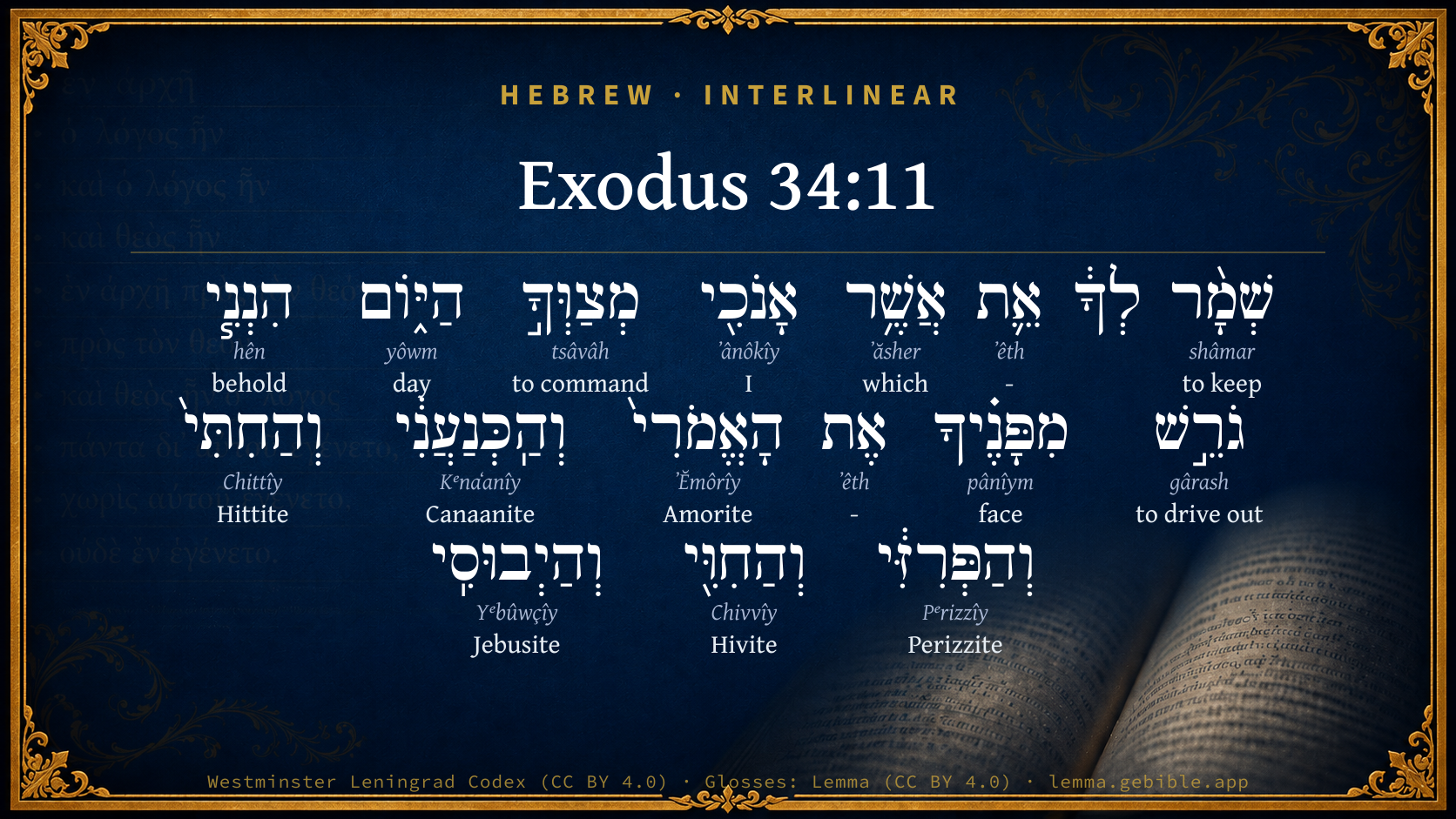
Exodus 34:11

Hebrew (Westminster Leningrad Codex) Exodus 34:11 appears in the Hebrew Old Testament. The text above is from the Westminster Leningrad Codex. Each word links to its Strong’s number, a concise gloss, and parsing drawn from the Open Scriptures Hebrew Bible morphology. Click any word for its full Brown-Driver-Briggs (BDB) entry.
Download image
Cite this verse

Exodus 34:11 (World English Bible). Public Domain. Lemma interlinear Bible study tool, https://lemma.gebible.app/v/exodus/34/11.

Show BibTeX & RIS
BibTeX
RIS
English Translation
Observe that which I command you this day. Behold, I drive out before you the Amorite, the Canaanite, the Hittite, the Perizzite, the Hivite, and the Jebusite.
World English Bible · Public Domain
Download a study sheet

One document with this verse’s original text, its word-by-word gloss line, the meaning frame, cross-references with their text, attributed commentary, and full source and license credits — printable, and it pastes into notes with its structure intact.

This verse Autodidact and up

Study sheet (.html) Plain text (.txt)

A passage Seminary Student

Up to 50 verses in one chapter. A passage sheet keeps up to 6 commentary sources and 12 cross-references per verse, in the order this page ranks them, and says so on the sheet whenever that leaves anything out. Ask for a single verse and you get the Autodidact verse sheet above.

Everything on this page stays free to read, with no account — the sheet is a download of what is already on screen, not access to it.

Want to remove ads? Support Godless Engineer
Compare translations 3

The same verse in 3 English versions, stacked beneath the original-language interlinear above. Click any original word for its lexicon entry.

Each is an independent rendering of the whole verse — the interlinear is not word-aligned to these translations.

Highlighted words mark where these versions differ — a whole-verse word diff, not a word-by-word alignment.

  • World English Bible Public Domain
    Observe that which I command you this day. Behold, I drive out before you the Amorite, the Canaanite, the Hittite, the Perizzite, the Hivite, and the Jebusite.
  • King James Version Public Domain
    Observe thou that which I command thee this day: behold, I drive out before thee the Amorite, and the Canaanite, and the Hittite, and the Perizzite, and the Hivite, and the Jebusite.
  • unfoldingWord Literal Text CC BY-SA 4.0
    Keep for yourself what I am commanding today. Behold I am about to drive out from before your face the Amorites and the Canaanites and the Hittites and the Perizzites and the Hivites and the Jebusites.

unfoldingWord Literal Text — © unfoldingWord, licensed CC BY-SA 4.0. Word-aligned USFM3 via Door43 (git.door43.org/unfoldingWord/en_ult).

Versions to compare (up to 4)

3 of 4 selected

Show all 18 translations

Every available English version of this verse, each an independent rendering of the whole verse.

  • World English Bible Public Domain
    Observe that which I command you this day. Behold, I drive out before you the Amorite, the Canaanite, the Hittite, the Perizzite, the Hivite, and the Jebusite.
  • Berean Standard Bible Public Domain
    Observe what I command you this day. I will drive out before you the Amorites, Canaanites, Hittites, Perizzites, Hivites, and Jebusites.
  • Majority Standard Bible Public Domain
    Observe what I command you this day. I will drive out before you the Amorites, Canaanites, Hittites, Perizzites, Hivites, and Jebusites.
  • King James Version Public Domain
    Observe thou that which I command thee this day: behold, I drive out before thee the Amorite, and the Canaanite, and the Hittite, and the Perizzite, and the Hivite, and the Jebusite.
  • American Standard Version (1901) Public Domain
    Observe thou that which I command thee this day: behold, I drive out before thee the Amorite, and the Canaanite, and the Hittite, and the Perizzite, and the Hivite, and the Jebusite.
  • Revised Version (1885) Public Domain
    Observe thou that which I command thee this day: behold, I drive out before thee the Amorite, and the Canaanite, and the Hittite, and the Perizzite, and the Hivite, and the Jebusite.
  • Geneva Bible (1599) Public Domain
    Keepe diligently that which I commande thee this day: Beholde, I will cast out before thee the Amorites, and the Canaanites, and the Hittites, and the Perizzites, and the Hiuites, and the Iebusites.
  • Douay-Rheims (1899) Public Domain
    Observe all things which this day I command thee: I myself will drive out before thy face the Amorrhite, and the Chanaanite, and the Hethite, and the Pherezite, and the Hevite, and the Jebusite.
  • Young's Literal Translation Public Domain
    `Observe for thyself that which I am commanding thee to-day: lo, I am casting out from before thee the Amorite, and the Canaanite, and the Hittite, and the Perizzite, and the Hivite, and the Jebusite;
  • Literal Standard Version CC BY-SA 4.0
    Observe for yourself that which I am commanding you today. Behold, I am casting out from before you the Amorite, and the Canaanite, and the Hittite, and the Perizzite, and the Hivite, and the Jebusite;
  • Unlocked Literal Bible CC BY-SA 4.0
    Obey what I command you today. I am about to drive out before you the Amorites, Canaanites, Hittites, Perizzites, Hivites, and Jebusites.
  • unfoldingWord Literal Text CC BY-SA 4.0
    Keep for yourself what I am commanding today. Behold I am about to drive out from before your face the Amorites and the Canaanites and the Hittites and the Perizzites and the Hivites and the Jebusites.
  • Darby Bible Public Domain
    Observe what I command thee this day: behold, I will drive out before thee the Amorite, and the Canaanite, and the Hittite, and the Perizzite, and the Hivite, and the Jebusite.
  • World Messianic Bible Public Domain
    Observe that which I command you today. Behold, I will drive out before you the Amorite, the Canaanite, the Hittite, the Perizzite, the Hivite, and the Jebusite.
  • Webster's Bible Public Domain
    Observe thou that which I command thee this day: Behold, I drive out before thee the Amorite, and the Canaanite, and the Hittite, and the Perizzite, and the Hivite, and the Jebusite.
  • Free Bible Version CC BY-SA 4.0
    But you must carefully follow what I tell you to do today. Pay attention! I'm going to drive out ahead of you the Amorites, Canaanites, Hittites, Perizzites, Hivites, and Jebusites.
  • Bible in Basic English Public Domain
    Take care to do the orders which I give you today; I will send out from before you the Amorite and the Canaanite and the Hittite and the Perizzite and the Hivite and the Jebusite.
  • JPS Tanakh (1917) Public Domain
    Observe thou that which I am commanding thee this day; behold, I am driving out before thee the Amorite, and the Canaanite, and the Hittite, and the Perizzite, and the Hivite, and the Jebusite.

Literal Standard Version (2020), Covenant Press — licensed CC BY-SA 4.0. Text via the HelloAO Bible API (eBible.org). Unlocked Literal Bible (unfoldingWord) — licensed CC BY-SA 4.0. Text via the HelloAO Bible API (eBible.org). unfoldingWord Literal Text — © unfoldingWord, licensed CC BY-SA 4.0. Word-aligned USFM3 via Door43 (git.door43.org/unfoldingWord/en_ult). Free Bible Version, Dr. Jonathan Gallagher — licensed CC BY-SA 4.0. Text via the HelloAO Bible API (eBible.org).

Word by word

More ways to search: Search by grammar → Find every occurrence → Compare this word →

Practice this passage: Drill this verse → Learn its vocabulary →

וְהַפְּרִזִּ֔י
Pᵉrizzîy
H6522
“and · the · Perizzite”
Conjunction + Particle, Definite Article + Noun, Gentilic, Masculine, Singular, Absolute
Part of Speech
Conjunction + Particle + Noun
Type
Gentilic
Gender
Masculine
Number
Singular
State
Absolute
Full BDB Definition

Origin: for H6521

TWOT: None

Perizzite = "belonging to a village" - a people who inhabited southern Canaan prior to the conquest
  1. שְׁמָ֨ר shâmar H8104 “keep” Verb, Qal, Imperative, 2nd Person, Masculine, Singular
  2. אֵ֛ת ʼêth H853 “-” Particle, Direct Object
  3. אֲשֶׁ֥ר ʼăsher H834 “which” Particle, Relative
  4. אָנֹכִ֖י ʼânôkîy H595 “I” Pronoun, Personal, 1st Person, Common, Singular
  5. מְצַוְּךָ֣ tsâvâh H6680 “commanding · you” Verb, Piel, Participle Active, Masculine, Singular, Construct + Suffix, Personal, 2nd Person, Masculine, Singular
  6. הַיּ֑וֹם yôwm H3117 “the · day” Particle, Definite Article + Noun, Common, Masculine, Singular, Absolute
  7. הִנְנִ֧י hên H2005 “behold · me” Particle, Demonstrative + Suffix, Personal, 1st Person, Common, Singular
  8. גֹרֵ֣שׁ gârash H1644 “driving out” Verb, Qal, Participle Active, Masculine, Singular, Absolute
  9. מִפָּנֶ֗יךָ pânîym H6440 “from · face(s) · your” Preposition + Noun, Common, Both, Plural, Construct + Suffix, Personal, 2nd Person, Masculine, Singular
  10. אֶת ʼêth H853 “-” Particle, Direct Object
  11. הָאֱמֹרִי֙ ʼĔmôrîy H567 “the · Amorite” Particle, Definite Article + Noun, Gentilic, Masculine, Singular, Absolute
  12. וְהַֽכְּנַעֲנִ֔י Kᵉnaʻanîy H3669 “and · the · Canaanite” Conjunction + Particle, Definite Article + Noun, Gentilic, Masculine, Singular, Absolute
  13. וְהַחִתִּי֙ Chittîy H2850 “and · the · Hittite” Conjunction + Particle, Definite Article + Noun, Gentilic, Masculine, Singular, Absolute
  14. וְהַחִוִּ֖י Chivvîy H2340 “and · the · Hivite” Conjunction + Particle, Definite Article + Noun, Gentilic, Masculine, Singular, Absolute
  15. וְהַיְבוּסִֽי Yᵉbûwçîy H2983 “and · the · Jebusite” Conjunction + Particle, Definite Article + Noun, Gentilic, Masculine, Singular, Absolute

About this verse

These counts appear in no published source. They are computed here, from the morphology-tagged text and Lemma’s own curated glosses. What Lemma adds →

17
words
15
distinct lemmas
Pentateuch
section

Notable vocabulary

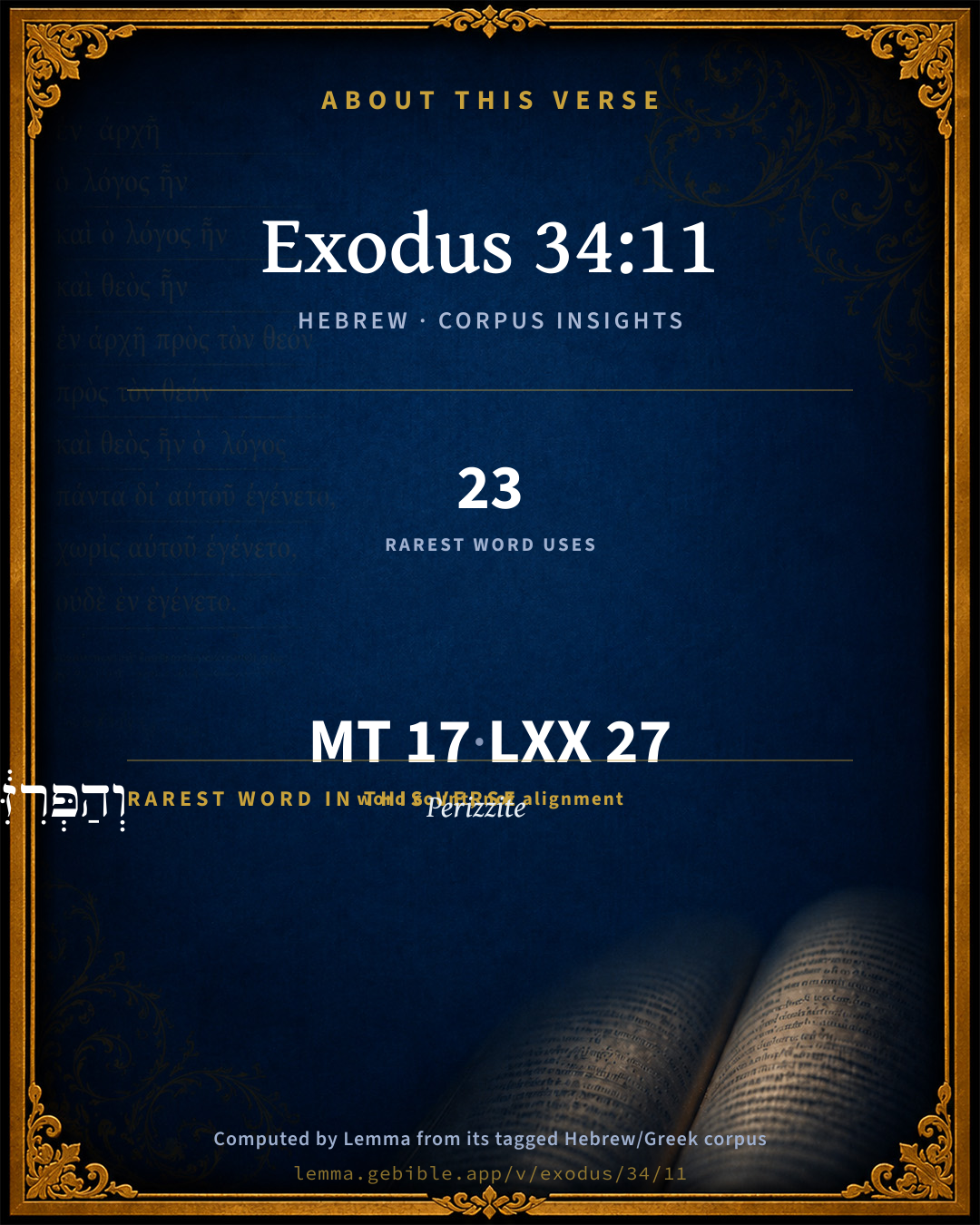
The rarest word here is וְהַפְּרִזִּ֔י Perizzite H6522 — appearing just 23 times in the whole Hebrew Bible.

Shared distinctive vocabulary

וְהַפְּרִזִּ֔י Perizzite H6522 occurs in 23 verses of the Hebrew Bible. Also found in:

Grammatical profile

  • 3 verbs
  • 8 nouns
  • 1 pronoun
  • 1 preposition
  • 4 particles

Verb forms

  • שְׁמָ֨ר Qal · Imperative
  • מְצַוְּךָ֣ Piel · Participle Active
  • גֹרֵ֣שׁ Qal · Participle Active

Hebrew & Septuagint length

In English translation the verse runs 27 words from the Hebrew and 35 from the Septuagint (LXX English) — closely comparable.

A rough comparison of the two English renderings, which tokenize alike — not a word-level alignment.

Word counts can differ between the Hebrew and the Greek without any difference in meaning — e.g. the Hebrew direct-object marker אֵת has no separate Greek word, and Greek often adds the article ὁ.

In the original languages it is 17 Hebrew tokens and 27 Greek tokens — but the two are counted differently (Hebrew bundles its prefixes and suffixes into one token; the Greek is in lemma form), so that isn’t a like-for-like length.

Cross-references

16

Topical passages linked to Exodus 34:11 in the Treasury of Scripture Knowledge — connected by theme and wording, ordered by reader-vote popularity; previews shown in the World English Bible.

  • Exodus 33:2 I will send an angel before you; and I will drive out the Canaanite, the Amorite, and the Hittite, and the Perizzite, the Hivite, and the Jebusite:
  • Exodus 3:17 and I have said, I will bring you up out of the affliction of Egypt to the land of the Canaanite, the Hittite, the Amorite, the Perizzite, the Hivite, and the Jebusite, to a land flowing with milk and honey."'
  • Deuteronomy 6:25–7:1 It shall be righteousness to us, if we observe to do all this commandment before Yahweh our God, as he has commanded us.
  • Genesis 15:18–21 In that day Yahweh made a covenant with Abram, saying, "To your seed have I given this land, from the river of Egypt to the great river, the river Euphrates:
  • Exodus 3:8 I have come down to deliver them out of the hand of the Egyptians, and to bring them up out of that land to a good and large land, to a land flowing with milk and honey; to the place of the Canaanite, the Hittite, the Amorite, the Perizzite, the Hivite, and the Jebusite.
  • Deuteronomy 6:3 Hear therefore, Israel, and observe to do it; that it may be well with you, and that you may increase mightily, as Yahweh, the God of your fathers, has promised to you, in a land flowing with milk and honey.
  • Deuteronomy 4:1–2 Now, Israel, listen to the statutes and to the ordinances, which I teach you, to do them; that you may live, and go in and possess the land which Yahweh, the God of your fathers, gives you.
  • Deuteronomy 4:40 You shall keep his statutes, and his commandments, which I command you this day, that it may go well with you, and with your children after you, and that you may prolong your days in the land, which Yahweh your God gives you, forever.
  • Deuteronomy 5:32 You shall observe to do therefore as Yahweh your God has commanded you: you shall not turn aside to the right hand or to the left.
  • Deuteronomy 7:19 the great trials which your eyes saw, and the signs, and the wonders, and the mighty hand, and the outstretched arm, by which Yahweh your God brought you out: so shall Yahweh your God do to all the peoples of whom you are afraid.
  • Deuteronomy 9:4–5 Don't speak in your heart, after that Yahweh your God has thrust them out from before you, saying, For my righteousness Yahweh has brought me in to possess this land; whereas for the wickedness of these nations Yahweh does drive them out from before you.
  • Deuteronomy 12:28 Observe and hear all these words which I command you, that it may go well with you, and with your children after you forever, when you do that which is good and right in the eyes of Yahweh your God.
  • Deuteronomy 12:32 Whatever thing I command you, that shall you observe to do: you shall not add thereto, nor diminish from it.
  • Deuteronomy 28:1 It shall happen, if you shall listen diligently to the voice of Yahweh your God, to observe to do all his commandments which I command you this day, who Yahweh your God will set you on high above all the nations of the earth:
  • Matthew 28:20 teaching them to observe all things that I commanded you. Behold, I am with you always, even to the end of the age." Amen.
  • John 14:21 One who has my commandments, and keeps them, that person is one who loves me. One who loves me will be loved by my Father, and I will love him, and will reveal myself to him."

Cross-references courtesy of OpenBible.info (CC BY 4.0).

Hebrew and Greek witnesses Masoretic Hebrew ↔ Greek Septuagint

The same verse in the two great witnesses to the Old Testament, shown verse-for-verse.

These are two independent witnesses, not word-aligned to each other, and the Septuagint is shown in lemma (dictionary) form.

Hebrew Exodus 34:11 Masoretic · Westminster Leningrad Codex

שְׁמָ֨ר לְךָ֔ אֵ֛ת אֲשֶׁ֥ר אָנֹכִ֖י מְצַוְּךָ֣ הַיּ֑וֹם הִנְנִ֧י גֹרֵ֣שׁ מִפָּנֶ֗יךָ אֶת הָאֱמֹרִי֙ וְהַֽכְּנַעֲנִ֔י וְהַחִתִּי֙ וְהַפְּרִזִּ֔י וְהַחִוִּ֖י וְהַיְבוּסִֽי

Observe that which I command you this day. Behold, I drive out before you the Amorite, the Canaanite, the Hittite, the Perizzite, the Hivite, and the Jebusite.

World English Bible · Public Domain

Greek LXX Exodus 34:11 Septuagint · lemma form

προςἔχω σύ πᾶς ὅσος ἐγώ ἐντέλλομαι σύ ἰδού ἐγώ ἐκβάλλω πρό πρόσωπον σύ ὁ ἀμορραῖος καί χαναναῖος καί χετταῖος καί φερεζαῖος καί ευαῖος καί γεργεσαῖος καί ιεβουσαῖος

Do you take heed to all things whatever I command you: behold, I cast out before your face the Amorite and the Chananite and the Pherezite, and the Chettite, and Evite, and Gergesite and Jebusite:

LXX2012 (modern English Septuagint) · Public Domain

On this verse, John Gill's Exposition discusses the Septuagint’s reading. Read the note in Commentary ↓

Hebrew: Westminster Leningrad Codex (CC BY 4.0). Greek: Septuagint (public domain); English from LXX2012 (modern English Septuagint) (Public Domain). How the Septuagint differs from the Hebrew →

Targum (Aramaic paraphrase)

2

The Targum is the ancient Jewish Aramaic paraphrase of the Hebrew Scriptures — an interpretive translation, not the Hebrew text itself. Onkelos (literal) and Pseudo-Jonathan (expansive) render the Torah, and Jonathan the Prophets. Coverage is partial: where no permissively-licensed English translation exists for a verse, only the Aramaic is shown. This is verse-level text, not a word-by-word alignment to the Hebrew.

  1. Targum Onkelos Torah (Genesis–Deuteronomy)
    טָר לָךְ יָת דִי אֲנָא מְפַקְדָךְ יוֹמָא דֵין הָא אֲנָא מְתָרֵךְ מִן קֳדָמָךְ יָת אֱמוֹרָאֵי וּכְנַעֲנָאֵי וְחִתָּאֵי וּפְרִזָאֵי וְחִוָאֵי וִיבוּסָאֵי:

    (no public-domain English translation for this verse)

    Targum Onkelos — Aramaic: “Onkelos Genesis” (public domain); “Onkelos Exodus” (public domain); “Onkelos Leviticus” (public domain); “Onkelos Numbers” (public domain); “Onkelos Deuteronomy” (public domain). English: “Sefaria Community Translation” (CC0 1.0 (public-domain dedication)); “J.W. Etheridge. The Targums of Onkelos and Jonathan Ben Uzziel on the Pentateuch. London: Longmans, Green, 1862” (public domain). Text via Sefaria.

  2. Targum Pseudo-Jonathan Torah (Genesis–Deuteronomy)
    טוֹר לָךְ יַת מַה דַּאֲנָא מְפַקֵיד לָךְ יוֹמָא דֵין הָאֲנָא מְתָרֵיךְ מִן קֳדָמָךְ יַת אֱמוֹרָאֵי וּכְנַעֲנָאֵי וְחִתָּאֵי וּפְרִיזָאֵי וְחִיוָאֵי וִיבוּסָאֵי

    Observe thou that which I command thee this day: behold, I drive out from before thee the Amoraee, and Kenaanaee, and Hittaee, and Pherizaee, and Hivaee, and Jebusaee.

    Targum Pseudo-Jonathan — Aramaic: “Targum Jonathan on Genesis” (public domain); “Targum Jonathan on Exodus” (public domain); “Targum Jonathan on Leviticus” (public domain); “Targum Jonathan on Numbers” (public domain); “Targum Jonathan on Deuteronomy” (public domain). English: “The Targum of Jonathan ben Uzziel, trans. J. W. Etheridge, London, 1862” (public domain). Text via Sefaria.

Commentary

Notes on Exodus 34:11 from classic Christian and Jewish commentators (each source and its license shown beneath its notes). The classic Christian expositions comment on the surrounding passage and are grouped to its opening verse, so a note may address several verses; the Jewish commentaries on the Tanakh (Rashi and others) are per-verse, so they appear only where the commentator wrote on this verse.

Lemma curates 59 commentaries, every one of them public domain or Creative Commons licensed, each selected and text-cleaned for this edition rather than reprinted as found. About our sources →

Trapp's Complete Commentary

John Trapp

Exo 34:11 Observe thou that which I command thee this day: behold, I drive out before thee the Amorite, and the Canaanite, and the Hittite, and the Perizzite, and the Hivite, and the Jebusite.

Ver. 11. Observe thou.] This is the condition of the covenant on man’s part to be performed. With others God makes a single covenant only, that they shall observe that which he commands them: but with his elect he makes a double covenant; to perform both parts, to "work all their works in them," and for them, to "put his fear into their hearts, and to cause them to keep his commandments." {Isa 26:12 Jer 32:40}

John Trapp, A Commentary or Exposition upon All the Books of the Old and New Testament (1647–1656) — public domain. Text from a community e-Sword module.

Joseph Benson's Commentary

Exo 34:11. Observe that which I command thee — We cannot expect the benefit of the promises unless we make conscience of the precepts. The two great precepts are, 1st, Thou shalt worship no other gods — A good reason is annexed; for the Lord, whose name is Jealous, is a jealous God — As tender in the matters of his worship as the husband is of the honour of the marriage bed. 2d, Thou shalt make thee no molten gods — Thou shalt not worship the true God by images. This was the sin they had lately fallen into, which therefore they are particularly cautioned against. That they might not be tempted to worship other gods, they must not join in affinity or friendship with those that did.

Joseph Benson's Commentary on the Old and New Testaments (1811–1818) — public domain. Text from a community e-Sword module.

Keil & Delitzsch

C. F. Keil & F. Delitzsch

To recall the duties of the covenant once more to the minds of the people, the Lord repeats from among the rights of Israel, upon the basis of which the covenant had been established (ch. 21-23), two of the leading points which determined the attitude of the nation towards Him, and which constituted, as it were, the main pillars that were to support the covenant about to be renewed. These were, first, the warning against every kind of league with the Canaanites, who were to be driven out before the Israelites (Exo 34:11-16); and, secondly, the instructions concerning the true worship of Jehovah (Exo 34:17-26). The warning against friendship with the idolatrous Canaanites (Exo 34:11-16) is more fully developed and more strongly enforced than in Exo 23:23. The Israelites, when received into the covenant with Jehovah, were not only to beware of forming any covenant with the inhabitants of Canaan (cf. Exo 23:32-33), but were to destroy all the signs of their idolatrous worship, such as altars, monuments (see Exo 23:24), and asherim, the idols of Astarte, the Canaanitish goddess of nature, which consisted for the most part of wooden pillars (see my Comm. on Kg1 14:23), and to worship no other god, because Jehovah was called jealous, i.e., had revealed Himself as jealous (see at Exo 20:5), and was a jealous God. This was commanded, that the Israelites might not suffer themselves to be led astray by such an alliance; to go a whoring after their gods, and sacrifice to them, to take part in their sacrificial festivals, or to marry their sons to the daughters of the Canaanites, by whom they would be persuaded to join in the worship of idols. The use of the expression "go a whoring" in a spiritual sense, in relation to idolatry, is to be accounted for on the ground, that the religious fellowship of Israel with Jehovah was a covenant resembling the marriage tie; and we meet with it for the first time, here, immediately after the formation of this covenant between Israel and Jehovah. The phrase is all the more expressive on account of the literal prostitution that was frequently associated with the worship of Baal and Astarte (cf. Lev 17:7; Lev 20:5-6; Num 14:33, etc.). We may see from Num 25:1. how Israel was led astray by this temptation in the wilderness.

Keil & Delitzsch — Biblical Commentary on the Old Testament (1861–1891) — public domain (CC PDM 1.0). Text via the HelloAO Bible API. (Old Testament only.)

Ellicott's Commentary for English Readers

(11) The Amorite, and the Canaanite . . . —The same six nations are particularised in Exo_3:8; Exo_3:17, in Exo_23:23, and also in Exo_33:2. In Deu_7:1, and Jos_3:10; Jos_24:11, the Girgashites are added, and the number of the nations made seven.

A Bible Commentary for English Readers, edited by Charles John Ellicott (1878–1897) — public domain. Text from a community e-Sword module.

The Cambridge Bible for Schools and Colleges

gen. ed. J. J. S. Perowne

11. that which I am commanding thee this day] viz. the injunction which follows (v. 12 ff.), to have no dealings with the Canaanites. The formula is one which is extremely common in Dt. (Deu_4:40, Deu_6:6, Deu_7:11, Deu_8:1; Deu_8:11 &c.).

behold, &c.] Jehovah Himself will make the way easy for such a command to be obeyed.

drive out] The promise, as Exo_23:28-30, Exo_33:2 : cf. the same word in a command, Exo_23:31 b.

the Amorite, &c.] See on Exo_3:8.

11–16. No alliance to be entered into with the Canaanites, lest intercourse with them seduce Israel into idolatry (comp. Exo_23:24; Exo_23:32 f., Deu_7:2-5).

11–26. The conditions of the covenant, i.e. the laws upon the acceptance of which its establishment depends. The laws themselves seem to have received parenetic additions from the compiler.

The Cambridge Bible for Schools and Colleges (gen. ed. J. J. S. Perowne; Cambridge University Press, 1878–1918) — public domain. Text from a community e-Sword module.

John Gill's Exposition

Observe thou that which I command thee this day,.... Which words are either said to Moses personally, as Aben Ezra thinks, as a direction to him to observe what had been said to him, and declare them to the children of Israel; or rather to the children of Israel, and respect the commands which are afterwards delivered out to be observed by them in the following verses; and what is expressed in the next clause is such as was not done by the ministry of Moses, nor in his time:

behold, I drive out before thee; not before Moses, but the people of Israel:

the Amorite, and the Canaanite, and the Hittite, and the Perizzite, and the Hivite, and the Jebusite; six nations are only mentioned, though there were seven, the Girgashites being omitted, because either they left the land before, as some think, or because they at once submitted; they are added in the Septuagint version.

John Gill's Exposition of the Whole Bible (1746–1763) — public domain (CC PDM 1.0). Text via the HelloAO Bible API.

Haydock's Catholic Bible Commentary

Observe, O my people, (Menochius) you who shall serve under Josue, when these promises shall be fulfilled. (Haydock) --- The Septuagint add the Gergesite to the list of people who should be expelled. But Lyranus thinks they are omitted in Hebrew, because they had already retired before the approach of the Hebrews. (Calmet)

George Leo Haydock (1774–1849), Haydock's Catholic Family Bible and Commentary, 1859 edition — public domain. Excludes Psalms (Douay-Rheims chapter numbering differs from Protestant) and Deuterocanonical books (Catholic canon only).

Whedon's Commentary on the Bible

Daniel D. Whedon

11. Drive out — Comp. Exo_33:2, and Exo_23:23; Exo_23:28. The frequent repetition of this promise was important, inasmuch as Israel’s greatest danger was from their heathen foes.

Daniel D. Whedon (gen. ed.), Commentary on the Old and New Testaments (1874–1909) — public domain. Text from a community e-Sword module.

The Pulpit Commentary

Observe thou that which I command thee this day. The precepts expressly given (vers. 12-26) are, as observed above, almost wholly positive. The moral law did not require recapitulation, because it was enjoined on the people afresh by the writing on the two tables (ver. 28). I drive out before thee. Compare Exo_3:8, 17 6:4, 8 13:5, 11 33:2.

The Pulpit Commentary (1880–1919), ed. H.D.M. Spence-Jones & Joseph S. Exell — public domain. Text from a community e-Sword module.

John Wesley's Explanatory Notes

Observe that which I command thee - We cannot expect the benefit of the promises, unless we make conscience of the precepts. The two great precepts are,

1. Thou shalt worship no other gods - A good reason is annexed; for the Lord, whose name is Jealous, is a jealous God - As tender in the matters of his worship as the husband is of the honour of the marriage-bed.

2. Thou shalt make thee no molten gods - Thou shalt not worship the true God by images. This was the sin they had lately fallen into, which therefore they are particularly cautioned against. That they might not be tempted to worship other gods, they must not join in affinity or friendship with those that did.

John Wesley, Explanatory Notes Upon the Whole Bible (1754–1765) — public domain. Text via the GEBible commentary corpus.

Rashi

Rabbi Shlomo Yitzchaki (Rashi)

את האמרי וגו׳ THE AMORITE etc. — There are only six nations mentioned here, because the seventh, the Girgashites, arose and emigrated of their own accord (Leviticus Rabbah 17:6; cf. Rashi on Exodus 33:2).

Rashi on the Tanakh — English translations: “The Judaica Press complete Tanach with Rashi, translated by A. J. Rosenberg” (CC BY 4.0); “Pentateuch with Rashi's commentary by M. Rosenbaum and A.M. Silbermann, 1929-1934” (public domain); “The Metsudah Tanach series, Lakewood, N.J” (CC BY 4.0); and “The Book of Joshua, Metsudah Publications, 1997” (CC BY 4.0). Text via Sefaria.

Ramban (Nachmanides)

Rabbi Moshe ben Nachman (Ramban / Nachmanides)

OBSERVE THOU THAT WHICH I AM COMMANDING THEE THIS DAY. Of all the commandments mentioned previously He did not say I am commanding thee. Therefore we must explain the meaning of His words as follows: “Observe the commandments which I command you today, and do not treat them as you have treated those which I commanded you at first, when you violated everything by worshipping the idols.” Now He promised here to drive out from before them the peoples [of the Land], and He warned them against their idols and against making a covenant with them, just as He had done in the section of Behold, I send an angel before thee, 23:20. thus going over the first conditions again. However, He added here, Thou shalt make thee no molten gods, meaning that they should not do as they had done with the calf, even if their thoughts are directed to Heaven, to make themselves a guide. He restated here the subject of the three festivals, Verse 23. that they appear before the Eternal G-d, the G-d of Israel, Verse 23. as He had mentioned it there. The reason [for the restatement] is known, since it comes after the admonition against idolatry. I have already explained it at the end of [Seder] Vayishma Yithro., 20:21.

Ramban (Nachmanides) on the Tanakh — English translation: “Commentary on the Torah by Ramban (Nachmanides). Translated and annotated by Charles B. Chavel. New York, Shilo Pub. House, 1971-1976” (CC BY 4.0). Text via Sefaria.

Lesson kit

Teaching starters — assembled from the data on this page, not authored interpretation. Every prompt links to the verse data it draws on. Edit before teaching.

Exodus, in the Pentateuch, opens this verse with 17 words (15 distinct Hebrew lemmas). Its most distinctive word is Pᵉrizzîy (“Perizzite”). A historical commentator’s framing appears above. Read the whole chapter for the surrounding context.

Discussion questions

  1. How does “Perizzite” (Pᵉrizzîy) shape what this verse is saying?
  2. How does Genesis 13:7, which shares the word «Perizzite», read alongside this verse?
  3. These translations render this verse differently. What is at stake in choosing one wording over another?
  4. «שְׁמָ֨ר» is a Qal Imperative verb. How does that grammatical form shape the action described?
  5. Compare how Trapp's Complete Commentary and Joseph Benson's Commentary read this verse. Where do they agree or differ?

Things to notice

Reading settings

Reading text

Shown beneath each verse's original-language words.

Old Testament
Old Testament edition

Read the OT as the Masoretic Hebrew (MT) or the Greek Septuagint (LXX).

English shown for the Greek Septuagint (in the Hebrew ↔ Greek comparison).

Comparing translations? Open the Compare panel on any verse page to stack up to four side by side.