1 Kings 17:9

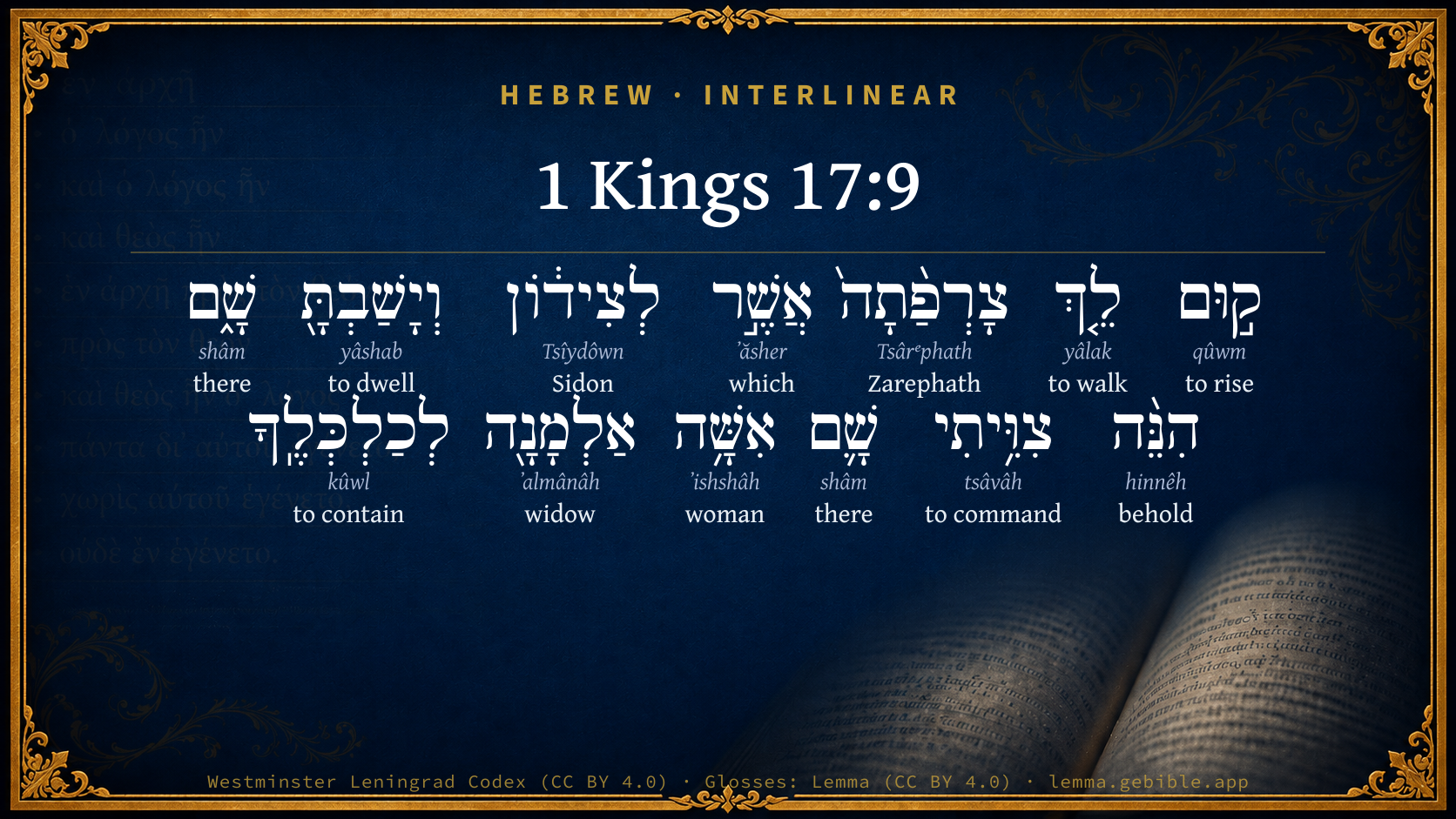
Hebrew (Westminster Leningrad Codex) 1 Kings 17:9 appears in the Hebrew Old Testament. The text above is from the Westminster Leningrad Codex. Each word links to its Strong’s number, a concise gloss, and parsing drawn from the Open Scriptures Hebrew Bible morphology. Click any word for its full Brown-Driver-Briggs (BDB) entry.
Download image
Cite this verse

1 Kings 17:9 (World English Bible). Public Domain. Lemma interlinear Bible study tool, https://lemma.gebible.app/v/1-kings/17/9.

Show BibTeX & RIS
BibTeX
RIS
English Translation
Arise, get you to Zarephath, which belongs to Sidon, and dwell there: behold, I have commanded a widow there to sustain you.
World English Bible · Public Domain
Highlights
  • 1 first appearance in the Hebrew Bible
Full analysis ↓
Download a study sheet

One document with this verse’s original text, its word-by-word gloss line, the meaning frame, cross-references with their text, attributed commentary, and full source and license credits — printable, and it pastes into notes with its structure intact.

This verse Autodidact and up

Study sheet (.html) Plain text (.txt)

A passage Seminary Student

Up to 50 verses in one chapter. A passage sheet keeps up to 6 commentary sources and 12 cross-references per verse, in the order this page ranks them, and says so on the sheet whenever that leaves anything out. Ask for a single verse and you get the Autodidact verse sheet above.

Everything on this page stays free to read, with no account — the sheet is a download of what is already on screen, not access to it.

Want to remove ads? Support Godless Engineer
Compare translations 3

The same verse in 3 English versions, stacked beneath the original-language interlinear above. Click any original word for its lexicon entry.

Each is an independent rendering of the whole verse — the interlinear is not word-aligned to these translations.

Highlighted words mark where these versions differ — a whole-verse word diff, not a word-by-word alignment.

  • World English Bible Public Domain
    Arise, get you to Zarephath, which belongs to Sidon, and dwell there: behold, I have commanded a widow there to sustain you.
  • King James Version Public Domain
    Arise, get thee to Zarephath, which belongeth to Zidon, and dwell there: behold, I have commanded a widow woman there to sustain thee.
  • unfoldingWord Literal Text CC BY-SA 4.0
    “Arise, go to Zarephath, which to Sidon, and you shall dwell there. Behold, I have commanded a woman, a widow, there to sustain you.”

unfoldingWord Literal Text — © unfoldingWord, licensed CC BY-SA 4.0. Word-aligned USFM3 via Door43 (git.door43.org/unfoldingWord/en_ult).

Versions to compare (up to 4)

3 of 4 selected

Show all 18 translations

Every available English version of this verse, each an independent rendering of the whole verse.

  • World English Bible Public Domain
    Arise, get you to Zarephath, which belongs to Sidon, and dwell there: behold, I have commanded a widow there to sustain you.
  • Berean Standard Bible Public Domain
    “Get up and go to Zarephath of Sidon, and stay there. Behold, I have commanded a widow there to provide for you.”
  • Majority Standard Bible Public Domain
    “Get up and go to Zarephath of Sidon, and stay there. Behold, I have commanded a widow there to provide for you.”
  • King James Version Public Domain
    Arise, get thee to Zarephath, which belongeth to Zidon, and dwell there: behold, I have commanded a widow woman there to sustain thee.
  • American Standard Version (1901) Public Domain
    Arise, get thee to Zarephath, which belongeth to Sidon, and dwell there: behold, I have commanded a widow there to sustain thee.
  • Revised Version (1885) Public Domain
    Arise, get thee to Zarephath, which belongeth to Zidon, and dwell there: behold, I have commanded a widow woman there to sustain thee.
  • Geneva Bible (1599) Public Domain
    Vp, and get thee to Zarephath, which is in Zidon, and remaine there: beholde, I haue commanded a widow there to sustaine thee.
  • Douay-Rheims (1899) Public Domain
    Arise, and go to Sarephta of the Sidonians, and dwell there: for I have commanded a widow woman there to feed thee.
  • Young's Literal Translation Public Domain
    `Rise, go to Zarephath, that `is' to Zidon, and thou hast dwelt there; lo, I have commanded there a widow woman to sustain thee.'
  • Literal Standard Version CC BY-SA 4.0
    “Rise, go to Zarephath, that [belongs] to Sidon, and you have dwelt there; behold, I have commanded a widow woman to sustain you there.”
  • Unlocked Literal Bible CC BY-SA 4.0
    “Arise, go to Zarephath, which belongs to Sidon, and live there. Look, I have commanded a widow there to provide for you.”
  • unfoldingWord Literal Text CC BY-SA 4.0
    “Arise, go to Zarephath, which to Sidon, and you shall dwell there. Behold, I have commanded a woman, a widow, there to sustain you.”
  • Darby Bible Public Domain
    Arise, go to Zarephath, which is by Zidon, and abide there: behold, I have commanded a widow woman there to maintain thee.
  • World Messianic Bible Public Domain
    “Arise, go to Zarephath, which belongs to Sidon, and stay there. Behold, I have commanded a widow there to sustain you.”
  • Webster's Bible Public Domain
    Arise, go to Zarephath, which belongeth to Zidon, and dwell there: behold, I have commanded a widow woman there to sustain thee.
  • Free Bible Version CC BY-SA 4.0
    “Leave here and go to Zarephath near Sidon and stay there. I have given instructions to a widow there to provide you with food.”
  • Bible in Basic English Public Domain
    Up! go now to Zarephath, in Zidon, and make your living-place there; I have given orders to a widow woman there to see that you have food.
  • JPS Tanakh (1917) Public Domain
    'Arise, get thee to Zarephath, which belongeth to Zidon, and dwell there; behold, I have commanded a widow there to sustain thee.'

Literal Standard Version (2020), Covenant Press — licensed CC BY-SA 4.0. Text via the HelloAO Bible API (eBible.org). Unlocked Literal Bible (unfoldingWord) — licensed CC BY-SA 4.0. Text via the HelloAO Bible API (eBible.org). unfoldingWord Literal Text — © unfoldingWord, licensed CC BY-SA 4.0. Word-aligned USFM3 via Door43 (git.door43.org/unfoldingWord/en_ult). Free Bible Version, Dr. Jonathan Gallagher — licensed CC BY-SA 4.0. Text via the HelloAO Bible API (eBible.org).

Word by word

More ways to search: Search by grammar → Find every occurrence → Compare this word →

Practice this passage: Drill this verse → Learn its vocabulary →

צָרְפַ֨תָה֙
Tsârᵉphath
H6886
“Zarephath · toward”
Noun, Proper + Suffix, Demonstrative
Part of Speech
Noun
Type
Proper
Full BDB Definition

Origin: from H6884

TWOT: None

Zarephath = "refinery" - a city on the coast south of Sidon and the residence of Elijah during the last part of the drought; modern 'Sura-fend'
  1. ק֣וּם qûwm H6965 “rise” Verb, Qal, Imperative, 2nd Person, Masculine, Singular
  2. לֵ֤ךְ yâlak H3212 “walk” Verb, Qal, Imperative, 2nd Person, Masculine, Singular
  3. אֲשֶׁ֣ר ʼăsher H834 “which” Particle, Relative
  4. לְצִיד֔וֹן Tsîydôwn H6721 “to/for · Sidon” Preposition + Noun, Proper
  5. וְיָשַׁבְתָּ֖ yâshab H3427 “and · to dwell” Conjunction + Verb, Qal, Sequential Perfect, 2nd Person, Masculine, Singular
  6. שָׁ֑ם shâm H8033 “there” Adverb
  7. הִנֵּ֨ה hinnêh H2009 “behold” Particle, Demonstrative
  8. צִוִּ֥יתִי tsâvâh H6680 “to command” Verb, Piel, Perfect, 1st Person, Common, Singular
  9. שָׁ֛ם shâm H8033 “there” Adverb
  10. אִשָּׁ֥ה ʼishshâh H802 “woman” Noun, Common, Feminine, Singular, Absolute
  11. אַלְמָנָ֖ה ʼalmânâh H490 “widow” Noun, Common, Feminine, Singular, Absolute
  12. לְכַלְכְּלֶֽךָ kûwl H3557 “to contain · you” Preposition + Verb, Pilpel, Infinitive Construct + Suffix, Personal, 2nd Person, Masculine, Singular

About this verse

These counts appear in no published source. They are computed here, from the morphology-tagged text and Lemma’s own curated glosses. What Lemma adds →

13
words
12
distinct lemmas
Historical
section

Notable vocabulary

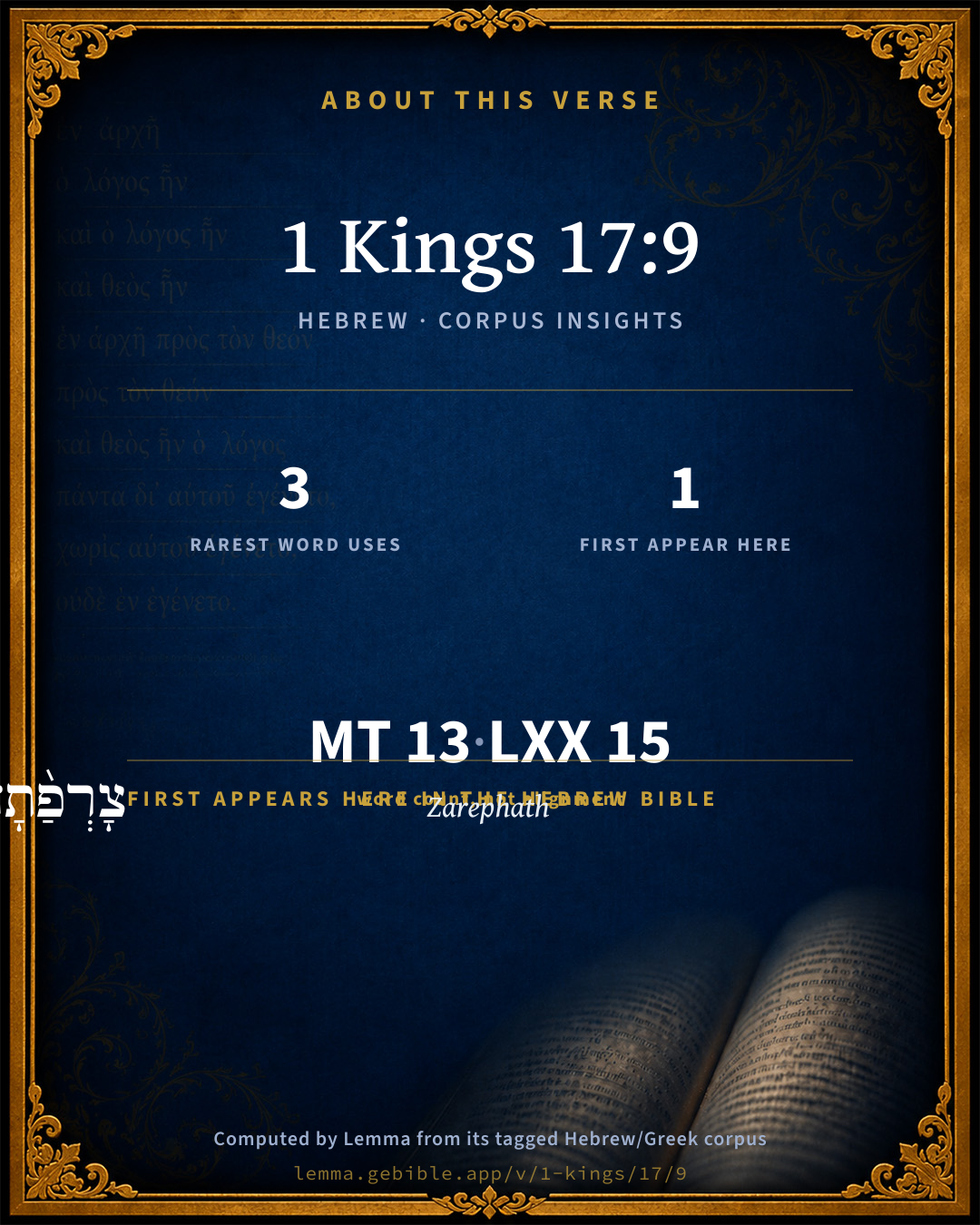
The rarest word here is צָרְפַ֨תָה֙ Zarephath H6886 — appearing just 3 times in the whole Hebrew Bible.

First appearance in Scripture

This word makes its first canonical appearance in the Hebrew Bible here:

  • צָרְפַ֨תָה֙ Zarephath H6886

Shared distinctive vocabulary

צָרְפַ֨תָה֙ Zarephath H6886 occurs in 3 verses of the Hebrew Bible. Also found in:

Grammatical profile

  • 5 verbs
  • 4 nouns
  • 2 adverbs
  • 2 particles

Verb forms

  • ק֣וּם Qal · Imperative
  • לֵ֤ךְ Qal · Imperative
  • וְיָשַׁבְתָּ֖ Qal · Sequential Perfect
  • צִוִּ֥יתִי Piel · Perfect
  • לְכַלְכְּלֶֽךָ Pilpel · Infinitive Construct

Repetition

A word recurs within this verse — often emphatic in Hebrew:

  • שָׁ֑ם there H8033 ×2

Hebrew & Septuagint length

In English translation the verse runs 22 words from the Hebrew and 19 from the Septuagint (LXX English) — closely comparable.

A rough comparison of the two English renderings, which tokenize alike — not a word-level alignment.

Word counts can differ between the Hebrew and the Greek without any difference in meaning — e.g. the Hebrew direct-object marker אֵת has no separate Greek word, and Greek often adds the article ὁ.

In the original languages it is 13 Hebrew tokens and 15 Greek tokens — but the two are counted differently (Hebrew bundles its prefixes and suffixes into one token; the Greek is in lemma form), so that isn’t a like-for-like length.

Cross-references

8

Topical passages linked to 1 Kings 17:9 in the Treasury of Scripture Knowledge — connected by theme and wording, ordered by reader-vote popularity; previews shown in the World English Bible.

  • Luke 4:26 Elijah was sent to none of them, except to Zarephath, in the land of Sidon, to a woman who was a widow.
  • Obadiah 1:20 The captives of this host of the children of Israel, who are among the Canaanites, will possess even to Zarephath; and the captives of Jerusalem, who are in Sepharad, will possess the cities of the Negev.
  • 2 Corinthians 4:7 But we have this treasure in clay vessels, that the exceeding greatness of the power may be of God, and not from ourselves.
  • 1 Kings 17:4 It shall be, that you shall drink of the brook; and I have commanded the ravens to feed you there.
  • Matthew 15:21–22 Jesus went out from there, and withdrew into the region of Tyre and Sidon.
  • Romans 4:17–21 As it is written, "I have made you a father of many nations." This is in the presence of him whom he believed: God, who gives life to the dead, and calls the things that are not, as though they were.
  • Judges 7:2 Yahweh said to Gideon, The people who are with you are too many for me to give the Midianites into their hand, lest Israel vaunt themselves against me, saying, My own hand has saved me.
  • Judges 7:4 Yahweh said to Gideon, The people are yet too many; bring them down to the water, and I will try them for you there: and it shall be, that of whom I tell you, This shall go with you, the same shall go with you; and of whoever I tell you, This shall not go with you, the same shall not go.

Cross-references courtesy of OpenBible.info (CC BY 4.0).

Hebrew and Greek witnesses Masoretic Hebrew ↔ Greek Septuagint

The same verse in the two great witnesses to the Old Testament, shown verse-for-verse.

These are two independent witnesses, not word-aligned to each other, and the Septuagint is shown in lemma (dictionary) form.

Hebrew 1 Kings 17:9 Masoretic · Westminster Leningrad Codex

ק֣וּם לֵ֤ךְ צָרְפַ֨תָה֙ אֲשֶׁ֣ר לְצִיד֔וֹן וְיָשַׁבְתָּ֖ שָׁ֑ם הִנֵּ֨ה צִוִּ֥יתִי שָׁ֛ם אִשָּׁ֥ה אַלְמָנָ֖ה לְכַלְכְּלֶֽךָ

Arise, get you to Zarephath, which belongs to Sidon, and dwell there: behold, I have commanded a widow there to sustain you.

World English Bible · Public Domain

Greek LXX 1 Kings 17:9 Septuagint · lemma form

ἀναἵστημι καί πορεύομαι εἰς σαρεπτα ὁ σιδωνία ἰδού ἐντέλλομαι ἐκεῖ γυνή χήρα ὁ διατρέφω σύ

Arise, and go to Sarepta of the Sidonian land: behold, I have there commanded a widow-woman to maintain you.

LXX2012 (modern English Septuagint) · Public Domain

On this verse, Ellicott's Commentary for English Readers discusses the Septuagint’s reading. Read the note in Commentary ↓

Hebrew: Westminster Leningrad Codex (CC BY 4.0). Greek: Septuagint (public domain); English from LXX2012 (modern English Septuagint) (Public Domain). How the Septuagint differs from the Hebrew →

Targum (Aramaic paraphrase)

1

The Targum is the ancient Jewish Aramaic paraphrase of the Hebrew Scriptures — an interpretive translation, not the Hebrew text itself. Onkelos (literal) and Pseudo-Jonathan (expansive) render the Torah, and Jonathan the Prophets. Coverage is partial: where no permissively-licensed English translation exists for a verse, only the Aramaic is shown. This is verse-level text, not a word-by-word alignment to the Hebrew.

  1. Targum Jonathan Prophets (Joshua–Malachi)
    קוּם אֱזֵיל לְצָרְפַת דִי לְצִידוֹנָאֵי וְתִתַב תַּמָן הָא פַּקְדִית תַּמָן אִתְּתָא אַרְמַלְתָּא לְסוֹבָרוּתָךְ:

    (no public-domain English translation for this verse)

    Targum Jonathan — Aramaic: “Mikraot Gedolot” (public domain). English: “Sefaria Community Translation” (CC0 1.0 (public-domain dedication)); “London "Chaldee Paraphrase," 1871” (public domain). Text via Sefaria.

Commentary

Notes on 1 Kings 17:9 from classic Christian and Jewish commentators (each source and its license shown beneath its notes). The classic Christian expositions comment on the surrounding passage and are grouped to its opening verse, so a note may address several verses; the Jewish commentaries on the Tanakh (Rashi and others) are per-verse, so they appear only where the commentator wrote on this verse.

Lemma curates 59 commentaries, every one of them public domain or Creative Commons licensed, each selected and text-cleaned for this edition rather than reprinted as found. About our sources →

Trapp's Complete Commentary

John Trapp

1Ki 17:9 Arise, get thee to Zarephath, which [belongeth] to Zidon, and dwell there: behold, I have commanded a widow woman there to sustain thee.

Ver. 9. Arise, get thee to Zarephath.] Which was, say chorographere, a hundred miles from the brook Cherith. But the Popish friars stick not at a journey to China or Peru, if their superiors command them to go it.

Which belongeth to Zidon.] And was inhabited by Gentiles; to figure out the rejection of the Jews, and vocation of the Gentiles, as our Saviour showeth. {Luk 4:25}

John Trapp, A Commentary or Exposition upon All the Books of the Old and New Testament (1647–1656) — public domain. Text from a community e-Sword module.

The Biblical Illustrator

Joseph S. Exell

1Ki_17:9

Arise, get thee to Zarephath.

Ordered to Zarephath

A friend of mine, spending a few days in the neighbourhood of our English lakes, came upon the most beautiful shrubs he had ever seen. Arrested by their extraordinary luxuriance, he inquired the cause; and learnt that it was due to a judicious system of transplanting, constantly pursued. Whatever may be the effect of such a process In nature, it is certainly true that our heavenly Father employs similar methods to secure the highest results in us. He is constantly transplanting us. And though these changes threaten at times to hinder all steady progress in the Divine life, yet, if they are rightly borne, they result in the most exquisite manifestations of Christian character and experience. Another illustration of the same truth is given by the prophet Jeremiah (Jer_48:11). The quiet life is by no means the greatest life. Some characters can only reach the highest standard of spirituality by the disturbings or displacings in the order of Gods providence. Will not this cast light upon Gods dealings with Elijah? Once he stood in the vessel, Home; then emptied into the vessel, Jezreel; then into the vessel, Cherith; and now into the fourth vessel, Zarephath: and all that he might not settle upon his lees. Believe only that your circumstances are those most suited to develop your character. To one who lives ever in the presence of the unchanging God, and who can say, Thus saith Jehovah, before whom I stand, the ever-varying conditions of our lot touch only the outer rim of life; whatever they take away, they cannot take away that; whatever they bring, they cannot give more than that. The consciousness of that Presence is the one all-mastering thought; the inspiration, the solace, the comfort, of every waking hour.

I. Faith awaits Gods plans. It came to pass, after a while, that the brook dried up, because there had been no rain in the land. Week after week, with unfaltering and steadfast spirit, Elijah watched that dwindling brook; often tempted to stagger through unbelief, but refusing to allow his circumstances to come between himself and God. Unbelief sees God through circumstances, as we sometimes see the sun shorn of his rays through the smoky air; but faith puts God between itself and circumstances, and looks at them through Him. Only then, to his patient and unwavering spirit, the word of the Lord came, saying, Arise, get thee to Zarephath. Most of us would have got anxious and worn with planning long before that. We should have ceased our songs, as soon as the streamlet carolled less musically over its rocky bed. And, probably, long ere the brook was dry, we should have devised some plan, and asking Gods blessing on it, would have started off elsewhere. Alas! we are all too full of our own schemes, and plans, and contrivings. Lord, show me Thy way; teach me to do Thy will: show me the way wherein I should walk, for unto Thee do I lift up my soul.

II. Gods plans demand implicit obedience. So he arose and went to Zarephath, as before he had gone to Cherith, and as presently he would go to show himself to Ahab. We catch sight of Gods ideal; we are enamoured with it; we vow to be only His; we use the most emphatic words; we dedicate ourselves upon the altar. For awhile we seem to tread another world, bathed in heavenly light. Then there comes a command clear and unmistakable. We must leave some beloved Cherith, and go to some unwelcome Zarephath; we must speak some word, take some step, cut off some habit: and we shrink from it--the cost is too great. But, directly we refuse obedience, the light dies off the landscape of our lives, and dark clouds fling their shadows far and near. Search the Bible from board to board, and see if strict, implicit, and instant obedience has not been the secret of the noblest lives.

III. Implicit obedience sometimes brings us into a smelting-furnace. Zarephath means a smelting-furnace. It lay outside the Land of Canaan, occupying the site of the modern Surafend, which stands on a long ridge, backed by the snowclad steeps of Hermon, and overlooking the blue waters of the Mediterranean. Many things might have made it distasteful to the prophet. It belonged to the land from which Jezebel had brought her impious tribe. It was as much cursed by the terrible drought as Canaan. It was impossible to reach it save by a weary journey of 100 miles through the heart of the land, where his name was execrated, and his person proscribed. And then to be sustained by a widow woman belonging to a heathen people! Surely it was a smelting-furnace for cleansing out any alloy of pride, or self-reliance, or independence which might be lurking in the recesses of his heart. And there was much of the refining fire in the character of his reception. When he reached the straggling town it was probably toward nightfall; and at the city gate a widow woman was gathering a few sticks to prepare the evening meal. To some it might have seemed a coincidence; but there is no such word in faiths vocabulary--that which, to human judgment Is a coincidence, to faith is a Providence. Everything that may abide the fire, ye shall make it go through the fire, and it shall be clean (Num_31:23). If, then, there is aught in you that can bear the ordeal, be sure you will be put into the furnace. But the fire shall not destroy; it shall only cleanse you.

IV. When God puts His people into the furnace, He will supply all their need. God had said that he should be fed, and by that widow; and so it should be, though the earth and heaven should pass away. Difficulties are to faith what gymnastic apparatus are to boys, means of strengthening the muscular fibre. Like the fabled salamander, faith feeds on fire. And so with heroic faith Elijah said: Fear not; go and do as thou hast said: for thus saith the Lord God of Israel, The barrel of meal shall not waste, neither shall the cruse of oil fail, until the day that the Lord sendeth rain upon the earth. Our only need is to inquire if we are at that point in Gods pattern where He would have us be. If we are, though it seem impossible for us to be maintained, the thing impossible shall be done. (F. B. Meyer, M. A.)

I have commanded a widow woman there to sustain thee.--

The widow of Zarephath

1. This woman was a Phoenician, of Jezebels own race and country, and by birth and training a believer in those very idolatries which the bloody Queen was then establishing in Palestine, and against which it was the chief part of the prophets burden to witness. From earliest days she had adored her gods. Doubtless the gorgeous ritual of Baal-worship had impressed and awed her senses, and under the terror of Astarte, the lover of blood, she had lived and cowered. Yet it is in her home that the persecuted Preacher of Jehovah finds refuge and welcome! And it is to her home that, in turn, he brings blessing. The Prophet of the Separation is also the Apostle of the Reconciliation. The essential germ of ultimate universality, that was in the Church from the beginning, bursts forth even in him who is the vindicator of her Dispensational exclusiveness. What a world of suggestion lies in the picture of Hebrew Prophet and Phoenician widow, Jehovahs champion and Jezebels countrywoman, under the same roof, sharing the same meal, in friendship and fellowship! The sternest anti-idolater of history by the side of an idolater, blessed and blessing! It is a forecast and prophecy, amid the worlds enmities and hates, of the reconciliation of the future to be wrought out by a greater than Elijah.

2. We have here, too, an illustration of the part which, in the economy of God, suffering plays in the education and perfection of men. The presence of common woe or want, of common peril or pain, has been to multitudes as the very angel of God, conciliating feuds, softening asperities, enlightening prejudices, cementing sundered souls, and forming those sympathetic attachments which give warmth to character and sweetness to life. These two in that marrow house at Zarephath, dwelling in harmony under the pressure of a common straitening, represent in themselves the emollient and healthful influence of suffering in softening and sweetening souls. They illustrate the part which the Divine economy of pain plays in purifying from prejudice, in bridging over the chasms of alienations and the gulches of hate. Dearth, drought, and the wrath of evil men drove these two to their meeting, a meeting for the gain of both, and of us too, and of all who have come between.

3. In this widow we have also a beautiful example of that faith that pleases God and is blessing to the soul in which it abides. I dare say there are some who may so unworthily judge about the matter as to think that she somewhat superstitiously concluded that this stranger was a miracle-worker, or that he was a God-possessed man, and that her faith was simply the credulity that led her to that conclusion. But I hope such persons are few. Lot us not draw that sharp line between faith and faithfulness which such a way of thinking implies. The two are not, indeed, as some would seem to say, the same thing. There is a difference; but it is such a difference as that which exists between bud and flower, flower and fruit, or fountain and flow. Faithfulness is that which impels a man to walk in the way of duty or charity, no matter how hard it may be, and to bear the consequences, be they what they may. Faith makes him do all that, but it adds its own element too. Her faithfulness would have made her do her duty: her faith made the doing of it to be religious. In this spirit and confidence she received her guest, followed her purest instincts--the dictates of her womanly affections--into the ways of self-forgetful charity, and looking up to the giving God overhead, left issues to Him. I do not say she thought or reasoned about it any more than a child would be likely to think or reason about the laws of respiration before breathing, or a flower to speculate scientifically before giving out its aroma. She herself was good, and kind, and self-denying, and she lovingly did her duty so as, according to her light, to please the power of the skies. A very commonplace village woman, in a lowly rut of life, tenderly doing the duty that lay next to her hand; and, within, a trustful heart, and an eye to look up.

4. But the point to which, just now, I must give the chief and closing emphasis is that she was a heathen. But of a truth I say unto you, There were many widows in Israel in the days of Elijah, and unto none of them was Elijah sent, but only to Zarephath, in the land of Zidon, unto a woman that was a widow. The point to which he here calls attention, and which was so distasteful to the Jews, is that the prophet was not sent to any of those within the circle of the visible Church, but to one living outside, in the darkness of a heathen land. And in her, the child of disprivilege, he found that faith which he found not among the children of privilege. (G. M. Grant, B. D.)

The widow of Zarephath

I. Faith in the promises of God.

II. Obedience. Elijah obeys God at the risk of his own life. The widow obeys when requested by the prophet to bring him first a little water, and then a little cake. As disobedience led to the ruin of our first parents, so is it ever still the cause of endless difficulties and dangers in our spiritual course.

III. That Gods demands often increase gradually in their stringency. The prophet asks the widow first for a little water, and afterwards, as if water was not sufficiently difficult to be obtained in such a time of drought, he further requests a little cake, when only a small store of meal and oil was left to the poor widow. So God demands often the lighter sacrifices from us first, and then, as our faith and our patience increase, He afterwards asks from us sacrifices of a higher character; until at length, when, by a course of afflictions He has weaned us from earthly attachments, He exclaims, My son, give Me thy heart.

IV. That the darkest hour often precedes the dawn. It was when the widow woman was about to resign herself to despair, and to despondently await death, that the prophet appeared with the promise of prolonged support for life. The darkest cloud frequently has a silver lining. Never despair, is a good motto, and is a still better one if coupled with another maxim, Put your trust in God.

V. That God is no respecter of persons. This moral our Lord Himself draws from the story of this widow of Zarephath, or Sarepta. The lesson that to the Gentiles also the mercies of God were to be shown, was one that the prejudiced and self-righteous Jews were loath to admit. In the same way the modern Pharisee is disinclined to allow that salvation is possible for those who are outside his own little coterie of professors. (R. Young, M. A.)

Lessons from the obedient widow

I. The personalness of the Divine providence. It is always toward a Providential personalness that the Bible reads, e.g. Joseph in his dungeon; Daniel in Babylon; Saul in the house of Judas in the street called Straight--how beautiful that is, God knew the street and number of the praying Saul who became Paul; Elijah at Cherith; this widow at Zeraphath. In hard times get vision of this fact and lean your heart against the solid truth of the personalness of Providence.

II. What seem to be often our worst trials, are really our best blessings. What could seem worse to this widow than the advent of Elijah demanding that she make him the little cake? But what seemed worst embosomed what was best--the unwasting meal, the unfailing oil. Do not let us be overmuch scared at black trials; they may hold the best benignancies.

III. How small soever our resources, we can still do something for God.

IV. The value of sharing. This woman gave one meal to the prophet and God sustained her for two years. It is as we give we get. This is specially true in religious experience. If we seek to impart the blessedness of our own faith we infallibly get increase of faith.

V. God first. Elijah, representing God, commanded, Make me a little cake first. Ah, that first I Seek ye first the kingdom of God and His righteousness and all these things shall be added unto you. (W. Hoyt, D. D.)

Gracious people outside the church

Nature has her wild flowers, and they have their own loose lawless beauty. Yet the finest effects in form, colour, and fragrance are only to be found under careful cultivation. Wild roses are no argument against the value of gardening; for even cultivated flowers, if left to themselves, will revert little by little to their wild, rude state. And so outside the church of Jesus Christ there are good and noble, end in some senses morally winsome souls: and yet it is true that, for the full cultivation of Christian character, we need the garden of the Lord, Christ Jesus, by His Spirit being the Chief Gardener. Even the wild flowers, in whatever measure they possess beauty and perfume, get it, from His secret influence, though they know it not. In the realm of spirit it is as true as in nature and history, He upholdeth all things by the word of His power. (H. O. Mackey.)

The Biblical Illustrator, edited by Joseph S. Exell (c. 1880s–1900s) — public domain. Text from a community e-Sword module.

Joseph Benson's Commentary

1Ki 17:9. Arise, get thee to Zarephath — A city between Tyre and Sidon, called Sarepta by St. Luk 4:26, and others. Which belongeth to Zidon — To the jurisdiction of that city, which was inhabited by Gentiles. And God’s providing for his prophet, first, by an unclean bird, and then by a Gentile, whom the Jews esteemed unclean, was a presage of the calling of the Gentiles, and rejection of the Jews. So Elijah was the first prophet of the Gentiles. Commanded a widow woman — That is, appointed or provided; for that she had as yet received no revelation or command of God about it, appears from 1Ki 17:12.

Joseph Benson's Commentary on the Old and New Testaments (1811–1818) — public domain. Text from a community e-Sword module.

Tyndale Open Study Notes

Tyndale Open Resources

17:9-16 Elijah’s faith was tested further. At Kerith Brook, God had supplied his needs directly. With these supplies cut off, Elijah now had to depend on a foreign woman’s response to a divine test. The account details the setting (17:8-10a), Elijah’s test for the widow (17:10b-14), the woman’s compliance, and God’s reward (17:15-16).

17:9-11 Zarephath was in Phoenician territory about seven miles south of Sidon, away from Ahab’s jurisdiction. Ironically, God provided Elijah a place of refuge in Jezebel’s homeland, which was associated with worship of Baal. • So he went: Elijah again (see 17:5) obeyed the Lord’s command. Obedience (1 Sam 15:22; Ps 40:1-6; Isa 1:10-20), trust (Ps 37:3; Prov 3:5-6), and faithfulness (Ps 18:25; Rev 2:10) are foundational attributes for successful spiritual service. • God’s ongoing provision for Elijah and the widow of Zarephath demonstrated God’s concern for all people who put him first. • water . . . bread: Elijah asked for the basic staples of life, but these were in scarce supply as the drought spread into Phoenician territory.

Tyndale Open Study Notes — © Tyndale Open Resources, licensed CC BY-SA 4.0. Text via the HelloAO Bible API.

Adam Clarke's Commentary

Verse 9. Get thee to Zarephath] This was a town between Tyre and Sidon, but nearer to the latter, and is therefore called in the text Zarephath which belongeth to Sidon; or, as the Vulgate and other versions express it, Sarepta of the Sidonians. Sarepta is the name by which it goes in the New Testament; but its present name is Sarphan. Mr. Maundrell, who visited it, describes it as consisting of a few houses only on the tops of the mountains; but supposes that it anciently stood in the plain below, where there are still ruins of a considerable extent.

Adam Clarke's Commentary on the Bible (1810–1826) — public domain. Text from a community e-Sword/MySword module.

Ellicott's Commentary for English Readers

(9) Zarephath—the Sarepta of the LXX. and of the New Testament (Luk_4:26). It is said by Josephus to have lain between Tyre and Sidon, and by St. Jerome to have been on the great coast-road. Hence it has been identified with a modern village, Surafend, in that position. The words, “which belongeth to Zidon,” appear to be emphatic, marking the striking providence of God, which, when the land of Israel was apostate and unsafe, found for the prophet a refuge and a welcome in a heathen country, which was moreover the native place of his deadliest enemy.

A Bible Commentary for English Readers, edited by Charles John Ellicott (1878–1897) — public domain. Text from a community e-Sword module.

The Cambridge Bible for Schools and Colleges

gen. ed. J. J. S. Perowne

8–16. Elijah sent to Zarephath and sustained by a widow woman (Not in Chronicles)

9. get thee to Zarephath] This was the city which was known in later times (Luk_4:26) as Sarepta. Josephus says it lay between Sidon and Tyre. There the enemy of Baal-worship would hardly be expected to have sought refuge.

and dwell there] These words are omitted in the LXX.

I have commanded a widow woman] A source of sustenance hardly less precarious than the supply of the ravens. As in the former case, so here, the command implies that God has prompted her to fulfil His purpose. Elijah has been called, from this event, the first Apostle to the Gentiles.

The Cambridge Bible for Schools and Colleges (gen. ed. J. J. S. Perowne; Cambridge University Press, 1878–1918) — public domain. Text from a community e-Sword module.

John Gill's Exposition

Arise, get thee to Zarephath, which belongeth to Zidon, and dwell there,.... This might be a trial of the prophet's faith, to be sent to dwell in a place belonging to the Zidonians, among whom Jezebel had an interest, being the daughter of their king, Kg1 16:31, the place is so called, to distinguish it from another Zarephath, Oba 1:20, Kimchi interprets it, near to Zidon, yet not as belonging to it, but of the land of Israel; though it rather seems to be a Gentile city; it is called, in Luk 4:26 Sarepta of Sidon; and also by Pliny (z); according to Josephus (a), it was not far either from Sidon or Tyre, and lay between them; it was three quarters of a mile from Sidon; and so Mr. Maundrell (b) speaks of it as in the way from Sidon to Tyre, and which is now called Sarphan; of which he says, the place shown us for this city consisted only of a few houses, on the tops of the mountains, within about half a mile from the sea; but it is more probable the principal part of the city stood below in the space between the hills and the sea, there being ruins still to be seen in that place of a considerable extent; and a traveller into those parts many years before him says (c), that he saw nothing of any building on the shore, but some small houses in the place where formerly the town of Sarepta did stand; and Bunting says (d), there are at this time but eight houses in all the town, though by the ruins it seems to have been in times past a very fair city; and another (e) observes, that it is about three miles from Berytus:

behold, I have commanded a widow woman there to sustain thee; not that this was declared to the woman, or that she had any orders from the Lord to support him; but that he had determined it in his mind, and would take care in his providence that he should be supplied by her: this was another trial of the prophet's faith, that he should be sent to a poor widow woman for his support, and she a Gentile; but he that had been so long fed by ravens, could have no reason to doubt of his being provided for in this way.

(z) Nat. Hist. l. 5. c. 19. (a) Ut supra. (Antiqu. l. 8. c. 13. sect. 2.) (b) Journey from Aleppo, &c. p. 48. (c) Rauwolff's Travels, par. 3. ch. 22. p. 326. (d) Ut supra. (Travels, &c. p. 205.) (e) Baumgarten. Peregrinatio, l. 3. c. 9. p. 126.

John Gill's Exposition of the Whole Bible (1746–1763) — public domain (CC PDM 1.0). Text via the HelloAO Bible API.

Albert Barnes' Notes on the Bible

The dependence of Zarephath (Sarepta) on Sidon is indicated in the inscriptions of Sennacherib, where it is mentioned as belonging to Luliya (Elulaeus), king of Sidon, and as submitting to the Assyrian monarch on Luliya’s flight from his capital. Elijah may have been sent to this place, so near the city of Jezebel’s father, as one which it was most unlikely that he would visit.

Albert Barnes' Notes on the Bible (1834–1885) — public domain. Text from a community e-Sword/MySword module.

Haydock's Catholic Bible Commentary

Sidonians, and nearer their city than it was to Tyre. (Calmet) --- Commanded, or provided that she shall feed thee. So he commanded the ravens, ver. 4. (Menochius) --- It appears that the widow had received no precise intimation, ver. 12. She was not an Israelite, (Luke iv. 25.) but probably a pagan. (St. Chrysostom, &c.) --- Many suppose that Elias did not know, at first, that she was to entertain him. (Calmet) --- But both the one and the other might be divinely instructed how to act. In due time the widow and the prophet became acquainted with the will of God, and complied with it. (Haydock)

George Leo Haydock (1774–1849), Haydock's Catholic Family Bible and Commentary, 1859 edition — public domain. Excludes Psalms (Douay-Rheims chapter numbering differs from Protestant) and Deuterocanonical books (Catholic canon only).

Matthew Poole's English Annotations

Zarephath; a city between Tyrus and Sidon, called Sarepta by Luk 4:26, by Pliny, and others.

To Zidon; to the jurisdiction of that city, which therefore was inhabited by Gentiles. See Luk 4:25. And God’s providing for his prophet, first by an unclean bird, and then by a Gentile, whom the Jews esteemed unclean, was a notable presage of the calling of the Gentiles, and of the rejection of the Jews.

I have commanded, i.e. appointed or provided, as before, 1Ki 17:4; for that she had as yet no revelation or command of God about it, appears from 1Ki 17:12.

Matthew Poole's English Annotations on the Holy Bible (1683–1685) — public domain. Text from a community e-Sword/MySword module.

Whedon's Commentary on the Bible

Daniel D. Whedon

9. Zarephath — An ancient city about half way between Sidon and Tyre, called Sarepta in Luk_4:26, and at present Surafend. “It would seem,” says Dr. Robinson, “that the former city of Sarepta stood near the seashore; and that the present village bearing the same name upon the adjacent hills, has sprung up since the time of the crusades; the people having probably chosen to remove thither for the same reason, whatever it may have been, which has caused the abandonment of all the rest of the plain. In the rocks along the foot of the hills are many excavated tombs, once doubtless belonging to the ancient city.” The ancient site is marked by “broken foundations and irregular heaps of stones.”

I have commanded a widow woman there to sustain thee — The widow, like the ravens, supplies Elijah by Divine command; a command, however, not audibly laid upon them. As the ravens obeyed, unconscious of the Divine power that controlled them, so largely with this woman.

Daniel D. Whedon (gen. ed.), Commentary on the Old and New Testaments (1874–1909) — public domain. Text from a community e-Sword module.

The Pulpit Commentary

Arise, get thee to Zarephath Cf. Oba_1:20. The name points to furnaces or workshops for the refining of metals, prx liquavit. LXX Sarepta; cf. Luk_4:26. It is now represented by an insignificant village, Surafend, which, however, preserves the original name. It lies still, as no doubt it did then, on the high road between Tyre and Sidon, and on the shore. The prophet would thus be in the lion"s den, in the very heart of the dominions of Ethbaal. See Porter, 2:397. Stanley (S. and P. p. 268) shows how the memory of this visit still lingers in thetraditions of the neighbourhood, which belongeth to Zidon Sidon is visible from a spot a quarter of an hour distant. "The dependence of Sarepta on Sidon is indicated in the inscriptions of Sennacherib, where it is mentioned as belonging to Luliya, king of Sidon," Rawlinson, and dwell there: behold, I have commanded a widow woman there to sustain thee In considering these words the generally destitute condition of the widow of the East should be borne in mind (Act_6:1; 1Ti_5:3-5, etc.) We gather from Luk_4:25, Luk_4:26, that it was for her sake as well as his that the prophet was sent thither. Mat_15:21-28 tells of another Syro-Phoenician woman.

The Pulpit Commentary (1880–1919), ed. H.D.M. Spence-Jones & Joseph S. Exell — public domain. Text from a community e-Sword module.

John Wesley's Explanatory Notes

Zarephath - A city between Tyre and Sidon, called Sarepta by St. Luke iv, 26, and others. Zidon - To the jurisdiction of that city, which was inhabited by Gentiles. And God's providing for his prophet, first, by an unclean bird, and then by a Gentile, whom the Jews esteemed unclean, was a presage of the calling of the Gentiles, and rejection of the Jews. So Elijah was the first prophet of the Gentiles. Commanded - Appointed or provided, for that she had as yet no Revelation or command of God about it, appears from ver. 12.

John Wesley, Explanatory Notes Upon the Whole Bible (1754–1765) — public domain. Text via the GEBible commentary corpus.

Scofield Reference Notes

C. I. Scofield

Zarephath called Sarepta, Oba 1:20; Luk 4:26.

The Scofield Reference Bible (1917 edition), notes by C. I. Scofield — public domain. Text from a community e-Sword module.

Rashi

Rabbi Shlomo Yitzchaki (Rashi)

To Tzorphas. [Tzorphas was] the name of the city.

I have commanded there. In My retinue, that a widow will feed you there.

Rashi on the Tanakh — English translations: “The Judaica Press complete Tanach with Rashi, translated by A. J. Rosenberg” (CC BY 4.0); “Pentateuch with Rashi's commentary by M. Rosenbaum and A.M. Silbermann, 1929-1934” (public domain); “The Metsudah Tanach series, Lakewood, N.J” (CC BY 4.0); and “The Book of Joshua, Metsudah Publications, 1997” (CC BY 4.0). Text via Sefaria.

Lesson kit

Teaching starters — assembled from the data on this page, not authored interpretation. Every prompt links to the verse data it draws on. Edit before teaching.

1 Kings, in the Historical, opens this verse with 13 words (12 distinct Hebrew lemmas). Its most distinctive word is Tsârᵉphath (“Zarephath”). A historical commentator’s framing appears above. Read the whole chapter for the surrounding context.

Discussion questions

  1. How does “Zarephath” (Tsârᵉphath) shape what this verse is saying?
  2. The word “Zarephath” first appears here in Scripture. What is being introduced at this debut?
  3. 1 Kings 17:10 shares the word «Zarephath» with this verse. How do the two illuminate each other?
  4. “there” occurs 2× in this one verse. What is the effect of the repetition?
  5. These translations render this verse differently. What is at stake in choosing one wording over another?
  6. The verb «ק֣וּם» is Qal Imperative. How does its form color the action?
  7. Reading how Trapp's Complete Commentary and The Biblical Illustrator read this verse, where do the two commentators agree and where do they part?

Things to notice

Reading settings

Reading text

Shown beneath each verse's original-language words.

Old Testament
Old Testament edition

Read the OT as the Masoretic Hebrew (MT) or the Greek Septuagint (LXX).

English shown for the Greek Septuagint (in the Hebrew ↔ Greek comparison).

Comparing translations? Open the Compare panel on any verse page to stack up to four side by side.