
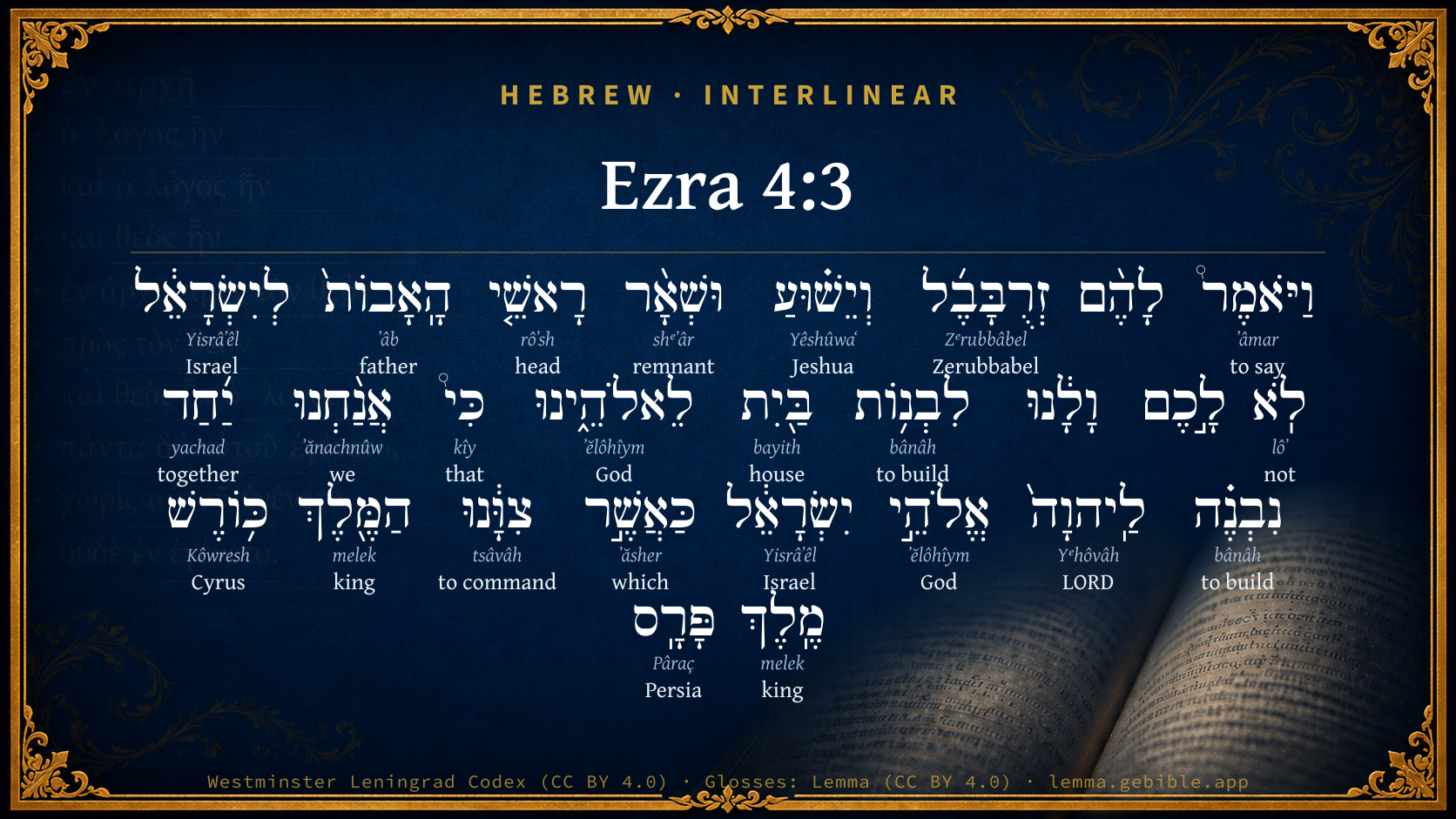
Ezra 4:3

Hebrew (Westminster Leningrad Codex) Ezra 4:3 appears in the Hebrew Old Testament. The text above is from the Westminster Leningrad Codex. Each word links to its Strong’s number, a concise gloss, and parsing drawn from the Open Scriptures Hebrew Bible morphology. Click any word for its full Brown-Driver-Briggs (BDB) entry.
Download image
Cite this verse

Ezra 4:3 (World English Bible). Public Domain. Lemma interlinear Bible study tool, https://lemma.gebible.app/v/ezra/4/3.

Show BibTeX & RIS
BibTeX
RIS
English Translation
But Zerubbabel, and Jeshua, and the rest of the heads of fathers' [houses] of Israel, said to them, You have nothing to do with us in building a house to our God; but we ourselves together will build to Yahweh, the God of Israel, as king Cyrus the king of Persia has commanded us.
World English Bible · Public Domain
Download a study sheet

One document with this verse’s original text, its word-by-word gloss line, the meaning frame, cross-references with their text, attributed commentary, and full source and license credits — printable, and it pastes into notes with its structure intact.

This verse Autodidact and up

Study sheet (.html) Plain text (.txt)

A passage Seminary Student

Up to 50 verses in one chapter. A passage sheet keeps up to 6 commentary sources and 12 cross-references per verse, in the order this page ranks them, and says so on the sheet whenever that leaves anything out. Ask for a single verse and you get the Autodidact verse sheet above.

Everything on this page stays free to read, with no account — the sheet is a download of what is already on screen, not access to it.

Want to remove ads? Support Godless Engineer
Compare translations 3

The same verse in 3 English versions, stacked beneath the original-language interlinear above. Click any original word for its lexicon entry.

Each is an independent rendering of the whole verse — the interlinear is not word-aligned to these translations.

Highlighted words mark where these versions differ — a whole-verse word diff, not a word-by-word alignment.

  • World English Bible Public Domain
    But Zerubbabel, and Jeshua, and the rest of the heads of fathers' [houses] of Israel, said to them, You have nothing to do with us in building a house to our God; but we ourselves together will build to Yahweh, the God of Israel, as king Cyrus the king of Persia has commanded us.
  • King James Version Public Domain
    But Zerubbabel, and Jeshua, and the rest of the chief of the fathers of Israel, said unto them, Ye have nothing to do with us to build an house unto our God; but we ourselves together will build unto the LORD God of Israel, as king Cyrus the king of Persia hath commanded us.
  • unfoldingWord Literal Text CC BY-SA 4.0
    But Zerubbabel, and Jeshua, and the rest of the heads of the fathers of Israel said to them, “It is not for you and for us to build a house for our God, but we ourselves together will build for Yahweh, the God of Israel, just as the king Cyrus, the king of Persia, has commanded us.”

unfoldingWord Literal Text — © unfoldingWord, licensed CC BY-SA 4.0. Word-aligned USFM3 via Door43 (git.door43.org/unfoldingWord/en_ult).

Versions to compare (up to 4)

3 of 4 selected

Show all 18 translations

Every available English version of this verse, each an independent rendering of the whole verse.

  • World English Bible Public Domain
    But Zerubbabel, and Jeshua, and the rest of the heads of fathers' [houses] of Israel, said to them, You have nothing to do with us in building a house to our God; but we ourselves together will build to Yahweh, the God of Israel, as king Cyrus the king of Persia has commanded us.
  • Berean Standard Bible Public Domain
    But Zerubbabel, Jeshua, and the other heads of the families of Israel replied, “You have no part with us in building a house for our God, since we alone must build it for the LORD, the God of Israel, as Cyrus king of Persia has commanded us.”
  • Majority Standard Bible Public Domain
    But Zerubbabel, Jeshua, and the other heads of the families of Israel replied, “You have no part with us in building a house for our God, since we alone must build it for the LORD, the God of Israel, as Cyrus king of Persia has commanded us.”
  • King James Version Public Domain
    But Zerubbabel, and Jeshua, and the rest of the chief of the fathers of Israel, said unto them, Ye have nothing to do with us to build an house unto our God; but we ourselves together will build unto the LORD God of Israel, as king Cyrus the king of Persia hath commanded us.
  • American Standard Version (1901) Public Domain
    But Zerubbabel, and Jeshua, and the rest of the heads of fathers' `houses' of Israel, said unto them, Ye have nothing to do with us in building a house unto our God; but we ourselves together will build unto Jehovah, the God of Israel, as king Cyrus the king of Persia hath commanded us.
  • Revised Version (1885) Public Domain
    But Zerubbabel, and Jeshua, and the rest of the heads of fathers’ houses of Israel, said unto them, Ye have nothing to do with us to build an house unto our God; but we ourselves together will build unto the LORD, the God of Israel, as king Cyrus the king of Persia hath commanded us.
  • Geneva Bible (1599) Public Domain
    Then Zerubbabel, and Ieshua, and the rest of the chiefe fathers of Israel, sayde vnto them, It is not for you, but for vs to buyld the house vnto our God: for we our selues together wil buylde it vnto the Lord God of Israel, as king Cyrus the king of Persia hath commanded vs.
  • Douay-Rheims (1899) Public Domain
    But Zorobabel, and Josue, and the rest of the chief of the fathers of Israel said to them: You have nothing to do with us to build a house to our God, but we ourselves alone will build to the Lord our God, as Cyrus king of the Persians hath commanded us.
  • Young's Literal Translation Public Domain
    And Zerubbabel saith to them, also Jeshua, and the rest of the heads of the fathers of Israel, `Not for you, and for us, to build a house to our God; but we ourselves together do build to Jehovah God of Israel, as the king Cyrus, king of Persia, commanded us.'
  • Literal Standard Version CC BY-SA 4.0
    And Zerubbabel says to them, also Jeshua, and the rest of the heads of the fathers of Israel, “Not for you, and for us, to build a house to our God; but we ourselves together build to YHWH God of Israel, as King Cyrus, king of Persia, commanded us.”
  • Unlocked Literal Bible CC BY-SA 4.0
    But Zerubbabel, Jeshua, and the heads of their ancestors' clans said, “It is not you, but we who must build the house of our God, for it is we who will build for Yahweh, the God of Israel, just as King Cyrus of Persia commanded.”
  • unfoldingWord Literal Text CC BY-SA 4.0
    But Zerubbabel, and Jeshua, and the rest of the heads of the fathers of Israel said to them, “It is not for you and for us to build a house for our God, but we ourselves together will build for Yahweh, the God of Israel, just as the king Cyrus, the king of Persia, has commanded us.”
  • Darby Bible Public Domain
    But Zerubbabel and Jeshua and the rest of the chief fathers of Israel said to them, Ye have nothing to do with us to build a house to our God, but we alone will build to Jehovah the God of Israel, as king Cyrus, the king of Persia, has commanded us.
  • World Messianic Bible Public Domain
    But Zerubbabel, Yeshua, and the rest of the heads of fathers’ households of Israel said to them, “You have nothing to do with us in building a house to our God; but we ourselves together will build to the LORD, the God of Israel, as King Cyrus the king of Persia has commanded us.”
  • Webster's Bible Public Domain
    But Zerubbabel, and Jeshua, and the rest of the chief of the fathers of Israel, said to them, Ye have nothing to do with us to build a house to our God; but we ourselves together will build to the LORD God of Israel, as king Cyrus the king of Persia hath commanded us.
  • Free Bible Version CC BY-SA 4.0
    But Zerubbabel, Jeshua, and the family leaders of Israel replied, “You can't share with us in building a Temple for our God. Only we can build it for the Lord, the God of Israel. This is what Cyrus the king of Persia has ordered us to do.”
  • Bible in Basic English Public Domain
    But Zerubbabel and Jeshua and the rest of the heads of families in Israel said to them, You have no part with us in the building of a house for our God; we ourselves will do the work together for the Lord, the God of Israel, as Cyrus, king of Persia, has given us orders.
  • JPS Tanakh (1917) Public Domain
    But Zerubbabel, and Jeshua, and the rest of the heads of fathers' houses of Israel, said unto them: 'Ye have nothing to do with us to build a house unto our God; but we ourselves together will build unto the LORD, the God of Israel, as king Cyrus the king of Persia hath commanded us.'

Literal Standard Version (2020), Covenant Press — licensed CC BY-SA 4.0. Text via the HelloAO Bible API (eBible.org). Unlocked Literal Bible (unfoldingWord) — licensed CC BY-SA 4.0. Text via the HelloAO Bible API (eBible.org). unfoldingWord Literal Text — © unfoldingWord, licensed CC BY-SA 4.0. Word-aligned USFM3 via Door43 (git.door43.org/unfoldingWord/en_ult). Free Bible Version, Dr. Jonathan Gallagher — licensed CC BY-SA 4.0. Text via the HelloAO Bible API (eBible.org).

Word by word

More ways to search: Search by grammar → Find every occurrence → Compare this word →

Practice this passage: Drill this verse → Learn its vocabulary →

כּ֥וֹרֶשׁ
Kôwresh
H3566
“Cyrus”
Noun, Proper
Part of Speech
Noun
Type
Proper
Full BDB Definition

Origin: from the Persians

TWOT: None

Cyrus = "posses thou the furnace" - the king of Persia and conqueror of Babylon; first ruler of Persia to make a decree allowing the Israelite exiles to return to Jerusalem
  1. וַיֹּאמֶר֩ ʼâmar H559 “and · to say” Conjunction + Verb, Qal, Sequential Imperfect, 3rd Person, Masculine, Singular
  2. זְרֻבָּבֶ֜ל Zᵉrubbâbel H2216 “Zerubbabel” Noun, Proper
  3. וְיֵשׁ֗וּעַ Yêshûwaʻ H3442 “and · Jeshua” Conjunction + Noun, Proper
  4. וּשְׁאָ֨ר shᵉʼâr H7605 “and · remnant of” Conjunction + Noun, Common, Masculine, Singular, Construct
  5. רָאשֵׁ֤י rôʼsh H7218 “heads of” Noun, Common, Masculine, Plural, Construct
  6. הָֽאָבוֹת֙ ʼâb H1 “the · fathers” Particle, Definite Article + Noun, Common, Masculine, Plural, Absolute
  7. לְיִשְׂרָאֵ֔ל Yisrâʼêl H3478 “to/for · Israel” Preposition + Noun, Proper
  8. לֹֽא lôʼ H3808 “not” Particle, Negative
  9. לִבְנ֥וֹת bânâh H1129 “to build” Preposition + Verb, Qal, Infinitive Construct
  10. בַּ֖יִת bayith H1004 “house” Noun, Common, Masculine, Singular, Absolute
  11. לֵאלֹהֵ֑ינוּ ʼĕlôhîym H430 “to/for · God(s) · our” Preposition + Noun, Common, Masculine, Plural, Construct + Suffix, Personal, 1st Person, Common, Plural
  12. כִּי֩ kîy H3588 “that” Conjunction
  13. אֲנַ֨חְנוּ ʼănachnûw H587 “we” Pronoun, Personal, 1st Person, Common, Plural
  14. יַ֜חַד yachad H3162 “together” Adverb
  15. נִבְנֶ֗ה bânâh H1129 “to build” Verb, Qal, Imperfect, 1st Person, Common, Plural
  16. לַֽיהוָה֙ Yᵉhôvâh H3068 “to/for · LORD” Preposition + Noun, Proper
  17. אֱלֹהֵ֣י ʼĕlôhîym H430 “God(s) of” Noun, Common, Masculine, Plural, Construct
  18. יִשְׂרָאֵ֔ל Yisrâʼêl H3478 “Israel” Noun, Proper
  19. כַּאֲשֶׁ֣ר ʼăsher H834 “like/as · which” Preposition + Particle, Relative
  20. צִוָּ֔נוּ tsâvâh H6680 “to command · us” Verb, Piel, Perfect, 3rd Person, Masculine, Singular + Suffix, Personal, 1st Person, Common, Plural
  21. הַמֶּ֖לֶךְ melek H4428 “the · king” Particle, Definite Article + Noun, Common, Masculine, Singular, Absolute
  22. מֶֽלֶךְ melek H4428 “king of” Noun, Common, Masculine, Singular, Construct
  23. פָּרָֽס Pâraç H6539 “Persia” Noun, Proper

About this verse

These counts appear in no published source. They are computed here, from the morphology-tagged text and Lemma’s own curated glosses. What Lemma adds →

27
words
20
distinct lemmas
Historical
section

Notable vocabulary

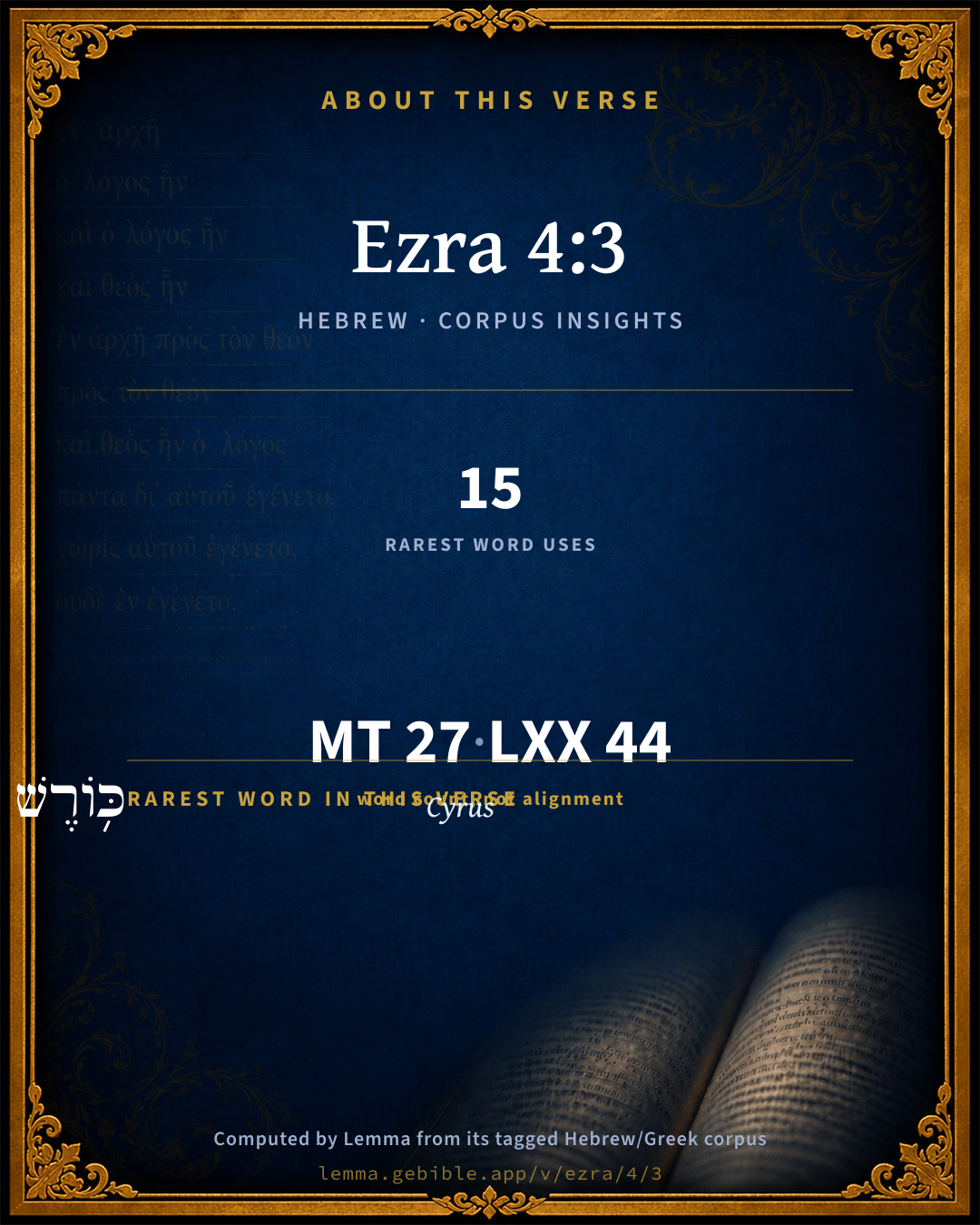
The rarest word here is כּ֥וֹרֶשׁ Cyrus H3566 — appearing just 15 times in the whole Hebrew Bible.

Shared distinctive vocabulary

כּ֥וֹרֶשׁ Cyrus H3566 occurs in 13 verses of the Hebrew Bible. Also found in:

Grammatical profile

  • 4 verbs
  • 15 nouns
  • 2 pronouns
  • 2 prepositions
  • 1 conjunction
  • 1 adverb
  • 2 particles

Verb forms

  • וַיֹּאמֶר֩ Qal · Sequential Imperfect
  • לִבְנ֥וֹת Qal · Infinitive Construct
  • נִבְנֶ֗ה Qal · Imperfect
  • צִוָּ֔נוּ Piel · Perfect

Repetition

Words recur within this verse — often emphatic in Hebrew:

  • לְיִשְׂרָאֵ֔ל Israel H3478 ×2
  • לִבְנ֥וֹת to build H1129 ×2
  • לֵאלֹהֵ֑ינוּ God H430 ×2
  • הַמֶּ֖לֶךְ king H4428 ×2

Hebrew & Septuagint length

In English translation the verse runs 54 words from the Hebrew and 52 from the Septuagint (LXX English) — closely comparable.

A rough comparison of the two English renderings, which tokenize alike — not a word-level alignment.

Word counts can differ between the Hebrew and the Greek without any difference in meaning — e.g. the Hebrew direct-object marker אֵת has no separate Greek word, and Greek often adds the article ὁ.

In the original languages it is 27 Hebrew tokens and 44 Greek tokens — but the two are counted differently (Hebrew bundles its prefixes and suffixes into one token; the Greek is in lemma form), so that isn’t a like-for-like length.

Cross-references

10

Topical passages linked to Ezra 4:3 in the Treasury of Scripture Knowledge — connected by theme and wording, ordered by reader-vote popularity; previews shown in the World English Bible.

  • Nehemiah 2:20 Then answered I them, and said to them, The God of heaven, he will prosper us; therefore we his servants will arise and build: but you have no portion, nor right, nor memorial, in Jerusalem.
  • Matthew 10:16 "Behold, I send you out as sheep in the midst of wolves. Therefore be wise as serpents, and harmless as doves.
  • 2 Chronicles 36:22 Now in the first year of Cyrus king of Persia, that the word of Yahweh by the mouth of Jeremiah might be accomplished, Yahweh stirred up the spirit of Cyrus king of Persia, so that he made a proclamation throughout all his kingdom, and [put it] also in writing, saying,
  • Ezra 6:3–5 In the first year of Cyrus the king, Cyrus the king made a decree: Concerning the house of God at Jerusalem, let the house be built, the place where they offer sacrifices, and let the foundations of it be strongly laid; the height of it sixty cubits, and the breadth of it sixty cubits;
  • Isaiah 44:28–45:1 Who says of Cyrus, [He is] my shepherd, and shall perform all my pleasure, even saying of Jerusalem, She shall be built; and of the temple, Your foundation shall be laid.
  • Isaiah 45:4 For Jacob my servant's sake, and Israel my chosen, I have called you by your name: I have surnamed you, though you have not known me.
  • John 4:22–23 You worship that which you don't know. We worship that which we know; for salvation is from the Jews.
  • Acts 8:21 You have neither part nor lot in this matter, for your heart isn't right before God.
  • Romans 9:4–5 who are Israelites; whose is the adoption, the glory, the covenants, the giving of the law, the service, and the promises;
  • 3 John 1:9–10 I wrote to the assembly, but Diotrephes, who loves to be first among them, doesn't accept what we say.

Cross-references courtesy of OpenBible.info (CC BY 4.0).

Hebrew and Greek witnesses Masoretic Hebrew ↔ Greek Septuagint

The same verse in the two great witnesses to the Old Testament, shown verse-for-verse.

These are two independent witnesses, not word-aligned to each other, and the Septuagint is shown in lemma (dictionary) form.

Hebrew Ezra 4:3 Masoretic · Westminster Leningrad Codex

וַיֹּאמֶר֩ לָהֶ֨ם זְרֻבָּבֶ֜ל וְיֵשׁ֗וּעַ וּשְׁאָ֨ר רָאשֵׁ֤י הָֽאָבוֹת֙ לְיִשְׂרָאֵ֔ל לֹֽא לָ֣כֶם וָלָ֔נוּ לִבְנ֥וֹת בַּ֖יִת לֵאלֹהֵ֑ינוּ כִּי֩ אֲנַ֨חְנוּ יַ֜חַד נִבְנֶ֗ה לַֽיהוָה֙ אֱלֹהֵ֣י יִשְׂרָאֵ֔ל כַּאֲשֶׁ֣ר צִוָּ֔נוּ הַמֶּ֖לֶךְ כּ֥וֹרֶשׁ מֶֽלֶךְ פָּרָֽס

But Zerubbabel, and Jeshua, and the rest of the heads of fathers' [houses] of Israel, said to them, You have nothing to do with us in building a house to our God; but we ourselves together will build to Yahweh, the God of Israel, as king Cyrus the king of Persia has commanded us.

World English Bible · Public Domain

Greek LXX Ezra 4:3 Septuagint · lemma form

καί εἶπον πρός αὐτός ζοροβαβελ καί ἰησοῦς καί ὁ κατάλοιπος ὁ ἄρχων ὁ πατριά ὁ ἰσραήλ οὐ ἐγώ καί σύ ὁ οἰκοδομέω οἶκος ὁ θεός ἐγώ ὅτι ἐγώ αὐτός ἐπί ὁ αὐτός οἰκοδομέω ὁ κύριος θεός ἐγώ ὡς ἐντέλλω ἐγώ κῦρος ὁ βασιλεύς πέρσης

then Zorobabel, and Jesus and the rest of the heads of the families of Israel said to them, It is not for us and you to build a house to our God, for we ourselves will build together to the Lord our God, as Cyrus the king of the Persians commanded us.

LXX2012 (modern English Septuagint) · Public Domain

In the Septuagint this is one book — Esdras B (2 Esdras): Ezra is chapters 1–10, Nehemiah 11–23.

Hebrew: Westminster Leningrad Codex (CC BY 4.0). Greek: Septuagint (public domain); English from LXX2012 (modern English Septuagint) (Public Domain). How the Septuagint differs from the Hebrew →

Commentary

Notes on Ezra 4:3 from classic Christian and Jewish commentators (each source and its license shown beneath its notes). The classic Christian expositions comment on the surrounding passage and are grouped to its opening verse, so a note may address several verses; the Jewish commentaries on the Tanakh (Rashi and others) are per-verse, so they appear only where the commentator wrote on this verse.

Lemma curates 59 commentaries, every one of them public domain or Creative Commons licensed, each selected and text-cleaned for this edition rather than reprinted as found. About our sources →

Trapp's Complete Commentary

John Trapp

Ezr 4:3 But Zerubbabel, and Jeshua, and the rest of the chief of the fathers of Israel, said unto them, Ye have nothing to do with us to build an house unto our God; but we ourselves together will build unto the LORD God of Israel, as king Cyrus the king of Persia hath commanded us.

Ver. 3. But Zerubbabel, and Jeshua] Jeshua would be one to keep them out, though they slighted him in their application to Zerubbabel and the chief of the fathers, Ezr 4:2.

Ye have nothing to do with us] You shall neither conquer us nor compound with us. This was right Roman resolution. They were wont to say of cowards in Rome, that there was nothing Roman in them. I can never sufficiently admire, saith one, the speech of blessed Luther, who, though he was very earnest to have the communion administered in both kinds, contrary to the doctrine and custom of Rome, yet he professes, if the pope, as pope, commanded him to receive in both kinds, he would receive but in one kind, lest he should seem to receive the mark of the beast. As for these reconcilers and moderators, saith another learned man, were they the wisest under heaven, and should live to the world’s end, they would be brought to their wit’s end before they could accomplish this work’s end, to make a reconciliation between Rome and us. They have nothing to do with us to build a house unto our God. From such stand off, saith the apostle, 1Ti 6:5. Say to them, when they offer their cost and service, as here, Pura Deus mens est: procul, o procul este profani. This was one of those ancient laws of the twelve tables among the Romans, Impius ne audeto placare donis iram deorum, Let no profane person presume to think to pacify the gods with their pains or presents.

But we ourselves together will build, &c.] This the adversaries call combination, conspiracy, faction, sedition, &c., see Ezr 4:13. But what saith Tertullian? Cum boni, cum probi coeunt non est factio dicenda, sed curia. Et e contra, illis nomen factionis accommodandum est, qui in odium piorum et proborum conspirant (Apol. advers, gent. Num 520). When good men get together, and hold together, it is not to be called a faction, but a court. As on the other side, they are to be counted factious, who conspire against the godly, as these malignants in the text did.

As king Cyrus, &c.] They had good authority for what they did, and they hold them to it.

John Trapp, A Commentary or Exposition upon All the Books of the Old and New Testament (1647–1656) — public domain. Text from a community e-Sword module.

Joseph Benson's Commentary

Ezr 4:3. Ye have nothing to do with us — The chief of the fathers were soon aware that they meant them no kindness, whatever they might pretend, but really designed to do them an injury; and therefore, (though they had need enough of help, if it had been such as they could confide in,) they told them plainly they could not accept it, nor unite with them, as being of another nation and religion, and therefore not concerned in Cyrus’s grant, which was confined to the Israelites. But we ourselves will build — For you are none of those with whom we dare hold communion. Thus we ought to take heed with whom we go partners, and on whose hand we lean. While we trust God with an absolute confidence, we must trust men with a prudent caution. They do not plead to them the law of their God, which forbade them to mingle themselves with strangers, though they especially had an eye to that, but they urge what they knew would have greater weight with them, the king’s commission, which was directed to themselves only. In doing good we have need of the wisdom of the serpent, as well as of the innocence of the dove.

Joseph Benson's Commentary on the Old and New Testaments (1811–1818) — public domain. Text from a community e-Sword module.

Tyndale Open Study Notes

Tyndale Open Resources

4:3 The key political, religious, and tribal leaders spoke with a unified voice against the foreigners’ proposal, which would have opened the door for their idolatrous beliefs. The Jews did not want to make the same mistake as their ancestors, who were sent into exile as a result of worshiping the false gods of the Canaanites. • as King Cyrus of Persia commanded us: See 1:2-4.

Tyndale Open Study Notes — © Tyndale Open Resources, licensed CC BY-SA 4.0. Text via the HelloAO Bible API.

Geneva Bible (1599)

Geneva Bible translators

For they perceived what their pretence was, to wit, to erect idolatry instead of true religion.

Geneva Bible (1599) marginal notes — public domain. Text via Bolls.life.

Jamieson, Fausset & Brown

Robert Jamieson, A. R. Fausset & David Brown

But Zerubbabel and Jeshua . . . said . . . Ye have nothing to do with us to build an house unto our God--This refusal to co-operate with the Samaritans, from whatever motives it sprang, was overruled by Providence for ultimate good; for, had the two peoples worked together, familiar acquaintanceship and intermarriage would have ensued, and the result might have been a relapse of the Jews into idolatry. Most certainly, confusion and obscurity in the genealogical evidence that proved the descent of the Messiah would have followed; whereas, in their hostile and separate condition, they were jealous observers of each other's proceedings, watching with mutual care over the preservation and integrity of the sacred books, guarding the purity and honor of the Mosaic worship, and thus contributing to the maintenance of religious knowledge and truth.

Jamieson, Fausset & Brown — Commentary Critical and Explanatory on the Whole Bible (1871) — public domain (CC PDM 1.0). Text via the HelloAO Bible API.

Adam Clarke's Commentary

Verse 3. Ye have nothing to do with us] We cannot acknowledge you as worshippers of the true God, and cannot participate with you in anything that relates to his worship.

Adam Clarke's Commentary on the Bible (1810–1826) — public domain. Text from a community e-Sword/MySword module.

Ellicott's Commentary for English Readers

(3) Ye have nothing to do with us.—The account in 2 Kings 17 carefully studied will show that the stern refusal of the leaders was precisely ill harmony with the will of God; there was nothing in it of that intolerant spirit which is sometimes imagined. The whole design of the Great Restoration would have been defeated by a concession at this point. The reference to the command of Cyrus is another and really subordinate kind of justification, pleaded as subjects of the King of Persia, whose decree was absolute and exclusive.

A Bible Commentary for English Readers, edited by Charles John Ellicott (1878–1897) — public domain. Text from a community e-Sword module.

The Cambridge Bible for Schools and Colleges

gen. ed. J. J. S. Perowne

3. But Zerubbabel &c.… the chief of the fathers] R.V. … heads of fathers’ houses. Zerubbabel’s name stands first, as in Ezr_3:8, in connexion with the work, with which he had been commissioned by Cyrus.

You have nothing to do with us] literally ‘It is not for you and for us’. A common Hebrew idiom, cf. Jdg_11:12, ‘What hast thou to do with me?’ literally ‘What is there for thee and for me &c.?’ 2Ki_3:13; for its occurrence in the N. T., cf. Mar_1:24; Joh_2:4. The A.V. of 1Es_5:70 gives ‘It is not for us and you to build together’.

unto our God] Almost as if they had said ‘our God and not yours’.

ourselves together] The union of the new community and the exclusion of all strangers. The word rendered ‘together’ is not to be understood as if the phrase were an exclusive one, ‘ourselves alone’. It emphasizes the combined action of the true Israelites. Cf. Psa_2:2 ‘take counsel together’.

unto the Lord God of Israel] R.V. ‘unto the Lord, the God of Israel’, cf. Ezr_4:4, Ezr_1:3. This implies, though it does not assert in so many words, that the applicants were not members of Israel.

as king Cyrus &c.] referring to the words in Ezr_1:3 ‘Who is there among you of all his people? his God be with him &c.’

The refusal of the application is thus technically based upon the wording of Cyrus’ decree; the applicants failed to come under the permission which Cyrus had granted, and could not therefore take part in the work. Zerubbabel and his companions evaded the dilemma of having to meet the religious plea either by counter-argument or by direct contradiction. At the same time they made it quite evident that they declined to recognize the identity of worship which was pleaded, or the claim to relationship and political union which underlay the plea.

On the two points (a) who made the overtures? (b) how we are to regard their rejection by the Jewish leaders, see Introduction, § 6. Outline of History.

The Cambridge Bible for Schools and Colleges (gen. ed. J. J. S. Perowne; Cambridge University Press, 1878–1918) — public domain. Text from a community e-Sword module.

John Gill's Exposition

But Zerubbabel, and Joshua, and the rest of the chief of the fathers, said unto them,.... The prince and high priest, and chief of the people:

you have nothing to do with us to build an house to our God; being neither of the same nation, nor of the same religion:

but we ourselves together will build to the Lord God of Israel; we and we only, who are together as one man, united in one body of people, and in the same religious sentiments, being Israelites; we separately, without admitting strangers among us, will build a temple to the God of Israel:

as King Cyrus, the king of Persia, hath commanded us; thereby letting them know that they acted by his authority, and the commission they had from him only concerned themselves, and not others.

John Gill's Exposition of the Whole Bible (1746–1763) — public domain (CC PDM 1.0). Text via the HelloAO Bible API.

Albert Barnes' Notes on the Bible

Ye have nothing to do with us - Because the Samaritans had united idolatrous rites with the worship of Yahweh 2Ki 17:29-41. To have allowed them a share in restoring the temple would have been destructive of all purity of religion.

As king Cyrus ... commanded us - The exact words of the edict gave the right of building exclusively to those who should “go up” from Babylonia to Judaea Ezr 1:3.

Albert Barnes' Notes on the Bible (1834–1885) — public domain. Text from a community e-Sword/MySword module.

Haydock's Catholic Bible Commentary

You, &c. Literally, "It is not for you and us to build." But why might not these people assist in the work, as well as king Hiram or Darius? (Haydock) --- Schismatics and heretics must not communicate in sacrifices with Catholics, (Worthington) nor must the latter have society with them, in matters of religion. The Jews feared lest the Samaritans might introduce the worship of idols, or claim a part of the temple, or at least boast of what they had done. (Tirinus) --- They were aware of the insincerity of these people. (Menochius) --- The permission was moreover only granted to the Jews: (Calmet) but Cyrus had exhorted all to contribute; (chap. i. 4,) and Darius, as well as his pagan governors, were not repelled with disdain, chap. vi. 13. This treatment caused the Samaritans to be more inveterate, though the Jews were always more unwilling to come to a reconciliation. (Haydock) --- "For the Scripture did not say, the Samaritans have no commerce with the Jews," says St. Chrysostom in John iv. The Jewish authors inform us, that "Ezra, &c., gathered all the congregation into the temple, and the Levites sung and cursed the Samaritans,...that no Israelite eat of any thing that is a Samaritan’s, not that any Samaritan be proselyted to Israel, nor have any part in the resurrection," &c. (R. Tanchum) (Lightfoot i. p. 598.) (Kennicott) --- If this were true, it would be carrying their resentment too far; as we ought to promote the conversion of the greatest reprobates. But we have no reason to condemn such great men. They knew the character of the Samaritans, and wished to bring them to a sense of their duty, by this rebuke. (Haydock)

George Leo Haydock (1774–1849), Haydock's Catholic Family Bible and Commentary, 1859 edition — public domain. Excludes Psalms (Douay-Rheims chapter numbering differs from Protestant) and Deuterocanonical books (Catholic canon only).

Matthew Poole's English Annotations

Ye have nothing to do with us; as being of another nation and religion, and therefore not concerned in Cyrus’s grant, which was confined to the Israelites and to the worshippers of the true God.

We ourselves together, i.e. who are united together by Cyrus’s grant in this work; or, alone, as this word is sometimes used, as Job 34:29; Psa 33:15; Hos 11:7.

Matthew Poole's English Annotations on the Holy Bible (1683–1685) — public domain. Text from a community e-Sword/MySword module.

Whedon's Commentary on the Bible

Daniel D. Whedon

3. Ye have nothing to do with us — Literally, It is not to you and to us to build, etc., that is, ye have no proper right or claim to be associated with us in rebuilding the temple, for, as 2Ki_17:41 shows, while these nations feared Jehovah, they still worshipped the graven images of their false gods, and so were really idolaters. The true Hebrew could not fellowship such worshippers of God.

Daniel D. Whedon (gen. ed.), Commentary on the Old and New Testaments (1874–1909) — public domain. Text from a community e-Sword module.

The Pulpit Commentary

Ye have nothing to do with us to build a house unto our God. You have no ground on which to rest your claim of uniting with us in this matter. You do not really wish to build to our God simply and singly; nor were you mentioned in the decree of Cyrus, which is our warrant for what we are doing.

The Pulpit Commentary (1880–1919), ed. H.D.M. Spence-Jones & Joseph S. Exell — public domain. Text from a community e-Sword module.

John Wesley's Explanatory Notes

With us - As being of another nation and religion, and therefore not concerned in Cyrus's grant, which was confined to the Israelites. Take heed, whom you go partners with, and on whose hand you lean. While we trust God with an absolute confidence, we must trust men with a prudent caution.

John Wesley, Explanatory Notes Upon the Whole Bible (1754–1765) — public domain. Text via the GEBible commentary corpus.

Keil & Delitzsch

C. F. Keil & F. Delitzsch

Zerubbabel and the other chiefs of Israel answer, "It is not for you and for us to build a house to our God;" i.e., You and we cannot together build a house to the God who is our God; "but we alone will build it to Jahve the God of Israel, as King Cyrus commanded us." יחד אנחנוּ, we together, i.e., we alone (without your assistance). By the emphasis placed upon "our God" and "Jahve the God of Israel," the assertion of the adversaries, "We seek your God as ye do," is indirectly refuted. If Jahve is the God of Israel, He is not the God of those whom Esarhaddon brought into the land. The appeal to the decree of Cyrus (Ezr 1:3, comp. Ezr 3:6, etc.) forms a strong argument for the sole agency of Jews in building the temple, inasmuch as Cyrus had invited those only who were of His (Jahve's) people (Ezr 1:3). Hence the leaders of the new community were legally justified in rejecting the proposal of the colonists brought in by Esarhaddon. For the latter were neither members of the people of Jahve, nor Israelites, nor genuine worshippers of Jahve. They were non-Israelites, and designated themselves as those whom the king of Assyria had brought into the land. According to Kg2 17:24, the king of Assyria brought colonists from Babylon, Cuthah, and other places, and placed them in the cities of Samaria instead of the children of Israel. Now we cannot suppose that every Israelite, to the very last man, was carried away by the Assyrians; such a deportation of a conquered people being unusual, and indeed impossible. Apart, then, from the passage, Ch2 30:6, etc., which many expositors refer to the time of the destruction of the kingdom of the ten tribes, we find that in the time of King Josiah (Ch2 34:9), when the foreign colonists had been for a considerable period in the country, there were still remnants of Manasseh, of Ephraim, and of all Israel, who gave contributions for the house of God at Jerusalem; and also that in Kg2 23:15-20 and Ch2 34:6, a remnant of the Israelite inhabitants still existed in the former territory of the ten tribes. The eighty men, too, who (Jer 41:5, etc.) came, after the destruction of the temple, from Shechem, Shiloh, and Samaria, mourning, and bringing offerings and incense to Jerusalem, to the place of the house of God, which was still a holy place to them, were certainly Israelites of the ten tribes still left in the land, and who had probably from the days of Josiah adhered to the temple worship. These remnants, however, of the Israelites inhabitants in the territories of the former kingdom of the ten tribes, are not taken into account in the present discussion concerning the erection of the temple; because, however considerable their numbers might be, they formed no community independent of the colonists, but were dispersed among them, and without political influence. It is not indeed impossible "that the colonists were induced through the influence exercised upon them by the Israelites living in their midst to prefer to the Jews the request, 'Let us build with you;' still those who made the proposal were not Israelites, but the foreign colonists" (Bertheau). These were neither members of the chosen people nor worshippers of the God of Israel. At their first settlement (Kg2 17:24, etc.) they evidently feared not the Lord, nor did they learn to do so till the king of Assyria, at their request, sent them one of the priests who had been carried away to teach them the manner of worshipping the God of the land. This priest, being a priest of the Israelitish calf-worship, took up his abode at Bethel, and taught them to worship Jahve under the image of a golden calf. Hence arose a worship which is thus described, Kg2 17:29-33 : Every nation made gods of their own, and put them in the houses of the high places which the Samaritans, i.e., the former inhabitants of the kingdom of the ten tribes, had made, every nation in their cities wherein they dwelt. And besides their idols Nergal, Asima, Nibhaz, Tartak, they feared Jahve; they sacrificed to all these gods as well as to Him. A mixed worship which the prophet-historian (Kg2 17:34) thus condemns: "They fear not the Lord, and do after their statutes and ordinances, not after the law and commandment which the Lord commanded to the sons of Jacob." And so, it is finally said (Kg2 17:41), do also their children and children's children unto this day, i.e., about the middle of the Babylonian captivity; nor was it will a subsequent period that the Samaritans renounced gross idolatry. The rulers and heads of Judah could not acknowledge that Jahve whom the colonists worshipped as a local god, together with other gods, in the houses of the high places at Bethel and elsewhere, to be the God of Israel, to whom they were building a temple at Jerusalem. For the question was not whether they would permit Israelites who earnestly sought Jahve to participate in His worship at Jerusalem-a permission which they certainly would have refused to none who sincerely desired to turn to the Lord God-but whether they would acknowledge a mixed population of Gentiles and Israelites, whose worship was more heathen than Israelite, and who nevertheless claimed on its account to belong to the people of God.

(Note: The opinion of Knobel, that those who preferred the request were not the heathen colonists placed in the cities of Samaria by the Assyrian king (Kg2 17:24), but the priests sent by the Assyrian king to Samaria (Kg2 17:27), has been rejected as utterly unfounded by Bertheau, who at the same time demonstrates, against Fritzsche on 1 Esdr. 5:65, the identity of the unnamed king of Assyria (Kg2 17:24) with Esarhaddon.)

To such, the rulers of Judah could not, without unfaithfulness to the Lord their God, permit a participation in the building of the Lord's house.

Keil & Delitzsch — Biblical Commentary on the Old Testament (1861–1891) — public domain (CC PDM 1.0). Text via the HelloAO Bible API. (Old Testament only.)

unfoldingWord translationNotes

Door43 World Missions Community

Jeshua

man's name. See how you translated this in Esra 2:06.

It is not you, but we who must build

Possible meanings are 1) the Jewish leader felt that Cyrus had authorized only them to build the temple or 2) building the temple was the exclusive work of the Jews and no non-Jew would be permitted to contribute to the work.

translationWords

king

Cyrus

Persia

command

unfoldingWord translationNotes — © Distant Shores Media and the Door43 World Missions Community, licensed CC BY-SA 4.0. Source: git.door43.org/Door43/en_tn.

Rashi

Rabbi Shlomo Yitzchaki (Rashi)

but we Heb. כִּי, but we alone shall build. This כִּי serves in place of אֶלָּא, but.

Rashi on the Tanakh — English translations: “The Judaica Press complete Tanach with Rashi, translated by A. J. Rosenberg” (CC BY 4.0); “Pentateuch with Rashi's commentary by M. Rosenbaum and A.M. Silbermann, 1929-1934” (public domain); “The Metsudah Tanach series, Lakewood, N.J” (CC BY 4.0); and “The Book of Joshua, Metsudah Publications, 1997” (CC BY 4.0). Text via Sefaria.

Lesson kit

Teaching starters — assembled from the data on this page, not authored interpretation. Every prompt links to the verse data it draws on. Edit before teaching.

Ezra, in the Historical, opens this verse with 27 words (20 distinct Hebrew lemmas). Its most distinctive word is Kôwresh (“Cyrus”). A historical commentator’s framing appears above. Read the whole chapter for the surrounding context.

Discussion questions

  1. How does “Cyrus” (Kôwresh) shape what this verse is saying?
  2. How does 2 Chronicles 36:22, which shares the word «Cyrus», read alongside this verse?
  3. What does the repetition of “Israel” (2× in this one verse) do in this verse?
  4. These translations render this verse differently; the difference is in the English rendering, not the original. What questions does that raise?
  5. «וַיֹּאמֶר֩» is a Qal Sequential Imperfect verb. How does that grammatical form shape the action described?
  6. Compare how Trapp's Complete Commentary and Joseph Benson's Commentary read this verse. Where do they agree or differ?

Things to notice

Reading settings

Reading text

Shown beneath each verse's original-language words.

Old Testament
Old Testament edition

Read the OT as the Masoretic Hebrew (MT) or the Greek Septuagint (LXX).

English shown for the Greek Septuagint (in the Hebrew ↔ Greek comparison).

Comparing translations? Open the Compare panel on any verse page to stack up to four side by side.