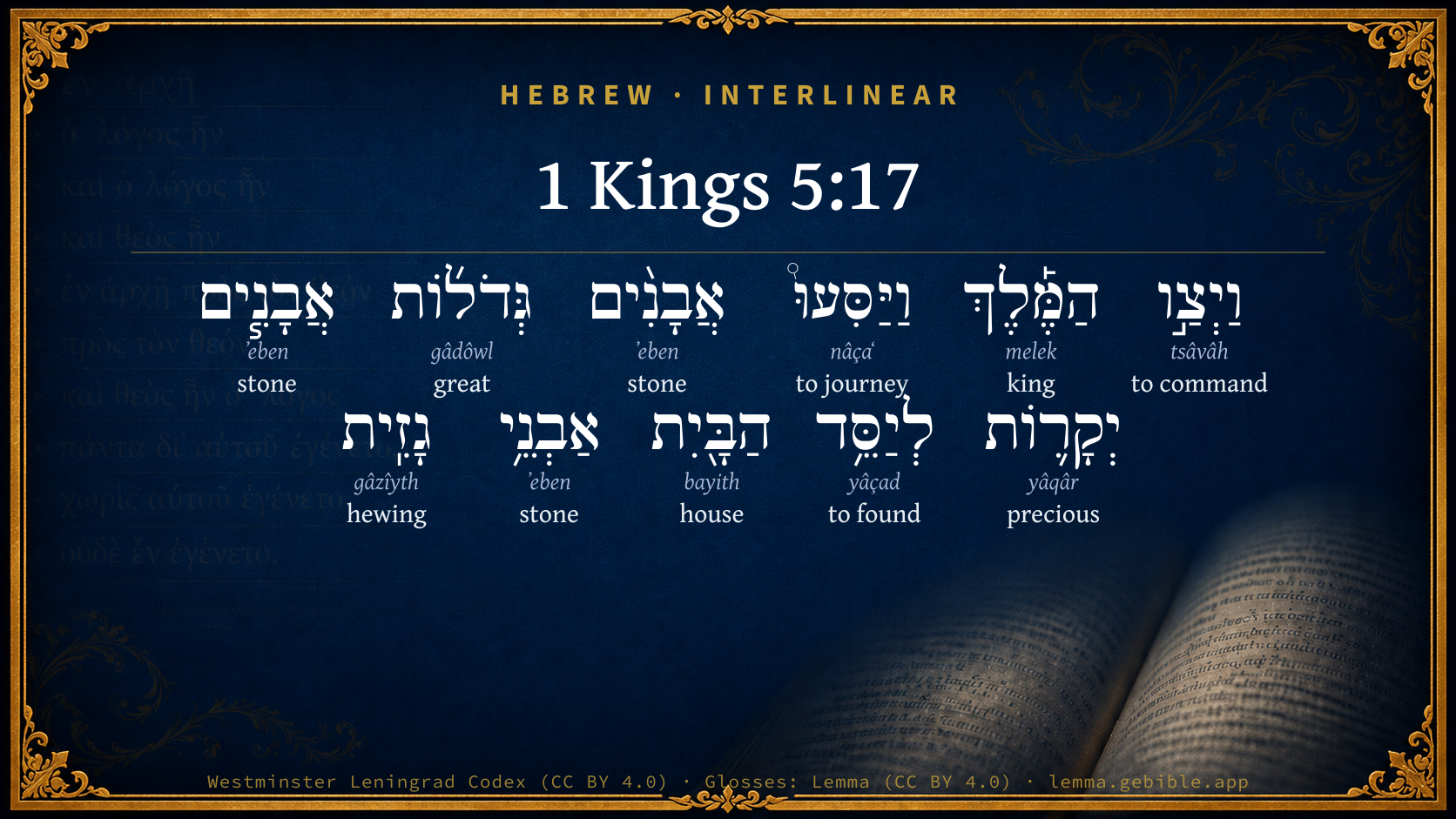
1 Kings 5:17

Hebrew (Westminster Leningrad Codex) 1 Kings 5:17 appears in the Hebrew Old Testament. The text above is from the Westminster Leningrad Codex. Each word links to its Strong’s number, a concise gloss, and parsing drawn from the Open Scriptures Hebrew Bible morphology. Click any word for its full Brown-Driver-Briggs (BDB) entry.
Download image
Cite this verse

1 Kings 5:17 (World English Bible). Public Domain. Lemma interlinear Bible study tool, https://lemma.gebible.app/v/1-kings/5/17.

Show BibTeX & RIS
BibTeX
RIS
English Translation
The king commanded, and they hewed out great stones, costly stones, to lay the foundation of the house with worked stone.
World English Bible · Public Domain
Download a study sheet

One document with this verse’s original text, its word-by-word gloss line, the meaning frame, cross-references with their text, attributed commentary, and full source and license credits — printable, and it pastes into notes with its structure intact.

This verse Autodidact and up

Study sheet (.html) Plain text (.txt)

A passage Seminary Student

Up to 50 verses in one chapter. A passage sheet keeps up to 6 commentary sources and 12 cross-references per verse, in the order this page ranks them, and says so on the sheet whenever that leaves anything out. Ask for a single verse and you get the Autodidact verse sheet above.

Everything on this page stays free to read, with no account — the sheet is a download of what is already on screen, not access to it.

Want to remove ads? Support Godless Engineer
Compare translations 3

The same verse in 3 English versions, stacked beneath the original-language interlinear above. Click any original word for its lexicon entry.

Each is an independent rendering of the whole verse — the interlinear is not word-aligned to these translations.

Highlighted words mark where these versions differ — a whole-verse word diff, not a word-by-word alignment.

  • World English Bible Public Domain
    The king commanded, and they hewed out great stones, costly stones, to lay the foundation of the house with worked stone.
  • King James Version Public Domain
    And the king commanded, and they brought great stones, costly stones, and hewed stones, to lay the foundation of the house.
  • unfoldingWord Literal Text CC BY-SA 4.0
    And the king commanded, and they removed great stones, valuable stones, to found the house, stones of hewing.

unfoldingWord Literal Text — © unfoldingWord, licensed CC BY-SA 4.0. Word-aligned USFM3 via Door43 (git.door43.org/unfoldingWord/en_ult).

Versions to compare (up to 4)

3 of 4 selected

Show all 18 translations

Every available English version of this verse, each an independent rendering of the whole verse.

  • World English Bible Public Domain
    The king commanded, and they hewed out great stones, costly stones, to lay the foundation of the house with worked stone.
  • Berean Standard Bible Public Domain
    And the king commanded them to quarry large, costly stones to lay the foundation of the temple with dressed stones.
  • Majority Standard Bible Public Domain
    And the king commanded them to quarry large, costly stones to lay the foundation of the temple with dressed stones.
  • King James Version Public Domain
    And the king commanded, and they brought great stones, costly stones, and hewed stones, to lay the foundation of the house.
  • American Standard Version (1901) Public Domain
    And the king commanded, and they hewed out great stones, costly stones, to lay the foundation of the house with wrought stone.
  • Revised Version (1885) Public Domain
    And the king commanded, and they hewed out great stones, costly stones, to lay the foundation of the house with wrought stone.
  • Geneva Bible (1599) Public Domain
    And the King commanded them, and they brought great stones and costly stones to make the foundation of the house, euen hewed stones.
  • Douay-Rheims (1899) Public Domain
    And the king commanded, that they should bring great stones, costly stones, for the foundation of the temple, and should square them:
  • Young's Literal Translation Public Domain
    And the king commandeth, and they bring great stones, precious stone, to lay the foundation of the house, hewn stones;
  • Literal Standard Version CC BY-SA 4.0
    And the king commands, and they bring great stones, precious stones, [and] hewn stones, to lay the foundation of the house;
  • Unlocked Literal Bible CC BY-SA 4.0
    At the king's command they quarried large stones of high quality with which to lay the foundation of the temple.
  • unfoldingWord Literal Text CC BY-SA 4.0
    And the king commanded, and they removed great stones, valuable stones, to found the house, stones of hewing.
  • Darby Bible Public Domain
    And the king commanded, and they brought great stones, costly stones, hewn stones, to lay the foundation of the house.
  • World Messianic Bible Public Domain
    The king commanded, and they cut out large stones, costly stones, to lay the foundation of the house with worked stone.
  • Webster's Bible Public Domain
    And the king commanded, and they brought great stones, costly stones, and hewed stones, to lay the foundation of the house.
  • Free Bible Version CC BY-SA 4.0
    Following the king's orders, they quarried large blocks of stone that were expensive to produce, and laid these dressed stones as the foundation for the Temple.
  • Bible in Basic English Public Domain
    By the king's orders great stones, stones of high price, were cut out, so that the base of the house might be made of squared stone.
  • JPS Tanakh (1917) Public Domain
    (5-31) And the king commanded, and they quarried great stones, costly stones, to lay the foundation of the house with hewn stone.

Literal Standard Version (2020), Covenant Press — licensed CC BY-SA 4.0. Text via the HelloAO Bible API (eBible.org). Unlocked Literal Bible (unfoldingWord) — licensed CC BY-SA 4.0. Text via the HelloAO Bible API (eBible.org). unfoldingWord Literal Text — © unfoldingWord, licensed CC BY-SA 4.0. Word-aligned USFM3 via Door43 (git.door43.org/unfoldingWord/en_ult). Free Bible Version, Dr. Jonathan Gallagher — licensed CC BY-SA 4.0. Text via the HelloAO Bible API (eBible.org).

Word by word

More ways to search: Search by grammar → Find every occurrence → Compare this word →

Practice this passage: Drill this verse → Learn its vocabulary →

גָזִֽית
gâzîyth
H1496
“hewing”
Noun, Common, Feminine, Singular, Absolute
Part of Speech
Noun
Type
Common
Gender
Feminine
Number
Singular
State
Absolute
Full BDB Definition

Origin: from H1491

TWOT: 335a

a cutting, hewing
  1. וַיְצַ֣ו tsâvâh H6680 “and · to command” Conjunction + Verb, Piel, Sequential Imperfect, 3rd Person, Masculine, Singular
  2. הַמֶּ֡לֶךְ melek H4428 “the · king” Particle, Definite Article + Noun, Common, Masculine, Singular, Absolute
  3. וַיַּסִּעוּ֩ nâçaʻ H5265 “and · to journey” Conjunction + Verb, Hiphil, Sequential Imperfect, 3rd Person, Masculine, Plural
  4. אֲבָנִ֨ים ʼeben H68 “stones” Noun, Common, Feminine, Plural, Absolute
  5. גְּדֹל֜וֹת gâdôwl H1419 “great” Adjective, Adjective, Feminine, Plural, Absolute
  6. אֲבָנִ֧ים ʼeben H68 “stones” Noun, Common, Feminine, Plural, Absolute
  7. יְקָר֛וֹת yâqâr H3368 “precious” Adjective, Adjective, Feminine, Plural, Absolute
  8. לְיַסֵּ֥ד yâçad H3245 “to found” Preposition + Verb, Piel, Infinitive Construct
  9. הַבָּ֖יִת bayith H1004 “the · house” Particle, Definite Article + Noun, Common, Masculine, Singular, Absolute
  10. אַבְנֵ֥י ʼeben H68 “stones of” Noun, Common, Feminine, Plural, Construct

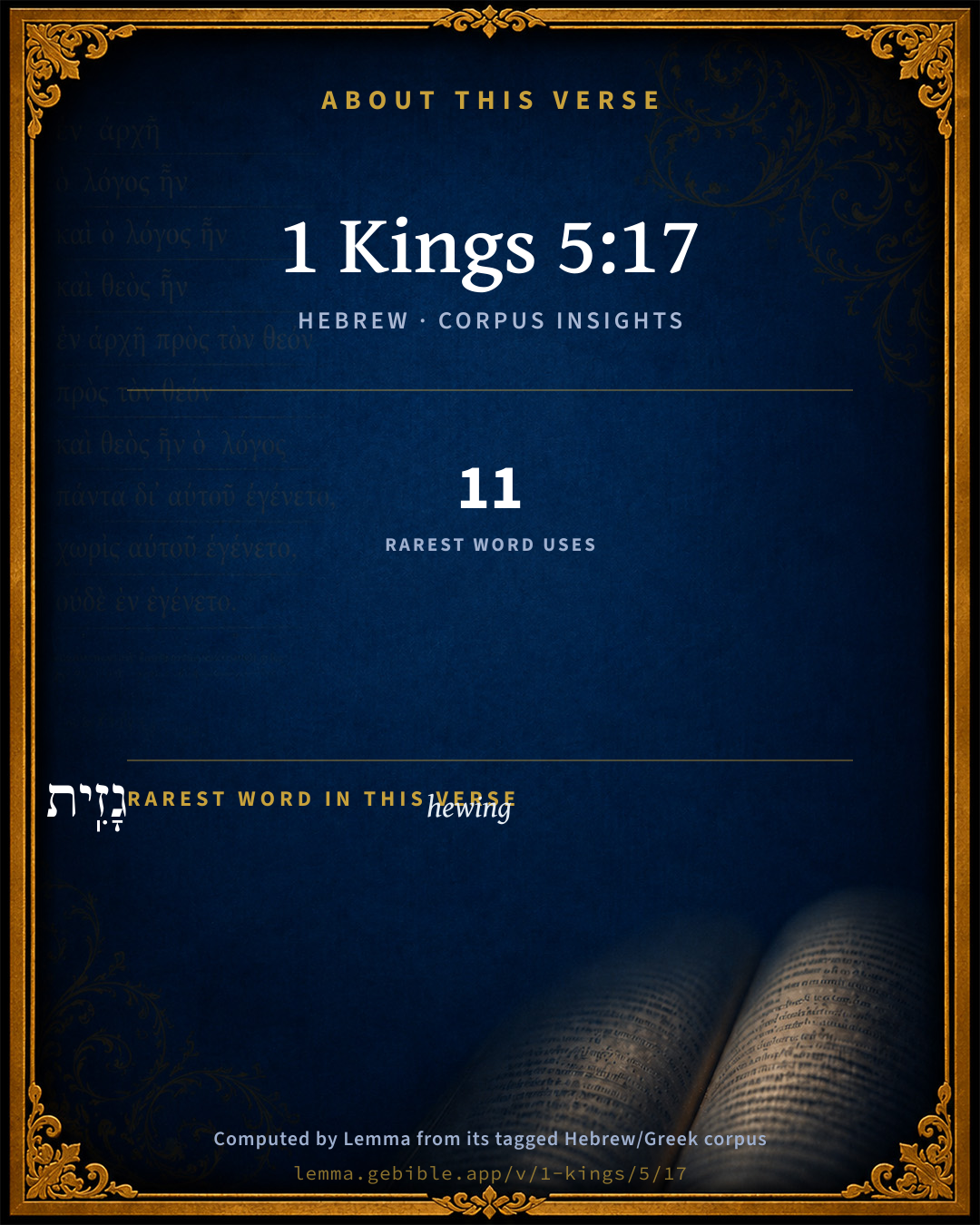
About this verse

These counts appear in no published source. They are computed here, from the morphology-tagged text and Lemma’s own curated glosses. What Lemma adds →

11
words
9
distinct lemmas
Historical
section

Notable vocabulary

The rarest word here is גָזִֽית hewing H1496 — appearing just 11 times in the whole Hebrew Bible.

Shared distinctive vocabulary

גָזִֽית hewing H1496 occurs in 11 verses of the Hebrew Bible. Also found in:

Grammatical profile

  • 3 verbs
  • 6 nouns
  • 2 adjectives

Verb forms

  • וַיְצַ֣ו Piel · Sequential Imperfect
  • וַיַּסִּעוּ֩ Hiphil · Sequential Imperfect
  • לְיַסֵּ֥ד Piel · Infinitive Construct

Repetition

A word recurs within this verse — often emphatic in Hebrew:

  • אֲבָנִ֨ים stone H68 ×3

Hebrew & Septuagint length

In English translation the verse runs 21 words from the Hebrew and 20 from the Septuagint (LXX English) — closely comparable.

A rough comparison of the two English renderings, which tokenize alike — not a word-level alignment.

Word counts can differ between the Hebrew and the Greek without any difference in meaning — e.g. the Hebrew direct-object marker אֵת has no separate Greek word, and Greek often adds the article ὁ.

Cross-references

7

Topical passages linked to 1 Kings 5:17 in the Treasury of Scripture Knowledge — connected by theme and wording, ordered by reader-vote popularity; previews shown in the World English Bible.

  • 1 Kings 6:7 The house, when it was in building, was built of stone made ready at the quarry; and there was neither hammer nor axe nor any tool of iron heard in the house, while it was in building.
  • 1 Chronicles 22:2 David commanded to gather together the foreigners who were in the land of Israel; and he set masons to hew worked stones to build the house of God.
  • 1 Kings 7:9 All these were of costly stones, even of hewn stone, according to measure, sawed with saws, inside and outside, even from the foundation to the coping, and so on the outside to the great court.
  • Isaiah 28:16 therefore thus says the Lord Yahweh, Behold, I lay in Zion for a foundation a stone, a tried stone, a precious corner -[stone] of sure foundation: he who believes shall not be in haste.
  • 1 Corinthians 3:11–12 For no one can lay any other foundation than that which has been laid, which is Jesus Christ.
  • 1 Peter 2:6–7 Because it is contained in Scripture, "Behold, I lay in Zion a chief cornerstone, chosen, and precious: He who believes in him will not be disappointed."
  • Revelation 21:14–21 The wall of the city had twelve foundations, and on them twelve names of the twelve Apostles of the Lamb.

Cross-references courtesy of OpenBible.info (CC BY 4.0).

Hebrew and Greek witnesses Masoretic Hebrew ↔ Greek Septuagint

The same verse in the two great witnesses to the Old Testament, shown verse-for-verse.

These are two independent witnesses, not word-aligned to each other, and the Septuagint is shown in lemma (dictionary) form.

Hebrew 1 Kings 5:17 Masoretic · Westminster Leningrad Codex

וַיְצַ֣ו הַמֶּ֡לֶךְ וַיַּסִּעוּ֩ אֲבָנִ֨ים גְּדֹל֜וֹת אֲבָנִ֧ים יְקָר֛וֹת לְיַסֵּ֥ד הַבָּ֖יִת אַבְנֵ֥י גָזִֽית

The king commanded, and they hewed out great stones, costly stones, to lay the foundation of the house with worked stone.

World English Bible · Public Domain

Greek LXX 1 Kings 5:17 Septuagint · lemma form

σύ οἶδα δαυίδ ὁ πατήρ ἐγώ ὅτι οὐ δύναμαι οἰκοδομέω οἶκος ὁ ὄνομα κύριος θεός ἐγώ ἀπό πρόσωπον ὁ πόλεμος ὁ κυκλόω αὐτός ἕως ὁ δίδωμι κύριος αὐτός ὑπό ὁ ἴχνος ὁ πούς αὐτός

And the king commanded and they brought great stones, precious stones for the foundation of the house, and unhewn stones.

LXX2012 (modern English Septuagint) · Public Domain

Hebrew: Westminster Leningrad Codex (CC BY 4.0). Greek: Septuagint (public domain); English from LXX2012 (modern English Septuagint) (Public Domain). How the Septuagint differs from the Hebrew →

Targum (Aramaic paraphrase)

1

The Targum is the ancient Jewish Aramaic paraphrase of the Hebrew Scriptures — an interpretive translation, not the Hebrew text itself. Onkelos (literal) and Pseudo-Jonathan (expansive) render the Torah, and Jonathan the Prophets. Coverage is partial: where no permissively-licensed English translation exists for a verse, only the Aramaic is shown. This is verse-level text, not a word-by-word alignment to the Hebrew.

  1. Targum Jonathan Prophets (Joshua–Malachi)
    אַתְּ יְדַעְתָּ יַת דָוִד אַבָּא אֲרֵי לָא יָכִיל לְמִבְנֵי בֵיתָא לִשְׁמָא דַייָ אֱלָהֵיהּ מִן קֳדָם עַבְדֵי קְרָבָא דְאַקְפוֹהִי עַד דִמְסַר יְיָ יַתְהוֹן תְּחוֹת פַּרְסַת רִגְלוֹהִי:

    (no public-domain English translation for this verse)

    Targum Jonathan — Aramaic: “Mikraot Gedolot” (public domain). English: “Sefaria Community Translation” (CC0 1.0 (public-domain dedication)); “London "Chaldee Paraphrase," 1871” (public domain). Text via Sefaria.

Commentary

Notes on 1 Kings 5:17 from classic Christian and Jewish commentators (each source and its license shown beneath its notes). The classic Christian expositions comment on the surrounding passage and are grouped to its opening verse, so a note may address several verses; the Jewish commentaries on the Tanakh (Rashi and others) are per-verse, so they appear only where the commentator wrote on this verse.

Lemma curates 59 commentaries, every one of them public domain or Creative Commons licensed, each selected and text-cleaned for this edition rather than reprinted as found. About our sources →

Trapp's Complete Commentary

John Trapp

1Ki 5:17 And the king commanded, and they brought great stones, costly stones, [and] hewed stones, to lay the foundation of the house.

Ver. 17. Great stones, costly stones, and hewed stones,] i.e., Marble of all sorts, as porphyry, parian, ophites, sphengites, &c.

To lay the foundation of the house.] Even those stones that were laid in the base of the building were not rugged and rude, but hewn and costly. God is not all for the eye: he pleaseth himself with the hidden value of the living stones of his spiritual temple.

John Trapp, A Commentary or Exposition upon All the Books of the Old and New Testament (1647–1656) — public domain. Text from a community e-Sword module.

The Biblical Illustrator

Joseph S. Exell

1Ki_5:17

The foundation of the house.

Foundation work

The king commanded: that is the beginning of all Holy zeal waits for the kings orders. But as soon as the command was given there was neither pause nor hesitation; the king commanded, and they brought. Solomon began to build the temple at the foundation. Begin with the foundation. The foundation, in his case, had to be carried to a great height, because the area upon which the temple stood was on high above the valley. Very much of foundation work is out of sight, and the temptation is to pay but small attention to its finish. It was not so with Solomon. I want to urge that all our work for God should be done thoroughly, and especially that part of it which lies lowest, and is least observed of men.

I. This is Gods method.

1. Observe the work of creation. God took care that even in the material universe there should be a grand foundation for His noble edifice.

2. The same is true of Gods work called Providence. No event happens but He has planned it, and ordained that a multitude of other events should precede or follow it. The doings of Providence are threaded together, like pearls upon a string; there is a relation of this to that, and of that to another. Events dovetail the one into the other. Every fact is fitted and adapted to take its place in the design of the Great Architect.

3. But we come into clearer light when we look at the Lords greatest work of redemption. You and I are not saved haphazard. It is not as though God had saved us on the spur of the moment, as an after-thought which was not in His first intent. No; redemption plays an essential part in the purposes of the Lord.

II. This must be our method. We must build after this fashion, and make sure of our foundations.

1. Let it be so in the building up of our own life.

2. So it must be, next, in the building up of a church. Is that a church of God which is not founded on everlasting truth? There are numbers of hasty builders with wood, hay, and stubble; but these neither attend to foundation nor to material laid thereon.

3. In the building up of character in others we must mind that we do the foundation work well. Sunday-school teachers are those who do the foundation work; for they begin first with young hearts, while they are tender and susceptible. It is a most important thing that we have our children and young people well instructed in Divine truth and soundly converted.

III. It is a wise method.

1. Because it is suitable for God. You build your temple for God, and not for men: you should, therefore, make that part of the building good which will be seen by him; and as he sees it all, it must be all of the best.

2. Next, look well to the foundation that is out of sight, for your own sake. No builder can afford to be negligent over the unseen part of a building; for it would involve a serious injury to his character. The very act of scamping is mean and degrading, and lowers a mans tone.

3. Further, lay the foundation well, and look to that part which is out of sight, because in this way you will secure the superstructure. There was a bit of a flaw in the foundation, but nobody saw it; for the builder covered it up very quickly, and ran up the whole concern as quickly as possible. The walls were built, and built well. It seemed clear that the fault down below was of no consequence whatever; and as it had a little cheapened the underground construction, was it not so much the better? How long was this the case? Well, the next year nothing happened: a longer time passed away, and then an ugly crack came down the wall. Had there been an earthquake? No, there was no earthquake. Perhaps a cyclone had beaten upon the work? No, there was no cyclone: the weather was the same as usual. What was the cause of that gaping space which marred the beauty of the building, and threatened to bring it down? It was that blunder long age: that underground neglect produced the terrible mischief above, which would involve a great expense, and perhaps render it needful to take all the building down. That which was out of sight did not always remain out of mind; it only needed time to produce a dangerous settlement.

4. Besides, to lay a good foundation, on Solomons hart was the way to save himself from future fears. Buildings which have to hold a crowd endure seasons of test and trial. Years ago, I was preaching in a building which was exceedingly crowded, and, to my apprehension, there was a continuous tremor. I grew so anxious that I said to a friend, who understood such matters, Go downstairs and see whether this building is really safe; for it seems hardly able to bear the weight of this crowd. When he returned he looked anxious, but gave me no answer. The service ended quietly, and then he said, I am so glad that everything has gone off safely. I do not think you should ever preach there again; for it is a very frail affair; but I thought that if I frightened you there would be more risk in a panic than in letting the service go on. Solomon had built with great stones, costly stones, and hewed stones; and therefore, when the vast multitudes came together around the temple, it never occurred to him to fear that the great weight of people might cause a subsidence of the foundation.

5. Do look well to the foundation, and to the secret part of your dealings with God, because there is a fire coming which will try all things. Every mans work shall be made manifest: for the day shall declare it, because it shall be revealed by fire; and the fire shall try every mans work of what sort it is. (C. H. Spurgeon.)

Faiths foundation secure

There is no kind of construction known to the modern engineer or builder which requires at all times so perfect and absolutely secure a foundation as a bridge. So, precisely, there is no faculty of the soul known to mans keenest spiritual sense which requires so perfect and absolutely secure a foundation as faith, and since faith is the bridge between man and God over the otherwise impassible chasm of doubt and destruction, the Great Constructor, the Engineer of the Universe, has seen to it that its foundations shall rest upon nothing less secure than His own Almighty Word.

The comfort of a sure foundation

As you gaze with admiration at the wonderful tower of the cathedral of Antwerp, it looks as if it were made of lace suspended by some invisible chain from the heavens; but you know when you come to examine it, that all the exquisite lacery and tracery is built upon a most solid foundation. So the experience of the saint, which seems to pierce the very heavens, and is lit up with the light of God, rests on a firm basis. That is assurance of a personal interest in the salvation, procured by the atoning love and sacrifice of Jesus. (R. Venting.)

The Biblical Illustrator, edited by Joseph S. Exell (c. 1880s–1900s) — public domain. Text from a community e-Sword module.

Joseph Benson's Commentary

1Ki 5:17. Costly stones — Marble and porphyry, or other stones of great size and value. To lay the foundation of the house — Where they could not afterward be seen; and therefore that this was done, is mentioned only as a point of magnificence, except it was intended for a type or mystical signification of the preciousness of Christ, who is the foundation of the true temple, and the church of God. “It should seem,” says Henry, “that Solomon was himself present at the founding of the temple, and that the first stone, as has been usual in famous buildings, was laid with great solemnity. Solomon commanded, and they brought costly stones — For a foundation; though, being out of sight, worse might have served. Christ, who is laid for a foundation, is an elect and precious stone, (Isaiah 28.,) and the foundations of the church are said to be laid with sapphires, Isa 54:11. and Rev 21:19. Sincerity obligeth us to lay our foundation firm, and to bestow most pains on that part of our religion which lies out of the sight, of men.”

Joseph Benson's Commentary on the Old and New Testaments (1811–1818) — public domain. Text from a community e-Sword module.

Tyndale Open Study Notes

Tyndale Open Resources

5:17-18 Large blocks of high-quality stone were probably cut to size (see 7:10) in a quarry near Jerusalem (6:7). The need to handle these massive stones is probably what led Solomon to institute forced labor. The craftsmen included men from . . . Gebal (Byblos), a port known for exporting timber, according to ancient Egyptian inscriptions.

Tyndale Open Study Notes — © Tyndale Open Resources, licensed CC BY-SA 4.0. Text via the HelloAO Bible API.

Jamieson, Fausset & Brown

Robert Jamieson, A. R. Fausset & David Brown

brought great stones--The stone of Lebanon is "hard, calcareous, whitish and sonorous, like free stone" [SHAW]. The same white and beautiful stone can be obtained in every part of Syria and Palestine.

hewed stones--or neatly polished, as the Hebrew word signifies (Exo 20:25). Both Jewish and Tyrian builders were employed in hewing these great stones.

Jamieson, Fausset & Brown — Commentary Critical and Explanatory on the Whole Bible (1871) — public domain (CC PDM 1.0). Text via the HelloAO Bible API.

Adam Clarke's Commentary

Verse 17. Great stones] Stones of very large dimensions.

Costly stones] Stones that cost much labour and time to cut them out of the rock.

Hewed stones] Everywhere squared and polished.

Adam Clarke's Commentary on the Bible (1810–1826) — public domain. Text from a community e-Sword/MySword module.

Ellicott's Commentary for English Readers

(17) Great stones.—The stones, so emphatically described as “great stones, costly stones, and hewed stones,” were necessary, not so much for “the foundation” of the Temple itself, which was small, but for the substructure of the area, formed into a square on the irregular summit of Mount Moriah. In this substructure vast stones are still to be seen, and are referred by many authorities to the age of Solomon. The labour of transport must have been enormous, especially as all were worked beforehand. (See 1Ki_6:7.)

A Bible Commentary for English Readers, edited by Charles John Ellicott (1878–1897) — public domain. Text from a community e-Sword module.

The Cambridge Bible for Schools and Colleges

gen. ed. J. J. S. Perowne

17. they brought] The verb is used most frequently of pulling up tent pegs when removing a tent. And it is hardly found with the mere sense of ‘bringing’ or ‘bearing.’ Therefore in this passage and in Ecc_10:9, the R.V. has given it (with the authority of the Targum) the meaning ‘to hew out.’ In the latter passage this rendering is certainly more appropriate and in harmony with the parallel clause, ‘Whoso heweth out stones shall be hurt therewith, and he that cleaveth wood is endangered thereby.’ Here too, the sense ‘they hewed out great stones’ fits the passage extremely well.

costly stones] The adjective is not unfrequently used of gems which are of great price; as, of the precious stones in the crown of the Ammonite king (2Sa_13:30). But in the present case the costly nature was due to the care and pains which had been taken in selecting and working these foundation stones. This seems to be the sense in such passages as Isa_28:16, where the worth consists in the stability and tried nature of the stone spoken of.

and hewed stones] As will be seen from the A. V. there is no conjunction expressed in the original. The rendering however which is given leads the reader to suppose that there stands another adjective in the Hebrew like those rendered ‘great’ and ‘costly.’ This is not so, and moreover the order of the words makes it clear that the words rendered ‘hewed stones’ should follow ‘to lay the foundation of the house.’ Hence the R.V. has to lay the foundation of the house with wrought stone.

The Cambridge Bible for Schools and Colleges (gen. ed. J. J. S. Perowne; Cambridge University Press, 1878–1918) — public domain. Text from a community e-Sword module.

John Gill's Exposition

And the king commanded, and they brought great stones,.... Not in quality, but in quantity, large stones, fit to lay in the foundation; strong, and durable against all the injuries of time, as Josephus says (i):

costly stones; not what are commonly called precious stones, as gems, pearls, &c. but stones of value, as marble, porphyry, &c.

and hewed stones; not rough as they were taken out of the quarry, but hewed, and made smooth:

to lay the foundation of the house; which, though out of sight, was to be laid with goodly stones for the magnificence of the building; so the church of Christ, its foundation is said to be laid even with sapphires and other precious stones, see Isa 54:11.

(i) Antiqu. l. 8. c. 3. sect. 2.

John Gill's Exposition of the Whole Bible (1746–1763) — public domain (CC PDM 1.0). Text via the HelloAO Bible API.

Albert Barnes' Notes on the Bible

Some of these “great, hewed (no and) stones,” are probably still to be seen in the place where they were set by Solomon’s builders, at the southwestern angle of the wall of the Haram area in the modern Jerusalem. The largest found so far is 38 ft. 9 in. long, and weighs about 100 tons.

Albert Barnes' Notes on the Bible (1834–1885) — public domain. Text from a community e-Sword/MySword module.

Haydock's Catholic Bible Commentary

Fountain, which did not appear. (Calmet) --- What sort would, therefore, be chosen for the most conspicuous parts of the temple? (Haydock)

George Leo Haydock (1774–1849), Haydock's Catholic Family Bible and Commentary, 1859 edition — public domain. Excludes Psalms (Douay-Rheims chapter numbering differs from Protestant) and Deuterocanonical books (Catholic canon only).

Matthew Poole's English Annotations

Costly stones; marble and porphyry, or other stones of great size and value.

To lay the foundation of the house; where they could not afterward be seen; and therefore that this was done, is mentioned only as a point of magnificence, except it was intended for a type or mystical signification of the preciousness of Christ, who is the foundation of the true temple, the church of God, as he is called, Isa 28:16; 1Co 3:11.

Matthew Poole's English Annotations on the Holy Bible (1683–1685) — public domain. Text from a community e-Sword/MySword module.

Whedon's Commentary on the Bible

Daniel D. Whedon

17. And they brought — ויסעו, they quarried out, great stones. The reference is to the digging of the stones from the quarry, not to their transportation.

Great stones, costly stones, hewed stones — Literally, They quarried out great stones, costly stones, to lay the foundation of the house of hewn stones. That is, the great costly stones were dug out for the purpose of being hewn or squared, that the foundation might be laid with stones thus squared, and not with rough stones. Josephus says: “The king laid the foundation of the temple very deep in the ground, and the materials were strong stones, and such as would resist the force of time. These were to unite themselves with the earth, and become a basis and sure foundation to sustain with ease those vast superstructures and precious ornaments whose own weight was to be not less than the weight of those other high and heavy buildings which the king designed to be very ornamental and magnificent.” Great stones are found in the walls of modern Jerusalem which measure from seventeen to over thirty feet in length, and vary in thickness from four to six and a half feet. They are doubtless some remains of the ancient temple. Dr. Robinson, who measured many of them, remarks that it is not only their great size, but also “the manner in which they are hewn, that gives them a peculiar character. In common parlance they are said to be bevelled; which means that after the whole face has first been hewn and squared, a narrow strip along the edge is cut down a quarter or half an inch lower than the rest of the surface. The face of the wall of such stones has the appearance of many panels.”

Daniel D. Whedon (gen. ed.), Commentary on the Old and New Testaments (1874–1909) — public domain. Text from a community e-Sword module.

The Pulpit Commentary

And the king commanded and they brought or cut out, quarried (Gesen.), as in Ecc_10:9; see also ch. 6:7 (Heb.) great stones, costly precious, not heavy, as Thenius. Cf. Psa_36:8; Est_1:4 in the Heb. stones and omit and. The hewed stones were the great and costly stones hewed stones or squared (Isa_9:10; cf. 1Ki_6:36 1Ki_7:9 1Ki_11:12) We learn from 1Ki_7:10 that the stones of the foundation of the palace were squared to 8 cubits and 10 cubits to lay the foundation of the house. Some of these great squared stones, we can hardly doubt, are found in situ at the present day. The stones at the south-east angle of the walls of the Haram (Mosque of Omar) are "unquestionably of Jewish masonry" (Porter, Handbook, p. 115). "One is 23 2:9 in. long; whilst others vary from 17 to 20 feet in length. Five courses of them are nearly entire" (ib. ) As Herod, in rebuilding the edifice, would seem to have had nothing to do with the foundations, we may safely connect these huge blocks with the time of Solomon. It is also probable that some at least of the square pillars, ranged in fifteen rows, and measuring five feet each side, which form the foundations of the Mosque El Aksa, and the supports of the area of the Haram, are of the same date and origin (cf. Ewald, Hist. Israel, 3:233). Porter holds that they are "coeval with the oldest part of the external walls." Many of them, the writer observed, were monoliths. The extensive vaults which they enclose are unquestionably "the subterranean vaults of the temple area" mentioned by Josephus (B.J. 5:3. 1), and the "cavati sub terra montes of Tacitus. It may be added here that the recent explorations in Jerusalem have brought to light many evidences of Phoenician handiwork.

Sure Foundations.

No city in the world has experienced so many vicissitudes as "the city of the Great King." The place of the "vision of peace" (or, foundation of peace") has known no peace. It has been sixteen times taken by siege since our blessed Lord"s day, and conqueror after conqueror has cried, "Rase it, rase it, even to the foundation thereof". (Psa_137:7) It has been the carcase round which the Roman "eagles" have repeatedly gathered; it has been the battlefield of Saracen and Crusader; now the Christian has wrested it from the Moslem, and now the Moslem has torn it back from the Christian. The consequence is that it is a mound of ruins, a heap of debris. When the Anglican church was built, it was necessary to dig down some forty feet, through the accumulated rubbish of ages, to get a foundation. The Jerusalem of the past can only be reached by deep shafts. It is literally true that not one stone of the ancient city is "left upon another". (Mat_24:2) With ONE exception. Amid the wreck and havoc of wax, amid the changes and chances of the world, the colossal foundations of Solomon remain undisturbed. His "great stones" are to be seen at the present day at the southeast angle and underneath the temple area (see on ver. 17). Everything built upon them has perished. Not a trace of tower or temple remains; nay, their very sites are doubtful. But "through all these great and various demolitions and restorations on the surface, its foundations, with their gigantic walls, have been indestructibly preserved" (Ewald). After the lapse of nearly three thousand years, "The foundation standeth sure.

Let us learn a lesson hence as to

I Christ.

II The Church of Christ.

III The doctrine of Christ and His Church.

We may see, then, in the Solomonic foundations of the Temple

I A PICTURE OF CHRIST. He compared Himself to the Temple, (Joh_2:19) and to the foundations of the Temple. (Mat_21:42) Yes, to these very corner stones which are still visible. It is remarkable that Psa_118:22 stone which the builders refused is become the head of the corner is cited by our Lord of Himself, (Mat_21:42) and is applied to Him by St. Peter, (Act_4:11 Isa_28:16) , "Behold, I lay in Zion for a foundation a stone," etc. words which were no doubt suggested by the great and precious stones of Solomon"s building are interpreted of Him both by St. Peter (1Pe_2:6) and St. Paul. (Rom_9:3-8) We have consequently "most certain warrants of Holy Scripture" for seeing in these venerable relics an image of the Eternal Son. He is the one foundation; (1Co_3:11) the chief corner stone (ajkrogioniaiov, Ephesians if. 20); He "abideth ever;" "Jesus Christ is the same yesterday, today, and for Heb_13:8, Gr. That "sure foundation" can never fail. How many systems of philosophy, how many "oppositions of science" have "had their day and ceased to be"? How many proud empires have tottered to their fall; how many dynasties are extinct and forgotten? But the carpenter"s Son still rules in the hearts of men, and the cross of Christ "towers above the wreck of time.

II A PICTURE OF THE CHURCH OF CHRIST. As surely as the great cornerstone images our Lord, so surely do the huge and strong foundations pourtray the Church of which He is the Founder. It is to the Church (ejkklhsia uJpo qeou teqemeliwmenh) those words refer, "The firm foundation of God standeth" (2Ti_2:19, Gk.) The Church is "the pillar and ground of the truth;" it is" built upon the foundation of apostles and prophets" (Eph_2:20; cf. Rev_21:14) And, like the foundations of the Temple, its base shall be stable and permanent. "The gates of hell shall not prevail against it". (Mat_16:18) It is founded on a rock (ibid.)

Crowns and thrones may perish, Kingdoms rise and wane, But the Church of Jesus Constant will remain.

It was the boast of Voltaire that what it took twelve men to build one man should suffice to break down. But the Church is stronger in the hearts of men now than it was in the eighteenth century. And Voltaire"s cry of impotent rage, Ecrasez l"infame, seems farther than ever from its realization. Its enemies assert that Christianity has "destroyed two civilizations a striking admission of its strength and vitality. True, the Church has a legion of foes. But let us take courage. There is at Jerusalem a pledge and picture of her stability. Her fashions, her excrescences, her sects and schisms, like the buildings of the Holy City, shall pass away. But her foundation is sure.

III A PICTURE OF THE DOCTRINE OF CHRIST AND THE CHURCH. As there are twelve foundations of the Church, so are there six foundation truths, six "principles of the doctrine of Christ". (Heb_6:2) And of these it may justly be said, "Other foundation can no man lay than that is laid." Some of these doctrines may have been, or may hereafter be, more or less obscured the "doctrines of baptism and of the laying on of hands" are often ignored or repudiated even now but for long centuries the foundations of the Temple area have been hidden. Obscured or not, they shall never be shaken or removed. This "firm foundation standeth." The monoliths beneath the Mosque El Aksa, standing where Solomon and Hiram"s builders placed them, are silent but eloquent pictures of the eternal and unchangeable truth of God. And if men build on the foundations of Christian doctrine, or on the one foundation of "the personal historical Christ" (Alford on, 1Co_3:11) "wood, hay, stubble," i.e. , systems, more or less worthless, of their own, like the Temple of Jerusalem, these shall be destroyed by fire in the "day of visitation;" but the foundation shall remain unscathed, strong and sure and eternal as the God who laid it.

The Pulpit Commentary (1880–1919), ed. H.D.M. Spence-Jones & Joseph S. Exell — public domain. Text from a community e-Sword module.

John Wesley's Explanatory Notes

Great and costly - Marble and porphyry, or other stones of great size and value. The foundation - Where they could not afterward be seen: and therefore that this was done, is mentioned only as a point of magnificence, except it was intended for a type, or mystical signification of the preciousness of Christ, who is the foundation of the true temple, the church of God.

John Wesley, Explanatory Notes Upon the Whole Bible (1754–1765) — public domain. Text via the GEBible commentary corpus.

Keil & Delitzsch

C. F. Keil & F. Delitzsch

And the king had large, costly stones broken, "to lay the foundation of the house with hewn stones." יקרות does not mean heavy (Thenius), for this would be a perfectly superfluous remark, inasmuch as large stones are always heavy, but costly, valuable stones, qui multa pecunia constabant (Cler.); compare Kg1 10:2, where the word stands for precious stones. ליסּד, i.e., to lay the foundation for the temple, by which we are to understand not merely the foundation for the temple-house, but the magnificent substructions for the whole of the temple area, even though the strong walls which surrounded the temple mountain, and which Josephus describes in his Antiquities, viii. 3, 9, and xv. 11, 3, and in his de Bell. Jud. v. 5, 1, may not have been all completed by Solomon, but may have been a work of centuries. For further remarks on this subject, see at Kg1 6:38. גזית אבני are squared stones, according to Kg1 7:10, of ten and eight cubits.

Keil & Delitzsch — Biblical Commentary on the Old Testament (1861–1891) — public domain (CC PDM 1.0). Text via the HelloAO Bible API. (Old Testament only.)

unfoldingWord translationNotes

Door43 World Missions Community

General Information:

Solomon continues to force men to build the temple.

quarried large stones of high quality

"dug large, good stones out of the mountain and cut them to be the right shape"

Gebalites

men from the city of Gebal (See: Translate Unknowns)

translationWords

command

unfoldingWord translationNotes — © Distant Shores Media and the Door43 World Missions Community, licensed CC BY-SA 4.0. Source: git.door43.org/Door43/en_tn.

Rashi

Rabbi Shlomo Yitzchaki (Rashi)

Was unable to build a house, etc. He was not permitted because of the state of war and the Torah states, “And He will give you rest from all your enemies all around,” and afterwards, “It will be that the place, etc. Will you seek His Presence, etc.”

Rashi on the Tanakh — English translations: “The Judaica Press complete Tanach with Rashi, translated by A. J. Rosenberg” (CC BY 4.0); “Pentateuch with Rashi's commentary by M. Rosenbaum and A.M. Silbermann, 1929-1934” (public domain); “The Metsudah Tanach series, Lakewood, N.J” (CC BY 4.0); and “The Book of Joshua, Metsudah Publications, 1997” (CC BY 4.0). Text via Sefaria.

Lesson kit

Teaching starters — assembled from the data on this page, not authored interpretation. Every prompt links to the verse data it draws on. Edit before teaching.

1 Kings, in the Historical, opens this verse with 11 words (9 distinct Hebrew lemmas). Its most distinctive word is gâzîyth (“hewing”). A historical commentator’s framing appears above. Read the whole chapter for the surrounding context.

Discussion questions

  1. The word gâzîyth carries the sense “hewing.” How does it shape the verse?
  2. Exodus 20:25 shares the word «hewing» with this verse. How do the two illuminate each other?
  3. “stone” occurs 3× in this one verse. What is the effect of the repetition?
  4. The translations on this page render this verse differently — a whole-verse word diff, not a word-by-word alignment. What might account for the different wordings?
  5. The verb «וַיְצַ֣ו» is Piel Sequential Imperfect. How does its form color the action?
  6. Reading how Trapp's Complete Commentary and The Biblical Illustrator read this verse, where do the two commentators agree and where do they part?

Things to notice

Reading settings

Reading text

Shown beneath each verse's original-language words.

Old Testament
Old Testament edition

Read the OT as the Masoretic Hebrew (MT) or the Greek Septuagint (LXX).

English shown for the Greek Septuagint (in the Hebrew ↔ Greek comparison).

Comparing translations? Open the Compare panel on any verse page to stack up to four side by side.