
Deuteronomy 5:15

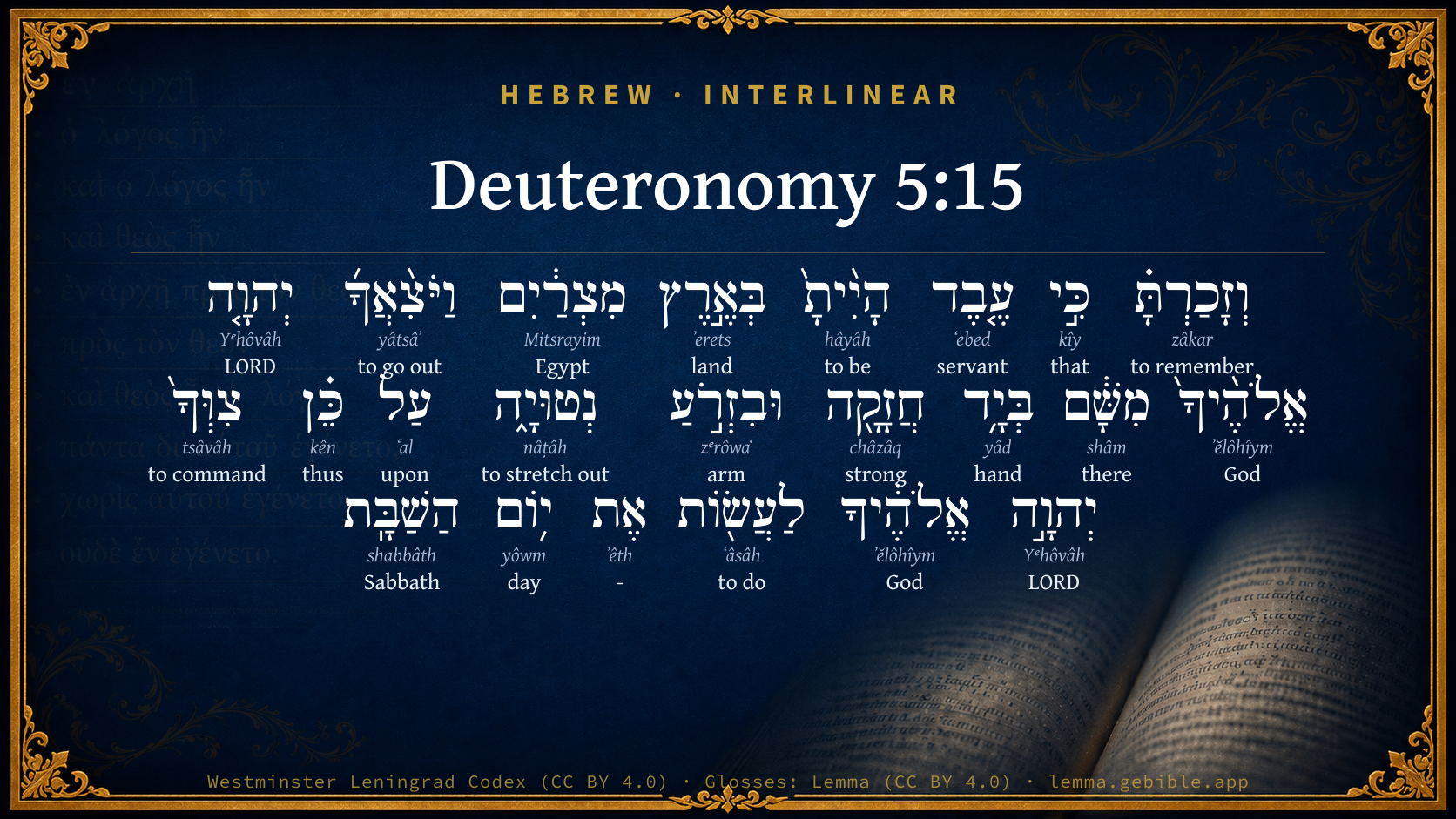
Hebrew (Westminster Leningrad Codex) Deuteronomy 5:15 appears in the Hebrew Old Testament. The text above is from the Westminster Leningrad Codex. Each word links to its Strong’s number, a concise gloss, and parsing drawn from the Open Scriptures Hebrew Bible morphology. Click any word for its full Brown-Driver-Briggs (BDB) entry.
Download image
Cite this verse

Deuteronomy 5:15 (World English Bible). Public Domain. Lemma interlinear Bible study tool, https://lemma.gebible.app/v/deuteronomy/5/15.

Show BibTeX & RIS
BibTeX
RIS
English Translation
You shall remember that you were a servant in the land of Egypt, and Yahweh your God brought you out of there by a mighty hand and by an outstretched arm: therefore Yahweh your God commanded you to keep the Sabbath day.
World English Bible · Public Domain
Download a study sheet

One document with this verse’s original text, its word-by-word gloss line, the meaning frame, cross-references with their text, attributed commentary, and full source and license credits — printable, and it pastes into notes with its structure intact.

This verse Autodidact and up

Study sheet (.html) Plain text (.txt)

A passage Seminary Student

Up to 50 verses in one chapter. A passage sheet keeps up to 6 commentary sources and 12 cross-references per verse, in the order this page ranks them, and says so on the sheet whenever that leaves anything out. Ask for a single verse and you get the Autodidact verse sheet above.

Everything on this page stays free to read, with no account — the sheet is a download of what is already on screen, not access to it.

Want to remove ads? Support Godless Engineer
Compare translations 3

The same verse in 3 English versions, stacked beneath the original-language interlinear above. Click any original word for its lexicon entry.

Each is an independent rendering of the whole verse — the interlinear is not word-aligned to these translations.

Highlighted words mark where these versions differ — a whole-verse word diff, not a word-by-word alignment.

  • World English Bible Public Domain
    You shall remember that you were a servant in the land of Egypt, and Yahweh your God brought you out of there by a mighty hand and by an outstretched arm: therefore Yahweh your God commanded you to keep the Sabbath day.
  • King James Version Public Domain
    And remember that thou wast a servant in the land of Egypt, and that the LORD thy God brought thee out thence through a mighty hand and by a stretched out arm: therefore the LORD thy God commanded thee to keep the sabbath day.
  • unfoldingWord Literal Text CC BY-SA 4.0
    And you shall remember that you were a slave in the land of Egypt, and Yahweh your God brought you out from there by a mighty hand and by an outstretched arm. Therefore, Yahweh your God has commanded you to observe the Sabbath day.

unfoldingWord Literal Text — © unfoldingWord, licensed CC BY-SA 4.0. Word-aligned USFM3 via Door43 (git.door43.org/unfoldingWord/en_ult).

Versions to compare (up to 4)

3 of 4 selected

Show all 18 translations

Every available English version of this verse, each an independent rendering of the whole verse.

  • World English Bible Public Domain
    You shall remember that you were a servant in the land of Egypt, and Yahweh your God brought you out of there by a mighty hand and by an outstretched arm: therefore Yahweh your God commanded you to keep the Sabbath day.
  • Berean Standard Bible Public Domain
    Remember that you were a slave in the land of Egypt, and that the LORD your God brought you out of there with a mighty hand and an outstretched arm. That is why the LORD your God has commanded you to keep the Sabbath day.
  • Majority Standard Bible Public Domain
    Remember that you were a slave in the land of Egypt, and that the LORD your God brought you out of there with a mighty hand and an outstretched arm. That is why the LORD your God has commanded you to keep the Sabbath day.
  • King James Version Public Domain
    And remember that thou wast a servant in the land of Egypt, and that the LORD thy God brought thee out thence through a mighty hand and by a stretched out arm: therefore the LORD thy God commanded thee to keep the sabbath day.
  • American Standard Version (1901) Public Domain
    And thou shalt remember that thou wast a servant in the land of Egypt, and Jehovah thy God brought thee out thence by a mighty hand and by an outstretched arm: therefore Jehovah thy God commanded thee to keep the sabbath day.
  • Revised Version (1885) Public Domain
    And thou shalt remember that thou wast a servant in the land of Egypt, and the LORD thy God brought thee out thence by a mighty hand and by a stretched out arm: therefore the LORD thy God commanded thee to keep the sabbath day.
  • Geneva Bible (1599) Public Domain
    For, remember that thou wast a seruant in the land of Egypt, and that the Lord thy God brought thee out thence by a mightie hand and a stretched out arme: therefore the Lord thy God commanded thee to obserue the Sabbath day.
  • Douay-Rheims (1899) Public Domain
    Remember that thou also didst serve in Egypt, and the Lord thy God brought thee out from thence with a strong hand, and a stretched out arm. Therefore hath he commanded thee that thou shouldst observe the sabbath day.
  • Young's Literal Translation Public Domain
    and thou hast remembered that a servant thou hast been in the land of Egypt, and Jehovah thy God is bringing thee out thence by a strong hand, and by a stretched-out arm; therefore hath Jehovah thy God commanded thee to keep the day of the sabbath.
  • Literal Standard Version CC BY-SA 4.0
    And you have remembered that you have been a servant in the land of Egypt, and your God YHWH brings you out from there by a strong hand and by an outstretched arm; therefore your God YHWH has commanded you to keep the Sabbath day.
  • Unlocked Literal Bible CC BY-SA 4.0
    You will call to mind that you were a servant in the land of Egypt, and Yahweh your God brought you out from there by a mighty hand and by an outstretched arm. Therefore Yahweh your God has commanded you to keep the Sabbath day.
  • unfoldingWord Literal Text CC BY-SA 4.0
    And you shall remember that you were a slave in the land of Egypt, and Yahweh your God brought you out from there by a mighty hand and by an outstretched arm. Therefore, Yahweh your God has commanded you to observe the Sabbath day.
  • Darby Bible Public Domain
    And thou shalt remember that thou wast a bondman in the land of Egypt, and that Jehovah thy God brought thee out thence with a powerful hand and with a stretched-out arm; therefore Jehovah thy God hath commanded thee to observe the sabbath day.
  • World Messianic Bible Public Domain
    You shall remember that you were a servant in the land of Egypt, and the LORD your God brought you out of there by a mighty hand and by an outstretched arm. Therefore the LORD your God commanded you to keep the Sabbath day.
  • Webster's Bible Public Domain
    And remember that thou wast a servant in the land of Egypt, and that the LORD thy God brought thee out thence with a mighty hand and by an out-stretched arm: therefore the LORD thy God commanded thee to keep the sabbath-day.
  • Free Bible Version CC BY-SA 4.0
    Remember that you were once slaves in Egypt, and that the Lord your God led you out from there with his great power and incredible strength. This is why the Lord your God has ordered you to keep the Sabbath day.
  • Bible in Basic English Public Domain
    And keep in mind that you were a servant in the land of Egypt, and that the Lord your God took you out of that land by his strong hand and his stretched-out arm: for this reason the Lord has given you orders to keep the Sabbath day.
  • JPS Tanakh (1917) Public Domain
    And thou shalt remember that thou was a servant in the land of Egypt, and the LORD thy God brought thee out thence by a mighty hand and by an outstretched arm; therefore the LORD thy God commanded thee to keep the sabbath day.

Literal Standard Version (2020), Covenant Press — licensed CC BY-SA 4.0. Text via the HelloAO Bible API (eBible.org). Unlocked Literal Bible (unfoldingWord) — licensed CC BY-SA 4.0. Text via the HelloAO Bible API (eBible.org). unfoldingWord Literal Text — © unfoldingWord, licensed CC BY-SA 4.0. Word-aligned USFM3 via Door43 (git.door43.org/unfoldingWord/en_ult). Free Bible Version, Dr. Jonathan Gallagher — licensed CC BY-SA 4.0. Text via the HelloAO Bible API (eBible.org).

Word by word

More ways to search: Search by grammar → Find every occurrence → Compare this word →

Practice this passage: Drill this verse → Learn its vocabulary →

חֲזָקָ֖ה
châzâq
H2389
“strong”
Adjective, Adjective, Feminine, Singular, Absolute
Part of Speech
Adjective
Type
Adjective
Gender
Feminine
Number
Singular
State
Absolute
Full BDB Definition

Origin: from H2388

TWOT: 636a

strong, stout, mighty - strong - severe, sharp, hot - firm, hard - a strong one (substantive)
  1. וְזָכַרְתָּ֗ zâkar H2142 “and · to remember” Conjunction + Verb, Qal, Sequential Perfect, 2nd Person, Masculine, Singular
  2. כִּ֣י kîy H3588 “that” Conjunction
  3. עֶ֤בֶד ʻebed H5650 “servant” Noun, Common, Masculine, Singular, Absolute
  4. הָיִ֨יתָ֙ hâyâh H1961 “to be” Verb, Qal, Perfect, 2nd Person, Masculine, Singular
  5. בְּאֶ֣רֶץ ʼerets H776 “in/at · land of” Preposition + Noun, Common, Both, Singular, Construct
  6. מִצְרַ֔יִם Mitsrayim H4714 “Egypt” Noun, Proper
  7. וַיֹּצִ֨אֲךָ֜ yâtsâʼ H3318 “and · to go out · you” Conjunction + Verb, Hiphil, Sequential Imperfect, 3rd Person, Masculine, Singular + Suffix, Personal, 2nd Person, Masculine, Singular
  8. יְהוָ֤ה Yᵉhôvâh H3068 “LORD” Noun, Proper
  9. אֱלֹהֶ֨יךָ֙ ʼĕlôhîym H430 “God(s) · your” Noun, Common, Masculine, Plural, Construct + Suffix, Personal, 2nd Person, Masculine, Singular
  10. מִשָּׁ֔ם shâm H8033 “from · there” Preposition + Adverb
  11. בְּיָ֥ד yâd H3027 “in/at · hand” Preposition + Noun, Common, Both, Singular, Absolute
  12. וּבִזְרֹ֣עַ zᵉrôwaʻ H2220 “and · in/at · arm” Conjunction + Preposition + Noun, Common, Both, Singular, Absolute
  13. נְטוּיָ֑ה nâṭâh H5186 “stretched out” Verb, Qal, Participle Passive, Feminine, Singular, Absolute
  14. עַל ʻal H5921 “upon” Preposition
  15. כֵּ֗ן kên H3651 “thus” Particle, Demonstrative
  16. צִוְּךָ֙ tsâvâh H6680 “to command · you” Verb, Piel, Perfect, 3rd Person, Masculine, Singular + Suffix, Personal, 2nd Person, Masculine, Singular
  17. יְהוָ֣ה Yᵉhôvâh H3068 “LORD” Noun, Proper
  18. אֱלֹהֶ֔יךָ ʼĕlôhîym H430 “God(s) · your” Noun, Common, Masculine, Plural, Construct + Suffix, Personal, 2nd Person, Masculine, Singular
  19. לַעֲשׂ֖וֹת ʻâsâh H6213 “to do” Preposition + Verb, Qal, Infinitive Construct
  20. אֶת ʼêth H853 “-” Particle, Direct Object
  21. י֥וֹם yôwm H3117 “day of” Noun, Common, Masculine, Singular, Construct
  22. הַשַׁבָּֽת shabbâth H7676 “the · Sabbath” Particle, Definite Article + Noun, Common, Both, Singular, Absolute

About this verse

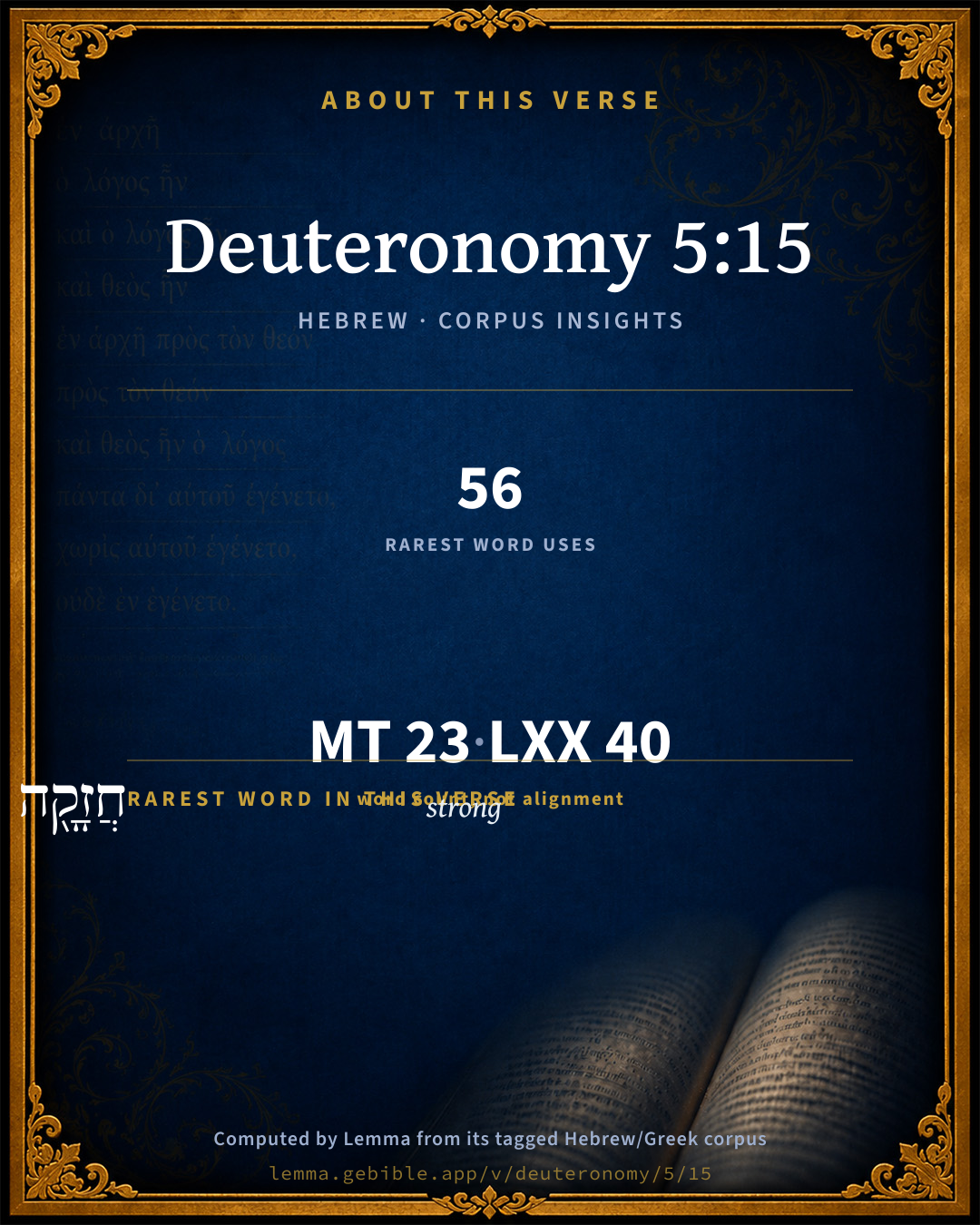
These counts appear in no published source. They are computed here, from the morphology-tagged text and Lemma’s own curated glosses. What Lemma adds →

23
words
21
distinct lemmas
Pentateuch
section

Shared distinctive vocabulary

חֲזָקָ֖ה strong H2389 occurs in 54 verses of the Hebrew Bible. Also found in:

Grammatical profile

  • 6 verbs
  • 11 nouns
  • 1 adjective
  • 1 preposition
  • 1 conjunction
  • 1 adverb
  • 2 particles

Verb forms

  • וְזָכַרְתָּ֗ Qal · Sequential Perfect
  • הָיִ֨יתָ֙ Qal · Perfect
  • וַיֹּצִ֨אֲךָ֜ Hiphil · Sequential Imperfect
  • נְטוּיָ֑ה Qal · Participle Passive
  • צִוְּךָ֙ Piel · Perfect
  • לַעֲשׂ֖וֹת Qal · Infinitive Construct

Repetition

Words recur within this verse — often emphatic in Hebrew:

  • יְהוָ֤ה LORD H3068 ×2
  • אֱלֹהֶ֨יךָ֙ God H430 ×2

Hebrew & Septuagint length

In English translation the verse runs 42 words from the Hebrew and 45 from the Septuagint (LXX English) — closely comparable.

A rough comparison of the two English renderings, which tokenize alike — not a word-level alignment.

Word counts can differ between the Hebrew and the Greek without any difference in meaning — e.g. the Hebrew direct-object marker אֵת has no separate Greek word, and Greek often adds the article ὁ.

In the original languages it is 23 Hebrew tokens and 40 Greek tokens — but the two are counted differently (Hebrew bundles its prefixes and suffixes into one token; the Greek is in lemma form), so that isn’t a like-for-like length.

Cross-references

11

Topical passages linked to Deuteronomy 5:15 in the Treasury of Scripture Knowledge — connected by theme and wording, ordered by reader-vote popularity; previews shown in the World English Bible.

  • Deuteronomy 5:6 "I am Yahweh your God, who brought you out of the land of Egypt, out of the house of bondage.
  • Deuteronomy 15:15 You shall remember that you were a bondservant in the land of Egypt, and Yahweh your God redeemed you: therefore I command you this thing today.
  • Deuteronomy 16:12 You shall remember that you were a bondservant in Egypt: and you shall observe and do these statutes.
  • Deuteronomy 24:18–22 but you shall remember that you were a bondservant in Egypt, and Yahweh your God redeemed you there: therefore I command you to do this thing.
  • Ephesians 2:11–12 Therefore remember that once you, the Gentiles in the flesh, who are called "uncircumcision" by that which is called "circumcision," (in the flesh, made by hands);
  • Deuteronomy 4:34–37 Or has God tried to go and take him a nation from the midst of [another] nation, by trials, by signs, and by wonders, and by war, and by a mighty hand, and by an outstretched arm, and by great terrors, according to all that Yahweh your God did for you in Egypt before your eyes?
  • Psalms 116:16 Yahweh, truly I am your servant. I am your servant, the son of your handmaid. You have freed me from my chains.
  • Isaiah 51:1–2 Listen to me, you who follow after righteousness, you who seek Yahweh: look to the rock whence you were hewn, and to the hold of the pit whence you were dug.
  • Isaiah 63:9 In all their affliction he was afflicted, and the angel of his presence saved them: in his love and in his pity he redeemed them; and he bore them, and carried them all the days of old.
  • Titus 2:14 who gave himself for us, that he might redeem us from all iniquity, and purify for himself a people for his own possession, zealous for good works.
  • Luke 1:74–75 To grant to us that we, being delivered out of the hand of our enemies, should serve him without fear,

Cross-references courtesy of OpenBible.info (CC BY 4.0).

Hebrew and Greek witnesses Masoretic Hebrew ↔ Greek Septuagint

The same verse in the two great witnesses to the Old Testament, shown verse-for-verse.

These are two independent witnesses, not word-aligned to each other, and the Septuagint is shown in lemma (dictionary) form.

Hebrew Deuteronomy 5:15 Masoretic · Westminster Leningrad Codex

וְזָכַרְתָּ֗ כִּ֣י עֶ֤בֶד הָיִ֨יתָ֙ בְּאֶ֣רֶץ מִצְרַ֔יִם וַיֹּצִ֨אֲךָ֜ יְהוָ֤ה אֱלֹהֶ֨יךָ֙ מִשָּׁ֔ם בְּיָ֥ד חֲזָקָ֖ה וּבִזְרֹ֣עַ נְטוּיָ֑ה עַל כֵּ֗ן צִוְּךָ֙ יְהוָ֣ה אֱלֹהֶ֔יךָ לַעֲשׂ֖וֹת אֶת י֥וֹם הַשַׁבָּֽת

You shall remember that you were a servant in the land of Egypt, and Yahweh your God brought you out of there by a mighty hand and by an outstretched arm: therefore Yahweh your God commanded you to keep the Sabbath day.

World English Bible · Public Domain

Greek LXX Deuteronomy 5:15 Septuagint · lemma form

καί μιμνήσκω ὅτι οἰκέτης εἰμί ἐν γῆ αἴγυπτος καί ἐκἄγω σύ κύριος ὁ θεός σύ ἐκεῖθεν ἐν χείρ κραταιός καί ἐν βραχίων ὑψηλός διά οὗτος συντάσσω σύ κύριος ὁ θεός σύ ὥστε φυλάσσω ὁ ἡμέρα ὁ σάββατον καί ἁγιάζω αὐτός

And you shall remember that you were a slave in the land of Egypt, and the Lord your God brought you out thence with a mighty hand, and a high arm: therefore the Lord appointed you to keep the sabbath day and to sanctify it.

LXX2012 (modern English Septuagint) · Public Domain

Hebrew: Westminster Leningrad Codex (CC BY 4.0). Greek: Septuagint (public domain); English from LXX2012 (modern English Septuagint) (Public Domain). How the Septuagint differs from the Hebrew →

Targum (Aramaic paraphrase)

2

The Targum is the ancient Jewish Aramaic paraphrase of the Hebrew Scriptures — an interpretive translation, not the Hebrew text itself. Onkelos (literal) and Pseudo-Jonathan (expansive) render the Torah, and Jonathan the Prophets. Coverage is partial: where no permissively-licensed English translation exists for a verse, only the Aramaic is shown. This is verse-level text, not a word-by-word alignment to the Hebrew.

  1. Targum Onkelos Torah (Genesis–Deuteronomy)
    וְתִדְכַּר אֲרֵי עַבְדָא הֲוֵיתָא בְּאַרְעָא דְמִצְרַיִם וְאַפְּקָךְ יְיָ אֱלָהָךְ מִתַּמָן בִּידָא תַקִיפָא וּבִדְרָעָא מְרָמְמָא עַל כֵּן פַּקְדָךְ יְיָ אֱלָהָךְ לְמֶעְבַּד יָת יוֹמָא דְשַׁבְּתָא

    (no public-domain English translation for this verse)

    Targum Onkelos — Aramaic: “Onkelos Genesis” (public domain); “Onkelos Exodus” (public domain); “Onkelos Leviticus” (public domain); “Onkelos Numbers” (public domain); “Onkelos Deuteronomy” (public domain). English: “Sefaria Community Translation” (CC0 1.0 (public-domain dedication)); “J.W. Etheridge. The Targums of Onkelos and Jonathan Ben Uzziel on the Pentateuch. London: Longmans, Green, 1862” (public domain). Text via Sefaria.

  2. Targum Pseudo-Jonathan Torah (Genesis–Deuteronomy)
    וְתֶהֱווֹן דְּכִירִין אֲרוּם מְשַׁעְבְּדוּן הֲוֵיתוּן בְּאַרְעָא דְמִצְרָיִם וּפְרַק וְאַפֵּיק יְיָ אֱלָהָכוֹן יַתְכוֹן מִתַּמָּן בִּידָא תַּקִּיפָא וּבִדְרַע מְרַמַּם בְּגִין כֵּן פַּקְדָךְ יְיָ אֱלָהָךְ לְמֶעֱבַד יַת יוֹמָא דְשַׁבְּתָא

    And remember that you were servants in the land of Mizraim, and that the Lord your God delivered and led you out with a strong hand and uplifted arm; therefore the Lord thy God hath commanded thee to keep the Sabbath day.

    Targum Pseudo-Jonathan — Aramaic: “Targum Jonathan on Genesis” (public domain); “Targum Jonathan on Exodus” (public domain); “Targum Jonathan on Leviticus” (public domain); “Targum Jonathan on Numbers” (public domain); “Targum Jonathan on Deuteronomy” (public domain). English: “The Targum of Jonathan ben Uzziel, trans. J. W. Etheridge, London, 1862” (public domain). Text via Sefaria.

Commentary

Notes on Deuteronomy 5:15 from classic Christian and Jewish commentators (each source and its license shown beneath its notes). The classic Christian expositions comment on the surrounding passage and are grouped to its opening verse, so a note may address several verses; the Jewish commentaries on the Tanakh (Rashi and others) are per-verse, so they appear only where the commentator wrote on this verse.

Lemma curates 59 commentaries, every one of them public domain or Creative Commons licensed, each selected and text-cleaned for this edition rather than reprinted as found. About our sources →

Trapp's Complete Commentary

John Trapp

Deu 5:15 And remember that thou wast a servant in the land of Egypt, and [that] the LORD thy God brought thee out thence through a mighty hand and by a stretched out arm: therefore the LORD thy God commanded thee to keep the sabbath day.

Ver. 15. And remember that thou.] It being a figure of our redemption by Christ, and so a fit subject for Sabbath meditations.

John Trapp, A Commentary or Exposition upon All the Books of the Old and New Testament (1647–1656) — public domain. Text from a community e-Sword module.

Tyndale Open Study Notes

Tyndale Open Resources

5:15 That is why: God commanded Israel to observe a day of rest to remember that God ceased his work of creation on the seventh day (Exod 20:11). In Deuteronomy, the Sabbath also celebrated Israel’s release from Egyptian bondage. In the Christian tradition, the first day rather than the seventh is generally set apart to observe the most significant event in Christian history, the resurrection of Jesus Christ (see study note on Rev 1:10).

Tyndale Open Study Notes — © Tyndale Open Resources, licensed CC BY-SA 4.0. Text via the HelloAO Bible API.

Adam Clarke's Commentary

Verse 15. And remember that thou wast a servant] In this and the latter clause of the preceding verse Moses adds another reason why one day in seven should be sanctified, viz., that the servants might rest, and this is urged upon them on the consideration of their having been servants in the land of Egypt. We see therefore that God had three grand ends in view by appointing a Sabbath.

1. To commemorate the creation.

2. To give a due proportion of rest to man and beast. When in Egypt they had no rest; their cruel task-masters caused them to labour without intermission; now God had given rest, and as he had showed them mercy, he teaches them to show mercy to their servants: Remember that thou wast a servant.

3. To afford peculiar spiritual advantages to the soul, that it might be kept in remembrance of the rest which remains at the right hand of God.

Therefore the Lord thy God commanded thee to keep the Sabbath day.] Here is a variation in the manner of expression, Sabbath day for seventh, owing, it is supposed, to a change of the day at the exodus from Sunday to Saturday, effected upon the gathering of the manna, Ex 16:23. The Sabbath now became a twofold memorial of the deliverance, as well as of the creation; and this accounts for the new reason assigned for its observance: "Therefore the Lord thy God commanded thee to keep the Sabbath day." See Dr. A. BAYLEY'S Hebr. and Eng. Bible, and See Clarke on Ex 16:23.

Adam Clarke's Commentary on the Bible (1810–1826) — public domain. Text from a community e-Sword/MySword module.

The Cambridge Bible for Schools and Colleges

gen. ed. J. J. S. Perowne

15. A different reason for the keeping of the Sabbath from that given in Exo_20:11. It is relevant to D’s addition in the previous v., and at first seems intended only to enforce the extension of the Sabbath-law to slaves, remember thou wast a bondman in the land of Egypt and Jehovah thy God brought thee out; but before it closes it bases the whole observance of the Sabbath on the deliverance from Egypt as if the S. were a memorial of that event—wherefore Jehovah thy God hath commanded thee to keep the S. day. This historical reference and the humanity enforced by it are characteristic of D. But Exo_20:11, under the influence of P, recites as the motive for the observance of the S. God’s rest on the seventh day from the work of creation. The influence of P on Ex. proves the D form to be the more original. Note that while it enforces the philanthropic motive for Sabbath-observance it is as theological as the other, and, like it, refers to God’s action as the ultimate sanction of the Sabbath.

remember that thou wast a bondman] The same motive is expressed for the laws enforcing liberality to slaves, Deu_15:15; the duty of sharing the joy of the feasts with needy dependents, Deu_16:12; and justice and generosity to the poor, Deu_24:18; Deu_24:22.

a mighty hand and … a stretched out arm] See on Deu_4:34.

to keep] lit. to do or make, i.e. to carry into effect; used by D also of the Passover, Deu_16:1; more frequently in P: of the Sabbath, Exo_31:16; of the Passover, Exo_12:47 f.; Num_9:4-6, etc.

The Cambridge Bible for Schools and Colleges (gen. ed. J. J. S. Perowne; Cambridge University Press, 1878–1918) — public domain. Text from a community e-Sword module.

John Gill's Exposition

Thou shalt not kill,.... The following commands begin with the copulative "and", different from the manner in which they are expressed, Exo 20:17 which joins these together, and them with the preceding ones; hence the law is by some said to be one copulative, and may serve to illustrate a passage in Jam 2:10.

.

Deuteronomy 5:21

deu 5:21

deu 5:21

deu 5:21Neither shalt thou desire thy neighbour's wife,.... Here a neighbour's wife is put before his house, different from Exo 20:17 and "his field" is added, which with what follows take in everything that is a man's property; and which is not to be desired or coveted in an unlawful manner by another, and much less should any means be made use of to deprive him of it; but "lust" is the thing intended and prohibited, be it after what it may, which is another man's: see Mat 5:28, of a man's field, see Isa 5:8.

John Gill's Exposition of the Whole Bible (1746–1763) — public domain (CC PDM 1.0). Text via the HelloAO Bible API.

Haydock's Catholic Bible Commentary

Therefore. This is another reason why the Jews were to observe the sabbath with particular rigour. The institution of a day of rest every week, (Haydock) was intended to preserve the memory of the creation. (Calmet) --- God also requires that his people should be grateful on this day for the rest which he had granted to them, (Haydock) and preserve carefully all the monuments of the true religion. (Calmet)

George Leo Haydock (1774–1849), Haydock's Catholic Family Bible and Commentary, 1859 edition — public domain. Excludes Psalms (Douay-Rheims chapter numbering differs from Protestant) and Deuterocanonical books (Catholic canon only).

Matthew Poole's English Annotations

Remember that thou wast a servant, and therefore art highly obliged both to serve that God who redeemed thee, especially upon his own day, and not to grudge thy servants their rest upon that day.

Matthew Poole's English Annotations on the Holy Bible (1683–1685) — public domain. Text from a community e-Sword/MySword module.

unfoldingWord translationNotes

Door43 World Missions Community

General Information:

Moses continues to speak to the people of Israel as if they were one man, so all instances of "you" and "your" are singular. (See: Forms of You)

You will call to mind

This is an idiom. AT: "You must remember" (See: Idiom)

by a mighty hand and by an outstretched arm

Here "a mighty hand" and "an outstretched arm" are metaphors for Yahweh's power. See how you translated these words in Deuteronomy 4:34. AT: "by showing his mighty power" (See: Metaphor)

translationWords

call

mind

servant

Egypt

Yahweh

God

might

hand

power

command

Sabbath

unfoldingWord translationNotes — © Distant Shores Media and the Door43 World Missions Community, licensed CC BY-SA 4.0. Source: git.door43.org/Door43/en_tn.

Rashi

Rabbi Shlomo Yitzchaki (Rashi)

וזכרת כי עבד היית וגו׳ AND THOU SHALT REMEMBER THAT THOU WAST A SLAVE [IN THE LAND OF EGYPT … AND THE LORD BROUGHT THEE FORTH FROM THERE … THEREFORE HE COMMANDS THEE TO KEEP THE SABBATH DAY] — On that condition He freed you — that you should be a servant to Him and observe His commandments.

Rashi on the Tanakh — English translations: “The Judaica Press complete Tanach with Rashi, translated by A. J. Rosenberg” (CC BY 4.0); “Pentateuch with Rashi's commentary by M. Rosenbaum and A.M. Silbermann, 1929-1934” (public domain); “The Metsudah Tanach series, Lakewood, N.J” (CC BY 4.0); and “The Book of Joshua, Metsudah Publications, 1997” (CC BY 4.0). Text via Sefaria.

Ramban (Nachmanides)

Rabbi Moshe ben Nachman (Ramban / Nachmanides)

THEREFORE THE ETERNAL THY G-D COMMANDED THEE TO KEEP THE SABBATH-DAY. The meaning thereof is that He commanded you to do so [give rest to the servant] on the Sabbath-day. So did Rabbi Abraham ibn Ezra explain it. But it is not correct, for we say in the Kiddush [i.e., the proclamation of the sanctity] of the Sabbath, “For this day is the first of the hallowed gatherings recalling our going forth from Egypt” just as we say that it “recalls the work of Creation!” of the Sabbath-day equates both reasons — the remembrance of the Creation and the remembrance of the exodus — as applying to the Sabbath itself, rather than referring to two different things as Ibn Ezra differentiated between them (see Note 157 above). And the Rabbi [Moshe ben Maimon] stated in the Moreh Nebuchim that “the ‘first statement’ [i.e., citing the Creation, as given in the Book of Exodus] expresses the honor and distinction of the day, just as He said, therefore the Eternal hath blessed the Sabbath-day, and hallowed it, and hence He mentioned the reason for in six days etc. But here he warned us to observe the Sabbath because of our having been slaves, working all day against our will and never having rest, and he commanded us now to abstain from work and rest in order that we remember the kindnesses of G-d towards us in bringing us forth from slavery to rest. Thus the Sabbath in general has two reasons: that we believe in the creation of the world [i.e., that the world was created at some point in time out of absolute nought rather than being of infinite age], that the world has a G-d Who is the Creator, and that we remember further the great kindness that He did with us, that we are His servants, since He acquired us for Himself as servants.” This [statement of Rambam] is also not clear to me, for when we are resting and not doing work on the seventh day we are not provided with a remembrance of the exodus from Egypt, nor does anyone who sees us being idle from work have any knowledge of this [reason]. Rather, the Sabbath is like all the other commandments, but it contains a reminder of the Creation because of the fact that we rest on the day that G-d ceased from work thereon and rested., 31:17. And it is more fitting to say that because the exodus from Egypt is evidence of the existence of an Eternal G-d, Who caused everything to come into existence through His will and Who has supreme power, as I have explained in the first commandment — therefore he stated here: “If there ever arises a doubt in your heart concerning the Sabbath that evidences the creation of the world by the will and power of G-d, you should remember what your eyes saw at the exodus from Egypt which is, to you, the evidence [of His infinite power] and the remembrance [of His deeds].” Thus the Sabbath is a remembrance of the exodus from Egypt, and the exodus is a remembrance of the Sabbath, for on it [the Sabbath] they remember and say that it is G-d Who makes new signs and wonders in everything and does with everything according to His will since it is He Who created everything at the beginning of creation. This, then, is the sense of the expression, therefore the Eternal thy G-d commanded thee to keep the Sabbath-day. Now, he did not explain here that the reason for the rest [on the Sabbath] is that in six days the Eternal made heaven etc., — since this has already been mentioned many times in the Torah. Instead, he said here briefly, and the seventh day is a Sabbath unto the Eternal thy G-d, meaning that He, blessed be, ceased from work thereon and rested, 31:17. and he explained to them that from the exodus from Egypt they will know that it was He Who spoke and the world came into existence, and He ceased from work thereon.And by way of the Truth, [the mystic teachings of the Cabala], we can further add to this [subject, by saying] that this commandment was given with [the expression] Observe [Observe the Sabbath-day to keep it holy], in order that we may fear the Glorious and Fearful Name, … The term “observe” found in the commandment of the Sabbath is thus to be understood in the light of that verse which begins with the expression of “observe” and concludes with a reference to the “fear” of G-d, as the text proceeds to explain. and therefore he commands us to remember the mighty hand and the outstretched arm that we saw at the exodus from Egypt, and from it the fear [of G-d] is to come to us, as it is said, And Israel saw the great work which the Eternal did upon the Egyptians, and the people ‘feared’ the Eternal. And therefore the Eternal thy G-d commanded thee to keep the Sabbath-day so that the congregation of Israel be the partner to the Sabbath, as is hinted in the words of our Rabbis. The student [learned in the mysteries of the Cabala] will understand.

Ramban (Nachmanides) on the Tanakh — English translation: “Commentary on the Torah by Ramban (Nachmanides). Translated and annotated by Charles B. Chavel. New York, Shilo Pub. House, 1971-1976” (CC BY 4.0). Text via Sefaria.

Lesson kit

Teaching starters — assembled from the data on this page, not authored interpretation. Every prompt links to the verse data it draws on. Edit before teaching.

Deuteronomy, in the Pentateuch, opens this verse with 23 words (21 distinct Hebrew lemmas). Its most distinctive word is châzâq (“strong”). A historical commentator’s framing appears above. Read the whole chapter for the surrounding context.

Discussion questions

  1. How does “strong” (châzâq) shape what this verse is saying?
  2. Exodus 3:19 shares the word «strong» with this verse. How do the two illuminate each other?
  3. “LORD” occurs 2× in this one verse. What is the effect of the repetition?
  4. These translations render this verse differently; the difference is in the English rendering, not the original. What questions does that raise?
  5. The verb «וְזָכַרְתָּ֗» is Qal Sequential Perfect. How does its form color the action?
  6. Reading how Trapp's Complete Commentary and Tyndale Open Study Notes read this verse, where do the two commentators agree and where do they part?

Things to notice

Reading settings

Reading text

Shown beneath each verse's original-language words.

Old Testament
Old Testament edition

Read the OT as the Masoretic Hebrew (MT) or the Greek Septuagint (LXX).

English shown for the Greek Septuagint (in the Hebrew ↔ Greek comparison).

Comparing translations? Open the Compare panel on any verse page to stack up to four side by side.