
1 Kings 8:58

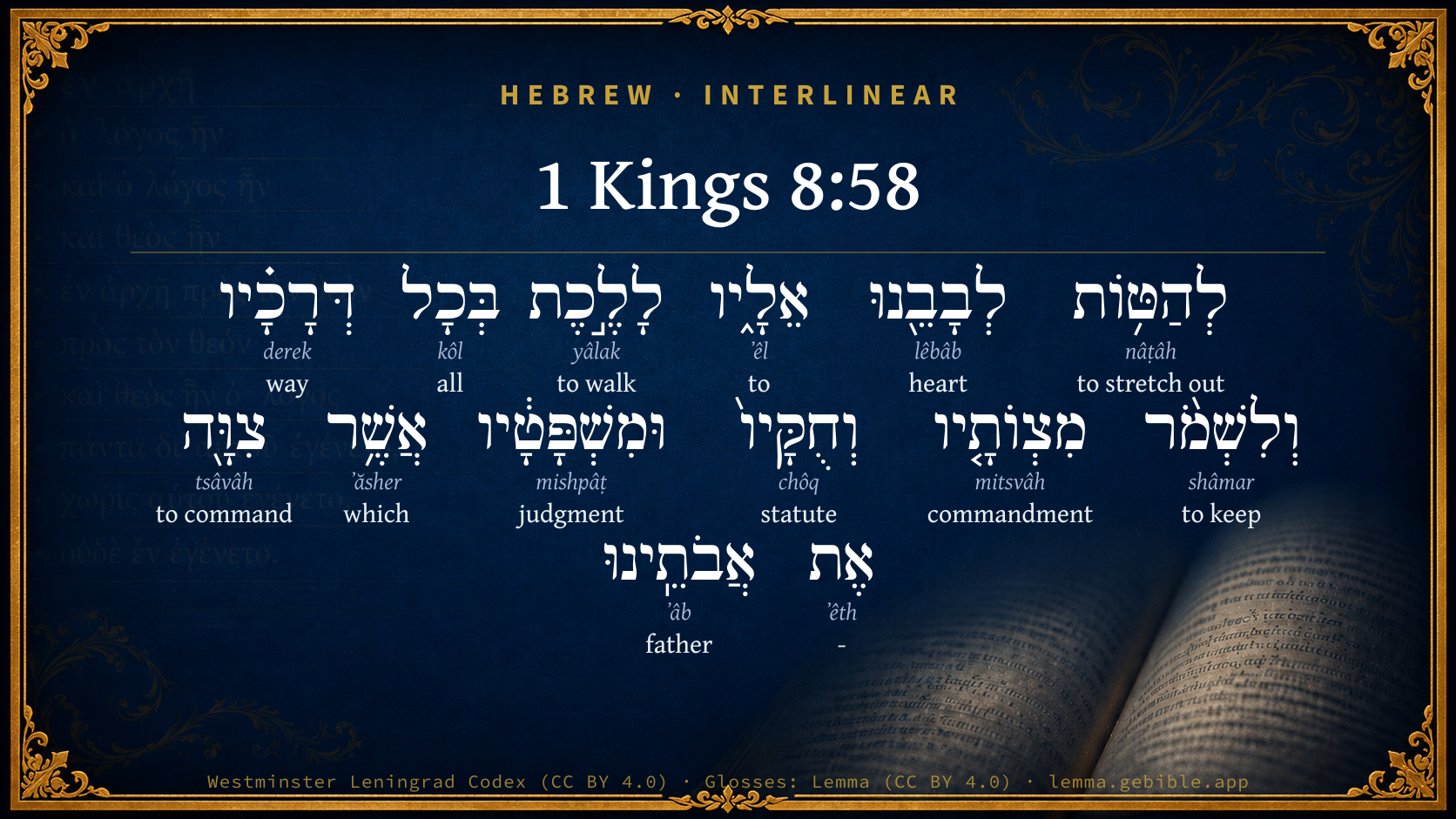
Hebrew (Westminster Leningrad Codex) 1 Kings 8:58 appears in the Hebrew Old Testament. The text above is from the Westminster Leningrad Codex. Each word links to its Strong’s number, a concise gloss, and parsing drawn from the Open Scriptures Hebrew Bible morphology. Click any word for its full Brown-Driver-Briggs (BDB) entry.
Download image
Cite this verse

1 Kings 8:58 (World English Bible). Public Domain. Lemma interlinear Bible study tool, https://lemma.gebible.app/v/1-kings/8/58.

Show BibTeX & RIS
BibTeX
RIS
English Translation
that he may incline our hearts to him, to walk in all his ways, and to keep his commandments, and his statutes, and his ordinances, which he commanded our fathers.
World English Bible · Public Domain
Download a study sheet

One document with this verse’s original text, its word-by-word gloss line, the meaning frame, cross-references with their text, attributed commentary, and full source and license credits — printable, and it pastes into notes with its structure intact.

This verse Autodidact and up

Study sheet (.html) Plain text (.txt)

A passage Seminary Student

Up to 50 verses in one chapter. A passage sheet keeps up to 6 commentary sources and 12 cross-references per verse, in the order this page ranks them, and says so on the sheet whenever that leaves anything out. Ask for a single verse and you get the Autodidact verse sheet above.

Everything on this page stays free to read, with no account — the sheet is a download of what is already on screen, not access to it.

Want to remove ads? Support Godless Engineer
Compare translations 3

The same verse in 3 English versions, stacked beneath the original-language interlinear above. Click any original word for its lexicon entry.

Each is an independent rendering of the whole verse — the interlinear is not word-aligned to these translations.

Highlighted words mark where these versions differ — a whole-verse word diff, not a word-by-word alignment.

  • World English Bible Public Domain
    that he may incline our hearts to him, to walk in all his ways, and to keep his commandments, and his statutes, and his ordinances, which he commanded our fathers.
  • King James Version Public Domain
    That he may incline our hearts unto him, to walk in all his ways, and to keep his commandments, and his statutes, and his judgments, which he commanded our fathers.
  • unfoldingWord Literal Text CC BY-SA 4.0
    may he stretch out our heart to him, to walk in all of his ways and to keep his commandments and his statutes and his judgments, which he commanded our fathers.

unfoldingWord Literal Text — © unfoldingWord, licensed CC BY-SA 4.0. Word-aligned USFM3 via Door43 (git.door43.org/unfoldingWord/en_ult).

Versions to compare (up to 4)

3 of 4 selected

Show all 18 translations

Every available English version of this verse, each an independent rendering of the whole verse.

  • World English Bible Public Domain
    that he may incline our hearts to him, to walk in all his ways, and to keep his commandments, and his statutes, and his ordinances, which he commanded our fathers.
  • Berean Standard Bible Public Domain
    May He incline our hearts to Himself, to walk in all His ways and to keep the commandments and statutes and ordinances He commanded our fathers.
  • Majority Standard Bible Public Domain
    May He incline our hearts to Himself, to walk in all His ways and to keep the commandments and statutes and ordinances He commanded our fathers.
  • King James Version Public Domain
    That he may incline our hearts unto him, to walk in all his ways, and to keep his commandments, and his statutes, and his judgments, which he commanded our fathers.
  • American Standard Version (1901) Public Domain
    that he may incline our hearts unto him, to walk in all his ways, and to keep his commandments, and his statutes, and his ordinances, which he commanded our fathers.
  • Revised Version (1885) Public Domain
    that he may incline our hearts unto him, to walk in all his ways, and to keep his commandments, and his statutes, and his judgments, which he commanded our fathers.
  • Geneva Bible (1599) Public Domain
    That he may bow our heartes vnto him, that we may walke in all his waies, and keepe his commandements, and his statutes, and his lawes, which he commanded our fathers.
  • Douay-Rheims (1899) Public Domain
    But may he incline our hearts to himself, that we may walk in all his ways, and keep his commandments, and his ceremonies, and all his judgments which he commanded our fathers.
  • Young's Literal Translation Public Domain
    to incline our heart unto Himself, to walk in all His ways, and to keep His commands, and His statutes, and His judgments, which He commanded our fathers;
  • Literal Standard Version CC BY-SA 4.0
    to incline our heart to Himself, to walk in all His ways, and to keep His commands, and His statutes, and His judgments, which He commanded our fathers;
  • Unlocked Literal Bible CC BY-SA 4.0
    that he may incline our hearts to him, to live in all his ways and keep his commandments and his regulations and his statutes, which he commanded our fathers.
  • unfoldingWord Literal Text CC BY-SA 4.0
    may he stretch out our heart to him, to walk in all of his ways and to keep his commandments and his statutes and his judgments, which he commanded our fathers.
  • Darby Bible Public Domain
    that he may incline our hearts to him, to walk in all his ways, and to keep his commandments and his statutes and his ordinances, which he commanded our fathers.
  • World Messianic Bible Public Domain
    that he may incline our hearts to him, to walk in all his ways, and to keep his commandments, his statutes, and his ordinances, which he commanded our fathers.
  • Webster's Bible Public Domain
    That he may incline our hearts to him, to walk in all his ways, and to keep his commandments, and his statutes, and his judgments, which he commanded our fathers.
  • Free Bible Version CC BY-SA 4.0
    May he help us to come to him, to follow all his ways and to keep the commandments, statutes, and regulations he ordered our forefathers to observe.
  • Bible in Basic English Public Domain
    Turning our hearts to himself, guiding us to go in all his ways, to keep his orders and his laws and his decisions, which he gave to our fathers.
  • JPS Tanakh (1917) Public Domain
    that He may incline our hearts unto Him, to walk in all His ways, and to keep His commandments, and His statutes, and His ordinances, which He commanded our fathers.

Literal Standard Version (2020), Covenant Press — licensed CC BY-SA 4.0. Text via the HelloAO Bible API (eBible.org). Unlocked Literal Bible (unfoldingWord) — licensed CC BY-SA 4.0. Text via the HelloAO Bible API (eBible.org). unfoldingWord Literal Text — © unfoldingWord, licensed CC BY-SA 4.0. Word-aligned USFM3 via Door43 (git.door43.org/unfoldingWord/en_ult). Free Bible Version, Dr. Jonathan Gallagher — licensed CC BY-SA 4.0. Text via the HelloAO Bible API (eBible.org).

Word by word

More ways to search: Search by grammar → Find every occurrence → Compare this word →

Practice this passage: Drill this verse → Learn its vocabulary →

וְחֻקָּיו֙
chôq
H2706
“and · statutes · his”
Conjunction + Noun, Common, Masculine, Plural, Construct + Suffix, Personal, 3rd Person, Masculine, Singular
Part of Speech
Conjunction + Noun
Type
Common
Gender
Masculine
Number
Plural
State
Construct
Full BDB Definition

Origin: from H2710

TWOT: 728a

statute, ordinance, limit, something prescribed, due - prescribed task - prescribed portion - action prescribed (for oneself), resolve - prescribed due - prescribed limit, boundary - enactment, decree, ordinance - specific decree - law in general - enactments, statutes - conditions - enactments - decrees - civil enactments prescribed by God
  1. לְהַטּ֥וֹת nâṭâh H5186 “to stretch out” Preposition + Verb, Hiphil, Infinitive Construct
  2. לְבָבֵ֖נוּ lêbâb H3824 “heart · our” Noun, Common, Masculine, Singular, Construct + Suffix, Personal, 1st Person, Common, Plural
  3. אֵלָ֑יו ʼêl H413 “to · him” Preposition + Suffix, Personal, 3rd Person, Masculine, Singular
  4. לָלֶ֣כֶת yâlak H3212 “to walk” Preposition + Verb, Qal, Infinitive Construct
  5. בְּכָל kôl H3605 “in/at · all of” Preposition + Noun, Common, Masculine, Singular, Construct
  6. דְּרָכָ֗יו derek H1870 “ways · his” Noun, Common, Both, Plural, Construct + Suffix, Personal, 3rd Person, Masculine, Singular
  7. וְלִשְׁמֹ֨ר shâmar H8104 “and · to keep” Conjunction + Preposition + Verb, Qal, Infinitive Construct
  8. מִצְוֺתָ֤יו mitsvâh H4687 “commandments · his” Noun, Common, Feminine, Plural, Construct + Suffix, Personal, 3rd Person, Masculine, Singular
  9. וּמִשְׁפָּטָ֔יו mishpâṭ H4941 “and · judgments · his” Conjunction + Noun, Common, Masculine, Plural, Construct + Suffix, Personal, 3rd Person, Masculine, Singular
  10. אֲשֶׁ֥ר ʼăsher H834 “which” Particle, Relative
  11. צִוָּ֖ה tsâvâh H6680 “to command” Verb, Piel, Perfect, 3rd Person, Masculine, Singular
  12. אֶת ʼêth H853 “-” Particle, Direct Object
  13. אֲבֹתֵֽינוּ ʼâb H1 “fathers · our” Noun, Common, Masculine, Plural, Construct + Suffix, Personal, 1st Person, Common, Plural

About this verse

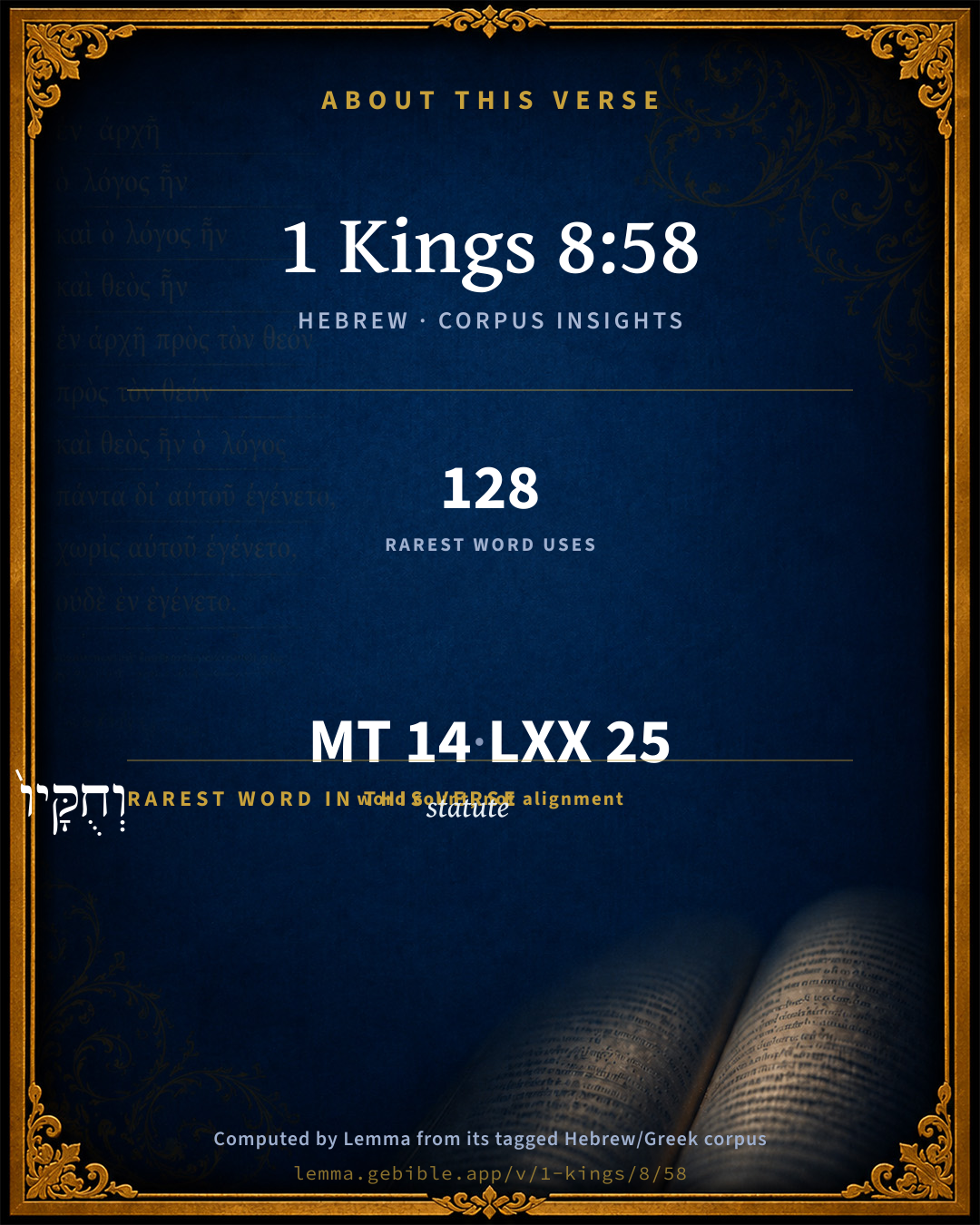
These counts appear in no published source. They are computed here, from the morphology-tagged text and Lemma’s own curated glosses. What Lemma adds →

14
words
14
distinct lemmas
Historical
section

Grammatical profile

  • 4 verbs
  • 7 nouns
  • 1 preposition
  • 2 particles

Verb forms

  • לְהַטּ֥וֹת Hiphil · Infinitive Construct
  • לָלֶ֣כֶת Qal · Infinitive Construct
  • וְלִשְׁמֹ֨ר Qal · Infinitive Construct
  • צִוָּ֖ה Piel · Perfect

Hebrew & Septuagint length

In English translation the verse runs 30 words from the Hebrew and 28 from the Septuagint (LXX English) — closely comparable.

A rough comparison of the two English renderings, which tokenize alike — not a word-level alignment.

Word counts can differ between the Hebrew and the Greek without any difference in meaning — e.g. the Hebrew direct-object marker אֵת has no separate Greek word, and Greek often adds the article ὁ.

In the original languages it is 14 Hebrew tokens and 25 Greek tokens — but the two are counted differently (Hebrew bundles its prefixes and suffixes into one token; the Greek is in lemma form), so that isn’t a like-for-like length.

Cross-references

10

Topical passages linked to 1 Kings 8:58 in the Treasury of Scripture Knowledge — connected by theme and wording, ordered by reader-vote popularity; previews shown in the World English Bible.

  • Psalms 119:36 Turn my heart toward your statutes, Not toward selfish gain.
  • Ezekiel 36:26–27 A new heart also will I give you, and a new spirit will I put within you; and I will take away the stony heart out of your flesh, and I will give you a heart of flesh.
  • Jeremiah 31:33 But this is the covenant that I will make with the house of Israel after those days, says Yahweh: I will put my law in their inward parts, and in their heart will I write it; and I will be their God, and they shall be my people:
  • Philippians 2:13 For it is God who works in you both to will and to work, for his good pleasure.
  • Hebrews 13:21 make you complete in every good work to do his will, working in you that which is well pleasing in his sight, through Jesus Christ, to whom be the glory forever and ever. Amen.
  • Deuteronomy 4:1 Now, Israel, listen to the statutes and to the ordinances, which I teach you, to do them; that you may live, and go in and possess the land which Yahweh, the God of your fathers, gives you.
  • Deuteronomy 4:45 these are the testimonies, and the statutes, and the ordinances, which Moses spoke to the children of Israel, when they came forth out of Egypt,
  • Deuteronomy 6:1 Now this is the commandment, the statutes, and the ordinances, which Yahweh your God commanded to teach you, that you might do them in the land where you go over to possess it;
  • Song of Solomon 1:4 Take me away with you. Let us hurry. The king has brought me into his chambers. Friends We will be glad and rejoice in you. We will praise your love more than wine! Beloved They are right to love you.
  • Psalms 110:3 Your people offer themselves willingly in the day of your power, in holy array. Out of the womb of the morning, you have the dew of your youth.

Cross-references courtesy of OpenBible.info (CC BY 4.0).

Hebrew and Greek witnesses Masoretic Hebrew ↔ Greek Septuagint

The same verse in the two great witnesses to the Old Testament, shown verse-for-verse.

These are two independent witnesses, not word-aligned to each other, and the Septuagint is shown in lemma (dictionary) form.

Hebrew 1 Kings 8:58 Masoretic · Westminster Leningrad Codex

לְהַטּ֥וֹת לְבָבֵ֖נוּ אֵלָ֑יו לָלֶ֣כֶת בְּכָל דְּרָכָ֗יו וְלִשְׁמֹ֨ר מִצְוֺתָ֤יו וְחֻקָּיו֙ וּמִשְׁפָּטָ֔יו אֲשֶׁ֥ר צִוָּ֖ה אֶת אֲבֹתֵֽינוּ

that he may incline our hearts to him, to walk in all his ways, and to keep his commandments, and his statutes, and his ordinances, which he commanded our fathers.

World English Bible · Public Domain

Greek LXX 1 Kings 8:58 Septuagint · lemma form

ἐπικλίνω καρδία ἐγώ πρός αὐτός ὁ πορεύομαι ἐν πᾶς ὁδός αὐτός καί φυλάσσω πᾶς ὁ ἐντολή αὐτός καί πρόσταγμα αὐτός ὅς ἐντέλλομαι ὁ πατήρ ἐγώ

that he may turn our hearts toward him to walk in all his ways, and to keep all his commandments, and his ordinances which he commanded our fathers.

LXX2012 (modern English Septuagint) · Public Domain

Hebrew: Westminster Leningrad Codex (CC BY 4.0). Greek: Septuagint (public domain); English from LXX2012 (modern English Septuagint) (Public Domain). How the Septuagint differs from the Hebrew →

Targum (Aramaic paraphrase)

1

The Targum is the ancient Jewish Aramaic paraphrase of the Hebrew Scriptures — an interpretive translation, not the Hebrew text itself. Onkelos (literal) and Pseudo-Jonathan (expansive) render the Torah, and Jonathan the Prophets. Coverage is partial: where no permissively-licensed English translation exists for a verse, only the Aramaic is shown. This is verse-level text, not a word-by-word alignment to the Hebrew.

  1. Targum Jonathan Prophets (Joshua–Malachi)
    לְאַפְנָאָה לִבָּנָא לִדְחַלְתֵּיהּ לִמְהַךְ בְכָל אוֹרְחָן דְתַקְנָן קָדָמוֹהִי וּלְמִטַר פִּקוּדוֹהִי וּקְיָמוֹהִי וְדִינוֹהִי דְפַקֵיד יַת אֲבָהָתָנָא:

    (no public-domain English translation for this verse)

    Targum Jonathan — Aramaic: “Mikraot Gedolot” (public domain). English: “Sefaria Community Translation” (CC0 1.0 (public-domain dedication)); “London "Chaldee Paraphrase," 1871” (public domain). Text via Sefaria.

Commentary

Notes on 1 Kings 8:58 from classic Christian and Jewish commentators (each source and its license shown beneath its notes). The classic Christian expositions comment on the surrounding passage and are grouped to its opening verse, so a note may address several verses; the Jewish commentaries on the Tanakh (Rashi and others) are per-verse, so they appear only where the commentator wrote on this verse.

Lemma curates 59 commentaries, every one of them public domain or Creative Commons licensed, each selected and text-cleaned for this edition rather than reprinted as found. About our sources →

Trapp's Complete Commentary

John Trapp

1Ki 8:58 That he may incline our hearts unto him, to walk in all his ways, and to keep his commandments, and his statutes, and his judgments, which he commanded our fathers.

Ver. 58. That he may incline our hearts.] Cause us to keep his commandments, {Eze 36:26-27} bend us to the obedience of his will. Lex iubet, gratia iuvat.

John Trapp, A Commentary or Exposition upon All the Books of the Old and New Testament (1647–1656) — public domain. Text from a community e-Sword module.

Joseph Benson's Commentary

1Ki 8:58. That he may incline our hearts unto him — That he may not only bless us with outward prosperity and glory; but especially with spiritual blessings; and that as he has given us his word to teach and direct us; so he would, by his Holy Spirit, effectually incline us to obey it.

Joseph Benson's Commentary on the Old and New Testaments (1811–1818) — public domain. Text from a community e-Sword module.

Geneva Bible (1599)

Geneva Bible translators

He concludeth that man of himself is enemy unto God, and that all obedience to his Law proceedeth of his mere mercy.

Geneva Bible (1599) marginal notes — public domain. Text via Bolls.life.

Ellicott's Commentary for English Readers

(58) That he may incline . . .—Comparing this verse with the exhortation of 1Ki_8:61, we find exemplified the faith which pervades all Holy Scripture and underlies the whole idea of covenant with God. It is a faith in the true, though mysterious, co-operation of the “preventing grace” of God, which must be recognised in all adequate conceptions of Him, as the Source of all life and action, physical and spiritual, and of that free responsibility of man which is the ultimate truth of the inner human consciousness. God “inclines the heart” and yet the heart must yield itself. The conviction of this truth naturally grows deeper and plainer, in proportion as man realises better the inner life of the soul as contrasted with the outer life of event and action, and realises accordingly the dominion of God over the soul by His grace, over and above His rule over the visible world by His providence. Hence it comes out especially in the Psalms, the Proverbs, and the Prophetic books. It is instructive, for example, to observe how through the great “psalm of the Law” (Psalms 119) the conviction again and again expresses itself that only by His gift can the heart be enabled to obey it. (See 1Ki_8:26-27; 1Ki_8:32-33; 1Ki_8:36, &c.) In the New Testament, the “covenant of the Spirit,” the truth is brought out in all its fulness; perhaps most vividly in the celebrated paradox of Php_2:12-13, “Work out your own salvation . . . For it is God which worketh in you both to will and to do of His good pleasure.”

A Bible Commentary for English Readers, edited by Charles John Ellicott (1878–1897) — public domain. Text from a community e-Sword module.

The Cambridge Bible for Schools and Colleges

gen. ed. J. J. S. Perowne

58. that he may incline our hearts unto him] Which will not happen if He leave or forsake His people.

The Cambridge Bible for Schools and Colleges (gen. ed. J. J. S. Perowne; Cambridge University Press, 1878–1918) — public domain. Text from a community e-Sword module.

John Gill's Exposition

And let these my words, wherewith I have made supplication before the Lord,.... At this time:

be nigh unto the Lord our God day and night; be continually remembered and regarded by him, that so gracious answers might always be returned to those who supplicated in this place:

that he maintain the cause of his servant; of himself and his successors in the throne, that they may continue to possess it in peace, to the glory of God, and the good of the people:

and the cause of his people Israel at all times: that their rights and privileges might be continued, and they supported in them; and both his cause and theirs be regarded:

as the matter shall require; as they should stand in need of assistance, direction, and protection.

John Gill's Exposition of the Whole Bible (1746–1763) — public domain (CC PDM 1.0). Text via the HelloAO Bible API.

Albert Barnes' Notes on the Bible

Incline our hearts - This is a doctrine which first appears in Scripture in the Davidical Psalms (see the margin reference and Psa 141:4). Solomon in this prayer seems to be thoroughly penetrated with his father’s spirit.

Albert Barnes' Notes on the Bible (1834–1885) — public domain. Text from a community e-Sword/MySword module.

Matthew Poole's English Annotations

That he may incline our hearts unto him; that he may not only bless us with outward prosperity and glory, but especially with spiritual blessings; and that as he hath given us his word and statutes to teach and direct us, so he would by his Holy Spirit effectually incline and engage our hearts to keep and obey them.

Matthew Poole's English Annotations on the Holy Bible (1683–1685) — public domain. Text from a community e-Sword/MySword module.

The Pulpit Commentary

That he may incline our hearts unto him, (Psa_119:26 Psa_141:4) to walk in his ways ver. 25; 1Ki_2:4. The condition on which God"s blessing was insured was at this time printed on Solomon"s mind, and to keep his commandments, and his satutes, and his Judgments see note on 1Ki_2:3, to which ver. there is not improbably a reference, which he commanded our fathers.

The Pulpit Commentary (1880–1919), ed. H.D.M. Spence-Jones & Joseph S. Exell — public domain. Text from a community e-Sword module.

John Wesley's Explanatory Notes

Incline - That he may not only bless us with outward prosperity, but especially, with spiritual blessings: and that as he hath given us his word to teach and direct us, so he would by his holy Spirit, effectually incline us to obey it.

John Wesley, Explanatory Notes Upon the Whole Bible (1754–1765) — public domain. Text via the GEBible commentary corpus.

Lesson kit

Teaching starters — assembled from the data on this page, not authored interpretation. Every prompt links to the verse data it draws on. Edit before teaching.

1 Kings, in the Historical, opens this verse with 14 words (14 distinct Hebrew lemmas). Its most distinctive word is chôq (“statute”). A historical commentator’s framing appears above. Read the whole chapter for the surrounding context.

Discussion questions

  1. What does “statute” (chôq) contribute to the verse as a whole?
  2. Psalms 119:36 shares this passage’s theme. How do the two illuminate each other?
  3. The translations on this page render this verse differently — a whole-verse word diff, not a word-by-word alignment. What might account for the different wordings?
  4. The verb «לְהַטּ֥וֹת» is Hiphil Infinitive Construct. How does its form color the action?
  5. Reading how Trapp's Complete Commentary and Joseph Benson's Commentary read this verse, where do the two commentators agree and where do they part?

Things to notice

Reading settings

Reading text

Shown beneath each verse's original-language words.

Old Testament
Old Testament edition

Read the OT as the Masoretic Hebrew (MT) or the Greek Septuagint (LXX).

English shown for the Greek Septuagint (in the Hebrew ↔ Greek comparison).

Comparing translations? Open the Compare panel on any verse page to stack up to four side by side.