Leviticus 25:21

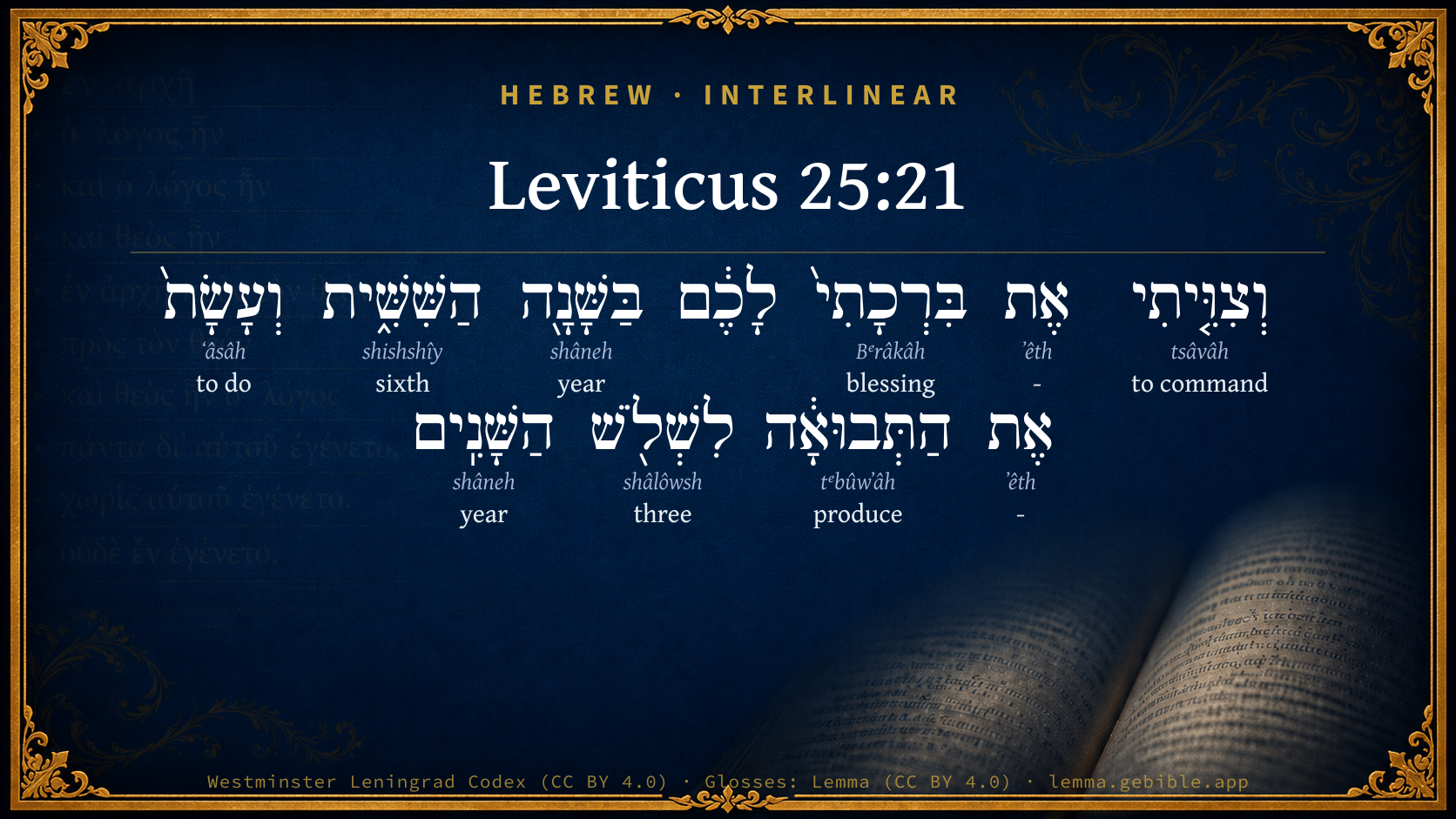
Hebrew (Westminster Leningrad Codex) Leviticus 25:21 appears in the Hebrew Old Testament. The text above is from the Westminster Leningrad Codex. Each word links to its Strong’s number, a concise gloss, and parsing drawn from the Open Scriptures Hebrew Bible morphology. Click any word for its full Brown-Driver-Briggs (BDB) entry.
Download image
Cite this verse

Leviticus 25:21 (World English Bible). Public Domain. Lemma interlinear Bible study tool, https://lemma.gebible.app/v/leviticus/25/21.

Show BibTeX & RIS
BibTeX
RIS
English Translation
then I will command my blessing on you in the sixth year, and it shall bring forth fruit for the three years.
World English Bible · Public Domain
Download a study sheet

One document with this verse’s original text, its word-by-word gloss line, the meaning frame, cross-references with their text, attributed commentary, and full source and license credits — printable, and it pastes into notes with its structure intact.

This verse Autodidact and up

Study sheet (.html) Plain text (.txt)

A passage Seminary Student

Up to 50 verses in one chapter. A passage sheet keeps up to 6 commentary sources and 12 cross-references per verse, in the order this page ranks them, and says so on the sheet whenever that leaves anything out. Ask for a single verse and you get the Autodidact verse sheet above.

Everything on this page stays free to read, with no account — the sheet is a download of what is already on screen, not access to it.

Want to remove ads? Support Godless Engineer
Compare translations 3

The same verse in 3 English versions, stacked beneath the original-language interlinear above. Click any original word for its lexicon entry.

Each is an independent rendering of the whole verse — the interlinear is not word-aligned to these translations.

Highlighted words mark where these versions differ — a whole-verse word diff, not a word-by-word alignment.

  • World English Bible Public Domain
    then I will command my blessing on you in the sixth year, and it shall bring forth fruit for the three years.
  • King James Version Public Domain
    Then I will command my blessing upon you in the sixth year, and it shall bring forth fruit for three years.
  • unfoldingWord Literal Text CC BY-SA 4.0
    And I will command my blessing to you in the sixth year, and it shall make the produce for three years.

unfoldingWord Literal Text — © unfoldingWord, licensed CC BY-SA 4.0. Word-aligned USFM3 via Door43 (git.door43.org/unfoldingWord/en_ult).

Versions to compare (up to 4)

3 of 4 selected

Show all 18 translations

Every available English version of this verse, each an independent rendering of the whole verse.

  • World English Bible Public Domain
    then I will command my blessing on you in the sixth year, and it shall bring forth fruit for the three years.
  • Berean Standard Bible Public Domain
    But I will send My blessing upon you in the sixth year, so that the land will yield a crop sufficient for three years.
  • Majority Standard Bible Public Domain
    But I will send My blessing upon you in the sixth year, so that the land will yield a crop sufficient for three years.
  • King James Version Public Domain
    Then I will command my blessing upon you in the sixth year, and it shall bring forth fruit for three years.
  • American Standard Version (1901) Public Domain
    then I will command my blessing upon you in the sixth year, and it shall bring forth fruit for the three years.
  • Revised Version (1885) Public Domain
    then I will command my blessing upon you in the sixth year, and it shall bring forth fruit for the three years.
  • Geneva Bible (1599) Public Domain
    I will sende my blessing vpon you in the sixt yeere, and it shall bring foorth fruite for three yeeres.
  • Douay-Rheims (1899) Public Domain
    I will give you my blessing the sixth year, and it shall yield the fruits of three years:
  • Young's Literal Translation Public Domain
    then I have commanded My blessing on you in the sixth year, and it hath made the increase for three years;
  • Literal Standard Version CC BY-SA 4.0
    Then I have commanded My blessing on you in the sixth year, and it has made the increase for three years;
  • Unlocked Literal Bible CC BY-SA 4.0
    I will command my blessing to come upon you in the sixth year, and it will produce harvest enough for three years.
  • unfoldingWord Literal Text CC BY-SA 4.0
    And I will command my blessing to you in the sixth year, and it shall make the produce for three years.
  • Darby Bible Public Domain
    then I will command my blessing upon you in the sixth year, that it may bring forth produce for three years;
  • World Messianic Bible Public Domain
    then I will command my blessing on you in the sixth year, and it shall bear fruit for the three years.
  • Webster's Bible Public Domain
    Then I will command my blessing upon you in the sixth year, and it shall bring forth fruit for three years.
  • Free Bible Version CC BY-SA 4.0
    I will bless you in the sixth year, so that the land will produce a crop that will be enough for three years.
  • Bible in Basic English Public Domain
    Then I will send my blessing on you in the sixth year, and the land will give fruit enough for three years.
  • JPS Tanakh (1917) Public Domain
    then I will command My blessing upon you in the sixth year, and it shall bring forth produce for the three years.

Literal Standard Version (2020), Covenant Press — licensed CC BY-SA 4.0. Text via the HelloAO Bible API (eBible.org). Unlocked Literal Bible (unfoldingWord) — licensed CC BY-SA 4.0. Text via the HelloAO Bible API (eBible.org). unfoldingWord Literal Text — © unfoldingWord, licensed CC BY-SA 4.0. Word-aligned USFM3 via Door43 (git.door43.org/unfoldingWord/en_ult). Free Bible Version, Dr. Jonathan Gallagher — licensed CC BY-SA 4.0. Text via the HelloAO Bible API (eBible.org).

Word by word

More ways to search: Search by grammar → Find every occurrence → Compare this word →

Practice this passage: Drill this verse → Learn its vocabulary →

הַשִּׁשִּׁ֑ית
shishshîy
H8345
“the · sixth”
Particle, Definite Article + Adjective, Ordinal number, Feminine, Singular, Absolute
Part of Speech
Particle + Adjective
Type
Ordinal number
Gender
Feminine
Number
Singular
State
Absolute
Full BDB Definition

Origin: from H8337

TWOT: 2336b

sixth - sixth (ordinal number) - sixth (as fraction)
  1. וְצִוִּ֤יתִי tsâvâh H6680 “and · to command” Conjunction + Verb, Piel, Sequential Perfect, 1st Person, Common, Singular
  2. אֶת ʼêth H853 “-” Particle, Direct Object
  3. בִּרְכָתִי֙ Bᵉrâkâh H1293 “blessing · my” Noun, Common, Feminine, Singular, Construct + Suffix, Personal, 1st Person, Common, Singular
  4. בַּשָּׁנָ֖ה shâneh H8141 “in/at the · year” Preposition, Determined + Noun, Common, Feminine, Singular, Absolute
  5. וְעָשָׂת֙ ʻâsâh H6213 “and · to do” Conjunction + Verb, Qal, Sequential Perfect, 3rd Person, Feminine, Singular
  6. אֶת ʼêth H853 “-” Particle, Direct Object
  7. הַתְּבוּאָ֔ה tᵉbûwʼâh H8393 “the · produce” Particle, Definite Article + Noun, Common, Feminine, Singular, Absolute
  8. לִשְׁלֹ֖שׁ shâlôwsh H7969 “to/for · three” Preposition + Adjective, Cardinal number, Feminine, Singular, Absolute
  9. הַשָּׁנִֽים shâneh H8141 “the · years” Particle, Definite Article + Noun, Common, Feminine, Plural, Absolute

About this verse

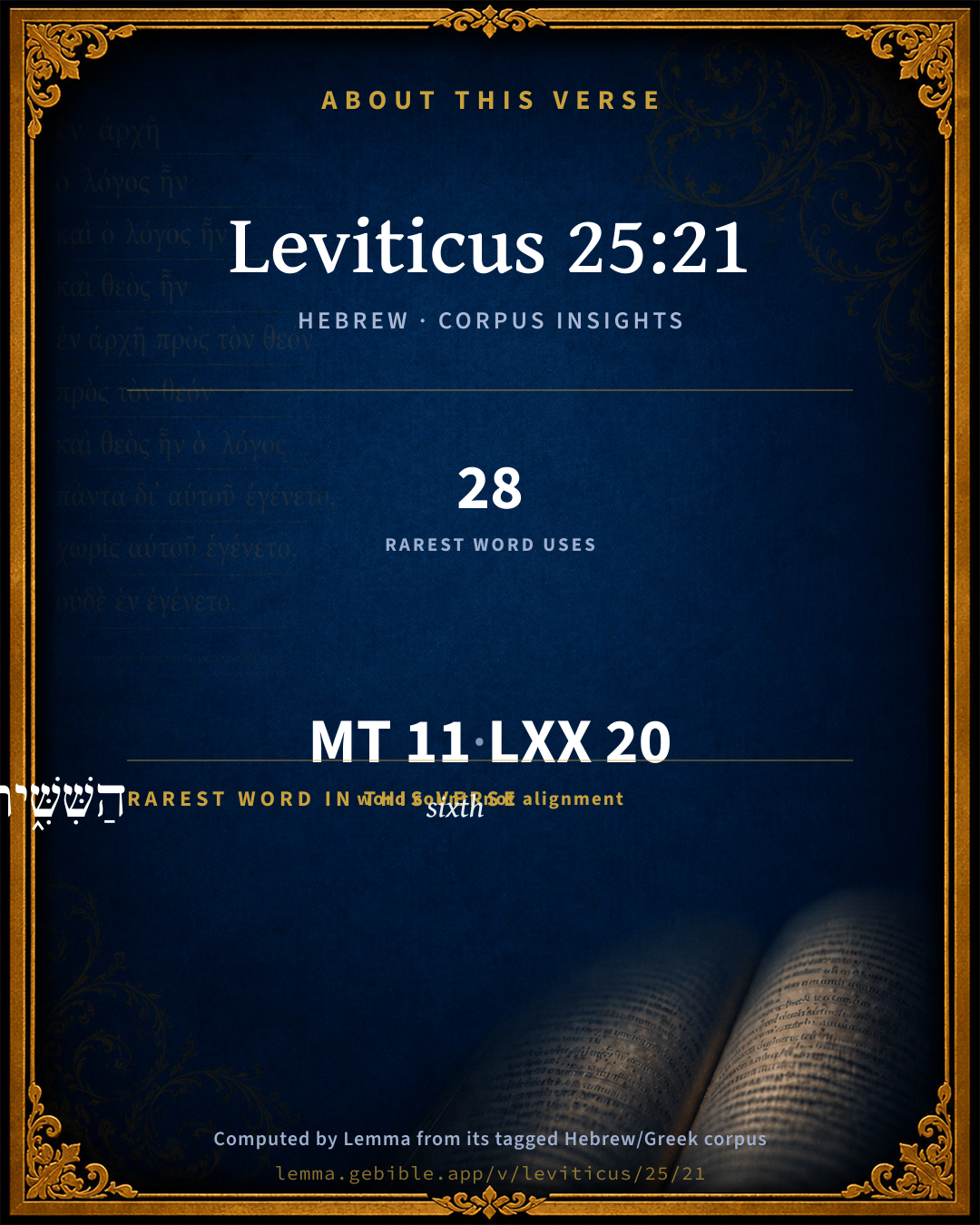
These counts appear in no published source. They are computed here, from the morphology-tagged text and Lemma’s own curated glosses. What Lemma adds →

11
words
8
distinct lemmas
Pentateuch
section

Shared distinctive vocabulary

הַשִּׁשִּׁ֑ית sixth H8345 occurs in 26 verses of the Hebrew Bible. Also found in:

Grammatical profile

  • 2 verbs
  • 4 nouns
  • 2 adjectives
  • 1 preposition
  • 2 particles

Verb forms

  • וְצִוִּ֤יתִי Piel · Sequential Perfect
  • וְעָשָׂת֙ Qal · Sequential Perfect

Repetition

A word recurs within this verse — often emphatic in Hebrew:

  • בַּשָּׁנָ֖ה year H8141 ×2

Hebrew & Septuagint length

In English translation the verse runs 22 words from the Hebrew and 22 from the Septuagint (LXX English) — the same length.

A rough comparison of the two English renderings, which tokenize alike — not a word-level alignment.

Word counts can differ between the Hebrew and the Greek without any difference in meaning — e.g. the Hebrew direct-object marker אֵת has no separate Greek word, and Greek often adds the article ὁ.

In the original languages it is 11 Hebrew tokens and 20 Greek tokens — but the two are counted differently (Hebrew bundles its prefixes and suffixes into one token; the Greek is in lemma form), so that isn’t a like-for-like length.

Cross-references

10

Topical passages linked to Leviticus 25:21 in the Treasury of Scripture Knowledge — connected by theme and wording, ordered by reader-vote popularity; previews shown in the World English Bible.

  • Deuteronomy 28:8 Yahweh will command the blessing on you in your barns, and in all that you put your hand to; and he will bless you in the land which Yahweh your God gives you.
  • Proverbs 10:22 Yahweh's blessing brings wealth, And he adds no trouble to it.
  • 2 Corinthians 9:10 Now may he who supplies seed to the sower and bread for food, supply and multiply your seed for sowing, and increase the fruits of your righteousness;
  • Psalms 133:3 Like the dew of Hermon, That comes down on the hills of Zion: For there Yahweh gives the blessing, Even life forevermore.
  • Deuteronomy 28:3 Blessed shall you be in the city, and blessed shall you be in the field.
  • Genesis 26:12 Isaac sowed in that land, and reaped in the same year one hundred times what he planted. Yahweh blessed him.
  • Genesis 41:47 In the seven plenteous years the earth brought forth abundantly.
  • Exodus 16:29 Behold, because Yahweh has given you the Sabbath, therefore he gives you on the sixth day the bread of two days. Everyone stay in his place. Let no one go out of his place on the seventh day."
  • Leviticus 25:4 but in the seventh year there shall be a Sabbath of solemn rest for the land, a Sabbath to Yahweh. You shall not sow your field or prune your vineyard.
  • Leviticus 25:8–11 "'You shall count off seven Sabbaths of years, seven times seven years; and there shall be to you the days of seven Sabbaths of years, even forty-nine years.

Cross-references courtesy of OpenBible.info (CC BY 4.0).

Hebrew and Greek witnesses Masoretic Hebrew ↔ Greek Septuagint

The same verse in the two great witnesses to the Old Testament, shown verse-for-verse.

These are two independent witnesses, not word-aligned to each other, and the Septuagint is shown in lemma (dictionary) form.

Hebrew Leviticus 25:21 Masoretic · Westminster Leningrad Codex

וְצִוִּ֤יתִי אֶת בִּרְכָתִי֙ לָכֶ֔ם בַּשָּׁנָ֖ה הַשִּׁשִּׁ֑ית וְעָשָׂת֙ אֶת הַתְּבוּאָ֔ה לִשְׁלֹ֖שׁ הַשָּׁנִֽים

then I will command my blessing on you in the sixth year, and it shall bring forth fruit for the three years.

World English Bible · Public Domain

Greek LXX Leviticus 25:21 Septuagint · lemma form

καί ἀποστέλλω ὁ εὐλογία ἐγώ σύ ἐν ὁ ἔτος ὁ ἕκτος καί ποιέω ὁ γένημα αὐτός εἰς ὁ τρεῖς ἔτος

Then will I send my blessing upon you in the sixth year, and the land shall produce its fruits for three years.

LXX2012 (modern English Septuagint) · Public Domain

Hebrew: Westminster Leningrad Codex (CC BY 4.0). Greek: Septuagint (public domain); English from LXX2012 (modern English Septuagint) (Public Domain). How the Septuagint differs from the Hebrew →

Targum (Aramaic paraphrase)

2

The Targum is the ancient Jewish Aramaic paraphrase of the Hebrew Scriptures — an interpretive translation, not the Hebrew text itself. Onkelos (literal) and Pseudo-Jonathan (expansive) render the Torah, and Jonathan the Prophets. Coverage is partial: where no permissively-licensed English translation exists for a verse, only the Aramaic is shown. This is verse-level text, not a word-by-word alignment to the Hebrew.

  1. Targum Onkelos Torah (Genesis–Deuteronomy)
    וֶאֱפַקֵד יָת בִּרְכְּתִי לְכוֹן בְּשַׁתָּא שְׁתִיתֵתָא וְתַעְבֵּד יָת עֲלַלְתָּא לִתְלַת שְׁנִין

    (no public-domain English translation for this verse)

    Targum Onkelos — Aramaic: “Onkelos Genesis” (public domain); “Onkelos Exodus” (public domain); “Onkelos Leviticus” (public domain); “Onkelos Numbers” (public domain); “Onkelos Deuteronomy” (public domain). English: “Sefaria Community Translation” (CC0 1.0 (public-domain dedication)); “J.W. Etheridge. The Targums of Onkelos and Jonathan Ben Uzziel on the Pentateuch. London: Longmans, Green, 1862” (public domain). Text via Sefaria.

  2. Targum Pseudo-Jonathan Torah (Genesis–Deuteronomy)
    וְאַפְקֵיד יַת בִּרְכָתִי לְכוֹן מִן אוֹצְרֵי טָבִין דְבִשְׁמֵי שְׁכִינְתִּי בְּשַׁתָּא שְׁתִיתֵיתָא וְתַעֲבֵיד יַת עֲלַלְתָּא דְתִסְפּוֹק לִתְלַת שְׁנִין

    I will command My blessing upon you from my treasures of goodness, which are in the heaven of My Presence, in the sixth year, and it will create produce that will suffice for three years.

    Targum Pseudo-Jonathan — Aramaic: “Targum Jonathan on Genesis” (public domain); “Targum Jonathan on Exodus” (public domain); “Targum Jonathan on Leviticus” (public domain); “Targum Jonathan on Numbers” (public domain); “Targum Jonathan on Deuteronomy” (public domain). English: “The Targum of Jonathan ben Uzziel, trans. J. W. Etheridge, London, 1862” (public domain). Text via Sefaria.

Commentary

Notes on Leviticus 25:21 from classic Christian and Jewish commentators (each source and its license shown beneath its notes). The classic Christian expositions comment on the surrounding passage and are grouped to its opening verse, so a note may address several verses; the Jewish commentaries on the Tanakh (Rashi and others) are per-verse, so they appear only where the commentator wrote on this verse.

Lemma curates 59 commentaries, every one of them public domain or Creative Commons licensed, each selected and text-cleaned for this edition rather than reprinted as found. About our sources →

Trapp's Complete Commentary

John Trapp

Lev 25:21 Then I will command my blessing upon you in the sixth year, and it shall bring forth fruit for three years.

Ver. 21. Command my blessing.] Now if God send his mandamus, who shall gainstand it?

John Trapp, A Commentary or Exposition upon All the Books of the Old and New Testament (1647–1656) — public domain. Text from a community e-Sword module.

Joseph Benson's Commentary

Lev 25:21. For three years — Not completely, but in great part; namely, for that part of the sixth year which was between the beginning of the harvest and the beginning of the seventh year, for the whole seventh year, and for that part of the eighth year which was before the harvest, which reached almost until the beginning of the ninth year. This is added to show the equity of this command. As God would hereby try their faith and obedience, so he gave them an evident proof of his own exact providence and tender care over them in making provisions suitable to their necessities.

Joseph Benson's Commentary on the Old and New Testaments (1811–1818) — public domain. Text from a community e-Sword module.

Geneva Bible (1599)

Geneva Bible translators

Hebrew, I will command.

Geneva Bible (1599) marginal notes — public domain. Text via Bolls.life.

Jamieson, Fausset & Brown

Robert Jamieson, A. R. Fausset & David Brown

I will command my blessing upon you in the sixth year, and it shall bring forth fruit for three years, &c.--A provision was made, by the special interposition of God, to supply the deficiency of food which would otherwise have resulted from the suspension of all labor during the sabbatic year. The sixth year was to yield a miraculous supply for three continuous years. And the remark is applicable to the year of Jubilee as well as the sabbatic year. (See allusions to this extraordinary provision in Kg2 19:29; Isa 37:30). None but a legislator who was conscious of acting under divine authority would have staked his character on so singular an enactment as that of the sabbatic year; and none but a people who had witnessed the fulfilment of the divine promise would have been induced to suspend their agricultural preparations on a recurrence of a periodical Jubilee.

Jamieson, Fausset & Brown — Commentary Critical and Explanatory on the Whole Bible (1871) — public domain (CC PDM 1.0). Text via the HelloAO Bible API.

Ellicott's Commentary for English Readers

(21) Then I will command my blessing. That is, He will send out His Divine command to the soil in the sixth year that it should be a blessing to them, and it shall be done. (See Deu_28:8; Psa_42:8; Psa_44:4; Psa_68:29.)

It shall bring forth fruit for three years.—Better, it shall bring forth produce. This special blessing will be manifested in the abundant crop of the harvest preceding the sabbatical year. Just as at the institution of the weekly Sabbath, when God enjoined abstention from labour, He sent down a double portion of manna every sixth day to make up for the day of rest (Exo_16:22-27), so He will exercise a special providence every sixth year by blessing the soil with a treble crop to compensate for giving the land a septennial sabbath. As the sabbatical year began the civil year, viz., 1 Tishri, which was in the autumn or in September, the three years here spoken of are to be distributed as follows: (1) the remainder of the sixth year after the harvest; (2) the whole of the seventh year; and (3) the period of the eighth year till the harvest is gathered in from the seeds sown in the eighth year. It will thus be seen that the question anticipated in Lev_25:29, viz., “What shall we eat the seventh year?” properly applies to the eighth year, since the requirements for the seventh year are supplied by the regular harvest of the sixth year, and it is the eighth year for which the harvest of the seventh is wanted. To meet this difficulty, one of the most distinguished Jewish expositors of the Middle Ages translates Lev_25:20 : “And if ye shall say in the seventh year ‘What shall we eat’” i.e., in the eighth year. It may, however, be that the question expresses the anxiety which the people might feel in eating their ordinary share in the seventh year, lest there should be nothing left for the eighth year, since in all other years the harvest is ripening for the next year whilst the fruits of the past year are being consumed.

A Bible Commentary for English Readers, edited by Charles John Ellicott (1878–1897) — public domain. Text from a community e-Sword module.

John Gill's Exposition

Then I will command my blessing upon you in the sixth year,.... Upon their fields, vineyards, and oliveyards, and make them exceeding fruitful, more than in other years; all fruitfulness at any time depends upon the blessing of God, and follows upon it, but is more visible and observable when there is an exceeding great plenty:

and it shall bring forth fruit for three years; and thus God blessed the sixth year with such a plentiful increase as was sufficient for time to come, until a new crop was gathered in; as he had blessed the sixth day with a double portion of manna, for the supply of the seventh.

John Gill's Exposition of the Whole Bible (1746–1763) — public domain (CC PDM 1.0). Text via the HelloAO Bible API.

Haydock's Catholic Bible Commentary

Three years. After the harvest of the sixth year was gotten in, the land rested from September to September, the beginning of the 8th year, when it was tilled again. Nothing would be ripe till about March; yet the harvest of the 6th year would suffice to furnish food till that time, or even for a year longer, as it would be requisite, when the year of jubilee succeeded that of rest, ver. 8. (Haydock)

George Leo Haydock (1774–1849), Haydock's Catholic Family Bible and Commentary, 1859 edition — public domain. Excludes Psalms (Douay-Rheims chapter numbering differs from Protestant) and Deuterocanonical books (Catholic canon only).

Matthew Poole's English Annotations

i.e. Give

my blessing. Commanding is oft used in Scripture either for the performance of promised blessings, as Deu 28:8 Psa 111:9; 133:3, or for the execution of threatened judgments, as Isa 5:6; Amo 9:4; both being acts of God’s providential will, as the command is of his legislative will.

For three years; not completely, but in great part, to wit, for that part of the sixth year which was between the beginning of harvest and the beginning of the seventh year, for the whole seventh year, and for that part of the eighth year which was before the harvest, which reached almost until the beginning of the ninth year. And by this expression we may understand the meaning of that eminent passage of Christ’s being three days and three nights in the grave, to wit, one whole day, and part of two days; of which more, if God please, in its proper place. This is added to show the equity of this command. As God would hereby try their faith, and exercise obedience, so he gave them an eminent proof of his own exact providence and tender care over them, in making provisions suitable to their necessities. Albeit it be also probable that divers of them, especially such as were more solicitous or distrustful of God’s providence, did lay up something of the fruits of former years against this time.

Matthew Poole's English Annotations on the Holy Bible (1683–1685) — public domain. Text from a community e-Sword/MySword module.

Whedon's Commentary on the Bible

Daniel D. Whedon

21. Fruit for three years — The fact that three years are here provided for instead of two, which the sabbath year required, is evidence that the jubilee succeeds the seventh sabbath year and is not identical with it, as some suppose. No merely human legislator would have ventured to enact a law forbidding seed sowing from the sixth to the eighth year, and harvesting from the sixth to the ninth year, omitting two successive harvests and thereby sinking two sevenths of the entire national wealth. Nor would any people have received such a law except on an unwavering faith in its divine origin. We regard obedience to this law the highest proof of Moses’s divine legation. The evident provision here made for the year of jubilee accounts for the apparent but not real displacement of this paragraph. We have only two passages of Scripture where this promise is alluded to, namely, 2Ki_19:29, Isa_37:30.

Daniel D. Whedon (gen. ed.), Commentary on the Old and New Testaments (1874–1909) — public domain. Text from a community e-Sword module.

John Wesley's Explanatory Notes

For three years - Not compleatly, but in great part, namely, for that part of the 6th year which was between the beginning of harvest and the beginning of the 7th year, for the whole 7th year, and for that part of the 8th year which was before the harvest, which reached almost until the beginning of the ninth year. This is added to shew the equity of this command. As God would hereby try their faith and obedience, so he gave them an eminent proof of his own exact providence and tender care over them in making provisions suitable to their necessities.

John Wesley, Explanatory Notes Upon the Whole Bible (1754–1765) — public domain. Text via the GEBible commentary corpus.

Rashi

Rabbi Shlomo Yitzchaki (Rashi)

לשלש השנים [IT SHALL BRING FORTH INCREASE] FOR THE THREE YEARS — i. e. for a part of the sixth year — from Nisan till the New Year of the seventh — for the whole seventh year and for part of the eighth year, for in the eighth year they will sow in Marcheshvan but will harvest only in Nisan (so that they will have to depend on the harvest of the sixth year in the eighth too).

Rashi on the Tanakh — English translations: “The Judaica Press complete Tanach with Rashi, translated by A. J. Rosenberg” (CC BY 4.0); “Pentateuch with Rashi's commentary by M. Rosenbaum and A.M. Silbermann, 1929-1934” (public domain); “The Metsudah Tanach series, Lakewood, N.J” (CC BY 4.0); and “The Book of Joshua, Metsudah Publications, 1997” (CC BY 4.0). Text via Sefaria.

Lesson kit

Teaching starters — assembled from the data on this page, not authored interpretation. Every prompt links to the verse data it draws on. Edit before teaching.

Leviticus, in the Pentateuch, opens this verse with 11 words (8 distinct Hebrew lemmas). Its most distinctive word is shishshîy (“sixth”). A historical commentator’s framing appears above. Read the whole chapter for the surrounding context.

Discussion questions

  1. What does “sixth” (shishshîy) contribute to the verse as a whole?
  2. Genesis 1:31 shares the word «sixth» with this verse. How do the two illuminate each other?
  3. “year” occurs 2× in this one verse. What is the effect of the repetition?
  4. The translations on this page render this verse differently — a whole-verse word diff, not a word-by-word alignment. What might account for the different wordings?
  5. The verb «וְצִוִּ֤יתִי» is Piel Sequential Perfect. How does its form color the action?
  6. Reading how Trapp's Complete Commentary and Joseph Benson's Commentary read this verse, where do the two commentators agree and where do they part?

Things to notice

Reading settings

Reading text

Shown beneath each verse's original-language words.

Old Testament
Old Testament edition

Read the OT as the Masoretic Hebrew (MT) or the Greek Septuagint (LXX).

English shown for the Greek Septuagint (in the Hebrew ↔ Greek comparison).

Comparing translations? Open the Compare panel on any verse page to stack up to four side by side.