
1 Chronicles 22:6

Hebrew (Westminster Leningrad Codex) 1 Chronicles 22:6 appears in the Hebrew Old Testament. The text above is from the Westminster Leningrad Codex. Each word links to its Strong’s number, a concise gloss, and parsing drawn from the Open Scriptures Hebrew Bible morphology. Click any word for its full Brown-Driver-Briggs (BDB) entry.
Download image
Cite this verse

1 Chronicles 22:6 (World English Bible). Public Domain. Lemma interlinear Bible study tool, https://lemma.gebible.app/v/1-chronicles/22/6.

Show BibTeX & RIS
BibTeX
RIS
English Translation
Then he called for Solomon his son, and charged him to build a house for Yahweh, the God of Israel.
World English Bible · Public Domain
Download a study sheet

One document with this verse’s original text, its word-by-word gloss line, the meaning frame, cross-references with their text, attributed commentary, and full source and license credits — printable, and it pastes into notes with its structure intact.

This verse Autodidact and up

Study sheet (.html) Plain text (.txt)

A passage Seminary Student

Up to 50 verses in one chapter. A passage sheet keeps up to 6 commentary sources and 12 cross-references per verse, in the order this page ranks them, and says so on the sheet whenever that leaves anything out. Ask for a single verse and you get the Autodidact verse sheet above.

Everything on this page stays free to read, with no account — the sheet is a download of what is already on screen, not access to it.

Want to remove ads? Support Godless Engineer
Compare translations 3

The same verse in 3 English versions, stacked beneath the original-language interlinear above. Click any original word for its lexicon entry.

Each is an independent rendering of the whole verse — the interlinear is not word-aligned to these translations.

Highlighted words mark where these versions differ — a whole-verse word diff, not a word-by-word alignment.

  • World English Bible Public Domain
    Then he called for Solomon his son, and charged him to build a house for Yahweh, the God of Israel.
  • King James Version Public Domain
    Then he called for Solomon his son, and charged him to build an house for the LORD God of Israel.
  • unfoldingWord Literal Text CC BY-SA 4.0
    And he called for Solomon his son, and he commanded him to build a house for Yahweh, the God of Israel.

unfoldingWord Literal Text — © unfoldingWord, licensed CC BY-SA 4.0. Word-aligned USFM3 via Door43 (git.door43.org/unfoldingWord/en_ult).

Versions to compare (up to 4)

3 of 4 selected

Show all 18 translations

Every available English version of this verse, each an independent rendering of the whole verse.

  • World English Bible Public Domain
    Then he called for Solomon his son, and charged him to build a house for Yahweh, the God of Israel.
  • Berean Standard Bible Public Domain
    Then David called for his son Solomon and instructed him to build a house for the LORD, the God of Israel.
  • Majority Standard Bible Public Domain
    Then David called for his son Solomon and instructed him to build a house for the LORD, the God of Israel.
  • King James Version Public Domain
    Then he called for Solomon his son, and charged him to build an house for the LORD God of Israel.
  • American Standard Version (1901) Public Domain
    Then he called for Solomon his son, and charged him to build a house for Jehovah, the God of Israel.
  • Revised Version (1885) Public Domain
    Then he called for Solomon his son, and charged him to build an house for the LORD, the God of Israel.
  • Geneva Bible (1599) Public Domain
    Then he called Salomon his sonne, and charged him to builde an house for the Lord God of Israel.
  • Douay-Rheims (1899) Public Domain
    And he called for Solomon his son: and commanded him to build a house to the Lord the God of Israel.
  • Young's Literal Translation Public Domain
    And he calleth for Solomon his son, and chargeth him to build a house to Jehovah, God of Israel,
  • Literal Standard Version CC BY-SA 4.0
    And he calls for his son Solomon, and charges him to build a house for YHWH, God of Israel,
  • Unlocked Literal Bible CC BY-SA 4.0
    Then he called for Solomon his son and commanded him to build a house for Yahweh, the God of Israel.
  • unfoldingWord Literal Text CC BY-SA 4.0
    And he called for Solomon his son, and he commanded him to build a house for Yahweh, the God of Israel.
  • Darby Bible Public Domain
    And he called for Solomon his son, and charged him to build a house for Jehovah the God of Israel.
  • World Messianic Bible Public Domain
    Then he called for Solomon his son, and commanded him to build a house for the LORD, the God of Israel.
  • Webster's Bible Public Domain
    Then he called for Solomon his son, and charged him to build a house for the LORD God of Israel.
  • Free Bible Version CC BY-SA 4.0
    Then he sent for his son Solomon and instructed him to build a house for the Lord, the God of Israel.
  • Bible in Basic English Public Domain
    Then he sent for his son Solomon, and gave him orders for the building of a house for the Lord, the God of Israel.
  • JPS Tanakh (1917) Public Domain
    Then He called for Solomon his son, and charged him to build a house for the LORD, the God of Israel.

Literal Standard Version (2020), Covenant Press — licensed CC BY-SA 4.0. Text via the HelloAO Bible API (eBible.org). Unlocked Literal Bible (unfoldingWord) — licensed CC BY-SA 4.0. Text via the HelloAO Bible API (eBible.org). unfoldingWord Literal Text — © unfoldingWord, licensed CC BY-SA 4.0. Word-aligned USFM3 via Door43 (git.door43.org/unfoldingWord/en_ult). Free Bible Version, Dr. Jonathan Gallagher — licensed CC BY-SA 4.0. Text via the HelloAO Bible API (eBible.org).

Word by word

More ways to search: Search by grammar → Find every occurrence → Compare this word →

Practice this passage: Drill this verse → Learn its vocabulary →

לִשְׁלֹמֹ֣ה
Shᵉlômôh
H8010
“to/for · Solomon”
Preposition + Noun, Proper
Part of Speech
Preposition + Noun
Type
Proper
Full BDB Definition

Origin: from H7965

TWOT: 2401i

Solomon = "peace" - son of David by Bathsheba and 3rd king of Israel; author of Proverbs and Song of Songs
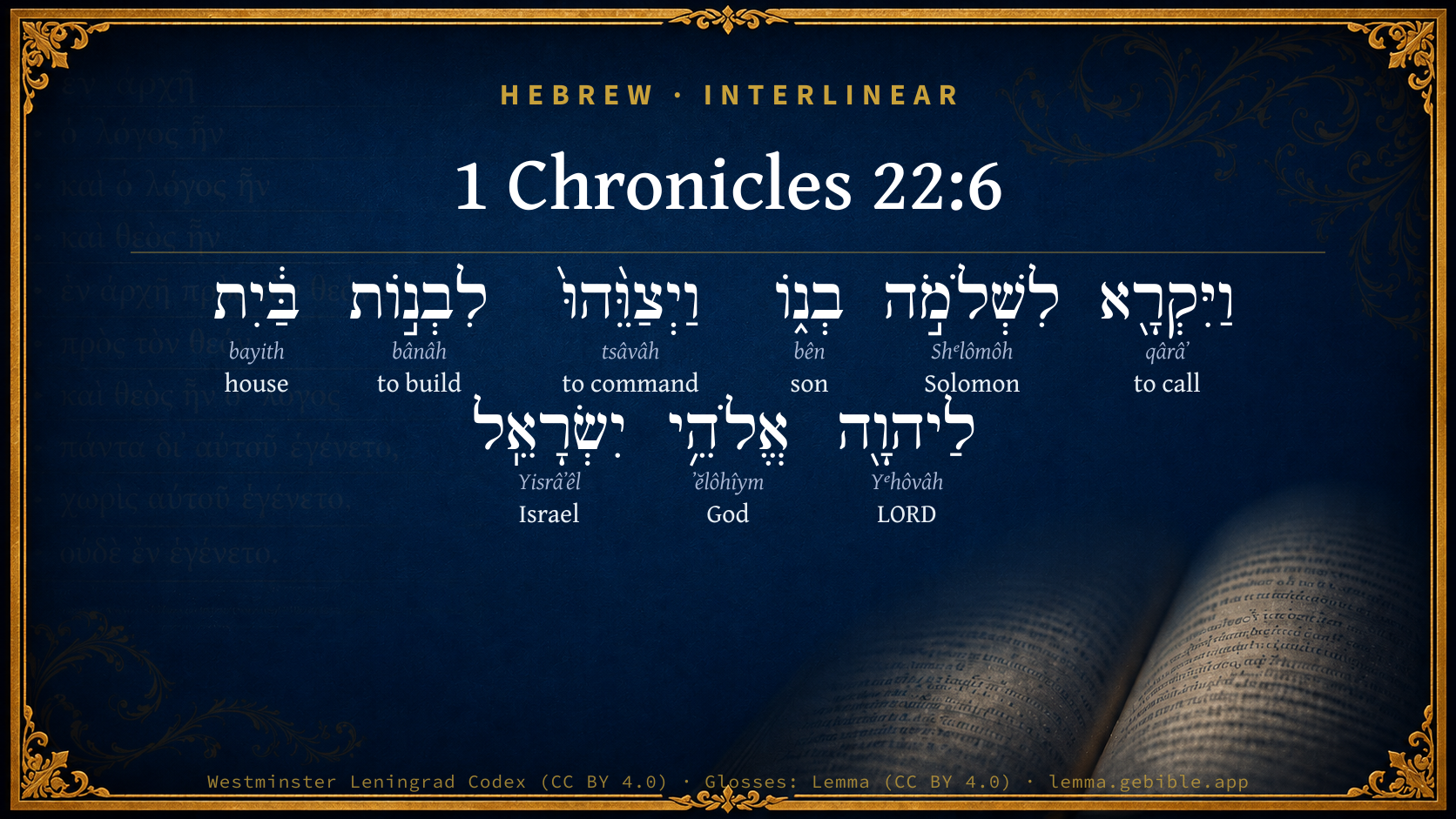
  1. וַיִּקְרָ֖א qârâʼ H7121 “and · to call” Conjunction + Verb, Qal, Sequential Imperfect, 3rd Person, Masculine, Singular
  2. בְנ֑וֹ bên H1121 “son · his” Noun, Common, Masculine, Singular, Construct + Suffix, Personal, 3rd Person, Masculine, Singular
  3. וַיְצַוֵּ֨הוּ֙ tsâvâh H6680 “and · to command · him” Conjunction + Verb, Piel, Sequential Imperfect, 3rd Person, Masculine, Singular + Suffix, Personal, 3rd Person, Masculine, Singular
  4. לִבְנ֣וֹת bânâh H1129 “to build” Preposition + Verb, Qal, Infinitive Construct
  5. בַּ֔יִת bayith H1004 “house” Noun, Common, Masculine, Singular, Absolute
  6. לַיהוָ֖ה Yᵉhôvâh H3068 “to/for · LORD” Preposition + Noun, Proper
  7. אֱלֹהֵ֥י ʼĕlôhîym H430 “God(s) of” Noun, Common, Masculine, Plural, Construct
  8. יִשְׂרָאֵֽל Yisrâʼêl H3478 “Israel” Noun, Proper

About this verse

These counts appear in no published source. They are computed here, from the morphology-tagged text and Lemma’s own curated glosses. What Lemma adds →

9
words
9
distinct lemmas
Historical
section

Grammatical profile

  • 3 verbs
  • 6 nouns

Verb forms

  • וַיִּקְרָ֖א Qal · Sequential Imperfect
  • וַיְצַוֵּ֨הוּ֙ Piel · Sequential Imperfect
  • לִבְנ֣וֹת Qal · Infinitive Construct

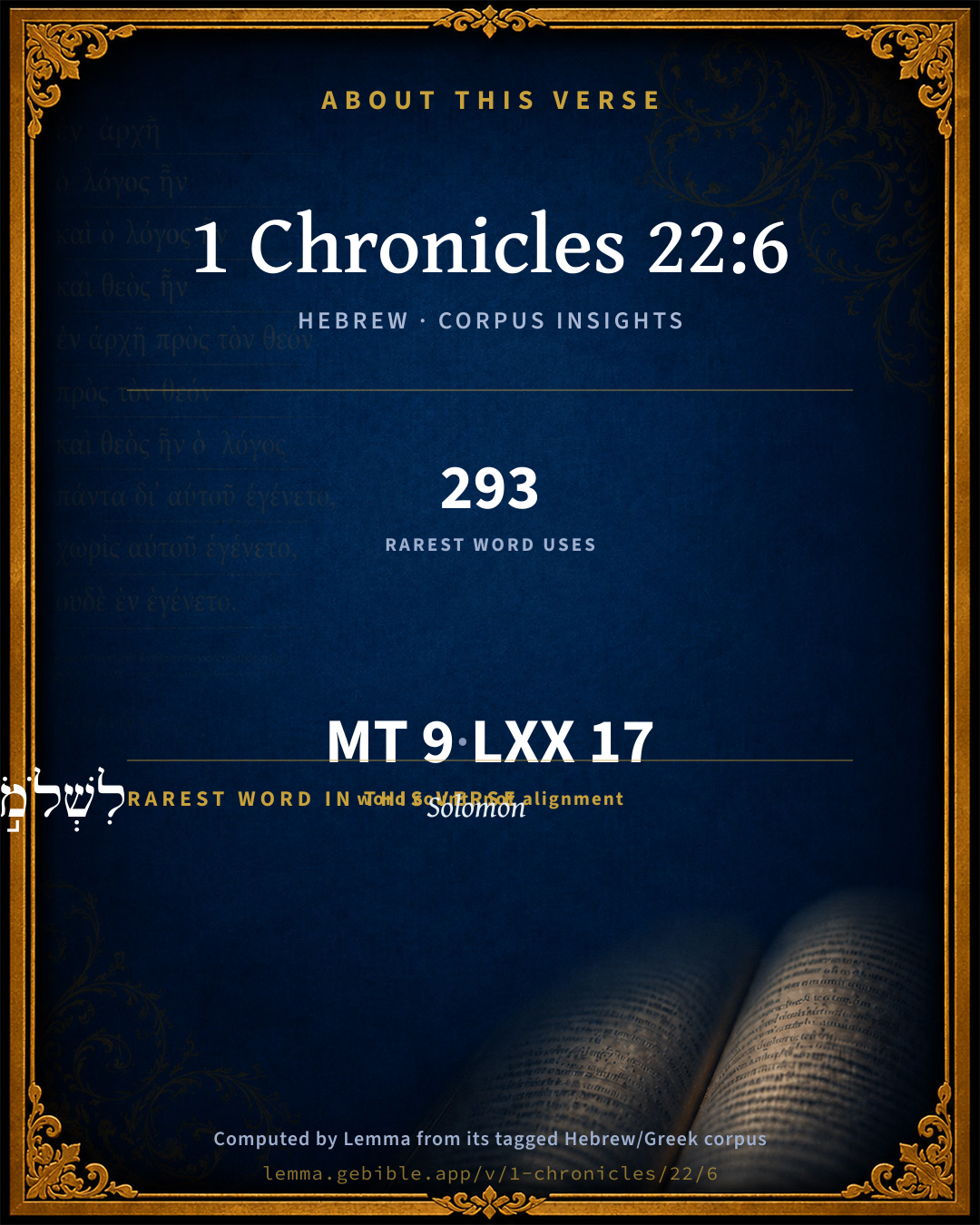
Hebrew & Septuagint length

In English translation the verse runs 20 words from the Hebrew and 19 from the Septuagint (LXX English) — closely comparable.

A rough comparison of the two English renderings, which tokenize alike — not a word-level alignment.

Word counts can differ between the Hebrew and the Greek without any difference in meaning — e.g. the Hebrew direct-object marker אֵת has no separate Greek word, and Greek often adds the article ὁ.

In the original languages it is 9 Hebrew tokens and 17 Greek tokens — but the two are counted differently (Hebrew bundles its prefixes and suffixes into one token; the Greek is in lemma form), so that isn’t a like-for-like length.

Cross-references

10

Topical passages linked to 1 Chronicles 22:6 in the Treasury of Scripture Knowledge — connected by theme and wording, ordered by reader-vote popularity; previews shown in the World English Bible.

  • Numbers 27:18–19 Yahweh said to Moses, Take Joshua the son of Nun, a man in whom is the Spirit, and lay your hand on him;
  • Numbers 27:23 and he laid his hands on him, and gave him a charge, as Yahweh spoke by Moses.
  • Deuteronomy 31:14 Yahweh said to Moses, Behold, your days approach that you must die: call Joshua, and present yourselves in the tent of meeting, that I may give him a charge. Moses and Joshua went, and presented themselves in the tent of meeting.
  • Deuteronomy 31:23 He gave Joshua the son of Nun a charge, and said, Be strong and of good courage; for you shall bring the children of Israel into the land which I swore to them: and I will be with you.
  • Matthew 28:18–20 Jesus came to them and spoke to them, saying, "All authority has been given to me in heaven and on earth.
  • Acts 1:2 until the day in which he was received up, after he had given commandment through the Holy Spirit to the apostles whom he had chosen.
  • Acts 20:25–31 Now, behold, I know that you all, among whom I went about preaching the Kingdom of God, will see my face no more.
  • 1 Timothy 5:21 I charge you in the sight of God, and Christ Jesus, and the chosen angels, that you observe these things without prejudice, doing nothing by partiality.
  • 1 Timothy 6:13–17 I charge you before God, who gives life to all things, and before Christ Jesus, who before Pontius Pilate testified the good confession,
  • 2 Timothy 4:1 I charge you therefore before God and the Lord Jesus Christ, who will judge the living and the dead at his appearing and his Kingdom:

Cross-references courtesy of OpenBible.info (CC BY 4.0).

Hebrew and Greek witnesses Masoretic Hebrew ↔ Greek Septuagint

The same verse in the two great witnesses to the Old Testament, shown verse-for-verse.

These are two independent witnesses, not word-aligned to each other, and the Septuagint is shown in lemma (dictionary) form.

Hebrew 1 Chronicles 22:6 Masoretic · Westminster Leningrad Codex

וַיִּקְרָ֖א לִשְׁלֹמֹ֣ה בְנ֑וֹ וַיְצַוֵּ֨הוּ֙ לִבְנ֣וֹת בַּ֔יִת לַיהוָ֖ה אֱלֹהֵ֥י יִשְׂרָאֵֽל

Then he called for Solomon his son, and charged him to build a house for Yahweh, the God of Israel.

World English Bible · Public Domain

Greek LXX 1 Chronicles 22:6 Septuagint · lemma form

καί καλέω σαλωμών ὁ υἱός αὐτός καί ἐντέλλομαι αὐτός ὁ οἰκοδομέω ὁ οἶκος ὁ κύριος θεός ἰσραήλ

And he called Solomon his son, and commanded him to build the house for the Lord God of Israel.

LXX2012 (modern English Septuagint) · Public Domain

Hebrew: Westminster Leningrad Codex (CC BY 4.0). Greek: Septuagint (public domain); English from LXX2012 (modern English Septuagint) (Public Domain). How the Septuagint differs from the Hebrew →

Commentary

Notes on 1 Chronicles 22:6 from classic Christian and Jewish commentators (each source and its license shown beneath its notes). The classic Christian expositions comment on the surrounding passage and are grouped to its opening verse, so a note may address several verses; the Jewish commentaries on the Tanakh (Rashi and others) are per-verse, so they appear only where the commentator wrote on this verse.

Lemma curates 59 commentaries, every one of them public domain or Creative Commons licensed, each selected and text-cleaned for this edition rather than reprinted as found. About our sources →

Matthew Henry's Commentary

Though Solomon was young and tender, he was capable of receiving instructions, which his father accordingly gave him, concerning the work for which he was designed. When David came to the throne he had many things to do, for the foundations were all out of course; but Solomon had only one thing in charge, and that was to build a house for the Lord God of Israel, Ch1 22:6. Now,

I. David tells him why he did not do it himself. It was in his mind to do it (Ch1 22:7), but God forbade him, because he had shed much blood, Ch1 22:8. Some think this refers to the blood of Uriah, which fastened such a reproach upon him as rendered him unworthy the honour of building the temple: but that honour was forbidden him before he had shed that blood; therefore it must be meant, as it is here explained, of the blood he shed in his wars (for he had been a man of war from his youth), which, though shed very justly and honourably in the service of God and Israel, yet made him unfit to be employed in this service, or rather less fit than another that had never been called to such bloody work. God, by assigning this as the reason of laying David aside from this work, showed how precious human life is to him, and intended a type of him who should build the gospel temple, not by destroying men's lives, but by saving them, Luk 9:56.

II. He gives him the reason why he imposed this task upon him. 1. Because God had designed him for it, nominated him as the man that should do it: A son shall be born to thee, that shall be called Solomon, and he shall build a house for my name, Ch1 22:9, Ch1 22:10. Nothing is more powerful to engage us to any service for God, and encourage us in it, than to know that hereunto we are appointed. 2. Because he would have leisure and opportunity to do it. He should be a man of rest, and therefore should not have his time, or thoughts, or wealth, diverted from this business. He should have rest from his enemies abroad (none of them should invade or threaten him, or give him provocation), and he should have peace and quietness at home; and therefore let him build the house. Note, Where God gives rest he expects work. 3. Because God had promised to establish his kingdom. Let this encourage him to honour God, that God had honour in store for him; let him build up God's house, and God will build up his throne. Note, God's gracious promises should quicken and invigorate our religious service.

III. He delivers him an account of the vast preparations he had made for this building (Ch1 22:14), not in a way of pride and vain glory (he speaks of it as a poor thing - I have, in my poverty, prepared, margin), but as an encouragement to Solomon to engage cheerfully in the work, for which so solid a foundation was laid. The treasure here mentioned of the 100,000 talents of gold, and 1,000,000 talents of silver, amounts to such an incredible sum that most interpreters either allow an error in the copy or think the talent here signifies no more than a plate or piece: ingots we call them. I am inclined to suppose that a certain number is here put for an uncertain, because it is said (Ch1 22:16) that of the gold and silver, as well as of the brass and iron, there was no number, and that David here includes all the dedicated things (Ch1 18:11) which he designed for the house of the Lord, that is, not only for the building of it, but for the treasure of it; and putting all together, it might come pretty near what is here spoken of. Hundreds and thousands are numbers which we often use to express that which is very much, when yet we would not be understood strictly.

IV. He charges them to keep God's commandments and to take heed to his duty in every thing, Ch1 22:13. He must not think by building the temple to purchase a dispensation to sin; no, on the contrary, his doing that would not be accepted, nor accounted of, if he did not take heed to fulfil the statutes which the Lord charged Moses with, Ch1 22:13. Though he was to be king of Israel, he must always remember that he was a subject to the God of Israel.

V. He encourages him to go about this great work, and to go on in it (Ch1 22:13): "Be strong, and of good courage, Though it is a vast undertaking, thou needest not fear coming under the reproach of the foolish builder, who began to build and was not able to finish it; it is God's work, and it shall come to perfection. Dread not, nor be dismayed." In our spiritual work, as well as in our spiritual warfare, we have need of courage and resolution.

VI. He quickens him not to rest in the preparations he had made, but to add thereto, Ch1 22:14. Those that enter into the labours of others, and build upon their advantages, must still be improving.

VII. He prays for him: The Lord give thee wisdom and understanding, and give thee charge concerning Israel, Ch1 22:12. Whatever charge we have, if we see God giving us the charge and calling us to it, we may hope he will give us wisdom for the discharge of it. Perhaps Solomon had an eye to this prayer of his father for him, in the prayer he offered for himself: Lord, give me a wise and understanding heart. He concludes (Ch1 22:16), Up, and be doing, and the Lord be with thee. Hope of God's presence must not slacken our endeavours. Though the Lord be with us, we must rise and be doing, and, if we do this, we have reason to believe he is and will be with us. Work out your salvation, and God will work in you.

Matthew Henry's Commentary on the Whole Bible (1708–1710) — public domain (CC PDM 1.0). Text via the HelloAO Bible API.

Jamieson, Fausset & Brown

Robert Jamieson, A. R. Fausset & David Brown

HE INSTRUCTS SOLOMON. (Ch1 22:6-19)

Then he called for Solomon . . . and charged him--The earnestness and solemnity of this address creates an impression that it was given a little before the old king's decease. He unfolded his great and long cherished plan, enjoined the building of God's house as a sacred duty on him as his son and successor, and described the resources that were at command for carrying on the work. The vast amount of personal property he had accumulated in the precious metals [Ch1 22:14] must have been spoil taken from the people he had conquered, and the cities he had sacked.

Next: 1 Chronicles Chapter 23

Jamieson, Fausset & Brown — Commentary Critical and Explanatory on the Whole Bible (1871) — public domain (CC PDM 1.0). Text via the HelloAO Bible API.

The Biblical Illustrator

Joseph S. Exell

1Ch_22:6-19

Then he called for Solomon his son.

Davids charge to Solomon

I. A fathers privilege.

1. To cherish a lofty ideal for his son. This does not require that the father should undertake to decide the particulars of his sons career. This would involve the danger of weakening his will, of lessening his power of independent judgment and free choice. I have seen an apricot tree trained to a wall, trunk and branch fastened to it by nails and bands. It made a vine of what was meant to be a tree. If it had been taken from the wall it would have lain limp on the ground.

2. To make the example of his own daily living one which will help and stimulate his son. A wise father will recognise the fact that he commends to his boy, not that which he praises, but that which he pursues. It is not by telling our children what we wish them to become that we mould them most effectually; it is by the evidence which they get from our daily living, as to bur main desire and hope for them. The unintended influence of the home is that which will move them most. The atmospheric influence is more pervasive than that which comes from medicine.

3. He may provide means by which his son may carry out his purpose and friends to help him in it.

II. A sons advantage. From all that a good father thus can do a son has no small advantage.

1. By the law of heredity.

2. By this harmonious environment a wise father can largely shape the influences under which his son grows up.

3. By the improved opportunity which comes to him as his fathers son and heir. Solomon has but to keep with care what David has acquired with hard work. The son stands naturally upon the platform to reach which the father has come by climbing the steep ladder. Many a son to-day has grand opportunity for noble living which has been gained for him by the toils of those who have gone before him. But only opportunity. There is a sermon in the word opportunity. It is that which is ob portus, over against the harbour; but there your fleet may rot at anchor as readily as it may be submerged at sea. The skilful master must raise the anchor, set the sail, take advantage of the favouring breeze, steer his craft to port, or all the shipbuilders skill has been for naught. All the advantages of the most favoured son will amount to nothing unless he will himself arise and build. Honour is not in what is inherited, but in what is accomplished. (Monday Club Sermons.)

Davids charge to Solomon:--

Learn

I. That some originate a good work, but are not permitted to execute it.

II. That others may be called to execute work which they never originated.

III. That when called, they should finish the work given them to do. (J. Wolfendale.)

But the word of the Lord came to me, saying.--

Gods word to David

How the word of the Lord came to David we do not know. In what way soever the communication was made to David, the communication itself is of singular moral value.

1. Say that the Lord delivered the message immediately in audible words, we have then the doctrine that God will not permit men of blood to end their career as if they had been guiltless of blood-shedding.

2. Say that David uttered these words out of the depths of his own consciousness, then we have the doctrine that there is a moral fitness of things that hands stained with blood should not be put forth in the erection of a house of prayer. The house of God is to be a house of peace, the sanctuary of rest, a Sabbatic building, calm with the tranquillity of heaven, unstained by the vices and attachments of earth. (J. Parker, D. D.)

Behold, a son shall be born to thee.

A son predicted

I. Son of David; so was Christ.

II. A man of rest; so was Christ.

III. The giver of peace; so was Christ.

IV. He had a significant name; so has Jesus Christ.

V. He was a glorious king; so is Christ.

VI. His great work was the building of the temple; so is the work of Christ. (Biblical Museum.)

The prediction of Solomons birth

This is a forecast which is full of moral instruction; it shows how God knows every man who is coming into the world, what his character will be, what function he will have to discharge, and what will be the effect of his ministry upon his day and generation. The Christian believes that every event is ordered from above, that every man is born at the right time, is permitted to live for a proper period if he be obedient to providence, and that the mission of every man is assigned, limited, and accentuated: all we have to do is to say, Lord, what wilt Thou have me to do? and to obey what we honestly believe to be the voice from heaven. (J. Parker, D. D.)

The Biblical Illustrator, edited by Joseph S. Exell (c. 1880s–1900s) — public domain. Text from a community e-Sword module.

MacLaren's Expositions of Holy Scripture

Alexander MacLaren

1 Chronicles

DAVID’S PROHIBITED DESIRE AND PERMITTED SERVICE

1Ch 22:6 - 1Ch 22:16.

This passage falls into three parts. In 1Ch 22:6 - 1Ch 22:10 the old king tells of the divine prohibition which checked his longing to build the Temple; in 1Ch 22:11 - 1Ch 22:13 he encourages his more fortunate successor, and points him to the only source of strength for his happy task; in 1Ch 22:14 - 1Ch 22:16 he enumerates the preparations which he had made, the possession of which laid stringent obligations on Solomon.

I. There is a tone of wistfulness in David’s voice as he tells how his heart’s desire had been prohibited. The account is substantially the same as we have in 2Sa 7:4 - 2Sa 7:16, but it adds as the reason for the prohibition David’s warlike career. We may note the earnestness and the motive of the king’s desire to build the Temple. ‘It was in my heart’; that implies earnest longing and fixed purpose. He had brooded over the wish till it filled his mind, and was consolidated into a settled resolve. Many a musing, solitary moment had fed the fire before it burned its way out in the words addressed to Nathan. So should our whole souls be occupied with our parts in God’s service, and so should our desires be strongly set towards carrying out what in solitary meditation we have felt borne in on us as our duty.

The moving spring of David’s design is beautifully suggested in the simple words ‘unto the name of the Lord my God.’ David’s religion was eminently a personal bond between him and God. We may almost say that he was the first to give utterance to that cry of the devout heart, ‘My God,’ and to translate the generalities of the name ‘the God of Israel’ into the individual appropriation expressed by the former designation. It occurs in many of the psalms attributed to him, and may fairly be regarded as a characteristic of his ardent and individualising devotion. The sense of a close, personal relation to God naturally prompted the impulse to build His house. We must claim our own portion in the universal blessings shrined in His name before we are moved to deeds of loving sacrifice. We must feel that Christ ‘loved me, and gave Himself for me,’ before we are melted into answering surrender.

The reason for the frustrating of David’s desire, as here given, is his career as a warrior king. Not only was it incongruous that hands which had been reddened with blood should rear the Temple, but the fact that his reign had been largely occupied with fighting for the existence of the kingdom showed that the time for engaging in such a work, which would task the national resources, had not yet come. We may draw two valuable lessons from the prohibition. One is that it indicates the true character of the kingdom of God as a kingdom of peace, which is to be furthered, not by force, but in peace and gentleness. The other is that various epochs and men have different kinds of duties in relation to Christ’s cause, some being called on to fight, and others to build, and that the one set of tasks may be as sacred and as necessary for the rearing of the Temple as the other. Militant epochs are not usually times for building. The men who have to do destructive work are not usually blessed with the opportunity or the power to carry out constructive work. Controversy has its sphere, but it is mostly preliminary to true ‘edification.’ In the broadest view all the activity of the Church on earth is militant, and we have to wait for the coming of the true ‘Prince of peace’ to build up the true Temple in the land of peace, whence all foes have been cast out for ever. To serve God in God’s way, and to give up our cherished plans, is not easy; but David sets us an example of simple-hearted, cheerful acquiescence in a Providence that thwarted darling designs. There is often much self-will in what looks like enthusiastic perseverance in some form of service.

II. The charge to Solomon breathes no envy of his privilege, but earnest desire that he may be worthy of the honour which falls to him. Petitions and exhortations are closely blended in it, and, though the work which Solomon is called to do is of an external sort, the qualifications laid down for it are spiritual and moral. However ‘secular’ our work in connection with God’s service may be, it will not be rightly done unless the highest motives are brought to bear on it, and it is performed as worship. The basis of all successful work is God’s presence with us, so David prays for that to be granted to Solomon as the beginning of all his fitness for his task.

Next, David recalls to his son God’s promise concerning him, that it may hearten him to undertake and to carry on the great work. A conviction that our service is appointed for us by God is essential for vigorous and successful Christian work. We must have, in some way or other, heard Him ‘speak concerning us,’ if we are to fling ourselves with energy into it.

The petitions in 1Ch 22:12 seem to stretch beyond the necessities of the case, in so far as building the Temple is concerned. Wisdom and understanding, and a clear consciousness of the duty enjoined on him by God in reference to Israel, were surely more than that work required. But the qualifications for God’s service, however the manner of service may be concerned with ‘the outward business of the house of God,’ are always these which David asked for Solomon. The highest result of true ‘wisdom and understanding’ given by God is keeping God’s law; and keeping it is the one condition on which we shall obtain and retain that presence of God with us which David prayed for Solomon, and without which they labour in vain that build. A life conformed to God’s will is the absolutely indispensable condition of all prosperity in direct Christian effort. The noblest exercise of our wisdom and understanding is to obey every word that we hear proceeding out of the mouth of God.

III. There is something very pathetic in the old king’s enumeration of the treasures which, by the economies of a lifetime, he had amassed. The amount stated is enormous, and probably there is some clerical error in the numbers specified. Be that as it may, the sum was very large. It represented many an act of self-denial, many a resolute shearing off of superfluities and what might seem necessaries. It was the visible token of long years of fixed attention to one object. And that devotion was all the more noble because the result of it was never to be seen by the man who exercised it.

Therein David is but a very conspicuous example of a law which runs through all our work for God. None of us are privileged to perform completed tasks. ‘One soweth and another reapeth.’ We have to be content to do partial work, and to leave its completion to our successors. There is but one Builder of whom it can be said that His hands ‘have laid the foundation of this house; His hands shall also finish it.’ He who is the ‘Alpha and Omega,’ and He alone, begins and completes the work in which He has neither sharers nor predecessors nor successors. The rest of us do our little bit of the great work which lasts on through the ages, and, having inherited unfinished tasks, transmit them to those who come after us. It is privilege enough for any Christian to lay foundations on which coming days may build. We are like the workers on some great cathedral, which was begun long before the present generation of masons were born, and will not be finished until long after they have dropped trowel and mallet from their dead hands. Enough for us if we can lay one course of stones in that great structure. The greater our aims, the less share has each man in their attainment. But the division of labour is the multiplication of joy, and all who have shared in the toil will be united in the final triumph. It would be poor work that was capable of being begun and perfected in a lifetime. The labourer that dug and levelled the track and the engineer that drives the locomotive over it are partners. Solomon could not have built the Temple unless, through long, apparently idle, years, David had been patiently gathering together the wealth which he bequeathed. So, if our work is but preparatory for that of those who come after, let us not think it of slight importance, and let us be sure that all who have had any portion in the toil shall share in the victory, that ‘he that soweth and he that reapeth may rejoice together.’

Alexander MacLaren, Expositions of Holy Scripture (1904–1910) — public domain. Text from a community e-Sword module.

Adam Clarke's Commentary

Verse 6. Solomon - is young and tender] He is as yet without complete knowledge and due experience; and it is necessary that I should make as much preparation for the work as I possibly can; especially as the house is to be exceedingly magnificent.

Adam Clarke's Commentary on the Bible (1810–1826) — public domain. Text from a community e-Sword/MySword module.

Ellicott's Commentary for English Readers

(6) Then he called.—And he called Solomon. When? After completing his preparations, and shortly before his death (1Ch_22:5). (Comp. 1Ki_2:1-9, especially 1Ch_22:3-4, of which we seem to hear echoes in the present speech.) Upon grounds of internal evidence we may pronounce this dying address of David to be an ideal composition, put into the king’s mouth by the unknown author whose work the chronicler follows: or rather, perhaps, by the chronicler himself, whose style is evident throughout. (Comp. the addresses attributed to David in 1 Chronicles 28)

For the Lord God of Israel.—There ought to be a comma after “Lord.” Literally the phrase would run, For Jehovah, the God of Israel. Thus the stress lies on the national aspect of the Deity, for whom Solomon was to undertake this national work.

(6-16) David gives formal charge to Solomon to build the Temple.

A Bible Commentary for English Readers, edited by Charles John Ellicott (1878–1897) — public domain. Text from a community e-Sword module.

John Gill's Exposition

Then he called for Solomon his son,.... To be brought before him:

and charged him to build an house for the Lord God of Israel; which charge was given a little before his death, after he had made great preparations for this work, as appears from Ch1 22:5.

John Gill's Exposition of the Whole Bible (1746–1763) — public domain (CC PDM 1.0). Text via the HelloAO Bible API.

Haydock's Catholic Bible Commentary

Tender, (delicatus) weak and unexperienced. (Calmet) --- Yet he might be 21 when he was crowned. (Tirinus) --- David began his preparations long before. --- Lord. Hebrew, "must be (Haydock) for grandeur, excellence, fame, and beauty, through all countries" a sort of prodigy. --- All. Hebrew, "abundantly."

George Leo Haydock (1774–1849), Haydock's Catholic Family Bible and Commentary, 1859 edition — public domain. Excludes Psalms (Douay-Rheims chapter numbering differs from Protestant) and Deuterocanonical books (Catholic canon only).

Whedon's Commentary on the Bible

Daniel D. Whedon

6-16. David’s charge to Solomon, here recorded, belongs to the same period as that of 1Ki_2:1-10. One passage supplements the other, and the contrast between them is very noticeable. The writer of Kings was concerned more particularly with the political history of David, and records the aged king’s counsel to his son in reference to dangerous political enemies; the chronicler omits all that, and records only the charge of David respecting the building of the temple.

Daniel D. Whedon (gen. ed.), Commentary on the Old and New Testaments (1874–1909) — public domain. Text from a community e-Sword module.

The Pulpit Commentary

HOMILIES BY W. CLARKSON Vers. 6-16.

Successful service.

David"s charge to his son Solomon will furnish us with the conditions of all successful work done in the Name of Christ and for the extension of his kingdom. We may remark, preliminarily, that our leisure time cannot be better spent than in Christian work. Solomon was to have time for internal administration. His father had defeated and subdued all the national enemies. In the midst of protracted "peace and quietness" (ver. 9) he would have an ample interval in which to build a house for the Lord. The time which the labour of others, or our own toil, has secured to us we spend most admirably when we give it to the direct service of the Divine Master. The conditions of successful work for him are

I SECURING DIVINE DIRECTION. "Only the Lord give thee wisdom and understanding" (ver. 12). David clearly felt, as this "only" indicates, that everything would utterly fail if God did not grant his Divine succour. That failing, everything must prove to be a failure.

II ENSURING PERSONAL FITNESS. (Vers. 7-9.) David was rendered personally unfit for the work by his much fighting. It was not fitting that a man of war should build the temple of the God of love. The two things did not go well together. It was far more becoming that Solomon, the "man of rest," should execute this work. Our guilty past may have been pardoned, our occupation may not be absolutely wrong, our surroundings may not be censurable, our position may not be blameworthy, and yet there may be something about one of these which makes it unsuitable for us and desirable for some one else to do the work which is required to be done.

III MAINTAINING PERSONAL INTEGRITY. (Vers. 11-13.) "Prosper thou, and build the house that thou mayest keep the Law of the Lord thy God. Then shalt thou prosper, if thou takest heed," etc. God distinctly promised to be Solomon"s Father, and to establish his throne (ver. 10); but this prosperity must depend on loyalty and the keeping of the Law. Without the maintenance of our moral and spiritual integrity we cannot expect to be prospered in any work we do for God.

IV MAKING ALL DUE PREPARATION. Solomon would have found himself overtasked and unable to do as he did if David had not "in his trouble prepared for the house" (vers. 14-16). The aged king may be said to have laid the foundation of the building by all the pains he took to collect material and make everything ready for his son to begin the work. We never strike a better stroke in the service of God than when we are engaged in the work of preparation. Moses in Horeb, Paul in Arabia, the Master himself in the quiet home in Galilee and the still more quiet resting-place of the mountain-fold and the seaside of after days, we ourselves in the chamber of communion and at the study desk, are "working for God," for we are doing that which is positively essential to true, abiding issues in the field of Christian labour.

V ACTING IN ACCORDANCE WITH THE REVEALED WILL OF CHRIST, "Build the house of the Lord as he hath said of thee" (ver. 11).

VI CHERISHING THE CONFIDENCE WHICH IS CLOSELY ALLIED TO STRENGTH. "Be strong, and of good courage" (ver. 13). There is a confidence which is presumption, and which will be dishonoured; but there is a confidence which is in the truth and in God, and which is a large element of success. Where the diffident are defeated, the assured and courageous win. Let the Christian workman fee! that behind him are Divine promises which "cannot be broken," and he will advance boldly and strike successfully.

VII MAKING THE WAY PLAIN FOR OUR SUCCESSORS. (Vers. 616.) Nothing is more hateful than the spirit of "apres moi le deluge." No worthy Christian workman will be content unless, like David, as he considers who and what are to come after him, he feels a devout thankfulness that he has made a plain path for his successors, in which they may walk in peace, honour, and usefulness. We may place by itself as a condition of success which is involved in some of the foregoing, but yet which deserves to be mentioned separately, cultivating and exhibiting the spirit of devotion. Thrice in this paternal counsel does David invoke the presence and blessing of Almighty God (nets. 11, 12, 16). It is in the spirit of conscious dependence on God and earnest uplooking to him for his Divine help (Psa_30:10) that the workman of the Lord will render successful service to his Master and mankind. C.

Vers. 6-16.

David"s charge to Solomon.

This was a solemn charge delivered by David in view of his death. The shadow of death makes everything solemn. But while we hear the charge to Solomon, it is impossible not to perceive from David"s words that "a greater than Solomon is here." The throne of Solomon was not established "for ever It is a promise of God which, like many such promises in the Old Testament, look forward to the kingdom of the Messiah, in whom alone they receive their literal and perfect fulfilment. Let us listen to their perfect consummation: "He shall be great, and shall be called the Son of the Highest: and the Lord God shall give unto him the throne of his father David: and he shall reign over the house of Jacob for ever; and of his kingdom there shall be no end". (Luk_1:32, Luk_1:33) Unless we notice the unexhausted promises and prophecies of the Old Testament, we shall read God"s Word to little real profit, and it will be full of difficulties and perplexities. David connects in this charge two things which are inseparable successful building and taking heed to the Law of God. If a man is tobuild well he must be a man of God. All successful building is inseparable from a heart under the constant influence of Divine truth. "Arise therefore, and be doing," says David, "and the Lord be with thee." God can only be with us as our own hearts are abidingly under the power of his Word; and if he be not with us, how can we build? "Except the Lord build the house, their labour is but lost that build it; except the Lord keep the city, the watchman waketh but in vain." The secret of all true rising in life, of all progress and attainment, is for the heart to be under the influence and constant guidance of the Word. Life will, in the end, be "life"s labour lost" without this. W.

The Pulpit Commentary (1880–1919), ed. H.D.M. Spence-Jones & Joseph S. Exell — public domain. Text from a community e-Sword module.

Keil & Delitzsch

C. F. Keil & F. Delitzsch

Then he called for Solomon his son,.... To be brought before him:

and charged him to build an house for the Lord God of Israel; which charge was given a little before his death, after he had made great preparations for this work, as appears from Ch1 22:5.

Keil & Delitzsch — Biblical Commentary on the Old Testament (1861–1891) — public domain (CC PDM 1.0). Text via the HelloAO Bible API. (Old Testament only.)

Kretzmann's Popular Commentary

Paul E. Kretzmann

David’s Instructions to Solomon

v. 6. Then he called for Solomon, his son, while he was still in possession of all his faculties, and charged him, with all earnestness and solemnity, to build an house for the Lord God of Israel.

v. 7. And David said to Solomon, My son, as for me, it was in my mind to build an house unto the name of the Lord, my God; he emphasizes this point as one of the supreme desires of his life, the one great unfulfilled wish of his career;

v. 8. but the word of the Lord came to me, saying, Thou hast shed blood abundantly and hast made great wars; thou shalt not build an house unto My name because thou hast shed much blood upon the earth in My sight. Cf 1Ch 28:3; 1Ki 5:3.

v. 9. Behold, a son shall be born to thee who shall be a man of rest, not chiefly a warrior, as David had been; and I will give him rest from all his enemies round about; for his name shall be Solomon ("peaceful"), and I will give peace and quietness unto Israel in his days.

v. 10. He shall build an house for My name; and he shall be My son, and I will be his Father; and I will establish the throne of his kingdom over Israel forever. Here the prophecy of 2Sa 7:12-14 is taken in its narrower sense, although the Messianic element is not wanting.

v. 11. Now, my son, the Lord be with thee, and prosper thou, and build the house of the Lord, thy God, as He hath said of thee. It was a sacred duty which was hereby laid upon Solomon as David’s heir and successor.

v. 12. Only the Lord give thee wisdom and understanding, both the right knowledge and the faculty to apply it properly, and give thee charge concerning Israel, that thou mayest keep the Law of the Lord, thy God, as the leader of the people also in this respect.

v. 13. Then shalt thou prosper, if thou takest heed to fulfil the statutes and judgments which the Lord charged Moses with concerning Israel, not only the special precepts of the covenant, but also those pertaining to the general duties toward all mankind. Be strong and of good courage; dread not, nor be dismayed. Since the undertaking was to be made to the glory of God alone, therefore the trust of Solomon was to be placed in Him with steadfast faith, and he was to be confident of success.

v. 14. Now, behold, in my trouble, in spite of the fact that the wars in which he was engaged often interfered with his pet hope and desire, I have prepared for the house of the Lord an hundred thousand talents of gold and a thousand thousand talents of silver, the total sum being estimated between two and four billions of dollars, and of brass and iron without weight; for it is in abundance, largely taken from people whom he had conquered and from cities which he had sacked. Timber also and stone have I prepared; and thou mayest add thereto.

v. 15. Moreover, there are workmen with thee in abundance, hewers and workers of stone and timber, both masons and carpenters, all selected chiefly from the conquered people living in the midst of Israel, v. 2, and all manner of cunning men for every manner of work.

v. 16. of the gold, the silver, and the brass, and the iron there is no number; the amounts were so incredibly large that ordinary methods of keeping track of the mass were inadequate. Arise, therefore, and be doing, and the Lord be with thee! Solomon was even now to make his plans and to estimate the costs of the entire building with all its equipment.

v. 17. David also commanded all the princes of Israel to help Solomon, his son, saying,

v. 18. Is not the Lord, your God, with you? And hath He not given you rest on every side? For He hath given the inhabitants of the land into mine hand; and the land is subdued before the Lord and before His people, and therefore the remembrance of all God’s former grace was the chief reason for this urgent invitation.

v. 19. Now set your heart and your soul to seek the Lord, your God, that being the basis of a Christian life in all true believers. Arise, therefore, and build ye the Sanctuary of the Lord God to bring the Ark of the Covenant of the Lord and the holy vessels of God into the house that is to be built to the name of the Lord. With this same zeal to inspire them, the believers of the New Testament will make it the object of their lives to build the Lord’s temple, the Church of Christ, to the glory of God’s holy name.

Paul E. Kretzmann, Popular Commentary of the Bible (1921–1924) — public domain. Text from a community e-Sword module.

unfoldingWord translationNotes

Door43 World Missions Community

he called

"David called"

commanded him to build ... my intention to build

The readers should understand that David intended for laborers to do the actual work. AT: "commanded him to oversee the building of a house for Yahweh ... my plan to oversee the building of the house myself" (See: Metonymy)

it was my intention

"I intended"

to build a house myself

The reflexive "myself" means that David originally planned to build the temple. AT: "that I would be the one to build the temple" (See: Reflexive Pronouns)

for the name of Yahweh my God

Here "name" represents God's honor. AT: "in order to honor Yahweh my God" (See: Metonymy)

shed much blood

Here the killing of people is spoken of as shedding their blood, where "blood" represents their lives. AT: "killed many people" (See: Metonymy)

for my name

Here "name" represents God's honor. AT: "to honor me" (See: Metonymy)

you have shed ... in my sight

Here "sight" refers to what God has seen. AT: "I have seen that you have shed much blood on the earth" (See: Metonymy)

translationWords

Solomon

command

house of God

David

name

bloodshed

unfoldingWord translationNotes — © Distant Shores Media and the Door43 World Missions Community, licensed CC BY-SA 4.0. Source: git.door43.org/Door43/en_tn.

Lesson kit

Teaching starters — assembled from the data on this page, not authored interpretation. Every prompt links to the verse data it draws on. Edit before teaching.

1 Chronicles, in the Historical, opens this verse with 9 words (9 distinct Hebrew lemmas). Its most distinctive word is Shᵉlômôh (“Solomon”). A historical commentator’s framing appears above. Read the whole chapter for the surrounding context.

Discussion questions

  1. How does “Solomon” (Shᵉlômôh) shape what this verse is saying?
  2. How does Numbers 27:18–19, which shares this passage’s theme, read alongside this verse?
  3. These translations render this verse differently. What is at stake in choosing one wording over another?
  4. «וַיִּקְרָ֖א» is a Qal Sequential Imperfect verb. How does that grammatical form shape the action described?
  5. Compare how Matthew Henry's Commentary and Jamieson, Fausset & Brown read this verse. Where do they agree or differ?

Things to notice

Reading settings

Reading text

Shown beneath each verse's original-language words.

Old Testament
Old Testament edition

Read the OT as the Masoretic Hebrew (MT) or the Greek Septuagint (LXX).

English shown for the Greek Septuagint (in the Hebrew ↔ Greek comparison).

Comparing translations? Open the Compare panel on any verse page to stack up to four side by side.