
Nehemiah 1:7

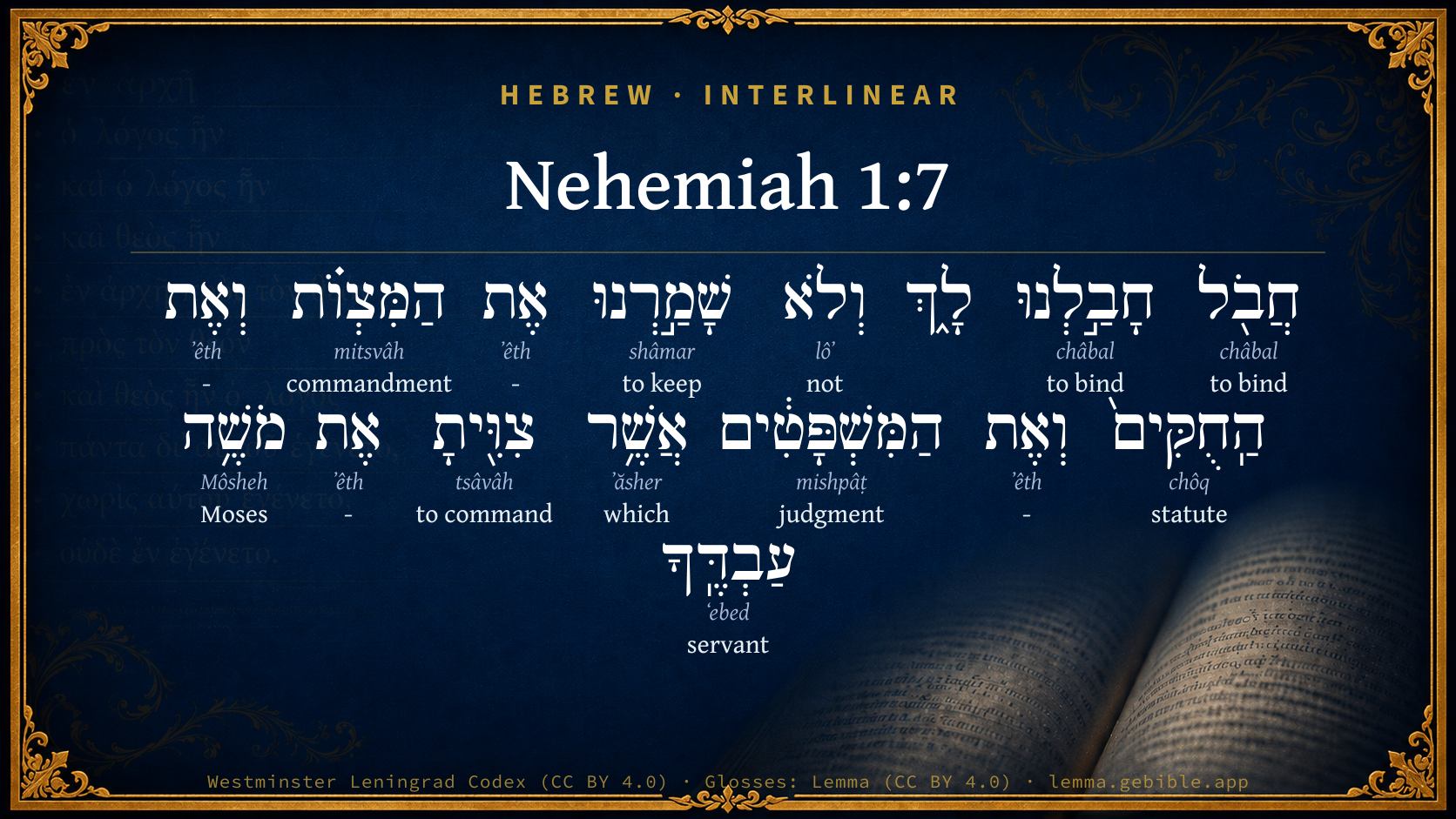
Hebrew (Westminster Leningrad Codex) Nehemiah 1:7 appears in the Hebrew Old Testament. The text above is from the Westminster Leningrad Codex. Each word links to its Strong’s number, a concise gloss, and parsing drawn from the Open Scriptures Hebrew Bible morphology. Click any word for its full Brown-Driver-Briggs (BDB) entry.
Download image
Cite this verse

Nehemiah 1:7 (World English Bible). Public Domain. Lemma interlinear Bible study tool, https://lemma.gebible.app/v/nehemiah/1/7.

Show BibTeX & RIS
BibTeX
RIS
English Translation
we have dealt very corruptly against you, and have not kept the commandments, nor the statutes, nor the ordinances, which you commanded your servant Moses.
World English Bible · Public Domain
Download a study sheet

One document with this verse’s original text, its word-by-word gloss line, the meaning frame, cross-references with their text, attributed commentary, and full source and license credits — printable, and it pastes into notes with its structure intact.

This verse Autodidact and up

Study sheet (.html) Plain text (.txt)

A passage Seminary Student

Up to 50 verses in one chapter. A passage sheet keeps up to 6 commentary sources and 12 cross-references per verse, in the order this page ranks them, and says so on the sheet whenever that leaves anything out. Ask for a single verse and you get the Autodidact verse sheet above.

Everything on this page stays free to read, with no account — the sheet is a download of what is already on screen, not access to it.

Want to remove ads? Support Godless Engineer
Compare translations 3

The same verse in 3 English versions, stacked beneath the original-language interlinear above. Click any original word for its lexicon entry.

Each is an independent rendering of the whole verse — the interlinear is not word-aligned to these translations.

Highlighted words mark where these versions differ — a whole-verse word diff, not a word-by-word alignment.

  • World English Bible Public Domain
    we have dealt very corruptly against you, and have not kept the commandments, nor the statutes, nor the ordinances, which you commanded your servant Moses.
  • King James Version Public Domain
    We have dealt very corruptly against thee, and have not kept the commandments, nor the statutes, nor the judgments, which thou commandedst thy servant Moses.
  • unfoldingWord Literal Text CC BY-SA 4.0
    With extreme corruption we have acted corruptly against you. And we have not kept the commandments, and the statutes, and the judgments that you commanded Moses your servant.

unfoldingWord Literal Text — © unfoldingWord, licensed CC BY-SA 4.0. Word-aligned USFM3 via Door43 (git.door43.org/unfoldingWord/en_ult).

Versions to compare (up to 4)

3 of 4 selected

Show all 18 translations

Every available English version of this verse, each an independent rendering of the whole verse.

  • World English Bible Public Domain
    we have dealt very corruptly against you, and have not kept the commandments, nor the statutes, nor the ordinances, which you commanded your servant Moses.
  • Berean Standard Bible Public Domain
    We have behaved corruptly against You and have not kept the commandments, statutes, and ordinances that You gave Your servant Moses.
  • Majority Standard Bible Public Domain
    We have behaved corruptly against You and have not kept the commandments, statutes, and ordinances that You gave Your servant Moses.
  • King James Version Public Domain
    We have dealt very corruptly against thee, and have not kept the commandments, nor the statutes, nor the judgments, which thou commandedst thy servant Moses.
  • American Standard Version (1901) Public Domain
    we have dealt very corruptly against thee, and have not kept the commandments, nor the statutes, nor the ordinances, which thou commandedst thy servant Moses.
  • Revised Version (1885) Public Domain
    we have dealt very corruptly against thee, and have not kept the commandments, nor the statutes, nor the judgments, which thou commandedst thy servant Moses.
  • Geneva Bible (1599) Public Domain
    We haue grieuously sinned against thee, and haue not kept the commandements, nor the statutes, nor the iudgements, which thou commandedst thy seruant Moses.
  • Douay-Rheims (1899) Public Domain
    We have been seduced by vanity, and have not kept thy commandments, and ceremonies and judgments, which thou hast commanded thy servant Moses.
  • Young's Literal Translation Public Domain
    we have acted very corruptly against Thee, and have not kept the commands, and the statutes, and the judgments, that Thou didst command Moses Thy servant.
  • Literal Standard Version CC BY-SA 4.0
    we have acted very corruptly against You, and have not kept the commands, and the statutes, and the judgments, that You commanded Your servant Moses.
  • Unlocked Literal Bible CC BY-SA 4.0
    We have acted very wickedly against you, and we have not kept the commandments, the statutes, and the rules you commanded your servant Moses.
  • unfoldingWord Literal Text CC BY-SA 4.0
    With extreme corruption we have acted corruptly against you. And we have not kept the commandments, and the statutes, and the judgments that you commanded Moses your servant.
  • Darby Bible Public Domain
    We have acted very perversely against thee, and have not kept the commandments, nor the statutes, nor the ordinances that thou commandedst thy servant Moses.
  • World Messianic Bible Public Domain
    We have dealt very corruptly against you, and have not kept the commandments, nor the statutes, nor the ordinances, which you commanded your servant Moses.
  • Webster's Bible Public Domain
    We have dealt very corruptly against thee, and have not kept the commandments, nor the statutes, nor the judgments, which thou commandedst thy servant Moses.
  • Free Bible Version CC BY-SA 4.0
    We have done terrible things to offend you and we have not kept the commandments, laws, and regulations that you gave to your servant Moses.
  • Bible in Basic English Public Domain
    We have done great wrong against you, and have not kept the orders, the rules, and the decisions, which you gave to your servant Moses.
  • JPS Tanakh (1917) Public Domain
    We have dealt very corruptly against Thee, and have not kept the commandments, nor the statutes, nor the ordinances which Thou didst command Thy servant Moses.

Literal Standard Version (2020), Covenant Press — licensed CC BY-SA 4.0. Text via the HelloAO Bible API (eBible.org). Unlocked Literal Bible (unfoldingWord) — licensed CC BY-SA 4.0. Text via the HelloAO Bible API (eBible.org). unfoldingWord Literal Text — © unfoldingWord, licensed CC BY-SA 4.0. Word-aligned USFM3 via Door43 (git.door43.org/unfoldingWord/en_ult). Free Bible Version, Dr. Jonathan Gallagher — licensed CC BY-SA 4.0. Text via the HelloAO Bible API (eBible.org).

Word by word

More ways to search: Search by grammar → Find every occurrence → Compare this word →

Practice this passage: Drill this verse → Learn its vocabulary →

חֲבֹ֖ל
châbal
H2254
“to bind”
Verb, Qal, Infinitive Construct
Part of Speech
Verb
Stem
Qal
Form
Infinitive Construct
Full BDB Definition

Origin: a primitive root

TWOT: 592 , 593 , 594 , 595

to bind - (Qal) - to bind - to take a pledge, lay to pledge - (Qal) to hold by a pledge, take in pledge, hold in pledge - (Niphal) to give a pledge, become pledged - to destroy, spoil, deal corruptly, offend - (Qal) to spoil, corrupt, offend - (Niphal) to be ruined - (Piel) to destroy, ruin - (Pual) to be ruined, be broken - to bring forth, travail - (Piel) to writhe, twist, travail
  1. חָבַ֣לְנוּ châbal H2254 “to bind” Verb, Qal, Perfect, 1st Person, Common, Plural
  2. וְלֹא lôʼ H3808 “and · not” Conjunction + Particle, Negative
  3. שָׁמַ֣רְנוּ shâmar H8104 “to keep” Verb, Qal, Perfect, 1st Person, Common, Plural
  4. אֶת ʼêth H853 “-” Particle, Direct Object
  5. הַמִּצְוֺ֗ת mitsvâh H4687 “the · commandments” Particle, Definite Article + Noun, Common, Feminine, Plural, Absolute
  6. וְאֶת ʼêth H853 “and · -” Conjunction + Particle, Direct Object
  7. הַֽחֻקִּים֙ chôq H2706 “the · statutes” Particle, Definite Article + Noun, Common, Masculine, Plural, Absolute
  8. וְאֶת ʼêth H853 “and · -” Conjunction + Particle, Direct Object
  9. הַמִּשְׁפָּטִ֔ים mishpâṭ H4941 “the · judgments” Particle, Definite Article + Noun, Common, Masculine, Plural, Absolute
  10. אֲשֶׁ֥ר ʼăsher H834 “which” Particle, Relative
  11. צִוִּ֖יתָ tsâvâh H6680 “to command” Verb, Piel, Perfect, 2nd Person, Masculine, Singular
  12. אֶת ʼêth H853 “-” Particle, Direct Object
  13. מֹשֶׁ֥ה Môsheh H4872 “Moses” Noun, Proper
  14. עַבְדֶּֽךָ ʻebed H5650 “servant · your” Noun, Common, Masculine, Singular, Construct + Suffix, Personal, 2nd Person, Masculine, Singular

About this verse

These counts appear in no published source. They are computed here, from the morphology-tagged text and Lemma’s own curated glosses. What Lemma adds →

16
words
11
distinct lemmas
Historical
section

Shared distinctive vocabulary

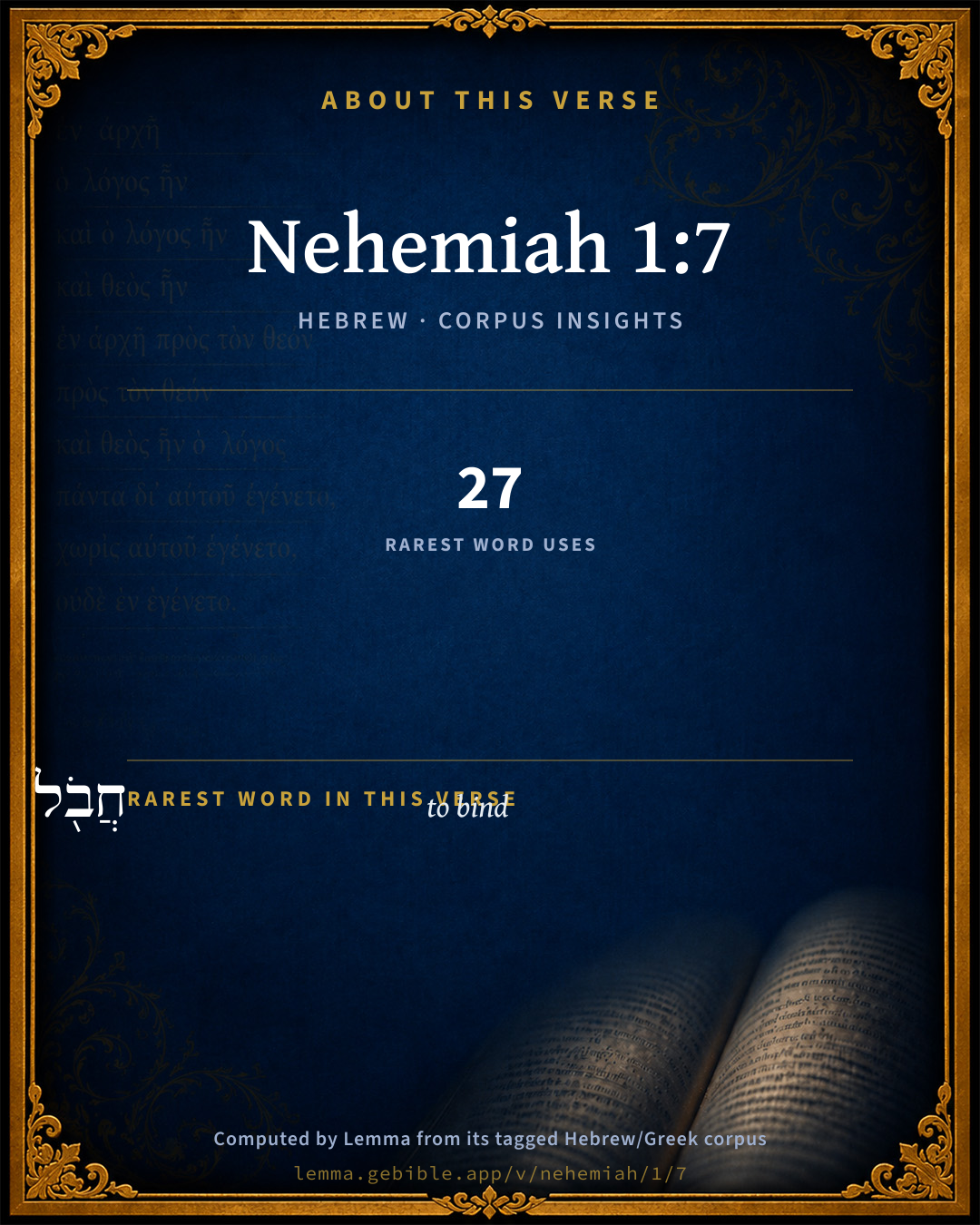
חֲבֹ֖ל to bind H2254 occurs in 23 verses of the Hebrew Bible. Also found in:

Grammatical profile

  • 4 verbs
  • 5 nouns
  • 1 preposition
  • 6 particles

Verb forms

  • חֲבֹ֖ל Qal · Infinitive Construct
  • חָבַ֣לְנוּ Qal · Perfect
  • שָׁמַ֣רְנוּ Qal · Perfect
  • צִוִּ֖יתָ Piel · Perfect

Repetition

A word recurs within this verse — often emphatic in Hebrew:

  • חֲבֹ֖ל to bind H2254 ×2

Cross-references

21

Topical passages linked to Nehemiah 1:7 in the Treasury of Scripture Knowledge — connected by theme and wording, ordered by reader-vote popularity; previews shown in the World English Bible.

  • Daniel 9:5–6 we have sinned, and have dealt perversely, and have done wickedly, and have rebelled, even turning aside from your precepts and from your ordinances;
  • Daniel 9:11 Yes, all Israel have transgressed your law, even turning aside, that they should not obey your voice: therefore has the curse been poured out on us, and the oath that is written in the law of Moses the servant of God; for we have sinned against him.
  • Daniel 9:13 As it is written in the law of Moses, all this evil is come on us: yet have we not entreated the favor of Yahweh our God, that we should turn from our iniquities, and have discernment in your truth.
  • Psalms 106:6 We have sinned with our fathers. We have committed iniquity. We have done wickedly.
  • Leviticus 27:34 These are the commandments which Yahweh commanded Moses for the children of Israel on Mount Sinai.
  • Deuteronomy 4:1 Now, Israel, listen to the statutes and to the ordinances, which I teach you, to do them; that you may live, and go in and possess the land which Yahweh, the God of your fathers, gives you.
  • Deuteronomy 4:5 Behold, I have taught you statutes and ordinances, even as Yahweh my God commanded me, that you should do so in the midst of the land where you go in to possess it.
  • Deuteronomy 5:1 Moses called to all Israel, and said to them, Hear, Israel, the statutes and the ordinances which I speak in your ears this day, that you may learn them, and observe to do them.
  • Deuteronomy 6:1 Now this is the commandment, the statutes, and the ordinances, which Yahweh your God commanded to teach you, that you might do them in the land where you go over to possess it;
  • Deuteronomy 28:14–15 and shall not turn aside from any of the words which I command you this day, to the right hand, or to the left, to go after other gods to serve them.
  • 1 Kings 2:3 and keep the charge of Yahweh your God, to walk in his ways, to keep his statutes, [and] his commandments, and his ordinances, and his testimonies, according to that which is written in the law of Moses, that you may prosper in all that you do, and wherever you turn yourself.
  • 2 Chronicles 25:4 But he didn't put their children to death, but did according to that which is written in the law in the book of Moses, as Yahweh commanded, saying, The fathers shall not die for the children, neither shall the children die for the fathers; but every man shall die for his own sin.
  • 2 Chronicles 27:2 He did that which was right in the eyes of Yahweh, according to all that his father Uzziah had done: however he didn't enter into the temple of Yahweh. The people did yet corruptly.
  • Ezra 7:6 this Ezra went up from Babylon: and he was a ready scribe in the law of Moses, which Yahweh, the God of Israel, had given; and the king granted him all his request, according to the hand of Yahweh his God on him.
  • Nehemiah 9:29–35 and testified against them, that you might bring them again to your law. Yet they dealt proudly, and didn't listen to your commandments, but sinned against your ordinances, (which if a man do, he shall live in them), and withdrew the shoulder, and hardened their neck, and would not hear.
  • Psalms 19:8–9 Yahweh's precepts are right, rejoicing the heart. Yahweh's commandment is pure, enlightening the eyes.
  • Psalms 119:5–8 Oh that my ways were steadfast To obey your statutes!
  • Hosea 9:9 They have deeply corrupted themselves, As in the days of Gibeah. He will remember their iniquity. He will punish them for their sins.
  • Zephaniah 3:7 I said, "Just fear me. Receive correction, so that her dwelling won't be cut off, according to all that I have appointed concerning her." But they rose early and corrupted all their doings.
  • Malachi 4:4 "Remember the law of Moses my servant, which I commanded to him in Horeb for all Israel, even statutes and ordinances.
  • Revelation 19:2 for true and righteous are his judgments. For he has judged the great prostitute, who corrupted the earth with her sexual immorality, and he has avenged the blood of his servants at her hand."

Cross-references courtesy of OpenBible.info (CC BY 4.0).

Hebrew and Greek witnesses Masoretic Hebrew ↔ Greek Septuagint

The same verse in the two great witnesses to the Old Testament, shown verse-for-verse.

These are two independent witnesses, not word-aligned to each other, and the Septuagint is shown in lemma (dictionary) form.

Hebrew Nehemiah 1:7 Masoretic · Westminster Leningrad Codex

חֲבֹ֖ל חָבַ֣לְנוּ לָ֑ךְ וְלֹא שָׁמַ֣רְנוּ אֶת הַמִּצְוֺ֗ת וְאֶת הַֽחֻקִּים֙ וְאֶת הַמִּשְׁפָּטִ֔ים אֲשֶׁ֥ר צִוִּ֖יתָ אֶת מֹשֶׁ֥ה עַבְדֶּֽךָ

we have dealt very corruptly against you, and have not kept the commandments, nor the statutes, nor the ordinances, which you commanded your servant Moses.

World English Bible · Public Domain

Greek LXX Structure differs

The Septuagint has no separate book of Nehemiah. Its Greek text is the second half of Esdras B (2 Esdras), chapters 11–23; Ezra is the first half (1–10).

A verse-for-verse comparison isn’t shown here because the chapters and verses don’t line up. Switch to the LXX edition with the MT / LXX toggle above to read the Greek directly.

On this verse, The Cambridge Bible for Schools and Colleges discusses the Septuagint’s reading. Read the note in Commentary ↓

Hebrew: Westminster Leningrad Codex (CC BY 4.0). Greek: Septuagint (public domain); English from a public-domain English Septuagint. How the Septuagint differs from the Hebrew →

Commentary

Notes on Nehemiah 1:7 from classic Christian and Jewish commentators (each source and its license shown beneath its notes). The classic Christian expositions comment on the surrounding passage and are grouped to its opening verse, so a note may address several verses; the Jewish commentaries on the Tanakh (Rashi and others) are per-verse, so they appear only where the commentator wrote on this verse.

Lemma curates 59 commentaries, every one of them public domain or Creative Commons licensed, each selected and text-cleaned for this edition rather than reprinted as found. About our sources →

The Cambridge Bible for Schools and Colleges

gen. ed. J. J. S. Perowne

7. We have dealt very corruptly] The words in the original occasion some difficulty. There is however no connexion, as commentators have supposed, between the Hebrew words used here and a similar root meaning ‘a pledge.’ The Vulgate, adopting a different derivation, has ‘vanitate seducti sumus.’ The LXX. rendering διαλύσει διελύσαμεν πρὸς σὲ and that of a few MSS. ματαιώσει ἐματαιώθημεν ἐν σοί (Field’s Orig. Hex.) show the uncertainty as to the meaning. Elsewhere in the O.T. the word occurs in Job_17:1; Isa_13:5; Isa_32:7; Isa_54:16; Pro_13:13; Mic_2:10; Son_2:15. The substantive derived from the root here used is rendered ‘hurt’ Dan_6:23. It is found with the same meaning as in this verse Job_34:31 ‘I will not offend any more.’

commandments … statutes … judgments] The three words occur together in Deu_5:31; Deu_6:1; Deu_7:11; Deu_8:11; Deu_11:1.

which thou commandedst] e.g. Deu_6:1.

thy servant Moses] and Neh_1:8, Neh_9:18.

‘The servant of the Lord’ was a favourite title applied to Moses. In Joshua it occurs with great frequency (e.g. Jos_1:1-2; Jos_1:7; Jos_1:13, &c.). Elsewhere it is found in 1Ki_8:53; 1Ki_8:56; 2Ki_18:12; 2Ki_21:8; 2Ch_1:3; Psa_105:26; Mal_4:4. He is called ‘the servant of God’ in Neh_10:29; 1Ch_6:49; Dan_9:11; ‘the man of God’ Ezr_3:2; 1Ch_23:14; Psalms 90. (title). Cf. in the New Testament the description of Moses as the ‘faithful servant’ in Heb_3:2-5, and Rev_15:3. The LXX. τῷ Μωυσῇ παιδί σου (Vulg. famulo tuo) will illustrate Act_4:27 ‘thy holy Servant Jesus’ (τὸν ἅγιον παῖδά σου Ἰησοῦν).

The Cambridge Bible for Schools and Colleges (gen. ed. J. J. S. Perowne; Cambridge University Press, 1878–1918) — public domain. Text from a community e-Sword module.

Trapp's Complete Commentary

John Trapp

Neh 1:7 We have dealt very corruptly against thee, and have not kept the commandments, nor the statutes, nor the judgments, which thou commandedst thy servant Moses.

Ver. 7. We have dealt very corruptly] Heb. Corrupting, we have corrupted ourselves against thee. Or, We have bound ourselves unto thee to be punished for our sins. Of confessing with utmost aggravation, and laying load upon ourselves, see the notes on Ezr 9:1-15. {See Trapp on "Ezr 9:1"} &c.

And have not kept the commandments, nor statutes, nor judgments] i.e. Neither the laws moral, ceremonial, nor judicial. We have broken all thy bonds, and cast thy cords from us.

John Trapp, A Commentary or Exposition upon All the Books of the Old and New Testament (1647–1656) — public domain. Text from a community e-Sword module.

Geneva Bible (1599)

Geneva Bible translators

Hebrew, corrupted.

Geneva Bible (1599) marginal notes — public domain. Text via Bolls.life.

Adam Clarke's Commentary

Verse 7. Have not kept thy commandments] The moral precepts by which our lives should be regulated.

Statutes] What refers to the rites and ceremonies of thy religion.

Judgments] The precepts of justice relative to our conduct to each other.

Adam Clarke's Commentary on the Bible (1810–1826) — public domain. Text from a community e-Sword/MySword module.

John Gill's Exposition

We have dealt very corruptly against thee,.... Corrupted his covenant, laws, and precepts, as well as themselves, ways, and works; all which were against the Lord, contrary to his nature, mind, and will:

and have not kept the commandments, nor the statutes, nor the judgments, which thou commandedst thy servant Moses; the laws, moral, ceremonial, and judicial.

John Gill's Exposition of the Whole Bible (1746–1763) — public domain (CC PDM 1.0). Text via the HelloAO Bible API.

Haydock's Catholic Bible Commentary

Vanity. Hebrew, "we have been corrupted." (Vatable) "we have dealt very corruptly." (Protestants) (Haydock) --- The author of the Vulgate has read e for e. (Calmet) --- Septuagint, "we have been very dissolute, or weak."

George Leo Haydock (1774–1849), Haydock's Catholic Family Bible and Commentary, 1859 edition — public domain. Excludes Psalms (Douay-Rheims chapter numbering differs from Protestant) and Deuterocanonical books (Catholic canon only).

Matthew Poole's English Annotations

We have dealt very corruptly, or we have wholly corrupted, to wit, ourselves, and our ways, and thy worship.

Matthew Poole's English Annotations on the Holy Bible (1683–1685) — public domain. Text from a community e-Sword/MySword module.

Whedon's Commentary on the Bible

Daniel D. Whedon

7. Commandments… statutes… judgments — Embracing respectively the moral precepts, like the ten commandments, the established rites and ceremonies of worship, and the judicial decision in respect to sin and righteousness.

Thy servant Moses — Moses and the law were then associated as now, and here is evidence that the Pentateuch was familiar to Nehemiah. Compare the marginal references in the next two verses.

Daniel D. Whedon (gen. ed.), Commentary on the Old and New Testaments (1874–1909) — public domain. Text from a community e-Sword module.

The Pulpit Commentary

We have not kept the commandments, nor the statutes, nor the judgments. The ordinances of the Law are frequently summed up under these three heads; (Deu_5:31 Deu_6:1 Deu_11:1, etc.) but it would be a mistake to regard them as constituting a logical division of the various precepts contained in the Pentateuch, or to suppose that every precept is to be referred absolutely to one or other of the three.

The Pulpit Commentary (1880–1919), ed. H.D.M. Spence-Jones & Joseph S. Exell — public domain. Text from a community e-Sword module.

Rashi

Rabbi Shlomo Yitzchaki (Rashi)

We have dealt corruptly Heb. חֲבֹל, a noun, an expression of corruption, since the “heth” is vowelized with a “hataf pattah,” and I cannot interpret it as a verb form, because in that case, it would have to be vowelized with a large “kamatz.”

we have dealt corruptly Heb. חָבַלְנוּ, an expression of corruption, as in Daniel (6:23): “I have done no harm.”

Rashi on the Tanakh — English translations: “The Judaica Press complete Tanach with Rashi, translated by A. J. Rosenberg” (CC BY 4.0); “Pentateuch with Rashi's commentary by M. Rosenbaum and A.M. Silbermann, 1929-1934” (public domain); “The Metsudah Tanach series, Lakewood, N.J” (CC BY 4.0); and “The Book of Joshua, Metsudah Publications, 1997” (CC BY 4.0). Text via Sefaria.

Lesson kit

Teaching starters — assembled from the data on this page, not authored interpretation. Every prompt links to the verse data it draws on. Edit before teaching.

Nehemiah, in the Historical, opens this verse with 16 words (11 distinct Hebrew lemmas). Its most distinctive word is châbal (“to bind”). A historical commentator’s framing appears above. Read the whole chapter for the surrounding context.

Discussion questions

  1. How does “to bind” (châbal) shape what this verse is saying?
  2. How does Exodus 22:26, which shares the word «to bind», read alongside this verse?
  3. What does the repetition of “to bind” (2× in this one verse) do in this verse?
  4. The translations on this page render this verse differently — a whole-verse word diff, not a word-by-word alignment. What might account for the different wordings?
  5. «חֲבֹ֖ל» is a Qal Infinitive Construct verb. How does that grammatical form shape the action described?
  6. Compare how The Cambridge Bible for Schools and Colleges and Trapp's Complete Commentary read this verse. Where do they agree or differ?

Things to notice

Reading settings

Reading text

Shown beneath each verse's original-language words.

Old Testament
Old Testament edition

Read the OT as the Masoretic Hebrew (MT) or the Greek Septuagint (LXX).

English shown for the Greek Septuagint (in the Hebrew ↔ Greek comparison).

Comparing translations? Open the Compare panel on any verse page to stack up to four side by side.