
1 Chronicles 17:6

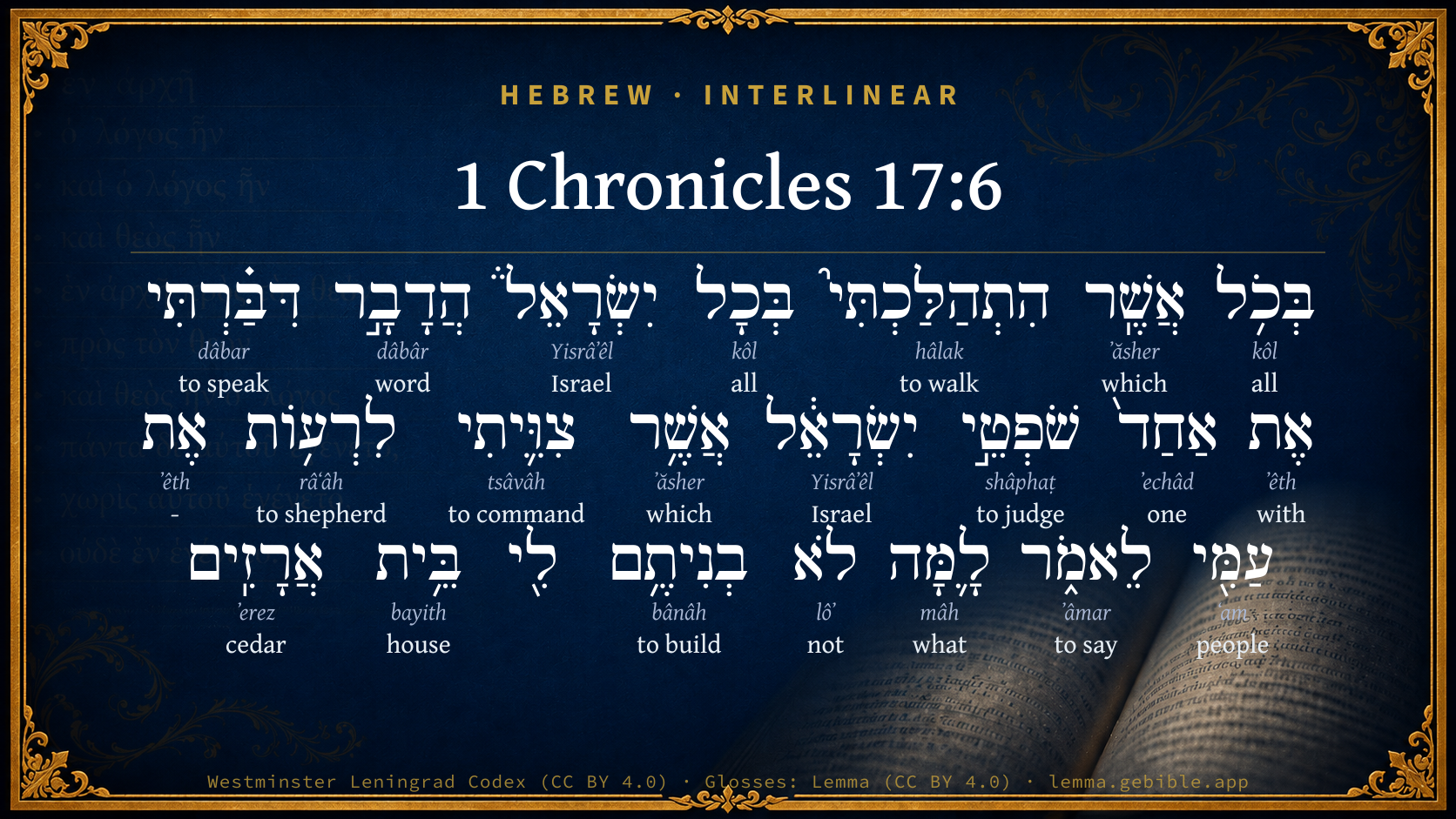
Hebrew (Westminster Leningrad Codex) 1 Chronicles 17:6 appears in the Hebrew Old Testament. The text above is from the Westminster Leningrad Codex. Each word links to its Strong’s number, a concise gloss, and parsing drawn from the Open Scriptures Hebrew Bible morphology. Click any word for its full Brown-Driver-Briggs (BDB) entry.
Download image
Cite this verse

1 Chronicles 17:6 (World English Bible). Public Domain. Lemma interlinear Bible study tool, https://lemma.gebible.app/v/1-chronicles/17/6.

Show BibTeX & RIS
BibTeX
RIS
English Translation
In all places in which I have walked with all Israel, spoke I a word with any of the judges of Israel, whom I commanded to be shepherd of my people, saying, Why have you not built me a house of cedar?
World English Bible · Public Domain
Download a study sheet

One document with this verse’s original text, its word-by-word gloss line, the meaning frame, cross-references with their text, attributed commentary, and full source and license credits — printable, and it pastes into notes with its structure intact.

This verse Autodidact and up

Study sheet (.html) Plain text (.txt)

A passage Seminary Student

Up to 50 verses in one chapter. A passage sheet keeps up to 6 commentary sources and 12 cross-references per verse, in the order this page ranks them, and says so on the sheet whenever that leaves anything out. Ask for a single verse and you get the Autodidact verse sheet above.

Everything on this page stays free to read, with no account — the sheet is a download of what is already on screen, not access to it.

Want to remove ads? Support Godless Engineer
Compare translations 3

The same verse in 3 English versions, stacked beneath the original-language interlinear above. Click any original word for its lexicon entry.

Each is an independent rendering of the whole verse — the interlinear is not word-aligned to these translations.

Highlighted words mark where these versions differ — a whole-verse word diff, not a word-by-word alignment.

  • World English Bible Public Domain
    In all places in which I have walked with all Israel, spoke I a word with any of the judges of Israel, whom I commanded to be shepherd of my people, saying, Why have you not built me a house of cedar?
  • King James Version Public Domain
    Wheresoever I have walked with all Israel, spake I a word to any of the judges of Israel, whom I commanded to feed my people, saying, Why have ye not built me an house of cedars?
  • unfoldingWord Literal Text CC BY-SA 4.0
    In any where I went about with all of Israel, did I speak a word with one of the scepters of Israel whom I commanded to shepherd my people, saying, ‘Why have you not built for me a house of cedars’?”’

unfoldingWord Literal Text — © unfoldingWord, licensed CC BY-SA 4.0. Word-aligned USFM3 via Door43 (git.door43.org/unfoldingWord/en_ult).

Versions to compare (up to 4)

3 of 4 selected

Show all 18 translations

Every available English version of this verse, each an independent rendering of the whole verse.

  • World English Bible Public Domain
    In all places in which I have walked with all Israel, spoke I a word with any of the judges of Israel, whom I commanded to be shepherd of my people, saying, Why have you not built me a house of cedar?
  • Berean Standard Bible Public Domain
    In all My journeys with all the Israelites, have I ever asked any of the leaders I appointed to shepherd My people, ‘Why haven’t you built Me a house of cedar?’
  • Majority Standard Bible Public Domain
    In all My journeys with all the Israelites, have I ever asked any of the leaders I appointed to shepherd My people, ‘Why haven’t you built Me a house of cedar?’
  • King James Version Public Domain
    Wheresoever I have walked with all Israel, spake I a word to any of the judges of Israel, whom I commanded to feed my people, saying, Why have ye not built me an house of cedars?
  • American Standard Version (1901) Public Domain
    In all places wherein I have walked with all Israel, spake I a word with any of the judges of Israel, whom I commanded to be shepherd of my people, saying, Why have ye not built me a house of cedar?
  • Revised Version (1885) Public Domain
    In all places wherein I have walked with all Israel, spake I a word with any of the judges of Israel, whom I commanded to feed my people, saying, Why have ye not built me an house of cedar?
  • Geneva Bible (1599) Public Domain
    Wheresoeuer I haue walked with all Israel spake I one word to any of the iudges of Israel (whome I commanded to feede my people) saying, Why haue ye not built mee an house of cedar trees?
  • Douay-Rheims (1899) Public Domain
    Abiding with all Israel. Did I ever speak to any one, of all the judges of Israel, whom I charged to feed my people, saying: Why have you not built me a house of cedar?
  • Young's Literal Translation Public Domain
    whithersoever I have walked up and down among all Israel, a word spake I, with one of the judges of Israel, whom I commanded to feed My people, saying, Why have ye not built for Me a house of cedars?
  • Literal Standard Version CC BY-SA 4.0
    Wherever I have walked up and down among all Israel, have I spoken a word with one of [the] judges of Israel, whom I commanded to feed My people, saying, Why have you not built a house of cedars for Me?
  • Unlocked Literal Bible CC BY-SA 4.0
    In all places I have moved among all Israel, did I ever say anything to any of Israel's leaders whom I appointed to shepherd my people, saying, “Why have you not built me a house of cedar?”'”
  • unfoldingWord Literal Text CC BY-SA 4.0
    In any where I went about with all of Israel, did I speak a word with one of the scepters of Israel whom I commanded to shepherd my people, saying, ‘Why have you not built for me a house of cedars’?”’
  • Darby Bible Public Domain
    In all my going about with all Israel, did I speak a word to any of the judges of Israel, whom I commanded to feed my people, saying, Why build ye me not a house of cedars?
  • World Messianic Bible Public Domain
    In all places in which I have walked with all Israel, did I speak a word with any of the judges of Israel, whom I commanded to be shepherd of my people, saying, ‘Why have you not built me a house of cedar?’”’
  • Webster's Bible Public Domain
    Wherever I have walked with all Israel, have I spoken a word to any of the judges of Israel, whom I commanded to feed my people, saying, Why have ye not built me a house of cedars?
  • Free Bible Version CC BY-SA 4.0
    But in all those travels with all of Israel did I ever ask any Israelite leader I'd ordered to take care of my people, ‘Why haven't you built a cedar house for me?’
  • Bible in Basic English Public Domain
    In all the places where I have gone with all Israel, did I ever say to any of the judges of Israel, whom I made the keepers of my people, Why have you not made for me a house of cedar?
  • JPS Tanakh (1917) Public Domain
    In all places wherein I have walked among all Israel, spoke I a word with any of the judges of Israel, whom I commanded to feed My people, saying: Why have ye not built Me a house of cedar?

Literal Standard Version (2020), Covenant Press — licensed CC BY-SA 4.0. Text via the HelloAO Bible API (eBible.org). Unlocked Literal Bible (unfoldingWord) — licensed CC BY-SA 4.0. Text via the HelloAO Bible API (eBible.org). unfoldingWord Literal Text — © unfoldingWord, licensed CC BY-SA 4.0. Word-aligned USFM3 via Door43 (git.door43.org/unfoldingWord/en_ult). Free Bible Version, Dr. Jonathan Gallagher — licensed CC BY-SA 4.0. Text via the HelloAO Bible API (eBible.org).

Word by word

More ways to search: Search by grammar → Find every occurrence → Compare this word →

Practice this passage: Drill this verse → Learn its vocabulary →

אֲרָזִֽים
ʼerez
H730
“cedars”
Noun, Common, Masculine, Plural, Absolute
Part of Speech
Noun
Type
Common
Gender
Masculine
Number
Plural
State
Absolute
Full BDB Definition

Origin: from H729

TWOT: 160a

cedar - cedar tree - cedar timber, cedar wood (in building) - cedar wood (in purifications)
  1. בְּכֹ֥ל kôl H3605 “in/at · all” Preposition + Noun, Common, Masculine, Singular, Absolute
  2. אֲשֶֽׁר ʼăsher H834 “which” Particle, Relative
  3. הִתְהַלַּכְתִּי֮ hâlak H1980 “to walk” Verb, Hithpael, Perfect, 1st Person, Common, Singular
  4. בְּכָל kôl H3605 “in/at · all of” Preposition + Noun, Common, Masculine, Singular, Construct
  5. יִשְׂרָאֵל֒ Yisrâʼêl H3478 “Israel” Noun, Proper
  6. הֲדָבָ֣ר dâbâr H1697 “word” Particle, Interrogative + Noun, Common, Masculine, Singular, Absolute
  7. דִּבַּ֗רְתִּי dâbar H1696 “to speak” Verb, Piel, Perfect, 1st Person, Common, Singular
  8. אֶת ʼêth H854 “with” Preposition
  9. אַחַד֙ ʼechâd H259 “one” Adjective, Cardinal number, Masculine, Singular, Absolute
  10. שֹׁפְטֵ֣י shâphaṭ H8199 “judging” Verb, Qal, Participle Active, Masculine, Plural, Construct
  11. יִשְׂרָאֵ֔ל Yisrâʼêl H3478 “Israel” Noun, Proper
  12. אֲשֶׁ֥ר ʼăsher H834 “which” Particle, Relative
  13. צִוִּ֛יתִי tsâvâh H6680 “to command” Verb, Piel, Perfect, 1st Person, Common, Singular
  14. לִרְע֥וֹת râʻâh H7462 “to shepherd” Preposition + Verb, Qal, Infinitive Construct
  15. אֶת ʼêth H853 “-” Particle, Direct Object
  16. עַמִּ֖י ʻam H5971 “people · my” Noun, Common, Masculine, Singular, Construct + Suffix, Personal, 1st Person, Common, Singular
  17. לֵאמֹ֑ר ʼâmar H559 “to say” Preposition + Verb, Qal, Infinitive Construct
  18. לָ֛מָּה mâh H4100 “to/for · what” Preposition + Particle, Interrogative
  19. לֹא lôʼ H3808 “not” Particle, Negative
  20. בְנִיתֶ֥ם bânâh H1129 “to build” Verb, Qal, Perfect, 2nd Person, Masculine, Plural
  21. בֵּ֥ית bayith H1004 “house of” Noun, Common, Masculine, Singular, Construct

About this verse

These counts appear in no published source. They are computed here, from the morphology-tagged text and Lemma’s own curated glosses. What Lemma adds →

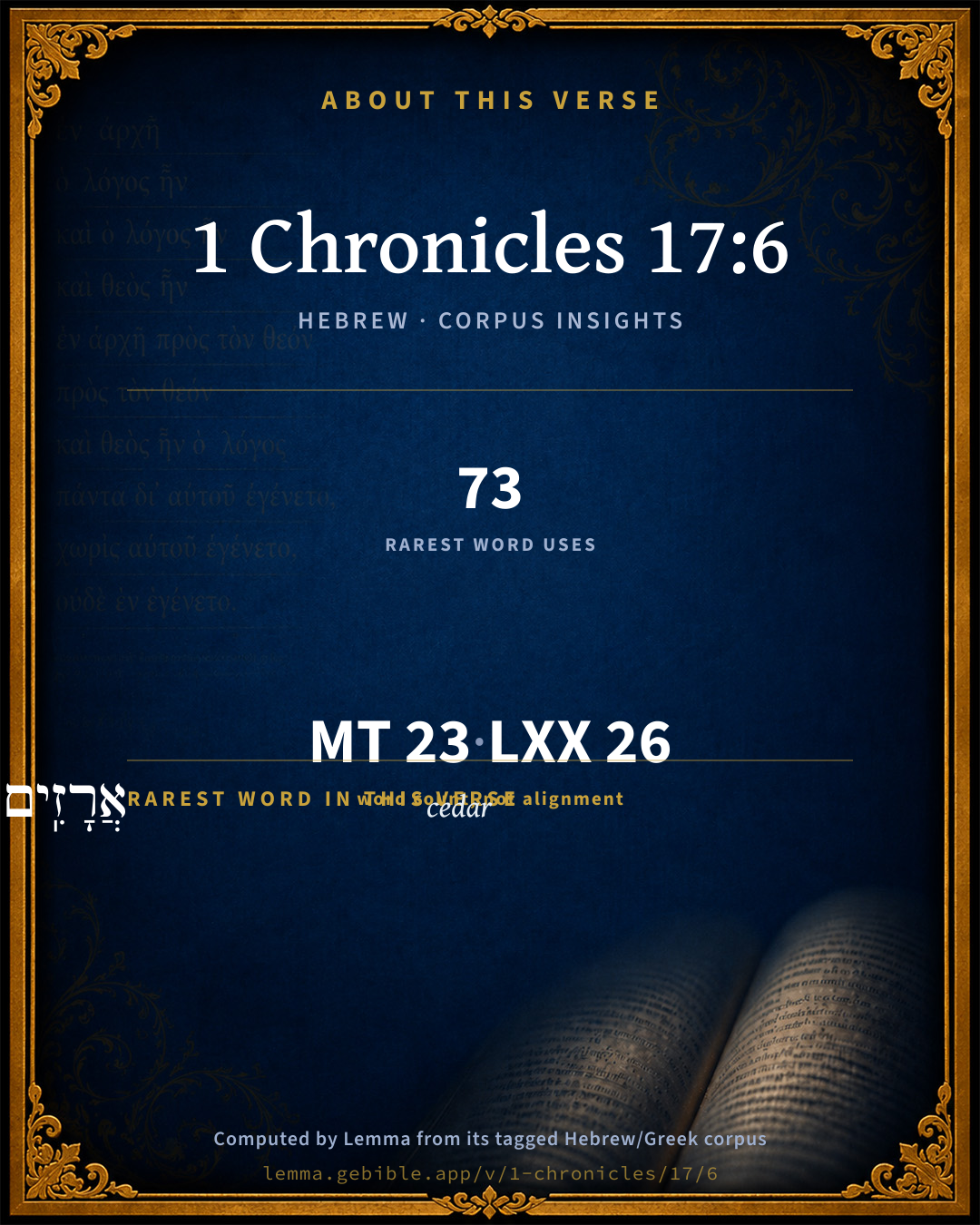
23
words
19
distinct lemmas
Historical
section

Grammatical profile

  • 7 verbs
  • 8 nouns
  • 1 adjective
  • 2 prepositions
  • 5 particles

Verb forms

  • הִתְהַלַּכְתִּי֮ Hithpael · Perfect
  • דִּבַּ֗רְתִּי Piel · Perfect
  • שֹׁפְטֵ֣י Qal · Participle Active
  • צִוִּ֛יתִי Piel · Perfect
  • לִרְע֥וֹת Qal · Infinitive Construct
  • לֵאמֹ֑ר Qal · Infinitive Construct
  • בְנִיתֶ֥ם Qal · Perfect

Repetition

Words recur within this verse — often emphatic in Hebrew:

  • בְּכֹ֥ל all H3605 ×2
  • יִשְׂרָאֵל֒ Israel H3478 ×2
  • אֲשֶֽׁר which H834 ×2

Hebrew & Septuagint length

In English translation the verse runs 42 words from the Hebrew and 42 from the Septuagint (LXX English) — the same length.

A rough comparison of the two English renderings, which tokenize alike — not a word-level alignment.

Word counts can differ between the Hebrew and the Greek without any difference in meaning — e.g. the Hebrew direct-object marker אֵת has no separate Greek word, and Greek often adds the article ὁ.

In the original languages it is 23 Hebrew tokens and 26 Greek tokens — but the two are counted differently (Hebrew bundles its prefixes and suffixes into one token; the Greek is in lemma form), so that isn’t a like-for-like length.

Cross-references

17

Topical passages linked to 1 Chronicles 17:6 in the Treasury of Scripture Knowledge — connected by theme and wording, ordered by reader-vote popularity; previews shown in the World English Bible.

  • 2 Samuel 7:7 In all places in which I have walked with all the children of Israel, spoke I a word with any of the tribes of Israel, whom I commanded to be shepherd of my people Israel, saying, Why have you not built me a house of cedar?
  • Numbers 10:33–36 They set forward from the Mount of Yahweh three days' journey; and the ark of the covenant of Yahweh went before them three days' journey, to seek out a resting-place for them.
  • 1 Chronicles 11:2 In times past, even when Saul was king, it was you who led out and brought in Israel: and Yahweh your God said to you, You shall be shepherd of my people Israel, and you shall be prince over my people Israel.
  • Exodus 33:14–15 He said, "My presence will go with you, and I will give you rest."
  • Exodus 40:35–38 Moses wasn't able to enter into the tent of meeting, because the cloud stayed on it, and Yahweh's glory filled the tent.
  • Leviticus 26:11–12 I will set my tent among you: and my soul won't abhor you.
  • Deuteronomy 23:14 for Yahweh your God walks in the midst of your camp, to deliver you, and to give up your enemies before you; therefore shall your camp be holy, that he may not see an unclean thing in you, and turn away from you.
  • Judges 2:16–18 Yahweh raised up judges, who saved them out of the hand of those who despoiled them.
  • 1 Samuel 12:11 Yahweh sent Jerubbaal, and Bedan, and Jephthah, and Samuel, and delivered you out of the hand of your enemies on every side; and you lived in safety.
  • Psalms 78:71–72 From following the ewes that have their young, He brought him to be the shepherd of Jacob, his people, And Israel, his inheritance.
  • Jeremiah 23:4 I will set up shepherds over them, who shall feed them; and they shall fear no more, nor be dismayed, neither shall any be lacking, says Yahweh.
  • Ezekiel 34:2 Son of man, prophesy against the shepherds of Israel, prophesy, and tell them, even to the shepherds, Thus says the Lord Yahweh: Woe to the shepherds of Israel who feed themselves! Shouldn't the shepherds feed the sheep?
  • Micah 5:4 He shall stand, and shall shepherd in the strength of Yahweh, In the majesty of the name of Yahweh his God: And they will live, for then he will be great to the ends of the earth.
  • Matthew 2:6 'You Bethlehem, land of Judah, Are in no way least among the princes of Judah: For out of you shall come forth a governor, Who shall shepherd my people, Israel.'"
  • Acts 13:20 After these things he gave them judges until Samuel the prophet.
  • 2 Corinthians 6:16 What agreement has a temple of God with idols? For you are a temple of the living God. Even as God said, "I will dwell in them, and walk in them; and I will be their God, and they will be my people."
  • Revelation 2:1 To the angel of the assembly in Ephesus write: "He who holds the seven stars in his right hand, he who walks among the seven golden lampstands says these things:

Cross-references courtesy of OpenBible.info (CC BY 4.0).

Hebrew and Greek witnesses Masoretic Hebrew ↔ Greek Septuagint

The same verse in the two great witnesses to the Old Testament, shown verse-for-verse.

These are two independent witnesses, not word-aligned to each other, and the Septuagint is shown in lemma (dictionary) form.

Hebrew 1 Chronicles 17:6 Masoretic · Westminster Leningrad Codex

בְּכֹ֥ל אֲשֶֽׁר הִתְהַלַּכְתִּי֮ בְּכָל יִשְׂרָאֵל֒ הֲדָבָ֣ר דִּבַּ֗רְתִּי אֶת אַחַד֙ שֹׁפְטֵ֣י יִשְׂרָאֵ֔ל אֲשֶׁ֥ר צִוִּ֛יתִי לִרְע֥וֹת אֶת עַמִּ֖י לֵאמֹ֑ר לָ֛מָּה לֹא בְנִיתֶ֥ם לִ֖י בֵּ֥ית אֲרָזִֽים

In all places in which I have walked with all Israel, spoke I a word with any of the judges of Israel, whom I commanded to be shepherd of my people, saying, Why have you not built me a house of cedar?

World English Bible · Public Domain

Greek LXX 1 Chronicles 17:6 Septuagint · lemma form

ἐν πᾶς ὅς διαἔρχομαι ἐν πᾶς ἰσραήλ εἰ λαλέω λαλέω πρός εἷς φυλή ἰσραήλ ὁ ποιμαίνω ὁ λαός ἐγώ λέγω ὅτι οὐ οἰκοδομέω ἐγώ οἶκος κέδρινος

in all places through which I have gone with all Israel: did I ever speak to any one tribe of Israel whom I commanded to feed my people, saying, Why is it that you⌃ have not built me a house of cedar?

LXX2012 (modern English Septuagint) · Public Domain

Hebrew: Westminster Leningrad Codex (CC BY 4.0). Greek: Septuagint (public domain); English from LXX2012 (modern English Septuagint) (Public Domain). How the Septuagint differs from the Hebrew →

Commentary

Notes on 1 Chronicles 17:6 from classic Christian and Jewish commentators (each source and its license shown beneath its notes). The classic Christian expositions comment on the surrounding passage and are grouped to its opening verse, so a note may address several verses; the Jewish commentaries on the Tanakh (Rashi and others) are per-verse, so they appear only where the commentator wrote on this verse.

Lemma curates 59 commentaries, every one of them public domain or Creative Commons licensed, each selected and text-cleaned for this edition rather than reprinted as found. About our sources →

Geneva Bible (1599)

Geneva Bible translators

Meaning, wheresoever his Ark went, which was a sign of his presence.

Geneva Bible (1599) marginal notes — public domain. Text via Bolls.life.

Jamieson, Fausset & Brown

Robert Jamieson, A. R. Fausset & David Brown

spake I a word to any of the judges--In Sa2 7:7 it is "any of the tribes" of Israel. Both are included. But the judges "who were commanded to feed the people," form the more suitable antithesis to David.

Why have ye not built me an house of cedars?--that is, a solid and magnificent temple.

Jamieson, Fausset & Brown — Commentary Critical and Explanatory on the Whole Bible (1871) — public domain (CC PDM 1.0). Text via the HelloAO Bible API.

Ellicott's Commentary for English Readers

(6) Wheresoever.—As long as . . . Literally, In all that . . .

With (in) all Israel.—Samuel, “in (among) all the sons of Israel.” (Comp. Lev_26:11-12; Deu_23:15.)

The judges of Israel.—Samuel has “tribes.” The term “judges” would be more intelligible in later times, and has probably been substituted for the more difficult original expression. The following clause seems to refer to individual rulers, but is not really incompatible with a reference to the ascendency or hegemony of different tribes at different epochs of Israelite history. (Comp. Gen_49:10; 1Ch_28:4; Psa_78:67-68.) The word “tribe” (shçbet) might only denote clan, or house, as in Jdg_20:12 (Heb.).

To feed.—Shepherd, or tend—i.e., to govern. (Comp. Psa_78:71.)

A Bible Commentary for English Readers, edited by Charles John Ellicott (1878–1897) — public domain. Text from a community e-Sword module.

The Cambridge Bible for Schools and Colleges

gen. ed. J. J. S. Perowne

6. the judges] A better reading than the tribes (Sam.).

of cedars] R.V. of cedar; cp. 1Ch_17:1.

The Cambridge Bible for Schools and Colleges (gen. ed. J. J. S. Perowne; Cambridge University Press, 1878–1918) — public domain. Text from a community e-Sword module.

The Pulpit Commentary

The judges of Israel. The substitution of the Hebrew character beth for pe, in the word "judges," would make it "tribes," and bring it into harmony with the parallel place. But the succeeding clause, Whom I commanded to feed my people, would rather suggest that the parallel place, which adds the same clause, should be brought into harmony with this (see again ver. 10 of this chapter). The general meaning and the gracious spirit underlying it is evident enough. God had never made a suggestion to tribe, or leader of tribe, nor to judge, who had been temporarily raised up to lead, and so to feed, all his people Israel, to build him a house. He had shared their lot, and had shared it unmurmuringly. He also "had not opened his mouth" (1Ki_8:12-16; 1Ch_28:3, 1Ch_28:4; Psa_78:67-71) Note also the expression, "I chose no city out of all the tribes of Israel". (1Ki_8:16) It is to be remarked that we learn from 1Ch_22:8 and 28:3 the fuller causes why David was not to be permitted to be the builder of the house. It is not apparent why those causes are not recited here. The same remark applies to the parallel place.

The Pulpit Commentary (1880–1919), ed. H.D.M. Spence-Jones & Joseph S. Exell — public domain. Text from a community e-Sword module.

Rashi

Rabbi Shlomo Yitzchaki (Rashi)

Wherever I walked among all Israel, I spoke a word, etc. I did not do this, and neither did they spontaneously think of building a house for Me, as it has entered your mind.

Rashi on the Tanakh — English translations: “The Judaica Press complete Tanach with Rashi, translated by A. J. Rosenberg” (CC BY 4.0); “Pentateuch with Rashi's commentary by M. Rosenbaum and A.M. Silbermann, 1929-1934” (public domain); “The Metsudah Tanach series, Lakewood, N.J” (CC BY 4.0); and “The Book of Joshua, Metsudah Publications, 1997” (CC BY 4.0). Text via Sefaria.

Lesson kit

Teaching starters — assembled from the data on this page, not authored interpretation. Every prompt links to the verse data it draws on. Edit before teaching.

1 Chronicles, in the Historical, opens this verse with 23 words (19 distinct Hebrew lemmas). Its most distinctive word is ʼerez (“cedar”). A historical commentator’s framing appears above. Read the whole chapter for the surrounding context.

Discussion questions

  1. The word ʼerez carries the sense “cedar.” How does it shape the verse?
  2. How does 2 Samuel 7:7, which shares this passage’s theme, read alongside this verse?
  3. What does the repetition of “all” (2× in this one verse) do in this verse?
  4. These translations render this verse differently. What is at stake in choosing one wording over another?
  5. «הִתְהַלַּכְתִּי֮» is a Hithpael Perfect verb. How does that grammatical form shape the action described?
  6. Compare how Geneva Bible (1599) and Jamieson, Fausset & Brown read this verse. Where do they agree or differ?

Things to notice

Reading settings

Reading text

Shown beneath each verse's original-language words.

Old Testament
Old Testament edition

Read the OT as the Masoretic Hebrew (MT) or the Greek Septuagint (LXX).

English shown for the Greek Septuagint (in the Hebrew ↔ Greek comparison).

Comparing translations? Open the Compare panel on any verse page to stack up to four side by side.